Film Review: Heaven’s Gate (dir by Michael Cimino)


First released in 1981 and then re-released in several different versions since then, Heaven’s Gate begins at Harvard University.

The year is 1870 and the graduates of Harvard have got their entire future ahead of them.  At the graduation ceremony, Joseph Cotten gives a speech about how, as men of cultivation, they have an obligation to help the uncultivated.  Student orator Billy Irvine (John Hurt) then gives a speech  in which he jokingly says the exact opposite.  Amongst the graduates, Billy’s friend, Jim Averill (Kris Kristofferson), laughs at Billy’s speech.  It’s a bit of a strange scene, if just because all of the graduates appear to be teenagers except for Hurt and Kristofferson, who are both clearly in their 30s.  The graduates of Harvard sing to their girlfriends and dance under a tree and, for a fleeting moment, all seems to be right with the world.

Twenty years later, all seems to be wrong with the world.  Averill is now the rugged and world-weary marshal of Johnson Country, Wyoming.  Cattle barons are trying to force immigrant settlers to give up their land.  Gunmen, like Nate Champion (Christopher Walken) and Nick Ray (Mickey Rourke), are accepting contracts to execute immigrants who are suspected of stealing cattle.  When Averill stands up for the people of Johnson Country, the head of the Wyoming Stock Grower Association, Frank Canton (Sam Waterston), hires a group of mercenaries to ride into Johnson County and execute 125 settlers.  Billy Irvine, who now is dissolute alcoholic who works with Canton, warns his old friend Averill.  Averill, who has fallen in love with Ella (Isabelle Huppert), the local madam, announces that he will defend the immigrants.  Nate, who is also in love with Ella, considers changing sides.

Heaven’s Gate is loosely based on an actual event.  I actually have three distant ancestors who traveled to Wyoming to take part in the Johnson County War.  All three of them survived, though one of them was shot and killed in an unrelated manner shortly after returning to Ft. Smith, Arkansas.  That said, director Michael Cimino is clearly not that interested in the historical reality of the Johnson County War or the issues that it raised.  Just as he did with Vietnam in The Deer Hunter, Cimino uses the Johnson County War as a way to signify a loss of national innocence.  Averill and Irvine start the film as hopeful “young” men with the future ahead of them.  By the end of the film, one is dead and the other is living on a yacht and dealing with what appears to be crippling ennui.

Heaven’s Gate is a bit of an infamous film.  Though the film was pretty much a standard western, Cimino still went far over-budget and turned in a first cut that was over six hours long.  A four hour version was briefly released in 1980 but withdrawn after a week, due to terrible reviews and audience indifference.  A studio-edited version that ran for two hours and 35 minutes got the widest release in 1981.  Since then, there have been several other versions released.  Cimino’s director’s cut, which was released as a part of the Criterion Collection in 2012, runs for 212-minutes and is considered to now be the “official” version of Heaven’s Gate.

For years, Heaven’s Gate had a terrible reputation.  It’s failure at the box office was blamed for bankrupting United Artists.  After the excesses of the Heaven’s Gate production, studios were far more reluctant to just give a director a bunch of money and let him run off to make his movie.  (They should have learned their lesson with Dennis Hopper and The Last Movie.)  Described by studio execs as being self-indulgent and even mentally unstable, Michael Cimino’s career never recovered and the director of The Deer Hunter went from being an Oscar-winner to being an industry pariah.  (Some who disliked The Deer Hunter’s perceived jingoistic subtext claimed that Heaven’s Gate proved The Deer Hunter was just an overrated fluke.)  However, the reputation of Heaven’s Gate has improved, especially with the release of Cimino’s director’s cut.  Many critics have praised Heaven’s Gate for its epic portrayal of the west and, ironically given the controversy over The Deer Hunter, its political subtext.  It’s anti-immigrant villains made the film popular amongst the Resistance-leaning film historians during the first Trump term.

So, is Heaven’s Gate a masterpiece or a disaster?  To be honest, it’s somewhere in between.  Whereas it was once over-criticized, it’s now over-praised.  Visually, it’s a beautiful film but those who complained that the film was too slow had a point.  As with The Deer Hunter, Cimino takes the time to introduce us to and immerse us in a tight-knit immigrant community.  Personally, I like the much-criticized scenes of the fiddler on skates and Averill and Ella dancing in the roller rink.  Overall though, as opposed to The Deer Hunter, the members of the film’s victimized community still feel less like individual characters and more like symbols.  As for the political subtext, I think that any subtext of that sort is accidental.  (I feel the same way about The Deer Hunter, which I like quite a bit more than Heaven’s Gate.)  Cimino is more interested in the loss of innocence than whether or not the Johnson County War can be fit into some sort of nonsense Marxist framework.

The main problem with the film is that there is no center to keep everything grounded.  Kris Kristofferson had a definite screen presence but, as an actor who was incapable of showing a great deal of emotion, he lacks the gravitas necessary to keep from being swallowed up by Cimino’s epic pretensions.  Isabelle Huppert, an otherwise great actress, also feels lost in the role of Ella and Sam Waterston is not necessarily the most-intimidating villain to ever show up in a western.  Christopher Walken, as the enigmatic and intriguing Nate Champion, gives the best performance in the film but his character still feels largely wasted.

There are some brilliant visual moments to be found in Heaven’s Gate.  I even like the Harvard prologue and the ending on the boat, both of which are not technically necessary to the narrative but still add an extra-dimension to both Averill and Irvine.  But, in the end, Heaven’s Gate is big when it should have been small and epic when its should have been intimate.  It’s a misfire but not a disaster.  Even great directors occasionally have a film that just doesn’t work.  Speilberg had his 1941.  Scorsese has had a handful.  Coppola’s career has been a mess but no one can take his successes away from him.  Michael Cimino, who passed away in 2016, deserved another chance.
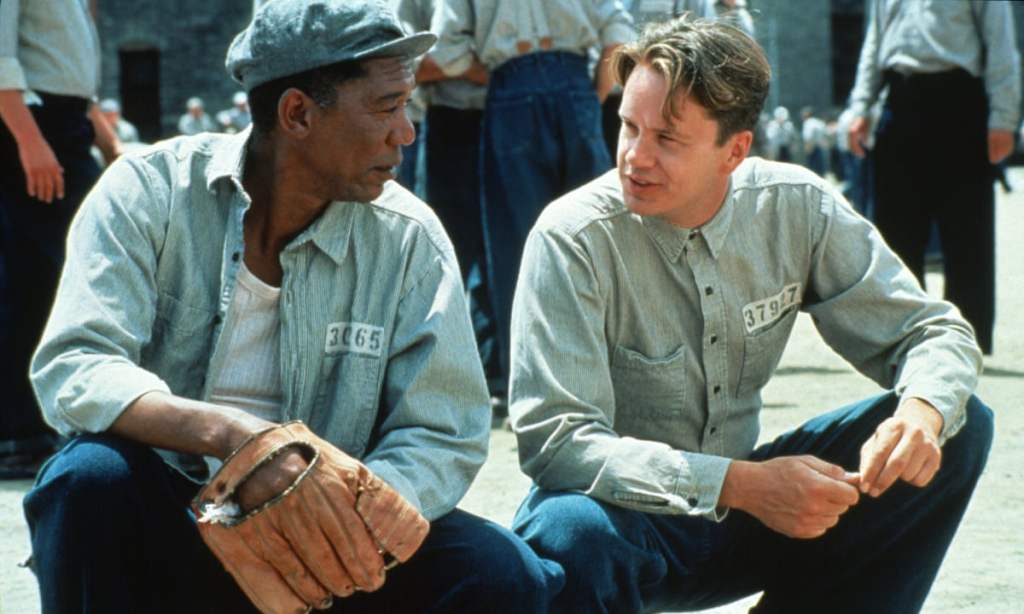
THE SHAWSHANK REDEMPTION (1994) – In honor of our son’s birthday, I review his favorite movie!


I sent our son a text the other day and asked him if he had an answer for the question “What’s your favorite movie?” I thought I knew the answer but it turns out I was only half right. I expected his answer to be THE HATEFUL EIGHT. Rather, the answer I received back was “The Hateful Eight or Shawshank Redemption!” Since I recently wrote about the time that he and I attended THE HATEFUL EIGHT roadshow in Dallas, I decided I would write about THE SHAWSHANK REDEMPTION this time around. It doesn’t hurt that it’s one of my favorite movies as well. It also doesn’t hurt that it’s the very top rated film on the Internet Movie Database.

Based on Stephen King’s “Rita Hayworth and Shawshank Redemption,” the story is well known… hot shot banker Andy Dufresne (Tim Robbins) is convicted of the murder of his wife and her lover, and gets sentenced to life at the Shawshank prison. Once on the inside, we meet a variety of characters that you expect in a prison movie. We meet Warden Norton (Bob Gunton), the hypocrite who speaks of the Bible while hiding a corrupt, evil spirit. We meet Captain Hadley (Clancy Brown), the brutal chief prison guard, who rules over the inmates with intimidation and a real willingness to inflict violence and pain on anyone who shows the least bit of independence. We meet Red (Morgan Freeman), the long-time inmate who has the ability and connections to get you anything you need. We meet other inmates like Heywood (William Sadler), the inmate who seems like a jerk when you first meet him but turns out to be a pretty good fella; Tommy (Gil Bellows), the young guy who comes into prison and may know something that proves Andy’s innocence; Brooks (James Whitmore), the old man who gets released after almost a lifetime in prison, and doesn’t know how to adjust to life on the outside; and Bogs (Mark Rolston), the sadistic prisoner who wants to force himself on Andy, and is willing to kill to get what he wants. Life isn’t easy at all in Shawshank, but Andy’s intelligence and ability to prove himself useful to Warden Norton and Captain Hadley allows him to finds ways to make life more bearable for him and his friends. After nineteen years in prison, even though he maintains his innocence, it appears that Andy is content to live out his remaining years in prison. Or is he??

I’ll never forget the first time I saw the movie THE SHAWSHANK REDEMPTION. I didn’t see it until a year or two after its initial release in 1994. I was one of those guys who figured a movie that praised by the critics was probably not something that I would like that much. Plus, at the time, the title of the movie just seemed kind of weird. But I kept hearing about how great it was, so I finally decided to give it a viewing. I agree with my son, I think THE SHAWSHANK REDEMPTION is one of the most emotionally uplifting movies ever made. Why is that you might ask? My answer would be because there’s something profoundly satisfying about people who persevere through the worst times imaginable and continue to find hope where most of us would be hopeless. Prison life is shown as horrific. One prisoner is literally beaten to death by Captain Hadley on his first night in prison for crying. Andy fights off the sadistic Bogs as much as he can, but he is unable to completely fight off his advances. But no matter what he goes through, Andy Dufresne is able keep moving forward, and he does not allow the prison life to completely crush his spirit. He keeps finding ways to persevere. Andy’s actions and endurance turn simple acts like listening to Mozart or having a beer into overwhelming emotional highs for us as the audience. The film also maintains a realistic sense of humor, which might seem difficult under the circumstances. This sense of humor is found in such mundane tasks as creating a prison library, providing tax prep services for the guards, or attending multiple parole hearings over the years. These comedic moments are earned by the way the movie takes it’s time letting us really get to the know the characters and then laugh with them as the individual moments occur. And the friendship between Andy and Red is something that deeply resonates with me. I think we all would like to have that kind of friendship. These kinds of friendships aren’t built overnight, and often they require a level of shared experience that is almost impossible to find. But they find it behind Shawshank’s prison walls, and it connects them for life. In my opinion, the friendship between these two characters leads to one of the most emotionally satisfying endings to any film, ever.

Director Frank Darabont was able to obtain some of career-defining performances from his cast. As good as Tim Robbins is as an actor, in my opinion, he has never been better than he was as Andy Dufresne. And I say this knowing full well he won an Oscar for MYSTIC RIVER. He maintains his dignity against all odds and only appears to break down a time or two. Morgan Freeman is great as always as Red, but his character is so important because we see him go from a hopeless skeptic, to a man who truly has hope thanks to his friendship with Andy. Freeman seems to handle this transition effortlessly. I’m going to give a shoutout to James Whitmore as well. With a career going all the way back to the 1940’s, his performance as Brooks Hatlen is one of the more touching and heartbreaking performances of the film. I haven’t seen all of his work, but I have never seen him better than he was in THE SHAWSHANK REDEMPTION. Each additional cast member, from Bob Gunton, Clancy Brown and Mark Rolston, to Willam Sadler and Gil Bellows all have powerful moments that add to the overall effect of the film.

Looking back now, it’s hard to believe that THE SHAWSHANK REDEMPTION did not win the Academy Award for best film. It lost to FORREST GUMP when the awards were handed out in 1995. It’s even harder to believe that the film did not win a single Academy Award even though it received seven nominations. But at the end of the day, that doesn’t really matter to me. I just know that it’s a great film, and it reaches emotional heights that very few movies, if any, have ever reached before. That’s a pretty damn good legacy.

Concert Film Review: Rockshow (dir by Jack Priestly)


I recently went on YouTube and I did a search for “concert films.”  The first video that came up was an upload of the 1980 film Rockshow.

Filmed during a 1976 world tour, Rockshow features Paul McCartney and Wings, the band that he formed after the break-up of the Beatles.  McCartney and his band play a total of 30 songs in front of an enthusiastic audience.  The crowd goes crazy for the Beatles songs, including Lady Madonna, The Long and Winding Road, Blackbird, and Yesterday.  That’s to be expected.  But they’re also pretty enthusiastic for the songs that McCartney wrote after the Beatles, quite a few of which I recognized.  (Silly Love Songs, Band on the Run, the beautiful Maybe I’m Amazed, and that annoying Listen To What The Man Said were all familiar to me.)  For all that I’ve read about people being disappointed by Paul McCartney’s post-Beatles career in the 70s, you wouldn’t know it from watching the audience in this film.  The highlight, for me, was undoubtedly the energetic performance of Live and Let Die, which featured a very basic but still effective light show.

It’s rare that you ever read anything positive about Paul McCartney’s work with Wings and, watching the film, it was pretty obvious that the band mostly just existed to showcase Paul.  The other members of the band seemed to understand that the crowd wasn’t there to see anyone but Paul McCartney and one gets the impression that they were okay with that.  That said, I actually liked quite a bit of their music.  Even if they weren’t as lyrically complex and creative as Paul’s work with the Beatles, the songs were still enjoyable to listen to and most of them got stuck in my head, for better or worse.  There’s a tendency, amongst music snobs, to be dismissive of Paul’s post-Beatles work because he is often viewed as being the most “corporate” of the Beatles.  In the popular imagination, John Lennon was the sarcastic peace activist.  George Harrison was the spiritual seeker.  Ringo Starr was the down-to-Earth comedian.  And Paul is often portrayed as being the one who was the most concerned with scoring the most hits, selling the most albums, and making the most money.  Well, so be it.  That’s usually the point of having a band, after all.  Very few people devote their life to the hope of being obscure and poor.  Johnny Rotten moved into a mansion the first chance he got.

As for Rockshow, it’s an interesting time capsule.  The main thing that stuck out to me was how straight-forward and simple the concert was.  There were a few laser effects, a few lighting effects, and a screen that occasionally flashed images of comic book characters but, as far as extra flourishes were concerned, that was pretty much it.  There weren’t any dancers doing carefully choreographed routines.  There weren’t any explosions or fancy costume changes.  Paul and the band played their songs and the audience obviously felt that they got their money’s worth.  Paul comes across as being cheerful and enthusiastic about performing and the band seems to have a good time as well. “Hey Paul,” someone in the audience yells and Paul pauses to wave back and it’s a moment of human connection that is missing from so many concert films.

Rockshow runs a little long.  30 songs can be a bit much.  But, overall, it’s a good concert film and an enjoyable time capsule.  Do you want to experience 1976?  Step into the YouTube time machine.

Music Video of the Day: May It Be by Enya (2001, dir by Peter Nydrle)


J.R.R. Tolkein was born 132 years ago today.

Today’s music video comes from Peter Jackson’s epic adaptation of The Lord of the RingsMay It Be was the theme song for the first installment, 2001’s The Fellowship of the Ring, and the music video features clips from the films, along with Enya singing.  The Hobbit trilogy probably would have been better if it had featured more Enya.

Enjoy!

Late Night Retro Television Review: Highway to Heaven 3.6 “Love at Second Sight”


Welcome to Late Night Retro Television Reviews, a feature where we review some of our favorite and least favorite shows of the past!  On Thursdays, I will be reviewing Highway to Heaven, which aired on NBC from 1984 to 1989.  The entire show is currently streaming on Freevee and several other services!

Let’s get back on the highway!

Episode 3.6 “Love At Second Sight”

(Dir by Michael Landon, originally aired on November 5th, 1986)

Jonathan and Mark are working as recreation directors at a retirement community and….

Again?

Actually, I can’t really remember if Jonathan and Mark have worked as a recreation director at a retirement community before but I do know that this is not the first time that they’ve been assigned to work at such a place.  And, if I remember correctly, both Mark and Jonathan have been assigned to work as a coach at other places.  In other words, Jonathan and Mark have a specific set of skills and they seem to center around athletics and the elderly.

Mark thinks that this assignment is going to be easy but then again, Mark thinks that about every assignment.  He might have a point here as he and Jonathan are only supposed to be helping out another angel named Ted (John McLiam).  Ted’s assignment is to help Roy (Harvey Vernon) and Laura (Martha Scott) fall in love and find happiness in their twilight years.  The complication is that Laura is Ted’s widow!  Ted doesn’t want to help his widow fall in love with another man so, instead, he goes out of his way to sabotage Roy and Laura’s relationship.  In fact, Ted starts to romance Laura himself and even proposes marriage to her.

Jonathan confronts Ted and tells him that “the Boss” isn’t going to let this happen.  Jonathan then takes Ted into the future, where he discovers that Laura has died of a broken heart and that their daughter, Margaret (Nana Visitor), is now heading in the same direction.  Realizing that he was being selfish and that he has a responsibility to help Laura move on, Ted returns to the present and pretends to be a jerk and a conman so that Laura will fall out of love with him and instead fall in love with Roy.  Ted even gets Roy to punch him so that Laura will be impressed with him.  Back to the Future, anyone?

That’s the power of love!

I have two issues with this episode.  The lesser of the two is that Ted pretending to suddenly be a jerk seems like the sort of thing that would make Laura even more hesitant about trusting another man as opposed to something that would automatically make her fall in love with Roy.  However, my main issue with this episode is that it all felt very familiar.  Last season, Jonathan was assigned to help his widow move on and he had mixed feelings about it.  (As I would think any angel would.)  This season, God gives the same assignment to another angel and again, it nearly backfires on everyone.  It actually seems a bit mean-spirited on the part of the Boss to continually give this assignment to the very people that it would most hurt, though I understand that the idea is that Ted and Jonathan both needed to move on as well.  That said, at no point does Jonathan say, “Hey, the exact same thing happened to me!”  (This was a rare episode that Landon didn’t write so it’s always possible that the actual writer wasn’t aware that he was repeating a storyline from the show’s past.)  This episode felt like a missed opportunity.

Catching Up With The Films of 2024: Megalopolis (dir by Francis Ford Coppola)


It’s hard to know where to really start with Megalopolis.

Directed, written, produced, and financed by Francis Ford Coppola, Megalopolis takes place in an alternate version of the United States of America.  In this alternative world, New York is called New Rome and it is dominated by a handful of wealthy families.  Former District Attorney Franklyn Cicero (Giancarlo Esposito) has been elected mayor.  Everyone seems to hate Cicero and the character tends to come across as being a bit whiny so you really do have to wonder how he got elected in the first place.

Cicero is obsessed with the powerful Crassus-Catallina family, which is headed by banker Hamilton Crassus III (Jon Voight).  Hamilton’s nephew is Cesar Catallina (Adam Driver), a brilliant architect who won a Nobel Prize for inventing a type of invisible material.  Ever since Cesar’s wife vanished under mysterious circumstances, a cloud of scandal has hung over Cesar’s name and with that scandal has come popularity with both the masses and the tabloid press.  When Cesar was tried for murder, the prosecutor was Franklin Cicero.  Cesar was acquitted but he now spends his time drinking and mourning his wife.  Cesar also has the power to stop time for everyone but him.  Why he has this power and how he came to possess it is never made clear, though Cesar compares it to the way that a great painter or writer can capture one moment for eternity.

Cesar is driven through the rainy streets of New York by his chauffeur, Fundi Romaine (Laurence Fishburne).  Fundi also serves as the film’s narrator, ruminating about how the Roman Empire eventually became a victim of its own decadence.  Just in case the viewer somehow doesn’t pick up on the fact that the movie is comparing modern America to ancient Rome, Fundi informs us of this fact.  Thanks, Fundi!

After Cesar publicly denounces Cicero’s plans to turn New Rome into a casino, Cicero’s daughter Julia (Nathalie Emmanuel) decides to take a break from decadent partying to follow Cesar around and try to discover whether or not he actually murdered his wife.  Julia discovers that Cesar is not only still mourning his wife but she also witnesses him stopping time.  Soon, Julia is working for Cesar’s design firm.  At some point, she and Cesar become lovers.

Meanwhile, Cesar’s former lover, Wow Platinum (Aubrey Plaza), has married Crassus and is plotting to take control of his bank.  Working with Wow is Cesar’s buffoonish cousin, Clodio Pulcher (Shia LaBeouf), who organizes the angry citizens of New Rome into a mob that threatens the safety and power of both Cicero and Cesar.  “Make Rome Great Again,” a sign reads at one of Clodio’s rallies, just in case anyone was missing Coppola’s point.

Clodio is obsessed with destroying Cesar.  First, he frames Cesar for deflowering New Rome’s vestal virgin, the singer Vesta Sweetwater (Grace VanderWaal).  Then, he sends a 12 year-old assassin after Cesar.  Cesar fears that he’s lost his ability to stop time.  Julia falls more and more in love with him.  Cicero gets booed everywhere he goes and, after his fixer (Dustin Hoffman) is mysteriously killed, he finds himself helpless against Clodio’s mob.  Can Cesar be convinced to abandon his self-pity long enough to stand up to Clodio?

And what about the Russian spy satellite that just crashed into New Rome?  Who will rebuild the city?

And …. well, let’s just say that there’s a lot going on in New Rome.

Francis Ford Coppola originally came up with the idea for Megalopolis in 1977 and he spent decades trying to bring the film to the big screen.  Eventually, Coppola ended up producing and financing the film himself.  From 2023 to the the day of the film’s Cannes premiere, the trade papers were full of stories about how difficult the production had been, with the underlying theme being that everything was Francis Ford Coppola’s fault and that the movie would be an unmitigated disaster.  (In the coverage found in both Variety and The Hollywood Reporter, there seemed to be a good deal of hostility directed at Coppola’s decision to work outside of the Hollywood system.)  Disgruntled members of the crew complained that Coppola was an undisciplined director who spent most of the production high.  A half-baked attempt to generate a #MeToo scandal around the film made it obvious that Coppola had burned a lot of bridges with both Hollywood and the media.  The film was released to critical derision and poor box office returns.  Coppola is 85 years old and it’s entirely possible that Megalopolis will be his final film.

Critics be damned, I liked the majority of Megalopolis.  Though the film may be thematically and narratively incoherent, it is a feast for the eyes and it’s hard not to respect the fact that, in this age of overwhelming conformity, Coppola brought his own unique vision to the screen.  There are a few moments of genuinely macabre beauty to be found in the film.  When the Russian satellite crashes into New York, we don’t see the impact but, on the city walls, we do see the shadows of people screaming in fear.  When a drunk Cesar is driven through New Rome, he sees gigantic statues stepping off of their bases and slumping to the ground, exhausted with being on display.  Coppola films New Rome like a beautiful, open-air prison.  It’s an amazing view but don’t even think about trying to escape.  The scenes in New Rome’s Coliseum are filled with an epic yet seedy grandeur.  At times, the film’s scenes seem to be almost randomly assembled, leaving us to wonder if we’re seeing the past, the present, or maybe just something that Cesar is imagining in his head.

What is the film actually about?  It’s not always easy to say.  Even in his best films, Coppola has had a tendency to be self-indulgent.  Sometimes, that self-indulgence pays off.  Though few would admit it now, The Godfather Part II is one of the most self-indulgent films ever made.  But it’s also brilliant so it doesn’t matter.  However, with Megalopolis, it’s hard not to feel that this film was such a passion project for Coppola that he didn’t stop to consider whether or not he really had anything new to say.  Megalopolis is hardly the first film to compare the supposed decline of America to the fall of the Roman Empire.  As much as I enjoyed the film’s visuals, I cringed at the film’s ending.  One can only imagine how a past Coppola collaborator like John Milius would have reacted to a bunch of children reciting a pledge to take care of the “one Earth.”

It’s a random film, one in which plot points are raised and often quickly abandoned.  At one point, Cesar starts to recite Hamlet’s famous “to be or not to be” soliloquy.  The cast is huge and everyone seems to be acting in a different movie.  Surprisingly enough, neither Esposito nor Adam Driver are particularly believable in their roles, though I think that has more to do with the film’s loose narrative structure than anything else.  Shia LaBeouf is convincingly feral as Clodio while Jon Voight seems to be having fun as the wealthy and crude Crassus.  The best performance in the film comes from Aubrey Plaza, who plays her role like a vampish femme fatale who has somehow found herself in a science fiction story.  Plaza holds nothing back with her performance and she actually manages to bring some genuine human emotion to Coppola’s surreal epic.

Megalopolis is a monument to self-indulgence but it’s always watchable.  Coppola may not know what he’s trying to say but he captures the surreal beauty that comes from getting trapped in one’s own imagination.  Megalopolis is not a film for everyone but I’m glad it exists.  At a time when artistic freedom seems to be under constant attack, it’s hard not to be happy that Coppola did things his way.

Lisa Marie Reviews An Oscar Nominee: In Old Chicago (dir by Henry King)


One of the ten films to be nominated for Best Picture of 1937, In Old Chicago tells the story of the O’Leary family.

When we first meet the O’Learys, they’re riding across the Illinois frontier in a covered wagon.  After patriarch Patrick O’Leary (J. Anthony Hughes) is killed in a freak accident, Hazel O’Leary (Alice Brady) decides to settle in the bustling town of Chicago.  Hazel and her three sons build a life for themselves in a poor, largely Irish neighborhood known as the Patch.  Hazel makes a living as a laundress and soon, her home is big enough for her to take in a cow named Daisy.  Better not put that lantern too close to Daisy, Mrs. O’Leary….

As for the O’Leary boys, they all build a life of their own in 19th century Chicago.

Free-spirited Dion (Tyrone Power) hangs out in the saloon owned by sinister Gil Warren (Brian Donlevy) and, to his mother’s consternation, he falls for a singer named Belle (Alice Faye).  Eventually, Dion and Belle open up their own saloon and go into competition with Warren.  Dion soon emerges as one of the leaders of the Patch, a rogue with a charming smile and zero ethics but a total love for his family.

The youngest, Bob (Tom Brown), falls in love with a German immigrant named Gretchen (June Storey).  Bob asks Gretchen to marry him while Mrs. O’Leary’s cow stares straight at camera.

Finally, the oldest of the O’Leary boys is Jack (Don Ameche).  Jack become a crusading lawyer and eventually, he runs for mayor on a reform ticket.  With Dion’s help, Jack is able to defeat Gil Warren.  But now that Jack is mayor, he immediately sets his sights on tearing down the Patch and, in his words, “starting over.”

In Old Chicago has a two-hour running time and a lot happens in those two hours.  Not only is there all the drama between the brothers but also there’s a handful of production numbers featuring Alice Faye.  (Considering that she’s performing at a saloon in the slums of Chicago, it’s impressive that Belle can put on such an elaborate show.)  Of course, anyone with a knowledge of history knows that every minute of In Old Chicago is building up to the moment when Mrs. O’Leary’s cow kicks over that lantern and all the wooden buildings in Chicago go up in flames.  In Old Chicago is an early disaster movie and, talented cast aside, the main reason that anyone will be watching will be for the recreation of the Great Chicago Fire.  As flames roar around them and cattle stampede through the streets, hundreds of extras run for their lives.  As Alice Brady, Tom Brown, and Alice Faye stare off to the horizon, the city of Chicago explodes in front of them.  Even today, the scenes of the city on fire are impressive.

As for the rest of the film, I enjoyed the melodramatic excess of it all.  The stars weren’t exactly the most dynamic actors of the 1930s but Tyrone Power and Don Ameche were both handsome and likable enough to carry the film and it’s easy to see why In Old Chicago was, at the time of its production, the most expensive film ever made.  It’s a big film, with ornate sets, hundreds of extras, and elaborate production numbers.  It’s entertaining, even though I did occasionally find myself growing impatient as I waited for the fire to finally start burning.

One thing this film is not is historically accurate.  Not only is it now generally agreed that Mrs. O’Leary’s cow was innocent of starting the fire but Mrs. O’Leary’s son was never mayor of Chicago.  It is true that Chicago caught fire in 1871 and that the mayor turned to General Philip Sheridan (played here by Sidney Blackmer) for help in both putting out the fire and keeping order in the streets.  For the most part, though, In Old Chicago is total fiction.  That didn’t bother me but then again, I don’t live in Chicago.

In Old Chicago was nominated for Best Picture of the Year but lost to The Life of Emile Zola.  However, Alice Brady won the Oscar for Best Supporting Actress.

Great Moments In Television History #35: The 33rd NFL Championship Game Is Broadcast In Color


60 years ago today, the Cleveland Browns and the Green Bay Packers met in the 33rd Championship Game of the National Football League.  The Packers were led by Vince Lombardi while the returning champions, the Browns, were coached by Blanton Collier and had all-star fullback Jim Brown on its offensive roster.  The game was played at Lambeau Field in Wisconsin, in the middle of a snowstorm that soon turned the field into a mud pit.  50,777 fans showed up for the game, braving freezing weather and paying ten dollars per ticket.  The Packers defeated the Browns, 23-12.

This game was significant for many reasons.  It was the last NFL Championship Game to be played before the Super Bowl era.  With the exception of that year’s Probowl, it was Jim Brown’s final game before he retired to concentrate on his acting career.  It was Lombardi’s 3rd NFL Championship.  (The next year, he would catch the Packers to victory at the first Super Bowl.)

It was also the first NFL title game to be broadcast in color.  Airing on CBS and announced by Ray Scott, Ken Coleman, and Frank Gifford, the game was broadcast into American household in full, glorious color.  It was both a worthy send-off to the Championship Game era and a welcome to the future of the NFL.

Previous Moments In Television History:

  1. Planet of the Apes The TV Series
  2. Lonely Water
  3. Ghostwatch Traumatizes The UK
  4. Frasier Meets The Candidate
  5. The Autons Terrify The UK
  6. Freedom’s Last Stand
  7. Bing Crosby and David Bowie Share A Duet
  8. Apaches Traumatizes the UK
  9. Doctor Who Begins Its 100th Serial
  10. First Night 2013 With Jamie Kennedy
  11. Elvis Sings With Sinatra
  12. NBC Airs Their First Football Game
  13. The A-Team Premieres
  14. The Birth of Dr. Johnny Fever
  15. The Second NFL Pro Bowl Is Broadcast
  16. Maude Flanders Gets Hit By A T-Shirt Cannon
  17. Charles Rocket Nearly Ends SNL
  18. Frank Sinatra Wins An Oscar
  19. CHiPs Skates With The Stars
  20. Eisenhower In Color
  21. The Origin of Spider-Man
  22. Steve Martin’s Saturday Night Live Holiday Wish List
  23. Barnabas Collins Is Freed From His Coffin
  24. Siskel and Ebert Recommend Horror Films
  25. Vincent Price Meets The Muppets
  26. Siskel and Ebert Discuss Horror
  27. The Final Scene of Dark Shadows
  28. The WKRP Turkey Drop
  29. Barney Pops On National TV
  30. The Greatest American Hero Premieres
  31. Rodney Dangerfield On The Tonight Show
  32. The Doors Are Open
  33. The Thighmaster Commercial Premieres
  34. The Hosts of Real People Say “Get High On Yourself”

Great Moments In Comic Book History #37: MAD Magazine Plays Both Sides


In January of 1961, Mad Magazine taught a nation of young readers how to cover their bets.  With the magazine due to go to press before the results of the 1960 presidential election would be known, Mad Magazine #60 was published with a double cover.

25 cents was not only a cheap price to pay for Mad’s trademark humor and satire but it was also the price of an invaluable political lesson.  Thank you, Mad Magazine!

Previous Great Moments In Comic Book History:

  1. Winchester Before Winchester: Swamp Thing Vol. 2 #45 “Ghost Dance” 
  2. The Avengers Appear on David Letterman
  3. Crisis on Campus
  4. “Even in Death”
  5. The Debut of Man-Wolf in Amazing Spider-Man
  6. Spider-Man Meets The Monster Maker
  7. Conan The Barbarian Visits Times Square
  8. Dracula Joins The Marvel Universe
  9. The Death of Dr. Druid
  10. To All A Good Night
  11. Zombie!
  12. The First Appearance of Ghost Rider
  13. The First Appearance of Werewolf By Night
  14. Captain America Punches Hitler
  15. Spider-Man No More!
  16. Alex Ross Captures Galactus
  17. Spider-Man And The Dallas Cowboys Battle The Circus of Crime
  18. Goliath Towers Over New York
  19. NFL SuperPro is Here!
  20. Kickers Inc. Comes To The World Outside Your Window
  21. Captain America For President
  22. Alex Ross Captures Spider-Man
  23. J. Jonah Jameson Is Elected Mayor of New York City
  24. Captain America Quits
  25. Spider-Man Meets The Fantastic Four
  26. Spider-Man Teams Up With Batman For The Last Time
  27. The Skrulls Are Here
  28. Iron Man Meets Thanos and Drax The Destroyer
  29. A Vampire Stalks The Night
  30. Swamp Thing Makes His First Cover Appearance
  31. Tomb of Dracula #43
  32. The Hulk Makes His Debut
  33. Iron Man #182
  34. Tawky Tawny Makes His First Appearance
  35. Tomb of Dracula #49
  36. Marvel Publishes Star Wars #1