Retro Television Review: Fantasy Island 5.11 “House of Dolls/Wuthering Heights”


Welcome to Retro Television Reviews, a feature where we review some of our favorite and least favorite shows of the past!  On Tuesdays, I will be reviewing the original Fantasy Island, which ran on ABC from 1977 to 1984.  Unfortunately, the show has been removed from most streaming sites.  Fortunately, I’ve got nearly every episode on my DVR.
This week, it’s all about the power of imagination.

Episode 5.11 “House of Dolls/Wuthering Heights”

(Dir by Philip Leacock, originally aired on January 9th, 1982)

After being absent last week, Tattoo returns for this episode.  That means that Julie, once again, is too busy on the other side of the Island to assist Mr. Roarke this week.  The excuse that the show’s writer come up with to explain Julie’s absence is that she accidentally opened up a box of Fantasy Island butterflies that were meant to be delivered to the San Diego Zoo.  Now, Julie has to catch all of the butterflies.  Good luck, Julie!

As for the fantasies, they both deal with imagination.

Clarissa Bevis (Britt Ekland) is a librarian who is single because she’s never met a real-life man who can compare to Heathcliffe from Clarissa’s favorite novel, Wuthering Heights.  Clarissa wants to enter the world of the novel so that she can meet Heathcliffe and hopefully put her obsession with him behind her.  Mr. Roarke grants her fantasy but warns her that she must not change the plot of the book in any way.  That strikes me as an odd rule because it’s not as if Clarissa is traveling into the past.  She’s entering her imagination so why would it matter if she decided to do what so many other readers have done and imagine a different ending to her favorite novel?

Clarissa finds herself approaching Wuthering Heights.  Heathcliffe (Hugh O’Brian) sees her and declares that his beloved Catherine has come back to life.  Meanwhile, Edgar Linton (Richard Anderson) believes that this proves Heathcliffe has gone mad and starts to plot to have Heathcliffe declared insane so that Edgar can claim Wuthering Heights and all of its farmland as his own.  To be honest, if we’re in Clarissa’s imagination, I can only assume that she’s only seen a movie version of Wuthering Heights because neither Heathcliffe nor Edgar behave like their characters in the book  (In particular, Edgar is portrayed as being a cartoonishly evil villain.)  And, it should be noted, no mention is made of Cathy, Linton, Hindley, Isabella, Harleton, or any of the book’s other characters.  How is Clarissa supposed to stay true to the plot of a book that she’s never read?

As for the other fantasy, Francis Elkins (Bob Denver) is a maker and dresser of mannequins,  He’s fallen in love with one of his mannequins — “Hey, that’s not creepy at all,” I say while dramatically rolling my eyes — and his fantasy is for her to come to life.  Roarke gives Francis a magical medallion thing that Francis uses to bring Courtney (Barbi Benton) to life, with the understanding that Courtney will only be human for two days.  Eager to live as much life as possible, Courtney uses the medallion to bring to life three other mannequins to serve as the members of her squad.  She also flirts with two salesmen (Larry Storch and Joey Forman) by telling them that’s she’s from Bloomingdale’s (“Oh yeah,” Storch says, “that town in Indiana,”) and that she’s only six years old.  Fortunately, Francis’s love for Courtney is so strong that Courtney remains human even after the two days are up.

At the start of this fantasy, Roarke promises Tattoo that it will be the most delightful fantasy ever.  Barbi Benton did a good job in the role of Courtney and she certainly showed more comedic timing here than she did during previous visits to the Island.  But I don’t know …. the whole falling in love with a mannequin thing was a little too creepy to be delightful.

That said, this was an entertaining episode, even if neither fantasy really worked.  Barbi Benton got to show off her comedic timing and the Wuthering Heights fantasy was enjoyably melodramatic, even if it got the book wrong and even though all-American Hugh O’Brian was not exactly the most convincing Heathcliffe.  This was a nice enough trip to the Island.

I wonder if Julie ever found those butterflies.
Horror Scenes That I Love: “Dentist!” from Little Shop of Horrors


Since we’ve been talking a lot about the original Little Shop of Horrors today, I thought I would only be appropriate to share a scene from the remake for today’s scene of the day.

From 1986’s Little Shop of Horrors, here is Steve Martin performing Dentist!  Because there’s nothing scarier than going to the dentist, right?

(Yes, I nearly picked Mean Green Mother From Outer Space but …. I don’t know.  It bothers me that the film remake changes the dark ending of both the original film and the stage production.)

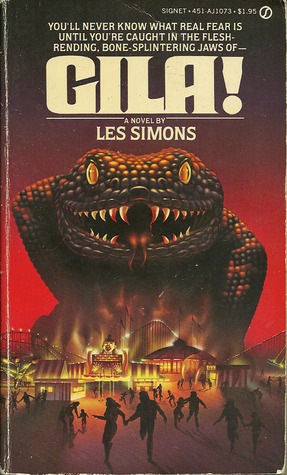
Horror Novel Review: Gila! by Kathryn Ptacek, writing as Les Simons


Watch out New Mexico!

Your long history of atomic testing is coming back to haunt you in the form of giant Gila Monsters!  Hiss, they say before they attack.  Hiss, they say as they look at the severed body parts that inevitably show up as a result of their rampages.  Hiss, they say as they make their way across the desert.  Hiss, hiss, hiss!

(Thanks a lot, Oppenheimer!)

Admirably, the 1981 novel Gila! is pretty straight-forward.  It’s about giant Gila monsters and it doesn’t pretend to be anything more than quick and rather pulpy read.  With the lizards cutting a path of destructing through New Mexico, Governor Bubba J. Roy wants something done and he wants it done now!

Heh heh — seriously, his name is Bubba J. Roy.  All of his dialogue is written phonetically, as if we might otherwise not guess that a character named Bubba J. Roy would have a fairly strong Southwestern accent.  That’s the type of novel this is.

It’s up to Dr. Kate Dwyer and her Native American lover, Chato Del KIinne, to figure out how to stop the mutated lizards.  It won’t be easy, both because the lizards are really big and, as always happens in this type of situation, there’s a bunch of ambitious bureaucrats who think they know better.  Before the humans can figure out a way to deal with the giant lizards, the monsters wipe out the patrons of a diner, the passengers on a school bus, and a huge amount of fairgoers, along with several soldiers and more than a few reporters.

(As I read the book, it occurred to me that perhaps the best solution would have been to build an electric fence around New Mexico and just let the Gila monsters have it.  Seriously, my family briefly lived in New Mexico and not one of us has ever had any great desire to go back.  I nearly stepped on a rattlesnake at one point.  Agck!  The state is dangerous enough even without all of the atomic monsters.)

Gila! is basically a throw-back to the classic giant monster movies of the 50s, though this book features a lot more sex than any of those films.  It’s relatively tame sex but still, there’s a surprisingly large amount for a relatively short novel about killer lizard.  Obviously, the writer knew what her readers were looking for and, to her credit, she gave it to them.

(It’s a bit of a shame that Gila! was apparently never turned into a movie.  Reading it, I kept thinking about how much this seemed like the type of story that just cried out to be the type of 70s movie that Leslie Nielsen made before he started doing comedies.  Ali MacGraw could have played Kate.  Burt Reynolds could have played Chato.  Bubba J. Roy?  Ned Beatty, of course!)

It’s a deeply silly book but entertaining and a quick read.  I picked up a beat-up paperback copy while visiting Snooper’s Book Barn in Fort Smith, Arkansas and I read the book the same day.

October True Crime: Chapter 27 (dir by J.P. Schaefer)


On December 8th, 1980, John Lennon was shot and killed in New York City by a man named Mark David Chapman.

While much has been written about John Lennon and his life and his beliefs, Mark David Chapman, serving a life sentence and rarely giving interviews, has always remained more of an enigma.  What exactly motivated him to shoot John Lennon remains a mystery.  At the time of the shooting, Chapman was carrying a copy of Catcher In The Rye and some accounts insist that Chapman believed himself to be Holden Caulfield or that he shot Lennon to try to bring more attention to the book.  Depending on which source you go to, Chapman was either a Beatles superfan or he was someone who rarely listened to rock ‘n’ roll.  Chapman either worshipped Lennon or he was offended by Lennon’s flippant remark about the Beatles being bigger than Jesus.  Some people claim that Chapman was looking for fame by killing someone famous.  Others claim that Lennon was not even Chapman’s main target and Chapman, in one of the few interviews that he did give, listed a long list of targets — including several other celebrities and politicians — that he considered going after at one point or another.

If anything, Mark David Chapman would appear to be a lot like Arthur Bremer, the directionless drifter who seriously wounded Governor George Wallace in 1972 and whose diary inspired Paul Schrader to create the character of Travis Bickle in Taxi Driver.  Like Chapman, Arthur Bremer traveled the country without apparent direction.  Like Chapman, Bremer considered many different targets before settling on Wallace.  And like Chapman, Bremer gave a lot of conflicting reasons for his actions.  One gets the feeling that neither Chapman nor Bremer (nor a lot of other assassins) really understood why they were driven to kill (or, in Bremer’s case, attempt to kill) so they grasped at whatever solution seemed to convenient at the time.  Apparently, anything was preferable to just admitting to being a severely damaged human being.

2007’s Chapter 27, follows Mark David Chapman (played by Jared Leto) as he travels to Manhattan and spends several days camped outside of the famous Dakota Apartment Building, hoping to see John Lennon (played by Mark Lindsay Chapman, who reportedly missed out on an earlier opportunity to play Lennon because he shared the same name as Lennon’s assassin).  The film is narrated by Mark David Chapman, who tries to talk tough just like Holden Caulfield but who can’t hide the fact that he’s basically just a fat loser who has no idea how to communicate with any of the other people that he meets in New York.  He creeps out a friendly groupie (played by Lindsay Lohan).  He gets into an argument with a photographer (Judah Friedlander).  He annoys countless Dakota doormen.  About the only person who isn’t annoyed by Chapman is Lennon himself, who politely signs an autograph just a few hours before Chapman shoots him in the back.

It’s a well-made and well-directed film and Jared Leto gives a memorably creepy performance as Mark David Chapman.  (That said, the accent that he uses while speaking as Chapman once again proves the danger of giving a method actor any role that involves a Southern accent.)  Leto gained a good deal of weight to Chapman and he’s thoroughly believable as a very familiar type of obsessive fan.  That said, the film still can’t make Chapman into a particularly compelling character because there’s really nothing compelling about someone like Mark David Chapman.  The man he killed was compelling, regardless of what you may think about the politics of a song like Imagine.  But Chapman himself was just a fat loser.  Leto does a good job of portraying Chapman as being a fat loser but it’s still hard to watch the film without wondering what the point of it all is.  We don’t need a movie to tell us that Mark David Chapman was a loser.

At its best, the film creates a sense of claustrophobia.  Almost the entire film is told from Chapman’s point of view and the best moments are the ones where Chapman finds himself overwhelmed by 1980s New York.  It’s a film that does inspire one to consider how strange it is that someone like Mark David Chapman could change the course of the culture through one deadly action.  (The film did cause me to think about how different things would have been if Chapman had boarded a Greyhound and left New York without returning to the Dakota that night.)  But, in the end, the film cannot answer the question of why Chapman did what he did.  Perhaps that’s because there really is no answer, beyond the randomness of fate and the dangers of fame.

Horror Film Review: Godzilla Raids Again (Dir by Motoyoshi Oda)


Godzilla Raids Again begins with a plane making an emergency landing on an island near Japan.  Soon, another plane lands to help out the first plane.  The two pilots, however, are immediately stunned by the sight of Godzilla battling an armored dinosaur with a spikey back.  Rushing back to the Japan, the pilots learn that the armored dinosaur was an Ankylosaurus that has been named Anguirus.  Anguirus and Godzilla are among the many prehistoric creatures who, having once been thought extinct, have been awakened and set free by nuclear testing.  And though Godzilla and Angurius are first spotted fighting on an isolate island, there’s little doubt that they will soon make their way to Japan, where the population is still recovering from the previous Godzilla attack.

First released in Japan in 1955 and subsequently released in the United States in 1959, Godzilla Raids Again was the first sequel to Gojira and, in a nod to continuity that would become extremely rare as the series continued, it actually does provide an explanation as to how exactly Godzilla is still alive after being apparently dissolved at the end of the first film.  It’s explained that there are actually several Godzillas.  The one that previously attacked Tokyo was destroyed but now a second one is coming.  Unfortunately, the man who destroyed the first Godzilla was killed in the process and apparently, he didn’t leave behind any notes explaining how he did what he did.

Once again, Japan is attacked by a giant monster.  Once again, cites are in flames and innocent people are dying.  The main difference is that, this time, Godzilla isn’t so much trying to destroy humanity as he just doesn’t even seem to realize that humanity is there.  Godzilla is more concerned with fighting Angurius and he barely seems to notice the buildings that he’s destroying and the lives that he’s ending.  If the first Godzilla film was about the lingering trauma of the nuclear attacks on Hiroshima and Nagasaki, Godzilla Raids Again is about being a small country caught in the middle of a conflict between two nuclear superpowers.  Godzilla and Angurius are so obsessed with beating each other that they really don’t care about anyone who gets trampled underfoot.  While Godzilla Raids Again is nowhere near as dark as the nightmarish first film, it’s still considerably more sober-minded than the Godzilla films that would immediately follow.  Godzillla Raids Again may not be as powerful a film as the first one but it still has its moments.  The film is at its best when it examines how ordinary citizens react to being pawns in the middle of a war between two super-powered monsters.  Some people defy the orders to stay home and instead try to have a good time in what may be their final moments.  Others cower in fear.  Some turn to religion.  Some turn to science.  A group of criminals try to bust out of prison.  In the end, it’s the brave citizens who are willing to risk and sacrifice their lives who ultimately save the world from Godzilla’s atomic fury.

When Godzilla Raids Again was released in the United States, it was in a heavily re-edited and poorly dubbed version.  (The narrator is sure to mention that the United States is willing to help out Japan with its monster problem.)  The film was retitled Gigantis and, throughout the Americanized version, Godzilla is referred to as being “Gigantis.”  Apparently, the film’s distributor thought that audiences would stay away if they knew that this film was a sequel, despite the fact that Godzilla had been a hit with American audiences.  Since Godzilla died at the end of the first film, the distributor felt that audiences would reject the idea of the character returning from the dead.  Times certainly have changed.

Of course, Godzilla is forever.

Previous Godzilla Reviews:

  1. Godzilla, King of the Monsters (1958)
  2. King Kong vs Godzilla (1962)
  3. Mothra vs. Godzilla (1964)
  4. Ghidorah: The Three-Headed Monster (1964)
  5. Invasion of the Astro-Monster (1965)
  6. Godzilla vs. The Sea Monster (1966)
  7. Son of Godzilla (1967)
  8. Destroy All Monsters (1968)
  9. All Monsters Attack (1969)
  10. Godzilla vs Hedorah (1971)
  11. Godzilla vs Gigan (1972)
  12. Godzilla vs Megalon (1973)
  13. Godzilla vs Mechagodzilla (1974)
  14. Godzilla vs. Mothra (1992)
  15. Godzilla vs. Destoroyah (1995)
  16. Godzilla, Mothra, and King Ghidorah: Giant Monsters All-Out Attack (2001)
  17. Godzilla (2014)
  18. Godzilla: Planet of the Monsters (2017)
  19. Godzilla, King of the Monsters (2019)
  20. Godzilla vs Kong (2021)
  21. Godzilla Minus One (2023)

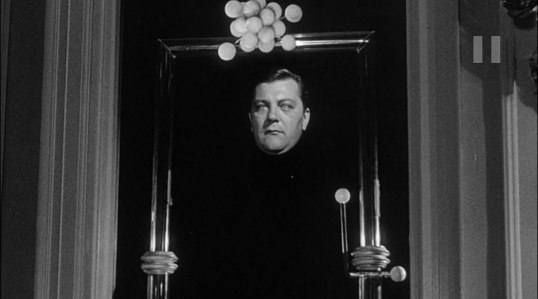
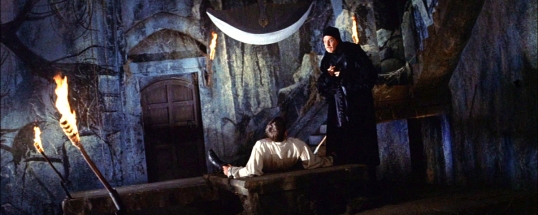
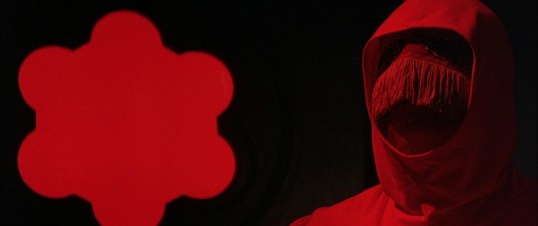
4 Shots From 4 Films: Special Roger Corman Edition


4 (or more) Shots From 4 (or more) Films is just what it says it is, 4 (or more) shots from 4 (or more) of our favorite films. As opposed to the reviews and recaps that we usually post, 4 (or more) Shots From 4 (or more) Films lets the visuals do the talking.

Today, on the first day of Horrorthon, we remember the great film pioneer and director, Roger Corman!  It’s time for….

4 Shots From 4 Roger Corman Films

Not of this Earth (1957, dir by Roger Corman DP: John J. Mescall)

Pit and the Pendulum (1961, dir by Roger Corman, DP: Floyd Crosby)

X: The Man With The X-Ray Eyes (1963, dir by Roger Corman, DP: Floyd Crosby)

The Masque of the Red Death (1964, dir by Roger Corman, DP: Nicolas Roeg)

Horror Film Review: The Survivor (dir by David Hemmings)


The 1981 film, The Survivor, opens with a group of school children watching as a plane crashes in the distance.  Of the 301 people on the plane, 300 die.  Somehow, the only survivor is the pilot, David Keller (Robert Powell).  It’s rare for a pilot to be the sole survivor, especially in a crash as severe as the one in this film.  Even more shocking, David walks away without a scratch on him or any memory of what happened in the minutes before the crash.

Though the airline wants to keep David hidden away until after it has determined what caused the crash, David insists on helping with the investigation.  He is haunted by strange visions and the sound of screaming passengers.  He has to know if the crash was his fault or if there was a bomb on the plane.  While the tabloid press tries to take his picture, the families of the victims blame him for the crash.  “There he is,” one angry woman shouts at a funeral service that is overseen by Joseph Cotten (in his last film role), “the pilot who walked away!”

When one of the tabloid photographers gets a little bit too aggressive in his attempts to take David’s picture, he finds himself pursued by a ghostly apparition of a little girl.  The photographer is so frightened of the little girl that he stumbles in front of a train, which has to rank right up there as one of the dumbest ways that someone can die in a horror movie.  Later, the photographer’s girlfriend tries to look at one of the pictures of David and her hand is promptly chopped off by a paper cutter.  That’s not quite as bad as stumbling in front of a train.

As David tries to understand what is happening, he realizes that he’s being followed by a woman named Hobbs (Jenny Agutter).  Hobbs says that she is a medium.  She witnessed the crash and now, she’s in contract with the spirits of the dead.  At one point, David and Hobbs suddenly start trying to strangle each other.  They manage to break free of whatever has possessed them but it’s obvious that these spirits are not fooling around.  (That said, the attack begins and ends so abruptly that, for those of us watching, it inspires more confusion than fright.)

The idea behind The Survivor is an intriguing one.  The film was directed by David Hemmings, the British actor who is probably best-remembered for starring in the 60s classic, Blow Up and in Dario Argento’s classic Deep Red.  Along with co-founding Hemdale Films, Hemmings also directed a handful of movies.  Unfortunately, intriguing premise aside, The Survivor is not one of Hemmings’s better directorial efforts.  There are a few effective visuals and Jenny Agutter is well-cast as Hobbs but the film’s pace is extremely slow and Robert Powell seems to be more bored than enigmatic as the title character.  The film’s plot calls out for an all-out grindhouse approach.  Hemmings’s instead gives us a stately and rather self-important film that ultimately feels like a lesser episode of some obscure 70s anthology show.

That said, this film does feature Joseph Cotten in his final film appearance.  He only has two scenes but he brings a quiet dignity to the role of the Priest.  The film doesn’t really work but Joseph Cotten and Jenny Agutter give performances that survive the wreckage.

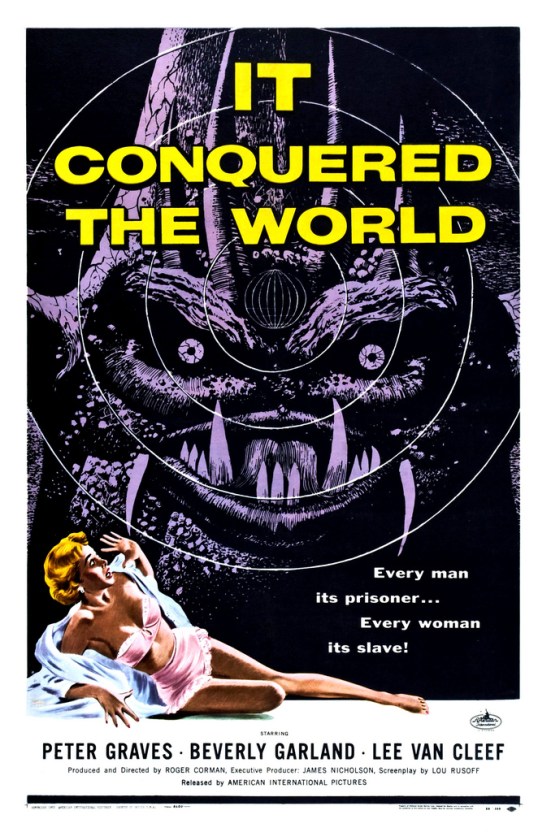
Horror Film Review: It Conquered The World (dir by Roger Corman)


“Man is a feeling creature, and because of it, the greatest in the universe….”

So says scientist Paul Nelson (Peter Graves) towards the end of 1956’s It Conquered The Universe.  Paul may be a scientist but he understands the importance of emotion and imagination and individuality.  He knows that it’ll take more than just cold logic to save humanity from destruction.

Unfortunately, Paul’s best friend, Tom Anderson (Lee Van Cleef), disagrees.  Tom worked at Los Alamos.  Tom helped to develop the atomic bomb.  Tom is convinced that humanity will destroy itself unless a greater power takes over.  Tom feels that he has discovered that greater power.  Tom has recently contacted a Venusian and invited it to come to Earth.  Upon arriving, the Venusian promptly disrupts all electrical power on Earth.  It sends out bat-like creatures that inject humans with a drug that takes control of their minds and turns them into a compliant slaves.  Paul tells Tom that robbing people of their free will is not going to save the Earth but Tom remains committed to the Venusian, even as it becomes obvious that the Venusian’s main concern is with its own survival.

It Conquered The World is very much a film of the 1950s.  Along with tapping into the era’s paranoia about nuclear war and UFOs, it also features Peter Graves delivering monologues about freedom and the inherent superiority of the human race.  When Paul confronts Tom, he not only accuses Tom of selling out the Earth but he also attacks Tom’s patriotism.  When Tom’s wife, Claire (Beverly Garland), confronts the alien and orders it to leave her plant along, she does it while wearing high heels and a tight sweater and holding a rifle.  The one female scientist (played by Karen Kadler) spends most of her screentime being menaced while wearing a white slip and there’s a platoon of bumbling but unbrainwashed soldiers hanging out in the woods.  If one looked up 1956 in the dictionary, there’s a very good chance this film would be the definition.

At the same time, the film’s story feels like a metaphor for modern times.  When the Venusian-controlled police turn authoritarian and start threatening to punish anyone who questions their orders, we’re reminded of the excesses of the COVID lockdowns.  When the editor of the town’s newspaper is shot by a policeman who says that words are no longer necessary in the new world, it’s hard not to think of all the writers, commentators, artists, and ordinary citizens who have run afoul the online cancellation brigade.  When Paul is reduced to riding a bicycle from place to place, it’s hard not to think of the environmental Luddites, with their hatred of anything that makes life more convenient.  When Tom rationalizes his activities by saying that humanity must be saved from itself, he’s expressing an opinion that is very popular among several people today.  Tom’s embrace of cold logic feels very familiar.  Of course, today, people don’t need a Venusian to order them to accept authoritarianism.  Instead, they’re more than happy to do on their own.

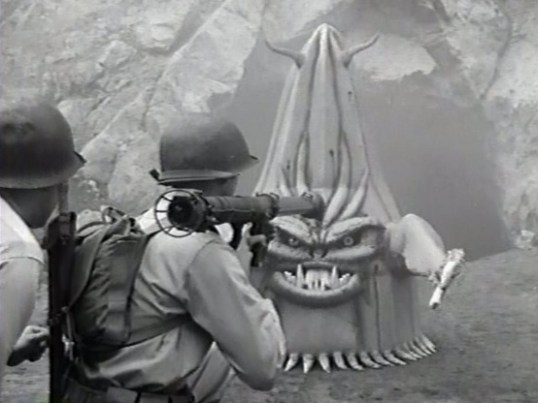
It Conquered The World was directed by Roger Corman.  It was his eighth film as a director and it remains one of his most entertaining.  As one might expect from a low-budget sci-fi film, It Conquered The World produces it’s share of laughs.  It’s hard not to smile at the sight of the extremely serious Peter Graves peddling his bicycle from location to location.  (It doesn’t help that Graves never takes off his suit or loosens his tie.)  And the Venusian simply has to be seen to be believed:

At the same time, It Conquered The World holds up well.  Lee Van Cleef and Beverly Garland both give performances that transcend the material, with Van Cleef especially doing a good job of paying a man struggling to rationalize his bad decisions.  It Conquered The World holds up today, as both a portrait of the 50s and 2024.

The Covers of Imagination


From 1951 through 1958, Imagination magazine brought stories of science fiction and horror to eager readers.  Among the writers who appeared in Imagination were Philip K. Dick, Robert Heinlien, Robert Sheckley, and John Wyndham.  Today, the magazine is well-remembered for its exciting covers, which were done by some of the best artists working in the pulps.  You can’t have art without Imagination.

Below is a sampling of The Covers of Imagination: Stories of Science and Fantasy.

1950, October, by Hannes Bok

1951, April, by Malcolm Smith

1952, May, by Malcolm Smith

1953, January, by Harold W. McCauley

1954, June, by Malcolm Smith

1954, July, by Harold W. McCauley

1954, September, by Bill Terry

1955, June, by Harold W. McCauley

1956, February, by Lloyd Rognan

1956, December, by Lloyd Rognan

1957, December, by Malcolm Smith

Horror on the Lens: The Little Shop of Horrors (dir by Roger Corman)


Hi!  Welcome to Horrorthon!  It’s a tradition around these parts that we offer up a classic (or not-so-classic) horror film for our readers to watch every day in October.  As we have just lost the great Roger Corman, it seems appropriate to start things off with one of his best films.

And so, without further ado….

Enter singing.

Little Shop…Little Shop of Horrors…Little Shop…Little Shop of Terrors…

For the 2024 Horrorthon’s first plunge into the world of public domain horror films, I’d like to present you with a true classic.  From 1960, it’s the original Little Shop of Horrors!

When I was 19 years old, I was in a community theater production of the musical Little Shop of Horrors.  Though I think I would have made the perfect Audrey, everybody always snickered whenever I sang so I ended up as a part of “the ensemble.”  Being in the ensemble basically meant that I spent a lot of time dancing and showing off lots of cleavage.  And you know what?  The girl who did play Audrey was screechy, off-key, and annoying and after every show, all the old people in the audience always came back stage and ignored her and went straight over to me.  So there.

Anyway, during rehearsals, our director thought it would be so funny if we all watched the original film.  Now, I’m sorry to say, much like just about everyone else in the cast, this was my first exposure to the original and I even had to be told that the masochistic dentist patient was being played by Jack Nicholson.  However, I’m also very proud to say that — out of that entire cast — I’m the only one who understood that the zero-budget film I was watching was actually better than the big spectacle we were attempting to perform on stage.  Certainly, I understood the film better than that screechy little thing that was playing Audrey.

The first Little Shop of Horrors certainly isn’t scary and there’s nobody singing about somewhere that’s green (I always tear up when I hear that song, by the way).  However, it is a very, very funny film with the just the right amount of a dark streak to make it perfect Halloween viewing.

So, if you have 72 minutes to kill, check out the original and the best Little Shop of Horrors