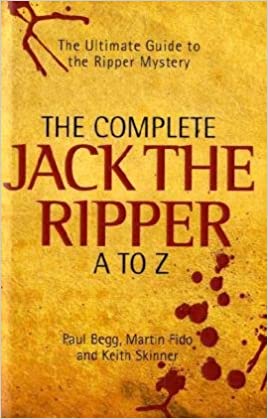
Book Review: The Complete Jack The Ripper: A to Z by Paul Begg, Martin Fido, and Keith Skinner


We will never actually know who Jack the Ripper actually was.

People will always be offering up theories, of course.  His crimes were so terrible and his nickname was so memorable and the fact that he was never caught is, to modern audiences spoiled by true crime shows and detective movies, so improbable that there’s a tendency to assume that Jack the Ripper must have been someone significant in his everyday life.  Everyone from Queen Victoria’s son to Lewis Carroll to Oscar Wilde has been accused over the years.

My personal theory is that Jack the Ripper was a nobody.  He didn’t have any medical training.  He wasn’t a part of a grand conspiracy.  He had no motive beyond his own hatred of women.  He stalked prostitutes because they were easy targets.  His murders were savage because he was a sadist who wanted to show off the power that he felt he had over his victims.  He got away with his crimes not because he was clever or protected but just because, in 1888, the police had no experience with a serial killer like Jack the Ripper.  In all probability, the killer was some anonymous loser, one of the many strange and angry men who could probably be spotted in Whitechapel on any foggy night.  

Unfortunately, after more than a 130 years of mystery, no one wants to admit that Jack the Ripper was probably some guy that no one’s ever heard of.  There’s a tendency to assume that he had to be someone important or, at the very least, someone who was at least mentioned in a handful of books about the Whitechapel murders.  Sadly, far too many people are under the impression that Patricia Cornwell solved the case in 2002.  In Portrait of a Killer, Cornwell accused the painter Walter Sickert of being the murderer.  Her main argument consisted of an inconclusive DNA test and an apparent inability to appreciate Victorian-era art.  Cornwell didn’t care much for Sickert’s paintings and therefore, Sickert had to be history’s most notorious murderer.  It’s a bit silly but a lot of people bought into it because it was Patricia Cornwell making the accusation.

To those people who insist that the murderer had to be a Victorian celebrity, I would point them to The Complete Jack the Ripper: A to Z.  Published in 2010, this book is the definitive guide to the Ripper murders.  It contains entries for every suspect, every victim, every policeman, every clue, and every theory.  There’s a lot of information to be found in this book.  In fact, there’s so much information that it’s easy to see how the actual killer could slip through the cracks and, unseen by the overwhelmed and underprepared legal authorities, disappear into the dark shadows of history.  Along with presenting a clear-eyed and nonbiased look at the suspects and the theories, the book is also to be commended for what it tells us about Jack the Ripper’s victims, who are too often forgotten when it comes to discussing the crimes.  So much time is spent on Jack’s identity that the women he murdered are often pushed to the side.  This book does not make that mistake.

This is the definitive book on Jack the Ripper, whoever he may have been.
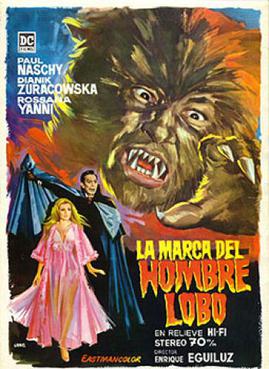
International Horror Review: The Mark of the Wolfman (dir by Enrique López Eguiluz)


The 1968 Spanish film, The Mark of the Wolfman, is a strange one.

Just try to keep this straight:

In Eastern Europe, two gypsies accidentally bring back to life a feared werewolf named Imre Wolfstein.  (Beware any supernatural creature who has an ironic name.)  Wolfstein proceeds to terrorize the countryside, attacking both the good and the bad alike.  He also finds the time to attack a Polish nobleman named Waldemer Danisky (Paul Naschy).  Danisky survives the attack but now he’s a werewolf!  Unlike Wolfstein, Danisky is not happy about being a werewolf, especially when he discovers that he’s been killing innocent people while transformed.  So, Danisky decides to go to a local scientist named Dr. Janos Mikhelov (Julian Ugarte).  Unfortunately, it turns out that Dr. Mikhelov is a vampire and so is his wife!  They’ve got special plans for both of the werewolves!

The Mark of the Wolfman was the first of many films in which Naschy would play Count Danisky.  They were extremely popular in Europe and Paul Naschy became a big star in Spain.  In fact, he was sometimes called the Spanish Lon Chaney and given that Naschy often talked about how The Wolf Man (starring Lon Chaney, Jr.) was one of his favorite films when he was a child, that undoubtedly brought him a lot of pleasure.  And indeed, Naschy’s performance as Danisky did owe a bit to Lon Chaney Jr’s performance as Larry Talbot.  They’re both tortured souls, desperately seeking an escape from their curse and continually being brought back to life against their will.  The main difference between the two was that Danisky never got quite as whiny as Talbot.  Whereas Lon Chaney Jr. played Larry Talbot as being just a big dumb lug, Naschy played Danisky as being a far more aggressive character.  Danisky wasn’t just depressed over being a werewolf.  He was pissed off about it.

The plot of Mark of the Wolfman may sound complicated but, by the standards of Naschy’s other films, it’s actually rather straight-forward and uncomplicated.  Of course, it can be difficult for an American to judge Naschy’s films because many of them were never released here in the United States and those that were can usually only be found in poorly dubbed and crudely edited versions.  For instance, Mark of the Wolfman was released in the United States as Frankenstein’s Bloody Terror, despite the fact that neither Frankenstein nor his monster were anywhere to be found in the original film.  However, the distributors needed a film to go on a double bill with another Frankenstein movie.  To justify the title change, narration was added to the start of the film that established that Wolfstein was a descendant of Frankenstein.  Apparently, the price for playing God was to be cursed with lycanthropy.  It’s actually kind of charming in a drive-in sort of way.

Even if you know nothing about the subsequent career of Paul Naschy or the many sequels that followed this film, The Mark of the Wolfman holds up well as an entertaining horror film.  It’s only 88 minutes long and it manages to pack drunken gypsies, tortured werewolves, devious vampires, and a dungeon into its brief running time.  As a result, it’s never boring. Visually, the film is a treat, with the camera swiftly moving across the wilderness or tracking through gothic castles.  (Mark of the Wolfman was originally filmed in 3D and, watching the film, I found myself thinking that it probably looked pretty damn impressive to audiences in 1968.)  Because the version that I saw was badly dubbed into English, it wasn’t always easy to judge the performances but Naschy played Danisky with a properly haunted look.

The Mark of the Wolfman is an enjoyable work of Spanish horror, one that undoubtedly helped to revitalize Spanish horror just as assuredly at the Blind Dead and Jess Franco.

Insomnia File #50: Zola (dir by Janicza Bravo)


What’s an Insomnia File? You know how some times you just can’t get any sleep and, at about three in the morning, you’ll find yourself watching whatever you can find on cable or Netflix? This feature is all about those insomnia-inspired discoveries!

If you were having trouble getting to sleep around two a.m. on Monday morning, you could have turned over to Showtime 2’s west coast feed and watched Zola.

Zola tells the story of Zola (Taylor Paige), a Detroit waitress and part-time stripper who is invited to go down to Florida by another stripper, Stefani (Riley Keough).  Stefani assures Zola that they’re just going to have a good time and make some money dancing in the clubs.  Instead, it turns out that they’re going to Florida with Stefani’s roommate, X (Colman Domingo, showing compelling flashes of charisma and danger), and her simple-minded but loyal boyfriend, Derrek (Nicholas Braun).  It also turns out that X is actually a Nigerian named Abegunde Olawale and that he is Stefani’s pimp.  It doesn’t take long for Zola to grow annoyed with everyone else on the road trip but, unfortunately, she’s already stuck in Tampa with them.  That’s the problem with going on a road trips with perfect strangers.  The trip grows stranger and more violent with each passing hour.  In fact, it gets so strange that, when Zola eventually tells her story on twitter, the thread goes viral.  And then this movie is made, with a disclaimer that states that most of the story is based on fact.

Zola made quite a splash when it premiered at Sundance in 2020.  Audiences either loved or hated its extreme stylization and rather crass cast of characters.  While the film was originally scheduled to be released in 2020, that release was delayed by the COVID pandemic.  At a time when people were scared to go outside and be near even their closest relatives or friends, I guess someone decided that it wasn’t the right time to release a movie about going on a cramped road trip with two morons and a psychotic pimp.  The film was finally released earlier this year.  It got good critical notices, though audiences seemed to be slightly less enamored with it.

Speaking for myself, I was both impressed and annoyed with Zola.  On the one hand, you have to respect a film that’s willing to run the risk of alienating the audience in order to tell its story.  Zola is violent, vulgar, and frequently funny.  It’s also frequently disturbing, with Zola continually finding herself in a bad situation from which she can’t escape.  Taylour Paige brings a lot of inner strength to the role of Zola.  When Zola gets annoyed, she doesn’t hide it.  When Zola says she’s not going to do something, she means it and she says it with such confidence that even X respects her.  She and Stefani also have an interesting relationship, one that will ring true to anyone who has ever had that one friend who simply cannot stop messing up her life.  The film embraces its characters and their activities, refusing to pass judgment or to sentimentalize.  You have to admire the film’s commitment.  At the same time, the film is occasionally a bit annoying.  It’s so extremely stylized and Stefani is so loud and crass that it can sometimes be tough to take.  This is a film that benefits from being watched at home as opposed to in theater, if just because you can hit pause whenever you feel a migraine starting to come on.  (Poor Zola, meanwhile, is stuck in the back of X’s car, listening to Stefani and Derreck and realizing that she’s pretty much stuck with all of them.)  Zola was produced and distributed by A24 and it is indeed very much an A24 film, loud, frustrating, paranoia-inducing, and occasionally compelling.

Zola is only 90 minutes long but it packs a lot into those minutes.  It’s not a boring film.  At the same time, it’s never quite as subversive as something like Spring Breakers.  Instead, it’s just an energetic recreation of the road trip from Hell.

Previous Insomnia Files:

  1. Story of Mankind
  2. Stag
  3. Love Is A Gun
  4. Nina Takes A Lover
  5. Black Ice
  6. Frogs For Snakes
  7. Fair Game
  8. From The Hip
  9. Born Killers
  10. Eye For An Eye
  11. Summer Catch
  12. Beyond the Law
  13. Spring Broke
  14. Promise
  15. George Wallace
  16. Kill The Messenger
  17. The Suburbans
  18. Only The Strong
  19. Great Expectations
  20. Casual Sex?
  21. Truth
  22. Insomina
  23. Death Do Us Part
  24. A Star is Born
  25. The Winning Season
  26. Rabbit Run
  27. Remember My Name
  28. The Arrangement
  29. Day of the Animals
  30. Still of The Night
  31. Arsenal
  32. Smooth Talk
  33. The Comedian
  34. The Minus Man
  35. Donnie Brasco
  36. Punchline
  37. Evita
  38. Six: The Mark Unleashed
  39. Disclosure
  40. The Spanish Prisoner
  41. Elektra
  42. Revenge
  43. Legend
  44. Cat Run
  45. The Pyramid
  46. Enter the Ninja
  47. Downhill
  48. Malice
  49. Mystery Date

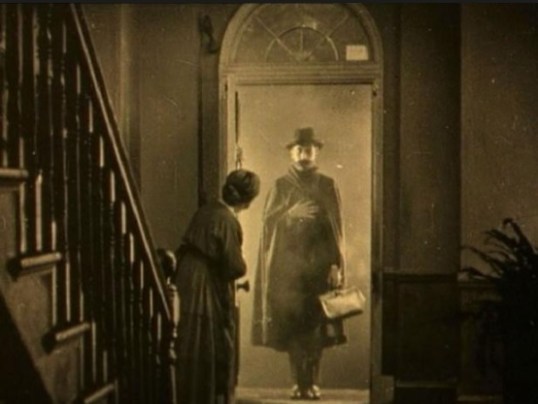
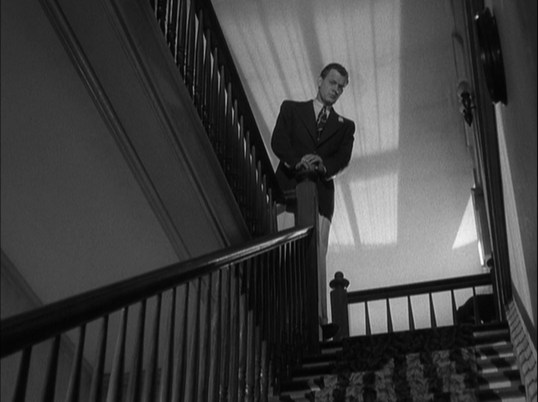
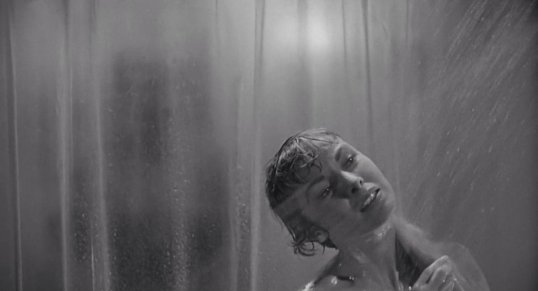
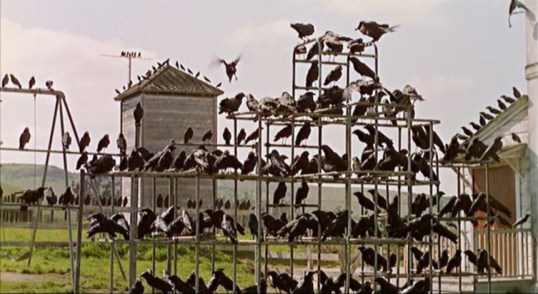
4 Shots From 4 Alfred Hitchcock Films


4 Shots From 4 Films is just what it says it is, 4 shots from 4 of our favorite films. As opposed to the reviews and recaps that we usually post, 4 Shots From 4 Films lets the visuals do the talking.

Today, we honor the master of suspense, Alfred Hitchcock.  Not all of his film were horror films, of course.  In fact, the majority were not.  But his influence on the genre cannot be overstated.  Just try to keep track of how many horror films owe a debt to Psycho or The Birds.

It’s time for….

4 Shots From 4 Alfred Hitchcock Films

The Lodger (1926, dir by Alfred Hitchcock, DP: Gaetano di Ventimiglia)

Shadow of a Doubt (1943, dir by Alfred Hitchcock, DP: Joseph A.Valetine))

Psycho (1960, dir by Alfred Hitchcock, DP: John L. Russell)

The Birds (1963, dir by Alfred Hitchcock, DP: Robert Burks)

How A Neighborhood Gets Ready For Halloween


It’s only a few days away but I realize that you may still be having trouble getting in the mood for Halloween! Don’t worry, I’m here to help. Yesterday morning, I took a walk around the neighborhood with my camera. There was a light fog. There was a misting of rain. It was the perfect weather for taking pictures of how people around here are getting ready to celebrate the 31st of October! If these decorations don’t get you in the mood for Halloween, nothing will!

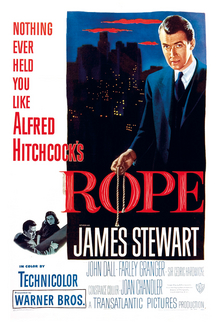
Suspense Film Review: Rope (dir by Alfred Hitchcock)


Rope, an odd little 1948 experiment from Alfred Hitchcock, opens with a murder.

Two wealthy young men, Brandon (John Dall) and Philip (Farley Granger), invite their friend, David Kentley (Dick Hogan), up to their apartment.  When David arrives, they strangle him and hide his body in a wooden chest.  As quickly becomes obvious, Brandon and Philip killed David largely to see if they could pull off the perfect murder.  Brandon is sure that they did and, that by doing so, they proved the concept of Nietzsche’s Übermensch,  The alcoholic Philip is less sure and starts drinking.

Brandon and Philip don’t just have murder planned for the day.  They’re also planning on throwing a little dinner party and, among those on the guest list, are David’s parents, his girlfriend, and his girlfriend’s former boyfriend.  Also attending will be Brandon and Philip’s former teacher and housemaster, Rupert Cadell (James Stewart).  In fact, Brandon regularly claims that he got the idea to commit the perfect murder as a result of discussing philosophy with Rupert.  Apparently, Rupert turned Brandon onto Nietzsche….

AGCK!  JIMMY STEWART LEADING YOUNG MEN TO FASCISM!?  SAY IT’S NOT SO!

Well, fortunately, the dinner party conversations reveals that Brandon and Philip misunderstood what Rupert was trying to tell them.  They assumed, using the same type of logic that currently fuels most debate today, that just because Rupert mentioned something that meant that he approved of it.  As it becomes clear that Rupert would not approve of what his students have done and as Rupert himself starts to suspect that something bad has happened at the apartment, Brandon and Philip start to plot against their former mentor….

Now, it can be argued that Rope is not a horror movie.  And indeed, if your definition of horror is ghosts, vampires, werewolves, or any other type of paranormal creature than yes, Rope has none of those.  Instead, the horror of Rope is the horror of human cruelty.  It’s the horror of two privileged young men who have so twisted the words of their mentor that they’ve become monsters.  The horror in Rope comes from the fact that, in 1948, Brandon and Philip have embraced the same philosophy that, only a few years earlier, had plunged the entire world into war.  While families mourned their dead and Europe struggled to rebuild, Brandon and Philip showed that they had no understanding of or concern for the trauma that humanity had just suffered.  And making it even more disturbing is that they found the justification for their crimes in the lessons taught by the epitome of American decency, Jimmy Stewart.  The idea of that is more terrifying than any Hammer vampire flick.

Of course, Rope is best known for being a bit of an experiment.  Hitchcock edited the film to make it appear as if it was all shot in one take and events, therefore, played out in real time.  It’s an interesting idea and, as always, you have to admire Hitchcock’s ingenuity and, even in a film as grim as this one, his playfulness.  At the same time, Hitchcock’s technique makes an already stagey story feel even stagier.  Some of the actors — like James Stewart, John Dall, and Cedric Hardwicke in the role of David’s father — are able to give naturalistic and convincing performances despite the staginess of the material. Others, like poor Farley Granger, find themselves overshadowed by the film’s one-shot gimmick.

Rope is an experiment that doesn’t quite work but flawed Hitchcock is still a pleasure to watch.  The final few minutes, with Stewart and Dall finally confronting each other, are among the best that Hitchcock ever put together.  I appreciate Rope, even if it doesn’t quite succeed.

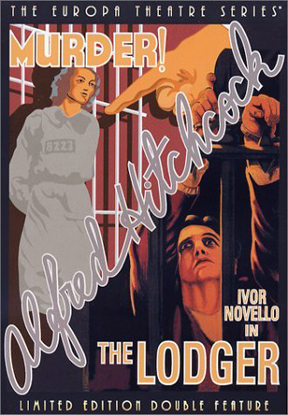
Horror on the Lens: The Lodger (dir by Alfred Hitchcock)


A serial killer known as “The Avenger” is murdering blonde women in London (which, once again, proves that its better to be a redhead).  And while nobody knows the identity of the Avenger, they do know that the enigmatic stranger  (Ivor Novello), who has just recently rented a room at boarding house, happens to fit his description.  They also know that the lodger’s landlord’s daughter happens to be a blonde…

Released in 1927, the silent The Lodger was Alfred Hitchcock’s third film but, according to the director, this was the first true “Hitchcock film.”  Certainly it shows that even at the start of his career, Hitchcock’s famous obsessions were already present — the stranger accused of a crime, the blonde victims, and the link between sex and violence.

Also of note, the credited assistant director — Alma Reville — would become Alma Hitchcock shortly before The Lodger was released.

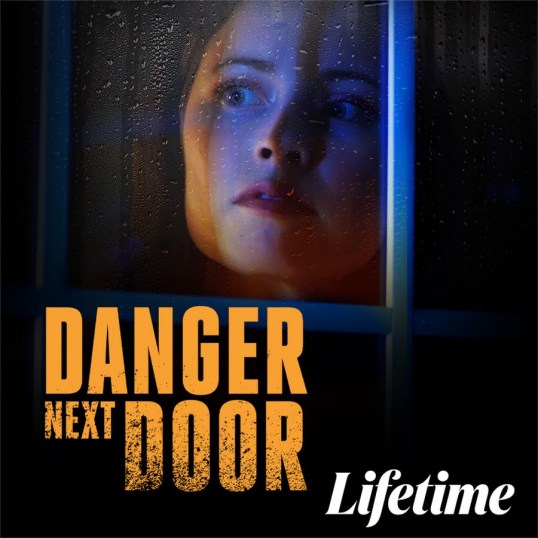
What Lisa Watched Last Night #216: The Danger Next Door (dir by Bill Corcoran)


Last night, I watched the latest Lifetime film, The Danger Next Door!

Why Was I Watching It?

Because it was on Lifetime, of course!  It’s been a while since I’ve gotten a chance to watch a Lifetime film on the night that it aired.  Seriously, my DVR is full of Lifetime films right now and waiting for me to dig into them come November.

What Was It About?

After getting mugged, pregnant Robin (Hannah Emily Anderson) and her husband, Ben (Jake Epstein) move to a small town.  At first, the town seems perfect but it’s hard not to notice that their next door neighbors, Guy (David Ferry) and Sharon (Kyra Harper), are a little bit too friendly.  Anyone who has watched a Lifetime film knows that no one that nice can be trusted and that’s certainly the case here.

What Worked?

I always love a good “small towns are evil” Lifetime film so, in that regard, The Danger Next Door delivered exactly what I wanted.  The town was pretty, the houses were big, and the melodrama was embraced.  Yay!

The film also featured Jake Epstein, playing a sympathetic character for once!  Epstein previously played Craig Manning on Degrassi.  I’ve seen him in a lot of other movies and shows since then but he’ll always be Craig to me!  Craig was one of the best characters on Degrassi, a bipolar musician with drug problems and a habit of breaking everyone’s heart.  I always hoped that Craig and Ellie would get together, though I do think Ashley was Craig’s soul mate.  Anyway, where was I?  Oh yeah, Jake Epstein was in this movie and it was good to see him!

What Did Not Work?

Towards the end of the movie, there were a few plot twists that demanded a lot of suspension of disbelief, even for a Lifetime film.

“Oh my God!  Just like me!” Moments

I have never been mugged but, when I was 16 years old, the house that I was living in was burglarized.  My mom, my sisters, and I woke up one morning to discover that the garage door was open, the microwave was missing, and someone had emptied out my mom’s purse.  Even more than that, though, they stole our feeling of being secure in our home.  I had nightmares for weeks afterwards and I even took to sleeping with a baseball bat next to my bed.  However, the bat was a bit heavy so, after a few days, I switched it out for a golf club.

One night, I thought I heard someone creeping outside my bedroom door at 3 in the morning.  I got up, grabbed my golf club, and creeped over to the door.  I took a deep breath, raised the club over my head, threw the door open, and swung at the first dark shadow that I saw.

“What the Hell, Lisa Marie!?” Erin exclaimed, as she (rather easily) avoided the club.

Looking back at it, I’m glad that I didn’t hit my sister in the face with a golf club.  I would have felt bad about that.  But there’s no worse feeling than having some stranger invade your personal safe place.  All these years later, I’m still a fanatic when it comes to locking all the doors, checking all the windows, and making sure I’ve got a golf club near the bed.

The movie did a good job of capturing that trauma.  I could definitely relate to Robin’s fears.

Lessons Learned

Never move to a small town.  No matter how bad and scary the city gets, it’s still safer than living in a small town.