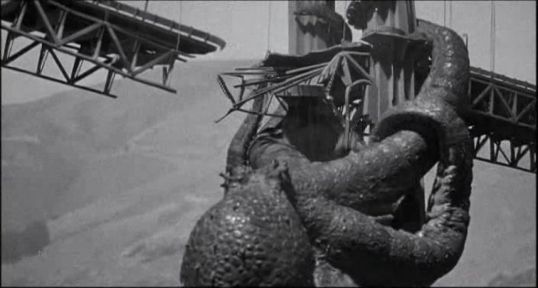
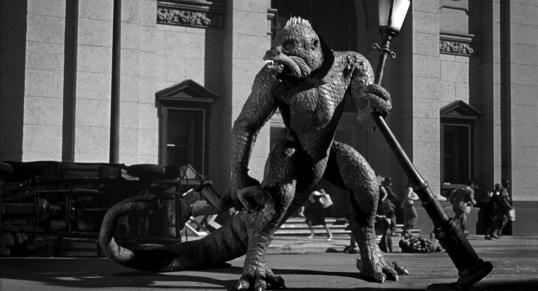
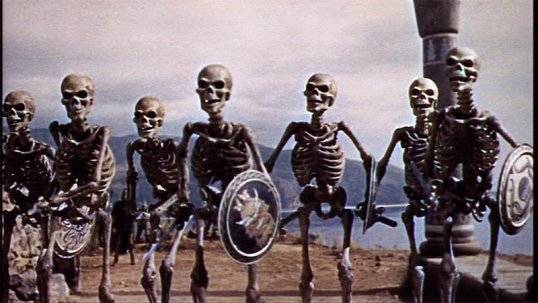
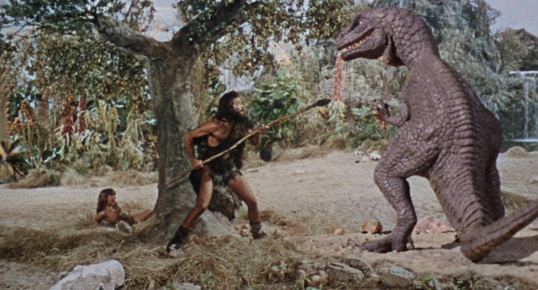
4 Shots From 4 Films is just what it says it is, 4 shots from 4 of our favorite films. As opposed to the reviews and recaps that we usually post, 4 Shots From 4 Films lets the visuals do the talking. Special Effects wizard Ray Harryhausen was born on this date in 1920. A protogee of Willis O’Brien, Harryhausen created some of the most iconic monsters in fantasy film history. Here are 4 shots celebrating the genius of Ray Harryhausen!
My introduction to Stone Temple Pilots was the album Tiny Music…Songs From the Vatican Gift Shop–not my recommended way to start listening to STP. I remember liking this song, but when I bought the album, it felt generic and instantly forgettable.
The video for Sour Girl on the other hand is still something I remember to this day. Apparently, despite the fact that they look like a creepy version of Teletubbies, they were inspired by a dream that Scott Weiland had. At least that’s according to the Wikipedia article that draws from the Songfacts page on the song and video. The song was written about his divorce from his first wife. I’m assuming this is the same wife who he wrote Interstate Love Song about since according to Scott Weiland’s memoir [Not Dead & Not for Sale: A Memoir]:
[About Sour Girl]: “Everyone is convinced that it’s about my romance with Mary [Forsberg, second wife],” Weiland writes in his autobiography Not Dead and Not For Sale. “But everyone is wrong. ‘Sour Girl’ was written after the collapse of my relationship with Jannina [Castaneda, first wife]. It’s about her. ‘She was a sour girl the day that she met me,’ I wrote. ‘She was a happy girl the day she left me… I was a superman, but looks are deceiving. The rollercoaster ride’s a lonely one. I pay a ransom note to stop it from steaming.’ The ransom note, of course, was the fortune our divorce was costing me. And the happy state, which I presumed to be Jannina’s mood, was because she had finally rid her life of a man who had never been faithful.”
[About Interstate Love Song]: “She’d ask how I was doing, and I’d lie, say I was doing fine.”
“I imagined what was going through her mind when I wrote, ‘Waiting on a Sunday afternoon for what I read between the lines, your lies, feelin’ like a hand in rusted shame, so do you laugh or does it cry? Reply?”
That explains the bleak video, why she is returned to a happy-looking state while in the dark world of the video, and why Weiland is left in the dark world with the creepy creatures.
Considering Weiland’s life and the meaning behind this song and video, it’s interesting that it was directed by David Slade. You might remember him as a producer and director of episodes of American Gods and Hannibal. He also directed The Twilight Saga: Eclipse (2010).
Yari Schutzer was the production manager. Schutzer seems to have worked on around 25 music videos as well as some movies.
Martin Coppen shot the video. He has worked on at least 25 videos. Since his credits date back as far as 1988, I wouldn’t be surprised if there are many more.
Bronni Bakke was the casting director, which I guess mean she picked out Sarah Michelle Gellar and the people in the suits. She worked on The Bogus Witch Project (2000) and a few other things. According to her IMDb profile, she “impersonates Britney Spears, Marilyn Monroe, Felicity Shagwell and Lara Croft.” From what I can find, it looks like she passed away in 2016 from breast cancer.
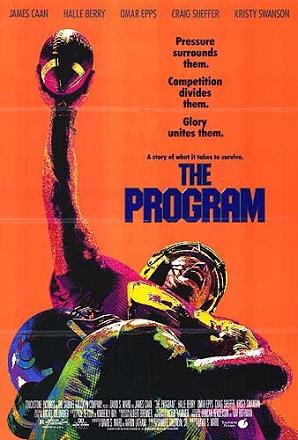
There’s not a single sports cliché that goes untouched in The Program.
A veteran college football coach who, after two disappointing seasons, is now being told that he must get wins at any cost? Check!
A cocky senior quarterback who is trying to live up to his father’s expectations? Check!
A cocky freshman who matures during the season? Check!
A cocky NFL prospect who suffers a career ending injury? Check!
Corrupt rich backers? Check!
Beer? Check!
Steroids? Check!
Hazing? Check!
Football groupies? Check!
Halle Berry wasted in a one-note role? Check!
Kristy Swanson as the one girl on campus who is not impressed by football? Check! Check! Check!
The Program has its good points. James Caan does a good job as the coach and Andrew Bryniarski, playing a player who is always on the verge of flying into roid rage, dominates every scene in which he appears. Kristy Swanson looks good in a tennis outfit, so it’s not all bad. But Craig Sheffer is neither credible nor likable as the star quarterback and there is not a single scene that won’t be seen coming.
When The Program came out in 1993, it included a scene where the team bonded by laying down in the middle of a busy street, while cars zoomed by on either side of them. Things turned out alright for the people in the movie but, for the idiots who tried to imitate the stunt in real life, it was a different story. It turns out that, in real life, drivers don’t always stay in their lane and, if you lay down in the middle of the street, there is a good chance that you are going to get run over. After several deaths, the scene was taken out of the film. If you’re going to die for a movie, do it for a movie better than The Program.
Culver City’s MGM “dream factory” and Gower Gulch’s PRC were miles apart both literally and figuratively. Metro-Goldwyn-Mayer boasted “more stars than there are in heaven”, while tiny Producer’s Releasing Corporation films starred faded names like Neil Hamilton, Harry Langdon, Bela Lugosi , and Anna May Wong. MGM films featured lavish, opulent sets; PRC’s cardboard walls looked like they would fall over if an actor sneezed. Poverty Row PRC movies were dark and grainy; MGM created glossy, gorgeous Technicolor productions. MGM specialized in big budget extravaganzas, whereas PRC rarely spent more than $1.98. Miles apart – so why did major studio MGM purchase and release a movie originally made for minor PRC, HITLER’S MADMAN?
For one thing, it’s a damn good film, and an important one as well. Based on the true-life atrocity of the destruction of Lidice, Czechoslovakia on June 10, 1942 after the assassination of Nazi Reichsprotektor Reinhardt Heydrich, known as “The Hangman of Prague”, HITLER’S MADMAN was…
What’s an Insomnia File? You know how some times you just can’t get any sleep and, at about three in the morning, you’ll find yourself watching whatever you can find on cable? This feature is all about those insomnia-inspired discoveries!
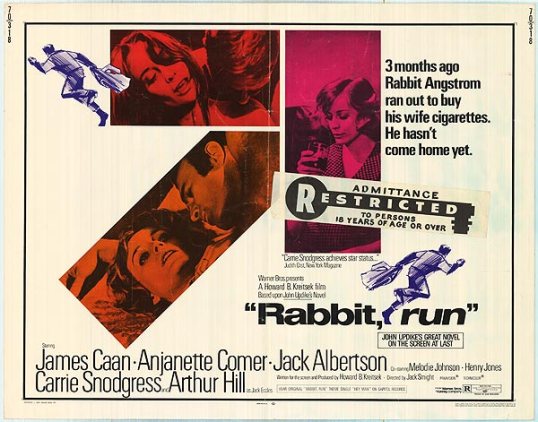
If, at one in the morning on Wednesday, you were suffering from insomnia, you could have turned over to TCM and watched the 1970 film, Rabbit Run. That’s what I did.
Rabbit Run is the epitome of a dumb lug film. In a dumb lug film, a male character finds himself living an unfulfilling life but he can’t figure out the reason. Why can’t he figure it out? Because he’s a dumb lug, with the emphasis on dumb. Usually, the viewer is supposed to sympathize with the dumb lug because he doesn’t mean to hurt anyone and everyone else in his world is somehow even more annoying than he is. Typically, the dumb lug will have an emotionally distant wife who refuses to have sex with him and who is usually portrayed as being somehow at fault for everything bad that has happened in the dumb lug’s face. (Want to see a more recent dumb lug film than Rabbit Run?American Beauty.) Ever since the silent era, there have been dumb lug films. In particular, male filmmakers and critics seem to love dumb lug films because they allow them to pat themselves on the back for admitting to being dumb while, at the same time, assuring them that everything is the fault of the wife or the girlfriend or the mother or the mother-in-law.
In Rabbit Run, the dumb lug is named Harry Angstrom (James Caan), though most people still remember him as Rabbit, the high school basketball star. Harry’s life peaked in high school. Now, he’s 28 and he can’t hold down a job. He’s married to Janice (Carrie Snodgress), who spends all of her time drinking and watching TV. He has a son and another baby is on the way. One day, when the pregnant Janice asks him to go out and get her a pack of cigarettes, Harry responds by getting in his car and driving all the way from Pennsylvania to Virginia.
When he returns to Pennsylvania, Rabbit doesn’t go back to his wife. Instead, he drops in on his former basketball coach (Jack Albertson) and begs for advice on what he should do. The coach, it turns out, is more than little creepy. He also has absolutely no practical advise to give. He does introduce Rabbit to a part-time prostitute named Ruth (Anjanette Comer). Rabbit quickly decides that he’s in love with Ruth and soon, he’s moved in with her.
Meanwhile, there’s all sorts of little things going on. Rabbit gets a job working as a gardener. Rabbit befriends the local Episcopal minister (Arthur Hill), even while the minister’s cynical wife (Melodie Johnson) tries to tempt Rabbit away from both his wife and his mistress. Rabbit both resents and envies the sexual freedom of the counter culture, as represented by his younger sister. And, of course, Janice is pregnant…
Rabbit Run is based on a highly acclaimed novel by John Updike. I haven’t read the novel so I can’t compare it to the film, beyond pointing out that many great works of literature have been turned into mediocre movies, largely because the director never found a way to visually translate whatever it was that made the book so memorable in the first place. Rabbit Run was directed by Jack Smight, who takes a rather frantic approach to the material. Since Rabbit Run is primarily a character study, it needed a director who would be willing to get out of the way and let the actors dominate the film. Instead, Smight overdirects, as if he was desperately trying to prove that he could keep up with all the other trendy filmmakers. The whole movie is full of extreme close-ups, abrupt jump cuts, intrusive music, and delusions of ennui. You find yourself wishing that someone had been willing to grab Smight and shout, “Calm down!”
(On the plus side, as far as the films of 1970 are concerned, Smight’s direction of Rabbit Run still isn’t as bad as Richard Rush’s direction of Gettting Straight.)
James Caan actually gives a likable performance as Rabbit, which is good because Rabbit would be totally unbearable if not played by an actor with at least a little genuine charisma. There’s nothing subtle about Caan’s performance but he makes it work. You never like Rabbit but, at the same time, you don’t hate him.
Unfortunately, there’s nothing subtle about the rest of the cast either. Something rather tragic happens about 80 minutes into the film and, as much as I knew I shouldn’t, I still found myself giggling because Carrie Snodgress’s performance was so bad that it was impossible for me to take any of it seriously. Even worse is Arthur Hill, as the minister who won’t stop trying to help Rabbit out. I eventually reached the point where, every time that sanctimonious character started to open his mouth, I found myself hoping someone would hit him over the head and knock him out. Among the major supporting players, only Anjanette Comer is allowed a chance to be something more than just a sterotype. Like Caan, she does the best that she can but ultimately. this is James Caan’s movie.
It’s a disappointing movie but it did not put me to sleep. Give credit for that to James Caan, who is the only reason to see Rabbit Run.
Earlier tonight, on TCM, I watched the 1968 science fiction film, Countdown.
Who will be the first man to walk on the moon? Will it be Chiz (Robert Duvall), who is a colonel in the Air Force and who has been training for years and who really should get the chance just because he has a really cool name like Chiz? Or will it be Chiz’s best friend, Lee (James Caan)? Lee may not have Chiz’s experience but he’s a scientist and selecting him would allow NASA to portray the mission of being one of peace as opposed to one of war. Add to that, Lee has a full head of hair and he looks like a young James Caan, who was an undeniably handsome man back in his younger days! I mean, seriously — who would you rather have as the face of the space program: Tom Hagen or Sonny Corleone?
Of course, it might not really matter who NASA picks because the Russians are determined to get to the moon as well. And you know what that means! If the Russians land on the moon first, they’ll turn it into a Socialist utopia and that’ll mean ugly architecture, bread lines, and a three-month wait for toilet paper. The stakes have never been higher!
Countdown was made and released at the height of the space race, at a time when Americans really did feel that they were competing with the Russians to be the first to reach the moon. (Of course later, it would be learned that the Russian space program actually managed to kill far more cosmonauts than it successfully sent into orbit.) It came out a year before Apollo 11 landed on the moon and Neil Armstrong became the first Earthling since Stanley Kubrick to ever step on the lunar surface. As such, it’s interesting to see how Countdown imagines the experience of exploring the moon. I won’t spoil who reaches the moon first but I will say that he moves remarkably quickly and with great ease for someone in a gravity-free environment.
Countdown is a good example of what I like to call a “time capsule” film. Seen today, it’s kinda slow and a bit predictable. For all the time that is spent on getting the astronauts ready to go into space, very little time is actually spent in orbit. This is a very Earth-bound film. And yet, if you’re a history nerd like me, it’s hard not to be a little bit fascinated by a movie like this. In everything, from its fashions to its dialogue to its cultural outlook, this is very much a document of its time. It may be a while until we have the technology necessary to travel through time. Until then, watching a film like this might be as close as I’ll ever get to experiencing what the straight, non-Hippie crowd was doing in 1968.
If you’re a student of film history, Countdown is significant for being one of the first films to be directed by Robert Altman. To be honest, if not for his name in the opening credits, you would probably never guess that Countdown was directed by one of America’s most influential and iconic directors. Altman specialized in making film that were almost defiantly iconaclastic and there’s very little of that to be found in Countdown. Admittedly, there are a few scenes that make use of overlapping dialogue and there’s a party scene that’s definitely Altmanesque. However, the only reason I really noticed that party scene is because I was specifically looking for evidence of Altman’s style. For the most part, the most identifiably Altmanesque element of Countdown is the casting of Michael Murphy in a small role.
The film is dominated by Robert Duvall and James Caan and, especially if you’re a fan of The Godfather, it’s undeniably fun to see these two acting opposite each other in something other than an epic gangster film. (Duvall and Caan also acted together in The Rain People and The Killer Elite and were reportedly great friends off-camera as well.) Duvall is especially good in Countdown, playing Chiz as a man torn between an innate sense of loyalty and his own competitive nature. The scenes between Duvall and Caan have a charge to them that occasionally bring some much-needed life to this film.
In the end, Countdown is a fairly forgettable film but it’s worth seeing as a piece of history.
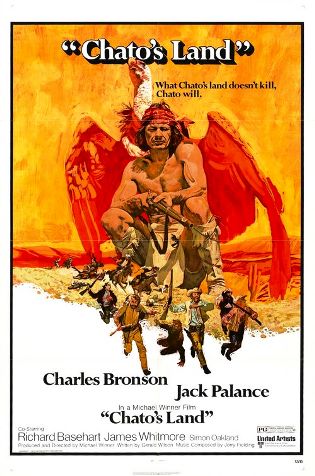
That’s the main lesson that can be taken away from Chato’s Land. In this western, Bronson plays Chato, an Apache who enters the wrong saloon and is forced to shoot a racist sheriff in self-defense. Former Confederate Captain Quincey Whitemore (Jack Palance) forms a posse to track Chato down but soon discovers that his posse is not made up of the best and brightest. Instead, most of them are sadistic racists who just want to kill Apaches. Despite Whitemore’s efforts to stop them, the posse rapes Chato’s wife and kills his best friend. Chato trades his white man’s clothes for a loin cloth and sets out for revenge.
Chato’s Land is historically significant because it was the first of many films that Charles Bronson made with Michael Winner. The most famous Bronson/Winner collaboration was Death Wish, which also featured Charles Bronson as a man who seeks revenge after his wife is raped. What is surprising about Chato’s Land is how little screen time Bronson actually has. Most the film is spent with the posse, which is full of familiar faces (Richard Jordan, Simon Oakland, Victor French, Ralph Waite, and James Whitmore all report for duty). It actually works to the film’s advantage, making Bronson even more intimidating than usual. There’s never any doubt that Chato is going to kill every member of the posse but since almost every member of the posse is loathsome, that’s not a problem.
It’s possible that Chato’s Land was meant to be an allegory for the Vietnam War, which is probably giving Michael Winner too much credit. (In an interview, the author of Death Wish, Brian Garfield, once shared an anecdote about Winner inserting a shot of three nuns into Death Wish and bragging about how the shot was meaningless but that it would fool the critics into thinking he was making a grand statement about something.) Like most of Winner’s films, Chato’s Land is good but not great. There are parts of the movie that drag and Jack Palance and Charles Bronson don’t get to share any big scenes together, which seems like a missed opportunity. Bronson, who was always underrated as an actor, gives one of his better performances as Chato. Chato does not say much but Bronson could do more with one glare than most actors could do with a monologue. In Europe, Bronson was known as Il Brutto and Chato’s Land features him at his most brutal.

 There’s not a single sports cliché that goes untouched in The Program.



 Don’t mess with Charles Bronson.
 Through the Shattered Lens