Film Review: The Prophecy (dir. by Gregory Widen)


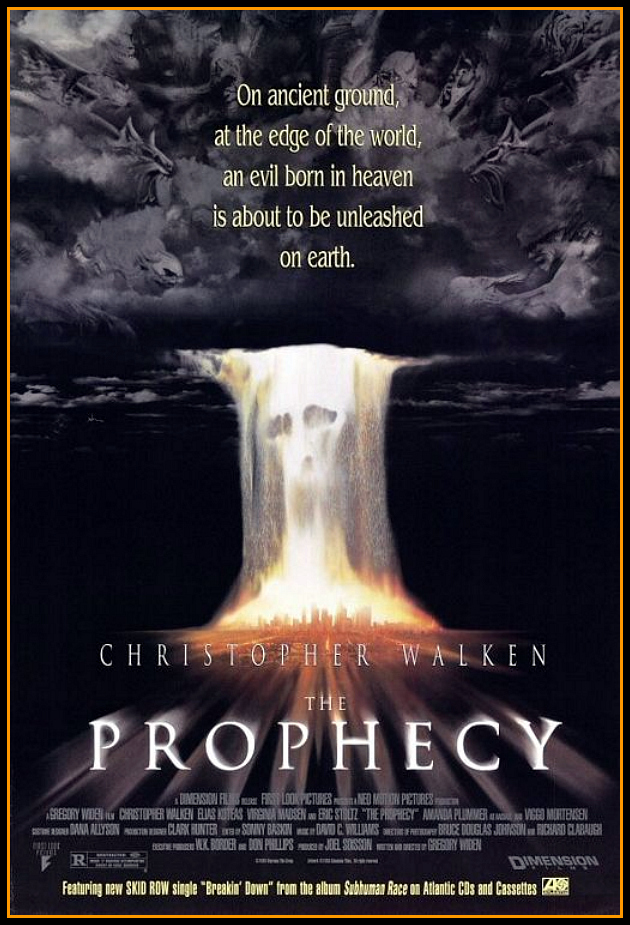
I first found out about this little cult film starring the very awesome Christopher Walken around 1993 or so when I was at the local Waldenbooks (yes there used to be bookstores not named Barnes & Noble or Borders back in the day) looking at the latest issue of Fangoria. Inside the magazine they were doing a brief feature on an upcoming horror film tentatively called God’s Army. All I saw was that it was to star Christopher Walken and it had gore and angels in it. That alone peaked my interest and I was looking forward to seeing it in the theaters. Almost two years passed and nothing about it was ever heard again until I visited the video rental place near my house and saw a VHS tape (yeah, those big videocassette thingies) with the title of The Prophecy and starring Christopher Walken.

This was the film I was so hyped to seeing in the theaters. The title had changed from it’s earlier (and much cooler) one of God’s Army. It would seem that it’s film distributor had little to no faith in the box-office potential of the film and just delayed it’s release to the point that when it did come out no one knew about it barely anyone saw it. It was a real damn shame since filmmaker Gregory Widen made such a good film that was able to mash-up horror, angels and a detective story all in one without creating a mess of things.

The Prophecy was about the war in heaven we were never taught about in Sunday school. We all know about the war in heaven where Lucifer and the rebel angels who followed him tried to overthrow God. That didn’t go over so well for Lucifer and he and his band of fallen angels were cast out into Hell by God and his right-hand man the Archangel Michael. This film talks about the second war in heaven soon thereafter which no one outside those who wrote little-known apocryphal texts about it (and being apocryphal they never were included in the Bible). This war now had a new group of angels led by the Archangel Gabriel rebelling against God for choosing humans (talking monkeys as these new rebels called them) above all living creatures including the angels themselves for God’s love. This war was now in a state of stalemate after countless millenia, but a prophecy about a soul so dark and evil was to be the tipping point for either side. This particular soul was to be found on Earth and whoever acquires it would break the stalemate and finally bring this second war to an end.

With this in mind we have Walken as the Archangel Gabriel coming down to Earth to look for this soul so he can finally win the war for his side (which also means the end of mankind). It’s the angel Simon (played by Eric Stoltz) who comes down to stop him from getting this soul or, at the very least, hide it from Gabriel. With these two factions of angels vying to acquire this soul we have a Detective Thomas Daggett smack in the middle of the case investigating all the weird happenings and deaths surrounding the battle between these two factions. The dead bodies of angels begin to appear on morgue slabs looking like eyeless, hermaphroditic specimens and angelic script found in crime scenes brings Daggett back to his time studying to be a priest before images of angels warring amongst themselves breaks him down and he quits the seminary to become a cop instead.

It would come down to these three factions racing against time to acquire this dark soul.

The film is not as gory as it’s feature in Fangoria made it out to be, but it is quite violent and bloody that I understand why it got the horror label attached to it. It’s more a dark fantasy thriller more than horror. It’s rare in today’s film that we see angels portrayed as the bloodthirsty beings that the really are. The film even points out this oft-ignored detail of God’s messengers. Angels are always the ones God sends to punish or send a very serious message to his chosen beings that is Man. The Prophecy shows this aspect of angels in full light and how their attitudes about humanity might lead some of them to hate God for raising Man above even them.

Christopher Walker does a great job conveying Gabriel’s hate and contempt for humans. His Gabriel is like one of those pundits always on tv (both liberal and consevative) who are so into their sides’ message that they never see the other side as anything but the enemy. One could almost say that Walken’s Gabriel is like then apocalypse-hungry version of Glenn Beck and Keith Olbermann in one body. This is not to say that Walken goes over-the-top with his performance. In fact, he’s quite subdued in how he uses those many tics and voice mannerisms a whole cottage industry has grown around in.

Walken’s portrayal of Gabriel infuses what could’ve become a one-note villain with lots of layers and complexities that the rest of the cast were able to play off from. His character would be terrifying one moment then smoothly switch over to being funny and charming then back to terror. It’s due to his great performance that the other cast members like Stoltz as the weary, loyal angel Simon and Koteas as the fallen religious cop Daggett were able to bring their own performance to another level. This is quite a feat since the dialogue in the film was a mixed bag of horror cliches and interesting Biblical-speak about secret wars, apocryphal books and prophecies. The film even has a nice appearance of the first fallen angel himself and none other than Viggo Mortensen plays Lucifer.

The Prophecy does have a feeling that it was always one misstep away from becoming an awful film. This had happened with 2010’s Legion and did that film about angels and the apocalypse turn out to be a huge steaming pile of shit-turd. But while Dimension Film saw the film fall over on the side of bad for myself and those who have come to admire and love this cult classic the film stayed balance between good and bad. Widen’s film never went over to the side of becoming a truly great film, but it also never fell on the side that Legion ended up on. What Prophecy ended up becoming was a film that was almost grindhouse in nature, but even then it still looked too good with too many good performances to be given that label. The fact that it contains one of Christopher Walken’s best performances speaks well of a film that many critics during it’s early days had dismissed as just another bad horror film.

In the end, this film became just one of the many little-gems that got lost in film studio money politics. I definitely would recommend this cult film to people who haven’t seen it, but I would tell them to stop at just this film and not even go near the four sequels which came after it.

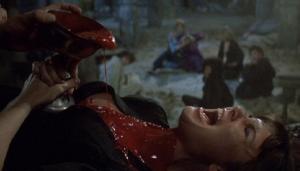
From Vanishing Point To Shivers, Here’s 6 More Trailers


As the snow outside slowly melts and I try to decide what to wear when I go see The Rite tonight, why don’t you enjoy six more of Lisa Marie’s Favorite Grindhouse and Exploitation Trailers?

1) Vanishing Point (1971)

I had to include this trailer at some point since Vanishing Point is one of the key influences on Quentin Tarantino’s Death Proof section of Grindhouse.  Is Vanishing Point the ultimate trip?  Maybe but I think there’s one other film that came out the same year that might disagree…

2) The Jesus Trip (1971)

And here it is!  I haven’t seen this actual film but the trailer would seem to indicate that this is some sort of religious biker film.  But then you have that final scene in the trailer and you’re kinda like, “Uhmmm….sacreligious much?”  Anyway, this is one of those trailers that I find myself watching over and over again.  I guess I was destined to grow obsessed with this trailer as it appeals to both my exploitation fanatic side and my fallen Catholic side.  Put them both together and I guess you’ve got The Jesus Trip.

Seriously, this is just a weird trailer.

3) Horror House On Highway 5 (1985)

I’ve come across this film on DVD a few times and I’ve always been seriously temped to buy it just on the basis of the title.  However, I may just end up settling for having seen the trailer because, to be honest, the trailer would seem to indicate that there’s a lot of really, really ugly people in this movie.  And ugly people kinda sorta make me nervous.

4) Revenge of the Cheerleaders (1976)

I guess this is like the grindhouse version of Bring It On.  Watching the trailer, I have to wonder why high schools in 70s movies always looked so dirty and unwashed.  I mean — BLEH!  Seriously, if my school had been that dirty, I would have ended up dropping out of school when I was 15.  I mean, gawd damn!  Get out the Scrubbing Bubbles and every sanitizer you can find and just — oh my God.  I think it’s the cafeteria that really makes me shudder.  Anyway, as for the rest of the trailer, I asked my sister Erin if it looked like a truthful depiction of high school cheerleading since she used to be one and she said no because most cheerleader don’t survive getting blown up as easily as the ones in this trailer.

5) Bad Girls Go To Hell (1965)

This is a film from the notoriously odd Doris Wishman.  Someday, somebody — maybe even me — is going to turn the life of Doris Wishman into a great novel and an even better film.

6) Shivers (1975)

And let’s close things out with a little Cronenberg.  From 1975, it’s Shivers.

Film Review: Dracula A.D. 1972 (dir. by Alan Gibson)


If you’re following the news then you probably heard that Dallas got hit with like a 100 inches of snow yesterday.  Seriously, more snow fell yesterday than has even fallen in recorded history (or, at the very least, in my recorded history).  You want to talk about Snowmageddon?  Well, we had a Snowpocalypse.

The neighborhood on Friday morning (picture taken by Erin Nicole Bowman)

So, I spent most of yesterday cooped up inside with my sister and our cat and once we got over the whole fun of being able to go outside and scream, “SNOW DAY!” at the top of our lungs, there really wasn’t much to do.  So, in an attempt to fight off cabin fever, I raided my DVD collection and we ended up watching one of the old Christopher Lee-as-Dracula-films from Hammer Studios.  Specifically, we ended up watching Dracula A.D. 1972.

The film opens in 1872 with a genuinely exciting fight on a runaway carriage that ends with the death of both Count Dracula (Christopher Lee) and his nemesis, Prof. Van Helsing (Peter Cushing).  However, as Van Helsing is buried, we see one of Dracula’s disciples (played by Christopher Neame, who had an appealingly off-kilter smile) burying Dracula’s ashes nearby.  The camera pans up to the clear Victorian sky and, in a sudden and genuinely effective jumpcut, we suddenly see an airplane screeching across the sky.

Well, it’s all pretty much downhill from there.  Suddenly, we discover that a hundred years have passed and we are now in “swinging” London.  The city is full of red tourist buses, hippies wearing love beads, and upright policemen who always appear to be on the verge of saying, “What’s all this, then?”  We are introduced to a group of hippies that are led by a creepy guy named Johnny Alculard (also played — quite well, actually — by Christopher Neame). One of those hippies (Stephanie Beacham) just happens to be the great-great-granddaughter of Prof. Van Helsing.  Apparently, she’s not really big on the family history because she doesn’t notice that Alculard spells Dracula backwards.  Then again, her father (played by Peter Cushing, of course) doesn’t either until he actually writes the name down a few times on a piece of a paper.

Anyway, the film meanders about a bit until finally, Alculard convinces all of his hippie friends to come take part in a black mass.  “Sure, why not?” everyone replies.  Well, I don’t have to tell you how things can sometimes get out-of-hand at black mass.  In this case, Dracula comes back to life, kills a young Caroline Munro, and eventually turns Johnny into a vampire before then setting his sights on the modern-day Van Helsings.

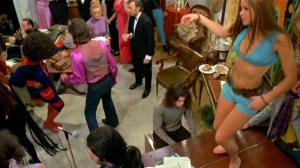
Dracula A.D. 1972 was Hammer’s attempt to breathe some new life into one of its oldest franchises and, as usually happens with a reboot, its critical and (especially) commercial failure ended up helping to end the series.  Among even the most devoted and forgiving of Hammer fans, Dracula A.D. 1972 has a terrible reputation.  Christopher Lee is on record as regarding it as his least favorite Dracula film.  And the film definitely has some serious flaws.  Once you get past the relatively exciting pre-credits sequence, the movie seriously drags.  There’s a hippie party sequence that, honest to God, seems to last for about 5 hours.  As for the hippies themselves, they are some of the least convincing middle-aged hippies in the history of fake hippies.  You find yourself eagerly awaiting their demise, especially the awkward-looking one who — for some reason — is always dressed like a monk.  (Those crazy hippies!)  But yet…nothing happens.  All the fake hippies simply vanish from the film.  Yet, they’re so annoying in just a limited amount of screen time that the viewer is left demanding blood.  Add to that, just how difficult is it to notice that Alculard is Dracula spelled backwards?  I mean, seriously…

To a large extent, the charm of the old school Hammer films comes from the fact that they’re essentially very naughty but never truly decadent.  At their heart, they were always very old-fashioned and actually quite conservative.  The Hammer films — erudite yet campy, risqué yet repressed — mirrors the view that many of my fellow Americans have of the English.  For some reason, however, that Hammer naughtiness only works when there’s the sound of hooves on cobblestone streets and when the screen is populated by actors in three-piece suits and actresses spilling out of corsets.  Dracula A.D. 1972 did away with the support of the corset and as a result, the film is revealed as a formless mess with all the flab revealed to the world.

Still, the film isn’t quite as bad as you may have heard.  First off, the film — with its middle-aged hippies — has a lot of camp appeal.  It’s the type of film that, once its over, you’re convinced that the term “groovy” was uttered in every other scene even though it wasn’t.  As with even the worst Hammer films, the film features a handful of striking images and Christopher Neame is surprisingly charismatic as Alculard. 

As with the majority of the Hammer Dracula films, the film is enjoyable if just to watch the chemistry between Christopher Lee and Peter Cushing.  Both of these actors — so very different in image but also so very stereotypically English — obviously loved acting opposite of each other and whenever you see them on-screen together, it’s difficult not to enjoy watching as each one tried to top the other with a smoldering glare or a melodramatic line reading.  As actors, they brought out the best in each other, even when they were doing it in a film like Dracula A.D. 1972.  In this film, Cushing is like the father you always you wished you had — the stern but loving one who protected you from all the world’s monsters (both real and cinematic). 

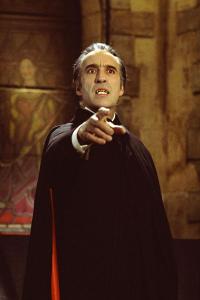
As for Lee, he’s only in six or seven scenes and he has even fewer lines but, since you spend the entire film wondering where he is, he actually dominates the entire movie.  Lee apparently was quite contemptuous of the later Hammer Dracula films and, oddly enough, that obvious contempt is probably why, of all the Draculas there have been over the years, Lee’s version is the only one who was and is actually scary.  F0rget all of that tortured soul and reluctant bloodsucker crap.  Christopher Lee’s Dracula is obviously pissed off from the minute he first appears on-screen, the embodiment of pure destructive evil.  And, for whatever odd reason, the purity of his evil brings a sexual jolt to his interpretation of Dracula that those little Twilight vampires can only dream about.  Even in a lesser films like Dracula A.D. 1972, Christopher Lee kicks some serious ass.

So, in conclusion, I really can’t call Dracula A.D. 1972 a good film nor can I really suggest that you should track down a copy of the DVD.  I mean, I love this stuff and I still frequently found my mind wandering whenever Cushing or Lee wasn’t on-screen.  However, it’s not a terrible movie to watch if you happen to find yourself trapped in the house by a mountain of snow.

Captain America: The First Avenger (Official Poster)


After a couple weeks of Marvel Studios and Paramount releasing official pics from the set of Captain America: The First Avenger we finally get to the first official film poster for the film. The poster itself is all about Chris Evans as Steve Rogers in the Captain America suit with the shield. The helmet is nowhere in sight, but previous released pics have already shown it and this image picked for the poster really shows off the suit.

The poster’s image is grittier in nature than I was expecting, but if one believes the rumors about which Captain America writers have influenced the script then the gritty look fits. It definitely brings to mind much of how Ed Brubaker of Marvel wrote the character just a couple years ago right before his death after the Civil War crossover in Marvel Comics.

So far, all the things Marvel has released about this film has done nothing but assuage whatever doubts fans may have about the film. Here’s to hoping that these pics and releases of information about the film will lead to a successful film.

NBC Still Doesn’t Understand The Internet


A few days ago, an old clip from the Today Show showed up on YouTube.  That clip was from 1994 and it featured Katie Couric and Bryant Gumbel trying to figure out what the Internet is.  Apparently, the clip was posted by an employee of NBC.  If you’ve seen the clip, you already know that while it’s mildly amusing, it’s also pretty tame. 

Well, NBC didn’t see it that way because they’ve responded by 1) firing the guy who posted it and 2) pulling the clip off of YouTube so quickly that you’d think the NBC offices are located in either Egypt or Iran.

Well — joke’s on you, NBC.  As my friend Ron always reminds me whenever I post a picture on plixi during Thong Thursday, the Internet is forever and now, so is that clip.

So, here’s one of the many copies of that clip that can be found on YouTube.  See it now before NBC demands that it be pulled down.

(Incidentally, my mom always hated Bryant Gumbel and I can still remember, when I was 13 or maybe 14, laughing so hard when my mom turned on the TV and was greeted by his image.  “Pendejo,” she said as she changed the channel.) 

Quickie Review: Running Scared (dir. by Wayne Kramer)


Director Wayne Kramer’s follow-up to his directorial debut (The Cooler) shows that he has a flair for drama and suspense that borders the line between reality and surrealism. Running Scared has such a gritty, washed out look right from the get-go that one starts to think it’s a film lifted right out of the 70’s. But that is only part of what Kramer does in creating a look and feel for Running Scared. Kramer actually uses every kind of trick in a director’s book to give his film such an over-the-top sense that the audience really doesn’t know what to expect just around the next dark corner.

Running Scared‘s first ten minutes sets up what the rest of the next two hours are going to be like. Kramer direct’s this ten minutes like a man possessed. The direction and editing is frantic and frenetic. Some have said that it’s all been done before by Tarantino, Woo and a dozen other action-stylists out of Hong Kong, but I disagree. Kramer’s style owes alot more to the grandfather of excessive film violence and that’s Sam Peckinpah. I’m not comparing Running Scared to Peckinpah’s seminal classic The Wild Bunch, but the pace and look of the chaotic shoot-out in the tiny apartment to start the film brings to mind the opening and closing shoot-outs of Peckinpah’s film.

Kramer knows he’s not making a social statement or even an intellectually relevant film. What he does know is that he wants to tell a fairy tale of one man’s hectic day and all the craziness he has to go through during that day. And this is what Running Scared really has turned out to be. A fairy tale set in an modern, dank, urban landscape where our hero (though anti-hero is more like it) and the two kids in his life must travel a surreal place filled with mack-daddy pimps, hooker with a heart of gold, corrupt cops and even a pair of child pedophiles who also turn out to be husband and wife. Running Scared is a like Grimms fairy tale as seen and told in a modern setting.

The cast of actors Kramer has assembled all do a good job in populating this violent, profane modern fairy tale. I’d be the last to think that Paul Walker was an actor who had any talent, but his performance in this film has given me pause to think that maybe its not him, but the projects he’s been doing that’s given him a bad reputation as an actor (which continues to this day as he continues to put himself in bad projects). Gone is the California surfer dude persona he seems to saddle himself with in most of his roles. He actually inhabits the low-level mobster soldier he plays as Joey Gazelle. This film may not be his breakout performance but it will open up some eyes. The boy’s got some skill he’s never been able to show before. The other actor who makes a standout performance is one Cameron Bright who plays Oleg. The neighbor kid whose theft of a mob gun Joey is suppose to make disappear turns Joey’s life upside down. Cameron’s almost like Pinocchio in that its through him that we see all the crazy characters he runs across. It’s a testament to Kramer’s direction that he’s able to get such good performances from Walker, Bright and the rest of the cast in a film that’s as confusing, complicated and surreal as this film turned out to be.

Running Scared was a wonderful surprise of a film for 2006. It’s an unabashed fun, thrilling urban fairy tale that goes for broke in everything it does. Wayne Kramer’s direction shows that his very good work in filming The Cooler wasn’t a fluke and one-time deal. He’s no Tarantino and surely not in the same league as Sam Peckinpah whose films this one owes alot to in style and feel, but he’s slowly making a name for himself as one who can do good work. Oh, Paul Walker does a good job in it as well.

DLC! Black Ops: First Strike


(This DLC is an add-on to  Call of Duty: Black Ops by Treyarch.)

Standard Open

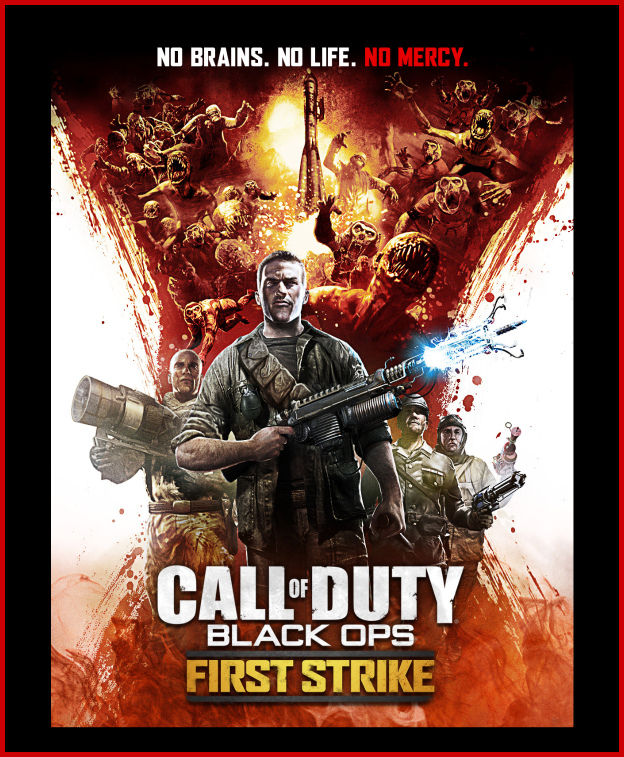
Hey, it’s that time of year! No, it’s not time for a new Call of Duty game… but it is time for the first multi-player map pack that Treyarch has released for the latest iteration of the Call of Duty franchise –  Black Ops. The “First Strike” pack contains 5 all-new maps, four for the standard multi-player modes of Black Ops, and one for the “Zombies” mode. Since there’s no other content for this review, I’ll go ahead and give you the multi-player play-by-play (if for some reason you need a review of a zombie mode map, I don’t know what to tell you)

Ascension

Hey, it’s a zombie map! As you would expect, it has a lot of doors… I guess that doesn’t tell you much. This map has you climbing a missile silo. Like all zombie maps, it centers around team-work and cooperation. Don’t play it with your enemies.

Berlin Wall

This map is a (relatively) small battleground that is divided into two distinctive halves by the existence of a kind of ‘neutral zone’ across the middle. This zone, marked very clearly on your radar in red, is the home to multiple guard towers who will shower you with a pleasant hail of sentry gun bullets if you so much as set foot inside of it. The rest of the combat is, to a lesser or greater extent, defined by this dead zone at its centre. Although it initially seems like more long-ranged combat would be the result, you may find that most combatants are seeking ways around the dead zone in order to engage their foes, and that the map actually has a much more intimate feel than you might expect given its small size.

Discovery

This map is the arctic site of some Nazi laboratory. It’s very small, and divided into two distinctive halves. The division is not nearly as clear as maps like Nuketown, but the presence of a bottomless chasm that divides the centrepoint of the map still leads to a limited number of routes from one side to another. It definitely feels like a map where a spawn lock could be effective. That having been said, a central bridge which connects the two halves of the map makes for a potentially brutally-contested “B” point for Domination and other balanced side game-types. Despite its small size and the relative open-ness of most of the map, Discovery is very much a 2-3 level map, and enemies will often be above or below you, so pay close attention!

Kowloon

This map is based on the Hong Kong escape level from the single player campaign, using many of the same terrain elements to create a multi-leveled brawl. This map is very small. In terms of physical size, it probably would rival most of the mid-sized maps, but because of the way the multiple levels and terrain intervene, it plays as small as any level in the game. You’ll often find that combat over the central portion of the map is the key to victory, and is defined by numerous level-changing bridges which provide access not only from rooftop to rooftop but also between the combat levels. Enemies can, and will, come from all sides on Kowloon, and it’s important that a prudent player stay careful throughout.

Stadium

Another small map, actually, despite having several different distinct combat areas. Depending on your chosen game-type you’ll find yourself mostly embroiled in combat in one of the map’s main “zones’… which is to say, the hockey arena itself,. the area outside of the building, or between the rink and its surrounding structures. Spawn points, available cover, and the general feel, of this map change significantly from iteration to iteration. Like most of the best multi-purpose maps, the first time that you play Satdium you should find yourself wondering what it plays like in Death-Match, or Domination, or Demolition, or whatever you’re not playing. Out of the four maps, I personally think that Stadium is the most universally fun design, albeit with some potential for tiresome slug-fests over the same couple of areas of the map.

The Details

For X-Box Liver users, this game is going to run 1200 Microsoft Points (or roughly $15). For hard core Black Ops players the DLC is very much worth it, as it significantly expands the basic roster of maps that the game shipped with. Much like Modern Warfare 2 this DLC will not allow you to match-make on the new maps if you don’t own them, without forcing you to select an alternate play-list (Halo style). On the other hand, this method filters down the available pool of players based on the ownership of the DLC, so it probably evens out.


The Bottom Line

Is this DLC worth it? If you’re a serious Call of Duty multi-player mode player, then yes, it probably is. You’ll appreciate the additions to the game’s maps… and the new maps seem to have been founded with an understanding of what Black Ops really is; a game that features much more intimate combat than its immediate predecessor. You probably won’t feel any urgency to use your sniper rifle on most of these DLC maps (not to say that you can’t snipe, but merely that these have a feel more like Firing Range or Nuketown, and less like Array), but your SMG will probably get a workout.

The Dark Lord of the Sith is also a Televangelist


After seeing this video highlighted on G4TV’s Attack of the Show a couple days ago I just had to go to Youtube and favorite the video.

What else is there to say other than I knew televangelists were actually Dark Lords of the Sith in sheep’s clothing. My favorite part is close to the end where the hapless congregation just filed into his lightsaber strikes one after the other like they wanted to die.

Source: YouTube

What Lisa Watched Last Night: Love Sick: Secrets of a Sex Addict (dir. by Grant Harvey)


On Tuesday night, as the temperature outside plunged down to 13 degrees and the ice continued to build up on the street outside, I watched Love Sick: Secrets of a Sex Addict on the Lifetime Movie Network.

Why Was I Watching It?

Uhmmm…hello?  Check out the title.

What Was It About?

This is one of those movies that starts with “Based on a True Story” and then continues on with “Some names and details have been changed.”  So, in other words, this is all true except for the parts that are false.  (Actually, this film is based on a memoir by Sue Silverman.)

Sally Pressman stars as Sue Silverman.  Sue is a writer.  While she battles writer’s block, her husband spends his time going to work and then coming home and whining about it.  Apparently, every day, he comes home, refuses to have sex, and says something like, “You could get a job…”  Or, hey, buddy — here’s what you could do: adjust your bra and stop crying like a little bitch.  Seriously.

(Frequently asked question: When is the right time to call a man bitch?  Any time he starts acting like one.)

Anyway, Sue responds to this by going out and sleeping with every man in Canada with the exception of her husband and who can blame her when you consider that her husband is a little bitch. 

Soon, Sue is undressing whenever she find herself alone with a man — any man.  Her obsession with sex soon brings an end to her marriage and eventually Sue is forced to go through one of those pain-in-the-ass interventions where everyone sits around and goes, “You’re addiction has harmed me in the following ways: 1) you borrowed money to spend on lingerie and you have yet to pay me back, 2) you missed my birthday party, 3) you fucked my husband…”

So, poor Sue ends up at the rehab place where the whole thing is like tough love and all “You will obey these rules or we’ll kick you out.  So there!”  Among the many rules: “No masturbation, no lingerie, no smoking, no avoiding eating, no throwing up…”  Uhm, fascist much?

(And also, what type of man leaves his wife because she wants to have sex?  Seriously, what a toadsucker.)

What Worked?

Oh, it all worked.  This was pure Lifetime Movie goodness in that it took a whole lot of serious issues and then presented them in such a way that made it impossible to take any of it seriously.  Ominous music, over-the-top dramatic line readings, and finally, a therapist who says exactly the right thing and magically makes all of the problems disappear.

Plus, I love that title.

What Didn’t Work?

Technically, the acting was pretty bad (with the exception of Sally Pressman) and the film dragged once Sue got into therapy.  But who cares?  Just check out that title.

“Oh my God!  Just like me!” Moments

Towards the end of the film, Sue says that knowing she was desired was occasionally the only thing that she could cling to, the only thing that allowed her to maintain her fragile sense of identity.  I’ve been there.  Who hasn’t?

I also share Sue’s obsession with black underwear.  Seriously, you can’t look bad in black lingerie.

Lessons Learned 

Some men, apparently, actually do say “Not tonight, I’m tired” when it comes to sex.  I’m still having a hard time buying that one.

Rehab is not fun.


A Quickie With Lisa Marie: Seven Souls (performed by Material and William S. Burroughs)


It was either 3 or 4 years ago that I first heard this song playing over the end credits of an episode of The Sopranos.  Other than recognizing the iconic and deadpan twang of the late William S. Burroughs, I had absolutely no idea who performed this song or even what the song’s title was.

However, this previous Christmas, I received a copy of The Sopranos: A Family History from my sister Erin and as I was reading through it last night, I came across a reference to the very song.  I discovered that the name of the song was “Seven Souls” and that it was performed by an “experimental” group called Material. 

I then proceeded to do even more extensive, deep-digging research and … well, okay, to be honest, I’m lazy so I just looked it up on Wikipedia.  And according to Wikipedia, Seven Souls was released in 1990 and it features William S. Burroughs reading passages from his book The Western Lands.

Anyway, here it is…”Seven Souls” by Material and William S. Burroughs…