Retro Television Reviews: In Search of America (by Paul Bogart)


Welcome to Retro Television Reviews, a feature where we review some of our favorite and least favorite shows of the past!  On Sundays, I will be reviewing the made-for-television movies that used to be a primetime mainstay.  Today’s film is 1971’s In Search of America!  It  can be viewed on YouTube!

College student Mike Olson (young Jeff Bridges) returns home and informs his mother (Vera Miles) and his father (Carl Betz) and his annoyingly quirky grandmother (Ruth McDevitt) that he’s dropped out of college.  He apologizes for wasting all the money that they spent on tuition but hey, maybe he can make it up to them by taking them on a journey as he drives across America in an old bus.

Uhmmm….

Now, let me just repeat this so that there is no confusion.  This absolutely schmuck took his parents’ money, wasted it, dropped out of college, and now he expects everyone to travel with him across America because he’s decided that he’s a part of the counterculture.

And, instead of telling him to go to Hell and get a job, his family agrees.

Oh sure, Mom is a little bit hesitant about Mike’s idea.  But Dad is really enthusiastic.  He understands the kids and he wants a chance to relive his own youth, before he got tied down with things like paying bills and being a responsible human being.  And, of course, if the Hippies were famous for anything, it was their love of upper class, middle-aged people.  Just ask the LaBiancas.

And, of course, grandma is totally excited about it because she’s an old person in a made-for-TV movie.

So, they all board the bus and Mike takes them to a music festival so that they can meet some of his friends.  For instance, there’s Nick (Sal Mineo), a drop-out who says that he’s more burned out than turned on.  There’s Annie (Tyne Daly), who is going to need someone to help deliver her baby.  There’s Bodhi (Glynn Turman), who is some sort of doctor.  He and grandma bond of their shared quirkiness.  And then there’s Kathy (Renne Jarrett), who is at the music festival despite the fact that she’s really sick and on the verge of dying. When Kathy’s parents (Howard Duff and Kim Hunter) show up looking for her, Mike has to decide whether to save her life or respect her wish to do her own thing.

This was obviously meant to be a pilot for a show where the family would travel around the country and I guess get involved in different adventures each week.  The main problem is that, while Jeff Bridges seems to be a bit of a hippie in real life, he’s not particularly convincing in this film.  He’s way too clean-cut and his family’s decision to follow him across the country never makes the least bit of sense.  As for the hippies themselves, they come across as being so shallow that I found myself wanting to donate money to the Nixon campaign.

Retro Television Reviews: International Airport (dir by Don Chaffey and Charles S. Dubin)


Welcome to Retro Television Reviews, a feature where we review some of our favorite and least favorite shows of the past!  On Sundays, I will be reviewing the made-for-television movies that used to be a primetime mainstay.  Today’s film is 1985’s International Airport!  It  can be viewed on YouTube!

It’s not easy working at an international airport!

At least, that’s the message of this made-for-television film.  Produced by Aaron Spelling and obviously designed to be a pilot for a weekly television series, International Airport details one day in the life of airport manager David Montgomery (Gil Gerard).  Everyone respects and admires David, from the recently graduated flight attendants who can’t wait for their first day on the job to the hard-working members of the airport security team.  The only person who really has a problem with David is Harvey Jameson (Bill Bixby), the old school flight controller who throws a fit when he learns that a woman, Dana Fredricks (Connie Sellecca), has been assigned to work in the tower.  Harvey claims that women can’t handle the pressure of working the tower and not having a personal life.  He demands to know what Dana’s going to do during that “one week of the month when you’re not feeling well!”  Harvey’s a jerk but, fortunately, he has a nervous breakdown early on in the film and Dana gets to take over the tower.

Meanwhile, David is trying to figure out why an old friend of his, Carl Roberts (played by Retro Television mainstay Robert Reed, with his bad perm and his retired porn star mustache), is at the airport without his wife (Susan Blakely).  David takes it upon himself to save Carl’s troubled marriage because it’s all in a day’s work for the world’s greatest airport manager!

While Carl is dealing with his mid-life crisis, someone else is sending threatening letters to the airport.  One of the letters declares that there’s a bomb on a flight that’s heading for Honolulu.  David and Dana must decide whether to allow Captain Powell (Robert Vaughn) to fly to Hawaii or to order him to return to California.  And Captain Powell must figure out which one of his passengers is the bomber.  Is it Martin Harris (George Grizzard), the sweaty alcoholic who want shut up about losing all of his friends in the war?  Or is it the woman sitting next to Martin Harris, the cool and aloof Elaine Corey (Vera Miles)?

Of course, there are other passengers on the plane.  Rudy (George Kennedy) is a veteran airline mechanic.  Rudy is hoping that he can talk his wife (Susan Oliver) into adopting Pepe (Danny Ponce), an orphan who secretly lives at the airport.  Unfortunately, when Pepe hears that Rudy’s plane might have a bomb on it, he spends so much time praying that he doesn’t realize he’s been spotted by airport security.  Pepe manages to outrun the security forces but he ends up hiding out in a meat freezer and, when the door is slammed shut, it appears that Pepe may no longer be available for adoption.  Will someone hear Pepe praying in time to let him out?  Or, like Frankie Carbone, will he end up frozen stiff?

International Airport was an attempt to reboot the Airport films for television, with the opening credits even mentioning that the film was inspired by the Arthur Hailey novel that started it all.  As well, Gil Gerard, Susan Blakely, and George Kennedy were all veterans of the original Airport franchise.  George Kennedy may be called Rudy in International Airport but it’s easy to see that he’s still supposed to be dependable old Joe Patroni.  Unfortunately, despite the familiar faces in the cast, International Airport itself is a bit bland.  It’s a disaster film on a budget.  While the viewers gets all of the expected melodrama, they don’t get anything as entertaining or amusing as Karen Black flying the plane in Airport 1975 or the scene in Concorde: Airport ’79 where George Kennedy leaned out the cockpit window (while in flight) and fired a gun at an enemy aircraft.  Probably the only thing that was really amusing (either intentionally or unintentionally) about International Airport was the character of Pepe and that was just because young Danny Ponce gave perhaps the worst performance in the history of television.

International Airport did not lead to a television series.  Watching it today, it’s a bit on the dull side but, at the same time, it is kind of nice to see what an airport was like in the days before the TSA.  If nothing else, it’s a time capsule that serves as a record of the days when the world was a bit more innocent.

10 Oscar Snubs From The 1960s


Ah, the 60s. Both the studio system and the production code collapsed as Hollywood struggled to remain relevant during a time of great social upheaval. The Academy alternated between nominating films that took chances and nominating films that cost a lot of money. It led to some odd best picture lineups and some notable snubs!

1960: Psycho Is Not Nominated For Best Picture and Anthony Perkins Is Not Nominated For Best Actor

To be honest, considering that the Academy has never really embraced horror as a genre and spent most of the 60s nominating big budget prestige pictures, it’s a bit surprising that Psycho was actually nominated for four Oscars.  Along with being nominated for its production design and its cinematography, Psycho also won nominations for Alfred Hitchcock and Janet Leigh.  However, Anthony Perkins was not nominated for Best Actor, despite giving one of the most memorable performances of all time.  The film literally would not work without Perkins’s performance and, considering that Perkins pretty much spent the rest of his career in the shadow of Norman Bates, it’s a shame that he didn’t at least get a nomination for his trouble.  Psycho was also not nominated for Best Picture, despite being better remembered and certainly more influential than most of the films that were.

1962: The Man Who Shot Liberty Valance Is Almost Totally Snubbed

The Man Who Shot Liberty Valance was not totally snubbed by the Academy.  It received a nomination for Best Costume Design.  But still, it deserved so much more!  John Ford, James Stewart, John Wayne, Lee Marvin, Vera Miles, and the picture itself were all worthy of nominations.  Admittedly, 1962 was a year full of great American films and there was a lot of competition when it came to the Oscars.  Still, The Man Who Shot Liberty Valance definitely deserved a best picture nomination over the bloated remake of Mutiny on the Bounty.  Today, if the first Mutiny on the Bounty remake is known for anything, it’s for Marlon Brando being difficult on the set.  But The Man Who Shot Liberty Valance is still remembered for telling us to always print the legend.
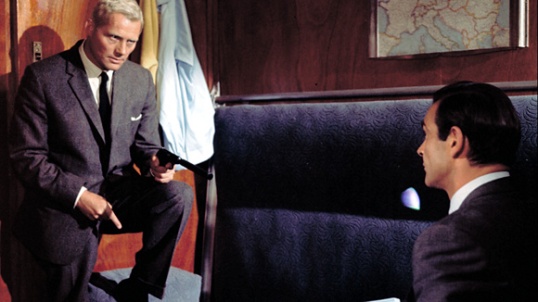
1964: From Russia With Love Is Totally Snubbed

The same year that the Academy honored George Cukor’s creaky adaptation of My Fair Lady, it totally ignored my favorite James Bond film.  From Russia With Love is a Bond film that works wonderfully as both a love story and a thriller.  Sean Connery, Lotte Lenya, Robert Shaw, and Terence Young all deserved some award consideration.  From Russia With Love was released in the UK in 1963.  In a perfect world, it would have also been released concurrently in the U.S., allowing From Russia With Love to be the film that gave the the Academy the chance to recognize the British invasion.  Instead, Tom Jones was named the Best Picture of 1963 and From Russia With Love had to wait until 1964 to premiere in the U.S.  It was snubbed in favor of one of old Hollywood’s last grasps at relevance.

1964: Slim Pickens Is Not Nominated For Best Supporting Actor

Playing three separate roles, Peter Sellers dominates Dr. Strangelove: Or How I Learned To Stop Worrying And Love The Bomb.  But, as good as Sellers is, the film’s most memorable image is definitely Slim Pickens whooping it up as he rides the bomb down to Earth.  George C. Scott and Sterling Hyaden also undoubtedly deserved some award consideration but, in the end, Pickens is the one who brings the film to life even as he helps to bring society to an end.

1967: In Cold Blood Is Not Nominated For Best Picture

In Cold Blood, though not a perfect film, certainly deserved a nomination over Dr. Doolittle.  In Cold Blood is a film that still has the power to disturb and haunt viewers today.  Dr. Doolittle was a box office debacle that was nominated in an attempt to help 20th Century Fox make back some of their money.

1967: Sidney Poitier Is Not Nominated For Best Actor For In The Heat Of The Night

In 1967, Sidney Poitier starred in two of the films that were nominated for Best Picture but somehow, he did not pick up a nomination himself.  His restrained but fiercely intelligent performance in In The Heat Of The Night provided a powerful contrast to Rod Steiger’s more blustery turn.  That Poitier was not nominated for his performance as Virgil Tibbs truly is one of the stranger snubs in Academy history.  (If I had to guess, I’d say that the Actors Branch was split on whether to honor him for In The Heat of the Night or Guess Who’s Coming To Dinner or even for To Sir With Love and, as a result, he ended up getting nominated for none of them.)

1968: 2001: A Space Odyssey and Planet of the Apes Are Not Nominated For Best Picture

Neither one of these classic science fiction films were nominated for Best Picture, despite the fact that both of them are far superior and far more influential than Oliver!, the film that won that year.

1968: The Good, The Bad, and the Ugly Is Totally Ignored

Not even Ennio Morricone’s score received a nomination!

1968: Petulia Is Totally Snubbed

Seriously, I don’t know what was going on with the Academy in 1968 but it seems they went out of their way to ignore the best films of the year.  Richard Lester’s Petulia is usually cited as one of the definitive films of the 60s but it received not a single Oscar nomination.  Not only did the film fail to receive a nomination for Best Picture but Richard Lester, George C. Scott, Julie Christie, Shirley Knight, Richard Chamberlain, and the film’s screenwriters were snubbed as well.

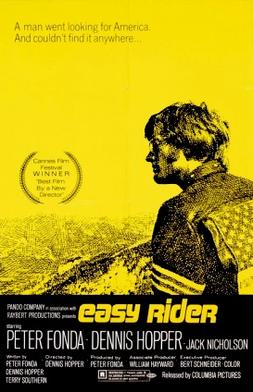
1969: Easy Rider Is Not Nominated For Best Picture

Yes, I know.  Easy Rider is a flawed film and there are certain moments that are just incredibly pretentious.  That said, Easy Rider defined an era and it also presented a portrait of everything that was and is good, bad, and timeless about America.  The film may have been produced, directed, and acted in a drug-razed haze but it’s also an important historical document and it was also a film whose success permanently changed Hollywood.  Certainly, Easy Rider’s legacy is superior to that of Hello, Dolly!

Agree? Disagree? Do you have an Oscar snub that you think is even worse than the 10 listed here? Let us know in the comments!

Up next: It’s the 70s!
Retro Television Reviews: Fantasy Island 1.8 “Superstar/Salem”


Welcome to Retro Television Reviews, a feature where we review some of our favorite and least favorite shows of the past!  On Tuesdays, I will be reviewing the original Fantasy Island, which ran on ABC from 1977 to 1986.  The entire show is currently streaming on Tubi!

Despite being exhausted last night, I still made sure to watch the next episode of Fantasy Island before allowing myself to fall asleep.  It’s all about priorities.

Episode 1.8 “Superstar/Salem”

(Dir by Earl Bellamy, originally aired on March 25th, 1978)

After a conversation with Tattoo about Tattoo’s sudden interest in photography, Mr. Roarke heads to the docks to meet this week’s guest stars!

First up, we have Richard Delaney (Gary Burghoff) and his wife, Dora (Darleen Carr).  Dora thinks they are on a business trip but actually, Richard has a fantasy.  Despite the fact that he is short, middle-aged, and not at all athletic, Richard’s fantasy is to not only pitch in a baseball game but to also strike out the best baseball players around.

(As a side note, as soon as I saw that this was going to be a baseball episode, I woke up Erin and made her watch it with me.  Of course, it was also one in the morning at the time but still, I would have been a bad sister if I hadn’t.)

Anyway, Richard gets his chance.  It turns out that Fantasy Island is holding a charity baseball game and Mr. Roarke has told everyone that Richard is the best amateur pitcher in the world.  With the help of some Fantasy Island magic, Richard is able to strike out every batter who comes up to the plate.  (According to Erin, all of the batters were real baseball players.)  We know that Richard’s skills are due to magic because, whenever he throws the ball, we hear goofy sound effects.  (“This is dumb,” Erin said, “Why did you wake me up for this?”)  Richard is offered a try-out with the Dodgers.  Yay!

Richard immediately get a little bit full of himself but it turns out that Richard’s fantasy didn’t include becoming a professional baseball player and he loses his ability to pitch.  Unfortunately, Richard doesn’t discover this until after he tells off his boss.  Fortunately, his boss is impressed by Richard’s honesty and he gives Richard a raise.  Richard may never play pro ball but at least he’ll make a lot of money as an accountant or whatever it is that he does for a living.  Yay!  (“Is it over?” Erin asked, “Can I finally get some sleep now?”)

Meanwhile, Martha and Walter Tate (played by Vera Miles and Stuart Whitman) think that the world has become too permissive of bad behavior so they want to go some place where people are better behaved.  Mr. Roarke promptly sends them to 17th century Salem, where they are both accused of being witches and narrowly avoid being executed.  You know, Mr. Roarke, you could have just sent them to a friendly rural community in Nebraska or something.  NOT EVERYTHING HAS TO BE A LESSON!

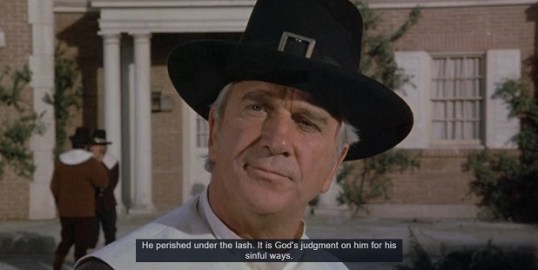
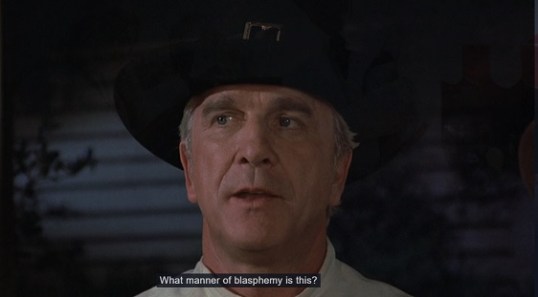
The best thing about the Salem storyline was that the evil and feared Dr. Whitfield, the man who ruled Salem with a iron fist, was played by Leslie Nielsen.  When we first meet Dr. Whitfield, he’s explaining how the town drunk came to die.

Dr. Whitfield wanted to hang both Martha and Walter for the sins of dancing and giving aspirin to a child.

Leslie Nielsen may be playing a villain but he delivers his lines in the same style that later made him a comedic icon.  If nothing else, that makes this episode fun to watch.

Martha and Walter end up fleeing Salem and, miraculously, they find themselves back on Fantasy Island.  Mr. Roarke says that he hopes they have had an enlightening fantasy.  Personally, if I was Mr. Roarke, I would be more worried about the lawsuit that they’re probably going to file against him.

This was a pretty silly episode but, as a general rule, I enjoy anything that features Leslie Nielsen playing a humorless villain.  Add to that, it was hard not to smile at the sight of Mr. Roarke and Tattoo casually emerging from the jungle in their white suits to greet Walter and Martha after the latter two escaped Salem.  It may have been a silly episode but it was also a fun one.  And really, what else does one expect from Fantasy Island?

Horror on the Lens: Baffled! (dir by Philip Leacock)


Leonard Nimoy is a race car driver who can see into the future and who uses his powers to solve crimes!

Seriously, if that’s not enough to get you to watch the 1973 made-for-TV movie Baffled!, then I don’t know what is.  In the film, Nimoy takes a break from racing so that he and a parapsychologist (played by Susan Hampshire) can solve the mystery of the visions that Nimoy is having of a woman in a mansion.  This movie was meant to serve as a pilot and I guess if the series had been picked up, Nimoy would have had weekly visions.  Of course, the movie didn’t lead to a series but Baffled is still fun in a 70s television sort of way.  Thanks to use of what I like to call “slow mo of doom,” a few of Nimoy’s visions are creepy and the whole thing ends with the promise of future adventures that were sadly never to be.

Enjoy Baffled!  Can you solve the mystery before Leonard?

https://www.youtube.com/watch?v=09JTgUcvyGE

Horror on the Lens: Mazes and Monsters (dir by Steven Hilliard Stern)


For today’s horror on the lens, we’ve got the 1982 made-for-TV movie, Mazes and Monsters!

Mazes and Monsters!  Sounds pretty scary, doesn’t it?  Well, have no fear.  Mazes and Monsters is just a role-playing game, one that definitely should not be mistaken for Dungeons and Dragons despite the fact that it’s exactly the same as Dungeons and Dragons.  Except, of course, for the fact that one game takes place in a dungeon and the other takes place in a maze.

A group of rich kids love playing Mazes and Monsters but, when they take it a step too far, it leads to the newest member of their group having a nervous breakdown, fleeing to New York City, and fighting demons that only he can see.  Our delusional hero is played by an actor named Tom Hanks.  Hey, whatever happened to him?

Anyway, Mazes and Monsters is kind of silly.  You’re going to get sick of Chris Makepeace’s hats pretty quickly.  It imagines a world where the most popular and attractive kids on campus just can’t wait to pretend to be clerics and magic users.  And yet, in its own melodramatic way, the film works.  If you’ve ever wanted to see Tom Hanks stab a green demon, this is the film to watch!  This was one of Tom Hanks’s first roles and he already looks a little bit too old to play a college student but his trademark likability is already evident.  When Tom has a moment of clarity and desperately announces that “THERE’S BLOOD ON MY KNIFE!,” it’s impossible for your heart not to ache for him a little.  Finally, as over-the-top as the moral panic about the possibility of LARPers going crazy in New York may be, the ending actually is surprisingly effective.

Enjoy!

https://youtu.be/FpcL-fQNPfQ

Horror on the Lens: Baffled! (dir by Philip Leacock)


Baffled! is an entertaining little made-for-TV movie from 1973.  Leonard Nimoy plays a race car driver who suddenly starts to have psychic visions of a woman who lives in what appears to be a gothic manor.  The woman is in some sort of danger.  Nimoy, of course, would rather just race cars but a parapsychologist (Susan Hampshire) convinces him that he has to figure out what his visions mean.

Now, to be honest, Baffled! is not a particularly scary movie.  Some of Nimoy’s visions are spooky but there’s nothing in this movie that’s going to give you nightmares.  Though it may not be horrifying, Baffled! is a lot of fun.  Apparently, it was meant to be a pilot for a TV series.  If it had been picked up, I guess Nimoy and Hampshire would have been helping out a new guest star every week.  Nimoy seems to be having a lot of fun playing a psychic race car driver and he and Susan Hampshire have a really sweet and enjoyable chemistry.

Enjoy!

http://www.youtube.com/watch?v=09JTgUcvyGE


Smash-Up On Interstate 5 (1976, directed by John Llewellyn Moxey)


Smash-Up On Interstate 5 begins with ominous shots of a crowded California interstate.  It’s the 4th of July weekend and old people are returning home, young people are looking for a party, and Sergeant Sam Marcum (Robert Conrad) of the California Highway Patrol is looking for a killer.  When one car swerves into the next lane and hits another, it leads to a chain reaction as hundreds of cars, trucks, and one motorcycle crash into each other.  While the vehicles crash, we see the people inside of them.  There’s Buddy Ebsen!  There’s Vera Miles!  There’s Sue Lyon (of Lolita fame) on the back of a motorcycle!  In a voice-over, Sam tells us that the accident will be classified as being due to “mechanical failure” and that 14 people are going to die as a result.  He might be one of them.

Smash-Up On Interstate 5 is a 70s disaster film so, after the pile-up, the movie flashed back 48 hours and we get to know everyone whose lives are going to eventually collide on Interstate 5.  Erica (Vera Miles) is recently divorced and trying to get back into the dating scene.  Albert (Buddy Ebsen) is trying to bring some joy to his terminally ill wife’s final days.  Lee (Scott Jacoby) and Penny (Bonnie Ebsen) are the hippies who are trying to get to Big Sur without getting arrested.  Burnsey (Sue Lyon) loves her biker boyfriend.  Some of them will survive the pile-up.  Some of them will not.

Smash-Up On Interstate 5 is an above average made-for-TV movie.  It’s got a notable cast and the movie does a good job of mixing together’s everyone’s subplots.  For instance, Burnsey and a group of bikers show up in the background of several scenes and harass Erica at one point long before the crash on the interstate.  It’s only a 100-minute film so the film doesn’t go into too much detail about everyone’s past but we learn just enough to make everyone stand out.  The crash itself is intense, even when seen today.  Made before the days of CGI, this is a film where the stunt crew definitely earned their paycheck.

Tommy Lee Jones plays a patrolman who is also Sam’s brother-in-law.  I was surprised when I first saw him but as soon as I saw the strained smile and heard the accent, I knew it was him.  Jones’s role is small and probably could have been played by anyone but the mere presence of Tommy Lee Jones definitely makes this film cooler than it would have been otherwise.

One final note: This film was directed by the made-for-TV horror specialist, John Llewellyn Moxey.  Be sure to read Gary Loggins’s tribute to this often underrated director.

Horror Film Review: Psycho II (dir by Richard Franklin)


Norman Bates is back!

No, I don’t mean Freddie Highmore from Bates Motel or Vince Vaughn from the odd Psycho remake that I keep seeing on Showtime.  No, I’m talking about the original Norman Bates, Anthony Perkins!

First released in 1983, Psycho II is a direct sequel to the classic shocker from Alfred Hitchcock.  The film opens with a replay of the original film’s famous shower scene and then immediately jumps forward 22 years.  Having been found not guilty by reason of insanity, Norman Bates has been in a mental institution ever since he was arrested for the murders of Marion Crane and Milton Arborgast.  However, Norman’s psychiatrist, Dr. Raymond (Robert Loggia, who was considered for the role of Sam Loomis in the original film), now feels that Norman has been cured and is no longer a danger to himself or others.  A judge agrees.  Marion Crane’s sister, Lila Loomis (Vera Miles, reprising her role from the original) does not.  She presents the judge with a petition demanding that Norman not be released.  When the judge ignores her, Lila yells that Norman will murder again!

Now free, Norman returns to the Bates Motel and discovers that it’s now being run by the sleazy Warren Toomey (Dennis Franz).  When Norman finds various party favors in the motel rooms and asks Warren what they are, Warren laughs and says, “They’re drugs, Norman.”  Norman’s not too happy about that.  As Dr. Raymond tells him, the world has changed considerably over the past two decades.

However, Norman has other issues to deal with.  For the most part, most of the people in town are not happy that their most famous resident has returned.  Emma Spool (Claudia Bryar) gets Norman a job at a local diner because, in her words, she believes in forgiveness and second chances.  Norman gets to know the new waitress, Mary Samuels (Meg Tilly) and, when Mary tells him that she’s had a fight with her boyfriend, he invites her to stay at the hotel until she can get things together.

From the minute that he returns home, Norman is struggling to keep it together.  When he first reenters his former house, he hears his mother’s voice but he tells himself that she’s not really there.  But if his mother isn’t there, then who keeps calling him on the phone and yelling at him about the state of the motel?  Who keeps taunting him about his awkward (yet rather sweet) relationship with Mary?  And when two teenagers are attacked after breaking into the house, who else could it possibly be but Norman’s mother?

I was really surprised by Psycho II, which turned out to be a really entertaining little movie, an effective thriller with a healthy dash of dark humor.  It’s a very plot-heavy film, with almost every scene introducing a new twist to the story.  With the exception of the sleazy Warren Toomey, no one in this film turns out to be who you initially expected them to be, including Norman.  Meg Tilly does a good job in the somewhat oddly written role of Mary Samuels and even manages to make an awkward line like “Norman, you’re as mad as a hatter” sound natural.  Not surprisingly, the film is dominated by Perkins’s performance as Norman Bates and what a great performance it is.  The best moments are the ones where Norman awkwardly tries to fit back in with society, nervously laughing at his own jokes and struggling to maintain eye contact with whoever he’s talking to.  You really can’t help but feel sorry for him, especially as the film progresses.

Wisely, Psycho II set out to establish it own identity as a film, as opposed to just trying to duplicate the shocks of Psycho.  (There is a shower scene that’s filmed similarly to the one from the first scene, with a key difference that I won’t spoil.)  It’s what a sequel should be, not a remake but a continuation of the original’s story.  This is definitely a film that’s far better than you may expect.


Coming Down The Mountain: Runaway! (1973, directed by David Lowell Rich)


Runaway! begins with a train starting a slow descent down a snowy mountain.  On board the train are collection of skiers, gigolos, conductors, and engineers.  One couple discusses their upcoming divorce.  An athletic father tries to bond with his less-athletic son.  A slick con artist tries to convince a depressed young woman not to throw herself from the train.  A group of skiers put on an impromptu concert, banging on their suitcases like bongo drums.  They get so loud that the conductor doesn’t even hear the engineer desperately trying to contact him.  What none of the passengers realize is that the train’s brake engines have frozen and the train is about to start hurtling down the mountain.  Unless the chief engineer can figure out a way to stop the train, everyone’s going to die!

Made for television in the year between the release of The Poseidon Adventure and The Towering Inferno, Runaway! is a low-key but entertaining disaster movie.  With a running time of only 70 minutes, Runaway! doesn’t waste any time getting down to business and, even if it is a low-budget movie, there’s no way that an out-of-control train racing down a mountain can’t be exciting.

Compared to the other disaster movies of the era, Runaway! does not exactly have an all-star cast though there are some familiar faces.  Vera Miles and Ed Nelson are the divorcing couple while Martin Milner is the father who puts too much pressure on his son.  Ben Murphy is the gigolo who refuses to pay for a ticket on general principle while Darleen Carr is the woman who wants to jump to her death.  Most of them are just there as placeholders.  It’s obvious from the start that the real stars of the film are going to be the train and the mountain.  However, the famously gruff character actor Ben Johnson manages to make an impression just by being Ben Johnson.  Johnson plays the chief engineer and, as long as he’s manning the engine, you know that the train’s passengers are in good hands.

Runaway! has never been released on DVD or even VHS but it is currently available on YouTube.