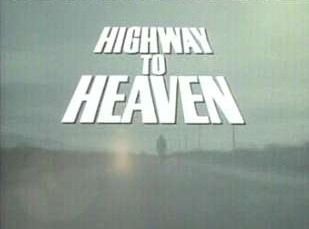
Welcome to Late Night Retro Television Reviews, a feature where we review some of our favorite and least favorite shows of the past! On Thursdays, I will be reviewing Highway to Heaven, which aired on NBC from 1984 to 1989. The entire show is currently streaming on Tubi and several other services!
This week, Jonathan and Mark help out a vet.
Episode 5.7 “The Squeaky Wheel”
(Dir by Michael Landon, originally aired on June 16th, 1989)
Jonathan and Mark attempt to turn Wayne Secret (Robert David Hall) into a disability activist. Having lost his legs in Vietnam, Wayne wants to live a quiet life with his wife (Deborah Benson) but, while staying at a recently renovated hotel, he is woken up by a fire alarm. With the the elevators not working and no ramps, Wayne is forced to depend on the kindness of a stranger who carries him down a flight of stairs. The fire turns out to be a false alarm but the experience leads to Wayne protesting the fact that the hotel is not wheelchair accessible.
The owner of the hotel not only agrees to make changes to the building but he also offers Wayne a job. Things are looking up for Wayne! But, when a gang of young men harass him and his wife at a drive-in movie, Wayne snaps. He buys an Uzi and then heads down to their clubhouse to take them out. Luckily, Jonathan appears and talks Wayne out of becoming a mass murderer. Wayne goes on to receive a “man of the year” award while Jonathan beats up the leader of the gang.
This episode felt very familiar. In the past, this episode would have featured Mark’s brother-in-law, Scotty. Instead, it features Wayne, who is not a particularly compelling character. I think that this episode would have worked if it had just focused on Wayne advocating for wheelchair accessible buildings. I also think it would have worked if it had just focused on Wayne’s anger to the gang and his struggle to let go of his bitterness over his war experiences. Unfortunately, trying to cram both those storylines into one 45-minute show led to the whole thing feeling half-baked.
There was one poignant scene in this episode. It opened with Mark and Jonathan visiting the Hollywood Walk of Fame. Mark got excited when he came across Michael Landon’s star. “Never heard of him,” Jonathan shrugged. “I forget you’ve been dead for forty years,” Mark replies. It captured Jonathan and Mark’s friendship, which was always been one of the more underrated aspects of Highway to Heaven. That said, it was also a bit of a sad scene as the episode itself aired a day after the death of Victor French and Landon himself would pass away nearly two years later.
Because today is the birthday of the great actress Jennifer Jason Leigh, I decided to rewatch the 1991 film, Rush.
Loosely based on a true story, Rush takes place on the outskirts of Houston, Texas in the 70s. Jack Raynor (Jason Patric) is a veteran undercover narcotics officer who is determined to take down a local drug lord named Gaines (Gregg Allman). Raynor takes his new partner, Kristen Cates (Jennifer Jason Leigh), under his wing and trains her on how to work undercover. He tests her joint-rolling abilities. He has her fire a gun at cans out by the quarry. He teaches her how to shoot-up drugs. As he explains it, if she is going to get the local drug dealers to trust her, she is going to have to shoot up drugs in front of them. Raynor and Cates work well together, quickly becoming lovers in real life as well as undercover life. They manage to force one dealer, a likable but unlucky clod named Walker (Max Perlich), to turn informant. However, their efforts to get to Gaines are threatened by their own growing addictions and Raynor’s erratic behavior. Chief Nettle (Tony Frank) and Captain Dodd (Sam Elliott) want results but will the results be worth the cost?
(Are they ever?)
I’ve watched Rush a few times. I have to admit that I always remember it as being better than it actually is. Rush was the only feature film to be directed by producer Lili Fini Zanuck and it definitely has its problems. The pace, especially during the film’s second half, is often too slow. Visually, there a few good location shots but the film often feels rather static. As Jack Raynor, Jason Patric gives a performance that is all method intensity with little actual depth. Patric looks good with his long hair, his beard, and his intense eyes but there’s not much depth overall to Jack Raynor.
And yet, when the film works, it really does work. Whatever other flaws might be present in her direction, Zanuck does capture the anything-goes, slightly ominous atmosphere that one often finds in the small towns on the carcinogenic coast. While there’s nothing about his performance here that suggests he was a particularly talented actor, Gregg Allman is still very convincing as the menacing Gaines. (One sign of Gaines’s power is that he never speaks unless absolutely necessary.) Character actor Max Perlich gives a strong and poignant performance as Walker, a well-meaning goof who finds himself being manipulated by both sides in the war on drugs. Though the soundtrack is probably best-known for its use of Eric Clapton’s Tears In Heaven, the rest of it is full of classic Southern rock. Some of the choices are a bit obvious. Free Bird coming on the radio just as Raynor explains that he does things his way? That’s a lucky coincidence! It works, though. It’s a cool song.
Ultimately, what truly makes the film work is the performance of Jennifer Jason Leigh, who always manages to find the truth of her character even when the film sometimes seems to be determined to let her down. While Patric gets to have the showy breakdowns, Leigh shows the audience what it’s like for someone to be trapped by not only her job but also her relationship. The scenes between her and Walker are the strongest in the film because even though Walker is a criminal and Cates is a cop, they’re both stuck in a situation that they didn’t create. Gaines wants the money and the power that comes from being a drug lord. Chief Nettle wants the publicity and acclaim that comes from busting a major dealer. If they have to sacrifice Walker and Cates to get what they want, that’s what they’re going to do. Walker, Cates, and Raynor ultimately become pawns in a game where the victor ultimately wins very little. If Gaines escapes justice, someone else will just come after him. If Gaines goes down, someone else will inevitably replace him.
Rush is not a perfect film but it is a film that shows just how great a talent Jennifer Jason Leigh was and is.
In 1978’s Every Which Way But Loose, Clint Eastwood plays Philo Beddoe.
Philo’s an ordinary guy with beautiful hair and a way with throwing punches. He’s a truck driver. He enjoys a cold beer. He enjoys country music. He makes some extra money by taking part in bare-knuckle brawls. Everyone says that he could be the next Tank Murdock, a legendary fighter. Philo is just a simple, blue collar guy who lives in a small house, next door to his best friend Orville (Geoffrey Lewis) and Orville’s profanity-loving mother (Ruth Gordon). Philo also owns an orangutan named Clyde. He saved Clyde from being sent to live in a “desert zoo.”
(Actually, now that I think about it, most blue collar guys don’t own monkeys but whatever. Clyde’s cute and Eastwood’s Eastwood.)
When Philo meets a country singer named Lynn Halsey-Taylor (Sondra Locke), he is immediately smitten. When Lynn disappears and leaves Philo a cryptic note, Philo decides to go looking for her. Clyde, Orville, and Philo hit the road. Along the way, Orville meets and picks up a woman named Echo (Beverly D’Angelo). This is a road movie so, of course, Clyde, Orville, Philo, and Echo have their adventures on the way to Colorado. They end running afoul both a corrupt cop and a gang of buffoonish bikers. Philo enters a fight whenever they need money and one occasionally gets the feeling that Eastwood took this role to show off the fact that, for someone approaching 50, he still looked good without a shirt on. And good for him! Because, seriously, Clint does look good in this movie….
I have to admit that, for all of my attempts at sophistication, my roots are in the country and I’ve traveled down enough dirt roads that I find it hard to resist a good redneck story. And really, there aren’t many films that as proudly and unashamedly redneck than EveryWhich Way But Loose. It’s a film that has a laid back, take-it-as-it-comes vibe to it. Philo may be looking for Lynn but he seems to be okay with taking a few detour along the way. There’s no real sense of urgency to any part of the movie. Instead, EveryWhichWay But Loose was made for people who like a cold beer at the end of the day and who find Ruth Gordon to be hilarious when she curses. Myself, I don’t drink. That’s one part of the country lifestyle that passed me over. But I did enjoy seeing Ruth Gordon cuss out the Nazi biker gang.
Eastwood, Lewis, and D’Angelo have a likable chemistry and the monkey’s cute. Unfortunately, Sondra Locke isn’t particularly well-cast in the role of Lynn. (Considering that she was in a relationship with Eastwood, it’s amazing how little chemistry they have in this movie.) As I watched the film, it occurred to me that it probably would have worked better if Locke and D’Angelo had switched roles. Locke’s character is supposed to be a femme fatale type but she gives a boring performance and, as a result, the revelation that Philo has misjudged her doesn’t really carry any emotional weight.
That said, this film features some beautiful shots of the wilderness, a charming romance between Lewis and D’Angelo, and a shirtless Clint Eastwood beating folks up. That’s more than enough to please this secret country girl.
In 2004’s Collateral, Jamie Foxx stars as Max, a taxicab driver who is hoping, in those days before Uber, to start his own limousine company. When we first see him, he’s giving a ride to a federal prosecutor named Annie (Jada Pinkett Smith) and he’s even getting her phone number after he drops her off at work. Unfortunately, for Max, his next passenger is a bit less friendly.
Vincent (Tom Cruise), with his gray hair that matches his suit, is polite, quiet, and direct when he speaks. He carries a briefcase with him everywhere that he goes and anyone who tries to take the briefcase soon discovers just how far Vincent will go to hold onto it. Vincent pays Max $600 to drive him around Los Angeles for the night. Vincent has a lot of business that he needs to attend to. Max agrees, not realizing until it’s too late that Vincent is a hired assassin and that his business is killing people. Vincent has been hired to wipe out a collection of crooks and lawyers and, though Vincent is careful not to reveal his emotions, it’s obvious that he’s looking forward to the challenge.
To his credit, Max doesn’t really have any interest in being a part of Max’s killing spree but he soon finds himself unable to escape from Vincent and being forced to drive from location to location. Along the way, Vincent and Max engage in debates of both morality and philosophy. Vincent sees death as just being a part of the job. Max is horrified, especially when people who haven’t done anything wrong end up as collateral damage in Vincent’s killing spree. The truth of the matter is that, even if Max hadn’t picked up Vincent, there’s no guarantee that he wouldn’t have picked up some other madman. As a taxi driver, Max surrenders his control once he unlocks the door and allows someone to get in the backseat. Sometimes, he gets a passenger like Annie. Other times, he’s going to get a passenger like Vincent. Somewhat improbably, Vincent and Annie turns out to be connected and Max’s chance encounter with her becomes even more important.
Because this is a Michael Mann film, Los Angeles is as much a character in this film as Max and Vincent. Mann captures the shadowy darkness of the city at the night and the feeling that both opportunity and danger could lurk around every corner. Claustrophobic scenes in the taxi cab are mixed with scenes in an equally claustrophobic (though for different reasons) club. The film’s haunting final image takes place not in the cab but instead on a train. Everyone is heading somewhere and, at some point during the film, both Vincent and Max deal with the feeling of having no control over where they’ll end up.
When Collateral first came out in 2004, I remember that a lot of people were shocked to see Cruise playing a villain. Cruise does give one of his best performances here, playing yet another one of Mann’s cool and efficient professionals. Strangely enough, Jamie Foxx is the one who was nominated for an Oscar, even though he’s actually a little on the boring side as Max. (In all fairness, Max is meant to be the conventional member of the film’s involuntary partnership.) The film is dominated by Cruise and his performance is still powerful to this day.
Though the Academy of Motion Picture Arts and Sciences claim that the Oscars honor the best of the year, we all know that there are always worthy films and performances that end up getting overlooked. Sometimes, it’s because the competition too fierce. Sometimes, it’s because the film itself was too controversial. Often, it’s just a case of a film’s quality not being fully recognized until years after its initial released. This series of reviews takes a look at the films and performances that should have been nominated but were, for whatever reason, overlooked. These are the Unnominated.
First released in 1995, Heat is one of the most influential and best-known films of the past 30 years. It also received absolutely zero Oscar nominations.
Maybe we shouldn’t be too surprised that Academy — especially the Academy of the 1990s — didn’t shower the film with nominations. For all of its many strengths, Heat is still a genre piece, an epic three-hour crime film from director Michael Mann. It’s a film about obsessive cops and tightly-wound crooks and it’s based on a made-for-TV movie that Mann directed in the late 80s. While the Academy had given a best picture nomination to The Fugitive just two years before, it still hadn’t fully come around to honoring genre films.
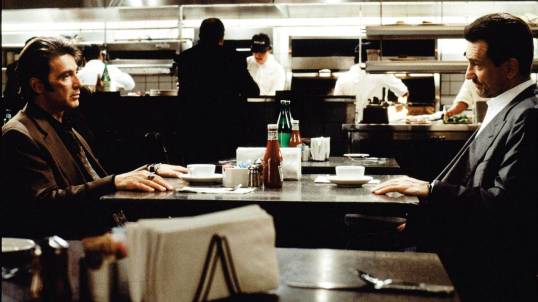
And yet one would think that the film could have at least picked up a nomination for its editing or maybe the sound design that helps to make the film’s signature 8-minute gun battle so unforgettable. (Heat is a film that leaves you feeling as if you’re trapped in the middle of its gunfights, running for cover while the cops and the crooks fire on each other.) The screenplay, featuring the scene where Al Pacino’s intense detective sits down for coffee with Robert De Niro’s career crook, also went unnominated.
Al Pacino was not nominated for playing Vincent Hanna and maybe we shouldn’t be too surprised at that. Pacino yells a lot in this movie. When people talk about Pacino having a reputation for bellowing his lines like a madman, they’re usually thinking about the scene where he confronts a weaselly executive (Hank Azaria) about the affair that he’s having with Charlene (Ashley Judd), the wife of criminal Chris Shiherlis (Val Kilmer). And yet, I think that Pacino’s performance works in the context of the film and it’s often forgotten that Pacino has quite scenes in Heat as well. Pacino’s intensity provides a contrast to Robert De Niro’s tightly controlled career criminal, Neil McCauley. McCauley has done time in prison and he has no intention of ever going back. But, as he admits during the famous diner scene, being a criminal is the only thing that he knows how to do and it’s also the only thing that he wants to do. (“The action is the juice,” Tom Sizemore says in another scene.) If any two actors deserved a joint Oscar nomination it was Pacino and De Niro. In Heat, they’re the perfect team. Pacino’s flamboyance and De Niro’s tightly-controlled emotions come together to form the heart of the picture.
No one from the film’s supporting cast was nominated either, despite there being a wealth of riches to choose from. Ashley Judd and Val Kilmer come to mind as obvious contenders. Kilmer is amazing in the shoot-out that occurs two hours into the film. Ashley Judd has a killer scene where she helps her husband escape from the police. Beyond Judd and Kilmer, I like the quiet menace of Tom Sizemore’s Michael Cheritto. (Just check out the look he gives to an onlooker who is getting a little bit too curious.) Kevin Gage’s sociopathic Waingro is one of the most loathsome characters to ever show up in a movie. William Fichtner, Jon Voight, Danny Trejo, and Tom Noonan all make a definite impression and add to Michael Mann’s portrait of the Los Angeles underworld. In an early role, Natalie Portman plays Hanna’s neglected stepdaughter and even Amy Brenneman has some good moments as Neil’s unsuspecting girlfriend, the one who Neil claims to be prepared to abandon if he sees “the heat coming.”
I have to mention the performance of Dennis Haysbert as Don Breedan, a man who has just been released from prison and who finds himself working as a cook in a diner. (The owner of the diner is played by Bud Cort.) Haysbert doesn’t have many scenes but he gives a poignant performance as a man struggling not to fall back into his old life of crime and what eventually happens to him still packs an emotional punch. For much of the film’s running time, he’s on the fringes of the story. It’s only by chance that he finds himself suddenly and briefly thrown into the middle of the action.
Heat is the ultimate Michael Mann film, a 3-hour crime epic that is full of amazing action sequences, powerful performances, and a moody atmosphere that leaves the viewer with no doubt that the film is actually about a lot more than just a bunch of crooks and the cops who try to stop them. Hanna and McCauley both live by their own code and are equally obsessed with their work. Their showdown is inevitable and, as directed by Michael Mann, it takes on almost mythological grandeur. The film is a portrait of uncertainty and fear in Los Angeles but it’s also a portrait of two men destined to confront each other. They’re both the best at what they do and, as a result, only one can remain alive at the end of the film.
I rewatched Heat yesterday and I was amazed at how well the film holds up. It’s one of the best-paced three-hour films that I’ve ever seen and that epic gunfight is still powerful and frightening to watch. Like Martin Scorsese’s Casino, it was a 1995 film that deserved more Oscar attention than it received.
Heat (1995, dir by Michael Mann, DP: Dante Spinotti)
In this 1993 film, Lou Diamond Phillips stars as Jeff Powers. Who is Jeff Powers? He’s a cop! He wants to keep the street safe! Sometimes, he knows that you have to be willing to break the rules! He’s a cop who does things his way!
Okay, is that enough exclamation points? I’m not just using them to be obnoxious. The film is pretty much just one big exclamation point. The action is hyperintense and the film is full of characters who always seem like they’re just one step away from exploding. No one in this film is particularly calm or laid back. From the start, everything is dialed to eleven and it just keeps going higher and higher.
After Jeff is put on probation for roughing up a suspect, he receives an invitation to join an elite squad of detective. Led by the charismatic Detective Dan Vaughn (Scott Glenn, giving a performance that is so over-the-top that he yells straight at the camera at one point), the Special Investigative Section is the best of the bed. Upon joining, Jeff finds himself a member of a sacred fraternity of law enforcers. Working with men like the always amused Detective Larson (Yaphet Kotto) and the somewhat paranoid Angel (Andrew Divoff), Jeff finds himself tracking some of the biggest criminals in the city.
What Jeff also discovers is that SIS does more than just arrest criminals. The SIS has been given an unofficial license to kill and they end up executing as many people as they take to jail. Often times, Vaughn will tells the men to allow a crime to be committed so that they can then dispense their own brand of justice. In the film’s most disturbing scene, the members of SIS wait until after a woman has been raped in an alley before they move to neutralize her attackers. When Jeff finally decides that he can’t be a part of all this and tries to reveal what’s going on, he discovers that the SIS has some support in some very high places. Who cares if the SIS is allowing crimes to be committed or if an innocent person occasionally gets caught in the crossfire? At least they’re taking care of the criminals!
Extreme Justice is a crude and energetic film and one that is based on some of the stories that spread about the LAPD’s RAMPART division in the 90s. That the film works is a testament to the performances of Phillips, Kotto, and Glenn and also the direction of Mark L. Lester. An exploitation vet who occassionally made big studio action films as well, Lester keeps the pace moving at breakneck speed and, even more importantly, he allows both sides to have their say. While Jeff is upset about SIS’s methods, Detective Vaughn is correct when he says that his unit is targeting the worst of the worst. It makes for an unusually intelligent exploitation film, one that leaves the audience with a lot to consider. How far would you go to keep your neighborhood safe?
In celebration of the 77th birthday of the great Director John Carpenter, I decided to watch his 1998 film VAMPIRES, starring one of my favorite actors in James Woods. I specifically remember the first time I ever read that this movie was being made and that it would star Woods. It was 1996, and I had just been hired to work for a company called Acxiom Corporation in Conway, Arkansas. It was at this job that I first had access to this new thing called the Worldwide Web. As far as I know, it was the first time I had ever looked at the internet. Of course, I immediately started completing searches on some of my favorite actors, including James Woods, when I came across VAMPIRES as a movie currently in production. These were the first times in my life that I was able to find out about new film projects without looking in a magazine or watching shows like Entertainment Tonight.
In VAMPIRES, James Woods stars as Jack Crow, the leader of team of vampire hunters who get their funding from the Vatican. We’re introduced to the team when they go into a house in New Mexico and proceed to impale and burn a nest of vampires. While the rest of the team celebrates the mission that night in a hotel filled alcohol, drugs, and whores, Jack can’t escape the feeling that something isn’t right, as he doesn’t believe they got the “master vampire” of the group. Unfortunately, Jack is right to worry. As they’re partying, the master vampire Valek (Thomas Ian Griffith) interrupts the fun and proceeds to kill everyone there, with the exception of Jack, his partner Tony (Daniel Baldwin), and Katrina (Sheryl Lee), a prostitute he decided to just bite on. Valek isn’t just a regular old master vampire, either. As it turns out, he’s the original vampire, and he’s on a quest to find the Berziers Cross, an ancient Catholic relic, that will allow him and other vampires to walk in the daylight. Against this backdrop, Jack, Tony, and a priest named Adam (Tim Guinee) use Katrina, who now has a psychic link with Valek, to try to kill the ultimate master vampire Valek, his cleric accomplice Cardinal Alba (Maximillian Schell), and just hopefully, save mankind in the process!
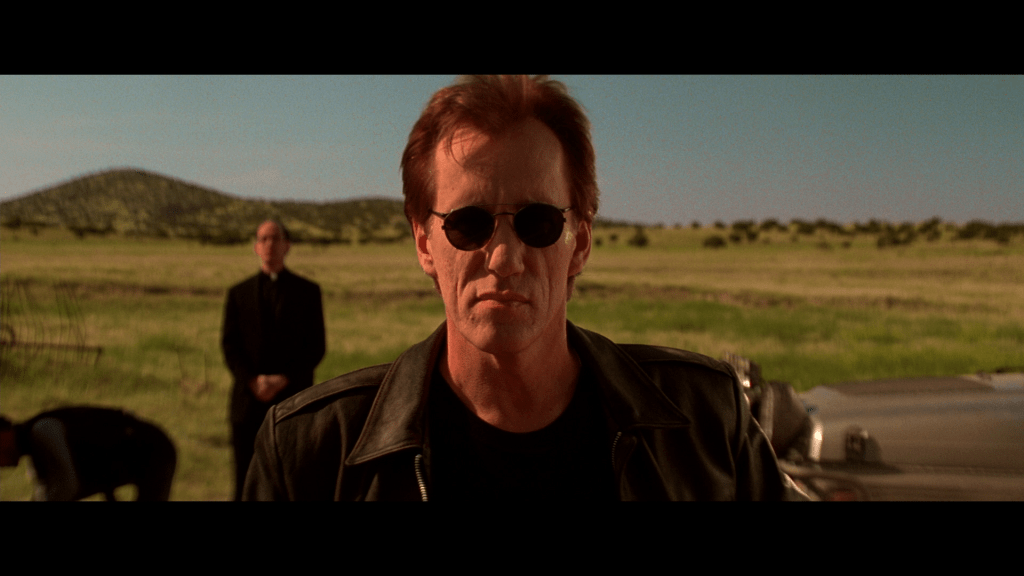
I know that VAMPIRES is not the most well-known or beloved John Carpenter film. He’s done so many great movies, but VAMPIRES is special to me as it was the first of his films that I ever saw in the movie theater. And the opening 30 minutes of the film is as badass as it gets. Carpenter is a master of the set-up. There’s lots of slow motion as Carpenter’s guitar riffs rock the soundtrack and the camera moves in on James Woods, with his cool sunglasses and black leather jacket, just before his team goes in and destroys a vampire nest at the beginning of the film. I also think the set-up of Thomas Ian Griffith as Valek is awesome, as he strolls up to the hotel room while the vampire hunters celebrate, completely unaware of the carnage about to befall them. Griffith has never looked cooler than he did in his long black coat and long hair, both blowing in the wind. These were awesome moments that illustrated Carpenter’s ability to project a sense of visual cool and power that I was mesmerized with. I wanted to see what happens next. And as a 25-year-old man at the time of VAMPIRE’s Halloween release in 1998, I also gladly admit that I really enjoyed the beauty of a 31-year-old Sheryl Lee. I would have definitely done everything I could do to save and protect her. The remainder of the film may have not been able to keep the same momentum as those first 30 minutes, but it’s a solid, enjoyable film, buoyed by the intense performance of Woods!
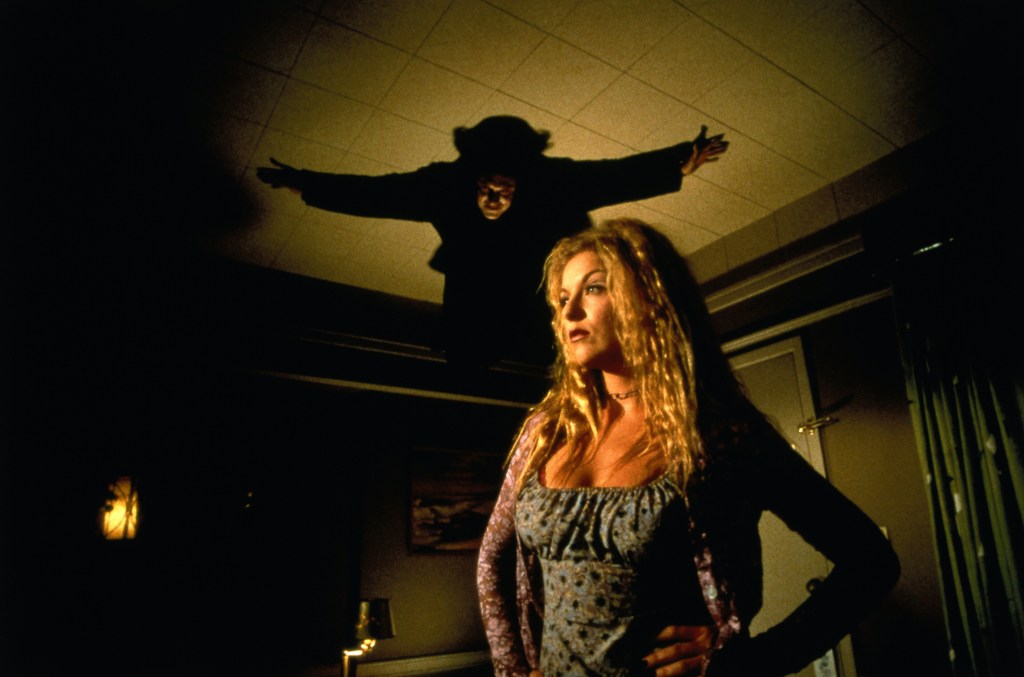
Vampires (1998)
Directed by John Carpenter
Shown: Thomas Ian Griffith, Sheryl Lee
There are several items of trivia that interest me about VAMPIRES:
John Carpenter had a good working relationship with James Woods on the set, but they had a deal: Carpenter could film one scene as it is written, and he would film another scene in which Woods was allowed to improvise. The deal worked great, and Carpenter found that many of Woods’ improvised scenes were brilliant.
VAMPIRES was John Carpenter’s only successful film of the 1990’s. Its opening weekend box office of $9.1 million is the highest of any John Carpenter film.
The screenplay for VAMPIRES is credited to Don Jakoby. Jakoby has some good writing credits, including the Roy Scheider film BLUE THUNDER (1983), the Cannon Films “classic” LIFEFORCE (1985), and the Spielberg produced ARACHNAPHOBIA (1990). The reason Don Jakoby interests me, however, is the fact that he had his name removed from the film I’ve seen more than any other, that being DEATH WISH 3 (1985), starring Charles Bronson. Even though Jakoby provided the script for DEATH WISH 3, due to the drastic number of changes, Jakoby insisted his name be removed. The script is credited to the fake “Michael Edmonds” instead.
As I was typing up my thoughts on VAMPIRES today, I learned of the death of the director David Lynch. This brings special poignancy to the fact that John Carpenter cast Sheryl Lee after seeing her on Lynch’s T.V. series TWIN PEAKS (1990).
Frank Darabont, who directed one of the great films of all time, THE SHAWSHANK REDEMPTION (1994), has a cameo as “Man with Buick.” Fairly early in the film, after Crow, Montoya, and Katrina crash their truck escaping the hotel massacre, they encounter the man at a gas station and forcefully take the Buick. This is a strong sign of just how respected John Carpenter was by other great filmmakers at the time.
John Carpenter has directed some absolute classics like ASSAULT ON PRECINCT 13 (1976), HALLOWEEN (1978), ESCAPE FROM NEW YORK (1981), THE THING (1982), and BIG TROUBLE IN LITTLE CHINA (1986). There’s no wrong way to celebrate a man who has brought such joy into our lives through his work. Today, I’m just thankful that he has been given the opportunity to share his talents with us!
 Through the Shattered Lens