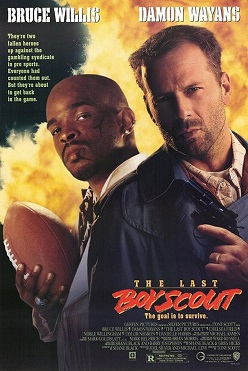
Holiday Film Review: The Last Boy Scout (dir by Tony Scott)


My God, what a violent holiday season!

Like the majority of the films that have been written and/or directed by Shane Black, The Last Boy Scout takes place in December.  It’s not quite as Christmas-y as some of Black’s other films.  I think that I may have spotted a few decorations in the background of some of the scenes.  And there’s a scene where private investigator Joe Hallenbeck (Bruce Willis) discovers that his daughter (played by a very young Danielle Harris) has been drawing pictures of “Satan Claus.”  Otherwise, there’s not a lot of Christmas to be found in this December-set film and perhaps that’s for the best.  Seriously, this movie is violent!  Not even the comedic relief characters are safe from getting a bullet to the head.  This is a film that actually begins with a football player shooting three other players during a game and then saying, “Ain’t life a bitch,” before shooting himself in the head.

The film’s plot isn’t always easy to follow.  Joe is a private investigator who drinks too much and whose partner has just been blown up in front of his house.  (His partner was also sleeping with Joe’s wife so guess who is now a suspect!)  Joe is also hired to act as a bodyguard for a stripper named Cory (Halle Berry).  Cory is dating Jimmy Dix (Damon Wayans), a former quarterback who used to be Joe’s hero.  Then Jimmy got kicked out of the league for gambling and Joe stopped watching football.  Cory says that she has a tape recording that will get Joe back into the NFL.  But then, Cory is brutally gunned down in the middle of the street and the tape is accidentally destroyed by Joe’s crappy tape player.  It’s time for Jimmy and Joe to team up, trade one liners, and uncover the conspiracy.

It all links back to the efforts of football team owner Shelley Marcuse (Noble Willingham) to legalize gambling.  Senator Calvin Baynard (Chelcie Ross) is standing in Marcuse’s way because Marcuse didn’t offer him a big enough bribe.  Marcuse is planning to assassinate the senator and he’s going to frame Joe for the crime because, in an amazing coincidence, Joe used to be a secret service agent until he caught Senator Baynard torturing a sex worker.  Of course, the actual assassination will be carried out by Marcuse’s chief henchman, Milo (Taylor Negron, who is absolutely chilling in the role).  Milo rarely shows emotion and always refers to everyone by their formal name.  (Joe is called Joseph.  Jimmy is called James.)  Milo is also a total sociopath, one who will shoot anyone in the head without a second thought.

Shane Black, who is a genius regardless of what I may think of this particular film, has said that he wrote The Last Boy Scout after he broke up with a longtime girlfriend and he was suffering from depression.  Disillusionment hangs over almost every frame of the movie.  Joe did the right thing and lost his career.  Jimmy lost his family on the same night that he played the best game of his career.  The Senator is opposed to Marcuse’s scheme solely because he’s not getting enough of a cut.  Marcuse is a respected businessman who thinks little of killing strangers.  Jimmy and Joe are heroes not because they’re particularly good but because everyone else around them is just so bad.  This is also very much a movie about guys doing guy things.  I watched it with my brother-in-law and I have to say that I think he got a bit more out of the film than I did.  Then again, I also think my sister Megan also got more out of it than I did so maybe I just wasn’t in the mood to watch so many people get shot in the head.  It happens.

The Last Boy Scout was directed by Tony Scott so, no matter what else you might want to say about it, the movie looks great.  Willis seems a bit bored with the film and Wayans sometimes struggles with the more dramatic moments.  In many ways, the film feels like a precursor to Shane Black’s The New Guys, though Willis and Wayans never have the same chemistry as Russell Crowe and Ryan Gosling did in that underrated film.  However, The Last Boy Scout’s action moves quickly and the screen is always full of neon lights.  It’s a well-made action movie though, unlike Lethal Weapon, Die Hard, and The Nice Guys, it’s not one that really sticks around in your head after the end credits roll.  Personally, I think it needed a little more holiday spirit.

Insomnia File #36: Punchline (dir by David Seltzer)


What’s an Insomnia File? You know how some times you just can’t get any sleep and, at about three in the morning, you’ll find yourself watching whatever you can find on cable? This feature is all about those insomnia-inspired discoveries!

Last night, if you were up at 12 midnight and couldn’t get to sleep, you could have turned over to Movies TV and watched the 1988 film, Punchline.

Sally Field is Lilah, a New Jersey housewife who, in between getting her children ready for school and helping her husband (John Goodman) throw dinner parties, is pursuing a career as a stand-up comedian.  Everyone says that she has a lot of stage presence but she struggles with her material.  She’s even resorted to buying jokes from a seedy man who hangs out in a grimy diner.

Tom Hanks is Steve Gold, the youngest member of a family of doctors.  When we first meet Steve, he’s getting kicked out of medical school for cheating on an exam.  That’s probably for the best, though.  Steve doesn’t want to be a doctor.  He wants to make people laugh!  Every night, he performs at a comedy club known as the Gas Station.  Audiences love him almost as much as he hates himself.

Together … they solve crimes!

No, actually, they don’t.  I wish they had but they don’t.  Instead, in the tradition of A Star is Born, Steve ends up mentoring Lilah and helping her develop her own voice as a comedian.  Lilah attempts to balance her loyality to her family with her friendship with Steve.  It’s not always easy, largely because Steve isn’t exactly emotionally stable.  On stage, Steve may be in control but offstage, he’s frequently selfish and self-destructive.  Complicating things is the fact that, even as he watches her talent threaten to eclipse his own, Steve thinks he might be falling in love with Lilah.

Punchline is an uneven movie, largely due to the fact that, while one role is perfectly cast, another one most definitely is not.  Not surprisingly, Tom Hanks is believable as a stand-up comedian.  It’s not just that he’s obviously comfortable on the comedy club stage.  Hanks also shows that he knows how to tell a joke.  To put it simply, he has good timing.  As played by Tom Hanks, you can look at Steve Gold and imagine people actually paying money for him to make them laugh.

But then you’ve got Sally Field.  At no point is Sally Field believable as a stand-up comedian.  That’s not so much a problem at the beginning of the film when Field is supposed to an inexperienced amateur.  But, as the film progresses, we’re asked to believe that Lilah could conceivably win a spot on television over Hanks and there’s nothing about Field’s performance that suggests that would be possible.  When we laugh at Sally Field’s jokes, it’s because she’s Sally Field and she’s talking about multiple orgasms.  However, the comedy club audience doesn’t know that she’s Sally Field.  Instead, they just know that she’s a comedian who has absolutely no timing.

Much like The Comedian and the Showtime TV series I’m Dyin’ Up Here, Punchline is one of those films that really goes overboard with the audience reaction shots.  The only thing worse than listening to an unfunny comedian is then being assaulted by a shot or the sound of an audience dying of laughter.  If someone’s not funny, showing some random guy doing spit take isn’t going to help.  One thing that directors rarely seem to take into account is that laughter is rarely neat.  It’s rare that a huge group of people both start and stop laughing at the exact same moment.  There’s usually a stray chuckle or two to be heard, both before and after the punchline has been delivered.  Even Tom Hanks, who actually is funny in the movie, is sabotaged by one scene where a group of patients at a hospital are way too amused by his act.

The film’s a bit too long and it takes its dramatic moments way too seriously but it’s almost worth watching for Tom Hanks. Hanks plays a real bastard in Punchline but you still care about Steve because he’s a likable bastard.  As you watch the film, you hope Steve becomes a star even if he doesn’t really deserve it.   I mean, he’s Tom Hanks!

Previous Insomnia Files:

  1. Story of Mankind
  2. Stag
  3. Love Is A Gun
  4. Nina Takes A Lover
  5. Black Ice
  6. Frogs For Snakes
  7. Fair Game
  8. From The Hip
  9. Born Killers
  10. Eye For An Eye
  11. Summer Catch
  12. Beyond the Law
  13. Spring Broke
  14. Promise
  15. George Wallace
  16. Kill The Messenger
  17. The Suburbans
  18. Only The Strong
  19. Great Expectations
  20. Casual Sex?
  21. Truth
  22. Insomina
  23. Death Do Us Part
  24. A Star is Born
  25. The Winning Season
  26. Rabbit Run
  27. Remember My Name
  28. The Arrangement
  29. Day of the Animals
  30. Still of The Night
  31. Arsenal
  32. Smooth Talk
  33. The Comedian
  34. The Minus Man
  35. Donnie Brasco

A Movie A Day #151: Easy Money (1983, directed by James Signorelli)


Rodney Dangerfield.  He didn’t get no respect but he did smoke a lot of weed.
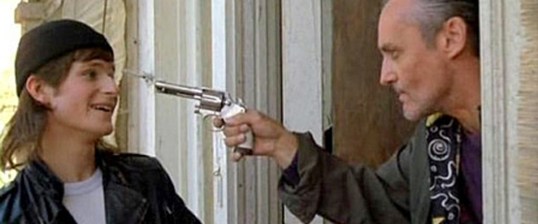
It’s true.  Rodney first lit up in 1942 when he was a 21 year-old struggling nightclub comic.  According to his widow, the moment meant so much to Rodney that, decades later, he could still remember the room number — 1411, at the Belvedere Hotel in New York City — where he and fellow comedians Bobby Byron and Joe E. Ross smoked that first joint.  That was back when Rodney was performing under the name Jack Roy.  (His was born Jacob Cohen.)  Rodney’s first comedy career went so badly that he quit and spent the next twenty-two years as an aluminum siding salesman until he found the courage to return to the stage.  However, whether he was selling or performing, Rodney never stopped smoking marijuana.  When he was working on his autobiography, he wanted to call it My Lifelong Romance With Marijuana.  His wife convinced him to go with a different title:  It’s Not Easy Bein’ Me: A Lifetime of No Respect but Plenty of Sex and Drugs.

There’s plenty of drugs in Easy Money, which is a problem for baby photographer Monty Capuletti (Rodney, of course).  Monty likes to gamble, drink, and smoke pot, much to the disapproval of his wealthy mother-in-law (Geraldine Fitzgerald).  When she dies, she stipulates in her will that if Monty goes for a year without indulging in any of his vices, he and his family will receive 10 million dollars.  Sounds easy, right?  The only problem is that Monty really likes to eat, drink, gamble, and get high.  His best friend (Joe Pesci) doesn’t think he can do it.  His mother-in-law’s former assistant, Quincy Barlow (Jeffrey Jones), is determined to catch Monty slipping back into his old ways so that he can inherit the money.  Monty’s determined, though, to win the money for his family, especially now that his daughter (Jennifer Jason Leigh) has married the bizarre Julio (Taylor Negron).

The episodic plot is really just an excuse for Rodney to be Rodney, spouting off one liners and making snobs like Quincy look foolish.  Rodney and Joe Pesci were a surprisingly effective comedy team.  The scene where they get stoned and try to drive home without damaging the huge wedding cake in the back of the van is a hundred times funnier than it has any right being.  Even though it is hard to imagine her being, in any way, related to Rodney Dangerfield, Jennifer Jason Leigh is always a welcome presence.  Like many comedies of that era, Easy Money is uneven, with as many jokes failing as succeeding but, for Rodney Dangerfield fans, it is a must see.

Back to School #43: River’s Edge (dir by Tim Hunter)


In his film guide, Heavy Metal Movies, Mike McPadden describes the disturbing 1987 teen crime drama River’s Edge as being “666 Candles“.  It’s a perfect description because River’s Edge appears to not only be taking place in a different socio-economic setting than Sixteen Candles and The Breakfast Club but perhaps on a different planet as well.

River’s Edge opens with a close-up of a dead and naked teenage girl lying on the edge of a dirty, polluted river and it gets darker from there.  The dead girl was the girlfriend of the hulking John Tollet (Daniel Roebuck, playing a character who is miles away from his role in Cavegirl).  As John explains to his friends, he strangled her for no particular reason.  His friends, meanwhile, respond with detachment.  Their unofficial leader, the hyperactive Layne (Crispin Glover), insists that since nothing can be done about the dead girl, their number one concern now has to be to keep John from getting caught.  While Layne arranges for John to hide out with a one-legged drug dealer named Feck (Dennis Hopper), two of John’s friends, Matt and Clarissa (played by Keanu Reeves and Ione Skye), consider whether or not they should go to the police.  Oddly enough, John really doesn’t seem to care one way or the other.

Seriously, River’s Edge is one dark film.  If it were made today, River’s Edge would probably be directed by someone like Larry Clark and, in many ways, it feels like a distant cousin to Clark’s Bully.  The teenagers in River’s Edge live in a world with little-to-no adult supervision.  Matt’s mom is more concerned with whether or not Matt has been stealing her weed than with the fact that Matt might be covering up a murder.  The local high school teacher is a former hippie who won’t shut up about how much better his generation was compared to every other generation.  In fact, the only adult with any sort of moral code is Feck and he’s usually too busy dancing with a sex doll to really be of much help.  It’s a world where no one has been raised to value their own lives so why should they care about a dead girl laying out on the banks of the river?

The film features good performances from Keanu Reeves, Ione Skye, and Daniel Roebuck but really, the entire movie is stolen by Crispin Glover and Dennis Hopper.  In the role of Layne, Glover is a manic wonder, speaking quickly and gesturing even when he isn’t making a point.  When Layne first shows up, he seems like he’s just overly loyal to his friend John but, as the film progresses, it becomes more apparent that he’s less concerned about protecting John and more interested in ordering other people to do it.  For Layne, protecting John is ultimately about maintaining power over Matt, Clarissa, and the rest of their friends.

As for Dennis Hopper — well, this is one of those films that you should show to anyone who says that Hopper wasn’t a great actor.  The role of a one-legged drug dealer who lives with a sex doll sound like exactly the type of role that would lead Hopper to going totally over-the-top.  Instead, Hopper gave a surprisingly subtle and intelligent performance and, as a result, he provided this film with the moral center that it very much needs.

Glover and Hopper


Back to School #40: Better Off Dead (dir by Savage Steve Holland)


Better-Off-Dead

There’s something really sad about knowing that John Cusack does not like the 1985 teen comedy, Better Off Dead, despite the fact that he himself starred in the film.

Just how much he dislikes the film depends on who you talk to.  I read an interview with the film’s director — the wonderfully named Savage Steve Holland — in which he said that Cusack approached him after a screening of the film and told him that he totally hated the film and would “never trust” Holland again.  (What’s truly sad is that Holland also said that this encounter caused him to momentarily lose all interesting in film making.)  However, a few years ago, Cusack said, while answering questions on Reddit, that he didn’t hate Better Off Dead, he just felt that it could be better and that he was glad that other people still like it.  In another interview, Cusack said that the “absurdist humor” of Better Off Dead just wasn’t his thing.

John, I understand that you’re a serious actor and I’ve always had a lot of respect for the fact that you’re an outspoken liberal who is still intellectually honest enough to hold Obama up to the same standard to which you previously held Bush.  But honestly, John, maybe you should loosen up just a little.  Not all of your movies have to be The Butler!  There’s nothing wrong with enjoying yourself onscreen.  And there’s nothing wrong with entertaining an audience and leaving them happy.  Better Off Dead may be one of more lightweight films that I’m reviewing for this Back to School series but it’s a lot of fun!  It makes people smile.  And you know what?  A lot of those smiling people are going to be more willing to see you in a film like The Butler because they’ve also seen you in films like Better Off Dead.

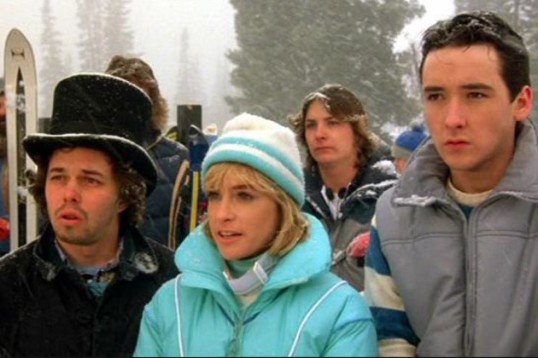
Add to that, you give a pretty good performance in Better Off Dead.  In fact, you provide the film with a much-needed center.  A lot of the comedy in Better Off Dead may be absurd but John, your performance is so likable and so grounded that you keep the film from getting too weird.  You do such a good job as Lane Myer and are so convincing as a well-meaning but dorky high school student who is trying to win back his ex-girlfriend (Amanda Wyss) by skiing down a mountain that it allows everyone else to be as weird as the film will allow.  Without your excellent performance, John, the film would be a total mess.

BOD

Better Off Dead is essentially a collection of skits.  There’s a plot but the plot is really only there as an excuse for the nonstop jokes.  For instance, there’s Lane’s best friend, Charles (Curtis Armstrong, essentially playing the same character he played in Risky Business) who spends the entire film looking for things to snort and who, when standing atop of snowy mountain, says, “This is pure snow!  Do you have any idea what the street value of this mountain is!?”

And then there’s Monique (Diane Franklin), the foreign exchange student who lives next door to Lane and who pretends that she can’t speak English because she’s trying to avoid being set up with creepy Ricky Smith (Daniel Schneider).

There’s Lane’s mother (Kim Darby), who cooks some of the strangest looking meals ever seen in an American film.  There’s also Lane’s younger brother, who never speaks but who knows how to build a laser gun.  Even Lane’s father (David Ogden Stiers). who seems relatively normal, still manages to destroy the garage door.

There’s the fact that Lane’s romantic rival is named Roy Stalin (Aaron Dozier).  Is that not just the perfect name for a villain?

There’s my favorite scene in the entire film, where a geometry teacher (Vincent Schiavelli) explains a complicated problem to his class and the class responds by cheering him along.  “Who wants to come up here and solve the problem?” the teacher asks.  The entire class raises their hands and goes, “Me!”

There’s quotable and memorable lines like: “I’ve been going to this high school for seven and a half years. I’m no dummy,” ” Now that’s a real shame when folks be throwin’ away a perfectly good white boy like that,” and “Gee, I’m really sorry your mom blow up, Ricky.”

And, of course, there’s that paperboy who wants his two dollars…

Seriously, John, Better Off Dead might not be your favorite movie but it’s really not that bad!

Want to see just how not bad Better Off Dead really is?  Watch it below!

http://www.youtube.com/watch?v=a3Q8oM_AnK8