October Positivity: Faith Of Our Fathers (dir by Carey Scott)


2015’s Faith Of Our Fathers tells the story of a road trip to Washington, D.C.

John (Kevin Downes) and Wayne (David A.R. White) might not seem to have much in common.  John is uptight and neurotic, on the verge of getting married but feeling like he has to do one final thing while his fiancée (Candace Cameron Bure) plans their wedding.  Wayne is a proud redneck, someone who lives in a trailer and enjoys picking fights.  When John first shows up at the trailer, Wayne shoots a shotgun at him.  When John refuses to leave, Wayne eventually allows him into the trailer and the two of them talk.

They are linked by their fathers, who both served and bonded in Vietnam.  Through flashbacks, we see how John’s father (Sean McGowan) found strength from his religious faith and how Wayne’s father (Scott Whyte, who viewers of a certain age will recognize from City Guys) eventually set aside his cynicism.  Wayne is in possession of the letters that his father wrote home from Vietnam and John, feeling a need to know who his father was, wants to read those letters.  Wayne agrees to show John the letters if he drives Wayne to Washington D.C. so that they can visit the Vietnam War memorial.

Along the way, the two of them bicker, bond, and have adventures.  This is a road film, which means that it has to take a while for John and Wayne to stop arguing with each other and start to open up about their pasts and their views on the modern world.  They meet a wide variety of people while on their trip, some of whom are trustworthy and many of whom are not.  They also meet Mansfield (Stephen Baldwin), who served in Vietnam with their fathers and who offers up some details about what happened to the men while they were serving in the military.

Unfortunately, the film itself doesn’t really work.  It has all of the flaws that one typically associates with a faith-based filmmaking.  The budget is noticeably low, something that especially becomes an issue during the Vietnam flashbacks.  The dialogue is often didactic.  Downes and White are familiar faces when it comes to faith-based films and they’ve both given good performances in other films but they both feel miscast here.  As played by Downes, John is a bit too neurotic to be believable (or particularly sympathetic) while White’s earnest and, at times, goofy style of performing feels wrong for a character who is supposed to be into random fights and beer.  For someone whose career has largely become about appearing in faith-based films, Stephen Baldwin seems rather detached throughout Faith of our Fathers.  In the flashbacks, he’s one of the least convincing commanding officers that I’ve ever seen in a war film.  In the modern scenes, he just seems bored.  If I’m being hard on Baldwin, it’s because I’ve seen him give really good performances in other films.  Knowing that he could be giving a good performance makes his bad performances all the more frustrating.

I will say this, though.  Faith of Our Fathers takes a stand for supporting our veterans, both when they’re serving and after they’ve come home.  I appreciated that.  All too often, we seem to hold the unpopular wars against those who served, as if the mistakes of those in command are somehow their fault.  That happened with Vietnam and it’s happening right now with Iraq and Afghanistan.  No one should ever be forgotten or deserted by their own country.
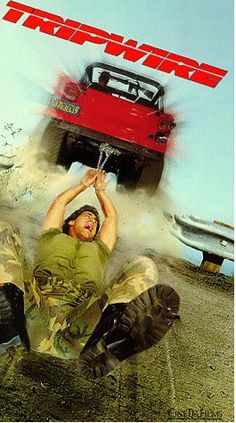
 

Tripwire (1989, directed by James Lemmo)


Terrorist Josef Szabo (David Warner) and his team (including Viggo Mortensen, Charlotte Lewis, and Sy Richardson) attempt to hijack a train that’s carrying weapons that they can use in their plans for world conquest.  Renegade ATF agent Jack DeForest (Terence Knox) catches them in the act and, in the resulting crossfire, Szabo’s son is killed.  Now looking for revenge, Szabo kidnaps Jack’s estranged wife (Meg Foster) and Jack’s son.   Even though his supervisor (Yaphet Kotto) claims that Jack is dangerous and out-of-control, fellow ATF agent Anne (Isabella Hofmann) teams up with Jack to rescue his family.

This is a well-done B action movie, featuring villains who have more depth than usual and an interesting opening sequence that plays out with almost no dialogue.  Terence Knox is not the most exciting of heroes (he was better served by television than the movies) but the supporting cast makes up for his character’s blandness.  Where also can you see Meg Foster, David Warner, Yaphet Kotto, Viggo Mortensen, and Tommy Chong (!) all in the same movie?  The mountainous Utah setting gives the film  a modern western feel and, though this may be a direct-to-video B movie, the cast gives it their all.  Tripwire is cinematic fast food, quick and just satisfying enough to leave you happy.

#MondayMuggers presents KINJITE: FORBIDDEN SUBJECTS (1989) starring Charles Bronson!


Every Monday night at 9:00 Central Time, my wife Sierra and I host a “Live Movie Tweet” event on X using the hashtag #MondayMuggers. We rotate movie picks each week, and our tastes are quite different. Tonight, Monday February 10th, we’re watching KINJITE: FORBIDDEN SUBJECTS starring Charles Bronson!

Back when I was a teenager, I would always get the entertainment section out of dad’s Sunday paper so I could check out the movie listings and see if there was a new movie I wanted to see. I would also look for information about my favorite movie star, Charles Bronson. Nowadays, we know about new movies months, even years, in advance, but back then I would first learn about them from the entertainment section of dad’s paper. I remember one Sunday in early 1989, seeing an advertisement for a new Charles Bronson film called KINJITE: FORBIDDEN SUBJECTS. It was the first time I had ever heard of the film. I knew I wasn’t going to get to see it at the movies because it was only playing in Little Rock, and it was rated R, but I was excited anyway because I knew it would be on its way to video pretty soon! 

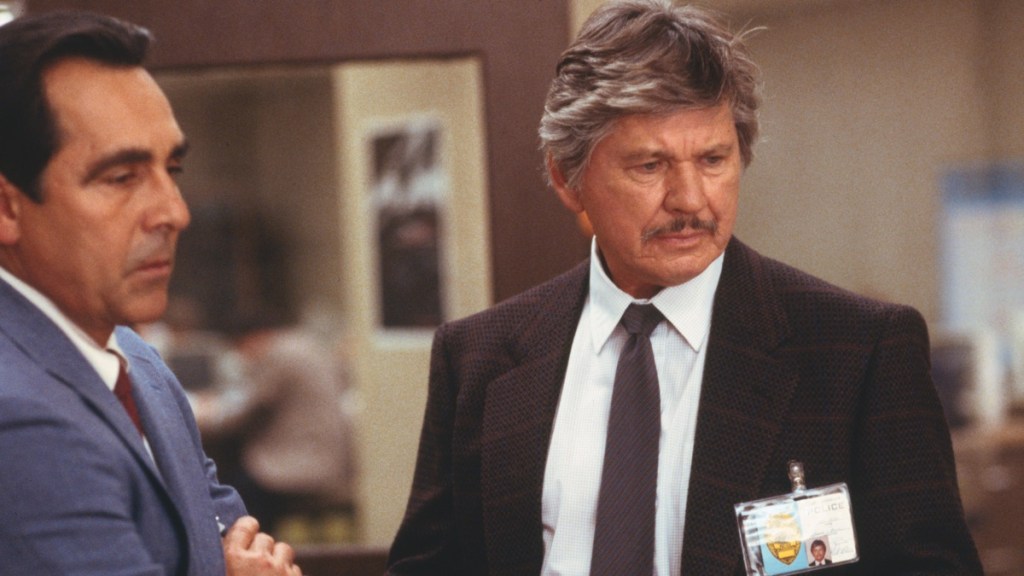
In KINJITE: FORBIDDEN SUBJECTS, Charles Bronson plays police lieutenant Crowe. He deals with the sleaziest criminals in Los Angeles on a daily basis and it’s starting to take a toll on his personal life. He’s currently personally invested in bringing down an underage prostitution ring led by Duke (Juan Fernandez) and Lavonne (Sy Richardson). When a Japanese businessman’s young daughter is kidnapped by Duke, Crowe decides he must do everything in his power to get her back to her family. 

Here is some interesting trivia about the film:

  1. Beginning with DEATH WISH II (1982) Charles Bronson made 8 films for the infamous Cannon Group. KINJITE: FORBIDDEN SUBJECTS was the last of those films. The others are 10 TO MIDNIGHT (1983), DEATH WISH 3 (1985), MURPHY’S LAW (1986), ASSASSINATION (1987), DEATH WISH 4: THE CRACKDOWN (1987), and MESSENGER OF DEATH (1988). 
  2. Director J. Lee Thompson directed Charles Bronson in 9 different films, with KINJITE: FORBIDDEN SUBJECTS being the final film he ever directed. Charles Bronson loved working with the same directors once he got comfortable with them. Thompson, who directed classics like THE GUNS OF NAVARONE (1961) and CAPE FEAR (1962), always made sure Bronson’s low budget Cannon films were filmed in a competent and professional manner. 
  3. Nicole Eggert plays a teen prostitute in this film and Amy Hathaway plays Charles Bronson’s daughter. Both were appearing in popular sitcoms at the time. Eggert was starring in CHARLES IN CHARGE and Hathaway was in MY TWO DADS. 
  4. The bad guy in the film is played by Juan Fernandez. He’s played some great villains in his day. Actor James Woods told me this about Juan, “The irony is that Juan Fernandez is one of the nicest actors I’ve ever worked with, and yet one of the most truly frightening villains. His work in SALVADOR was superb. A lovely, talented man.” 
  5. Perry Lopez, who plays Bronson’s partner in the film had worked with Bronson twice before. He appeared with Bronson in the excellent 1954 western DRUM BEAT, and also in 1987’s DEATH WISH 4: THE CRACKDOWN. 

So join us tonight to for #MondayMuggers and watch KINJITE: FORBIDDEN SUBJECTS! It’s on Amazon Prime.

I’ve included the trailer below:

Evil Obsession (1996, directed by Richard W. Munchkin)


11 models have been murdered in Los Angeles and Margo (Kimberly Stevens) fears that she could be next.  She’s been receiving threatening notes and feels as if someone is watching her and her boyfriend, Bill (Michael Phenicie).  She hires a private detective (Mark Derwin) to protect her but it might be too late because Homer (Corey Feldman), the man who has been sending her the notes, has already enrolled in the same acting class of Margo.  After Bill turns up dead, Homer is assigned to be Margo’s new scene partner.  Is Homer moving in for the kill or is someone else responsible for the murders?

This mix of erotic thriller and horror was one of those movies that used to show up on a late night Cinemax in the 90s, where it could be watched by teenagers who kept one eye on the screen and one eye looking out for their parents.  Corey Feldman starred in a lot of these films and in this one, he gives a twitchy and occasionally funny performance as the nerdy Homer.  Homer is the most obvious stalker imaginable and it’s hard to believe that Margo, who is so concerned about being stalked that she’s hired a private detective, would not look at Homer and immediately realize that he was the culprit.  Feldman overacts but he at least provides the film with the energy that is missing from the performances of Kimberly Stevens and Mark Derwin.  Even better is the performance of Brion James as the autocratic and pretentious acting teacher.  Watching him, I got the feeling that James probably could have based his performance on any number of Hollywood acting coaches.

Guilty Pleasure No. 62: Backtrack (dir by Dennis Hopper)


Sometimes, you see a film that is just so weird and incoherent that you can’t help but love it.

Of course, it also helps if the film has a once-in-a-lifetime cast of actors who you would never expect to see acting opposite each other.

For me, that’s certainly the case with 1990’s Backtrack.  Directed by Dennis Hopper, Backtrack is a film about an artist (Jodie Foster, channeling Jenny Holzer) who witnesses a mob murder committed by Joe Pesci, Dean Stockwell, Tony Sirico, and John Turturro.  An FBI agent played by Fred Ward suggests that the artist should go into the witness protection program but she doesn’t want to give up her life as a New York sophisticate who creates challenging LED displays and who can eat Sno Balls whenever she gets the craving for one.  (Yes, this is a plot point.)  Turturro and Sirico break into the artist’s apartment and kill her boyfriend, who is played by a wide-eyed Charlie Sheen.  The artist puts on a blonde wig and goes on the run, eventually getting a job in advertising.

Realizing that his men can’t get the job done, mob boss Vincent Price decides to hire a legendary hitman played by Dennis Hopper (who also directed this film) to track down the artist.  However, the hitman becomes fascinating with the artist’s work, finds pictures of her posing in black lingerie, and immediately falls in love with her.  Not only does he wants to save her life but he wants her to wear the same lingerie exclusively for him.  (Yes, this is a pretty big plot point.)  At first, the artist refuses and views the hitman as being some sort of pathetic perv.  But then she discovers that he’s covered her bed with Sno Balls….

Meanwhile, a young Catherine Keener shows up as the girlfriend of a trucker who briefly considers giving the artist a ride to Canada.

And then Bob Dylan shows up, handling a chainsaw.

And there’s Helena Kallianiotes, the outspoken hitch-hiker from Five Easy Pieces, yelling at Joe Pesci!

And there’s Dennis Hopper’s The Last Movie co-star, Julie Adams!  And there’s Toni Basil!  And there’s director Alex Cox!

Dennis Hopper not only starred in Backtrack but he also directed and it’s obvious that he placed a call into just about everyone he knew.  In fact, one could argue that the only thing more shocking than Vincent Price showing up as a mob boss is that Peter Fonda, Karen Black, Elliott Gould, Robert Walker Jr., and Kris Kristofferson are nowhere to be found in the film.  Hopper’s first cut of Backtrack was reportedly 3 hours long but the studio cut it down to 90 minutes, renamed it Catchfire, and Hopper insisted on being credited as Alan Smithee.  Later, Hopper released a two-hour version with the Backtrack title and his directorial credit restored.

Regardless of which version you see, Backtrack is an odd film.  It’s hardly the first film to be made about a hit man falling for his target.  What distinguishes this film is just how bizarre a performance Dennis Hopper gives in the role of the hitman.  It’s as if Hopper gave into every method instinct that he had and the end result was a mix of Blue Velvet‘s Frank Booth and the crazed photojournalist from Apocalypse Now.  Jodie Foster’s cool intelligence makes her the ideal choice for a conceptual artist but it also makes it hard to believe that she would fall for a jittery hitman and, in her romantic scenes with Hopper, Foster often seems to be struggling to resist the temptation to roll her eyes.  Somehow, their total lack of romantic chemistry becomes rather fascinating to work.  They are two talented performers but each appears to be acting in a different movie.  What’s interesting is that I think a movie just about Hopper’s spacey hitman would be interesting (and, if you’ve ever seen The American Friend, it’s hard not to feel that such a movie already exists) but I think a movie about just about Foster’s artist and her life in New York would be just as fascinating.  Taken as individuals, the artist and the hitman are both compelling characters.  Taken as a couple, they don’t belong anywhere near each other.

But let’s be honest.  This is a film that most people will watch for the parade of character actors delivering quirky dialogue.  Even if one takes Hopper and Foster out of this mix, this is an amazingly talented cast.  One need only consider that John Turturro did Do The Right Thing before appearing in this film while Joe Pesci and Tony Sirico did Goodfellas immediately afterwards.  This film features a once-in-a-lifetime cast, made up of actors who were apparently told to do whatever they felt like doing.  Turturro plays up the comedy.  Sirico plays his role with cool menace.  Stockwell barely speaks above a whisper.  Fred Ward plays the one sane man in a world of lunatics. Vincent Price delivers his line as if he’s appearing in one of Roger Corman’s Poe films and somehow, it makes sense that, in the world of Backfire, an Italian gangster would have a snarky, mid-Atlantic accent.

It’s an odd little film, an example of 80s filmmaking with a 70s sensibility.  While it’s not touched with the lunatic genius that distinguished Hopper’s The Last Movie, Backtrack is still something that should be experienced at least once.

Previous Guilty Pleasures

  1. Half-Baked
  2. Save The Last Dance
  3. Every Rose Has Its Thorns
  4. The Jeremy Kyle Show
  5. Invasion USA
  6. The Golden Child
  7. Final Destination 2
  8. Paparazzi
  9. The Principal
  10. The Substitute
  11. Terror In The Family
  12. Pandorum
  13. Lambada
  14. Fear
  15. Cocktail
  16. Keep Off The Grass
  17. Girls, Girls, Girls
  18. Class
  19. Tart
  20. King Kong vs. Godzilla
  21. Hawk the Slayer
  22. Battle Beyond the Stars
  23. Meridian
  24. Walk of Shame
  25. From Justin To Kelly
  26. Project Greenlight
  27. Sex Decoy: Love Stings
  28. Swimfan
  29. On the Line
  30. Wolfen
  31. Hail Caesar!
  32. It’s So Cold In The D
  33. In the Mix
  34. Healed By Grace
  35. Valley of the Dolls
  36. The Legend of Billie Jean
  37. Death Wish
  38. Shipping Wars
  39. Ghost Whisperer
  40. Parking Wars
  41. The Dead Are After Me
  42. Harper’s Island
  43. The Resurrection of Gavin Stone
  44. Paranormal State
  45. Utopia
  46. Bar Rescue
  47. The Powers of Matthew Star
  48. Spiker
  49. Heavenly Bodies
  50. Maid in Manhattan
  51. Rage and Honor
  52. Saved By The Bell 3. 21 “No Hope With Dope”
  53. Happy Gilmore
  54. Solarbabies
  55. The Dawn of Correction
  56. Once You Understand
  57. The Voyeurs 
  58. Robot Jox
  59. Teen Wolf
  60. The Running Man
  61. Double Dragon

Movie A Day #178: Kinjite: Forbidden Subjects (1989, directed by J. Lee Thompson)


This is the one where Charles Bronson sodomizes a guy with a dildo.

Don’t worry, though.  Bronson does it off-screen and the guy was abusing Nicole Eggert so he had it coming.

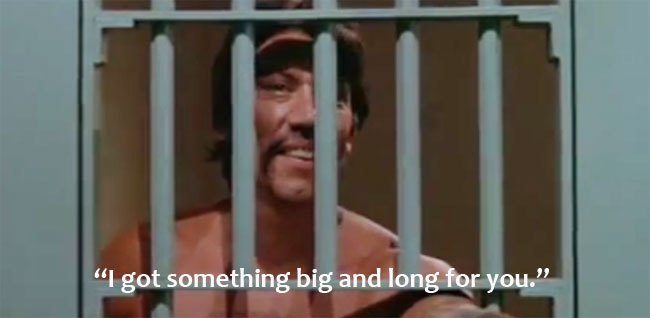
In Kinjite, Bronson plays Lt. Crowe, a tough LAPD vice cop who hates two groups of people: pedophiles (which is cool, who doesn’t hate them?) and the Japanese (which is not cool).  Not only does Crowe sodomize a pervert but he also forces a pimp to eat a gold watch and later, with the help of his partner, he holds another man over the edge of a balcony, just to have that man accidentally slip out of his shoes and plunge to his death.  Finally, Crowe tosses a convict into a prison cell, where another prisoner (played by Danny Trejo, in what may have been his film debut) announces that he’s “got something big and long for you.”  Crowe chuckles, “That’s justice” and then walks away.

Danny Trejo in Kinjite

Of the many strange films that Bronson made for Cannon Films, Kinjite may be the strangest.  The main plot involves Crowe searching for and rescuing the kidnapped daughter of a Japanese businessman (James Pax).  Before his daughter was kidnapped, the businessman groped Crowe’s fifteen year-old daughter on a city bus.  The entire movie seems to be building up to the moment that Crowe, who is portrayed as being overprotective of his daughter, discovers what the businessman did but that moment never comes.  There are numerous scenes of the businessman in Japan but they do not have anything to do with the rest of the plot.  Strangely, neither Crowe’s daughter nor his wife (played by Peggy Lipton) are ever menaced by the bad guys.  What type of Charles Bronson movie is this?

In Bronson’s defense, he was 71 year-old when he made this movie and, off screen, his wife Jill Ireland was battling the cancer that would eventually take her life.  Bronson can be excused for not appearing to be overly invested in Kinjite: Forbidden Subjects.  (Since Kinjite means Forbidden Subjects in Japanese, the actual title of this movie is Forbidden Subjects: Forbidden Subjects.)  No one appears to have made much of an effort on Kinjite, though Bronson’s stunt double gets a good work out.  Kinjite is full of scenes where Bronson throws a punch in close-up but his first in never actually shown connecting with anyone.  Most of the action scenes are clumsily filmed so that Crowe keeps his back to the camera.   All Kinjite needs is a supporting turn from Troy McClure and a cameo from McGarnagle and it would be perfect viewing for The Simpsons.

Kinjite would be the final film that Bronson made for Cannon Films.  It would also be the last Bronson film to be directed by J. Lee Thompson.  After Kinjite, Bronson appeared in two more feature films: Sean Penn’s The Indian Runner (which, if not for Penn’s pretentious direction, could have launched Bronson on a second career as a first-rate character actor) and a final Death Wish film.  Bronson returned to television, appearing in three made-for-TV movies before retiring in 1999.  Bronson died in 2003 but, as long as there are people who enjoy a good action movie, he will never be forgotten.

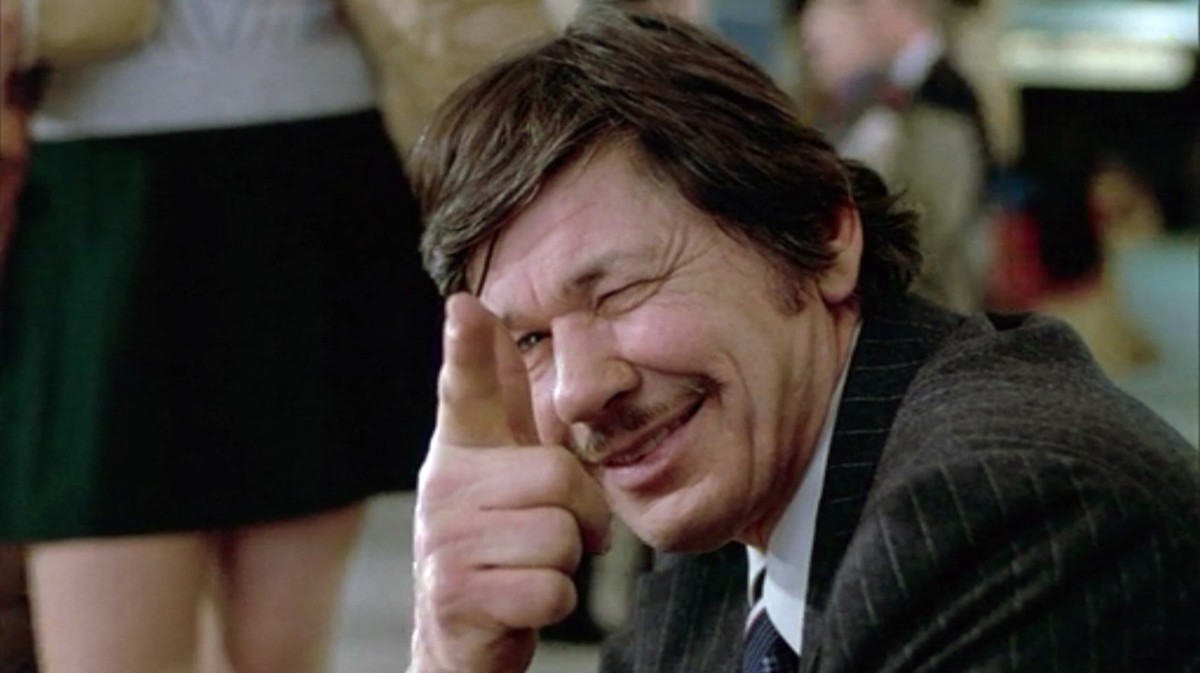
This scene is not from Kinjite but it’s still pretty fucking cool.