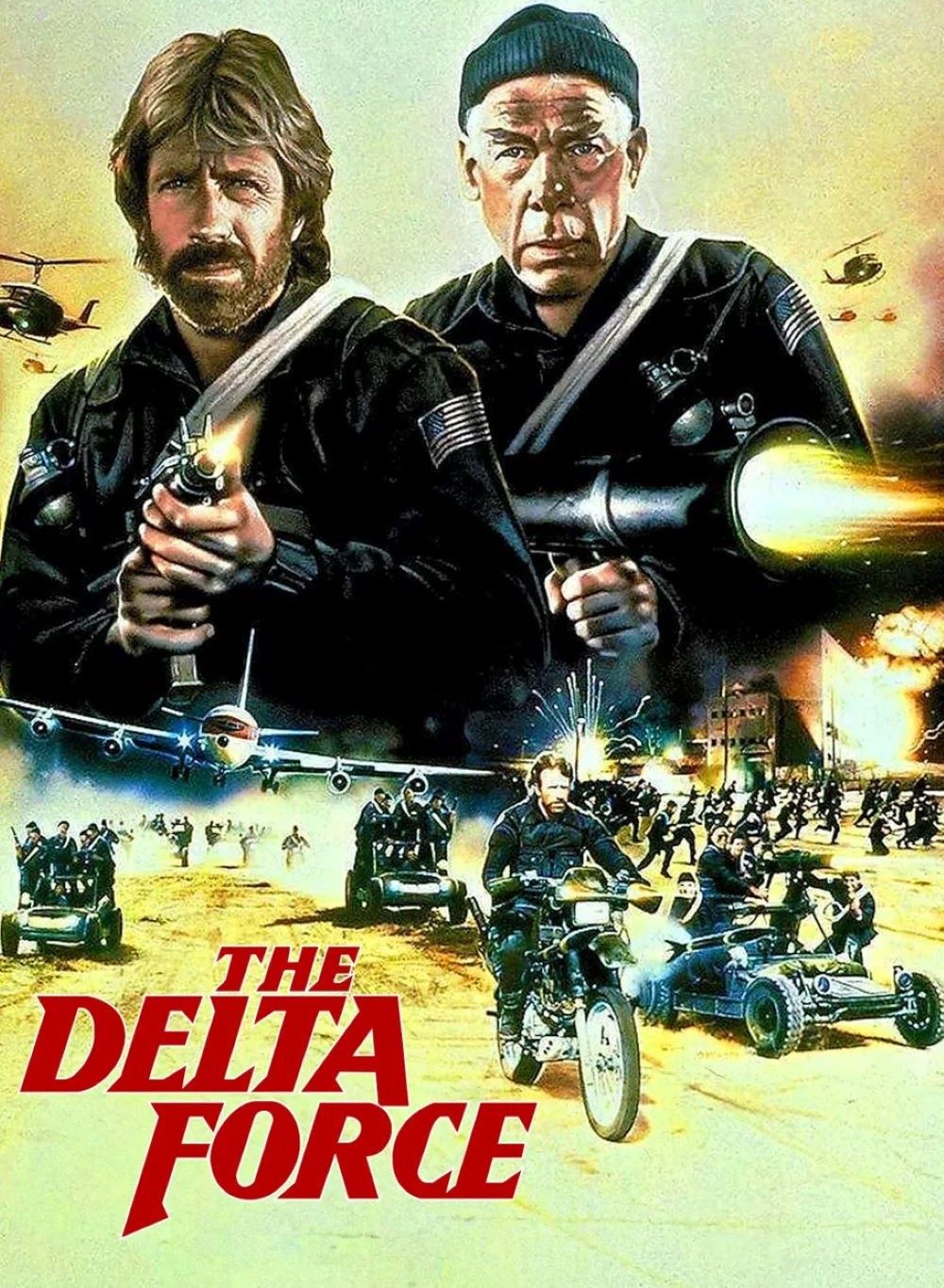
Guilty Pleasure No. 95: The Delta Force (dir. by Menahem Golan)


The Delta Force is the ultimate guilty pleasure from the ’80s, that rocket-bike-riding, Chuck Norris-kicking fantasy you pop on when you need two hours of unapologetic, brain-off escapism. It’s a hijacking thriller crossed with Cannon Films overkill, blending real Middle East tensions with pure action movie wish fulfillment, and yeah, it’s politically charged and dated as hell, but damn if it doesn’t deliver the kind of dumb-fun thrills that make you grin despite yourself.

Right from the jump, the film sets up its hook with a failed Delta Force raid in Iran, nodding to the real-life Eagle Claw disaster that still stung in 1986. Fast-forward, and Lee Marvin’s grizzled Colonel Nick Alexander gets yanked out of retirement when Lebanese militants hijack an Athens-to-New York flight, forcing it to Beirut and beyond. Enter Chuck Norris as Major Scott McCoy, the brooding ex-operator haunted by that botched op, who’s all too ready to strap on his gear when innocents are on the line. The setup drags you through passenger terror and terrorist demands, then explodes into rescue mayhem—it’s like the movie knows you’re here for the payback, and it serves it up hot.

As a plot, it’s pure popcorn simplicity: plane gets taken, hostages split by nationality and faith, planes hopscotch across terror hotspots, and Delta swoops in for the save. Drawing from the TWA 847 ordeal, the onboard stuff feels eerily real at first—sweaty close-ups of scared folks like Shelley Winters’ kvetching grandma or Martin Balsam’s anxious exec, turning the cabin into a pressure cooker. George Kennedy’s priest adds heart, and you almost buy the drama until Norris’ dirt bike starts spitting missiles, flipping the script to glorious absurdity. That’s the guilty pleasure pivot: from newsreel grit to arcade-game heroics, and you can’t help but love the whiplash.

Once the action ramps, The Delta Force leans into its B-movie soul with reckless abandon. McCoy’s team hits beaches, raids compounds, and yeah, that motorcycle sequence where Norris zips through baddies like a one-man apocalypse? Iconic cheese that screams “turn off your brain and enjoy.” It’s less about realism and more about catharsis—after watching hostages suffer, the third act’s bullet ballet feels like the justice porn we all secretly crave in these flicks. No deep strategy, just explosions and one-liners, perfectly tuned for that “hell yeah” rush that keeps you glued.

The cast is a riot of guilty-pleasure gold. Marvin, in his last role, growls through command with that unbeatable world-weary vibe, making every order land like gravitas wrapped in grit. Norris? Stone-faced perfection—says little, does everything, his quiet rage bubbling just enough to humanize the roundhouse legend. The passenger ensemble shines in panic mode: Winters chews scenery, Balsam frets convincingly, Kennedy prays with soul. Villain Robert Forster? Over-the-top terrorist glee, accent thick as plot armor, stealing scenes with gleeful menace that’s so cartoonish, it’s addictive.

Sure, the politics are a time-stamped minefield—terrorists as flat-out monsters, Middle East as villain playground, America as lone savior—but that’s part of the era’s guilty thrill. In a post-9/11 world, the stereotypes jar, yet for ’80s nostalgia buffs, it’s that raw, unfiltered patriotism dialed to eleven, the kind you laugh at now but cheered then. The film doesn’t pretend to balance views; it picks a lane—righteous rage—and floors it, making the righteousness feel perversely fun amid the preachiness.

Technically, it’s rough-around-the-edges charm personified. Menahem Golan directs with propulsive energy, keeping the 126 minutes zipping between dread and dazzle. Action’s shot clean—no shaky cam nonsense—with wide lenses capturing chaos in practical, pre-CGI glory that pops on a big screen. The score? Brass-blasting heroism that’s comically epic, sticking like glue and amping every slow-mo strut. Sets fake Beirut convincingly enough, backlots be damned, all fueling that immersive, low-budget magic.

The Delta Force thrives on its split personality: tense hijack bottle episode crashing into commando wet dream. Plane scenes build real unease, echoing headlines, but then rocket bikes and cheering crowds yank it back to fantasy ad. That clash? Pure guilty pleasure fuel—serious enough to hook you, silly enough to forgive its flaws, never letting tension sag.

Bottom line, embrace The Delta Force as peak time-capsule junk: terrorism tamed by ‘stache and firepower, geopolitics as blockbuster bait. Norris and Cannon diehards will fist-pump through every raid; casual viewers get a hoot from the excess. It’s flawed, fervent, and fantastically rewatchable— the kind of flick where you know it’s ridiculous, but two hours later, you’re humming the theme and plotting your next viewing. Guilty pleasure? Abso-freaking-lutely, and wear that shame badge proud.

Previous Guilty Pleasures

  1. Half-Baked
  2. Save The Last Dance
  3. Every Rose Has Its Thorns
  4. The Jeremy Kyle Show
  5. Invasion USA
  6. The Golden Child
  7. Final Destination 2
  8. Paparazzi
  9. The Principal
  10. The Substitute
  11. Terror In The Family
  12. Pandorum
  13. Lambada
  14. Fear
  15. Cocktail
  16. Keep Off The Grass
  17. Girls, Girls, Girls
  18. Class
  19. Tart
  20. King Kong vs. Godzilla
  21. Hawk the Slayer
  22. Battle Beyond the Stars
  23. Meridian
  24. Walk of Shame
  25. From Justin To Kelly
  26. Project Greenlight
  27. Sex Decoy: Love Stings
  28. Swimfan
  29. On the Line
  30. Wolfen
  31. Hail Caesar!
  32. It’s So Cold In The D
  33. In the Mix
  34. Healed By Grace
  35. Valley of the Dolls
  36. The Legend of Billie Jean
  37. Death Wish
  38. Shipping Wars
  39. Ghost Whisperer
  40. Parking Wars
  41. The Dead Are After Me
  42. Harper’s Island
  43. The Resurrection of Gavin Stone
  44. Paranormal State
  45. Utopia
  46. Bar Rescue
  47. The Powers of Matthew Star
  48. Spiker
  49. Heavenly Bodies
  50. Maid in Manhattan
  51. Rage and Honor
  52. Saved By The Bell 3. 21 “No Hope With Dope”
  53. Happy Gilmore
  54. Solarbabies
  55. The Dawn of Correction
  56. Once You Understand
  57. The Voyeurs 
  58. Robot Jox
  59. Teen Wolf
  60. The Running Man
  61. Double Dragon
  62. Backtrack
  63. Julie and Jack
  64. Karate Warrior
  65. Invaders From Mars
  66. Cloverfield
  67. Aerobicide 
  68. Blood Harvest
  69. Shocking Dark
  70. Face The Truth
  71. Submerged
  72. The Canyons
  73. Days of Thunder
  74. Van Helsing
  75. The Night Comes for Us
  76. Code of Silence
  77. Captain Ron
  78. Armageddon
  79. Kate’s Secret
  80. Point Break
  81. The Replacements
  82. The Shadow
  83. Meteor
  84. Last Action Hero
  85. Attack of the Killer Tomatoes
  86. The Horror at 37,000 Feet
  87. The ‘Burbs
  88. Lifeforce
  89. Highschool of the Dead
  90. Ice Station Zebra
  91. No One Lives
  92. Brewster’s Millions
  93. Porky’s
  94. Revenge of the Nerds

Horror On The Lens: Mazes and Monsters (dir by Steven Hilliard Stern)


Hi there and welcome to October!  This is our favorite time of the year here at the Shattered Lens because October is our annual horrorthon!  For the past several years (seriously, we’ve been doing this for a while), we have celebrated every October by reviewing and showing some of our favorite horror movies, shows, books, and music.  That’s a tradition that I’m looking forward to helping to continue this year!

Let’s get things started with 1982’s Mazes and Monsters!

Based on a best-seller by Rona Jaffe, Mazes and Monsters tell the story of some college students who enjoy playing a game called Mazes and Monsters.  Now, I realize that Mazes and Monsters may sound a lot like Dungeons and Dragons but they are actually two separate games.  One game takes place in a dungeon.  The other takes place in maze, got it?

When the players decide to play the game in some nearby caves, it causes the newest member of the group (Tom Hanks — yes, Tom Hanks) to snap and become his character.  Convinced that he’s living in a world full of monsters and wizard, Hanks runs away to New York.  How does that go?  During a moment of clarity, Hanks calls his friends and wails, “There’s blood on my knife!”

It’s all fairly silly.  There was a moral panic going on about role playing games when this film was made and this film definitely leans into the panic.  But, in its own over-the-top way, it works.  If you’ve ever wanted to see Tom Hanks battle a big green lizard, this is the film for you.  And I defy anyone not to tear up a little during the final scene!

From 1982, here is Mazes and Monsters!  Happy Horrorthon!

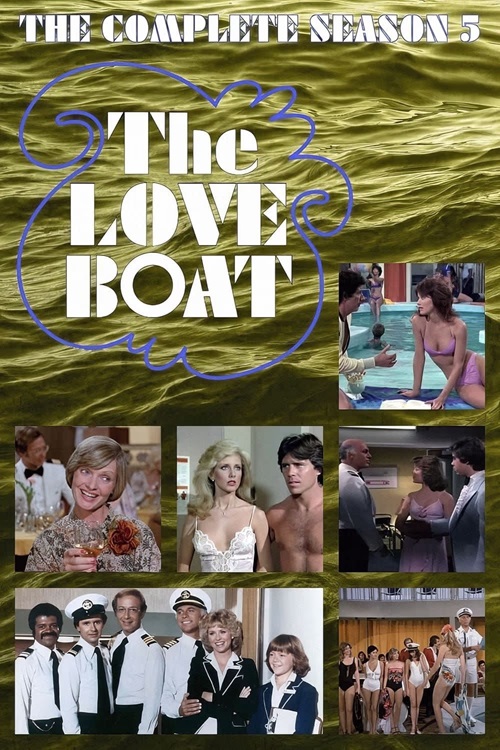
Retro Television Review: The Love Boat 5.26 “Pal-I-Mony-O-Mine/Does Father Know Best?/An ‘A’ for Gopher”


Welcome to Retro Television Reviews, a feature where we review some of our favorite and least favorite shows of the past!  On Wednesdays, I will be reviewing the original Love Boat, which aired on ABC from 1977 to 1986!  The series can be streamed on Paramount Plus!

This week, Ted Lange presents three stories of cruise ship love.

Episode 5.26 “Pal-I-Mony-O-Mine/Does Father Know Best?/An ‘A’ for Gopher”

(Dir by Ted Lange, originally aired on April 10th, 1982)

Dr. John Hanson (Ben Vereen) boards the ship with his new girlfriend, attorney Jenny Brooks (Denise Nicholas).  John is shocked to discover that his former girlfriend, Ellen (Lynne Moody), is also on the cruise.  Jenny befriends Ellen and, after listening to all the details of how Jenny supported John while he was going through medical school, she suggests that Ellen should sue John for palimony.  Jenny even offers to help Ellen and John figure out how much John owes her.  John agrees.  As he and Ellen itemize their former relationship, they come to realize that they’re still in love.  Sorry, Jenny!  Jenny leaves the boat alone.  John and Ellen leave the boat engaged.  (Jenny does give them a bill for her legal services.  John and Ellen have a good laugh.)

WOW!  That’s not the type of story that you regularly see on The Love Boat.  It’s rare for a passenger to leave as angry as Jenny did.  What’s surprising is that neither Ellen nor John seemed to feel that bad about Jenny getting her heart broken.  Then again, what was Jenny thinking when she invited Ellen back into their lives to begin with?  This is why you’re never friendly with your significant other’s exes.  I don’t care how nice they seem or act.  They’re all potential enemies!  I don’t care how polite they are when they approach you outside the Dallas Museum of Art and start speaking in their fakeass British accent, don’t trust them …. well, anyway, let’s move on.

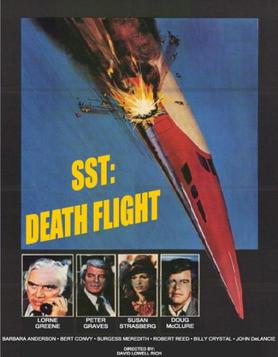
Gopher is super-excited when his junior high English teacher, Susan Wilkham (Susan Strasberg), boards the ship.  Gopher explains that he’s always had a crush on her and, now that Gopher is an adult, Susan appears to also now have a crush on him.  (Don’t freak out, she doesn’t even realize he was a former student until he specifically mentions that he was in her class.)  Except …. oh no!  Captain Stubing has a crush on her as well!  Well, don’t worry.  Things work out for Gopher.  While Vicki does not get a stepmother, Gopher gets a girlfriend who we will probably never hear about again.  Fred Grandy and Susan Strasberg made for a surprisingly cute couple.  (It helped that they both appeared to be the same age, despite the show’s effort to cast her as being “the older woman.”)  Good for Gopher, it’s about time something good happened to him.

Finally, a father (Lloyd Bochner) encourages his nerdy son (Kevin Brophy) to hit on a beautiful but snobbish blonde (Kristina Wayborn).  The son prefers the blonde’s shy best friend (Patty Freedman).  On every episode of The Love Boat, there’s one story that doesn’t amount too much and that what this story was.

Hey, this episode was directed by Isaac Washington himself, Mr. Ted Lange!  Obviously, The Love Boat isn’t really a show that demands or even allows an auteurist approach but I will say that this was one of the better acted episodes that I’ve seen.  Vereen and Moody, Grandy and Strasberg, they all had plenty of chemistry.  This was a truly pleasant cruise, despite Jenny’s anger.


Join #MondayMuggers For THE DELTA FORCE!


Hi, everyone!  Guess is who is guest hosting the #MondayMuggers live tweet tonight?  That’s right …. me!

Tonight’s movie will be The Delta Force (1986), starring Chuck Norris, Lee Marvin, Robert Forster, George Kennedy, Robert Vaughn, Steven James, Hanna Schygulla, Shelley Winters, Martin Balsam, Bo Svenson, Joey Bishop, Susan Strasberg, Kim Delaney …. well, you get the idea.  There’s a lot of people in this movie!  Jedadiah Leland swears that this is the greatest film ever made.  We’ll find out tonight!

You can find the movie on Prime and then you can join us on twitter at 9 pm central time!  (That’s 10 pm for you folks on the East Coast.)  See you then!

October Hacks: Sweet Sixteen (dir by Jim Sotos)


1983’s Sweet Sixteen takes place in a small town in Texas.

Sherriff Dan Burke (Bo Hopkins) does his best to try to maintain the peace but it’s not always easy.  Not when a good majority of the town is prejudiced against the Native Americans living on a nearby reservation.  There’s a major archeological dig happening on the reservation, headed up by Dr. John Morgan (Patrick Macnee), but the town doesn’t care about any of the artifacts that Dr. Morgan and his team might discover.  They’re too busy harassing local activist Jason Longshadow (Don Shanks) for stepping into the wrong bar.

However, a distraction from all of the casual racism has arrived in the form of Dr. Morgan’s daughter, Melissa (Aleisa Shirley).  Soon, it seems like every teenage boy and young man in town is lusting after Melissa.  Melissa, for her part, is only fifteen years old and is struggling to deal with all of the attention.  Sometimes, she enjoys the attention.  Sometimes, she just wants to be left alone.  (Believe me, as someone who had adults hitting on her when she was 13, I could relate.)  Melissa’s birthday is coming up and her mother (Susan Strasberg) is planning on throwing a big party and inviting the whole town to come over and celebrate.  Sheriff Burke thinks it’s a great idea.  “This town could use something to celebrate.”

The only problem is that any boy who so much as looks at Melissa ends up getting brutally murdered.  When an old Native American man named Greyfeather (Henry Wilcoxin) is spotted near the scene of one of the crimes, the local redneck blame him for the murders and tragedy ensues.  Sheriff Burke has to find the real murderer and, whether he likes it or not, he’s going to get some help from his kids, Hank (Steve Antin) and Marci (Dana Kimmel).

Hank and Marci really are this film’s secret weapons.  In the past, I’ve been pretty critical of Dana Kimmel’s performance in Friday the 13th Part 3 and her insistence that her character be re-written to reflect her own religious beliefs and desire to be a good role model.  However, Kimmel is really likable (and perhaps more appropriately cast) as the fiercely intelligent but still relatively innocent Marci, who reads murder mysteries and is totally excited about the prospect of getting to solve a real murder.  Hank is perhaps a bit less enthusiastic about about crime-solving than Marci but he still helps out his sister because she’s his sister.  Awwwwww!

Sweet Sixteen is a bit of an untraditional slasher film, one that is as concerned with social issues as is it was stalking and slashing teenagers.  Perhaps that explains why it has a slightly better cast than the typical 80s slasher, with veteran actors like Patrick McNee, Susan Stasberg, and Bo Hopkins acting opposite equally capable but younger actors like Kimmel, Antin, and Aleisa Shirley.  It’s also a surprisingly likable slasher film, due to the Dana Kimmel and Steve Antin’s engaging lead performances.  Honestly, I think it’s kind of a shame that there weren’t a series of films featuring Marci and Hank solving crimes.  Dana Kimmel and Steve Antin make quite a team in this above average slasher.

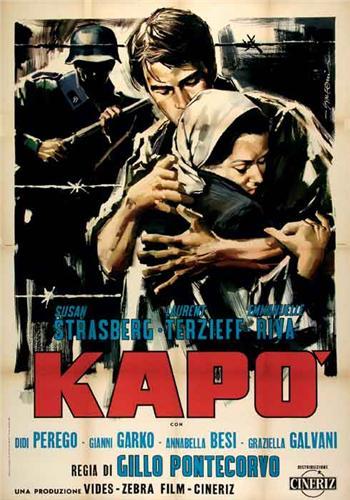
International Film Review: Kapo (dir by Gillo Pontecorvo)


What turns someone into a collaborator?

That’s the question that is at the heart of the 1960 Italian-French film, Kapo.

The film opens in Nazi-occupied France, with 14 year-old Edith (played by 22 year-old Susan Strasberg) practicing the piano at her teacher’s house.  Edith wears the yellow star on her dress and, as she finishes her lesson, her teacher instructs her to be careful returning home.  Edith cheerfully states that she and her family have nothing to worry about.  Edith walks home and, as the opening credits roll, we follow her as she walks through what appears to be a very robust and busy city.  Other than the yellow star on Edith’s dress, there are no outward signs of the occupation in the city.  However, when Edith finally reaches her neighborhood, she sees that her family and her neighbors are being rounded up the Germans.

Edith and her parents are sent to a concentration camp but get separated as soon as they arrive.  Wandering around the camp, Edith meets another prisoner named Sofia (Didi Perago).  Sofia takes Edith to the camp doctor.  He arranges for Edith to switch identities with a non-Jewish prisoner who has just died.  Edith’s new name is Nicole and her yellow star is removed and replaced by a black triangle, which designates Edith/Nicole as being “asocial.”

Edith is transferred to another concentration camp, this one in Poland.  She comes to think of herself as being Nicole.  When another prisoner, Terese (Emmanuelle Riva), asks her is she’s Jewish, Nicole replies that she’s not.  Nicole quickly grows hardened to life in the camp and exchanges sex for food.  She becomes the lover of a guard named Karl (played by future spaghetti western mainstay Gianni Garko) and is made a Kapo, a prisoner who also works as a guard.  However, when Nicole then falls in love with a Russian prisoner-of-war and he asks her to help him and his comrades escape, she is forced to finally decide whether she is Nicole or whether she’s Edith.

To return to the question that started this review: What makes someone a collaborator?  That’s the question that Kapo attempts to answer and it’s a question that was undoubtedly close to  Director Gillo Pontecorvo’s heart.  Pontecorvo was one of the most political of the post-World War II Italian filmmakers.  He was born in 1919 and, as a child, saw firsthand the rise of Mussolini.  As a Jew, he also experienced anti-Semitism firsthand and, in 1938, he left Italy for France.  In France, he befriended Sartre and many other key members of the International Left.  He was reportedly emotionally and politically moved by his friends who left France to fight on the Republican side during the Spanish Civil War.  During World War II, he joined the Italian communist party and fought in the resistance.  It’s perhaps not a surprise that, in Kapo, Nicole’s chance at redemption comes about as a result of falling in love with a communist soldier.

Unfortunately, Kapo struggles to answer the question of why one would collaborate with the enemy.  The main problem is that Susan Strasberg is miscast of Edith/Nicole, never convincing us that she’s a naïve teenager or a hardened collaborator.  She’s also not helped by a script that continually reduces everything down to who Edith/Nicole happens to be in love with at any given point of time.  It also doesn’t help that Strasberg find herself acting opposite Emmuelle Riva, Gianni Garko, and other actors who all authentic in a way that she’s not.

Kapo is more valuable as an examination of the horrors of the camps than as a character study.  The film’s most powerful moment comes early on, when Edith/Nicole learns that, in the eyes of the Nazis, it’s preferable that someone be a criminal to being a Jew.  In that moment, the film captures both the brutal horror and the arbitrary absurdity of prejudice.  The scene is followed by another harrowing moment, in which Edith can only helplessly watch as her parents are marched to gas chambers.  In those brief moments, Kapo becomes an important film.  You may not remember much about Edith/Nicole but you will remember those scenes.

I should also note that, regardless of its flaws, the film does end on a powerful note, one that will leave many viewers asking how much they would be willing to sacrifice to do the right thing.  Would you sacrifice your life to save hundreds of others?  It’s a question that Edith/Nicole has to answer, though the film leaves it ambiguous as to whether her final decision was made by her or if it was made for her.  Still, the film’s final images do stay with you.

In America, Kapo received a nomination for what was then known as the Best Foreign Film Oscar.  In Europe, though, many critics criticized Pontecorvo for making a film that they felt sentimentalized the Holocaust.  Stung by their criticism, Pontecorvo’s next film, which would be considered by many critics to be his masterpiece, would be the documentary-style The Battle of Algiers, one of the most resolutely anti-sentimental political films ever made.

Film Review: Psych-Out (dir by Richard Rush)


There’s a scene in the 1968 film, Psych-Out, in which a group of hippies are talking to be a liberal-minded minister, asking him if a mysterious figure known as “The Seeker” has even come by his church.  The minister tells them that he has not seen the Seeker, though he has heard of him.  As the hippies politely leave the church, one of them accidentally brushes past a middle-aged woman.  Though the hippie politely apologizes, the woman is still obviously disgusted by his presence in the church.  She asks her companion how the minister can possibly allow people who “dress like that” into the church.

As the woman complains, the camera focuses in on the stained glass window directly over her shadow.  There’s Jesus and the disciples.  They’ve all got beards.  They all have long hair.  They’re all wearing simple clothing …. oh my God, they’re hippies!

That’s actually one of the more subtle moments to be found in Psych-Out, an entertainingly heavy-handed film about hippies and wanderers in California.  Psych-Out was made at the height of the counter culture.  It was filmed on location in the San Francisco neighborhood of Haight-Ashbury, where both the love and the clothes are free and no one is about judging anyone else’s thing.  Into this neighborhood comes Jenny Davis (Susan Strasberg), who has run away from home and who is looking for her brother, Steve (Bruce Dern).  Jenny may have been raised in a conservative household but she’s eager to embrace the counter-culture.  Jenny is also deaf but she can read lips.  She also has the police looking for her but fear not!  The residents of Haight-Ashbury look after one another!  They have to, considering that there are still cops and even a few rednecks hanging out around the neighborhood.

No sooner has Jenny arrived in San Francisco than she falls in with a 30-something hippie named Stoney (Jack Nicholson, with a pony tail).  Stoney is a member of a band, along with Elwood (Max Julien) and Ben (Adam Roarke).  Even though Stoney says that he doesn’t care about material goods, he’s still eager to become a rock star.  Stoney also says that he doesn’t want to get tied down by any commitments.  He wants to do his own thing.  He may sleep with Jenny but that doesn’t mean that either one belongs to the other.  Stoney may say that but he certainly gets jealous when he sees Jenny talking to the local guru, Dave (Dean Stockwell).  Dave calls Stoney for being a phony.  “You may be righteous but you’re not hip,” Dave tells him.   Can Stoney become both righteous and hip before the film ends?  Can Jenny find her brother?  Will the band get signed to a recording contract and will the menacing junkyard rednecks ever see the errors of their fascist ways?

Today, of course, Jack Nicholson is probably the main reason why most people would want to see Psych-Out.  Ironically, for a figure who is so identified with the counter-culture, Jack Nicholson did not make for a very convincing hippie.  A lot of that is because Nicholson’s trademark sarcasm (which is on full display in Psych-Out, as this is a far more typical Nicholson performance than the one that would make him a star a year later in Easy Rider) owed more to the beats than to the hippies.  Nicolson’s persona always had more in common with Jack Kerouac than Abbie Hoffman.  In Psych-Out, he comes across as being too much of a natural skeptic to fit in with the free-spirited hippies all around him.  Nicholson is fun to watch because he’s Jack Nicholson but you never buy him as someone who would really want to live in a commune where no one has any possessions and money is frowned upon.

Dean Stockwell, on the other hand, is a totally believable hippie guru though, to his credit, his still brings some welcome wit to his role.  The script may call for him to recite some fairly shallow platitudes but he does so with just enough of a smile to let use know that not even Dave takes himself that seriously.  As for the rest of the cast, Bruce Dern gets to do his spaced-out routine and Henry Jaglom, who would later become an insufferably self-important director, plays an artist with huge sideburns who tries to chop off his hand while having a bad trip.  Jenny is horrified but everyone tells her not to judge.  Susan Strasberg is sympathetic as Jenny and is convincing as a deaf character.  Unfortunately, the film doesn’t give her much to do other than walk around San Francisco with a dazed expression on her face and stare lovingly up at Jack Nicholson.

Psych-Out‘s greatest value is probably as a time capsule.  It was filmed on location and it features actual hippies.  Watching it is like getting a chance to step into a time machine and go back to San Francisco in 1968.  Of course, judging from this film, San Francisco in 1968 wasn’t that appealing of a place but still, Psych-Out remains an entertainingly silly historical document.  Just a year after the release of Psych-Out, Charles Manson and his followers would come out of the canyons and the Altamont Free Concert would end in murder and the 60s would come to an abrupt end.  Watching Psych-Out, it’s hard to believe all of that was right around the corner.

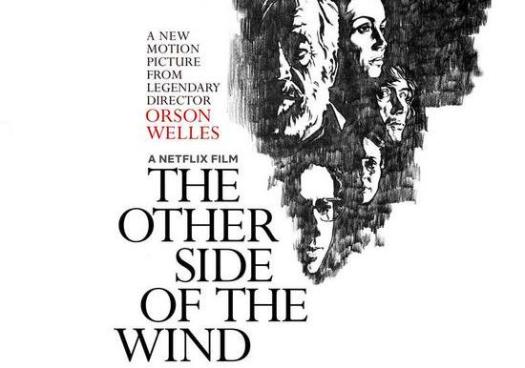
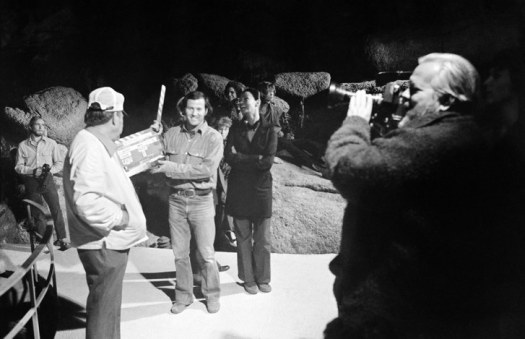
What A Long, Strange Trip It’s Been: Orson Welles’ THE OTHER SIDE OF THE WIND (Netflix 2018)


gary loggins's avatarcracked rear viewer

The day has finally arrived. November 2, 2018. I ordered a free trial of Netflix specifically so I could watch the completed version of Orson Welles’ final film, THE OTHER SIDE OF THE WIND . Welles worked on this project for over a decade, and the footage sat for decades more before finally being restored and re-edited. A film buff’s dream come true – perhaps. There were questions I needed answered. Was there enough salvageable material to make a coherent movie? Does it follow Welles’ vision? Would it live up to the hype? Was it worth the wait?

The answer: OH, HELL YEAH!!

Welles shot over ten hours of film, utilizing different film stocks (Super 8, 16mm, 35mm), switching back and forth from color to classic black and white, to create his movie, which is a documentary about the movie-within-the-movie’s director – a movie-within-a-movie-within-a-movie. It took six years (from 1970-76)…

View original post 719 more words

Cleaning Out the DVR #18: Remember Those Fabulous Sixties?


gary loggins's avatarcracked rear viewer

There’s a lot of good stuff being broadcast this month, so it’s time once again to make some room on the ol’ DVR. Here’s a quartet of capsule reviews of films made in that mad, mad decade, the 1960’s:

THE FASTEST GUITAR ALIVE (MGM 1967; D: Michael D. Moore) –  MGM tried to make another Elvis out of rock legend Roy Orbison in this Sam Katzman-produced comedy-western. It didn’t work; though Roy possessed one of the greatest voices in rock’n’roll, he couldn’t act worth a lick. Roy (without his trademark shades!) and partner Sammy Jackson (TV’s NO TIME FOR SERGEANTS) peddle ‘Dr. Ludwig Long’s Magic Elixir’ in a travelling medicine show, but are really Confederate spies out to steal gold from the San Francisco mint to fund “the cause” in the waning days of the Civil War. The film’s full of anachronisms and the ‘comical Indians’ aren’t all that funny…

View original post 728 more words

A Movie A Day #356: The Delta Force (1986, directed by Menahem Golan)


Last year, at this time, I set a goal for myself.

I decided that, in 2017, I would review a movie a day and I nearly succeeded. I didn’t review a movie on the day Chris Cornell died.  I missed a few days in March due to a sinus infection.  Including the review that I’m posting below, I reviewed 356 movies in 2017.  According to the year-end stats, my most popular reviews were for Heavy Metal Parking Lot, Slaughter, Body Chemistry 3, Body Chemistry 4, and Beatlemania.

Since tomorrow will be the start of a new year, this is going to be the end of my A Movie A Day experiment.  In 2018, I’ll still be watching movies and posting reviews on this site but this is my final daily review.  For my final Movie A Day, I picked the greatest movie of all time, The Delta Force!

Produced by Cannon Films, The Delta Force starts in 1980, with a helicopter exploding in the desert.  America’s elite special missions force has been sent to Iran to rescue the men and women being held hostage in the embassy.  The mission is a disaster with the members of Delta Force barely escaping with their lives.  Captain Chuck Norris tells his commanding officer, Col. Lee Marvin, that he’s finished with letting cowardly politicians control their missions.  Chuck heads to Montana while Lee spends the next few years hitting on the bartender at his local watering hole.

In 1985, terrorists led by Robert Forster hijack an airplane and divert it to Beirut.  Among those being held hostage: Martin Balsam, Shelley Winters, Lainie Kazan, Susan Strasberg, Kim Delaney, and Bo Svenson.  The great George Kennedy plays a priest named O’Malley who, when the Jewish passengers are moved to a separate location, declares himself to be Jewish and demands to be taken too.  Jerry Lazarus is a hostage who spends the movie holding a Cabbage Patch doll that his daughter gave him for luck.  Former rat packer Joey Bishop plays a passenger who says, “Beirut was beautiful then.  Beautiful.”  Fassbinder favorite Hanna Schygulla is the stewardess who refuses to help the terrorists because, “I am German!”

In America, General Robert Vaughn activates The Delta Force to rescue the hostages and take out the terrorists.  As Lee Marvin prepares everyone (including Cannon favorite, Steve James and, in a nonspeaking role, Liam Neeson) to leave, the big question is whether Chuck Norris will come out of retirement for the mission.  Of course, he does.  Even better, he brings his motorcycle with him.

Anyone who has ever seen The Delta Force remembers Chuck’s motorcycle.  Not only did it look incredibly cool but it was also mounted with machine guns and it could fire missiles at cowardly terrorists.  It didn’t matter whether you agreed with the film’s politics were or whether you even liked the movie, everyone who watched The Delta Force wanted Chuck’s motorcycle.  As the old saying goes, “You may be cool but you’ll never be Chuck Norris firing a missile from a motorcycle cool.”

The Delta Force is really three different films.  One film, shot in the style of a disaster film, is about the hostages on the plane and their evil captors.  The second film is Lee Marvin (in his final movie role) preparing his men to storm the airplane.  The third movie is Chuck Norris chasing Robert Forster on his motorcycle.  Put those three movies together and you have the ultimate Cannon movie.  The Delta Force was even directed by Cannon’s head honcho, Menahem Golan.  (Years earlier, Golan also directed Operation Thunderbolt, an Israeli film about the raid on Entebbe, which features more than a few similarities to The Delta Force.  Golan received his first and only Oscar nomination when Operation Thunderbolt was nominated for Best Foreign Language Film.)

The Delta Force is also the ultimate 80s movie.  It opens with the Carter administration fucking everything up and it ends with the Reagan administration giving Lee Marvin and Chuck Norris the greenlight to blow up some terrorists.  There is not much nuance to be found in The Delta Force but it still feels good to watch Chuck beat the bad guys.  Top that off with a shameless score from Alan Silvestri and you have one of the greatest action movies of all time.

At the end of The Delta Force, as cans of Budweiser are being passed out to rescued hostages, an extra is clearly heard to shout, “Beer!  America!”  Then everyone sings America The Beautiful.

That says it all.