Retro Television Review: Miami Vice 3.7 “El Viejo”


Welcome to Retro Television Reviews, a feature where we review some of our favorite and least favorite shows of the past!  On Mondays, I will be reviewing Miami Vice, which ran on NBC from 1984 to 1989.  The entire show can be purchased on Prime!

This week, Willie Nelson and Steve Buscemi guest star!

Episode 3.7 “El Viejo”

(Dir by Aaron Lipstadt, originally aired on November 7th, 1986)

Using their undercover identities of Burnett and Cooper, Crockett and Tubbs are attempting to take down a Bolivian drug lord named Mendez (Anwar Zayden).  Unfortunately, Crockett’s first attempt to bust Mendez does not go so well.  Their meeting, which is being held at a museum for some reason, is interrupted by a security guard.  In the resulting shootout, the security guard is killed and a green briefcase that’s full of cocaine is stolen by an old man named Jake Pierson (Willie Nelson).  Soon, Jake is attempting to contact Mendez himself, offering to bring him the briefcase.  Jake’s actions also bring him to the attention of Crockett and Tubbs, who both wonder why a 66 year-old Texan with no criminal record is suddenly trying to get involved in their drug deal.

Jake, it turns out, is a former Texas Ranger.  When he was younger, he was a legend.  He and his partner took down criminals like Bonnie and Clyde and protected Texas from Mexican revolutionaries who were preying on the border towns.  It’s been a while since Jack retired.  Now, he lives in a tiny apartment and spends most of his time thinking about the past.  He’s still a killer shot with a gun and knows how to handle himself in a fight.  But he also has a heart condition and, in fact, he would have died early on in the episode if Tubbs hadn’t given him his pills.  Crockett, for his part, idolizes the Texas Rangers, to an extent that almost seems out-of-character when you consider how cynical Crockett is usually portrayed as being.  Crockett is stunned that a former Ranger would be involved with running drugs.  Even though he’s pretending to be career criminal Sonny Burnett, Crockett still asks Jake about all of his adventures as a Ranger and does little to hide how impressed he is.

So, why has Jake gone over to the bad side?  Well, he really hasn’t.  It turns out that the son of his former partner was murdered by Mendez and Jake is looking to get revenge.  It all leads to a number of shoot-outs, including an exciting one that occurs on a Miami highway and an explosive finale at a cemetery.  Jake kills Mendez and his men but, in typical Miami Vice fashion, he takes a bullet himself and dies right after he reveals that he knew Crockett was a cop all along.

This episode features two notable guest stars.  Along with Willie Nelson, Steve Buscemi shows up in a small but memorable role as Rickles, who serves as a go-between for Crockett and Mendez.  Buscemi is as wonderfully weaselly as ever and, even though he’s a bit stiff as an actor, Nelson still brings a lot of Texas authenticity to the character of Jake Pierson.  Of course, in real life, Vice would have stopped Willie and searched his tour bus as soon as he entered the Miami city limits.  This is a pretty dark episode but it’s still amusing to watch iconic hippie stoner Willie Nelson play a cop, even if Jake is retired.

This was a good episode.  That Don Johnson and Willie Nelson were friends in real life is easy to deduce from witnessing how easily they play off of each other in this episode.  This is another episode where the bad guys are defeated but at the cost of a good guy.  Mendez will soon be replaced by another drug lord but no one will ever replace Jake Pierson.
 

Late Night Retro Television Review: Monsters 2.14 “Bed and Boar”


Welcome to Late Night Retro Television Reviews, a feature where we review some of our favorite and least favorite shows of the past! On Wednesdays, I will be reviewing Monsters, which aired in syndication from 1988 to 1991. The entire series is streaming on YouTube.

Episode 2.14 “Bed and Boar”

(Dir by Sara Driver, originally aired on January 21st, 1990)

Traveling salesman John Dennis (a young Steve Buscemi) just wants to get a good night’s rest in a sleazy motel but, unfortunately, the couple in the room next to his is making a racket.  A woman and a man are fighting and yelling at each other.  “Bitch!  Bitch!” the man seems to be yelling.  Finally, the woman (Jodie Markell) leaves her room, runs through the stormy night, and ends up in John’s room.

John take one look at the woman in her white nightgown (which has gotten soaked in the rain) and decides that he has absolutely no problem with her staying in his room.  He has no problem with her removing her wet nightgown and wrapping herself in the sheets of his bed.  The only problem that John has is with her husband (Charles Kay-Hune), who not only tries to break into the room but also has the head of a boar.

You would think that would be enough to convince John to find another motel but instead, after chasing off the board husband, John spends the night with the woman.  John declares that he’s falling in love with the woman.  When her husband literally tears down a wall to get at them, John fights off and kills the woman’s boar-headed husband.

And it’s only then that it occurs to John that the woman might be a witch (“He wasn’t yelling bitch, he was yelling….”) and that maybe she was the one responsible for turning her husband into a pig.  (Someone has obviously never read The Odyssey.)  Of course, by this point, John is himself starting to turn into a pig.

The good thing about this episode is that it features a young Steve Buscemi, playing one of his trademark quirky characters who never knows when to stop talking.  The bad thing is that the episode doesn’t really give Buscemi much to do, other than be an idiot.  Since it was obvious, to me, that the woman was a witch and that she was the one who turned her husband into a boar, I spent the entire episode waiting for some sort of a surprise twist.  I was waiting for John to reveal that he was a warlock or a werewolf or a vampire or anything other than just a salesman in a motel room.  But that never happened.  As a result, the whole story felt rather pointless.

On the plus side, the husband was frightening.  The show did a good job with the boar makeup because I I did jump a little when that thing came bursting into the room.  This was a case where the monster was better than the story.

Ghosts of Sundance Past: Living in Oblivion (dir by Tom DiCillo)


As we all know, this year’s Sundance Film Festival started yesterday.

To me, Sundance has always signified the official start of a new cinematic year.  Not only is it the first of the major festivals but it’s also when we first learn about some of the films that we’ll be looking forward to seeing all year.  It seems like every year, there’s at least one successful (or nearly successful) Oscar campaign that gets it start at Sundance.  For instance, it is probable that Past Lives will receive an Oscar nomination for Best Picture on Tuesday and its campaign started with how it was received at the 2023 Sundance Film Festival.

My plan for this year is to spend the last few days of January looking at some of the films that have won awards or otherwise created a splash at previous Sundance Film Festivals.

Like 1995’s Living in Oblivion for example….

Living in Oblivion centers around the filming of an independent movie called, appropriately enough, Living in Oblivion.  The film is being directed by Nick Reve (a youngish and, I’ll just say it, hot Steve Buscemi), a filmmaker whose indie cred does not protect him from the difficulties of shooting a movie with next to no budget.  His cinematographer is Wolf (Dermot Mulroney), who is talented but pretentious and who is dating the first assistant director, Wanda (Danielle von Zerneck).  The film stars Nicole (Catherine Keener), a struggling actress who is best known for appearing in a shower scene in a Richard Gere movie.  Also appearing in the movie is Chad Palomino (James LeGros), an up-and-coming star who is appearing in Nick’s film to build up his critical reputation.  (He also assumes that Nick is friends with Quentin Tarantino.)

We don’t really learn much about the plot of the film-within-a-film.  It appears that Nicole is playing Ellen, a woman who is trying to come to terms with her abusive childhood and her romantic feelings towards her friend, Damien (played by Chad Polomino).  The scenes of the film that we see alternate between being insightful, melodramatic, and pretentious.  We see Ellen confronting her mother about her abusive childhood but we also see a dream sequence in which Ellen, who is dressed as a bride, attempts to grab an apple from Tito, a person with dwarfism (played, in his film debut, by Peter Dinklage).

To talk too much about the film’s narrative structure would be to spoil one of Living In Oblivion‘s most clever twists.  What I can safely say is that, much as with Truffaut’s Day For Night, Living In Oblivion is more concerned with the production than the film that’s being shot.  Nick struggles to keep his cool.  Nicole struggles with her fear that she’ll always just be known as the “shower girl” and with the difficulty of keeping her performance fresh through multiple retakes.  Wolf makes a point of wearing an eyepatch after claiming Wanda injured his eye and turns sullen when Nick says he doesn’t want to shoot a scene with a hand-held.  A smoke machine first produces too little smoke and then too much.  When Chad does show up on set, he is passive-aggressively tries to change the blocking of one of the film’s most important scenes.  As for the dream sequence, it’s threatened when Tito denounces the scene and his role in it as being an indie film cliche.  Throughout, director Tom DiCillo contrasts the studied structure of a finished film with the chaotic reality that goes into shooting.

Living In Oblivion is an affectionate satire, one that pokes fun at the indie film scene while also celebrating all of the hard work and different personalities that are involved in making a movie.  Steve Buscemi and Catherine Keener give heartfelt performances as two people who understand that every movie could be their last while Dermot Mulroney scores some of the biggest laughs as the self-important Wolf.  James LeGros is hilariously shallow and vain as a character who is rumored to be based on one of the biggest movie stars of the past 30 years.  (“I want an eyepatch!” Chad declares while looking at Wolf.)  Living In Oblivion is a movie that celebrates the beautiful madness of trying to shoot an important film for next to no money in a grubby warehouse.  Throughout the film, the film’s crew is forced to compromise but, at the same time, there are also the small and unexpected moments that make it all worth it.

Living In Oblivion‘s witty script deservedly won the Waldo Salt Screenwriting Award at the 1995 Sundance Film Festival.  Living in Oblivion is a celebration of both cinema and independence.

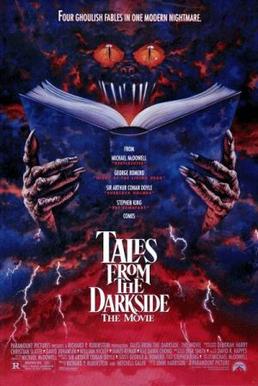
Horror Film Review: Tales From The Darkside: The Movie (dir by John Harrison)


First released in 1990 and based on a horror-themed television series that was created by the one-and-only George Romero, Tales From The Darkside: The Movie is an anthology film.  Usually, I can’t stand anthology films because it seems like the viewer only gets one good story and has to sit through two or three mediocre stories to get to the worthwhile stuff.  However, I have to say that I really enjoyed all of the stories featured in Tales From The Darkside: The Movie.

The film opens with a wrap-around story, featuring Timmy (Matthew Lawrence), a young boy who is chained up in a pantry and who a local witch named Betty (Debbie Harry) is planning on cooking for a dinner party.  Timmy tries to distract Betty from her kitchen duties by telling her three stories.

The first story features Steve Buscemi as a nerdy college student named Edward Bellingham.  On the verge of getting a much-needed scholarship, Edward is framed for theft by two of his classmates (one of whom is played by Julianne Moore) and loses the scholarship.  Edward responds by doing what anyone would do.  He unrolls an ancient parchment and brings to life a mummy who kills his rivals.  A very preppy Christian Slater plays Andy, the smug brother of one of the victims who seeks revenge against Bellingham.  In a surprise twist, Bellingham is able to get some vengeance of his own.

The second story features William Hickey as Drogan, an annoying old man who is convinced that he is being stalked by an evil black cat.  Drogan hires a hitman (David Johansen) to kill the cat but, as we all know, black cats are far more clever than anyone realizes.  The story ends on a notably grisly note because cats rule!

Finally, the third story features James Remar as a struggling artist who, one night, discovers that the stone gargoyle that sits atop of his apartment building is actually alive.  After witnessing the gargoyle kill someone, the artist promises never to reveal that the gargoyle exists.  “Cross your heart?” the gargoyle asks before flying away.  Later, the artist meets a mysterious woman (Rae Dawn Chong) who helps him to become a success on the art scene.  However, even after he marries the woman and they start a family, Remar is still haunted by his memories of the gargoyle.

As I said at the start of this review, I’m not a huge fan of anthology films but I really liked Tales From The Darkside: The Movie.  All three of the stories are equally good and there’s really not a slow spot to be found.  This is a horror anthology that manages to balance scares and laughs without becoming too silly or forgetting that the movie is meant to be a horror story.  Steve Buscemi, Christian Slater, and James Remar are stand-outs amongst the cast.  Even the wrap-around story had a good ending!

If you’re going to watch an anthology film for Halloween, allow me to recommend Tales From The Darkside: The Movie!

10 Oscar Snubs From the 1990s


Ah, the 90s. Some would say that this was the last good decade that the world would ever experience. It was certainly a good decade for films!  Still, there were some notable Oscar snubs during this decade.  Here are ten of them.

1990: Ray Liotta Is Not Nominated For Goodfellas

The fact that Ray Liotta did not even receive a nomination for playing Henry Hill in Goodfellas will always astound me.  While the film did receive several nominations (and really, it should have won the majority of them), Ray Liotta was snubbed despite the fact that it was his performance that pretty much held the film together.  Alec Baldwin, Tom Cruise, and Val Kilmer were among those who were considered for the role before Liotta received it.  They’re all fine actors but it’s hard to imagine any of them bringing Henry to life quite as well as Ray Liotta.

1991: John Goodman is Not Nominated for Barton Fink

“I WILL SHOW YOU THE LIFE OF THE MIND!”

It’s a little bit amazing that John Goodman has never received an Oscar nomination.  I don’t think he’s ever been scarier (and, in his way, more poignant) than when he played Charley “Mad Man Mundt” Meadows in Barton Fink.

1993: The Age of Innocence Is Not Nominated For Best Picture

While we’re on the subject of Scorsese films that were snubbed by the Academy, it’s amazing to me that Scorsese’s witty, smart, and visually stunning adaptation of The Age of Innocence did not receive a Best Picture nomination.

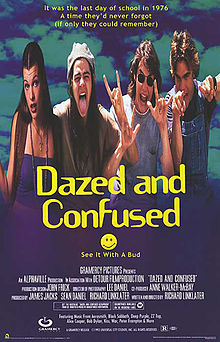
1993: Dazed and Confused Is Completely Snubbed

Okay, maybe this one isn’t as surprising as the Academy snubbing as Scorsese picture.  Even today, it’s doubtful that the Academy would embrace a film about a bunch of stoned Texas high school kids.  Still, it bothers me that Dazed and Confused received not a single nomination.  It’s certainly better remembered than many of the films that were nominated that year.

1995: Heat Is Completely Ignored

Considering that the film is now regularly cited as one of the best crime films ever made, it’s interesting to note that the Academy totally ignored Heat.  The film received no acting nominations.  Michael Mann was not nominated for his skill in juggling several different storylines.  The film didn’t even receive any technical nominations.  The cinematography was ignored.  You would think that the massive shoot-out would have gotten the film a nomination for Best Sound Editing but, even in that category, Heat was ignored.

Needless to say, Heat was not nominated for Best Picture.  The 1995 Best Picture line-up has always seemed like an odd mix of films, with Babe, Apollo 13, Sense and Sensibility, and Il Postino all losing out to Mel Gibson’s Braveheart.  Apollo 13 and Sense and Sensibility didn’t even receive nominations for their directors, Ron Howard and Ang Lee.  It was an odd year, I guess.  Heat was not the only acclaimed film to miss out on a Best Picture nomination but at least Casino, Leaving Las Vegas, and Dead Man Walking still received nominations in other categories.  Heat was totally snubbed.

1996: Steve Buscemi Is Not Nominated For Fargo

Despite being a cultural institution, Steve Buscemi has never received an Oscar nomination.  I would have nominated him for Fargo.

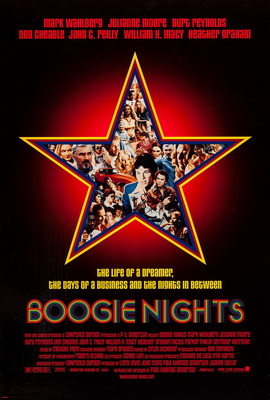
1997: Boogie Nights Is Not Nominated For Best Picture, Best Director, or Best Actor

Despite receiving two acting nominations for Burt Reynolds and Julianne Moore and a screenplay nomination, Boogie Nights missed out on the big award.  To be honest, I have a feeling that the film would have been nominated if it had been released today.  But, in the year of Titanic, the Academy may not have been ready to embrace a film about the Golden Age of Porn.  And they certainly weren’t ready to embrace Mark Wahlberg, despite his award-worthy performance of The Touch.  Given a choice, the Academy will always embrace the James Camerons of the world before it embraces the Jack Horners.  That said, as we saw in the film, Dirk and Angels Live In My Town swept the AFAA awaards and that’s the important things.

1997: Billy Zane Is Not Nominated For Titanic

C’mon, he was the best thing about the movie!  If Billy Zane can’t receive a nomination for shouting, “I hope you’ll be very happy together!” while chasing Leo and Kate through a sinking ship, what is the point of even having the Oscars?

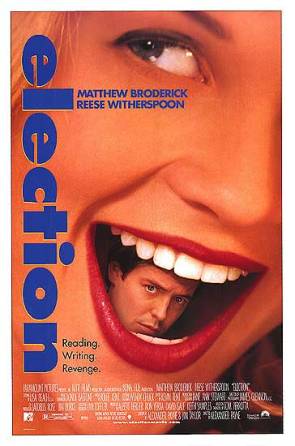
1999: Reese Witherspoon Is Not Nominated For Best Actress For Election

Reese Witherspoon’s performance as Tracey Flick is iconic precisely because it feels so real.  Everyone has known as Tracey Flick.  Everyone has been annoyed by a Tracey Flick.  Everyone has hoped for a Tracey Flick to fail.  And everyone has inwardly lost a little faith in karma as the Tracey Flicks of the world have continued to find work as mid-level bureaucrats.  In fact, I imagine that might be the reason why Reese Witherspoon was not nominated for her outstanding performance in Election.  No one wanted to reward Tracey Flick.

1999: Bruce Willis Is Not Nominated For Best Actor For The Sixth Sense

Seriously, everyone really took him for granted.  Just try to imagine The Sixth Sense with someone else in his role.

Agree?  Disagree?  Do you have an Oscar snub that you think is even worse than the 10 listed here?  Let us know in the comments!

Up next: A new century brings new snubs!

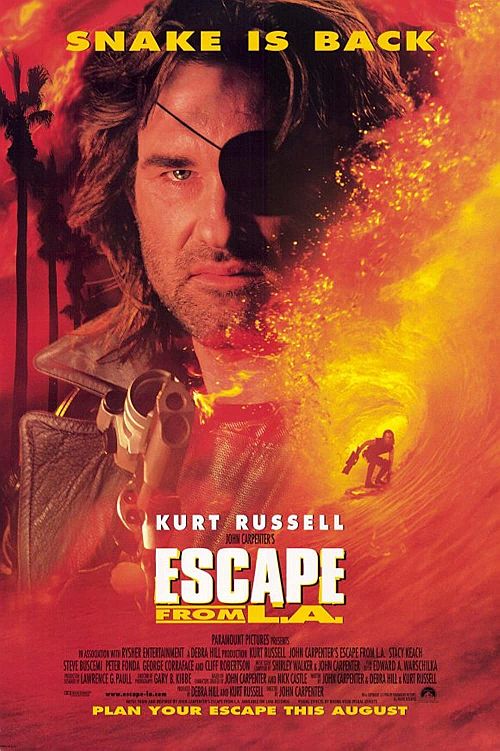
Live Tweet Alert: Join #FridayNightFlix for Escape From L.A.!


As some of our regular readers undoubtedly know, I am involved in a few weekly live tweets on twitter.  I host #FridayNightFlix every Friday, I co-host #ScarySocial on Saturday, and I am one of the five hosts of #MondayActionMovie!  Every week, we get together.  We watch a movie.  We tweet our way through it.

Tonight, at 10 pm et, I will be hosting #FridayNightFlix!  The movie? 1996’s Escape From L.A.!

Director John Carpenter reunites with Kurt Russell and Peter Fonda, Steve Buscemi, Bruce Campbell, and Cliff Robertson are along for the ride!

If you want to join us this Friday, just hop onto twitter, start the movie at 10 pm et, and use the #FridayNightFlix hashtag!  I’ll be there tweeting and I imagine some other members of the TSL Crew will be there as well.  It’s a friendly group and welcoming of newcomers so don’t be shy.

Escape From L.A. is available on Prime and Paramount!  See you there!

Ed and His Dead Mother (1993, directed by Jonathan Wacks)


After the death of his mother (Miriam Margoyles), shy Ed (Steve Buscemi) inherits the family hardware store.  Even though Ed now has his own business and maybe even a chance at having a relationship with Storm Reynolds (Sam Jenkins), Ed simply cannot leave the memory of his mother behind.  One day, he is approached by a salesman named A.J. Peddle (John Glover).  Peddle explains that he can bring Ed’s mother back to life for a thousand dollars.  Ed agrees and soon, Ed’s mother is once again living with Ed and Ed’s Uncle Benny (Ned Beatty).  Benny is upset because he doesn’t think that it’s proper to tamper in matters of morality and he never liked his sister to begin but, at first, Ed is happy to have her back.  However, Ed soon discovers that his mother has changed now that she’s come back to life.  She now has a craving for blood and soon, she’s chasing the neighborhood dogs while holding a knife.  Ed’s mom has returned as a zombie!  Can Ed finally move on and commit to sending his mother back to the grave?

This quirky comedy came out in 1993, a few years too early to take advantage of either the zombie boom or the horror comedy boom.  The movie never really find the right balance between scares and laughs.  The script is full of funny lines and Steve Buscemi and Ned Beatty are a good comedic team but the direction is as flat and as lifeless as Ed’s mom before she was resurrected.  Today, the movie is mostly interesting as a precursor for later trends in horror.  It’s also a chance to see Steve Buscemi is rare starring role.  Buscemi is ideally cast as the gentle Ed, who eventually learns the importance of letting go, accepting death, and moving on.  Buscemi is good, even in a misfire like this one.

Just two years after starring in this movie, Buscemi would appear on Homicide: Life on the Streets, playing a white supremacist murderer named Gordon Pratt.  Among the detectives assigned to arrest Pratt was Stanley Bolander, played by Ned Beatty.  As far as I know, that’s the only other pairing of Buscemi and Beatty and there wasn’t much to laugh about in that episode of Homicide.  It’s too bad because, judging from their interactions in this movie, Ned Beatty and Steve Buscemi could have been one of the great comedy teams.

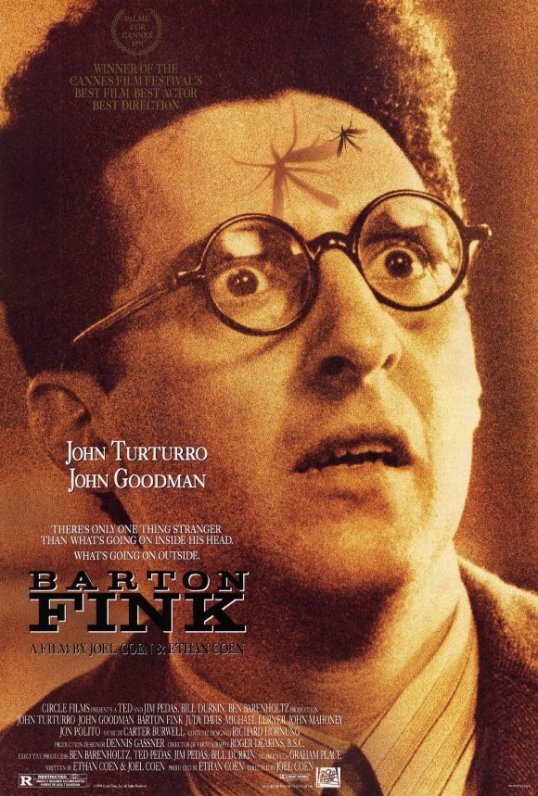
Lisa Reviews A Palme d’Or Winner: Barton Fink (dir by Joel and Ethan Coen)


With the Cannes Film Festival underway in France, I decided that I would spend the next few days watching and reviewing some of the previous winners of the Palme d’Or.  Today, I got things started with the 1991 winner, Barton Fink.

Directed by the Coen Brothers and taking place in the mythological Hollywood of 1941, Barton Fink tells the story of a writer.  Played by John Turturro, Barton Fink is a playwright who has just had a big hit on Broadway.  We don’t see much of the play.  In fact, we only hear the final few lines.  “No,” one the actors says, in exaggerated “common man” accent, “it’s early.”  From what we hear of the reviews and from Barton himself, it seems obvious that the play is one of those dreary, social realist plays that were apparently all the rage in the late 30s.  Think Waiting for Lefty.  Think Hand That Rocks The Cradle.  Think of the Group Theater and all of the people that Elia Kazan would later name as having been communists.  These plays claimed to tell the stories of the people who couldn’t afford to see a Broadway production.

Barton considers himself to be the voice of the common man, an advocate for the working class.  He grandly brags that he doesn’t write for the money or the adulation.  He writes to give a voice to the voiceless.  When his agent tells him that Capitol Pictures wants to put Barton under contract, Barton resists.  His agent assures Barton that the common man will still be around when Barton returns from Hollywood.  There might even be a few common people in California!  “That’s a rationalization,” Barton argues.  “Barton,” his agent replies with very real concern, “it was a joke.”  Barton, we quickly realize, does not have a sense of humor and that’s always a huge problem for anyone who finds themselves in a Coen Brothers film.

In Hollywood, Barton meets the hilariously crass Jack Lipnik (Oscar-nominated Michael Lerner).  Lipnik is the head of Capitol Pictures and he is sure that Barton can bring that “Barton Fink feeling” to a Wallace Beery wrestling picture.  Barton has never wrestled.  He’s never even seen a film.  The great toast of Broadway finds himself sitting in a decrepit hotel room with peeling wallpaper.  He stares at his typewriter.  He writes three or four lines and then …. nothing.  He meets his idol, Faulknerish writer W.P. Mayhew (John Mahoney), and discovers that Mayhew is a violent drunk and that most his recent work was actually written by his “secretary,” Audrey (Judy Davis).  He seeks help from producer Ben Geisler (Tony Shalhoub), who cannot understand why Barton is having such a difficult time writing what should be a very simple movie.  Barton sits in his hotel room and waits for inspiration that refuses to come.

He also gets to know Charlie Meadow (John Goodman).  Charlie is Barton’s neighbor.  Charlie explains that he’s an insurance agent but he really sells is “peace of mind.”  At first, Barton seems to be annoyed with Charlie but soon, Barton finds himself looking forward to Charlie’s visits.  Charlie always brings a little bottle of whiskey and a lot of encouragement.  Charlie assures Barton that he’ll get the script written.  Barton tells Charlie that he wants to write movies and plays about “people like you.”  Charlie shows Barton a wrestling move.  Barton tells Charlie to visit his family if he’s ever in New York.  Charlie tells Barton, “I could tell you some stories” but he never really gets the chance because Barton is usually too busy talking about his ambitions to listen.  Charlie tells Barton, “Where there’s a head, there’s hope,” a phrase that takes on a disturbing double meaning as the film progresses.  Just as Barton isn’t quite the class warrior that he believes himself to be, Charlie isn’t quite what he presents himself to be either.  Still, in the end, Charlie is far more honest about who he is than Barton could ever hope to be.

When it comes to what Barton Fink is actually about, it’s easy to read too much into it.  The Coens themselves have said as much, saying that some of the film’s most debated elements don’t actually have any deeper meaning beyond the fact that they found them to be amusing at the time.  At its simplest, Barton Fink is a film about writer’s block.  Anyone who has ever found themselves struggling to come up with an opening line will be able to relate to Barton staring at that nearly blank page and they will also understand why Barton comes to look forward to Charlie visiting and giving him an excuse not to write.  It’s a film about the search for inspiration and the fear of what that inspiration could lead to.  Towards the end of the film, Barton finds himself entrusted with a box that could contain his worst fears or which could cpntain nothing at all.  There’s nothing to stop Barton from opening the box but he doesn’t and it’s easy to understand why.  To quote another Coen Brothers film, “Embrace the mystery.”

There’s plenty of other theories about what exactly is going on in Barton Fink but, as I said before, I think it’s easy to overthink things.  The Coens have always been stylists and sometimes, the style is the point.  That said, I do think that it can be argued that Barton Fink’s mistake was that he allowed himself to think that he was important than he actually was.  Self-importance is perhaps the one unforgivable sin in the world of the Coen Brothers.  Like most Coen films, Barton Fink takes place in a universe that is ruled by chaos and the random whims of fate.  Barton’s mistake was thinking that he could understand or tame that chaos through his art or his politics.  Barton’s mistake is that he tries to rationalize and understand a universe that is irrational and incapable of being explained.  He’s a self-declared storyteller who refuses to listen to the stories around him because those stories might challenge what he considers to be the “life of the mind.”

Barton Fink is a film that people either seem to love or they seem to hate.  Barton, himself, is not always a  particularly likable character and the Coens seem to take a very definite joy in finding ways to humiliate him.  Fortunately, Barton is played by John Turturro, an actor who has the ability to find humanity in even the most obnoxious of characters.  (As obnoxious as Barton can be, it’s hard not to want to embrace him when he awkwardly but energetically dances at a USO club.)  Turturro has great chemistry with John Goodman, who gives one of his best performances as Charlie.  It’s putting it lightly to say that most viewers will have mixed feelings about Charlie but the film makes such great use of Goodman’s natural likability that it’s only on a second or third viewing that you realize that all of Charlie’s secrets were pretty much out in the open from the start.  Michael Lerner deserved his Oscar nomination but certainly Goodman deserved one as well.  The rest of the cast is full of Coen Brothers regulars, including Jon Polito as Lerner’s obsequies assistant and Steve Buscemi as Chet, the very friendly front deskman.  And finally, I have to mention Christopher Murney and Richard Portnow, who play two of the worst cops ever and who deliver their hardboiled dialogue with just the right mix of menace and parody.

Barton Fink won the Palme d’Or at Cannes, defeating such films as Spike Lee’s Jungle Fever and Lars Von Trier’s Europa.  It also won awards for the Coens and for John Turturro.  It’s perhaps not a film for everyone but it’s one that holds up well and which continues to intiruge.  Don’t just watch it once.  This isn’t a film that can fully appreciated by just one viewing.  This isn’t a Wallace Beery wrestling picture.  This is Barton Fink!

Everyone’s Changing In The Trailer for Hotel Transylvania 4!


I have to admit that my initial reaction to the trailer for Hotel Transylvania 4 was to say, “They’ve done four of these!?”

And it’s true. For an animated franchise that has never exactly been a critical favorite and which isn’t backed by PIXAR, there’s been quite a installments in the Hotel Transylvania saga. Regardless of what the critics may think, the films do well enough at the box office. I’d be lying I said I could remember much about the previous few installments but I do recall that they were cute if not particularly ground-breaking.

The fourth film explores what happens when all the monsters get transformed into human beings. It’s a good look for Frankenstein but less so for Dracula. Adam Sandler, who voiced Dracula in the previous three films, does not return in this installment and he has been replaced by YouTuber Brian Hull. As well, Kevin James will not be returning as Frankenstein and has been replaced by Brad Abrell. Selana Gomez, however, does return to voice Mavis and the great Steve Buscemi will be back as Wayne the Werewolf.

Hotel Transylvania 4 will be replaced on October 1st.

Horror(-ish) Film Review: Hubie Halloween (dir by Steven Brill)


“Oh my God!” I said as I looked at what was new on Netflix, “A Halloween movie starring the guy from Uncut Gems!?  THIS IS GOING TO BE INTENSE!”

Of course, as I’m sure you already guessed, Hubie Halloween might as well be taking place in a totally different universe from Uncut GemsUncut Gems was an intense drama that starred Adam Sandler as a man so self-destructive that he literally seems to spend the entire movie just daring death to reach out and take him.  Hubie Halloween, on the other hand, is fairly laid back comedy featuring Adam Sandler playing yet another well-meaning manchild.  The film features supporting performances from all the usual Happy Madison suspects, like Kevin James, Rob Schneider, Steve Buscemi, Tim Meadows, Ben Stiller, Maya Rudolph, Keenan Thompson, and Colin Quinn.  It’s sentimental and it’s about thirty minute too long and the humor is often juvenile but also frequently funny.

Adam Sandler plays Hubie, who lives in Salem, Massachusetts with his mother (June Squibb).  Hubie is the town eccentric, the type of guy who thinks that he’s protecting the entire town but who mostly just gets on everyone’s nerves.  A lot of people make fun of Hubie (who they call Pubie).  Pete Landolfa (Ray Liotta) may be mourning the recent death of his father but he still finds time to toss Hubie into an open grave.  Not even Father Dave (Michael Chiklis) has much sympathy for Hubie.  Hubie is the type of guy who goes down to the local school to give a speech on Halloween safety, just for the students (and teachers) to respond by throwing all of their food at him.

One of the few people who is nice to Hubie is his new neighbor, Walter Lambert (Steve Buscemi).  However, Hubie suspects that Walter might be a werewolf and when people start to disappear over the course of Halloween, Hubie suspects that Walter’s responsible.  Meanwhile, the police (represented by a heavily bearded Kevin James) thinks that it might be Hubie, seeing as how everyone who has disappeared is also someone who has bullied him.

Then again, Richie Hartman (Rob Schneider) has just escaped from the local mental institution.  Could he possibly have something to do with the mysterious happenings in Salem!?

When Adam Sandler won his Indie Spirit Award for Uncut Gems, he infamously announced that, if he didn’t get an Oscar nomination, he would get back at the Academy by making the worst film of all time.  Well, Sandler was snubbed the Academy.  (Though Sandler deserved that nomination — and probably nominations for The Meyerowtiz Stories, Funny People, and Punch-Drunk Love as well — it’s pretty obvious that the Academy is never going to nominate the star of That’s My Boy and Jack and Jill.)  However, Hubie Halloween is certainly not the worst film ever made.  It’s actually a rather likable and sweet-natured comedy, one in which the humor is definitely juvenile but, in contrast to some of the other Happy Madison comedies, never really mean-spirited.  In many ways, it’s a perfect Netflix film.  It’s good enough to keep you entertained while, at the same time, you don’t necessarily have to really pay attention to every minute of the film to get it.  It’s the epitome of the type of film that you can watch while doing something else.

One of the main complaints that’s always lodged against Sandler is that he primarily just makes movies so that he can hang out with his friends and get paid for it.  There’s a certain amount of truth to that statement and that, more than anything, explains why Sandler’s filmography tends to be so frustratingly uneven.  The cast of Hubie Halloween looks like they had a lot of fun making it.  Fortunately, in this case, that sense of fun actually translates onto the screen.  Steve Buscemi, June Squibb, and particularly Ray Liotta all seem to be having a ball getting to parody their own dramatic images.

Admittedly, Hubie Halloween is not a film that sticks with you.  It won’t make you laugh as much as Happy Gilmore and it won’t leave you stunned like Uncut Gems.  But, for what it is, it’s just likable enough to be entertaining.