Until Dogs and Cats Live Together, Your Childhood Will Survive: Ghostbusters (1984, directed by Ivan Reitman)


Harold-Ramis-Actor-300x300I always wanted to be Egon Spengler.

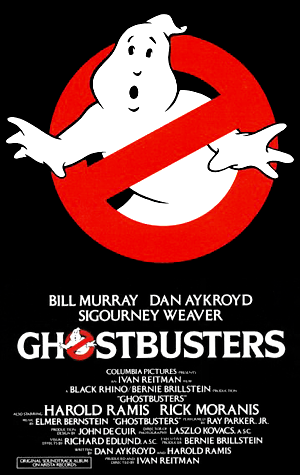
I can not remember how old I was when I first saw the original Ghostbusters but I know I was young enough that “Gatekeeper” and “Keymaster” went over my head.  But I do remember that Ghostbusters was one of my favorite movies from the first time I saw it and that Egon Spengler (played by the much missed Harold Ramis) was always my favorite character.

I know that, for most people, Peter Venkmen (Bill Murray) is their favorite.  It is true that Peter got the best lines and Sigourney Weaver.  But I always wanted to be Egon.  Egon was the one who knew everything.  He knew how to track down and capture ghosts.  He knew that the only way to defeat Gozer was to cross streams.  No matter what happened, Egon was never surprised or scared.  Egon always knew what to do.  Egon did not get Sigourney Weaver but he did get Annie Potts.

Dan Aykroyd’s Ray Stantz never gets as much attention as either Peter or Egon, even though, without Aykroyd, there never would have been a Ghostbusters.  Aykroyd originally envisioned Ghostbusters as being a sci-fi epic that would be a vehicle for him and John Belushi.  After Belushi died, Aykroyd and Harold Ramis rewrote the script and scaled back the story.  Bill Murray took the role that would have been played by Belushi and the famous ghost, Slimer, was created as a tribute to their fallen friend.

As for Ernie Hudson’s Winston Zeddemore, his role was much larger in the original script.  But with each rewrite, Winston’s role got smaller and Peter’s role got larger.  Winston’s role is still important because he is the ghostbuster who stands in for the audience.  He is not a skeptic like Peter but he’s not a true believer like Ray and Egon.  Winston just wants a steady paycheck.

Stay-Puft-Marshmallow-Man-Attacks-New-York-City-Ghostbusters

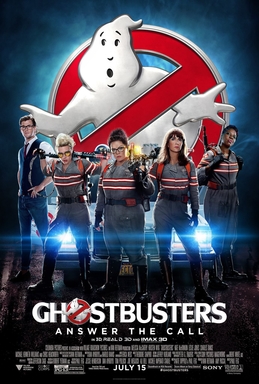
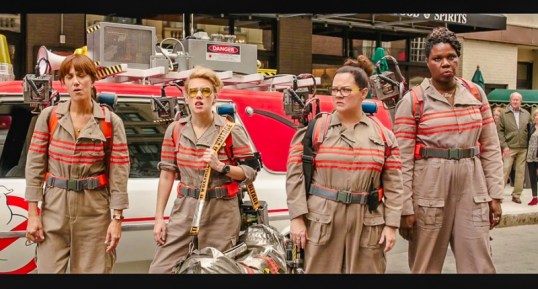
I remember loving the original Ghostbusters when I was a kid but a new Ghostbusters is being released today and I have read that some people think that it is going to destroy my childhood.  Since the lovely Lisa Marie Bowman and I are planning on seeing the new Ghostbusters tonight, we rewatched the original on Wednesday.  In case my childhood was on the verge of being destroyed, I needed to enjoy it one final time.

32 years after it was first released, the original Ghostbusters holds up well.  With the exception of Slimer and the Stay Puft Marshmallow Man, the special effects are no longer special but the script is still full of laugh out loud moments, from the opening with Bill Murray testing students for ESP to Rick Moranis asking random New Yorkers if they were the Gatekeeper to “It’s true … this man has no dick” to “when someone ask you if you are a god, you say yes!”  Even the song is still catchy.

As I watched the original Ghostbusters, I realized that my childhood was not in danger of being destroyed.  I hope the remake is good but even if it is terrible, the original Ghostbusters will always be there and it will always be too good to be forgotten.  The original Ghostbusters was both smart and funny enough to survive  a bad sequel, which Lisa and I made the mistake of watching after we finished the original and about which we swore to never speak again.  Ghostbusters will survive a remake.  If the remake is bad, it can be placed in storage with Ghostbusters 2, The Phantom Menace, X-Men: Apocalypse, Gus Van Sant’s Psycho, Batman and Robin, and every other ill-conceived remake, reboot, and sequel of the past 50 years.  If the remake is good, it will be continuing a fine legacy of comedy.  If a new audience enjoys the remake as much as we enjoyed the original, who are any of us to begrudge them that pleasure?

Whether the remake is good or bad, I’m not worried.

My childhood is going to be fine and so is everyone else’s.

Or, at least, it will be until dogs and cats start to live together…

Ghostbusters_cover

Shattered Politics #54: Dave (dir by Ivan Reitman)


Dave Poster

Way back in 1919, the terrible U.S. President and tyrannical dictator Woodrow Wilson* suffered a stroke that left him semi-paralyzed and unable to perform his duties.  By all standards, Wilson should have been removed from office, if just temporarily.  However, in those pre-Internet days, it was a lot easier to hide the truth about Wilson’s physical and mental condition.  While Wilson spent his days locked away in his bedroom, his wife Edith would forge his signature on bills.  Whenever anyone asked for the President’s opinion, Edith would give her opinion and then assure everyone that it was actually the President’s.

(And really, as long as you were promoting eugenics and white supremacy, it probably was not difficult to imitate Wilson’s opinions.)

Of course, back then, people were used to the idea of never seeing their President in public.  Hence, it was very easy for Wilson to remain sequestered in the White House.  If a similar situation happened today, it’s doubtful that anyone could successfully keep the public from finding out.  When we don’t see the President every day, we wonder why.  How, in this day and age, could a Presidential incapacitation be covered up?

The 1993 film Dave offers up one possible solution.

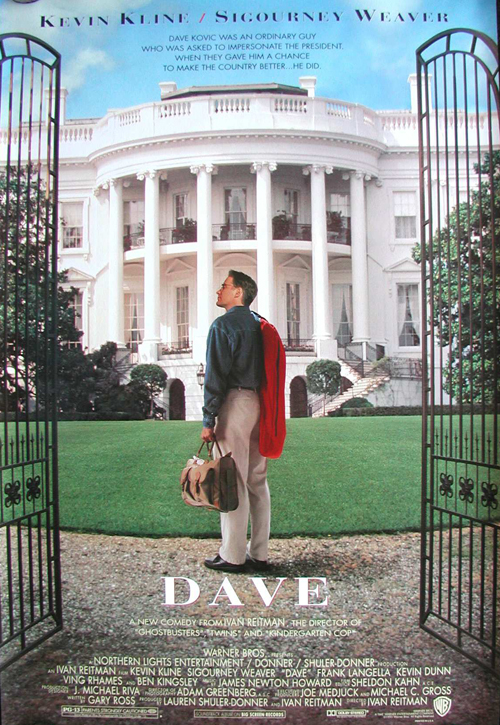
Dave is the story of two men who happen to look exactly like Kevin Kline.  One of them is named Bill Mitchell and he’s the arrogant and corrupt President of the United States.  The other is named Dave Kovic.  He’s a nice guy who runs a temp agency and who has a nice side job going as a professional Bill Mitchell imitator.

So, when Bill has a stroke while having sex with a white house staffer (Laura Linney), it only makes sense to recruit Dave Kovic to pretend to the President.  White House Chief of Staff Bob Alexander (played by Frank Langella, so you know he’s evil) tells Dave that Vice President Nance (Ben Kingsley) is insane and corrupt.  Dave agrees to imitate the President.  Of course, Alexander’s main plan is to convince Nance to resign and then get Dave to appoint him as Vice President.  Once Alexander is Vice President, it will be announced that Mitchell has had another stroke and then Alexander will move into the Oval Office.

However, what Alexander did not take into account was just how much Dave would enjoy being President.  From the moment that he joyfully shouts, “God Bless, America!,” Dave’s enthusiasm starts to win the public over.  Suddenly, people are realizing that President Mitchell isn’t such a bad President after all.  Even more importantly, Dave wins over the first lady (Sigourney Weaver) who, previously, had little use for her philandering husband.  When Alexander claims that there’s no money in the budget to continue funding a program for the homeless, Dave calls in his best friend, an accountant named Murray (Charles Grodin), and has him rewrite the budget…

And you know what?

Dave is one of those films that tempts me to be all cynical and snarky but, ultimately, the film itself is so likable and earnest that I can even accept the idea that one accountant could balance the budget through common sense alone.  I’ll even accept the idea that Dave could come up with a program that would guarantee everyone employment without, at the same time, bankrupting the country.  Kevin Kline is so enthusiastic in the lead role and the film itself is so good-natured that it almost feels wrong to criticize it for being totally implausible.

Sometimes, you just have to appreciate a film for being likable.

Dave—–

* For those of you keeping count, that’s the third time in two weeks that I’ve referred to Woodrow Wilson as being  a dictator.  Before anyone points out that some historians rank Wilson as being in the top ten of President, allow me to say that I don’t care.  I DO WHAT I WANT!

Trailer: Chappie (2nd Official)


Chappie

Chappie will be the third film from Neill Blomkamp and with the release of it’s second trailer there already seems to be a sort of negative buzz surrounding the film. The first trailer made Chappie look like a modern remake of the 80’s “robot come to life” film Short Circuit. For many this is not a good comparison.

This second trailer pulls back on the cutesy Chappie robot stuff and takes a much more ominous and serious tone. The film seems like it’s all about the danger of artificial intelligence and how Chappie may be the key behind what can make A.I. work or fail.

Yet, despite taking a much more action direct approach the negative buzz is still there. Maybe people are not as quick to embrace Chappie after the underwhelming (some say heavy-handed) result of Blomkamp’s follow-up to District 9 with Elysium. It’s an understandable reaction considering how high Blomkamp reached and succeeded with his very first feature film.

Chappie (and Neil Blomkamp) has between now and March 6, 2015 to convince people that it will not be another Icarus-like release.

Quick Review: Exodus: Gods & Kings (dir. by Ridley Scott)


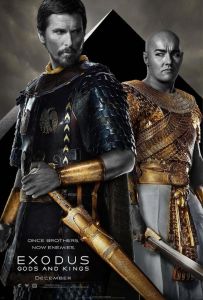
Exodus-Gods-and-Kings-Poster-Bale-and-EdgertonOkay, let’s face it.

After Cecil B. DeMille’s 1956 epic “The Ten Commandments”, it’s pretty hard to come up with another story about Moses that comes as close to it. I’ll admit I have a personal love for 1998’s The Prince of Egypt.  Ridley Scott makes a great attempt in his new film “Exodus: Gods and Kings”, but it comes off feeling like the result of having one person relay a story to you through 3 other individuals. By the time the story reaches you, it’s no longer the same tale.

This is a hard review to write with regards to avoid spilling details.

Exodus follows the story of brothers Moses (Christian Bale – The Dark Knight Trilogy) and Ramses (Joel Edgerton – The Thing, The Great Gatsby), sons to the great Pharaoh of Egypt (John Turturro). Both brothers are seasoned warriors, but with the passing of Pharaoh, a truth is brought to light that forces Moses into exile. During his time away, he finds God and makes it his mission to free his people. Ramses refuses to listen to reason, and some drastic measures are taken to help convince him.

That sounds great on the surface, but it’s the execution that’s flawed. And this is Ridley Scott of all people. I loved Kingdom of Heaven and moderately enjoyed Robin Hood, but I just didn’t completely feel like I was invested in this film.

Biblical tales are tricky. Stick too close to the source material and you can have a heavy-handed story that says what it should, but could bore some audiences. Take too many liberties, and you can have audiences excited, but leave some upset or shocked at what’s presented (like with Scorsese’s The Last Temptation of Christ). Here, the liberties are taken to a place where most of the movie doesn’t even require Moses to be in it. The argument could be made that the other films did this too – that the acts occurred with Moses as a harbinger of what was to come. Exodus makes it more of a difference of opinion on how to handle Ramses. Moses elects for a more battle hardened strategy – let the people fight for themselves. This left me wondering where they found the time and freedom away from the Egyptian Soldiers to learn what they did.

On the flip side of the coin, God decides to handle it Their own way. This leaves our Moses in a position where he’s at odds with the Almighty, a sharp contrast to the Moses that followed the Word to the letter. To an audience that can’t help but make comparisons, it’s way off, though it’s supported by the theme that one shouldn’t say things just to placate others and that they should follow what they believe. What came before basically said..”Okay, I don’t know what your plan is, but you’ve shown me your wonders, I believe in you and you’ll guide me right.” Exodus says..”Okay, you’ve got a plan I’m not too cool with, so…uh…just give me a chance to save / warn the people before your wrath comes down.”

There were four writers on board for Exodus. Both Adam Cooper and Bill Collage worked together on Brett Ratner’s “Tower Heist” and Jeffrey Caine is known for “The Constant Gardner” and “Goldeneye”. Steven Zallian (Moneyball, The Girl With the Dragon Tattoo, American Gangster) was the fourth. I’m thinking with all those fingers in the pie, the movie was bound to go in a different direction. Again, it’s not terrible, just different.

The casting for Exodus is okay. The strongest performances go to both Bale and Edgerton, and I’ll state here that I had more fun watching Edgerton on screen than I did with Bale. I haven’t seen him play the villain like this since The Guardians of Ga’Hoole and he does a decent job here. Bale does well, but it’s like watching Batman again. Not saying he’s typecast because of it, but seeing Christian Bale yell is almost expected in a movie these days. Reunited with her Aliens director, Sigourney Weaver has about 10 to 15 minutes total of screen time in the film, and Ben Kingsley might have the same amount. Aaron Paul spends most of his time making that stare he does when he see something incredible. There’s not a lot for any of these actors to chew on, but they try their best with it.  Both Indira Varma (Game of Thrones) and Ewan Bremer (Jack the Giant Slayer, Trainspotting) are on hand as Ramses’ advisors. They don’t really count too much in all this.

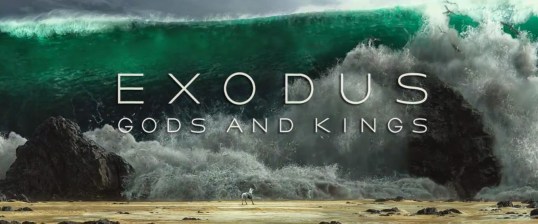
Visually, the effects for the Plagues are very good. I honestly think those segments were the best in the entire film. The rest, I’m not so sure. The Red Sea sequence, when it happens, it done in such a way that the mysticism is just about sucked out of it. I’m sitting there hoping for a big reveal and found myself asking if that was it. Perhaps it was the angle where I was sitting or the theatre I saw it in, but it wasn’t as clear as it could be. It seemed like I was watching a 3D version of the film (I went for the regular one). The fight sequences were also done very well, many of which were similar to Ridley’s Robin Hood or Gladiator. Also note that at 154 minutes, it’s a long film. I pulled my iPod Nano out of my pocket twice to check the time.

As for the kid factor, I would say that teens and older can see this. There’s quite a bit of violence early on, along with some bloodshed, but nothing too extreme. In terms of sexual situations, there really aren’t any.

I think overall, my expectations for what this could be were larger than the final product. Had I never known of any film prior to this, Exodus would have more of an impact for me. As it stands, I’d watch it again, but probably when it hits Cable.

Trailer: Exodus: Gods and Kings (Final)


Exodus Banner

Ridley Scott has been hit-or-miss (mostly misses) of late and response to the trailers and news about Exodus: Gods and Kings doesn’t seem to be helping.

Yet, despite all the indifference to Scott’s upcoming Biblical epic (and calls of whitewashing) I am quite intrigued about this take on the Book of Exodus. Will it have the pageantry of Demille’s The Ten Commandments (both of them)? Or will it be another CGI-overload? Or will it be a piece of entertaining pulp a la Gladiator? I guess we will find out this Holiday season.

Exodus: Gods and Kings is set for a December 12, 2014 release date.

Trailer: Chappie (Official)


Chappie

District 9 introduced Neill Blomkamp to the world. People bought into that film hardcore and were soon wondering what he would be doing next. Some fans of Blomkamp who have been following his career since he was first chosen by Peter Jackson to helm the now defunct Halo film thought he now had the leverage to get the film made. This was never going to happen.

The follow-up to District 9 was Elysium and the visuals that was slowly released for the film and having Matt Damon star in it gave it some major buzz and hype. The finished product was more than just a tad disappointing.

Was Elysium a hiccup?

People will find out on March 6, 2015 if this was indeed just a blip on the rising career of Neill Blomkamp as his third feature film, Chappie, will arrive in theaters.

Trailer: Exodus: Gods and Kings (Official)


Exodus Banner

Ridley Scott has been instrumental in bringing back the sword-and-sandal epic when he unleashed Gladiator to audiences everywhere in the summer of 2000. Since then he has made many films which range from black comedy to historical epic right up to horror and a war film.

With Exodus: God and Kings, Scott returns to the sword-and-sandal epic but now with a heavy dose of the Biblical as he adapts the Old Testament Book of Exodus. A film working on the same scope and scale as Cecil B. Demille The Ten Commandments released in 1956, this latest adaptation of Moses, Ramses and the exodus of the Israelites from Egypt looks to put the epic back in 2014.

With each passing year, more and more of Scott’s films have taken on the unavoidable sheen of the CGI as his visuals attempt to recreate time and places of Earth’s past. For some, Scott’s been more miss than hit with the last couple films yet they all remain visual feasts and Exodus: Gods and Kings looks to continue that streak. Whether the film will be good storytelling will be something that’s still to be decided.

Exodus: Gods and Kings is set for a December 12, 2014 release date.

Horror Scenes I Love: Alien


Lisa Marie Bowman had chosen her favorite scene from Dario Argento’s Suspiria as her latest “Scenes I Love” post and it’s quite the scene. I will match her choice with a horror scene which remains one of my favorite scenes in film history. It is also a scene from one of the best scifi-horror films ever made and, I would dare to even say, one of the best films ever created. The scene I speak of comes from Ridley Scott’s classic and iconic film Alien.

Anyone who has ever watched this classic scifi-horror will always gravitate towards talking about one particular scene. The scene is the first time the crew of the space tug Nostromo gets together to a meal as a group after the crisis which saw one of their own crew members attacked by an alien creature. This scene started off quite normal. Professionals enjoying food and good company. It’s through Ridley Scott’s direction and the exceptional performances of all involved which elevates the scene to one of the greatest. Through the scene’s depiction of normalcy we start to get a sense that something may not be right even before Kane begins to cough and have convulsions. For me it was a prolonged shot of crew member Ash during the banter around the table. His expression is all subdued smile then for just a split second we see him glance at Kane eating and being merry but he knows something is wrong and about to happen.

Even if people didn’t pick up that moment from Ash it still created a subconscious effect on the audience so that when Kane did begin to cough and convulse uncontrollably the audience was already on the razor’s edge. When the climactic event which punctuates this scene finally occurs the surprise on all the actors, especially that of actress Veronica Cartwright, has gone done as in film history as a classic. It helped that their reactions were quite genuine. Even knowing that the chestburster alien would pop out it was not being told that fake blood would squirt out that made their reaction of surprise and disgust so real. The extended version of this scene even had Cartwright slipping and falling as she screamed in horror at all the blood which had splashed on her.

One last thing which made this scene one I love and also one which I think makes it one of the greatest scenes in film history is that it was done in one take and that single take came out perfectly. This is a scene that has influenced many filmmakers since but its effect has never been fully replicated.


Lisa Marie Finally Gets Around To Reviewing Cedar Rapids (dir. by Miguel Arteta)


So, in my review of The Beaver, I talked about the annual Hollywood Black List and how the movies that are always listed at the top of the black list usually turn out to be vaguely disappointing.  Well, in that review, I failed to mention that The Beaver was not the only Black List film that I’ve seen (so far) in 2011.  A few months ago, I saw the film that topped last year’s list, Cedar Rapids(The Cedar Rapids screenplay, by the way, was written by Phil Johnston.)

Now, Cedar Rapids (which is scheduled to be released on DVD in June) actually had a pretty good run down in here in Dallas.  Unlike Austin, Dallas is not a film-crazed city and — with only four theaters currently specializing in indie and art films — it’s usually a case of “you snooze, you lose” when it comes to seeing anything out of the mainstream.  We’ll have a few hundred theaters all showing something like Avatar for half a year but a film like James Gunn’s Super will usually sneak in, play in one theater for two weeks, and then just as quickly vanish.

Cedar Rapids, however, stuck around for about a month and a half, playing exclusively at the Dallas Angelika.  It took me a while to actually find the time to go see it (and, perhaps because of the whole Black List thing, I just didn’t feel much enthusiasm for seeing it) and, in fact, I ended up seeing it the last day it played at the Angelika. 

As for why I wanted to see it — well, it had gotten some very positive reviews from critics who traditionally don’t give comedies good reviews so that piqued my interest.  I knew that the film featured three of my favorite character actors — John C. Reilly, Stephen Root, and Thomas Lennon.  The film was also being touted as a comeback for Anne Heche whose autobiography Call Me Crazy was a favorite book of a former roommate of mine.  Finally, I wanted to see the film because it starred Ed Helms, who, at the time, I thought seriously might end up as the new boss on The Office.

Helms, in case you don’t know for some reason, plays Cornell graduate Andy Bernard on The Office.  When he first appeared during the show’s third season, he was portrayed as an incredibly obnoxious preppy with an anger management problem and I loved how Helms so thoroughly threw himself into making Andy just the most annoying human being ever.  Andy was eventually sent to anger management classes and, upon returning, the character has become less obnoxious and just more buffoonish and, in my opinion, a lot less entertaining.  As well, with Jim and Pam now safely married, Andy ended up as the focus of some of the Office’s weakest episodes.  In fact, Andy was the center of so many episodes earlier this season that I found myself wondering if the show’s producers weren’t perhaps trying to see how the audience would react to Ed Helms becoming the new star of the show.  Since I had mixed feelings about that prospect, I felt that maybe Cedar Rapids would provide me with an answer.

In Cedar Rapids, Ed Helms plays Tim Lippe, an almost impossibly innocent insurance agent who is sent by his boss (Stephen Root, who appears to be the go-to guy when you need someone to play a friendly but vaguely threatening manager) to a regional conference in Cedar Rapids, Iowa.  Tim is ordered to conduct himself well, to go out of his way to impress the conference president (Kurtwood Smith), and to win the prestigious “Two Diamonds” Award.  (The award has been won for the company in the past by Helms’ rival at the company who, at the beginning of the film, accidentally kills himself while practicing autoerotic asphyxiation.  The rival is played by Thomas Lennon and I’m kinda sorry that Lennon didn’t have more scenes because seriously, he always makes me smile.)

After saying goodbye to his much older girlfriend (Sigourney Weaver, who is wasted in her cameo), Helms heads off for Cedar Rapids.  This is a big deal for him because he’s the type of movie innocent who has never even been on a plane before.  Helms arrives at Cedar Rapids determined to do the right thing but he soon discovers that he is rooming with Dean Ziegler (John C. Reilly), a loud, crude, and cynical agent who indulges in every vice that Helms has been ordered to avoid.  Needless to say, Helms initially tries to resist being drawn into Reilly’s orbit but soon, he finds himself being corrupted and enjoying it.  Through Reilly, he meets yet another insurance agent (played by Anne Heche) that he soon finds himself falling in lust with.  All this happens, of course, under the disapproving eye of Kurtwood Smith and Helms soon learns just how far he is expected to go to win that Two Diamonds Award…

As it might be obvious from the above description, Cedar Rapids is one of those films that attempts to be both a wild comedy and a poignant coming-of-age drama.  And it succeeds very well at being a comedy and it does pretty good job of being a drama but it never manages to do both at the same time.  The end result is an entertaining but wildly uneven film that never feels like it’s quite as good as it should be. 

The film is at it’s best when it’s just Helms, Reilly, Heche, and Isiah Whitlock, Jr. (playing another insurance agent) hanging out and BSing.  Those scenes ring well and all four of these actors have a real ensemble chemistry together.  You really do end up believing that Reilly, Heche, and Whitlock truly do care about their new friend and you just as strongly believe that Helms really is falling in love with Heche.  These are the best scenes in the movie. 

The film is less effective when it tries to be something more than just an ensemble comedy.  It’s in these scenes — with Kurtwood Smith quoting bible verses and the Two Diamonds Award becoming a metaphor for all sorts of things — that the film gets heavy-handed and a bit boring.  I also have a feeling that these scenes are probably the reason why so many Hollywood readers went nuts of the Cedar Rapids screenplay because these scenes are the least challenging in the film.  These are the scenes that pat you on the back for watching the movie.  Anyone who has ever seen a movie knows that Kurtwood Smith’s character is going to turn out to be a hypocrite because when was the last time that you see a movie in which the guy who talked about Jesus didn’t turn out to be a hypocrite?  Therefore, it’s kinda hard to buy into Helms’s shock when he discovers that Smith isn’t all that he’s cracked up to be.  I mean, I can force myself to buy that the Helms character has never been on a plane before but my God, has he never seen a movie or an episode of Law and Order before either?  Seriously, the character isn’t a Mennonite.  He’s just from the midwest.

In the lead role, Ed Helms is a lot like the movie.  He’s great when he’s just a member of the ensemble but sometimes seems to struggle a bit in the more dramatic scenes.  To a large extent, the problem is that the film goes so out of it’s way to present Helms as being some sort of man-child that it’s hard to take him seriously once he suddenly starts to think for himself.  As I previously stated, the supporting cast is uniformly strong.  Reilly is a drunken, foul-mouthed force of nature while Heche steals every scene that she’s in and, in the end, proves herself to really be the heart and soul of the film.

So, in the end, I guess I would say that Cedar Rapids, as uneven and as frustrating as it occasionally turned out to be, is worth seeing once it comes out on DVD in June.

10 Reasons Why I Hated Avatar


(The opinions in this review are mine and mine alone.  They reflect the feelings of Lisa Marie Bowman and not the feelings of any other editor on this site.  To prove that the opinions below are solely mine, check out this very positive review of Avatar that was posted on this very site last December.)

In case you didn’t already know this from my previous reviews, I’m going to confess something here.  I hated Avatar.  It was probably my least favorite film of 2009.  How much did I hate Avatar?  Well, I didn’t care much for The Hurt Locker either but I still cheered when it won best picture because it meant that Avatar didn’t. 

Most of my friends and family loved Avatar and, I’m proud to say, that none of them have allowed our difference of opinion to effect our relationship.  Indeed, most Avatar fans have been very tolerant of my dissenting views.  However, there’s always an exception.  From the 1st time I ever openly admitted to disliking Avatar, I have had to deal with a small but vocal group of people who not only disagree but apparently feel that I’ve committed a crime against humanity.  So, why bring it up now?  Because on Thursday, Avatar is going to be released on DVD and Blu-ray.  In honor of that event, here are 10 reason why I personally hated Avatar

1) Ironically enough, most people who love Avatar will probably agree with the majority of my criticisms.  They’ll argue that yes, the story is predictable and yes, James Cameron is heavy-handed as both a writer and a director but none of that matters because of all the brilliant visual effects.  They’ll argue that Cameron made a whole different world, Pandora, come to life.  To a certain extent, they’re right.  Cameron does manage to make Pandora believable and wow, Pandora certainly turns out to be a boring planet.  Seriously, does that jungle cover the entire freaking planet?  However, regardless of my personal feelings about Pandora, James Cameron is hardly the 1st director to make an alien world believable.  Peter Jackson did it with his Lord of the Rings trilogy and the same can, arguably, be said of the Narnia films.  Even earlier, Mario Bava did it with Planet of the Vampires and he did it with a lot less money.  Of course, none of these films were in 3-D but so what?  Just because the mundane appears to be inches in front of your nose doesn’t make it any less mundane.

2) Speaking of mundane, wouldn’t you be let down if, when you first met the members of a totally alien race, they all turned out to be a bunch of movie stereotypes?  The Na’vi appear to have developed their entire culture as the result of a steady diet of Hollywood westerns, New Age self-help books, and some 16 year-old’s half-assed understanding of what it means to be a Pagan.  I remember when I first saw Avatar, it was impossible for me not to compare it unfavorably with District 9, a film that addressed many of the same themes and issues as Avatar but did it with a much lower budget and a much more intelligent script.  This was especially evident when one compares Avatar’s Na’vi with District 9’s prawns.  While the prawns were believable as both individual characters and as representatives of a totally alien race, the Na’vi are essentially the reflections of James Cameron’s sophomoric noble savage fantasies.

3) District 9 wasn’t the only great science fiction film to come out in 2009.  There was also Moon, which featured a great performance by Sam Rockwell and excellent direction from Duncan Jones.  When /Film asked Jones for his opinion of Avatar, Jones replied, “…at which point in the film did you have any doubt what was going to happen next?”  It’s a good question. 

In all honesty, I’m a horror girl.  I haven’t seen much science fiction and therefore, I’m not as well acquainted with the genre’s clichés as I am with horror.  However, I can still say that, at no point, did anything that happened in Avatar take me by surprise.

Of course, some of my favorite movies were (and are) very predictable.  Georges Polti argued that there were really only 36 basic plots available to use in fiction so its understandable that you’re going to come across the same one used several times.  However, a predictable plot can be forgiven if maybe that plot features at least a few interesting characters or maybe an occasional unexpected line of dialogue.  Avatar, however, can’t even manage this.  Our hero is an impulsive man of action.  The villains are all evil because … well, they just are.  In the manner of most oppressed races in American film, the Na’vi are noble savages who require a white guy to come save them.  The only lines of dialogue that I remember are the ones that made me roll my eyes.  I’m talking about stuff like a bunch of 22nd century marines being greeted with “You’re not in Kansas anymore.”  Well, that and “I see you,” which was apparently included in the script so that it could serve as the title of a syrupy theme song.

4) Strangely enough, even though the movie took absolutely no narrative risks, it was still full of plot holes and things that just didn’t make much sense. 

For instance, why does Quaritich promise to give Jake back his legs (“your real ones”)?  I mean, does Quaritich have them sitting in a freezer somewhere? 

As part of his deal with Quaritich, Jake agrees to make videos about the Na’vi.  Oddly enough, it appears that he’s still making the videos even after he turns against Quaritich and you have to wonder exactly why.  Also, Jake records many of these videos in an isolated, apparently one-room outpost occupied by him and two other scientists yet the scientists are later shocked and outraged when told that Jake was making the videos.  Okay, what did they think he was doing all that time?  Were they just not listening to what he was saying? 

What exactly was the backstory of Sigourney Weaver’s character and when exactly did she join Sully in the Na’vi camp?   And why were the Na’vi willing to let her into their tribe when they would only grudgingly accepted Sully even after the Goddess selected him?  I mean, if Weaver already had such a great relationship with the Na’vi, it seems like she could have saved a lot of time by just taking Sully straight to them.  (Editor’s Note: According to the comments below, this issue actually was addressed in the film. — LMB)

Sully, after the final battle, decides to stay on Pandora and he might as well since the Tree of Souls (good God!) transferred his soul into his Na’vi body.  But what’s in it for Max and Norm?  We seem them at the end (though really, Norm should be dead) standing there pointing guns at all the humans that are leaving.  Norm, at least, could still probably hang out in his avatar but what about Max?  Why is Max, who has had nothing to do with Na’vi, so quick to join the revolution?

I’m sure a lot of this is because scenes were edited out and I know that Cameron has a reputation for reinserting those scenes once his movies come out on DVD and blu-ray.  Well, more power to him.

5) The film suffers from a really bad case of the white man’s burden disease.  This is another one of those films where a caucasian character befriends an oppressed minority and, with remarkably little dissent, manages to appoint himself as the leader of that minority.  It’s a fantasy, one in which members of the bourgeoisie (like James Cameron) can live out their childhood fantasies of being outlaws without having to worry about  (unlike actual “outlaws,”) being punished for taking their stand.

Once again, it’s hard not to compare Avatar with District 9.  Both of them feature lead characters who are transformed into aliens.  The difference is that, with the exception of one brief scene, Jake Sully accomplishes the transformation rather easily and quickly becomes the best Na’vi there is while in District 9, poor Sharlto Copley is terrified by the process and, even though it does lead to him understanding the prawns (and ironically, learning how to show a little humanity), the movie never pretends that Copley isn’t losing his own individuality in the process of transforming.

6) The lead character is named Jake Sully.  Did James Cameron get frustrated and just use a Random Generic Movie Hero Name Generator to come up with that?  I wonder if Nick Sully was Cameron’s 2nd choice.  It’s not that there’s anything wrong with either name.  It’s just that it feels so generic.  Of course, the leader character is going to be named Jake and, of course, he’s not going to be an intellectual and, of course, Sigourney Weaver’s going to spend the whole movie making sarcastic comments about how stupid he is.  Speaking of which…

7) Sigourney plays Dr. Grace Augustine.  Her character and her performance are typical of a rather annoying Hollywood tradition, that of portraying any “strong” female as a total and complete bitch.  If you want the audience to know they’re supposed to take a woman seriously, have that woman spend the entire movie pissed off about something, as if the only way a woman can be strong is by sacrificing anything that might make her unique.  Now, there’s a lot I could say about why, from a cultural perspective, American movies often seem to be so conflicted about how to portray any woman who is neither an Eve nor a Lillith.  But in the case of Avatar, its hard not to feel that it comes down to screenwriter Cameron’s inability to make any of his characters interesting unless something nearby is exploding.

8 ) And while we’re on the subject of misunderstood women…okay, let’s say you discover a planet and this planet is a lush, beautiful paradise.  Why the Hell would you then call it Pandora?  Yes, I understand that newly discovered planets are usually named after mythological figures.  But there’s still usually some sort of vague logic behind the names.  For instance, Mars was named after the God of War because of its red hue.  Venus was often considered to be the most beautiful star in the sky.  Mercury has the fastest orbit.  Jupiter’s the biggest planet.  Pluto (before it got downgraded) was considered the darkest and coldest of the planets.  Pandora, however, was the woman who opened up the jar that released everything terrible, evil, and destructive into the world.  Why would anyone name a planet after her?  It’s possible, of course, that all the good names were taken.  Of course, it’s also possible that this is just another example of how thuddingly obvious Avatar is in its symbolism and subtext.

9) Speaking of obvious, what about the villain played by Stephen Lang?  More specifically, what about that accent?  It’s true that Cameron doesn’t exactly encourage his villains to be subtle.  Just check out Billy Zane in Titanic.  Zane, however, at least appeared to be having a little fun at his director’s expense.  He, alone among the cast, seemed to realize that Titanic was a silly melodrama and so he gave something of a silly performance.  It’s no great secret that it’s often more important to have a good villain than to have a good hero.  A good villain usually has some sort of motivation beyond just being the villain.  This is something that Cameron has never seemed to be able to grasp.  Whenever I see a military figure show up in a James Cameron movie, I get the same feeling that I get whenever a preacher shows up in a Stephen King novel.  Automatically I know that they’re going to turn out to be evil and I find myself dreading having to even waste the time with the “shocking” discovery of that evil. 

10) Perhaps most importantly, this is a movie that wants to preach peace but celebrate war.  Avatar contains all the trendy environmental messages that you’d expect from a Hollywood film but — even though director Cameron seems to be in a state of denial about it — the film’s heart is with its villanous soldiers.  Much as how Titanic, for all the rhetoric about the passengers in third class, was really only interested in portraying the lives (and deaths) of those in first class, Avatar spends a lot of time talking about trees but is much more interested in blowing them up with the destruction of the Home Tree serving as the money shot.

To be honest, I don’t mind a little hypocrisy when it comes to movies.  Most exploitation films celebrate hypocrisy.  The filmmakers knew it and, for the most part, the audiences knew it.  The fact that a movie like Child Bride could be advertised as “an important movie every parent must see!” became something of a shared joke between the filmmaker and his audience.  Rather than being hypocritical, the exploitation filmmaker is simply inviting his audience to join in a conspiracy against the forces of dullness.

Unfortunately, Avatar is not an exploitation film.  If Avatar was simply a B-movie, none of the my previous complaints would matter.  They would add to the film’s rogue charm.  Avatar, however, is too expensive to be considered an exploitation film.  And James Cameron, as he proved when he went ballistic over Kenneth Turan’s negative review of Titanic and as he has continued to prove with his recent comments regarding global warming, does not have the sensibility of a B-movie maker.  Arguably, he once did.  This is a man who, after all, did the special effects for Galaxy of Terror and made his directorial debut with Piranha IIThe Terminator was a great B-movie, right down to the accusations of plagiarism from Harlan Ellison.  However, as he’s become the most financially succesful director in history, Cameron has lost that B-movie sensibility. 

In other words, James Cameron takes himself seriously now and that, ultimately, is the main reason I hated Avatar.  It just takes itself too damn seriously.

Yes, I’ve read quite a few favorable reviews that have argued that Avatar‘s sole purpose is to entertain and that people like me who occasionally expect unique characters and an interesting story should just lie back and enjoy it.  I’ve seen the term “popcorn epic” used in quite a few reviews. 

I’m sorry but I’m not buying it.  If Avatar was truly setting out to be a “popcorn epic,” than I’d be a lot more willing to cut it some slack.  However, when the script contains lines about how on Earth, humans have “destroyed all the green,” and when the villains are accused of launching a “shock and awe” campaign, it’s ludicrous to then argue that Avatar isn’t setting itself up to be judged by a higher standard. 

It becomes hard to escape the fact that Cameron, regardless of how well he handles the special effects, has essentially made a stupid movie about deep issues.

As I said before, the majority of the people I know love Avatar.  I don’t hold it against them or think any less of them because, ultimately, movies are a subjective experience.  Whether or not a movie is good has less to do with the actual movie and more to do with the person watching it.

It would be nice to have the same courtesy extended to me .  Since I first revealed my opinion of Avatar on a non-Avatar related message board, I have found myself frequently attacked by little fanboys who apparently cannot handle the fact that one human being didn’t enjoy Avatar.  I’ve been told that, as a female, I can’t be expected to understand Avatar.  I’ve been accused of being “unimaginative,” “a snob,” “a bitch,” and my personal favorite “the type of cunt who cried at the end of the Blind Side.” 

I realize the risk I’m taking by openly admitting my dislike of Avatar but then again, movies are supposed to inspire conversation and not just pavlovian agreement.  So, in conclusion, I’ll just admit that yes, I am female and yes, I did cry at the end of The Blind Side, and yes, I hated Avatar.