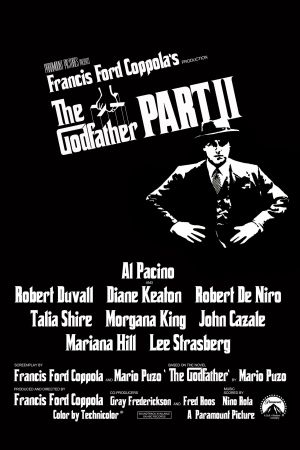
Shattered Politics #36: The Godfather, Part II (dir by Francis Ford Coppola)


Godfather_part_ii

Believe it or not, The Trial of Billy Jack was not the only lengthy sequel to be released in 1974.  Francis Ford Coppola’s The Godfather Part II was released as well and it went on to become the first sequel to win an Oscar for best picture.  (It was also the first, and so far, only sequel to a best picture winner to also win best picture.)  Among the films that The Godfather, Part II beat: Chinatown, Coppola’s The Conversation, and The Towering Inferno.  1974 was a good year.

Whenever I think about The Godfather, Part II, I find myself wondering what the film would have been like if Richard Castellano hadn’t demanded too much money and had actually returned in the role of Clemenza, as was originally intended.  In the first Godfather, Clemenza and Tessio (Abe Vigoda) were Don Corleone’s two lieutenants.  Tessio was the one who betrayed Michael and was killed as a result.  Meanwhile, Clemenza was the one who taught Michael how to fire a gun and who got to say, “Leave the gun.  Take the cannoli.”

Though Castellano did not return to the role, Clemenza is present in The Godfather, Part II.  The Godfather, Part II tells two separate stories: during one half of the film, young Vito Corleone comes to America, grows up to be Robert De Niro and then eventually becomes the Godfather.  In the other half of the film, Vito’s successor, Michael (Al Pacino), tries to keep the family strong in the 1950s and ultimately either loses, alienates, or kills everyone that he loves.

During Vito’s half of the film, we learn how Vito first met Clemenza (played by Bruno Kirby) and Tessio (John Aprea).  However, during Michael’s half of the story, Clemenza is nowhere to be seen.  Instead, we’re told that Clemenza died off-screen and his successor is Frankie Pentangeli (Michael V. Gazzo).  All of the characters talk about Frankie as if he’s an old friend but, as a matter of fact, Frankie was nowhere to be seen during the first film.  Nor is he present in Vito’s flashbacks.  This is because originally, Frankie was going to be Clemenza.  But Richard Castellano demanded too much money and, as a result, he was written out of the script.

And really, it doesn’t matter.  Gazzo does fine as Frankie and it’s a great film.  But, once you know that Frankie was originally meant to be Clemenza, it’s impossible to watch The Godfather Part II without thinking about how perfectly it would have worked out.

If Clemenza had been around for Michael’s scenes, he would have provided a direct link between Vito’s story and Michael’s story.  When Clemenza (as opposed to Frankie) betrayed Michael and went into protective custody, it would have reminded us of how much things had changed for the Corleones (and, by extension, America itself).  When Tom Hagen (Robert Duvall) talked Clemenza (as opposed to Frankie) into committing suicide, it truly would have shown that the old, “honorable” Mafia no longer existed.  It’s also interesting to note that, before Tessio was taken away and killed, the last person he talked to was Tom Hagen.  If Castellano had returned, it once again would have fallen to Tom to let another one of his adopted father’s friends know that it was time to go.

Famously, the Godfather, Part II ends with a flashback to the day after Pearl Harbor.   We watch as a young and idealistic Michael tells his family that he’s joined the army.  With the exception of Michael and Tom Hagen, every character seen in the flashback has been killed over the course of the previous two films.  We see Sonny (James Caan), Carlo (Gianni Russo), Fredo (John Cazale), and even Tessio (Abe Vigoda).  Not present: Clemenza.  (Vito doesn’t appear in the flashback either but everyone’s talking about him so he might as well be there.  Poor Clemenza doesn’t even get mentioned.)

If only Richard Castellano had been willing to return.
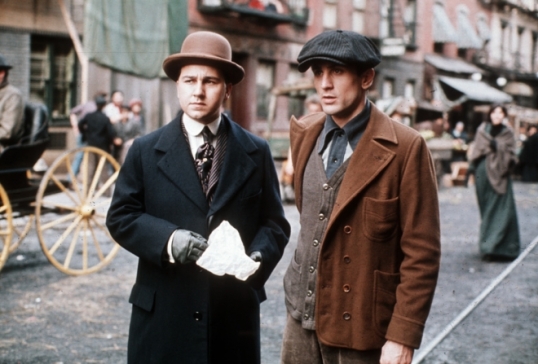
Clemenza_and_Vito

Clemenza and Vito


But he didn’t and you know what?  You really only miss him if you know that he was originally meant to be in the film.  With or without Richard Castellano, The Godfather, Part II is a great film, probably one of the greatest of all time.  When it comes to reviewing The Godfather, Part II, the only real question is whether it’s better than the first Godfather.

Which Godfather you prefer really depends on what you’re looking for from a movie.  Even with that door getting closed in Kay’s face, the first Godfather was and is a crowd pleaser.  In the first Godfather, the Corleones may have been bad but everyone else was worse.  You couldn’t help but cheer them on.

The Godfather Part II is far different.  In the “modern” scenes, we discover that the playful and idealistic Michael of part one is gone.  Micheal is now cold and ruthless, a man who willingly orders a hit on his older brother and who has no trouble threatening Tom Hagen.  If Michael spent the first film surrounded by family, he spends the second film talking to professional killers, like Al Neri (Richard Bright) and Rocco Lampone (Tom Rosqui).  Whereas the first film ended with someone else closing the door on Kay, the second film features Michael doing it himself.  By the end of the film, Michael Corleone is alone in his compound, a tyrant isolated in his castle.

Michael’s story provides a sharp contrast to Vito’s story.  Vito’s half of the film is vibrant and colorful and fun in a way that Michael’s half is not and could never be.  But every time that you’re tempted to cheer a bit too easily for Vito, the film moves forward in time and it reminds you of what the future holds for the Corleones.

So, which of the first two Godfathers do I prefer?  I love them both.  If I need to be entertained, I’ll watch The Godfather.  If I want to watch a movie that will truly make me think and make me question all of my beliefs about morality, I’ll watch Part Two.

Finally, I can’t end this review without talking about G.D. Spradlin, the actor who plays the role of U.S. Sen. Pat Geary.  The Godfather Part II is full of great acting.  De Niro won an Oscar.  Pacino, Gazzo, Lee Strasberg, and Talia Shire were all nominated.  Diane Keaton, Robert Duvall, and John Cazale all deserved nominations.  Even Joe Spinell shows up and brilliantly delivers the line, “Yeah, we had lots of buffers.”  But, with each viewing of Godfather, Part II, I find myself more and more impressed with G.D. Spradlin.

Sen. Pat Geary doesn’t have a lot of time on-screen.  He attends a birthday party at the Corleone Family compound, where he praises Michael in public and then condescendingly insults him in private.  Later, he shows up in Cuba, where he watches a sex show with obvious interest.  And, when Michael is called before a Senate committee, Geary gives a speech defending the honor of all Italian-Americans.
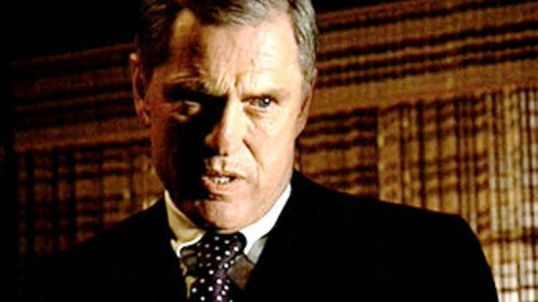
G.D. Spradlin as Sen. Pat Geary

G.D. Spradlin as Sen. Pat Geary

But the scene that we all remember is the one where Tom Hagen meets Sen. Geary in a brothel.  As Geary talks about how he passed out earlier, the camera briefly catches the sight of a dead prostitute lying on the bed behind him.  What’s especially disturbing about this scene is that neither Hagen nor Geary seem to acknowledge her presence.  She’s been reduced to a prop in the Corleone Family’s scheme to blackmail Sen. Geary.  His voice shaken, Geary says that he doesn’t know what happened and we see the weakness and the cowardice behind his almost all-American facade.

It’s a disturbing scene that’s well-acted by both Duvall and Spradlin.  Of course, what is obvious (even if it’s never explicitly stated) is that Sen. Geary has been set up and that nameless prostitute was killed by the Corleones.  It’s a scene that makes us reconsider everything that we previously believed about the heroes of the Godfather.

For forcing us to reconsider and shaking us out of our complacency, The Godfather, Part II is a great film.

(Yes, it’s even better than The Trial of Billy Jack.)
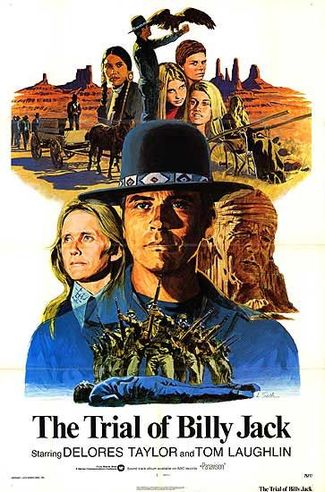
 

Shattered Politics #35: The Trial of Billy Jack (dir by Tom Laughlin)


Trial_of_billy_jackFor the past week, I’ve been in the process of reviewing 94 films about politicians and, to a lesser extent, politics.  I’ve recently taken a look at Born Losers and Billy Jack, the first two segments in the cinematic life of future U.S. Sen. Billy Jack.  Today, I’m taking a look at the third part of the Billy Jack saga, 1974’s The Trial of Billy Jack!

I have to admit that, when you’re watching these first three films, it’s a little hard to see how Billy Jack is ever going to end up in the U.S. Senate.  After all, The Born Losers ended with Billy getting shot in the back by an overeager deputy sheriff.  Billy Jack ended with Billy shooting at the National Guard and then getting arrested for murder.  And then, in Trial of Billy Jack, Billy gets released from prison but promptly kills yet another member of the Posner family and then eventually, the National Guard shows up (again!) and ends up gunning down at least half of the students at the Freedom School.

If I didn’t already know that Trial would be followed up Billy Jack Goes To Washington, I think I’d be justified in being a little pessimistic about Billy’s future.

But anyway, let’s talk about The Trial of Billy Jack.  After the surprise box office success of Billy Jack, Tom Laughlin and Delores Taylor set about to make a sequel that would not only revisit the themes of Billy Jack but which would touch on literally every single other political issue of the day as well.  The result is a three-hour mess of a film that, despite the excessive length and a generally preachy tone, remains oddly watchable.

Despite the film’s title, the actual Trial of Billy Jack only takes up a few minutes of screen time.  The prosecution lays out its case, which is that Billy Jack killed Bernard Posner.  The defense calls Billy to the stand and, instead of asking him about the events that led to Bernard’s death (i.e., the fact that Bernard was a rapist and that Billy caught him with a 13 year-old girl), they instead allow Billy to give his opinions on the political issues of the day.  And, since this film was released in 1974, we get a lengthy flashback to the Vietnam War where we see Billy refusing to take part in a civilian massacre.

And then Billy Jack is sent to prison.  And it’s actually quite some time before he shows up in the film again.  This actually took me by surprise because, when it comes to people directing films starring themselves, I’m more used to the narcissistic style of Norman Mailer.  But, in Laughlin’s case, he was actually willing to stay off-screen for close to an hour and allow the film to focus on Jean (Delores Taylor) and the Freedom School.

And that is one reason why I can never be as critical of the Billy Jack films as maybe I should be.  They really are such sincere films.  Laughlin was willing to stay off-screen and allow the film to be about the issues and for that he should be commended.  However, at the same time, Laughlin was not only the best actor in most of the Billy Jack films.  He was also usually the only good actor in the films as well.  So, while you respect Laughlin for not being a narcissist, you also kind of wish that maybe the film could have been more about him and less about the students at the Freedom School (which, to judge from the performances in this film, did not have much of a drama department).

When I reviewed Billy Jack, I mentioned that, if anything could cause me to transform from being the politically moderate girl that you all know and love to being a right-wing extremist, it would be having to spend any amount of time with the smug and self-righteous students at the Freedom School.  Well, by the end of the first half of The Trial of Billy Jack, I had spent so much time with those students that I was on the verge of ordering a Sarah Palin bumper sticker to put on my boyfriend’s car.

(Fortunately, Billy Jack got out of jail before I went that far but seriously…)

Of course, they’re not just students at the Freedom School anymore.  No, in the Trial of Billy Jack, the Freedom School suddenly has the power and resources to launch its own independent television station.  The kids are now crusading journalists.  They’re first expose is on a local businessman who repossessed a woman’s furniture after she failed to make the payments and … well, wait a minute.  Is that really an expose?  When you’re paying something off, aren’t you supposed to keep up with the payments?  If the students were trying to raise money to help the woman pay off her bills, that would be one thing.  But, instead, their expose seems to be that if you break a contract, there will be consequences.  Uhmmm…

BUT ANYWAY!  Best not to think too much when the powers of crusading righteousness are on display!

We also discover that one of the students has invented a machine that will tell you whether or not someone on television is lying.  Which again … what?  I mean, that’s a pretty powerful machine but it’s just kind of mentioned and then never really brought up again….

And then, for some reason, the students hold a big carnival in town and demand to know why the national media isn’t down there covering it.

Listen, this film is occasionally confusing.  It’s not three hours long because it’s an epic or anything.  Instead, it’s three hours long because, apparently, Tom and Delores just stuck every thought they ever had into the script.  Some of those thoughts — like the TV lie detector — are abandoned as soon as they are brought up.  Other thoughts — like the National Guard showing up and shooting up the Freedom School — are returned to over and over again.

Fortunately, Billy does eventually get out of jail and returns to the Freedom School.  Again, he finds himself debating non-violence with Jean and he also finds himself being harassed by yet another evil Mr. Posner (Riley Hill).  However, during the film’s undeniable high point, Billy goes on a vision quest.  He sees a bearded professor type and smacks him.  Then he sees Jesus Christ and smacks him too.

No, I’m not making that up!

However, Jesus forgives Billy and Billy learns that nonviolence is the way to go.  But then the National Guard shows up and starts shooting up the Freedom School and…

(Actually, what’s funny is that one of the National Guardsmen is played by William Wellman, Jr., who also played an evil biker named Child in The Born Losers.  I like to think that, after the events of Born Losers, Child cleaned up his act, got married, had a baby, and then joined the Guard.  And then he ended up shooting up the Freedom School, little realizing that his old enemy Billy Jack was just a few miles away “gettin’ hassled by The Man.”*)

Like I said, The Trial of Billy Jack is a mess but I’m still going to recommend because it really is a one-of-a-kind mess.  It’s one of those films that everyone should sit through at least once.  Full of pretentious dialogue, half-baked political posturing, and some of the most preachy end titles ever seen, The Trial of Billy Jack ultimately stands as a tribute to the determination of Tom Laughlin to both preach to the already converted and to preserve his own unique vision.

And you know what?

Good for him!  The Trial of Billy Jack may not be a good film but at least it’s a film that refuses to compromise.

Both Tom Laughlin and Billy Jack would return three years later in Billy Jack Goes To Washington!

—-

* Copyright 1967 by Big Evil Corporation PR Department.

Shattered Politics #34: The Parallax View (dir by Alan J. Pakula)


Parallax_View_movie_poster

Judging from the films that the decade produced, the 1970s were truly a paranoid time.  (Of course, 2015 is a paranoid time as well, which is probably why so many of the classic films of the 70s still feel incredibly relevant.)  Some weekend, you should watch a marathon of 1970s films and I guarantee that, by the time Monday rolls around, you will be looking for lurkers in every shadow and automatically distrusting any and all authority figures.  The 1970s were a good time to be paranoid.

And it’s really not surprising at all.  The previous decade was a time of turmoil and upheavel, a time when some people feared protestors and some people feared the establishment but, ultimately, everyone was afraid of someone.  When you think of the 1960s, you think about all the leaders who were violently assassinated — John F. Kennedy, Malcolm X, Martin Luther King, Robert F. Kennedy, and more.  (And that’s just in America!)  And then the 70s came along, with Watergate and the revelations about the CIA partnering up with the Mafia to try to kill Fidel Castro.

The 70s were a good time to be paranoid and the films of the 70s reflected that fact.

Take for instance, 1974’s The Parallax View.  The Parallax View opens and ends with assassination.  In both cases, the victims are U.S. politicians who are running for President and whose ambitions have caused concern for the shadowy and rarely seen leaders of the established order.  In both cases, the official story is that the assassin was a lone gunman, a nut with a gun and absolutely no political or religious motivations.  Of course, both accused assassins were apparently involved with the shadowy Parallax Corporation and, over the course of the film, anyone who knows anything about Parallax ends up dying.  Reporter Joe Frady (Warren Beatty) goes undercover to investigate the group but, as he does so, he grows increasingly paranoid and unstable, until finally  it’s easy to mistake him for any other paranoid madman, ranting in the street and, in many ways, indistinguishable from the accused assassins that he’s been investigating.  In many ways, Joe becomes like a character in a H.P. Lovecraft short story who, upon laying eyes on Cthulhu, is driven mad as punishment.

It’s a good film, one that’s enhanced by Gordon Willis’s trademark shadowy cinematography and the convincing desperation of Warren Beatty’s performance.  In the film’s best scene, Frady applies for a job with the Parallax Corporation.  As a part of his job interview, he’s taken a dark room and he’s told to watch a short film.  His reactions will help to determine what role he could possibly play at Parallax.

Needless to say, The Parallax View feels just as relevant today as it did when it was first released.  We still live in paranoid times and hints of conspiracy are still everywhere to be seen.  Perhaps the only thing that has changed is that, back in 1974, conspiracies could still take people be surprise.

Now, we just take them for granted.

Shattered Politics #33: Detroit 9000 (dir by Arthur Marks)


Detroit9000

Pity poor Detroit!

For the past few years, it seems that, whenever someone has wanted to make the argument that America is heading in the wrong direction, Detroit gets mentioned.  The once thriving city and industrial center is now best known for high unemployment, high crime, and a declining population.  After years of civic mismanagement, Detroit went bankrupt.  Fairly or not, many people will always view Detroit as being the city that can’t afford to keep the lights on and where citizens can’t afford to pay their water bill.  It doesn’t matter how many “Detroit is making a comeback!” commercials run during the Super Bowl.

I have to admit that, for someone like me who lives on the other end of the country, Detroit might as well be on another planet.  (And that planet is called Michigan.)  I have no way of knowing what Detroit was like before the media started to bombard me with stories about the city’s decline.  And that’s one reason why I have to feel sorry for the city of Detroit.  Anything positive about Detroit will never be reported but you can rest assured that anything negative will be recorded, reported, and repeated until everyone in the country can recite the details by memory.

If I’ve got Detroit on the mind, it’s because I recently watched a fairly memorable crime film from 1973 that was set and filmed in Detroit.  It was a film that — long before Only Lovers Left Alive — attempted to use the city itself as a metaphor for the political issues and social concerns of the day.  In fact, the city was such an important part of the film that the film itself was even named Detroit 9000.

(Reportedly, the film was originally meant to be set in Chicago but, when the Chicago political establishment objected to the film’s violence, production was relocated to Detroit, where apparently the script’s violence was not a problem.)

Detroit 9000 opens with a fundraiser for Congressman Aubrey Hale Clayton (Rudy Challeneger), who is running for governor of Michigan.  A group of masked gunmen break into the hotel and rob the fundraiser.  (While the guests are forced to kneel on the floor while being robbed, a woman stands on stage and sings a gospel song, which just adds to the surreal feel of the scene.)  To investigate the case, the laid-back, casually corrupt Lt. Danny Basset (Alex Rocco) is partnered up with upright Sgt. Jesse Williams (Hari Rhodes).  Because Clayton is the first black man to ever have a real chance to be elected governor and because everyone robbed at the fundraiser was black, Williams believes that there had to be a racial motivation behind the robbery.  Danny, meanwhile, insists that it was just an ordinary robbery.

Detroit 9000 is a favorite film of Quentin Tarantino’s and, watching it, you can see why.  From the soundtrack to the hard-edged dialogue to the morally ambiguous heroes, Detroit 9000 is a masterpiece of 1970s exploitation.  The film ends with a genuinely exciting chase through the streets (and cemeteries) of Detroit that eventually gets so excessively violent that it takes on an oddly operatic beauty of its own.

And, in the underrated style of so many so-called grindhouse and exploitation films, Detroit 9000 has a lot more on its mind than most mainstream film.  Even today, I think you’d have a hard time finding a big-budget, studio production that would be willing to take as honest a view of race relations as Detroit 9000 does.  Beneath all of the exploitation trapping, there lies a film that was actually saying something about the way life was being lived in 1973 and which still has a lot to say about how life is being lived today in 2015.

And, much like Jim Jarmusch in Only Lovers Left Alive, director Arthur Marks finds a strange sort of life in Detroit’s abandoned buildings and dark alleys.  As odd as it may seem, this cynical and violent film will actually make you love Detroit more than a hundred “Detroit is making a comeback!” super bowl commercials ever could.

Shattered Politics #32: The Werewolf of Washington (dir by Milton Moses Ginsberg)


Werewolf of Washington (1973)

First released in 1973, The Werewolf of Washington is one of those obscure films that always seems to pop up in Mill Creek box sets.  That’s largely because Werewolf of Washington has slipped into the public domain and anyone can release and sell a copy of it.  (It’s also been uploaded to YouTube by a few hundred different users.)  It’s a film that I’ve actually watched quite a few times, largely because it is so easily available.

Which doesn’t necessarily mean that it’s any good.  I have to admit that, in between viewings, I always seem to convince myself that The Werewolf of Washington is a better film than it actually is.  The idea behind the film sounds clever.  The President’s press secretary (played by Dean Stockwell) is a werewolf.  When the full moon shines, he transforms and wrecks havoc on the streets on D.C.  Stockwell still wears his suit, even when he’s a wolfman.  The President (played by Biff McGuire) is a total idiot who spends a lot of time bowling.  The Attorney General (Clifton James) is a paranoid fascist who is quick to blame the werewolf’s murders on outside agitators.  For no particular reason, a dwarf mad scientist (Michael Dunn) shows up.

Yes, the idea is clever but the execution … actually, the execution is not terrible.  Dean Stockwell gives a good performance and there’s a funny scene where he starts to turn into a werewolf while bowling with the President.  Stockwell’s fingers swell up and get stuck in the bowling ball and Stockwell totally freaks out.  And then there’s a scene where the werewolf attacks a woman in a phone booth and it’s actually rather suspenseful and almost scary.  Plus, Biff McGuire is great and all too plausible as the vapid President.

And yet, overall, the film itself is never as good as you want it to be.  I think a large part of the problem is that the film opens with a long voice over from Dean Stockwell, which explains why his character ended up in Budapest (that would be where he gets bitten by the werewolf) and why the President subsequently named him press secretary.  It’s so much backstory that you get the feeling that the opening narration must have been added in post production in order to cover up scenes that either did not work or that the film’s director never got a chance to shoot.

And really, the entire film is like that.  The film is a collection of scenes that never really flow together or establish any sort of steady pace.  And, when it comes to both horror and comedy, pace is key.

The Werewolf of Washington is a clever idea.  I just wish the execution had been just as clever.

And I’ll probably continue to wish that the next time that I rewatch it.

The_Werewolf_of_Washington_FilmPoster


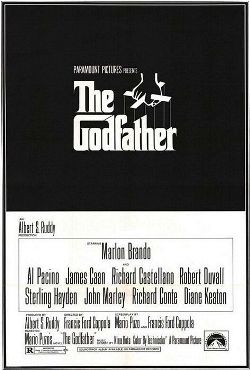
Shattered Politics #31: The Godfather (dir by Francis Ford Coppola)


Godfather_ver1

“I got something for your mother and Sonny and a tie for Freddy and Tom Hagen got the Reynolds Pen…” — Kay Adams (Diane Keaton) in The Godfather (1972)

It probably seems strange that when talking about The Godfather, a film that it is generally acknowledged as being one of the best and most influential of all time, I would start with an innocuous quote about getting Tom Hagen a pen.

(And it better have been a hell of a pen because, judging from the scene where Sollozzo stops him in the street, it looked like Tom was going all out as far as gifts were concerned…)

After all, The Godfather is a film that is full of memorable quotes.  “Leave the gun.  Take the cannoli.”  “I’m going to make him an offer he can’t refuse.”  “It’s strictly business.”  “I believe in America….”  “That’s my family, Kay.  That’s not me.”

But I went with the quote about the Reynolds pen because, quite frankly, I find an excuse to repeat it every Christmas.  Every holiday season, whenever I hear friends or family talking about presents, I remind them that Tom Hagen is getting the Reynolds pen.  Doubt me?  Check out these tweets from the past!

[tweet https://twitter.com/LisaMarieBowman/status/411891527837687810  ]

[tweet https://twitter.com/LisaMarieBowman/status/280387983444697088 ]

That’s how much I love The Godfather.  I love it so much that I even find myself quoting the lines that don’t really mean much in the grand scheme of things.  I love the film so much that I once even wrote an entire post about who could have been cast in The Godfather if, for whatever reason, Brando, Pacino, Duvall, et al. had been unavailable.  And I know that I’m not alone in that love.

But all that love also makes The Godfather a difficult film to review.  What do you say about a film that everyone already knows is great?

Do you praise it by saying that Al Pacino, Robert Duvall, James Caan, Diane Keaton, Marlon Brando, John Cazale, Richard Castellano, Abe Vigoda, Alex Rocco, and Talia Shire all gave excellent performances?  You can do that but everyone already knows that.

Do you talk about how well director Francis Ford Coppola told this operatic, sprawling story of crime, family, and politics?  You can do that but everyone already knows that.

Maybe you can talk about how beautiful Gordon Willis’s dark and shadowy cinematography looks, regardless of whether you’re seeing it in a theater or on TV.  Because it certainly does but everyone knows that.

Maybe you can mention the haunting beauty of Nina Rota’s score but again…

Well, you get the idea.

Now, if you somehow have never seen the film before, allow me to try to tell you what happens in The Godfather.  I say try because The Godfather is a true epic.  Because it’s also an intimate family drama and features such a dominating lead performance from Al Pacino, it’s sometimes to easy to forget just how much is actually going on in The Godfather.

The Godfather tells the story of the Corleone Family.  Patriarch Vito Corleone (Marlon Brando) has done very well for himself in America, making himself into a rich and influential man.  Of course, Vito is also known as both Don Corleone and the Godfather and he’s made his fortune through less-than-legal means.  He may be rich and he may be influential but when his daughter gets married, the FBI shows up outside the reception and takes pictures of all the cars in the parking lot.  Vito Corleone knows judges and congressmen but none of them are willing to be seen in public with him.  Vito is the establishment that nobody wants to acknowledge and sometimes, this very powerful man wonders if there will ever be a “Governor Corleone” or a “Senator Corleone.”

Vito is the proud father of three children and the adopted father of one more.  His oldest son, and probable successor, is Sonny (James Caan).  Sonny, however, has a temper and absolutely no impulse control.  While his wife is bragging about him to the other women at the wedding, Sonny is upstairs screwing a bridesmaid.  When the enemies of the Corleone Family declare war, Sonny declares war back and forgets the first rule of organized crime: “It’s not personal.  It’s strictly business.”

After Sonny, there’s Fredo (John Cazale).  Poor, pathetic Fredo.  In many ways, it’s impossible not to feel sorry for Fredo.  He’s the one who ends up getting exiled to Vegas, where he lives under the protection of the crude Moe Greene (Alex Rocco).  One of the film’s best moments is when a bejeweled Fredo shows up at a Vegas hotel with an entourage of prostitutes and other hangers-on.  In these scenes, Fred is trying so hard but when you take one look at his shifty eyes, it’s obvious that he’s still the same guy who we first saw stumbling around drunk at his sister’s wedding.

(And, of course, it’s impossible to watch Fredo in this film without thinking about both what will happen to the character in the Godfather, Part II and how John Cazale, who brought the character to such vibrant life, would die just 6 years later.)

As a female, daughter Connie (Talia Shire) is — for the first film, at least — excluded from the family business.  Instead, she marries Sonny’s friend Carlo Rizzi (Gianni Russo).  And, to put it gently, it’s not a match made in heaven.

And finally, there’s Michael (Al Pacino).  Michael is the son who, at the start of the film, declares that he wants nothing to do with the family business.  He’s the one who wants to break with family tradition by marrying Kay Adams (Diane Keaton), who is most definitely not Italian.  He’s the one who was decorated in World War II and who comes to his sister’s wedding still dressed in his uniform.  (In the second Godfather film, we learn that Vito thought Michael was foolish to join the army, which makes it all the more clear that, by wearing the uniform to the wedding, Michael is attempting to declare his own identity outside of the family.)  To paraphrase the third Godfather film, Michael is the one who says he wants to get out but who keeps getting dragged back in.

And finally, the adopted son is Tom Hagen (Robert Duvall).  Tom is the Don’s lawyer and one reason why Tom is one of my favorite characters is because, behind his usual stone-faced facade, Tom is actually very snarky.  He just hides it well.

Early on, we get a hint that Tom is more amused than he lets on when he has dinner with the crude Jack Woltz (John Marley), a film producer who doesn’t want to use Johnny Fontane (Al Martino) in a movie  When Woltz shouts insults at him, Tom calmly finishes his dinner and thanks him for a lovely evening.  And he does it with just the hint of a little smirk and you can practically see him thinking, “Somebody’s going to wake up with a horse tomorrow….”

However, my favorite Tom Hagen moment comes when Kay, who is searching for Michael, drops by the family compound.  Tom greets her at the gate.  When Kay spots a car that’s riddled with bullet holes, she asks what happened.  Tom smiles and says, “Oh, that was an accident.  But luckily no one was hurt!”  Duvall delivers the line with just the right attitude of “That’s my story and I’m sticking to it!”  How can you not kind of love Tom after that?

And, of course, the film is full of other memorable characters, all of whom are scheming and plotting.  There’s Clemenza (Richard S. Catellano) and Tessio (Abe Vigoda), the two Corleone lieutenants who may or may not be plotting to betray the Don.  There’s fearsome Luca Brasi (Lenny Montana), who spends an eternity practicing what he wants to say at Connie’s wedding and yet still manages to screw it up.  And, of course, there’s Sollozzo (Al Lettieri, playing a role originally offered to Franco Nero), the drug dealer who reacts angrily to Vito’s refusal to help him out.  Meanwhile, Capt. McCluskey (Sterling Hayden) is busy beating up young punks and Al Neri (Richard Bright) is gunning people down in front of the courthouse.  And, of course, there’s poor, innocent, ill-fated Appollonia (Simonetta Stefanelli)…

The Godfather is a great Italian-American epic, one that works as both a gangster film and a family drama.  Perhaps the genius of the Godfather trilogy is that the Corleone family serves as an ink blot in a cinematic rorschach test.  Audiences can look at them and see whatever they want.  If you want them and their crimes to serve as a metaphor for capitalism, you need only listen to Tom and Michael repeatedly state that it’s only business.  If you want to see them as heroic businessmen, just consider that their enemies essentially want to regulate the Corleones out of existence.  If you want the Corleones to serve as symbols of the patriarchy, you need only watch as the door to Michael’s office is shut in Kay’s face.  If you want to see the Corleones as heroes, you need only consider that they — and they alone — seem to operate with any sort of honorable criminal code.  (This, of course, would change over the course of the two sequels.)

And, if you’re trying to fit a review of The Godfather into a series about political films, you only have to consider that Vito is regularly spoken of as being a man who carries politicians around in his pocket.  We may not see any elected officials in the first Godfather film but their presence is felt.  Above all else, it’s Vito’s political influence that sets in motion all of the events that unfold over the course of the film.

The Godfather, of course, won the Oscar for best picture of 1972.  And while it’s rare that I openly agree with the Academy, I’m proud to say that this one time is a definite exception.

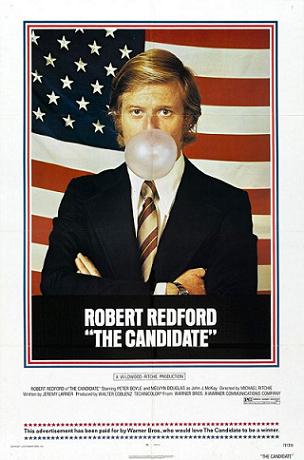
Shattered Politics #30: The Candidate (dir by Michael Ritchie)


Candidateposter

“What do we do now?” — Democratic senate candidate Bill McKay (Robert Redford) in The Candidate (1972)

When I reviewed Advise & Consent, I mentioned that if anyone could prevent billionaire Tom Steyer from winning the Democratic nomination to run in the 2016 California U.S. Senate election, it would be Betty White.  Well, earlier today, Tom Steyer announced that he would NOT be a candidate.  You can guess what that means.  Betty White has obviously already started to set up her campaign organization in California and, realizing that there was no way that he could possibly beat her, Tom Steyer obviously decided to step aside.

So, congratulations to Betty White!  (I would probably never vote for her but I don’t live in California so it doesn’t matter.)  As future U.S. Senator Betty White prepares for the next phase of her career, it would probably be a good idea for her to watch a few movies about what it takes to win political office in the United States.

For example: 1972’s The Candidate.

The Candidate would especially be a good pick for the nascent Betty White senate campaign because the film is actually about a senate election in California!  California’s  U.S. Sen. Crocker Jarmon (Don Porter) is a Republican who everyone assumes cannot be defeated for reelection.  Democratic strategist Marvin Lucas (a heavily bearded Peter Boyle) is tasked with finding a sacrificial candidate.

The one that Marvin comes up with is Bill McKay (Robert Redford, before his face got all leathery), a 34 year-old lawyer who also happens to be the estranged son of former Governor John J. McKay (Melvyn Douglas, whose wife Helen ran for one of California’s senate seats in 1950).  As opposed to his pragmatic and ruthless father, Bill is idealistic and the only reason that he agrees to run for the Senate is because Marvin promises him that he’ll be able to say whatever he wants.  Marvin assures Bill that Jarmon cannot be beaten but if Bill runs a credible campaign, he’ll be able to run for another office in the future.

However, Jarmon turns out to be a weaker candidate than everyone assumed.  As the charismatic Bill starts to close the gap between himself and Jarmon, he also starts to lose control of his campaign.  He soon finds himself moderating his positions and worrying more about alienating potential voters than stating his true opinions.  (In one of the film’s best scenes, Bill scornfully mutters his standard and generic campaign speech to himself, obviously disgusted with the vapid words that he has to utter in order to be elected.)  The film ends on a properly downbeat note, one that reminds you that the film was made in the 70s but also remains just as relevant and thought-provoking in 2015.

Written by a former political speech writer and directed, in a semi-documentary style, by Michael Ritchie, The Candidate is an excellent film that answer the question as to why all political campaigns and politicians seem to be the same.  The Candidate is full of small details that give the film an air of authenticity even when a familiar face like Robert Redford is on screen.

Whenever I watch The Candidate, I find myself wondering what happened to Bill McKay after the film’s iconic final scene.  Did he ever regain his idealism or did he continue on the path to just becoming another politician.  As much as we’d all like to think that the former is true, it’s actually probably the latter.

That just seems to be the way that things go.

Hopefully, Betty White will learn from Bill McKay’s example.

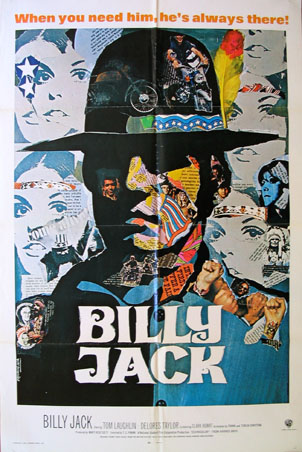
Shattered Politics #29: Billy Jack (dir by Tom Laughlin)


Billy_Jack_poster

“Go ahead and hate your neighbor; go ahead and cheat a friend.
Do it in the name of heaven; you can justify it in the end.
There won’t be any trumpets blowin’ come the judgment day
On the bloody morning after, one tin soldier rides away”

— From One Tin Soldier, the theme song of Billy Jack (1971)

Yesterday, we took a look at The Born Losers, the first film to ever feature the character of future U.S. Senator Billy Jack.  The Born Losers ended with former Green Beret-turned-gun-toting-pacifist Billy Jack (played, of course, by Tom Laughlin) saving the girl, killing the bad guy, and getting shot in the back by the police.  As Born Losers ended, we were left to wonder whether Billy would survive his wounds or would he just be another victim of the establishment.

Well, audiences had to wait five years to find out.

When Laughlin returned to the role in 1971’s Billy Jack, it was revealed that not only had Billy Jack lived but he was now residing in a cave with his wise Native American grandfather.  Billy still had little use for civilization but he would occasionally emerge from his cave.  Sometimes, it was to protect wild mustangs from being hunted the evil Old Man Posner (Bert Freed) and his sociopathic son Bernard (David Roya).  Other times, it was to protect the Freedom School and, even more importantly, the Freedom School’s founder, Jean (played by Laughlin’s wife, Delores Taylor).

The local townspeople viewed the Freedom School with suspicion and whenever the students went into town, they would be harassed by Bernard and his friends.  Fortunately, the students could always count on Billy to show up, say a few angry words, and then lose control. Billy may have been a liberal but he was no pacifist.  Jean, however, fully embraced nonviolence and she always made it clear that she wasn’t comfortable with Billy providing her kids with a violent example.

Finally, both Jean and Billy’s convictions were put to the test.  First off, the bigoted townspeople tried to close the school.  Then, Jean was raped by Bernard.  And finally, Billy found himself barricaded in an old mission, surrounded by police and national guardsmen.  Even as Jean pleaded with Billy to lay down his weapons and to peacefully surrender, Billy made it clear that he was willing to die for his beliefs.

And, as the film ended, you would never guess that Billy Jack would eventually become a member of the U.S. Senate.  But, in just a few years, that’s exactly what would happen in Billy Jack Goes To Washington!

Now, of course, Billy Jack is ultimately a product of its time and that’s both a blessing and a curse.  To be honest, if anything could transform me from being the socially liberal, economically conservative girl that you all know and love into a card-carrying right-wing extremist, it would be having to spend any time with the students at the Freedom School.  They are all so smugly convinced of their own moral superiority that the townspeople almost start to look good by default.  Whether they’re attending improv class or disrupting a meeting at town hall, the majority of the students come across like a bunch of rich kids from the suburbs, playing hippy and slumming by hanging out with poor minorities.  As you watch them, it’s difficult not to suspect that most of them are going to get bored with rebelling after a year or two and eventually end up growing up to be just like their parents.

Fortunately, the film is saved by the pure sincerity of Laughlin and Taylor.  For all the attention that the film gets for the scenes of Billy Jack beating people up, the most compelling scenes are the ones where Jean and Billy Jack debate nonviolence.  There’s an honesty and a passion to these scenes, one that proves that Laughlin and Taylor, as opposed to so many other self-styled counterculture filmmakers, were actually serious about their beliefs.  Billy Jack is an essential film, not only as a time capsule of the era in which it was made but also as one of the few films to actually make a legitimate attempt to explore what it truly means to embrace nonviolence.

Billy Jack is also a historically important film.  When American Independent Pictures withdrew from the production, Laughlin took Billy Jack to 20th Century Fox.  When 20th Century Fox looked at the completed film and did not know how to market it, Laughlin distributed the film himself, without the support of a major studio.  And, despite what all of the naysayers may have predicted, Billy Jack was a huge hit.

And every indie filmmaker since owes a huge debt of gratitude to Tom Laughlin.

Shattered Politics #28: Maidstone (dir by Norman Mailer)


Rip Torn in Maidstone

Rip Torn in Maidstone

If you ever find yourself on the campus of the University of North Texas and you need to kill some time, stop by the UNT Library, go up to the second floor, find the biographies, and track down a copy of Peter Manso’s Mailer: His Life and Times.  

Back in December of 2007, at a time when I really should have been studying for my finals, I spent an entire afternoon in the library reading Manso’s book.  I didn’t know much about Norman Mailer, the Pulitzer prize-winning writer and occasional political candidate, beyond the fact that he died that previous November and that a lot of older people who I respected apparently thought highly of his work.  Though Manso’s book had been written 20 years earlier, it still provided an interesting portrait of the controversial author.  It was largely an oral history, full of interviews with people who had known Mailer over the years.  As I skimmed the book, it quickly became apparent that, among other things, Mailer was a larger-than-life figure.

For me, the book was at its most interesting when it dealt with Mailer’s attempts to be a filmmaker.  In the 1960s, Mailer directed three movies.  All three of them also starred Norman Mailer and featured his friends in supporting roles.  All three of them were largely improvised.  And, when released into theaters, all three of them were greeted with derision.

Maidstone, Mailer’s 3rd film, was filmed in 1970.  In the film, Mailer played Norman Kingsley, an avante garde film director who is running for President.  Over the course of one weekend, while also working on a movie about a brothel, Norman meets with potential supporters and debates the issues.  And, of course, shadowy figures plot to assassinate Norman, not so much because they don’t want him to be President as much as they want him to be a martyr for their vaguely defined cause.

Just based on what I read in Manso’s book, it’s hard not to feel that the making of Maidstone could itself be the basis of a good movie.  Mailer essentially invited all of his friends to his estate and they spent 5 days filming, with no script. It was five days of drinking, drugs, and bad feelings.

At one point, actor and painter Herve Villechaize (who would later play Knick Knack in The Man With The Golden Gun) got so drunk and obnoxious that he was picked up by actor Rip Torn and literally tossed over a fence.  The unconscious Villechaize ended up floating face down in a neighbor’s pool.  After fishing Villechaize out of the pool, the neighbor tossed him back over the fence and shouted, “Norman, come get your dwarf!”

Eventually, after five days, filming fell apart.  Some members of the cast were okay with that.  And one most definitely was not..

Fortunately, Maidstone is currently available on YouTube so I watched it last night.  Unfortunately, the film itself is never as interesting as the stories about what went on behind the cameras.  Maidstone is essentially scene after scene of people talking and the effectiveness of each scene depends on who is in it.  For instance, Norman’s half-brother is played by Rip Torn, a professional actor with a big personality.  The scenes with Torn are interesting to watch because Rip Torn is always interesting to watch.  However, other scenes feature people who were clearly cast because they happened to be visiting the set on that particular day.  And these scenes are boring because, quite frankly, most people are boring.

And then you’ve got Norman Mailer himself.  For an acclaimed writer who was apparently quite a celebrity back in the day, it’s amazing just how little screen presence Norman Mailer had as an actor.  Preening for the camera, standing around shirtless and showing off his hairy back along with his middle-aged man boobs, Mailer comes across as being more than a little pathetic.  He’s at his worst whenever he tries to talk to a woman, giving off a vibe that’s somewhere between creepy uncle and super veiny soccer dad having a midlife crisis.

It’s an uneven film but, for the first half or so, it’s at least interesting as a time capsule.  For those of us who want to know what rich intellectuals were like in the late 60s, Maidstone provides a service.  However, during the second half of the film, it becomes obvious that Mailer got bored.  Suddenly, all pretense towards telling an actual story are abandoned and the film becomes about Mailer asking his cast for their opinion about what they’ve filmed so far.

And then, during the final 15 minutes of the film, Norman Mailer decides to have the cameramen film him as he plays with his wife and children.  This is apparently too much for Rip Torn who, after spending an eternity glaring at Mailer and undoubtedly thinking about everything he could have been doing during those five day if he hadn’t been filming Maidstone, walks up to Mailer, says, “You must die, Kingsley,” and then hits Mailer on the head with a hammer.

This, of course, leads to a long wrestling match between Mailer and Torn and, as the cameras roll, blood is spilled and insults are exchanged.  There’s a lot of differing opinions about whether this final fight was spontaneous or staged.  Having seen the footage, I get the impression that Mailer was caught off guard but that Torn probably let the cameraman know what he was going to do ahead of time.

Regardless, it’s hard to deny that the pride of Temple, Texas, Elmore “Rip” Torn, appears to be the one who came out on top.  After the fight, Mailer and Torn have a lengthy argument that amounts to Rip saying that he had to do it because it was the only way that the film would make sense while Mailer replies with some of the least imaginative insults ever lobbed by a Pulitzer winner.

(So basically, Rip Torn won both the physical and the verbal rounds of the fight.)

Anyway, you can watch the entire Rip Torn/Norman Mailer confrontation below.

Now, while the fight is really the only must-see part of Maidstone, it still has considerable value as a time capsule of the time when it was made.  You can watch it below!

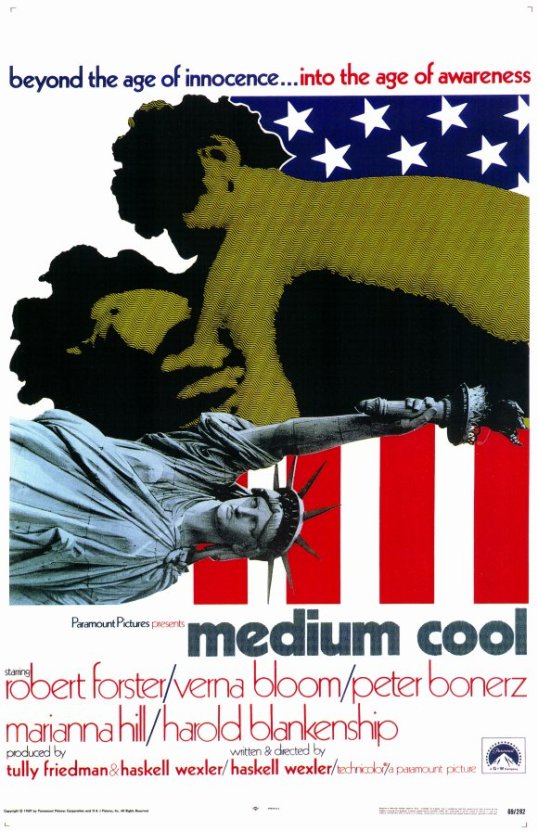
Shattered Politics #27: Medium Cool (dir by Haskell Wexler)


Film_Poster_for_Medium_CoolFor the past few days, I’ve been chronologically reviewing 94 films about politicians and, to a lesser extent, politics.  Four days ago, I started in on the 60s by taking a look at Sunrise at Campobello, one of the most traditional-minded and pro-American movies ever made.  And now, I’m closing out the decade by taking a look at 1969’s Medium Cool, a film that is — in style, ideology, and content — the exact opposite of Sunrise at Campobello.

I should admit that I’m cheating a bit by including Medium Cool in this series of reviews.  When I first started Shattered Politics, I said that I would be reviewing films about politicians.  While Medium Cool is a fiercely political film, there are few elected officials to be seen on screen.  That said, it was shot during the infamous 1968 Democratic National Convention and, as such, the politicians are present regardless of whether or not they’re seen.

Plotwise, the film follows a news cameraman, John (Robert Forster), and his sound guy (Peter Bonerz) as they go around Chicago, searching for stories.  Along the way, they interview the disturbingly cheerful owner of a gun club (played, in his film debut, by Peter Boyle), several people who volunteered on Robert Kennedy’s presidential campaign, and, in one of the film’s best and most awkward scenes, a group of Black Panthers.

Throughout the first half of the film, John remains detached from the stories that he covers.  He’s more concerned with getting the footage and getting a good soundbite than in really listening to what anyone is saying.  (In many ways, he’s like a less sociopathic version of the character played by Jake Gyllenhaal in Nightcrawler.)  It’s not until John discovers that his station is sharing his footage with the FBI that John finally starts to show some political awareness.  Unfortunately, he also shows some anger and ends up losing his job as a result.

Now unemployed, John meets Eileen (Verna Bloom), a single mother who has recently moved to Chicago from West Virginia.  Now that he’s free from the detachment of his job, John actually starts to develop feelings for both Eileen and her son, Harold (Harold Blankenship).  When Harold runs away, Eileen and John search Chicago for him.  Unfortunately, their search happens at the same time as the 1968 Democratic Convention.  While John and Eileen search, the Chicago police are busy beating protestors in the street.

(The video below is long, but worth watching, as is the entire film.)

Now, I know that, in the past, I’ve been critical of many of the counter culture films of the late 60s and early 70s, describing their politics as being shallow, trendy, and faux Leftist.  (And if you doubt me, read my reviews of Getting Straight, Zabriskie Point, and R.P.M.)  However, Medium Cool is an exception to those films, in that it actually works.  Medium Cool was directed by famed cinematographer, Haskell Wexler.  Wexler began his career shooting documentaries and, in many ways, that’s exactly what Medium Cool is.  Though Robert Forster may be an actor, many of the people that he interviewed in the film were not.  When he talks to the former Kennedy campaign workers, he’s talking to actual volunteers and getting their true feelings, as opposed to something written for them by an out-of-touch screenwriter.  When we see John and Eileen trying to survive the violence outside the Democratic Convention, we’re also seeing Robert Forster and Verna Bloom attempting to do the same thing.  The protestors being attacked were real.  The cops doing the attacking were real.  The violence was real.

And, considering that Medium Cool was released 46 years ago, the issues raised by the film are still real.  When the Black Panthers suspiciously view John and his sound guy, we’re reminded of the protestors in Ferguson demanding that the national media get out of their way.  When we see the protests outside the 1968 Democratic Convention, how can we not compare them to the protests that we still see every day?  When the cops line up in military precision and we hear that orders must be followed, are we watching Medium Cool or are we watching CNN?

During one of Medium Cool‘s better known moments, an off-screen voice is heard to shout, “Look out, Haskell!  It’s real!,” warning director Haskell Wexler that the violence he’s filming is actually happening.  And that’s a warning that’s still appropriate and relevant today.  We may be watching from the safety of our homes but it’s still real.

(Of course, it should be mentioned that, according to Wexler himself, “Look out, Haskell!  It’s real!” was actually added to the scene in post production.)

It’s perhaps indicative of how much American culture changed in the 60s that a decade that started with Ralph Bellamy playing Franklin D. Roosevelt would end with Medium Cool.  Fortunately, Medium Cool gives us plenty of evidence about how that change happened.