Shattered Politics #46: Used Cars (dir by Robert Zemeckis)


Used_Cars_film_poster

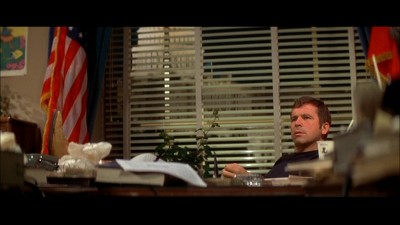
“Do you think we like being associated with the President of the United States?  I mean, we run an honest business here!” —

Jeff (Gerrit Graham) in Used Cars (1980)

As a film lover, I’ve sat through so many disappointing commentary tracks that, when I come across one that’s actually fun and informative, it causes me to like the film even more.  One of the best commentary tracks that I’ve ever heard was the one that Robert Zemeckis, Bob Gale, and Kurt Russell recorded for the DVD release of the 1980 comedy Used Cars.

The film — which was an early credit for both director Zemeckis and screenwriter Gale — tells the story of two rival used car lots.  The bad guy car lot is owned by Roy L. Fuchs (Jack Warden).  The good guy car lot is owned by Roy’s brother, Luke Fuchs (also played by Jack Warden).  The top salesman at the good guy car lot is Rudy Russo (Kurt Russell).  The film shows what happens when Luke dies and Rudy tries to prevent Roy from taking over the lot.

The commentary track is distinguished by just how much Zemeckis, Gale, and Russell seem to truly enjoy watching and talking about the film.  Kurt Russell, in particular, has an incredibly engaging laugh and his sense of fun is contagious.  However, for me, the most interesting part of the commentary track came when Bob Gale explicitly compared Rudy Russo and Luke’s daughter (played by Deborah Harmon) to Bill and Hillary Clinton and then even starts to do a surprisingly good imitation of Bill’s hoarse Arkansas accent.

What made it interesting was that the comparison was absolutely correct.

Politicians are salesmen.  Much as politicians will say anything to get your vote, the salesmen in Used Cars will say and do anything to get your money.  Politicians sell promises that are too good to be true.  Rudy Russo and Roy L. Fuchs do the same thing, claiming that their used cars are just as good and safe as a car that’s never been owned before.

In fact, one of the major plotlines in Used Cars is that Rudy is plotting to make the move from selling cars to buying votes.  There’s a vacancy in the state senate and Rudy is planning on running for the seat.  All he has to do is come up with the $10,000 necessary to buy the nomination from the local political machine. (I imagine it would be more expensive to buy a nomination today.)  Luke agrees to loan Rudy the money but, before he can, Luke goes on a test drive with a former race car driver.

The driver works for Luke’s evil brother, Roy.  Roy knows that Luke has a heart condition and he specifically sends over that driver to give Luke a fatal heart attack.  Just as Rudy is trying to sell a car to a costumer who is skeptical about whether or not he should pay an extra fifty dollar for something he doesn’t want (“$50.00 never killed anyone!” the customer insists), Luke staggers into the office and dies.

(The shocked customer agrees to pay the extra fifty dollars.  Ever the salesman, Luke grabs the fifty before he dies.)

With Luke dead and his estranged daughter nowhere to be seen, Roy is next-in-line to take over Luke’s car lot.  So, Rudy hides the body and tells everyone that Luke is down in Florida.  Both he and his fellow salesman, the hilariously superstitious Jeff (Gerrit Graham), conspire to make as much money as possible before anyone discovers the truth.

How do they do it?  Illegally, of course!

First off, they break into the broadcast of a football game and do an ad.  Then, they use strippers to attract customers.  And finally, Rudy comes up with his master plan, interrupting a televised address from the President of the United States.

“You can’t fuck with the President!” Jeff says.

“Hey, he fucks with us…” Rudy responds.

Seriously, I love Rudy.

In fact, I really liked Used Cars.  It’s a good combination of broad humor and clever satire and both Kurt Russell and Gerrit Graham give such likable performances that you can ignore the fact that they’re both playing total jerks.  (In fact, I would argue that one reason that we love Rudy is because he’s so honest about being so crooked.)  Not every scene worked perfectly.  The scene where Rudy and Jeff interrupt that football game goes on forever and, after a spokesmodel’s dress is ripped off, becomes so uncomfortable to watch that it actually takes the film a while to recover.  But then, after that, you get the interruption of the President’s speech.  You get Jeff freaking out over whether or not red cars or unlucky.  You get some fun driving school humor.  And, of course, you get a cute dog that can do tricks and helps to sell cars.  The film recovers and, ultimately, Used Cars is a celebration of small businesses everywhere.

And you know what?

I really hope Rudy did make it into the state senate.

We need more Rudy Russos in government.

And we really need more commentary tracks featuring Kurt Russell!
Shattered Politics #45: The Changeling (dir by Peter Medak)


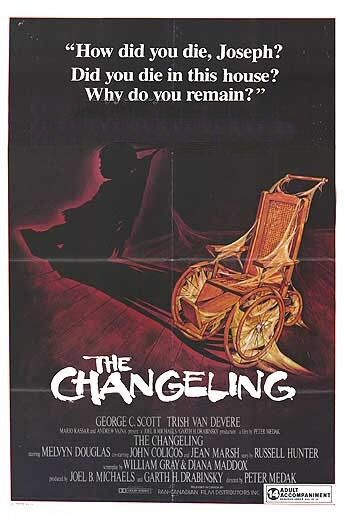
Changeling_ver1If you love horror movies, you have to track down and see The Changeling.

First released in 1980, The Changeling stars George C. Scott as John Russell, a composer.  At the start of the film, he watches helplessly as both his wife and his daughter are killed in a horrific auto accident.  The grieving John leaves his New York home and relocates to Seattle, Washington.  With the help of a sympathetic realtor, Claire Norman (Trish Van Devere), John finds and rents a previously abandoned Victorian mansion.

At first, it seems that John is alone with his grief.  But, as you can probably guess, it quickly becomes apparent that John isn’t alone in his house.  Windows shatter.  Doors slam.  And, most dramatically, every night a mysterious banging sound echoes through the house.  Slowly, John comes to suspect that his house might be haunted…

And, of course, it is!  It’s no spoiler to tell you that because the film is admirably straight forward about being a ghost story.  And what a clever ghost story it is.  I don’t want to give too much away so I’ll just say that the story behind the ghost involves a powerful family, an age-old scandal, and a powerful U.S. Senator (played, with a mixture of poignant sadness and menace, by Melvyn Douglas).

The Changeling is a very well-done and effective ghost story.  For the most part, director Peter Medak emphasizes atmosphere over easy shocks, the end result being a film that maintains a steady feeling of dread and sticks with you long after the final credit rolls up the screen.  George C. Scott is well-cast as John Russell, capturing both the character’s grief and his curiosity.  (There’s actually a very interesting subtext to the film, in that investigating death actually gives John a reason to live.)  At the time the film was made, he was married to Trish Van Devere and the two of them have a very likable chemistry.  And, as previously stated, Melvyn Douglas makes for a great quasi-villain.

(It’s interesting to compare Douglas’s intimidating work here with the far more sympathetic performances that he gave, around the same time, in Being There and The Seduction of Joe Tynan.)

My favorite scene in The Changeling comes when John and Claire hold a séance in order to try to discover what the ghost wants.  The séance team is made up one woman who asks questions, one woman who channels the spirit and writes down his answers, and one man who reads the answers after they’re written.  It’s a wonderfully effective scene, dominated by the eerie sounds of questions being asked, answers being scribbled, and then being shakily read aloud.  It’s probably one of the best cinematic séances that I’ve ever seen.

The Changeling is a wonderful mix of political intrigue and paranormal horror. It was also the first film ever to win a Genie award for Best Canadian Film, which just goes to prove the 90% of all good things come from Canada.

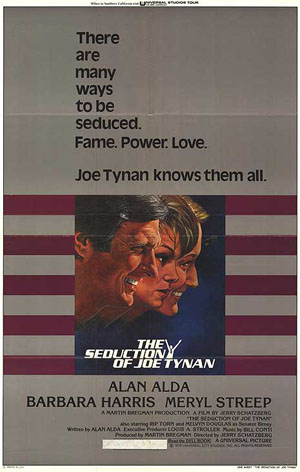
Shattered Politics #44: The Seduction of Joe Tynan (dir by Jerry Schatzberg)


The Seduction of Joe Tynan (1979)

You know how sometimes you see a film and you can just tell that it was probably a big deal when it was first released but now, in the present day, it’s just not that interesting?  That’s the way that I felt when I saw 1979’s The Seduction of Joe Tynan on Netflix.  This is one of those film’s that you just know was probably praised for being adult and mature when it was first released but seen today, it’s just kinda bleh.

Joe Tynan (Alan Alda) is a Democratic senator from New York, a committed liberal who is also an ambitious pragmatist.  As quickly becomes apparent, Joe is happiest when he’s at work.  He struggles to talk to his rebellious teenage daughter (Blanche Baker).  While he may love his wife (Barbara Harris), she’s also one of the few people in his life who isn’t always telling him how great he is and, to an extent, she resents having to live in his shadow.  At times, it seems like the only thing holding Joe’s family together is the possibility that Joe could soon be nominated for the presidency.

When a Southern judge is nominated for the Supreme Court, Joe is asked by his mentor, Sen. Birney (a great Melvyn Douglas), to not oppose the nomination.  While Joe originally agrees to keep quiet, he soon changes his mind when he’s approached by lobbyists who make it clear that, if he goes back on his word to Birney, they’ll be willing to support Joe for President.

Leaving behind his family, Joe heads down south where he meets a researcher named Karen Traynor (Meryl Streep).  With Karen’s help, Joe discovers that the judge actually is a racist.  He also discovers that, politically, he has a lot more in common with Karen than he does with his own wife and soon, they’re having an affair.

The Seduction of Joe Tynan is an odd film.  As written, Tynan is a decent but flawed man.  He may do the right thing but he does so largely because of his own ambition.  That’s not a problem, of course.  If anything, that would seem to be the making of a great political film.  Some of the greatest film characters of all time have been morally ambiguous.  But then, Alan Alda (who also wrote the script) gives a performance that would seem to indicate that he was scared of being disliked by the audience.  Alda is believable when he’s being a self-righteous crusader but, whenever he has to play up the pragmatic and ruthless side of Joe Tynan, he almost seems to have zoned out.  It’s interesting to compare Alda’s lukewarm performance here with the far more nuanced performance that he would give, as a less idealistic Senator, decades later in The Aviator.  As far as the film’s senators are concerned, Melvyn Douglas and Rip Torn (playing a libertine colleague) are far more believable than Alda.

The film’s best performance is delivered by Meryl Streep.  That might not sound shocking but actually, Streep’s performance here is surprising because it’s far more natural and less mannered than some of her more acclaimed performances.  Believe it or not, you actually forget that you’re watching Meryl Streep.

Ultimately, you have to respect the fact that the film attempted to tell an adult and mature story about politics but that doesn’t make The Seduction of Joe Tynan any less forgettable.

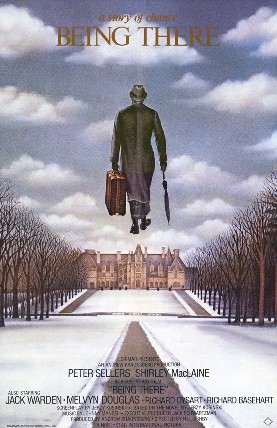
Shattered Politics #43: Being There (dir by Hal Ashby)


Original_movie_poster_for_Being_There

As a general rule, I don’t watch the news.  However, a few nights ago, I made an exception and I watched CNN.  The reason was because it was snowing in New York City and apparently, CNN anchorman Don Lemon was broadcasting from something called the Blizzardmobile.  I just had to see that!

Well, the Blizzardmobile turned out to be huge letdown.  I was hoping for something like the Snowpiercer train but instead, it just turned out to be a SUV with a camera crew and a pompous anchorman who hilariously kept insisting that he was knee-deep in a blizzard when even a Texas girl like me could tell that the Blizzardmobile was only encountering a few snow flurries.

So, I flipped around to see if any of the other news stations had anyone in a blizzardmobile.  What I discovered was that only CNN had a blizzardmobile but one thing that every news station did have was a panel of experts.  An anchorperson would say something like, “What does the future look like?” and the panel of experts would tell us what the future looked like to them.  What I found interesting was that I had no idea who these experts were but yet I was supposed to just believe that their opinions were worth considering.

I mean, for all I knew, those experts could have just been people who were spotted wandering around New York at night.  But, because they were introduced as experts and looked directly at the camera whenever they spoke, they were suddenly authoritative voices.

Oddly enough, the very next night, I watched a movie from 1979 that dealt with the exact same issue.

Being There tells the story of Chance (Peter Sellers), a dignified, middle-aged man who lives in Washington, D.C. and works as a gardener for a wealthy older man.  Chance cannot read.  Chance cannot write.  Chance goes through life with a blank smile on his face.  Chance has never experienced the outside world.  Instead, he spends all of his time working in the old man’s garden and obsessively watching TV.  When the old man dies, Chance finds himself exiled from the house.  Wandering around Washington D.C., Chance asks a random woman to make him dinner.  He politely speaks with a drug dealer who pulls a knife on him.  Finally, he finds himself entranced by a window display of televisions.  Backing away from the window, Chance stumbles into the street and is struck by a car.

Though he’s not seriously injured, the owner of the car, Eve Rand (Shirley MacClaine), insists that Chance come back to her mansion with him so that he can be checked out by her private physician (Richard Dysart).  As they drive back to the house, Eve asks Chance for his name.

“Chance the Gardner,” Chance replies.

“Chauncey Gardiner?” Eve asks.

Chance blankly nods.

Back the house, Chance meets Eve’s husband, Ben (Melvyn Douglas).  Ben is a wealthy industrialist who is dying of leukemia.  Ben takes an immediate liking to Chance.  Because Chance is wearing the old man’s suits, everyone assumes that Chance is a wealthy businessman.  When Chance says that he had to leave his home, they assume that his business must have failed due to government regulation.  When Chance talks about his garden, everyone assumes that he’s speaking in metaphors.

Soon, Ben is introducing Chance to his friend, Bobby (Jack Warden).  Bobby happens to be the President and when he quotes Chance in a speech, Chance the Gardner is suddenly the most famous man in the country.  When he appears on a TV talk show, the audience mistakes his emotionless comments for dry wit.  When he talks about how the garden reacts to different seasons, they assume that he’s an economic genius.  By the end of the film, Bobby has become so threatened by Chance’s popularity that he’s been rendered impotent while wealthy, rich men plot to make Chance the next President of the United States.

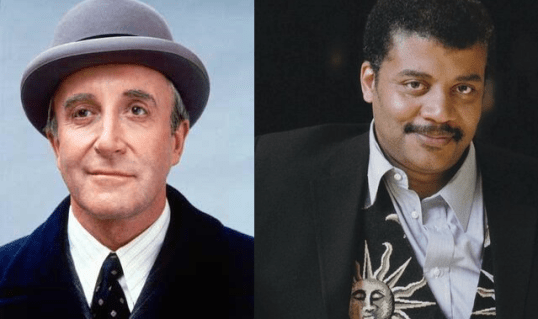
Chance and Neil

In many ways, Chauncey Gardiner was the Neil deGrasse Tyson of his era.

Being There is a one joke film and the idea of someone having no emotional skills beyond what he’s seen on television was probably a lot more mind-blowing back in 1979 than it is in 2015.  But I still enjoyed the film.  Peter Sellers gave a great performance as Chance, never sentimentalizing the character.  As well, the film’s point is still relevant.  If Being There were made today, Chance would be the subject of clickbait articles and Facebook memes.  (Chauncey Gardiner listed his ten top movies and number 8 will surprise you!  Or maybe This boy asked Chauncey Gardiner about his garden and his response was perfect.)

At its best, Being There is a film that will encourage you to question every expert you may see.  Especially if he’s just stepped out of a blizzardmobile…


Shattered Politics #42: Blue Sunshine (dir by Jeff Lieberman)


(I wrote an earlier version of this review for HorrorCritic.Com.)

Blue_Sunshine_(film)

Occasionally, on twitter, I would take part in the Drive-In Mob live tweet session.  Every Thursday night, a group of exploitation, grindhouse, and horror film fans gog together and watched the same film and, via twitter, provided their own running commentary track.  It was always terrific fun and a good opportunity to discover some films that you might have otherwise missed.  It was through the Drive-In Mob that I first discovered a low-budget cult classic from 1978, Blue Sunshine.

Blue Sunshine (directed by the underrated horror director Jeff Lieberman) opens in the late 1970s.  Across California, people are suddenly going bald and turning psychotic.  At a party, singer Frannie Scott (played by Richard Crystal) has a nervous breakdown when another reveler playfully pulls off his wig and reveals Frannie to be hairless.  Frannie responds by tossing half of the guests into the fireplace and then running out into the night.  He’s pursued by his best friend Jerry Zipkin (played by future director Zalman King) but when Frannie is accidentally killed while running away, Jerry finds himself accused of being a murderer.  Even as the police pursue him, Jerry starts his own investigation.  He quickly discovers that there’s an epidemic of bald people suddenly murdering those closest to them.  The one thing that these people have in common: they all attended Stanford University in the late 1960s and they all used a powerful form of LSD known as “blue sunshine.”  Now, ten years later, they’re all having the worst flashback imaginable.

And, perhaps most dangerously, the campus drug dealer, spoiled rich kid Edward Fleming (Mark Goddard), is on the verge of being elected to the U.S. Congress.  Not only it is possible that Edward may have taken the acid himself but Edward and his campaign manager have their own reasons to try to make sure that Jerry never reveals the truth behind Blue Sunshine.

Blue Sunshine is probably one of the best of the old grindhouse films, a film that embraces the conventions of both the horror and the political thriller genres while, at the same time, neatly subverting our expectations.  Director Jeff Lieberman emphasizes atmosphere over easy shocks and the film’s cast does a pretty good job of making us wonder who is normal and who has dropped the blue sunshine.  Wisely, Lieberman doesn’t resort to giving us any easy villains in this film.  Much like the best horror films, the monsters in Blue Sunshine are as much victims as victimizers.  I especially sympathized by one poor woman who was driven to rip off her wig by the sound of two particularly obnoxious children chanting, “We want Dr. Pepper!” over and over again.  Seriously, that’s enough to drive anyone crazy.

Blue Sunshine is one of those wonderfully odd little cult films that makes me thankful that I own a DVD player.  First released in 1978, Blue Sunshine mixes psychological horror with political conspiracy and the end result is an unusually intelligent B-movie that remains relevant even when seen today.  Blue Sunshine was originally released on DVD by Synapse Entertainment and it has since been re-released by the New Video Group.  I own the Synapse edition, which features a very entertaining director’s commentary with Jeff Lieberman as well as a bonus CD of the film’s haunting and atmospheric score.

Shattered Politics #41: Billy Jack Goes To Washington (dir by Tom Laughlin)


39c7523029bb4c926a278a4a6a333ae5

The Happy Hooker wasn’t the only person to go to Washington in 1977!  Billy Jack may have started out killing bikers and then moved on to killing Bernard Posner and then finally ended up killing yet another Mr. Posner but, in 1977, Billy Jack was appointed to the U.S. Senate.

Now, it may seem strange to think of someone like Billy Jack being appointed to the U.S. Senate.  Over the course of the previous three films in the franchise, Billy had been shot in the back, shot in the leg, arrested for murder, convicted of manslaughter, and then shot by the National Guard.  In Billy Jack and The Trial of Billy Jack, Billy goes as far as to state that he does not feel the laws of the United States apply to him.

And then, when you consider that the three previous films all featured old, rich, white guys plotting to kill Billy, you would be justified in wondering how he would ever find himself appointed to serve in the senate.

But it happened!

And we’ve got a movie to prove it.

Directed by and starring Tom Laughlin, Billy Jack Goes To Washington is actually a remake of Mr. Smith Goes To Washington.  (To the film’s credit, it’s honest enough to actually give credit to Mr. Smith‘s screenwriters in the opening credits.)  What’s remarkable is just how faithful a remake Billy Jack Goes To Washington actually is.  All the scenes made famous by Jimmy Stewart — the scene where the newest member of the Senate attempts to introduce his first bill, the scene where he’s shocked to discover that Sen. Paine (played here by E.G. Marshall) takes orders from Boss Bailey (Sam Wanamaker), the scene where cynical Saunders (Lucie Arnaz) tells the senator that he should leave Washington, and, of course, that famous filibuster — are all faithfully recreated here.  The only difference, of course, is that it’s no longer idealistic Jimmy Stewart proving himself to be incredibly naive about politics.  Instead, it’s a former Green Beret, half-Indian, judo master named Billy Jack.

Tom Laughlin was a good actor, which is something that’s often overlooked by reviewers writing about the Billy Jack films.  As flawed as The Trial of Billy Jack may have been, Tom Laughlin was a compelling enough presence that the film itself remains a compulsively watchable 3-hour mess.  Laughlin had a very authoritative presence.  You looked at him and you knew that he knew what he was doing.  He was someone who you automatically wanted on your side, a natural born leader who knew how to get things done.  However, in Billy Jack Goes To Washington, Laughlin attempts to play Billy Jack as the type of naive neophyte who would be shocked to discover that politicians are corrupt.  But surely, after spending three films being harassed by every authority figure in America, Billy would have already realized that.  There’s nothing about Laughlin’s screen presence that suggests he could ever be that innocent.

And that’s the main problem with Billy Jack Goes To Washington.  For the film to have any chance of working, you have to forget everything that you’ve learned about Billy Jack over the previous three films.  However, if you haven’t seen any of the other Billy Jack films, then you probably wouldn’t be watching Billy Jack Goes To Washington in the first place.

Of course, since this is a Billy Jack film, there are a few scenes that were nowhere to be found in Mr. Smith Goes To Washington.  For instance, Saunders’s husband is murdered when he threatens to reveal the truth about Bailey’s operation.  Later, Billy, Jean (Delores Taylor), and Carol (Teresa Laughlin) are confronted by a gang of Bailey’s assassins and, for the only time in the entire movie, Billy goes through that whole routine where he takes off his boots while slowly speaking and then kicks everyone’s ass.  (Jean and Carol get to join in the ass-kicking as well and good for them!)

And, of course, there’s the scene where Billy, Jean, and the kids from the Freedom School (who are apparently now known as Billy’s Raiders) have a meeting with two liberal social activists.  It’s an interesting scene because it was clearly unscripted and it has a naturalistic feel to it that’s lacking from the rest of the film.  However, that does not mean that it’s a particularly good scene.  If I learned anything from Billy Jack Goes To Washington, it’s that self-righteous activists in 1977 were just as boring as self-righteous activists in 2015.

And yet, as I’ve said about all of the other Billy Jack films, I can’t bring myself to be too hard on Billy Jack Goes To Washington.  Again, it all comes down to sincerity.  It’s clear that Laughlin and Taylor felt they were making a difference with their films and that sincerity comes through in a way that makes Billy Jack Goes To Washington a likable, if rather inept, film.

Billy Jack Goes To Washington ran for a week in one theater in 1977 and was reportedly such a box office disaster that it couldn’t get a wider release.  (In a commentary track that he recorded for the film’s DVD release, Laughlin suggests the film was the victim of shadowy government forces.)*  While Laughlin and Taylor would later try to make The Return of Billy Jack, that film was left uncompleted at the time of Laughlin’s death.  So, the last time that filmgoers would see Billy Jack, he would still be U.S. Sen. Billy Jack.

And really, that’s the perfect ending for the saga of Billy Jack.  Starting out as a loner who protected a small California town from a biker gang to eventually becoming the protector of the Freedom School to finally embracing both non-violence and his love for Jean, Billy Jack earned himself a happy ending.

Having now watched and reviewed all four of the Billy Jack films, all I can do is say thank you to Delores Taylor and the spirit of Tom Laughlin.  It was great ride.

1251421109_1

—-

* To be honest, the commentaries that Laughlin and Taylor recorded for the Billy Jack films are actually very informative and interesting.  Laughlin actually had a far better sense of humor than you might guess from some of the movies he directed.

Shattered Politics #40: The Happy Hooker Goes To Washington (dir by William A. Levey)


happy-hooker-470-x-647

“God bless you, Ms. Hollander!  You have saved us from recession!”

— Dialogue from The Happy Hooker Goes To Washington (1977)

Le sigh.

The things that I do for this site!

If I wasn’t currently in the process of watching and reviewing 94 films about politicians and politics, I can guarantee that I would never have watched The Happy Hooker Goes To Washington.  However, while I was looking for films to review for this series, I went over to Netflix and did a search on “Washington.”

Guess which film came up first?

If you guessed The Happy Hooker Goes To Washington, you would be correct!  And you know what?  I watched this movie with an open mind.  As anyone who has read this site knows, I have never been shy about my love of old exploitation films.  The fact of the matter is that some of the most imaginative films ever made were low-budget grindhouse movies.  Nothing angers me more than elitist film bloggers who dismiss a film just because it originally played in grindhouse cinema.

But, honestly, The Happy Hooker Goes To Washington is just bad.  It’s boring.  The acting is terrible.  The jokes fall flat.  The attempts at political satire are about as clever as what you’d find on any site trying to read like the Onion without actually being the Onion.

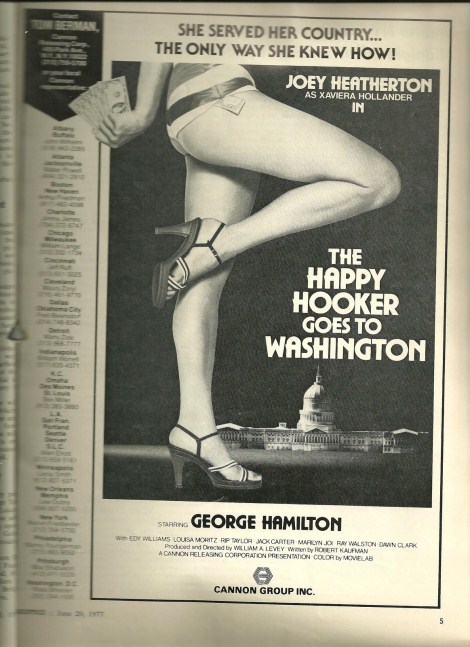
In the Happy Hooker Goes To Washington, Joey Heatherton plays Xaviera Hollander, a former madam who is now a businesswoman, magazine publisher, and sex advise columnist.  She is apparently the world’s leading authority on sex.  We know this because, when she first appears, she’s surrounded by reporters.  “When sex is news, you’re news!” one of them tells her.

Xaviera has been called to testify in front of the Senate Committee To Investigate Sexual Excess In America.  And goddamn, this movie is stupid.  But anyway, Xaviera goes to Washington to stand up for sexual freedom.  Accompanying her is an attorney named Ward Thompson (George Hamilton) and, quicker than you can say “Fifth place on Dancing With The Stars,” Ward is explaining to Xaviera why her testimony is so important.

“We’re heading right into the teeth of a new puritanism,” he tells her.  “Under the new puritanism, there won’t be any happy hookers!”

Anyway, Xaviera testifies in front of the committee and we get a few flashbacks to some of Xaviera’s past accomplishments.  And then she gets recruited by a dwarf (Billy Barty) and is sent to seduce an Middle Eastern ruler and … well, it just keep going and going.  This is one of the longest 84-minute films ever released.

Anyway, this movie sucks.  (And so does Xaviera!  That’s the level of humor that you can expect when you watch The Happy Hooker Goes To Washington.)  It’s still lurking around Netflix.  Avoid it at all costs.

Shattered Politics #39: Taxi Driver (dir by Martin Scorsese)


Taxi_Driver_poster

We’ve never had a President named Charles.  We’ve had several Presidents named John and a quite a few named James.  We’ve even had three named George.  But we’ve never had a Charles.  We’ve come close.  Charles Evans Hughes nearly beat evil old Woodrow Wilson in 1916.  Charles Cotesworth Pinckney was nominated two times in a row by the Federalists but lost to Thomas Jefferson and James Madison respectively.  We’ve had three Vice Presidents names Charles — Fairbanks, Dawes, and Curtis — but never a President.

And, if we ever do elect a President named Charles, he’s probably go by either Charlie or Chuck.  The United States has always liked to think of itself as being a country that has no official royal family and, as a name, Charles probably sounds far to aristocratic for most voters.

That’s why I’m sure that, once U.S. Sen. Charles Palatine won the Democratic presidential nomination back in 1976, he probably insisted that people start calling him Chuck.  Of course, Sen. Palatine probably had no idea how lucky he was to win that nomination.  If not for a few secret service agents, Sen. Palatine could very well have fallen victim to a psychotic taxi driver named Travis Bickle.

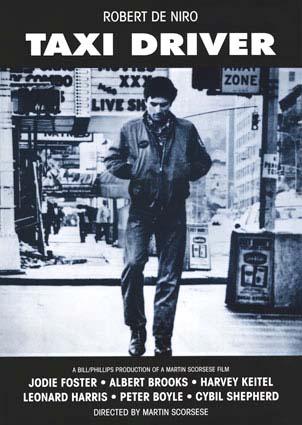
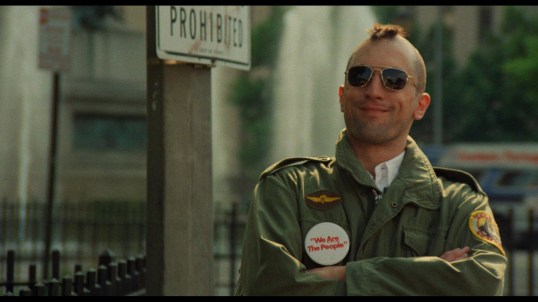
Sen. Palatine’s presidential campaign is a major subplot of Martin Scorsese’s 1976 masterpiece of paranoia, Taxi Driver.  As played by an actor named Leonard Harris, Sen. Palatine appears to be the epitome of a politician.  He may smile at the right moment but his eyes are always shifty.  Even his campaign slogan (“We Are The people!”) is vapid in an all too plausible way.  (How different is “We Are the People” from “We Are The People We’ve Been Waiting For?”)  For the most part, Palatine remains a remote figure, giving speeches and appearing in television commercials.  The only time that we get to know Palatine as a person is when he gets in a taxi being driven by Travis Bickle (Robert De Niro).

Travis recognizes him immediately and tells him that he tells everyone who gets in the cab that “they gotta vote for you.”  Palatine smirks a little as he asks Travis what he thinks the most important issue of the election is.  Travis goes on a bit about how someone needs to destroy all of the scum and filthy lowlifes who seem to populate Travis’s section of New York.  As Travis rambles, Palatine’s smile disappears and it becomes obvious that he’s realized that he is essentially being driven by a psycho.  Oh shit, Palatine is probably thinking, this guy is telling people that they gotta vote for me?  However, Palatine quickly regains his composure and assures Travis that the wisest people that he’s ever met have been taxi drivers.

Of course, what Palatine doesn’t realize is that Travis only knows about the campaign because he happens to be obsessed with a Palatine campaign worker named Betsy (Cybill Shepherd).  And Betsy even goes out with Travis a few times.  But then Travis, who spends the majority of the film showing how little skill he has when it comes to understanding and relating to other people, takes Betsy to an adult film.

With Betsy refusing to take his calls, Travis’s attention shifts to Iris (Jodie Foster), a teenage prostitute.  Obviously seeing himself as being a knight in shining armor, Travis tells Iris that she has to go back home to her parents.  As Travis talks, it becomes apparent that he’s simply repeating talking points that he’s heard on TV.  (If Taxi Driver was made today, Travis would be one of those people constantly sharing “inspirational” Facebook posts.)  Iris laughs at Travis and goes back to her pimp, Sport (Harvey Keitel).

And, of course, Travis goes even crazier than before.

38 years after it was first released, Taxi Driver remains a disturbing and powerful film.  However, what makes it effective is that, in many ways, it’s perhaps the darkest comedy ever made.  Throughout the entire film, Travis essentially tells everyone that he meets that he’s disturbed and potentially dangerous and, throughout the entire film, everyone seems to be determined to ignore all of the signs.

Critics always talks about the scene where Travis points a gun at his mirror and asks, “You talkin’ to me?”  And that’s a great scene.  It deserves to be famous, just as De Niro deserves all of the praise that he’s gotten for his iconic performance in Taxi Driver.

However, for me, there are two other scenes that are just as brilliant.  The first is where Travis attempts to get some advice from an older cabbie named Wizard (Peter Boyle).  Travis says he’s been having a lot bad thoughts.  Wizard shrugs and says that everyone has those.  What makes this scene particularly memorable are the lengths that Wizard goes to in order to avoid acknowledging that Travis is obviously disturbed.

And then, there’s the scene where Travis buys a gun from Easy Andy (Steven Prince).  Andy is such a salesman and is so nonchalant about all of his weaponry that, for a few brief minutes, Steven Prince actually manages to steal the spotlight from Robert De Niro.

Whenever one thinks about Taxi Driver, one automatically pictures Robert De Niro.  That’s why it’s all the more interesting that De Niro was not the first choice for Travis.  When Taxi Driver was in pre-production and a pre-Jaws Steven Spielberg (of all people) was thinking about directing it, Jeff Bridges as briefly attached to the role.  And while it’s always tempting to think about what a Spielberg/Bridges version of Taxi Driver would look like, I think we’re all right to be happy that the actual film was directed by Scorsese and starred De Niro.  They truly made Taxi Driver into one of the most memorable films ever made.

taxi-driver-mohawk

Shattered Politics #38: Nashville (dir by Robert Altman)


Nashville-Cover

“Oh we must be doin’ somethin right to last 200 years…”

— Haven Hamilton (Henry Gibson) in Nashville (1975)

The 1975 Best Picture nominee Nashville is the epitome of an ensemble film.  It follows 24 characters as they spend five days wandering around Nashville, Tennessee.  Some of them are country music superstars, some of them are groupies, some of them are singers looking for a first break, and at least one of them is an assassin.  The one thing that they all have in common is that they’re lost in America.  Released barely a year after the resignation of Richard Nixon and at a time when Americans were still struggling to come to terms with the turmoil of the 60s, Nashville is a film that asks whether or not America’s best days are behind it and seems to be saying that they may very well be.  (That’s a question that’s still being asked today in 2015.)  It’s appropriate, therefore, that Nashville both takes place in and is named after a city that everyone associates with perhaps the most stereotypically American genre of music that there is.

Nashville follows 24 characters, some of whom are more interesting than others.  For five days, these characters wander around town, occasionally noticing each other but far more often failing to make any sort of connection.

Haven Hamilton (Henry Gibson) is a veteran star, a somewhat comical character who sings vapid songs about home and family and who smiles for the public while privately revealing himself to be petty and vain.  His son, Bud (Dave Peel), is a Harvard graduate who acts as his father’s business manager.  Oddly enough, Haven is an unlikable character until the end of the film when he suddenly reveals himself to be one of the few characters strong enough to keep Nashville for descending into chaos.  Meanwhile, Bud seems to be a nice and modest guy until he takes part in humiliating another character.

Haven’s lover is Lady Pearl (Barbara Baxley), who owns a nightclub and spends most of the film drinking.  Much like Haven, she starts out as a vaguely comical character until she finally gets a chance to reveal her true self.  In Pearl’s case, it comes when she delivers a bitter monologue about volunteering for Bobby Kennedy’s presidential campaign.

Haven’s lawyer is Delbert Reece (Ned Beatty), an obsequies good old boy who is married to gospel singer Linnea (Lily Tomlin).  They have two deaf children.  Linnea has learned sign language.  Delbert has not.  Over the course of the film, both Delbert and Linnea will be tempted to cheat.  Only one of them actually will.

And then there’s Barbara Jean (Ronee Blakley), a mentally unstable singer who has come to Nashville with her manipulative husband/manager, Barnett (Allen Garfield).  Almost every character in the film wants something from Barbara Jean.  A mostly silent Vietnam veteran named Kelly (Scott Glenn) claims that his mother knows Barbara Jean.  A nerdy guy named Kenny (David Hayward) comes to Nashville just to see her perform.

Both Kelly and Kenny end up getting to know Mr. Green (Keenan Wynn), a rare Nashville resident who doesn’t seem to care about music.  However, Mr. Green’s spacey niece, L.A. Joan (Shelly Duvall), is obsessed with having sex with as many musicians as possible.

Among those being targeted by L.A. Joan is Tom Frank (Keith Carradine), one-third of the folk trio Bill, Mary, and Tom.  Unknown to Bill (Allan F. Nicholls), Tom is sleeping with Bill’s wife, Mary (Cristina Raines).  Unknown to Mary, Tom is sleeping with almost every other woman in Nashville as well.  When Tom takes to the stage at Pearl’s nightclub and sings a song called I’m Easy, the audience is full of women who think that he’s specifically singing to them.

Another one of Tom’s songs, the appropriately titled “It Don’t Worry Me,” is frequently sung by Albuquerque (Barbara Harris), who spend the entire film trying to get discovered while hiding out from her much older husband, Star (Bert Remsen).

Another aspiring star is Sulleen Grey (Gwen Welles), who is a tone deaf waitress who suffers the film’s greatest humiliation when she agrees to perform at a political fund raiser without understanding that she’s expected to strip while singing.  Trying to look after Sulleen is Wade (Robert DoQui), who has just been released from prison.

And then there’s the loners, the characters who tend to pop up almost randomly.  Norman (David Arkin) is a limo driver who, like everyone else in Nashville, wants to be a star.  The hilariously bitchy Connie White (Karen Black) and the bland Tommy Brown (Timothy Brown) already are stars.  (The character of Tommy Brown is one of Nashville’s oddities.  He’s listed, in the credits, as being a major character but he only appears in a few scenes and never really gets a storyline of his own.)  There’s the Tricycle Man (Jeff Goldblum), a silent magician who mysteriously appears and disappears throughout the film.

And, finally, there’s Opal (Geraldine Chaplin), an apparently crazed woman who is wandering around Nashville and pretending to be a reporter for the BBC.  (It’s never specifically stated that Opal is a fake but it’s fairly obvious that she is.)  How you feel about the character of Opal will probably determine how you feel about Nashville as a whole.  If you find Opal to be a heavy-handed caricature, you’ll probably feel the same way about the rest of the film.  If you find the character of Opal to be genuinely amusing with her increasingly pretentious musings, you’ll probably enjoy Nashville.

There is one more very important character in Nashville.  He’s the character who literally holds the film together.  He’s also the reason why I’m including Nashville in this series of reviews about political films.  That character is named Hal Phillip Walker and, though he’s never actually seen in the film, he’s still the driving force behind most of what happens.  Walker is a third-party presidential candidate, a man who seems to be universally admired despite the fact that his campaign appears to just be a collection of vapid platitudes.  Walker’s campaign manager, John Triplette (Michael Murphy), comes to Nashville and sets up the Walker For President rally.  That’s where Nashville reaches its violent and not-all-together optimistic climax.

Reportedly, Nashville is a favorite film of Paul Thomas Anderson’s and you can see the influence of Nashville in many of Anderson’s films, from the large ensemble to the moments of bizarre humor to the refusal to pass judgement on any of the characters to the inevitable violence that ends the film.  Also, much like Anderson’s films, Nashville seems to be a film that was specifically made to divide audiences.  You’re either going to think that Nashville is a brilliantly satirical piece of Americana or you’re going to think it’s a self-indulgent and self-important mess.

As for me, I think it’s great and I think that, after you watch it, you should track down and read Jan Stuart’s The Nashville Chronicles: The Making of Robert Altman’s Masterpiece.  It’s the perfect companion for a great film.


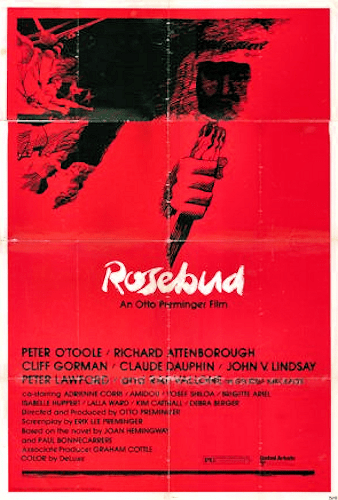
Shattered Politics #37: Rosebud (dir by Otto Preminger)


Rosebud_-_1975_-_Film_Poster

Before I review the 1975 film Rosebud, allow me to tell you about how I first discovered the existence of this particular film.

The greatest used bookstore in the world is located in Denton, Texas.  It’s called Recycled Books and it is three stories of pure literary goodness!  (Plus, there are apartments on the top floor where I attended some pretty interesting parties but that’s another story….)  When I was attending the University of North Texas, I used to stop by Recycled Books nearly every day.  One day, I happened to be searching the Film and TV section when I came across a beat-up paperback called Soon To Be A Major Motion Picture.

This book, which was written by Theodore Gershuny, told the story of how the previously acclaimed director Otto Preminger attempted to make a film about terrorism.  Starting with the attempts of Preminger’s son, Erik Lee Preminger, to come up with a workable script and then going on to detail how Peter O’Toole came to replace Robert Mitchum as the star of the film and ending with the film’s disastrous release, Soon To Be A Major Motion Picture proved to be a fascinating read.

After finishing the book, I simply had to see Rosebud for myself.  Unfortunately, at that time, Rosebud had not yet been released on Blu-ray or DVD.  So, I actually ended up ordering an old VHS copy of it.  The tape that I got was not in the best condition but it played well enough and I can now say that, unlike the majority of people in the world, I’ve actually seen Rosebud!

Which is not to say that Rosebud is any good.  It’s not the disaster that I had been led to expect.  In fact, it probably would have been more fun if it had been a disaster, as opposed to being just a forgettable film from a director who was probably capable of better.  Preminger started his career in the 30s and was considered, at one point, to be quite innovative.  He directed Laura and Anatomy of a Murder, two great films.  Unfortunately, there’s really nothing innovative about his direction of Rosebud.  In Gershuny’s book, Preminger comes across like an intelligent and thoughtful man who was too set in his ways to realize that what was shocking in 1959 was no longer that big of a deal in 1975.  (And, needless to say, it’s even less of a big deal in 2015.)

As for what Rosebud‘s about, it’s about a man named Sloat (Richard Attenborough), a former journalist who now lives in a cave in Israel and dreams of establishing a worldwide terrorist network.  Under Sloat’s direction, terrorists storm a yacht named the Rosebud and take the girls on board hostage.  The girls are wealthy and privileged.  Their fathers are judges, senators, and businessmen.  CIA agent Larry Martin (Peter O’Toole) is tasked with tracking down and rescuing the girls.  If it sounds like an action film — well, it’s not.  This is not a prequel to Taken.  Instead, it’s a very talky film that has a few isolated good moments and performances but otherwise, is fairly forgettable.

That said, the film does have an interesting cast.  Peter O’Toole seems bored by his role (and who can blame him?) but Attenborough briefly livens things up in the role of Sloat.  As for the girls being held hostage, they’re not given much to do.  One of them is played by a young Isabelle Huppert.  Long before she would play Samantha on Sex and the City, Kim Cattrall plays a hostage here.  The English hostage is played by Lalla Ward, who is now married to Richard Dawkins.

And then there’s the girl’s parents, who are played by an odd assortment of character actors.  Raf Vallone, an Italian, plays a Greek.  (His daughter, meanwhile, is played by the French Isabelle Huppert.)  Peter Lawford, looking somewhat dazed, shows up as Lalla Ward’s father.  (One of the sadder scenes in Gershuny’s book deals with Lawford’s attempts to remember his lines.)  And than, in the role of Cattrall’s father, we have a very distinguished looking man named John Lindsay.

John Lindsay was the former mayor of New York City, a man who ran for President in 1972 and, three years later, attempted to launch a new career as an actor.  Rosebud was his both his first and final film.  (Rumor has it that Martin Scorsese attempted to convince Lindsay to play Senator Palatine in Taxi Driver but Lindsay turned the role down.)  Lindsay is not particularly memorable in Rosebud.  It’s not so much that Lindsay gives a bad performance as much as it’s just the fact that he has a very bland screen presence.  That blandness probably served him well as a politician but, as an actor — well, let’s just say that John Lindsay was apparently no Fred Thompson.

And so that’s Rosebud.  It’s a film that, much like Maidstone, you can only appreciate if you know what went on behind the scenes.  I can’t really recommend Rosebud but, if you ever come across a battered old copy of Soon To Be A Major Motion Picture in a used bookstore, be sure to buy it!

Seriously, you will not be sorry.