Late Night Retro Television Review: Sledge Hammer! 1.1 “Under the Gun”


Welcome to Late Night Retro Television Reviews, a feature where we review some of our favorite and least favorite shows of the past! On Fridays, I will be reviewing SLEDGE HAMMER!, a cop comedy which ran on ABC from 1986 to 1988. The entire series can be found on Prime!

My friend Pat McCurry introduced me to Sledge Hammer earlier this year.  Starring David Rasche as Detective Sledge Hammer, this show was a parody of Dirty Harry and Hunter.  Since I’m currently reviewing Hunter on Thursday night, it seems only appropriate to review Sledge Hammer on Friday night!

Episode 1.1 “Under the Gun

(Dir by Martha Coolidge, originally aired on September 23rd, 1986)

“HAMMER!” shouts police Captain Trunk (Harrison Page), “YOU COULDN’T RESIST BLOWING UP A BUILDING ON YOUR WAY TO WORK THIS MORNING, COULD YOU!?”

Captain Trunk yells a lot but that’s just because he’s been put in charge of managing Detective Sledge Hammer (David Rasche), a San Francisco cop who talks to his gun and who is currently on suspension for shooting a robber at a grocery store before then buying some eggs and “those little cocktail weenies.”  When asked by a reporter if his response was too violent, Hammer replied that he really needed his groceries.

For the record, Trunk is correct.  Hammer did blow up a building on his way to work.  There was a sniper on the roof so Hammer pulled a rocket launcher out of the back of his car and took care of the problem.

Despite all of that, the mayor (John Vernon, who previously played San Francisco’s mayor in Dirty Harry) orders that Sledge Hammer be taken off suspension.  The Mayor’s daughter, Francie (Judie Aronson), has disappeared.  (“She was either kidnapped or she is just very good at hiding.”)  The police think that she was taken by the Allied Violent Offence Network (AVON), a terrorist group led by Weird Willy Luxley (D.W. Brown).  Weird Willy is so evil that his own parents gave him up for adoption three years before he was born.  The Mayor thinks that Sledge Hammer’s unapologetic embrace of violence is the way to go.

Hammer is assigned a partner, Dori Doreau (Anne-Marie Martin), an expert in negotiation and criminal psychology.  At first, Hammer is uneasy about working with a woman.  But, when he sees her beat up a man with a shotgun, he’s impressed.  “That was excessively violent and totally unnecessary.  I loved it.”  Doreau mentions she was at the top of her class in hand-to-hand combat.  “I’d like to fight you sometimes, Doreau,” Hammer replies.

Hammer promises to bring back “the mayor’s daughter, dead or alive.”  Reasoning that it’s usually a member of the family who is to blame in cases like this, Hammer arrests and interrogates the Mayor’s wife.  That gets Hammer suspended again but it turns out that Hammer was half-right.  It wasn’t the Mayor’s wife.  Instead, in true Patty Hearst manner, it turns out that Francie Flambo is a member of AVON and she arranged her own kidnapping!

It all leads to a shootout in a warehouse, as these things often do.  When AVON makes their ransom demand, Doreau is sent to deliver the money.  (She’s actually given a suitcase full of shredded paper.)  Sledge Hammer crashes through a skylight and lands on a box, grinning.

“Why are you smiling!?”  Weird Willie Luxley demands.

“I’m trigger happy, that’s why!” Hammer replies.

Soon, all of the members of AVON have been subdued and Francie has been arrested.  The Mayor offers Doreau a promotion but Doreau refuses to accept it because she feels that Hammer is not being given the recognition that he deserves.

This seems like the start of a beautiful friendship.

The first episode of Sledge Hammer may be 40 years old but it’s still feels relevant and the laughs still feel earned.  As played by David Rasche, Sledge Hammer is the perfect parody of every unapologetically violent action hero.  Though there are hints of attraction between him and Doreau, the episode makes it pretty clear that Hammer’s true love is for his gun.  At the same time, there’s something rather refreshing about Hammer’s total and complete lack of angst.  As I watched this episode, it occurred to me that Hammer would probably get as annoyed with Daniel Craig’s self-pitying version of James Bond as I do.

This pilot was enjoyable and funny 26 minutes of pure entertainment.  I look forward to reviewing the rest of the series!
Late Night Retro Television Review: Highway to Heaven 4.4 “The People Next Door”


Welcome to Late Night Retro Television Reviews, a feature where we review some of our favorite and least favorite shows of the past!  On Thursdays, I will be reviewing Highway to Heaven, which aired on NBC from 1984 to 1989.  The entire show is currently streaming on Tubi and several other services!

This week, Jonathan and Mark take on prejudice.

Episode 4.4 “The People Next Door”

(Dir by Michael Landon, originally aired on October 21st, 1987)

Dr. William Martin (David Spielberg) is living a double life.  His family and his neighbors know him as a white doctor who lives in a suburban community and who is a part of the homeowner’s community.  He’s told his wife and his son that his parents died before he met them.

His mother knows him as Dr. Guillermo Martinez, who works at the free clinic in the economically disadvantaged area of town.  Anna Martinez (Mariam Colon) works as a maid and has no idea that her son is married and that she’s a grandmother.

Guillermo changed his name and lied about his ethnicity so that he could get ahead as a doctor and it’s worked for him.  His best friend is Brad Bowman (John Lawlor), the real estate agent who is dedicated to making sure that only “the right people” move into the neighborhood.  But when Jonathan and Mark show up as rival real estate agents and hire Anna to help them clean up the house next door, William/Guillermo is forced to face the truth about who he is.

At the start of this episode, Jonathan tells Mark that their assignment is not only to show William the foolishness of denying his heritage but to also help William’s neighbors become more tolerant.  They definitely help out William but they don’t really seem to have much luck with the neighbors.  Brad Bowman (no relation!) is as much of a bigot at the end of the show as he was at the start.  Jonathan and Mark do arrange for a black family to move into the empty house and then Jonathan and Mark promptly leave the neighborhood.  So, I guess the responsibility for teaching everyone else tolerance is going to be on the new homeowners.  This is one of those episodes where you wish Jonathan had actually gone to extremes to make his point, instead of just arranging for people to run into each other while wandering around the neighborhood.  I know that some people would say, “Well, Brad’s just a bad person,” but wasn’t one the original themes of this show that everyone had the potential to see the light, learn the errors of their ways, and be redeemed?

While the show suggested that there was no hope for Brad to see the error of his ways, it also let Guillermo off way too easy.  His wife was surprisingly understanding about her husband lying to her for years.  And, in the end, his mother was surprisingly forgiving about him lying about the fact that she had a grandson.  Jonathan scolded him briefly but that was pretty much it.  My grandmother, who came to this country from Franco’s Spain, would not have been as forgiving.

This episode was well-intentioned but didn’t quite work.

Late Night Retro Television Reviews: Highway to Heaven 1.15 “One Winged Angels”


Welcome to Late Night Retro Television Reviews, a feature where we review some of our favorite and least favorite shows of the past!  On Thursdays, I will be reviewing Highway to Heaven, which aired on NBC from 1984 to 1989.  The entire show is currently streaming on Tubi and several other services!

This week, Jonathan falls in love.

Episode 1.15 “One Winged Angel”

(Dir by Michael Landon, originally aired on January 16th, 1985)

This week, Jonathan’s mission seems simple.

Libby Hall (Robin Dearden) is a widow who owns a small hotel, one that she manages with her mother (Peggy McCay).  Libby’s son, Max (a young Wil Wheaton), has been struggling without a father figure in his life and has reached the point where he now regularly acts out and refuses to obey his mother.  He’s so obnoxious that guests will often check out of the hotel early rather than spend another minute around him.  The owner of the local gas station, Earl (John Lawlor), has a crush on Libby but he is too shy to ask her out.  It doesn’t help that Earl knew Libby’s late husband and he feels guilty about liking her.

When Jonathan and Mark show up at the hotel, it’s obvious what is meant to happen.  Jonathan just has to help Max deal with his anger and help Earl summon up the courage to ask out Libby.  Jonathan says that mission is so simple that Mark can spend the whole week fishing.  Mark’s excited about that!

Except …. uh-oh!  Jonathan starts to fall in love with Libby and Libby starts to fall for him.  Max is soon looking up to Jonathan and asking him if he wants to throw the old football around.  Earl can only watch helplessly.  Jonathan explains to Mark that he knows what his mission is but he can’t help how he feels about Libby.  Mark suggests that maybe “the boss” wants Jonathan to be reminded of what it feels like to be human.

Well, no worries!  With Jonathan struggling with his feelings, Mark takes it upon himself to go out fishing with Earl.  He tells Earl that he and Jonathan travel from town to town, get involved in people’s lives, and then move on.  Mark isn’t lying but Earl takes it to mean that Jonathan is just leading Libby on.  This gives Earl the courage to tell Jonathan how he feels about Libby (and to also tell Jonathan not to hurt her).  Realizing the Libby and Earl are meant to be together, Jonathan checks out of the hotel and tells Libby and Max that it’s time for him to move on.  Libby and especially Max are upset but things brighten up when Earl shows up.  He not only offers to give Max a job at the garage (and to also throw around the football with the kid) but he finally asks Libby out on a date.

This was a pretty sad episode, all things considered.  Earl and Libby are finally together and it’s obvious that they belong together but Jonathan is still really depressed as Mark drives him out of town.  But, seriously, Jonathan had to know about the dangers of falling in love with a human woman.  As an angel, he has surely read the Book of Enoch and knows about the Nephilim.  All that aside, this was a very sincere and a very earnest episode about lost love and it was nicely done.

Shattered Politics #41: Billy Jack Goes To Washington (dir by Tom Laughlin)


39c7523029bb4c926a278a4a6a333ae5

The Happy Hooker wasn’t the only person to go to Washington in 1977!  Billy Jack may have started out killing bikers and then moved on to killing Bernard Posner and then finally ended up killing yet another Mr. Posner but, in 1977, Billy Jack was appointed to the U.S. Senate.

Now, it may seem strange to think of someone like Billy Jack being appointed to the U.S. Senate.  Over the course of the previous three films in the franchise, Billy had been shot in the back, shot in the leg, arrested for murder, convicted of manslaughter, and then shot by the National Guard.  In Billy Jack and The Trial of Billy Jack, Billy goes as far as to state that he does not feel the laws of the United States apply to him.

And then, when you consider that the three previous films all featured old, rich, white guys plotting to kill Billy, you would be justified in wondering how he would ever find himself appointed to serve in the senate.

But it happened!

And we’ve got a movie to prove it.

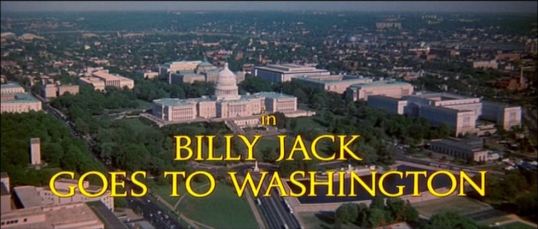
Directed by and starring Tom Laughlin, Billy Jack Goes To Washington is actually a remake of Mr. Smith Goes To Washington.  (To the film’s credit, it’s honest enough to actually give credit to Mr. Smith‘s screenwriters in the opening credits.)  What’s remarkable is just how faithful a remake Billy Jack Goes To Washington actually is.  All the scenes made famous by Jimmy Stewart — the scene where the newest member of the Senate attempts to introduce his first bill, the scene where he’s shocked to discover that Sen. Paine (played here by E.G. Marshall) takes orders from Boss Bailey (Sam Wanamaker), the scene where cynical Saunders (Lucie Arnaz) tells the senator that he should leave Washington, and, of course, that famous filibuster — are all faithfully recreated here.  The only difference, of course, is that it’s no longer idealistic Jimmy Stewart proving himself to be incredibly naive about politics.  Instead, it’s a former Green Beret, half-Indian, judo master named Billy Jack.

Tom Laughlin was a good actor, which is something that’s often overlooked by reviewers writing about the Billy Jack films.  As flawed as The Trial of Billy Jack may have been, Tom Laughlin was a compelling enough presence that the film itself remains a compulsively watchable 3-hour mess.  Laughlin had a very authoritative presence.  You looked at him and you knew that he knew what he was doing.  He was someone who you automatically wanted on your side, a natural born leader who knew how to get things done.  However, in Billy Jack Goes To Washington, Laughlin attempts to play Billy Jack as the type of naive neophyte who would be shocked to discover that politicians are corrupt.  But surely, after spending three films being harassed by every authority figure in America, Billy would have already realized that.  There’s nothing about Laughlin’s screen presence that suggests he could ever be that innocent.

And that’s the main problem with Billy Jack Goes To Washington.  For the film to have any chance of working, you have to forget everything that you’ve learned about Billy Jack over the previous three films.  However, if you haven’t seen any of the other Billy Jack films, then you probably wouldn’t be watching Billy Jack Goes To Washington in the first place.

Of course, since this is a Billy Jack film, there are a few scenes that were nowhere to be found in Mr. Smith Goes To Washington.  For instance, Saunders’s husband is murdered when he threatens to reveal the truth about Bailey’s operation.  Later, Billy, Jean (Delores Taylor), and Carol (Teresa Laughlin) are confronted by a gang of Bailey’s assassins and, for the only time in the entire movie, Billy goes through that whole routine where he takes off his boots while slowly speaking and then kicks everyone’s ass.  (Jean and Carol get to join in the ass-kicking as well and good for them!)

And, of course, there’s the scene where Billy, Jean, and the kids from the Freedom School (who are apparently now known as Billy’s Raiders) have a meeting with two liberal social activists.  It’s an interesting scene because it was clearly unscripted and it has a naturalistic feel to it that’s lacking from the rest of the film.  However, that does not mean that it’s a particularly good scene.  If I learned anything from Billy Jack Goes To Washington, it’s that self-righteous activists in 1977 were just as boring as self-righteous activists in 2015.

And yet, as I’ve said about all of the other Billy Jack films, I can’t bring myself to be too hard on Billy Jack Goes To Washington.  Again, it all comes down to sincerity.  It’s clear that Laughlin and Taylor felt they were making a difference with their films and that sincerity comes through in a way that makes Billy Jack Goes To Washington a likable, if rather inept, film.

Billy Jack Goes To Washington ran for a week in one theater in 1977 and was reportedly such a box office disaster that it couldn’t get a wider release.  (In a commentary track that he recorded for the film’s DVD release, Laughlin suggests the film was the victim of shadowy government forces.)*  While Laughlin and Taylor would later try to make The Return of Billy Jack, that film was left uncompleted at the time of Laughlin’s death.  So, the last time that filmgoers would see Billy Jack, he would still be U.S. Sen. Billy Jack.

And really, that’s the perfect ending for the saga of Billy Jack.  Starting out as a loner who protected a small California town from a biker gang to eventually becoming the protector of the Freedom School to finally embracing both non-violence and his love for Jean, Billy Jack earned himself a happy ending.

Having now watched and reviewed all four of the Billy Jack films, all I can do is say thank you to Delores Taylor and the spirit of Tom Laughlin.  It was great ride.

1251421109_1

—-

* To be honest, the commentaries that Laughlin and Taylor recorded for the Billy Jack films are actually very informative and interesting.  Laughlin actually had a far better sense of humor than you might guess from some of the movies he directed.