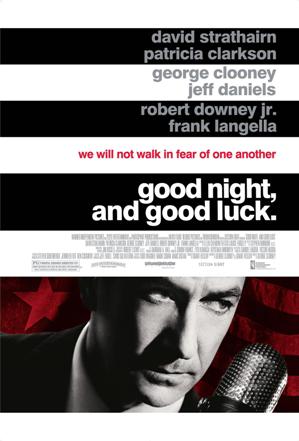
Shattered Politics #76: Good Night, and Good Luck (dir by George Clooney)


Goodnight_posterOne of my favorite episodes of South Park is called Smug Alert!  As you may remember, this is the episode where the citizens of South Park all buy hybrid cars and end up getting so self-satisfied that a dangerous cloud of smug forms over the town.  At the same time, another smug storm is racing across the United States.  This smug storm was created by the speech that George Clooney gave when he won the Oscar for Syriana.  When those two clouds of smug meet, it’s the perfect storm.  It also ends up destroying San Francisco.

The same year that Clooney was named Best Supporting Actor for Syriana, he was also nominated for directing the 2005 best picture nominee, Good Night, and Good Luck.  In his speech, Clooney specifically said that he felt he was winning supporting actor to make up for not winning director and proceeded to give the speech that he would have given if he had won director.

And looking back, I think that we do have to admit that it was a very smug speech.

Fortunately, Good Night, and Good Luck has aged better than Clooney’s speech.

I do have to admit that, when I recently rewatched Good Night and Good Luck, I was a little concerned.  I always manage to forget that the film starts on a really bad note.  The year is 1958 and news anchorman Edward R. Murrow (played by David Strathairn) is receiving an award.  As Murrow stands behind the podium, he proceeds to give a long and self-righteous speech about how television should be used not to entertain but to educate as well.  And, quite frankly, he comes across like such a pompous blowhard that I was dreading the idea of having to spend the next 90 or so minutes with him.

But then, fortunately, the film entered into flashback mode and, until the final few minutes of the film, we didn’t have to listen to anymore of Murrow’s speech.  The majority of Good Night and Good Luck takes place in 1953.  U.S. Sen. Joseph McCarthy (who appears in archival footage throughout the film) has declared that he has the names of communists who hold important positions in both the government and the media.  Murrow and his producer, Fred Friendly (George Clooney) defy the corporate overlords of CBS and bravely investigate and challenge McCarthy’s claims.  McCarthy and his henchmen respond by trying to smear both Murrow and one of his reporters (Robert Downey, Jr.) as a communists.  As always seems to happen in films about McCarthyism, another supporting character reacts to the change of communism by committing suicide.  And, in this particular vision of the fight against Joseph McCarthy, Edward R. Murrow and the media save America.

Of course, if you actually make the effort to learn history, you’ll discover that it wasn’t just Edward R. Murrow who stood up to McCarthy.  In fact, you’ll discover that Murrow stood up to McCarthy after several other prominent people — on both sides of the political divide — had already done so.  If anything, the real-life Murrow seems to have more in common with pompous scold seen at the beginning and end of the film, as opposed to the one that we see standing up to McCarthy.

One can very legitimately debate whether or not Murrow deserves all of the credit that he’s given in this film.  Still, the film does make a larger and very important point.  We, as Americans, have to always be on guard against witch hunts and against demagogues and the forces of fear and paranoia that are always trying to shape our politics.  And, whether or not Murrow was a hero or just a bystander, one cannot deny that the larger message of Goodnight, and Good Luck remains as relevant today as when the film was originally released.

Judging from some of his other films — The Monuments Men and the Ides of March — I don’t particularly feel that George Clooney is that good of a director.  But he does do a good job with Good Night and Good Luck.  (In fact, he does such a good job that you can’t help but feel that it’s the exception to the rule as far as Clooney the director is concerned.)  Filmed in wonderful black-and-white and full of good performances, Good Night, and Good Luck remains surprisingly watchable.

Just avoid any George Clooney Oscar speeches while watching it.  San Francisco has never recovered.
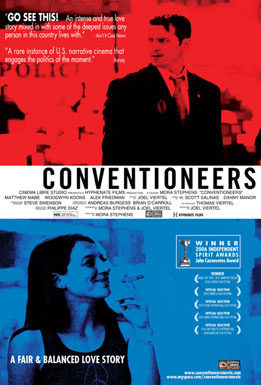
Shattered Politics #75: Conventioneers (dir by Mora Stephens)


Conventioneersposter

As I watched the 2005 indie film Conventioneers, I realized that I could never be a professional protestor.  Conventioneers, you see, was shot at the 2004 Republican National Convention and it combines actual footage of both the conventions and the protests with scenes of a Republican delegate (Matthew Mabes) reuniting with a college friend (Woodwyn Koons) who is now a liberal activist.  When Mabes and Koons first get together, they end up arguing about politics.  When they meet a second time, they end up having sex.  Meanwhile, Koons’ friend Dylan (Alek Friedman) has been enlisted to provide a sign language interpretation for President Bush’s acceptance speech.  Should Dylan use the opportunity to stage his own protest…

Oh, who cares?

Sorry.  I guess I should admit right now that I tend to be allergic to self-righteous and self-important people, regardless of which side of the political divide they call home.

And that’s one reason why I could never be a professional protestor.  Or, at the very least, I couldn’t be the type of protestor who populates Conventioneers.  They’re all so humorless and sure of their own importance and uniqueness (despite the fact that they all pretty much had the same look and the same way of speaking) that, as I watched them discuss and debate every little detail of their ideology, I could only think about how annoying it would be to ever watch a movie with them.  I would want to laugh at the antics of Jonah Hill and Channing Tatum.  They would want to debate the morality of watching a movie where the characters don’t ride bicycles or wear Che t-shirts.  It would just get so tedious!

Add to that, I have a need to smile, even when I’m talking about something important.  As I watched Conventioneers, I was struck by how both the real protestors and the actors always had those, “We’re so serious” scowls on their faces.  You could tell they were thinking, “If we look really pissed off, everyone will be sooooooo impressed.  We’re changing the fucking world!”

Bleh.

And that’s really the problem with Conventioneers.  It’s a left-wing film but all of the left-wing characters are so dogmatic and full of themselves that, had the film come out in time to influence the 2004 elections, Bush probably would have defeated Kerry in a landslide.  Just because you have good intentions and might be on the right side of the issues, that’s no excuse to make a tedious movie.  That’s a lesson that many political filmmakers really need to learn.

Reportedly, while shooting on location, director Mora Stephens and her crew were actually arrested and had to spend a few hours in jail.  That makes for an interesting story but it doesn’t make for a good movie.  If you want to see a good political film that was shot at a political convention, I would suggest watching Medium Cool.

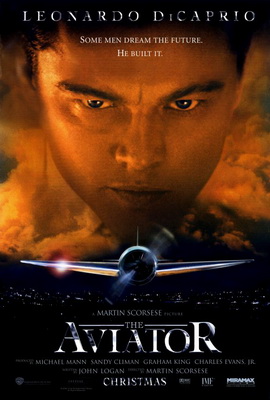
Shattered Politics #74: The Aviator (dir by Martin Scorsese)


The_Aviator_Poster

“The way of the future.” — Howard Hughes (Leonardo DiCaprio) in The Aviator (2004)

As I recently rewatched the 2004 best picture nominee, The Aviator, I realized that, in the film’s scheme of things, Ava Gardner was far more important than Katharine Hepburn.  (Or, perhaps it would be more appropriate to say that Kate Beckinsale’s Ava Gardner was far more important than Cate Blanchett’s Katharine Hepburn.)

Over the course of the film, both Hepburn and Gardner are involved with billionaire-turned aviator-turned film director Howard Hughes (Leonardo DiCaprio).  Throughout the film, Katherine is portrayed as being flighty, pretentious, and overdramatic.  There’s a lot of dark humor to the scene where Katherine breaks up with Howard, largely because Katharine is incapable of not acting as if she’s making a film.  Her every word is so carefully rehearsed that you have to agree when Howard says that she’s incapable of not giving a performance.  Ava, on the other hand, is always direct.  She has a sense of humor.  She has no trouble telling Howard off.  Whereas Katharine put on airs of being an incurable romantic, Ava tells Howard flat out that she doesn’t love him and is only using him to forward her career.

But, while Katharine Hepburn gets more screen time, it’s Ava Gardner who actually saves Howard’s business.  Towards the end of the film, after Howard has had a nervous breakdown and has locked himself in a hotel room, it’s Ava who suddenly shows up, cleans him, and dresses him.  She’s the one who gives Howard the strength to leave his room and to face down the corrupt senator (Alan Alda) who is investigating his business.

Of course, Howard Hughes is best known for once being the world’s richest recluse.  In the 1960s, Howard locked himself away in a hotel room in Las Vegas and spent the next decade laying naked in bed and watching television.  The Aviator doesn’t deal with this period of Howard’s life but it’s full of scenes where we catch glimpses of Howard’s future.  Throughout the film, we watch as Howard obsessively washes his hands.  We watch as he gives precise instructions on how even the simplest of tasks are to be accomplished.  We watch as he grows increasingly paranoid about the germ-filled outside world.  The film suggests that Howard’s obsessive compulsive disorder both served to make him a great engineer and a great filmmaker while, at the same time, ultimately destroying him.

The Aviator was the second film that DiCaprio made with Scorsese.  And, as bad as DiCaprio may have been in Gangs of New York, he’s absolutely brilliant in The Aviator.  As a character, Howard Hughes has so many quirks and tics that it would have been easy for DiCaprio to go overboard.  Instead, he gives a surprisingly subtle performance.  And, even more importantly as far as I’m concerned, he actually sounds authentically Texan when he speaks.

In many ways, much of The Aviator reminds me of Gangs of New York.  Both films are gorgeously produced period epics that try to cover a lot of material.  Both films are absolute cat nip for history nerds like me.  But, whereas Gangs of New York leaves one feeling vaguely dissatisfied, The Aviator actually improves with subsequent viewings.  Whereas the action in Gangs had no center, The Aviator revolves around Howard and the actor playing him.

While the Aviator starts off with Howard making movies and romancing Katharine Hepburn, it’s at its best when Howard appears before a committee chaired by Sen. Owen Brewster (Alan Alda) and passionately defends both himself as an engineer and a businessman and the right of innovators everywhere to freely pursue their passion.  The film suggests that Brewster was bribed by Howard’s main business rival, Juan Trippe (Alec Baldwin, in unapologetic villain mode), and it’s hard not to applaud when Howard stands up for himself.

Speaking of which, it’s odd, so soon after reviewing Alan Alda in The Seduction of Joe Tynan, to see Alda playing a far less ethical politician in The Aviator.  That said, Alda’s corrupt performance in The Aviator is a hundred times better than his cutesy work in Joe Tynan.  If anything, Alda gives a performance here that will remind everyone of why they don’t care much for their congressman.

The Aviator was nominated for best picture but it lost to the far more low-key Million Dollar Baby.  Scorsese would have to wait until the release of The Departed for one of his films to finally win best picture.

Shattered America #73: Team America: World Police (dir by Trey Parker)


Team_america_poster_300px

So, are we once again allowed to watch Team America: World Police?

As you may remember, back in December, the entire nation totally freaked out over the possibility that North Korea might be offended by the James Franco/Seth Rogen comedy The Interview.  Hackers — who many assumed were working for North Korea — released embarrassing emails that were exchanged among Sony executives and filmmakers.  Barely literate threats were posted, warning that any theater showing The Interview would be blown up.  Common sense should have told us that these were empty threats but instead, everyone panicked.

Sony announced that they would not be releasing The Interview.  The film would never see the light of day.  Overdramatic people like me got on twitter and announced that, if Sony didn’t release The Interview, then free speech was dead.  “It is every American’s duty to see The Interview!” I tweeted, “If you don’t see The Interview, you’re letting the terrorists win!”

Then Sony changed their mind and released The Interview after all.  People got to watch it.  Critics got to slam it.  Free speech lived for yet another day.

As for me, I never got around to watching it.

Uhmm, anyway…

What got forgotten in all of this drama is that some theaters announced that they would show the 2004 film Team America: World Police in the place of the Interview.  In many ways, it was a brilliant idea.  Team America, after all, is a brilliantly profane satire from South Park creators Trey Parker and Matt Stone.  Not only was the film a parody of overdone Hollywood blockbusters but it also featured the members of Team America using their powers to take out Kim Jong-il, the father of the political leader targeted for assassination in The Interview.  Even better than that, it featured Team America violently destroying the vapid (and surprisingly well-armed) celebrities who Kim Jong-il had tricked into supporting him.  How can you not love a film that features a puppet of Michael Moore blowing itself up?

Oh, did I mention that the entire movie features puppets?  Because it so does!

The use of puppets allows Parker and Stone to not only create some spectacular action scenes but also to feature parodies of more than a few real-life celebrities, all of whom are portrayed as being stupid, trendy, and easily manipulated.  The fact that Sean Penn saw himself lampooned in the film and then wrote an angry letter to Parker and Stone (ending it with, “Fuck you!”) is one of many reasons to love Team America.

So, we weren’t going to get to see The Interview but at least we could see Team America.  But then Paramount Pictures announced that they were not going to let any theater show Team America.  As annoyed as I was by what happened with The Interview, the ban on Team America was even more annoying.

I mean, we all knew The Interview as probably a really bad film.  But we also knew that Team America was great!  Indeed, banning Team America seemed like exactly the type of thing that one of the film’s puppet celebrities would have demanded.

Plus, as Team America‘s theme song reminded us — “America!  Fuck yeah!”  Bowing down to dictators does not make anyone want to shout, “America!  Fuck yeah!”

More like, “America!  Fuck no!”

Anyway, eventually Sony relented and released The Interview.  But I haven’t heard anything about Team America.  However, it’s currently available on Netflix so I’m going to assume that it is once again legal to watch Team America.  But that doesn’t change the fact that I still felt like I was breaking the law when I recently rewatched it.

Yet another reason to love Team America: World Police.

http://www.youtube.com/watch?v=RPBX47zSktc

Shattered Politics #72: Welcome to Mooseport (dir by Donald Petrie)


Welcome_To_Mooseport

The 2004 film comedy Welcome to Mooseport would probably be totally forgotten if not for one thing.  This is the film that was supposedly so bad that co-star Gene Hackman looked at the final cut and then probably looked over at the Oscars he won for The French Connection and Unforgiven and then probably looked back at the final cut and then announced, “I quit!”  There’s a reason why Hackman now spends his time writing novels and, according to most accounts, Welcome to Mooseport is that reason.

In Welcome to Mooseport, Gene Hackman plays Monroe “Eagle” Cole, the former President of the United States.  From the minute we first hear the President’s name, we know exactly what type of film Welcome to Mooseport is going to be.  It’s not enough to give Hackman’s a character a totally over-the-top name like Monroe Cole.  He also has to have a cutesy nickname.  The entire time I watched the film, I found myself wondering if Monroe Cole was listed on the presidential ballots as being Monroe “Eagle” Cole.  Personally, I always find it funny when people feel the need to include their nickname in the credits.  Is it really important for every William out there to let everyone know that some people call him Billy?

Anyway, Eagle is apparently the most popular president ever.  However, he’s also recently divorced and his ex-wife (Christine Baranski, playing the same role that she played in Bulworth) wants all of his property.  Eagle is forced to retire to one of the few residences that he has left, his vacation home in Mooseport, Maine.  In order to keep his wife from claiming that home, Eagle decides to run for mayor of Mooseport…

Now, right here, we’ve got a huge issue.  Eagle’s only motivation for running for mayor is because he doesn’t want to have to give over his vacation home to his wife.  But that could be anyone’s motivation.  One does not have to be President to want to keep the house in a divorce.  It would have been more interesting if Eagle, now out of office and struggling to adjust to no longer being the most powerful man in the world, ran for mayor because he really wanted the job.

But anyway, Eagle is not the only person running for mayor.  Hardware store owner Hardy Harrison (Ray Romano) is also running.  At first, Hardy wants to withdraw but then he sees Eagle flirting with Hardy’s longtime girlfriend (Maura Tierney) and Hardy suddenly decides that he’s going to run and he’s going to win.

I actually like Ray Romano as an actor and he doesn’t give a bad performance here.  But, at the same time, it’s obvious that his scenes were written to capitalize on his TV persona.  It’s easy to imagine stumbling across a rerun of Everybody Loves Raymond where Ray runs for mayor and has a panic attack when he loses.  The difference, of course, is that Ray Barone would not have been running against Gene Hackman (much less a former President).

Needless to say, Welcome to Mooseport has a sitcom feel to it.  After every line, you find yourself waiting for a laugh track.  Gene Hackman feels incredibly out-of-place in the film and there’s a discomfort to his performance.  Watching him in this film, you can see the wheels turning in his brain.  You can literally see Gene Hackman thinking, “I’m too old for this shit.”

And I guess he was because, in the 11 years since Welcome to Mooseport was first released, Gene Hackman has not appeared in another film.  Which is bad news for everyone waiting for Welcome to Mooseport Part II

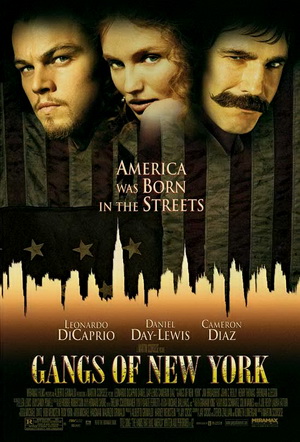
Shattered Politics #71: Gangs of New York (dir by Martin Scorsese)


Gangs_of_New_York_Poster

Despite the fact that it was nominated for best picture and marked the start of his fantastically successful collaboration with actor Leonardo DiCaprio, Martin Scorsese’s 2002 film Gangs of New York does not have the best reputation.  It always seems to be regarded as one of Scorsese’s lesser films and, often times, both The Aviator and The Departed are described as representing a comeback of sorts from Gangs.

To a certain extent, I have to agree.  Gangs of New York is a lesser Scorsese movie but then again, a lesser Scorsese film is still a hundred times better than the greatest films from Brett Ratner or Michael Bay.

The flaws of Gangs of New York are many.  The film, which tells the epic story of how an Irish gang led by Leonard DiCaprio battled a nativist gang led by Daniel Day-Lewis in Civil War-era New York City, runs for nearly 3 hours and yet it somehow still feels rushed and incomplete.  Cameron Diaz is far too contemporary of an actress to be truly believable as a 19th century pickpocket.  For that matter, Leonardo DiCaprio gives one of the worst performances of his career, coming across as being one-note and shrill.  If you only knew DiCaprio from his work in Gangs of New York, you would have a hard time believing that he was capable of doing the type of work that he did in Inception or The Wolf of Wall Street.

And yet, Gangs of New York is one of those flawed films that I can’t help but enjoy.

First off, on a purely personal level, how can I not love a film about how terribly the Irish were treated in the 19th Century?  Seriously, the Irish were regarded as if they were somehow subhuman.  They were attacked for being Catholic.  They were viewed as being criminals.  An entire freaking political party — the American party — was formed specifically to keep the Irish out.  But you know what?  We Irish kept coming, we kept fighting for our rights, and now everyone wishes they could be one of us!

Secondly, and this should not a shock when you consider that the film was directed by Martin Scorsese, the film looks absolutely gorgeous!  Despite the fact that it’s takes place in a 19th century slum and most of the characters are poor, Gangs of New York is a visual feast.  I loved the ornate sets and all the colorful clothes.  I loved the attention to detail that was put into everything.

(My favorite visual from the film: Daniel Day-Lewis and his entourage walking down a street while fireworks explode directly over Day-Lewis’s shoulder.)

Third, there’s Daniel Day-Lewis’s performance as Bill “The Butcher” Cutting.  One reason why DiCaprio’s performance is so noticeably bad is because he’s acting opposite Day-Lewis.  Sporting a handle-bar mustache and speaking in an almost satirically exaggerated New York accent, Day-Lewis turns Bill into one cinema’s greatest villains.

Add to that, the great Italian actor Giovanni Lombardo Radice show up for a few minutes, playing Simon Legree in a theatrical production of Uncle Tom’s Cabin!  Scorsese should make more films with Radice.

But, perhaps the main reason why I enjoy Gangs of New York is because, as I’ve mentioned so many times in the past, I really am a big history nerd.  And Gangs of New York deals with a period in American history that really doesn’t get as much attention as it deserves.  While we all know that the Civil War started when the South seceded from the union, what is often forgotten is that the North was not united in their support of Abraham Lincoln and the Union.  In fact, the Mayor of New York, Fernando Wood, was such a strong supporter of the Confederacy that he, at one point, suggested that New York City should secede from the union as well.  And when Lincoln instituted the draft, NYC — and several other cities in the north — exploded into riots.

Of course, Gangs of New York is not a 100% historically accurate.  For one thing, it compresses the time frame of the draft riots and — as films often do — it downplays the culture of Northern racism and instead portrays racists like Bill Cutting as being the exception to the rule.  But, even with that in mind, Gangs of New York still serves as a good starting point for those who want to learn more about American history than what they’ve been told in school.

My favorite parts of Gangs of New York dealt not with how the gangs fought each other but instead how the gangs were used as political foot soldiers.  One of the major supporting characters in Gangs of New York is William “Boss” Tweed (Jim Broadbent), a real-life politician who was at the center of one of America’s first major political scandals.  When we first meet Tweed, he is using Bill Cutting’s gang to fix elections.  However, as the film progresses, Tweed comes to realize that the political future of New York rests with the Irish.  So, Tweed starts using the Irish gang to fix elections.  For those of us who are into political history, the Boss Tweed scenes are a lot of fun.

Gangs of New York has its flaws.  It’s the type of project that, if it were made today, it would probably be a series on HBO and it would win all sorts of awards.  (Actually, it did kinda.  It was called Boardwalk Empire.)  It’s not perfect, but I like it.

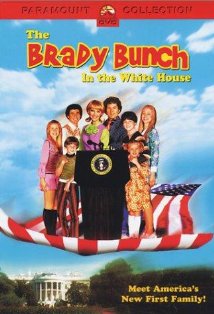
Shattered Politics #70: The Brady Bunch In The White House (dir by Neal Israel)


The_Brady_Bunch_in_the_White_House

What happens when architect and suburban dad Mike Brady (Gary Cole) is elected Vice President of the United States?  Well, President Randolph (Dave Nichols) ends up having to resign when it turns out that he’s thoroughly corrupt.  Mike Brady is sworn in as the new President and then appoints his wife Carol (Shelley Long) as his new Vice President.  He and his wife run an ethical and determinedly old-fashioned administration.  When Senators argue, Carol suggests that they need a time out.  When Mike is handed a report that indicates trouble for the economy, Mike looks at it, signs it, and says, “We can do better.”  When a racist Senator is seated next to a black nationalist at a White House reception, the two opponents are both served peanut butter on crackers by the Alice, the Brady Family housekeeper and soon, they are bonding over their shared love of peanut butter.

Of course, not everything’s perfect.  For instance, middle daughter Jan (Ashley Drane) is haunted by voices in her head that tell her that she’ll never be better than older sister Marcia (Autumn Reeser).  However, fortunately, Jan discovers a talking portrait of Abraham Lincoln who talks some sense to her.

And then, middle son Peter (Blake Foster) accidentally breaks a priceless Ming vase.  All of the other Brady kids take responsibility for breaking it.  President and Vice President Brady quickly figure out that Peter was responsible and, in order to make him confess, they punish every Brady kid but Peter.  And then…

Okay, are you getting the feeling that Brady Bunch In The White House is a stupid movie?  Well, it is.  This 2002 film was made for television and serves as a sequel to the earlier Brady Bunch Movie and A Very Brady Sequel.  It features the same basic idea as the first two films: the rest of the world is cynical and angry while the Bradys are still trapped in the wholesome world of their old television show.  Mike is still offering up life lessons.  Carol is still smiling and saying, “Your father’s right.”  Marcia is self-centered.  Jan is obsessive.  Cindy has issues with tattling.  Greg thinks every girl that he meets is really happening in a far out way.  Peter is always feeling guilty.  Bobby … well, Bobby doesn’t do much of anything.

The big difference is that the Bradys are in the White House now.  They’re still reliving incidents from their TV show but now they’re doing it in the White House.  And, some of it is kinda cute.  Well, I take that back.  Most of it is really stupid but the part about the vase made me smile despite myself.

So there’s that.

But, honestly — no, I really can’t think of any clever way to prove that the Brady Bunch In The White House is actually a subversive satire or anything that’s really worth recommending.

Sorry.

However, I did see A Very Brady Sequel on Cinemax last night.  It’s kind of funny and features a lot of pretty Hawaiian scenery.  Go watch that.  Forget about the Brady Bunch In The White House

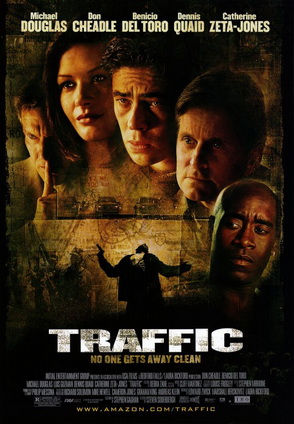
Shattered Politics #69: Traffic (dir by Steven Soderbergh)


Traffic2000Poster

I have mixed feelings about Steven Soderbergh.  On the one hand, his talent cannot be denied and you have to respect the fact that he’s willing to take chances and make films like The Girlfriend Experience and The Informant.  On the other hand, he’s also the director who has been responsible for overrated messes like Contagion and utter pretentious disasters like Haywire.  And it doesn’t help that Soderbergh’s fanbase seems to be largely made up of the type of hipsters who end up leaving comments under the articles at The A.V. Club.  Some people mourned Soderbergh’s retirement.  Personally, I think he made the right decision.  He retired before his misfires ended up outnumbering all of his masterpieces.

The thing about Soderbergh is that his good films are so good that it makes it all the more frustrating to watch his failures.  If Soderbergh was just your typical bad director than a film like Contagion wouldn’t be as annoying.  But this is the man who also gave us Traffic!

And Traffic is a very good film.

First released in 2000, Traffic attempted to deal with the American war on drugs, a war that the film suggests might not even be worth fighting.  (Full disclosure: I support the legalization of drugs and, for that matter, just about everything else.  And yes, I am biased towards films that agree with me.  So is every other film critic out there.  The difference is that I’m willing to admit it.)  Traffic won four Oscars, including Best Director and Best Supporting Actor for Benicio Del Toro.  It was also nominated for best picture but lost to Gladiator.

Traffic tells three, barely connected stories.  Each story is given its own distinct look, feel, and color scheme.  And while it takes a few minutes to get used to film’s visual scheme, it ultimately works quite well.  Though all of the film’s characters share the same general existence, they live in different worlds.  The only thing linking them together is drugs.

Judge Andrew Wakefield (Michael Douglas) is a judge on the Ohio Supreme Court who has recently been named as the new drug czar.  However, while Judge Wakefield is going around the country and talking to politicians (Harry Reid shows up playing himself and is just as creepy as always), his daughter Caroline (Erika Christensen) is dating Seth (Topher Grace) and getting addicted to cocaine and heroin.  When Caroline run away, Judge Wakefield recruits Seth and, using him as a guide, searches the ghetto for his daughter.

The Wakefield scenes are bathed in cold and somber blues.  They’re beautiful to look at but, in some ways, they’re also some of the weakest in the film.  The whole plotline of Caroline going from being an innocent honor’s student to being a prostitute who sells her body for heroin feels a lot like the notorious anti-drug film Go Ask Alice.  At the same time, it’s interesting and a little fun to see Topher Grace playing such a little jerk.  Grace gets some of the best lines in the film, especially when he attacks Wakefield’s feelings of smug superiority.

In the film’s second storyline, two DEA Agents (Don Cheadle and Luis Guzman) arrest drug trafficker Eddie Ruiz (Miguel Ferrer).  Eddie works for the Ayala syndicate and, once he’s arrested, he turns informant.  Drug lord Carlos Ayala (Steven Bauer) is arrested.  While Carlos sits on trial, his pregnant wife (Catherine Zeta-Jones) and his sleazy business associate (Dennis Quaid) struggle to hold together the business and find a way to kill Ruiz before he can testify.

This storyline is filmed in bright and vibrant colors and why not?  The Ayalas are rich and, unlike the Wakefields, they don’t feel the need to hide their material wealth.  This is actually probably my favorite storyline, largely because it’s the best acted and the most entertaining.  Miguel Ferrer, in particular, steals every scene that he’s in.  The scene where he explains the economics of being a drug trafficker is fascinating to watch.

The Ayala storyline may be my favorite but the film’s most thought-provoking storyline is the third one.  Taking place in Mexico, it stars Benicio Del Toro as Javier Rodriguez, a casually corrupt police officer who gets recruited to work for General Salazar (Tomas Milian), who is heading up Mexico’s war on the cartels.  Following the orders of Salazar, Javier captures assassin Frankie Flowers (Clifton Collins, Jr.) who is then savagely tortured by Salazar until he turns informer.  Javier comes to realize that Salazar is actually working for one of Mexico’s cartels.  When he decides to inform on Salazar, he puts his own life at risk.

The Mexico storyline is also the harshest and visually, it reflects that fact.  The heat literally seems to be rising up from the desert and the streets of Tijuana.  It takes a few minutes to adjust to the look of the Mexico scenes but, once you do, they become enthralling.

And Traffic, as a film, is undeniably enthralling as well.  Soderbergh deftly juggles the multiple storylines and brings them together to create a portrait of a society that’s being destroyed by the efforts to save it.  Hopefully, if Soderbergh ever does come out of retirement, he’ll give us more films like Traffic and less films like Contagion.


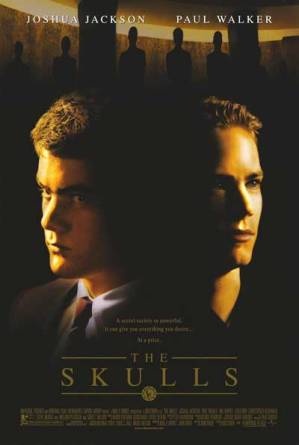
Shattered Politics #68: The Skulls (dir by Rob Cohen)


Theskullsposter

What do George W. Bush, John Kerry, and Paul Giamatti all have in common?

They were all members of the Skull and Bones, which may be an organization that secretly controls the world.  Then again, it might also just be an organization for male students at Yale, a place for the sons of the rich and famous to get together, drink, and do whatever else rich kids do when they go to an Ivy League college.

One thing’s for sure — when you’re a member of the Skulls and Bones, you’re a Bonesman for life.  If you have any doubt about that, go ahead and watch the 2000 film The Skulls.  In The Skulls, Martin Lombard (Christopher McDonald) is such a loyal member of the Skulls that, even though he’s currently a provost at Yale, he’s still willing to break a student’s neck in order to keep him from revealing the society’s secrets.

Seriously, do all Ivy League administrators know how to break necks or just ones that were former members of the Skulls?  It just makes me glad that I went to UNT, a good school with absolutely no ivy on the walls.  A degree from UNT might not translate into membership into America’s elite but at least you don’t have to worry about being targeted by any dangerous secret societies.

(Unless, of course, you’re a TAM.  But that’s another story…)

Anyway, the dead student’s best friend is Luke McNamara (Joshua Jackson).  We know Luke’s the hero because he doesn’t come from a rich family and he’s attending Yale on a rowing scholarship.  Shortly before Will’s death, Luke is invited to join the Skulls and does so because he thinks it will help him court rich art major Chloe (Leslie Bibb).  However, after Will death, Luke decides that he has to join so that he can find out the identity of the murderer.

Luke wrongly suspects that the murderer was his new friend and fellow Skull, Caleb Mandrake (Paul Walker).  What Luke doesn’t know is that the murder was actually ordered by Caleb’s father, Supreme Court candidate Litten Mandrake (Craig T. Nelson).  (As a sidenote, has anyone named Litten Mandrake ever not turned out to be evil?)  However, as Luke gets closer to the truth, the Skulls arrange for him to be arrested and put into a mental asylum.

Oh, and Martin Lombard starts chasing after him with a gun.

Remember, this is the same Martin Lombard who is a provost at Yale.  Now, I’m not saying that it’s out of the question that a Yale provost could chase after a student with a gun.  But, at the very least, it seems like a conspiracy as wealthy and powerful as the Skulls could afford to hire less recognizable henchmen.

In fact, watching The Skulls, you can’t help but suspect that this secret conspiracy is not exactly the smartest conspiracy in the word.  Not only do they do a terrible job of hiding their existence but they are continually outsmarted by a bunch of undergrads.

Anyway, eventually, it all leads to Luke challenging Caleb to a duel.  A mysterious Senator (William Petersen) shows up and says, “Well done, son, well done.”

It’s all kind of stupid.

http://www.youtube.com/watch?v=0d0qdIbUEXo

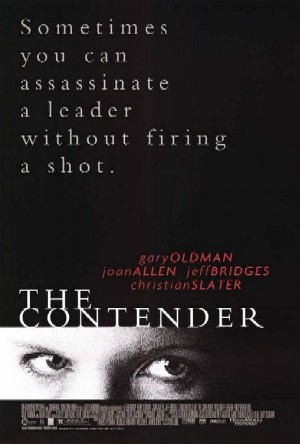
Shattered Politics #67: The Contender (dir by Rod Lurie)


Contenderposter(Spoilers)

The 2000 political melodrama The Contender is one of the most hypocritical films that I’ve ever seen.

The Contender tells the story of what happens when U.S. Sen. Laine Hanson (played by Joan Allen) is nominated to be vice president by President Jackson Evans (Jeff Bridges).  During Laine’s confirmation hearings, Rep. Shelly Runyon (Gary Oldman) dredges up rumors that, at a college frat party, Laine took part in a threesome in exchange for money.

When Runyon asks Laine about the rumors, she replies that she refuses to answer any questions about what she may or may not have done while she was younger.  She replies that it is “simply beneath my dignity” and you know what?  She’s absolutely right.  First off, if someone could be disqualified just because of what they did in college then nobody would eve be eligible to be President.  Secondly, and far more importantly, nobody would care about Laine’s sexual history if she was a man.

For over two hours, Laine refuses to answer any questions about the allegations and instead, she turns the tables on her attackers.  And while this alone would not have made The Contender a good film (because, after all, The Contender was written and directed by Rod “Straw Dogs” Lurie), it at least would have been a film that I could respect.

But, Rod Lurie being Rod Lurie, he just couldn’t help but fuck it all up.

Towards the end of the film, Laine is attending a White House reception.  She and President Evans sit down on the White House lawn and, as the stars shine above them, Evans says, “Just between us, is it true?”

Now, there’s two things that Laine could have said here that would have kept this film from falling apart.  Laine could have said, “It’s none of your business.”  And that would have been the right thing to say because, quite frankly, it is none of the President’s business.  The whole point of the movie has been that it’s not anyone’s business.

Or, if the film actually had any guts, Laine could have said, “Yes, it’s totally true.  Like most people, I experimented when I was in college.  But that doesn’t have anything to do with whether or not I’m qualified to be your vice president.”

But no.  Instead, Laine smiles and says, “Nothing happened.  Two guys propositioned me, I said no, and they spread rumors.”

So, basically, the film is saying, “It’s nobody’s business if Laine was sexually active in college but don’t worry, Mr. and Mrs. American Audience, she was a virgin until she turned 30.  So, it’s still okay for you to like her…”

And that’s the thing about The Contender.  It’s a film that doesn’t have the courage of its own convictions.  It’s a film that drags on for over two hours and it expects you to forgive it just because it pretends to have good intentions.  As a woman, there’s nothing I hate more than being pandered to and, for all of its attempts to come across as being feminist, The Contender is all about pandering.

What makes The Contender an interesting bad film — as opposed to just your usual bad film — is how even the littlest details feel false.  It’s obvious that Lurie knew all of the legal details that go into confirming a Vice President but he didn’t know how to make any of those details dramatically compelling.  So, the film becomes a bit of a know-it-all lecture.  By the time that Saul Rubinek popped up and said, “Do you know what Nelson Rockefeller said about the vice presidency?,” I found myself snapping back, “No, what did Nelson Rockefeller say about the Vice Presidency?  Please tell because ah am so sure that it is just goin’ to be the most fascinatin’ thang that ah will ever hear in mah entire life!”

(The more annoyed I get, the more pronounced my Texas accent.)

There’s a lot of weird little things about The Contender that just don’t work.  They may not sound like major problems but when combined together, they start to add up.  For instance, there’s a long shot where we see U.S. Rep. Reginald Webster (Christian Slater) and his blonde wife at a White House reception and the shot just lingers on them for no particular reason.  Long after you would expect the shot to end, it’s still going.  This wouldn’t be an issue if there was some narrative reason for that shot.  Instead, it’s just randomly dropped in there.

And then, after Laine is nominated, we see the front page of a newpaper and there, in the middle of the page, is a headshot of Joan Allen.  Underneath it, a small headline reads, “It’s Laine!”  It just feels so fake.  Wouldn’t the nomination of the first female vice present actually rate a bigger headline and a more dynamic picture?

Speaking of fake, towards the end of the film, President Evans picks up a framed magazine cover and stares down at it.  The magazine, itself, looks like one of those joke “Man of the Year” pictures that people pose for at a state fair.  On the cover is a picture of Last Picture Show era Jeff Bridges.  The headline on the magazine reads: “President Jackson Evans.  His ideas have changed the world.”  Not his actions, mind you.  Not his policies.  Instead, his ideas have changed the world.  But the film shows us no evidence of this and, during Laine’s confirmation hearings, everyone spends the whole time debating the same old shit that they always seem to be debating in Washington.

(Of course, if you’re lucky enough to have a name like Jackson Evans, I guess you might as well become President.)

Of course, when it looks like Laine might not be confirmed, President Evans speaks before Congress.  “For the first time, a woman will serve in the executive!” he declares, which seems like a hilariously awkward way to put it.  (People in this film don’t talk like human being as much as they talk like characters in some fucked up Washington D.C. fanfic.)  He then adds, “There are traitors among us!”

So, I guess the message here is yay for demagogues.

And don’t even get me started on Kathryn Morris, as the cheerful FBI agent who investigates Laine’s past and who, at one point, announces, “Laine is hope!”  Would a male FBI agent ever have to deliver a line that stupid?

And also don’t even get me started on the subplot about Gov. Jack Hathaway (William Petersen), who stages an auto accident in an attempt to convince President Evans to nominate him for vice president.

The Contender is not a good film but it could have at least been a respectable film.  But then, Rod Lurie had to have President Evans ask whether it was true or not.

Perhaps being a hypocrite was the idea that changed the world.