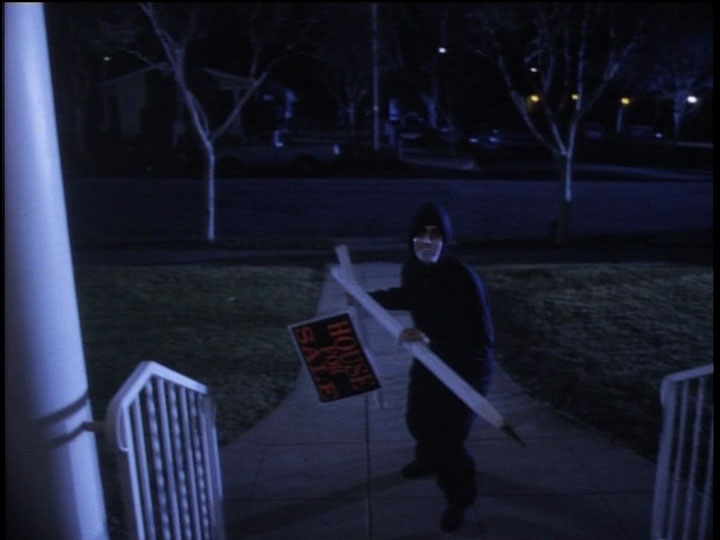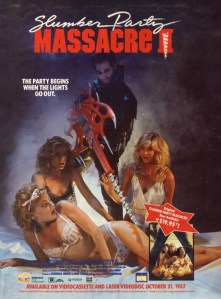
Back to School #34: Suburbia (dir by Penelope Spheeris)


tlc_spheeris_suburbia_poster

I’ve been reviewing film on this site for over four years now and one theme that I find myself returning to, time-after-time, is that I love movies that serve as time capsules.  I love movies that were made specifically to capitalize on specific trends, culture, and fashion.  Many people dismiss these films as being dated but that’s precisely why I enjoy them.  I just love seeing how the world once looked and how life was once lived.

The 1984 film Suburbia definitely falls into that category.  Produced by the legendary Roger Corman and directed by documentary filmmaker Penelope Spheeris, Suburbia tells the tale of The Rejected, a group of teenage runaways and other outcasts who, having both rejected and been rejected from conventional society, now illegally live in an abandoned house in the middle of the suburbs.  The film focuses on two runaways — Sheila (Jennifer Clay), who was abused by her father, and Evan (Bill Coyne), who is fleeing an alcoholic mother.  Both of them — along with yet another runaway named Joe Schmoe (Wade Waltson) — are invited to live in the “T.R. House” by the group’s leader, Jack Diddley (Chris Pedersen), on the condition that all three of them allow themselves to be branded with the letters “T.R.”  In short, when you’re rejected, you’re rejected for life.

Eventually, all three of them settle into life at the house.  Joe and Sheila start a tentative relationship.  Evan brings his younger brother Ethan (Andrew Pece) to the house.  They spend their days frightening their conventional, middle class neighbors and being harassed by a group who, rather ominously, refer to themselves as “Citizens Against Crime.”  When they need food, they either steal it or they rummage through other people’s garbage.  Jack’s stepfather, a cop named Bill (Donald Allen), drops by the house and tells them that they need to leave before someone tries to make them leave.  The Rejected, however, refuse to forced out.  It all leads to both violence and tragedy…

What makes Suburbia an interesting film (even for someone like me, who would probably be spit at by the residents of the T.R. House) is that Spheeris is both clearly on the side of the Rejected but, at the same time, she also makes no attempt to idealize them.  The film does not shy away from showing that the residents of the T.R. House are, for the most part, angry, violent, and self-destructive.  However, Spheeris suggests that, in a society that continually tries to co-opt and neuter all forms of rebellion, the Rejected don’t have much of a choice but to continually go to the next extreme.  She finds a humanity and a beauty in their often hopeless existence because, even if they are doomed, at least they’re going to be doomed on their own terms.

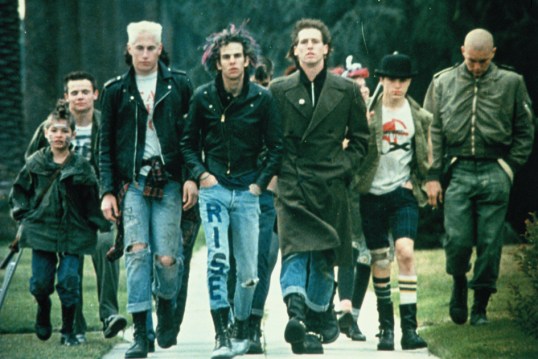
Spheeris filled the film with non-actors and local Los Angeles musicians (A very young Flea plays one of the residents of the house) and, as a result, Suburbia features some of the most wooden performances and awkward line readings that I have ever seen or heard.  But, what the cast lacks in acting ability, they make up for with the right attitude and the right look.  And you can see that in perhaps the film’s best and most iconic scene, the infamous punk parade.

And you can watch that parade below!

Guilty Pleasure No. 22: Battle Beyond the Stars (dir. by Jimmy T. Murakami)


maxresdefault

Two of my favorite films of all-time happen to be very similar. In fact, one could say that they’re pretty much the same films. I’m talking about Akira Kurosawa’s Seven Samurai and it’s Western-remake by John Sturges, The Magnificent Seven. Kurosawa’s film is one of the greatest films of all-time and it’s no wonder that many have taken the film’s story of the downtrodden hiring a band of misfits, rogues, but still honorable men to help them fight against huge odds.

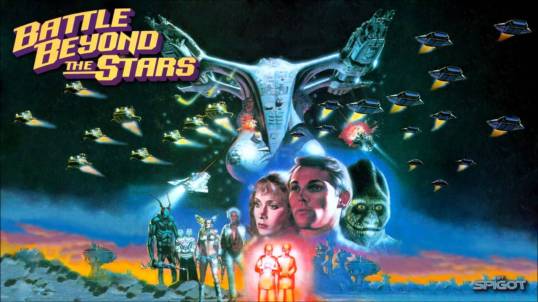
One such film that tries to add onto Kurosawa film’s legacy was the Roger Corman-produced scifi-adventure film Battle Beyond the Stars. This 1980 film was one of Corman’s many attempts to cash-in on the Star Wars phenomena, but in his usual low-budget style.

For a low-budget scifi film, Battle Beyond the Stars happened to have quite a cast one doesn’t usually see in such productions. While it had such grindhouse and exploitation regulars as John Saxon and Sybil Danning, it also starred the wholesome Richard Thomas from The Waltons and George Peppard (who would later become famous with a new generation as Hannibal Smith of The A-Team). The film would be directed by Jimmy T. Murakami, but from watching the film one could see Corman’s fingerprints all over the production from the script which was pretty lean and cut to the basic outline of Kurosawa’s original film. There’s not much fluff to bog down the pacing of the film.

This film has always been a guilty pleasure of mine because it so resemble Seven Samurai and The Magificent Seven, but adds in it’s own unique style and look to a well-worn and well-trodden plot. It was much later that I found out that James Cameron had a major hand in the special effects work in the film. Think about that for a moment. The self-proclaimed “King of the World” who literally breaks film budget records every time he begins work on a film did FX work on battle Beyond the Stars whose effects budget probably wouldn’t buy a day’s worth of crafts table eating for his most modestly budgeted films.

Lisa Marie always loved to say that grindhouse and exploitation films are some of most honest films out there. There’s no bullshit to what we see on the screen. It’s filmmakers forced to be daring and inventive because the lack of resources forces them to think outside the box. Battle Beyond the Stars might be seen as a mediocre attempt to cash-in on a scifi cultural phenomena, but it does so with a go for broke mentality that makes it such a fun film to watch. It’s not the greatest thing Corman has ever produced and some would even call it a very bad film, but once one looked past it’s rough and flawed surface then one could see a gem in the rough hidden beneath.

Oh, this remake of the remake of the original also happened to star one Robert Vaughn who was one of original Magnificent Seven.

  1. Half-Baked
  2. Save The Last Dance
  3. Every Rose Has Its Thorns
  4. The Jeremy Kyle Show
  5. Invasion USA
  6. The Golden Child
  7. Final Destination 2
  8. Paparazzi
  9. The Principal
  10. The Substitute
  11. Terror In The Family
  12. Pandorum
  13. Lambada
  14. Fear
  15. Cocktail
  16. Keep Off The Grass
  17. Girls, Girls, Girls
  18. Class
  19. Tart
  20. King Kong vs. Godzilla
  21. Hawk the Slayer

Fear The Creature From The Haunted Sea


Creature_from_the_Haunted_Sea

I have this fear that someday I’ll meet Roger Corman and before I can compliment him for directing and producing so many entertaining films or praise him for helping so many women break into the film industry or talk about the subversive feminism of his 70s exploitation films, Corman will ask me something like, “So, what did you think of Creature From The Haunted Sea?”

Because, seriously…

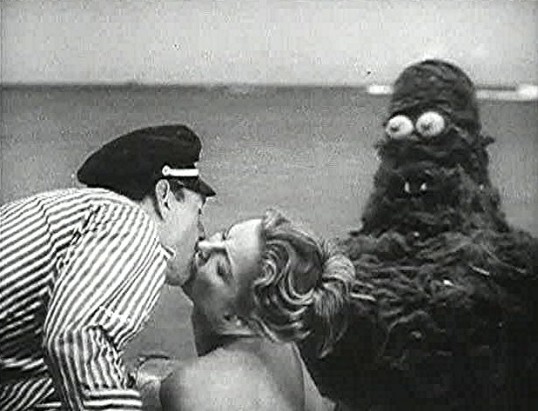
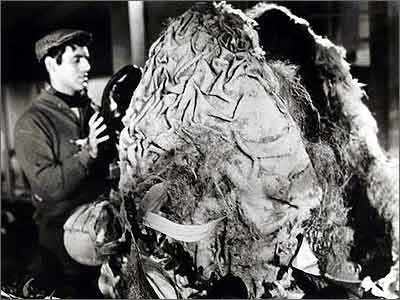
Creature From The Haunted Sea, which the Late Night Movie crew and I watched after Space Raiders, was originally released in 1961.  It tells the story of a mobster named Renzo (Anthony Carbone) who flees Cuba with a bunch of stolen gold.  Renzo finds himself stranded on a boat with a group of revolutionaries, a guy who communicates by making animal noises, and a CIA agent (played by future Oscar-winning screenwriter, Robert Towne).  Anyway, Renzo plans to double-cross everyone by exploiting their fear of the legendary creature of the haunted sea.  However, the joke is on Renzo because it turns out that the creature is real.

In the past, I have defended Roger Corman as a director and I imagine that I’ll do so again in the future.  However, Creature From The Haunted Sea has got to be one of the most boring films that I have ever seen, a film that starts as a comedy and then tries to turn into a horror film but never really succeeds in being funny or scary.  So little happens in the film that it ends up becoming oddly fascinating.

That said, if you’re a fan of Roger Corman’s or a student of B-cinema, you should make time to watch Creature From The Haunted Sea.  While the film might not be exactly watchable, the story behind it is vintage CormanReportedly, Creature From The Haunted Sea was produced because Corman had just finished directing The Last Woman On Earth in Puerto Rico and had some film left over.  So, he decided why not make another movie?  Regardless of the film’s final quality, it’s hard not to respect Roger’s refusal to allow any opportunity to pass by.

Beyond that, I would recommend Creature From The Haunted Sea for two reasons.  Number one, the opening credits feature some cute cartoons and you know I can’t resist a cute cartoon.  Finally, the creature itself simply has to be seen to be believed.  How can you not be somewhat charmed by a monster that appears to be made out of sea weed and ping-pong balls?

If you dare, check out Creature From The Haunted Sea below.


A Quickie In Space: Space Raiders (dir by Howard R. Cohen)


Space Raiders

Last Saturday was Roger Corman’s 88th birthday and what better way to celebrate than to watch one of the many low-budget but undeniably entertaining films that the great man has produced?

That’s just what I did on Saturday with my Late Night Movie friends.  The movie we watched was an obscure 1983 science fiction film called Space Raiders.  Now, technically, this film was directed by Howard Cohen but, from the first frame, it was obviously a Roger Corman film.  It was also a lot of fun.

Space Raiders takes place in the distant future, at a time when intergalactic corporations have colonized planets with sullen children and space criminals spend their spare time hanging out in dank space stations.  From the minute the film opens with a scene of robots doing menial labor in a factory while a the factory foreman assures the human workers that the next company picnic will take place on a planet where it doesn’t rain, there’s little doubt that the main message of Space Raiders is that the future sucks.

10 year-old Peter (David Mendelhall) lives on the planet of Proycon III (which, if nothing else, is a great name for a planet).  Neglected by his wealthy parents and apparently being the only child on Proycon III, Peter spends his spare time sneaking into robot-filled factories and capturing space bugs.  That’s what Peter is doing when he witnesses a daring raid by a group of — wait for it — space raiders!  Led by the surly but kind-hearted Hawk (Vince Edwards), the raiders steal a spaceship from the factory.  What they don’t realize is that Peter (and the bug that he had just captured seconds before the raid) has stowed away on the ship.

At first, Hawk is not enthusiastic about Peter being on the ship and Peter just wants to get home.  However, as the space raiders deal with both intergalactic cops and alien gangsters, Hawk and the kid start to bond and Peter gets to know the rest of the crew.

Now, to be honest, the majority of Hawk’s crew were pretty interchangeable but my friends and I quickly decided that our favorite was the one that we named Capt. Forehead (played by Thom Christopher).  Capt. Forehead was an alien who had psychic powers and who carried himself with the wounded dignity of a head waiter having a bad night.  It was hard not to like him.

Captain Forehead

Anyway, Peter’s parents want their son back and, since they work for an evil corporation, they have no problem hiring evil mercenaries to get their son back.  It all leads to a lot of people shooting lasers at each other and exploding spaceships.

Now, honestly, we can get all technical and picky about whether or not the plot of Space Raiders made any sense or whether or not any of the actors gave good performances.  We can even talk about the logic of the scene where Peter –upon realizing that Hawk is on a different spaceship than him — responds by attempting to yell, “HAWK!” across the far reaches of space.

But you know what?

That’s missing the point.

In the way that only a low-budget science fiction film produced by Roger Corman can be, Space Raiders was a lot of fun.  The movie moved quickly, the aliens were fun to look at, and the special effects were charmingly cheap.  Flaws and all, Space Raiders had more humanity than Man of Steel, more humor than Gravity, and it was a lot shorter than Avatar.

Watch it below and see for yourself.


44 Days of Paranoia #10: The Intruder (dir by Roger Corman)


For today’s entry in the 44 Days of Paranoia, we take a look at one of the most underappreciated films of all time, Roger Corman’s 1962 look at race relations, The Intruder.

Despite the fact that he’s regularly cited as being one of the most important figures in the development of American cinema, Roger Corman remains an underrated director.  Many critics tend to focus more on the filmmakers that got their start working for Corman than on Corman himself.  When they talk about Roger Corman, they praise him for knowing how to exploit trends.  They praise him as a marketer but, at the same time, they tend to dismiss him as a director.

I would suggest that those critics see The Intruder before they presume to say another word about Roger Corman.

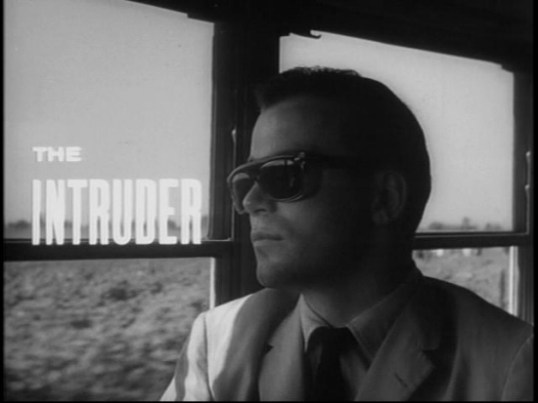
The Intruder opens with a young, handsome man named Adam Cramer sitting on a bus.  The first thing that we notice about Cramer is that he’s wearing an immaculate white suit.  The second thing we notice is that he’s being played by a very young (and, it must be said, rather fit) William Shatner.

I know that many people will probably be inclined to dismiss The Intruder from the minute they hear that it stars William Shatner.  Based simply on Shatner’s presence, they’ll assume that this film must be very campy, very Canadian, or both.  Well, they’re wrong.  Shatner gives an excellent performance in this film, bringing to life one of the most evil characters ever to appear on-screen.

Adam Cramer, you see, is a representative on a Northern organization known as the Patrick Henry Society and he’s riding the bus because he’s heading to a small Southern town.  The high school in that town has just recently been desegregated and Cramer’s goal is to make sure that no black students attend class.  As Cramer explains it, he’s a “social worker” and his goal is to help preserve Southern society.

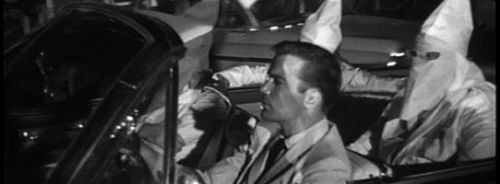
To achieve this goal, Cramer partners up with the richest man in town, Verne Shipman (who is played, rather chillingly, by Robert Emhardt).  With Verne’s sponsorship, Cramer gives an inflammatory speech in the town square and then later returns with a group of Klansmen.  As opposed to recent films like Django Unchained (which scored easy laughs by casting Jonah Hill as a Klansman and playing up the group’s ignorance), The Intruder presents the Klan as figures that have stepped straight out of a nightmare, making them into literal demons who appear at night and disappear during the day.  In a genuinely disturbing scene, the Klansmen set a huge cross on fire.  As the flames burn behind him, Cramer seduces the wife of a local salesman.

intruder-shatner-klan

After Cramer delivers his speech, the local black church is blown up and a clergyman is killed.  The editor of the town newspaper — who, before Cramer showed up, was opposed to desegregation — changes his mind and publishes an editorial strongly condemning Cramer.  Cramer’s mob reacts by nearly beating the editor to death.  Realizing that he’s losing the power to control the mob that he created, Cramer frames a black student for rape which leads the film to its powerful and disturbing conclusion.

Particularly when compared to other films that attempted to deal with race relations in 1962, The Intruder remains a powerful and searing indictment of intolerance and a portrait of how demagogues like Adam Cramer will always use fear, resentment, and ignorance to build their own power.  Corman filmed The Intruder on location in Missouri and used a lot of locals in the cast.  Judging from the disturbing authenticity of some of the performances that Corman got from some of these nonprofessionals, it’s not unreasonable to assume that quite a few of them agreed with everything that Adam Cramer was saying.

As opposed to most films made about the civil rights era in America, The Intruder doesn’t shy away from showing the ugliness of racism.  The Intruder casually tosses around the N word (and yes, it is shocking to not only hear Shatner use it but to see him smile as he does so) but, unlike a lot of contemporary films, it does so not just to shock but to show us just how naturally racism comes to the film’s characters.  The scene in which Verne repeatedly strikes a black teenager who failed to call him sir is also shocking, not just for the violence but because of how nobody seems to be particularly surprised by it.  As a result, The Intruder is not necessarily an easy film to watch but then again, that’s the point.  The hate on display in The Intruder should never be easy to watch.

The Intruder was written by Charles Beaumont, who also wrote several classic episodes of The Twilight Zone.  I think it can be argued that The Intruder represents the best work of Beaumont, Corman, and Shatner.  Unfortunately, but not surprisingly, The Intruder was the only film directed by Roger Corman to not be a box office success.

However, in a world where people are patting themselves on the back for sitting through The Butler, The Intruder is an important film that deserves to be seen now more than ever.

intruder (1962) title capture

Horror On The Lens: The Little Shop of Horrors (dir by Roger Corman)


little_shop_of_horrors_2

So, guess what?

Originally, we were going to feature an Italian film called Dawn of the Mummy today.  It’s the world’s only zombie/mummy hybrid and you guys would have loved it!  Or maybe not.  I have to admit that I don’t really love it.  It’s actually a pretty bad movie but, at the same time, how many times do you get to see a movie that features both a mummy and zombies?

However, last night, the YouTube account that was hosting Dawn of the Mummy was deleted.

AGCK!

So, instead of showing you Dawn of the Mummy, we’re going to show you the original Little Shop of Horrors.  It’s true that we featured Little Shop last Halloween but, oh well.  It’s a fun little movie, especially when you consider that Roger Corman filmed it in 3 days.  Jack Nicholson gets all the attention for playing a masochistic dental patient but I think the best performance is given by flower-eating Dick Miller.

From 1960, enjoy the original (non-musical) Little Shop of Horrors!

(However, speaking of the musical, I was in a community theater production of Little Shop of Horrors when I was 19.  I so should have been cast as Audrey but instead, I was just a member of the “ensemble.”  Bleh!  Anyway, our director showed us the original Little Shop of Horrors and I was the only member of the cast to understand that Corman’s film was superior to the musical version.  That said, I still tear up whenever I hear “Somewhere that’s green.”)

R.I.P. Richard Matheson


Richard-Matheson-author

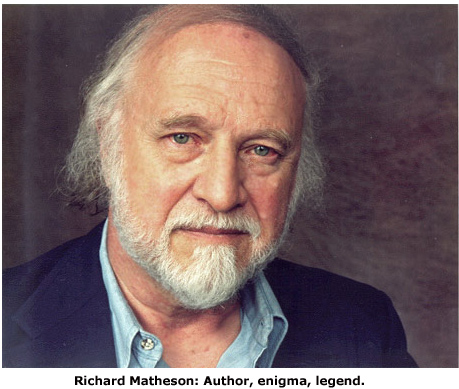
News hit the internet today that legendary author Richard Matheson passed away at the age of 87.

Matheson has been instrumental and influential in horror and dark fantasy pop culture of the 60 or so years. Stephen King and George A. Romero, undoubtedly two of the most recognizable masters of horror of their generation, has called Matheson a major influence in their work. Where would the zombie genre of today be without Matheson’s groundbreaking vampire novel, I Am Legend, which gave Romero the idea to make his Night of the Living Dead. It is also this very same vampire novel whose influence could be seen throughout King’s own classic vampire tale with Salem’s Lot. Even King’s own foray into a zombie novel, Cell, would be dedicated to Matheson.

Yet, Matheson’s influence wouldn’t just be felt in the literary world. He would pen some of the best Twilight Zone episodes and would also provide Roger Corman with screenplay adaptations of Edgar Allen Poe’s short stories and novellas. He would also provide Hollywood with screenplays based on his own stories that would become classic horror and dark fantasy films in their own right.

There’s no way to quantify just how many people Richard Matheson has touched and influenced with his work, but one would be hard pressed not to find someone who hasn’t come across something that had Matheson’s fingerprint whether it was one of his stories, films based on his works or a tv episode that he didn’t have a hand in writing. Then there’s those who have seen or read something that had been influenced by his work.

Today the world has lost of the giant’s in his field of work. Yet, as his best known work says as it’s ending, Matheson will survive far longer than he had lived: HE IS LEGEND.

On a personal note, I count Matheson as one of the biggest influences in my life. Everything he has done or touched have had a hand in showing me the power of the written word. Much of what I watch and read has been influenced by his work. Where would horror and dark fantasy be without him to set the path for future writers and filmmakers. Whether they care to admit it or not they, just like myself, owe Richard Matheson a debt of gratitude for work in the field.

A giant of a man has passed into legend and it’s now up to us, his admirers and fans, to continue on his work of providing the world with quality genre entertainment.

The SPM Trilogy Revisited : “Slumber Party Massacre III”


SLUMBER-PARTY-MASSACRE-III-DVD

What the heck, let’s wrap this up, shall we?

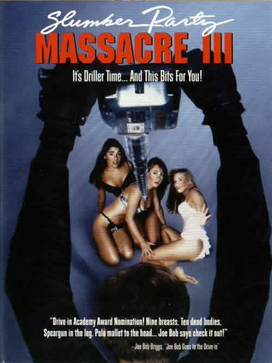
While the appearance of Slumber Party II may have surprised some being that it came five years after the original, it’s safe to say that when Roger Corman unleashed Slumber Party Massacre III  on the direct-to-video market in 1990, nobody was shocked in the least.

Shot primarily at one beach location and one residential home for exteriors, and with all the interiors being filmed at Corman’s Venice, California studio, the third installment in the SPM series cost a grand total of $350,000 and took somewhere in the neighborhood of one week to get “in the can,” as the saying goes, so yeah — it’s cheap , quick stuff we’re talking about here.

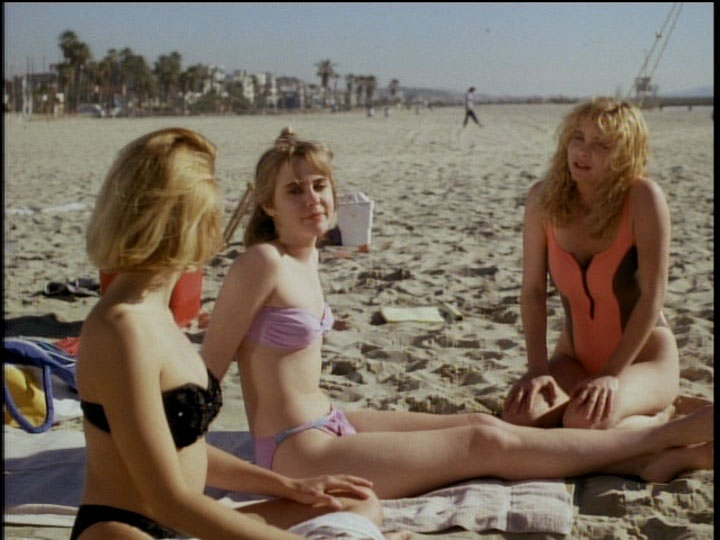
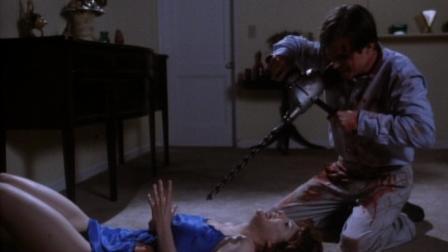
That being said, that certainly doesn’t mean it’s bad. What starts as a pretty bog-standard tale of stereotypical SoCal bimbo Diane (Brandi Burkett) and her friends ( a crew that features a few  young-at-the-time ladies, such as Hope Marie Carlton, Maria Ford, and Keely Christian, whose faces — and other parts — you may recognize from similar early-90s “slasher”/sexploitation fare) playing volleyball at the beach and then returning to Diane’s parents’ place for a weekend slumber party, where they are set upon, in turn, by their prankster-ish boyfriends, a voyeuristic “nosy neighbor” type, a mute Albino creepy dude, and finally a pyscho killer with a power drill, actually morphs somewhere along the way into a flick with a pretty wickedly sadistic, even black-hearted, sense of humor — with a pretty heavy dose of the misogyny you’ve come to expect from these things thrown in, of course.

As a brief case in point, instead of the standard bathtub-electrocution with either a hair dryer or toaster, in SPM III one of the nubile young co-eds is dispatched in the tub by means of a vibrator gone haywire! Nasty stuff, to be sure, but clearly not something that takes itself too terribly seriously while it’s dishing out its feminist-unfriendly — hell, female-unfriendly — goods.

slumberpartymassacre3girls

As with the previous two entries in this series, Corman again opted for an all-female writing and directing team here in order, one would assume, to help deflect any criticism this one might bet from the usual quarters (not that very many people were paying attention by this point), with those duties falling to Catherine Cyran (one of his regular screenwriters at the time) and Sally Mattison (a semi-veteran of Hollywood’s low-budget fringes best known for her work as a producer), respectively, and while it’s fair to say that this film is the most “seems-like-it-coulda-been-directed-by-a-man-ish” of the bunch, given that it ups the ante a bit in terms of its misogyny and plays it much “straighter,” if you will, than its predecessors in terms of sticking to the standard and much-maligned slasher formula, at the end of the day it’s still a pretty tongue-in-cheek affair  that’s just a bit more self-indulgent and gratuitous in terms of the T&A and overall mean-spiritedness.

To their absolute, credit, though, Mattison and Cyran, while carrying over the blatant phallo-centrism of the whole power drill thing, at least decide to throw in a bit of “whodunit?”-style mystery into the proceedings vis a vis their killer’s identity. Yes, folks, for the first time in a Slumber Party Massacre movie, the psycho might actually have some motivation for his murder spree here!

Or, ya know, he might turn out to be just some random stranger after all. I guess I won’t “spoil” anything in case you haven’t actually seen it. I will say, however,  that the mystery angle isn’t a particularly involving one — but hell, at least it’s there. We’ve already firmly established that “take what you can get” is the order of business with these things, haven’t we? The same — ahem! — “philosophy” applies here.

spmpt32

All in all,  though, you do get the sense that everyone involved here is giving it their best go on what they’ve got — which admittedly isn’t much in terms of time, talent, and money — but I’d rather watch so-called “D-listers” actually try than “A-listers” sleepwalking through yet another mega-budget production any day of the week. Slumber Party Massacre III may not be particularly ambitious stuff by any stretch, but it’s put together and performed by people who gave an honest day’s effort at the office. That’s worth a little something right there,  and after the absolute clusterfuck of wanna-be “trippy-ness” in the second flick, the “return to roots” sensibility in this one is very welcome indeed.

slumber-party-massacre-iii

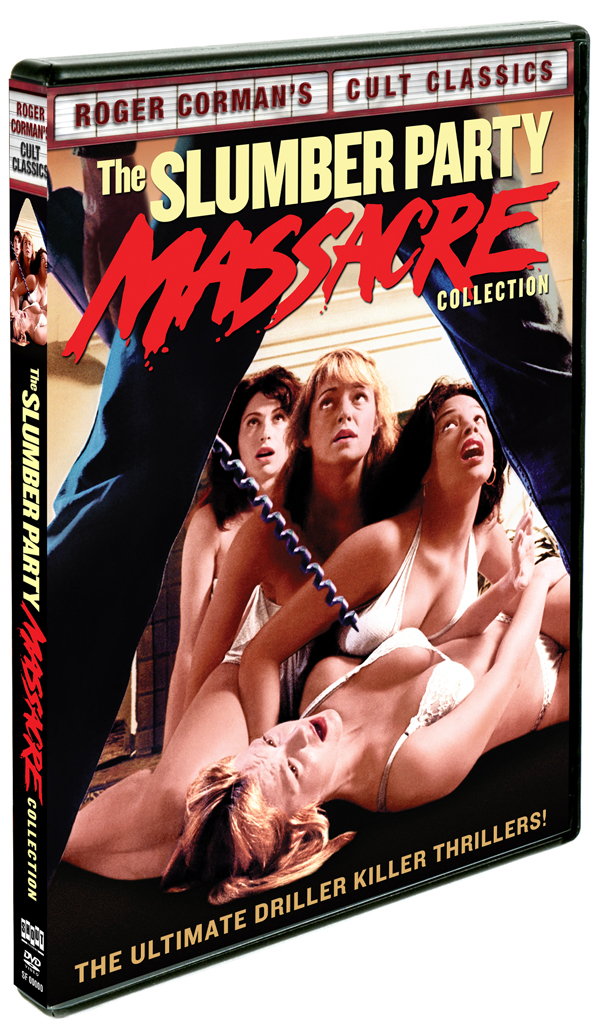
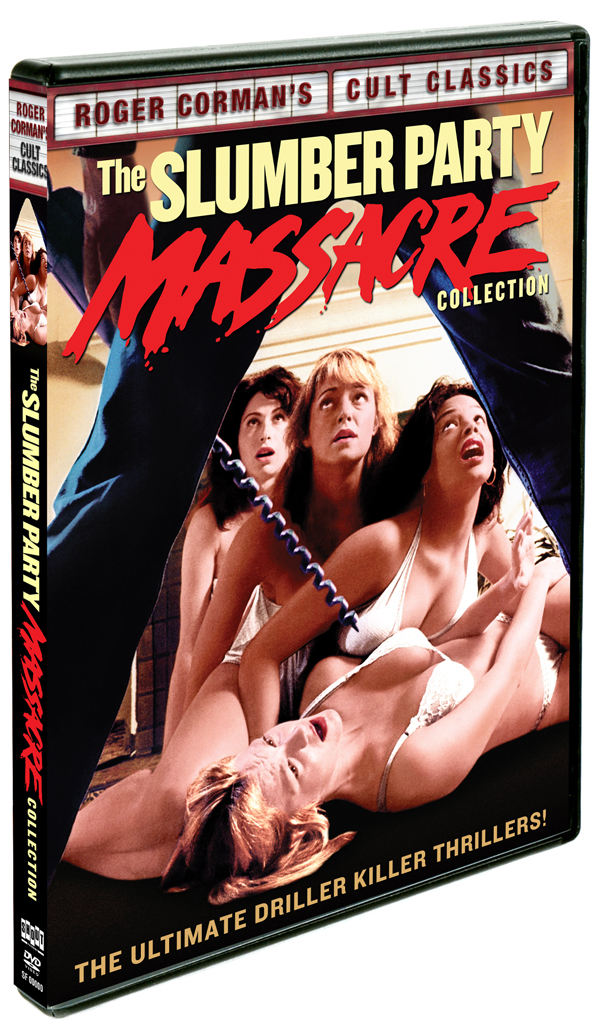
As always, the third and final outing (to date) in the SPM “oeuvre” is available on DVD from Shout! Factory packed together with its older celluloid sisters in a two-disc set under the heading “The Slumber Party Massacre Collection,” part of the “Roger Corman’s Cult Classics” series. It’s presented full-frame with 2.0 stereo sound — and while if there’s been any remastering done with either it’s certainly minimal, the whole thing looks and sounds generally decent enough. Extras include a good little “making-of” featurette, a feature-length commentary with director Mattison, the original trailer, a few trailers for other titles in the Corman series, a poster and still gallery, and a liner notes booklet by Slumber Party Massacre fanatic/filmmaker Jason Paul Collum. A very comprehensive package well worth your time.

slumber082710

Look, who are we kidding? This isn’t a movie out to set the world on fire — hell, it’s not even out to set the DTV slasher world on fire. It’s there to give two distinct parties their money’s worth — Roger Corman and you, the viewer. It manages to deliver on both fronts, even if just barely. That doesn’t mean it’s necessarily worthy of a ton of respect, but it’s not worthy of any sort of scorn, either. Don’t expect too damn much, and you’ll walk away satisfied.

Not, I suppose, that anyone who might be inclined to “expect much” as far as their entertainment choices go  is even watching this in the first place.

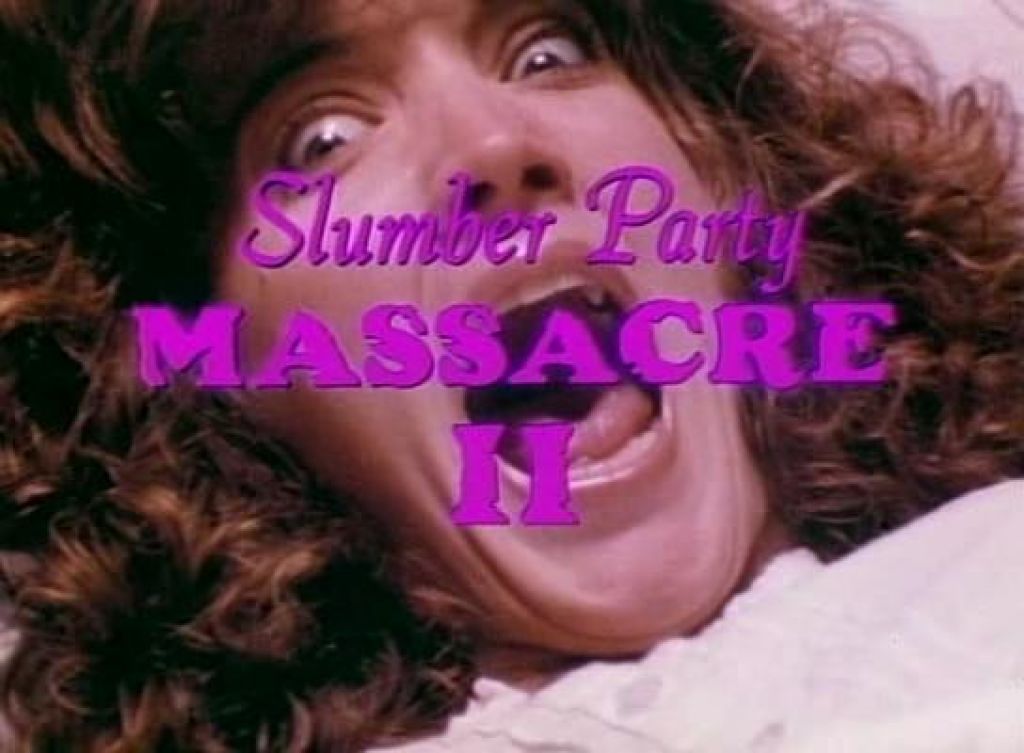
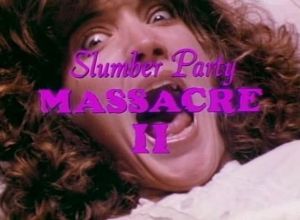
The SPM Trilogy Revisited : “Slumber Party Massacre II”


Slumber%20Party%20Massacre%202%201987

By 1987, I’m not sure that anyone was expecting Roger Corman to trot out a sequel to The Slumber Party Massacre. Sure, the movie had gained something of a cult following thanks to the VHS rental market (it did rather middling business at the box office upon its initial release), but it had been a few years and since most “slasher” sequels at the time tended to pop up within a year or two of the first flick (heck, that’s pretty much still the case), I think it’s pretty safe to say that the general feeling at the time was  that SPM was a one-and-done deal.

We all should have known better, or course. When you’ve got an ultra-simple premise that can be filmed cheaply and quickly using just a couple of different locations, and the original turned a profit (however modest), then there’s no way Corman’s not gonna go back to that well at some point. And so it came to pass that, five years on from its progenitor, Slumber Party Massacre II saw the light of day.
jurkohdkcrtibig

Needless to say, times had changed in the half-decade between the two films. While not strictly a straight-to-video release since Corman was still pulling together limited theatrical runs for all his product at the time (mostly in the Southern California area), those were really just a clevver way to essentially pull “focus group” test audiences together (and have them pay for the privilege of being guinea pigs rather than vice-versa!) to make sure the end result more or less had the effect on folks that it was supposed to. Pretty much all the action for the second Slumber Party Massacre was going to be on home video, and ol’ Roger knew it  — hence a smaller cast, fewer sets, and, I’m willing to bet, probably an even smaller budget (at least in terms of adjusted-for-inflation dollars). Heck, this thing even clocks in with a slightly shorter run time than its predecessor, if you can believe that, at a paltry 75 minutes!

One thing about the SPM modus operandi that Corman didn’t change, though, was hiring a young, relatively fresh-outta-film-school woman to direct the thing, his hire in those case being one Deborah Brock, who also wrote the script.
slumberpartymassacre2killer

To Brock’s credit, she tried to do something a little bit different — and, dare I say, maybe even a little bit more ambitious — than the average low-budget, essentially-DTV slasher sequel allows for with this movie. To her discredit, what she tried doesn’t exactly work. To wit:

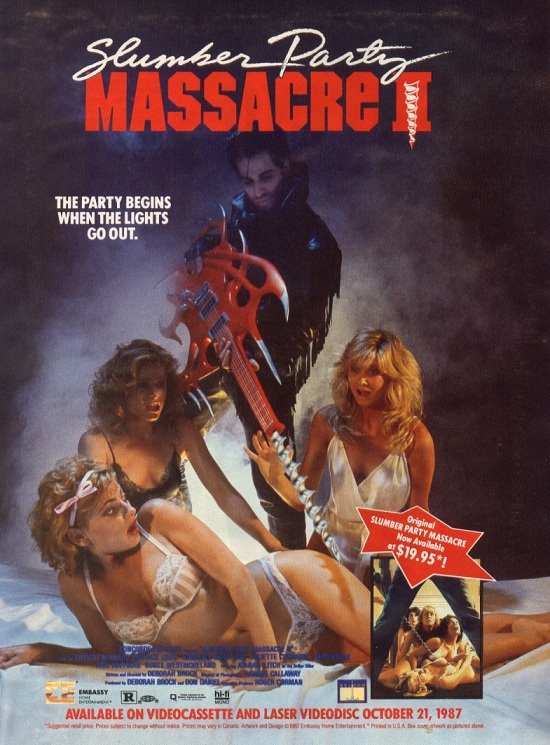
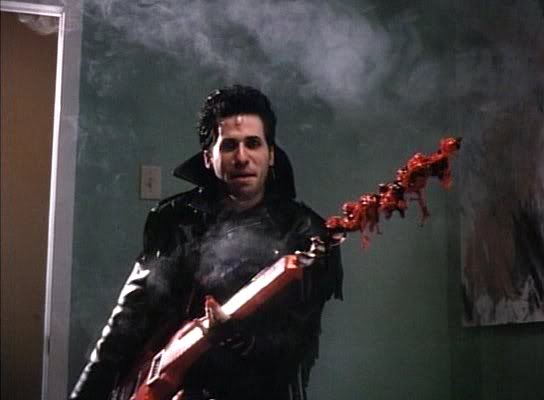
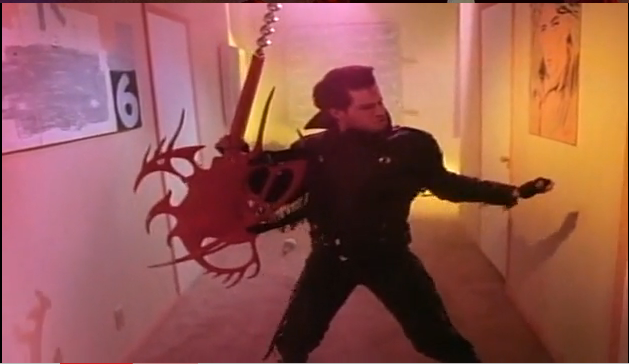
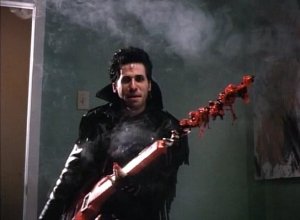
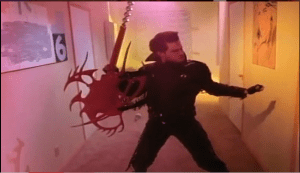
Our story here centers around a young gal named Courtney (Crystal Bernard, who would go on to star on the long-running TV sitcom Wings), who just so happens to be the younger sister of the “final girl” from the first Slumber Party Massacre flick. Courtney fronts an all-girl rock band (gotta vary it up from the high school basketball team premise at least a little bit) that’s headed to a rental condo for weekend of fun n’ semi-naked games with their boyfriends. There’s just one problem, though — she’s also been suffering from horribly vivid nightmares involving things like refrigerated whole chickens coming to life and her friend’s acne boiling, pulsating, throbbing, and eventually exploding all over the place. The one constant in all of these bad dreams, though, is an unnamed “devil rocker” (he’s referred to in the credits only as the “Driller Killer” and is played by Atanas Ilitch, who looks more than just a bit like a young Andrew Dice Clay) who terrorizes Courtney and her gal pals with a murderously-retrofitted guitar that’s equipped with a long, uber- phallic (again) power-drill for a neck.
spm23

Needless to say, once the weekend revelries get going, things don’t go quite as planned, and Courtney, her fellow girl-group rockers, and their fellas are soon experiencing a very violent reduction in their numbers at the hands of the “driller killer,” who turns out to be very real indeed.

Or is he? And that, my friends, is the crux of Slumber Party II‘s problem in a nutshell (besides the fact that the “real” killings don’t start taking place until just after the halfway point of the flick). At first, the whole “is this the real life, is this just fantasy?” (sorry, Freddie!) gimmick is kinda neat, but it definitely starts to wear on the average viewer’s nerves after awhile, and Brock’s decision not to delineate in much of any way what’s actual from what isn’t ultimately makes for kind of a confusing experience. Still, you figure that in a genre this (for the most part) cut-and-dried, things are bound to make sense by the end, right?

zit

Well, not so fast. Brock throws us not one, not two, but three rapid-fire concluding twists that never end up leaving  us with a satisfactory explanation as to whether or not the events we’ve just witnessed “really” happened or not. When we finally learn that Courtney’s locked up in a loony bin, three distinct possibilities emerge —  either it  was all a dream-within-a-dream in her disturbed mind, or she killed all her friends and this “driller killer” is some alternate persona she’s created in order to absolve herself of any guilt, or it all actually happened, she survived, and the ordeal drove her over the brink. And when the “driller killer” pops up again right before the credits roll, this time in the sanitarium with Courtney, Brock doesn’t in the least bit clue us in as to whether he’s there in the flesh or only in her erstwhile heroine’s admittedly traumatized psyche.

Some folks might find this lack of anything even resembling a concrete resolution interesting, maybe even a bit exciting. Hell, we all like to think for ourselves, right? Unfortunately, Courtney and her cohorts are such a largely uninteresting lot that most of us can’t really be bothered to care all that much about solving this film’s wanna-be-mind-fucking puzzle. And the “driller killer” himself is so OTT, and stripped of any pretense of motivation for his murder n’ mayhem, that he never seems “real” enough to make the purported “mystery” all that involving. The whole thing rings both flat and hollow to this wannabe-critic, at the very least.

slumber082710

Like the other pics in this soon-to-be-concluded little mini-round-up we’re doing here, Slumber Party Massacre II is available on a two-DVD set from Shout! Factory entitled, appropriately enough, “The Slumber Party Massacre Collection,” which is part of their larger “Roger Corman’s Cult Classics” series. It’s sporting a nicely-remastered widescreen transfer, has good 2.0 stereo sound, and there are extras aplenty including a fairly comprehensive little “making-of” featurette, a full-length commentary from writer/director Brock, a poster and still image gallery, the original theatrical trailer, some trailers for other flicks in this series, and a liner notes booklet by SPM historian Jason Paul Collum. While I may not consider this a great movie by any means, this is certainly a great DVD package.

Still,  ya know what? Flaws n’ all, I’d still go so far as to say that the film itself is at least worth a look. I do admire Brock for her willingness to break the mold and think outside of the usual slasher box. Her intentions for this flick strike me as being pretty solid, and as almost-innovative as her budget would allow for — she just fails in her execution. And let’s face it — a slasher movie that can’t execute properly is saddled with a problem it can never overcome.
The SPM Trilogy Revisited : “The Slumber Party Massacre”


the film poster only features one actress actually in the film (Andre Honore)

Ah, the folly of youth. When we’re young, we’re so determined to prove we can “make it on our own” that we’ll turn our backs on opportunities that might serve us better in the long run just because they would mean answering to “The Man” in the short term. A hot-shot young chef (a nauseating demographic which our nation is currently, and quite literally, under absolute fucking assault from) will bypass the chance to apprentice under a master of his craft in a popular and established kitchen in order to go start up his own restaurant that will be lucky to last out the year. A promising young journalist will eschew the opportunity to work as a “beat” reporter on a local paper in order to start up a “cutting edge” news website with “attitude” that folds when they can’t get any advertisers. A way-too-full-of-himself young lawyer will say “no thanks” to a “lesser” offer from a major, established firm in order to start his own personal injury practice before realizing that there are already 10,000 other guys in town doing the exact same thing. There’s no doubt about it, my friends — we don’t know jack shit when we’re young, but we know we know better than anybody else.

All of which is to say, I guess, a couple of things : one, that I’m older and wiser now and will gladly give up the “freedom” and “total control” I have over my own website in less than a goddamn heartbeat in order to go work for somebody who actually pays me to write this shit; and two, that back in 1982 a semi-recent USC film school grad named Amy Holden Jones, who was considered something of an up-and-comer behind the camera in Hollywood at the time, turned down the chance to be Steven Spielberg’s cinematographer on a little something called E.T. in order to directmuch littler something for Roger Corman called The Slumber Party Massacre.

I’m sure she’s not kicking herself too badly over that decision today.

spm_za

Corman, of course, as he always seemed to, had an angle figured with this one, as well — in order to deflect, or at least try to deflect, some of the rampant feminist criticism that was just starting to be directed at the “slasher” genre back then, he’d take the  largely (okay, entirely) symbolic step of hiring women to both direct (Jones) and script (Rita Mae Brown) his latest girls-take-off-their-shirts-and-get-butchered-for-being -“slutty” opus, therefore “proving” that he, himself, had no problem with the fairer sex —only his movies did.

To their credit, both Jones and Brown obviously knew full well what they were getting into here (hell, how could you not?) and decided to play the whole thing up for all it was worth by indulging in blatant self-parody at more or less every turn. Their escaped-from-the-loony-bin killer, one Russ Thorne (Michael Villella) is given essentially no motivation whatsoever and goes after his victims with the most overtly phallic power drill ever conceived of; he’s thrust into the middle of a high school all-girls’ basketball team slumber party (hence, ya know, the title) by the most contrived set of circumstances possible; and every one of the nubile young targets of his kill-spree is a paper-thin, less-than-two-dimensional cipher rather than being anything like an actual, proper character.

slumberpartym4

As far as any kind of plot synopsis goes, that’s probably all you really need here, if not more — after all, you know the drill (sorry!), right? The party’s hostess, Trish (Michelle Michaels), despite being listed first in the credits, isn’t gonna be the last girl standing (or limping, or writhing, or crawling), that honor goes to picked-on-for-being-aloof-quiet-and-too-much-better-at-basketball-than-the-others (she’s even a new girl at school, to boot! How many different ways can you say “virgin” without just blurting it out?) Valerie (Robin Stille). All the proceedings here follow the typical cut-and-dried formula more or less to a “T,” with a heavy dose of self-awareness being basically the only wrinkle added into the mix, apart from “keep your eyes open for an early turn by future ‘scream queen’ semi-star Brinke Stevens.”

None of which is to say that I didn’t enjoy The Slumber Party Massacre — the fact of the matter is, this one of those flicks that I always kinda turn to when I want to turn my brain off. It’s solid, if unspectacular, tongue-in-cheek fun, leaves a pleasant-enough grin on your face, and keeps you reasonably involved for its brief-but-just-right-all-things-considered 77-minute run time. If ol’ Russ was as smart and efficient at his job as Holden was at hers, he might still be running around sticking his power drill in high school girls today. And yeah, I realize that last sentence sounded every bit as unsubtle as this movie is, that was kinda the — errrmmm — point (damn! Just can’t help myself).

Slumber Party Massacre 12

Being that this movie and its two sequels (part two being even more OTT farcical than this one, part three being something of a “back-to-basics” straight-to-video affair) have a semi-sizable cult following, Shout! Factory made the wise decision to release ’em all together in one collection on (two-disc) DVD and (single-disc) Blu-Ray. Since I’ll be going to the “effort” of reviewing ’em all here in the next few days, I’ll just take it one at a time with the technical specs and extras. The Slumber Party Massacre is presented in a 1.78:1 widescreen remastered transfer that looks pretty damn stunning, and the remastered mono sound is perfectly serviceable, as well. There’s a really good little “making-of” featurette included , a photo still and poster artwork gallery, and director Jones is on hand for a full-length commentary track. The original theatrical trailer, a smattering of trailers for other titles in the “Roger Corman’s Cult Classics” series, and a solid set of liner notes by Jason Paul Collum round out the package.

spm-new

If you don’t have the time, money, or inclination to break new ground — and let’s face it, Roger Corman never had any of the above — you could do a lot worse than to tread the same ol’ familiar territory with a little bit of style, self-deprecating wit, and a quick little wink to the audience. The Slumber Party Massacre certainly delivers on each of those counts, and while I’ll never be fully on board with those who view this thing as some sort of “classic,” it’s definitely a good — if thoroughly predictable — time.

I’m older and wiser now, remember?  I’m perfectly happy to take what I can get.