1992’s The Player tells the story of Griffin Mill (Tim Robbins).
It’s not easy being Griffin Mill. From the outside, of course, it looks like he has the perfect life. He’s a studio executive with a nice house in Hollywood. He’s young. He’s up-and-coming. Some people, especially Griffin, suspect that he’ll be the president of the studio some day. By day, he sits in his office and listens to pitches from respected screenwriters like Buck Henry. (Henry has a great idea for The Graduate II!) During the afternoon, he might attends dailies and watch endless takes of actors like Scott Glenn and Lily Tomlin arguing with each other. Or he might go to lunch and take a minute to say hello to Burt Reynolds. (“Asshole,” Burt says as Griffin walks away.) At night, he might go to a nice party in a big mansion and mingle with actors who are both young and old. He might even run into and share some sharp words with Malcolm McDowell.
But Griffin’s life isn’t as easy as it seems. He’s constantly worried about his position in the studio, knowing that one box office failure could end his career. He fears that a new executive named Larry Levy (Peter Gallagher) is after his job. Two new screenwriters (Richard E. Grant and Dean Stockwell) keep bugging him to produce their downbeat, no-stars anti-capitol punishment film. His girlfriend (Cynthia Stevenson) wants to make good movies that mean something. Even worse, someone is sending Griffin threatening notes.
It doesn’t take long for Griffin to decide that the notes are coming from a screenwriter named Dave Kahane (Vincent D’Onofrio). Griffin’s attempt to arrange a meeting with Dave at a bar so that Griffin can offer him a production deal instead leads to Griffin murdering Dave in a parking lot. While the other writers in Hollywood mourn Dave’s death, Griffin starts a relationship with Dave’s artist girlfriend (Great Scacchi) and tried to hide his guilt from two investigating detectives (Whoopi Goldberg and Lyle Lovett). Worst of all, the notes keep coming. The writer, whomever they may be, is now not only threatening Griffin but also seems to know what Griffin did.
After spend more than a decade in the industry wilderness, Robert Altman made a critical and commercial comeback with The Player. It’s a satire of Hollywood but it’s also a celebration of the film industry, featuring 60 celebrities cameoing as themselves. Everyone, it seems, wanted to appear in a movie that portrayed studio execs as being sociopathic and screenwriters as being whiny and kind of annoying. The Player both loves and ridicules Hollywood and the often anonymous men who run the industry. Largely motivated by greed and self-preservation, Griffin may not love movies but he certainly loves controlling what the public sees. In the end, only one character in The Player sticks to her values and her ideals and, by the end of the movie, she’s out of a job. At the same time, Griffin has a social life that those in the audience can’t help but envy. He can’t step out of his office without running into someone famous.
The Player is one Altman’s most entertaining films, with the camera continually tracking from one location to another and giving as a vision of Hollywood that feels very much alive. Tim Robbins gives one of his best performances as Griffin Mill and Altman surrounds him with a great supporting cast. I especially liked Fred Ward as the studio’s head of security. With The Player, Altman mixes melodrama with a sharp and sometimes bizarre comedy, with dialogue so snappy that the film is as much a joy to listen to as to watch. That said, the real attraction of the film is spotting all of the celebrity cameos. (That and cheering when Bruce Willis saves Julia Roberts from certain death.) Altman was a director who often used his films to explore eccentric communities. With The Player, he opened up his own home.
It’s a bit frustrating that I have to start this review of a documentary about one of my favorite classic film actresses by discussing the gossip and innuendo that has surrounded her death but, unfortunately, that’s the world that we live in nowadays.
It’s been nearly 40 years since the death of Natalie Wood and the circumstances of her drowning are still debated, largely by people who know nothing about the incident beyond what they’ve read online. In 2011, when an employee of Wood and her husband, Robert Wagner, suddenly changed the story that he had been telling for 30 years, the Los Angeles Police Department reopened the investigation into Wood’s death. Suddenly, all over twitter, people were accusing Wagner of having killed Wood, either deliberately or accidentally. Interestingly enough, Christopher Walken was also on the boat on the night that Wood drowned but very few people accused him of having anything to do with it, largely because Walken is better-known to most twitter users than Wagner. (It’s easier to accuse someone of murder when he’s not a celebrated cultural icon.) Things were not helped when the LAPD announced that Wagner a “person of interest” in the case. Of course, “person of interest” is a vague term that can mean anything.
Also not helping matters was that Lana Wood, Natalie’s sister, publicly accused Wagner of having something to do with Natalie’s death. I can still remember that bloviating gasbag, Dr. Phil, having Lana on his show and asking her if she thought Wagner murdered Natalie. Footage from that interview appears in the HBO documentary, Natalie Wood: What Remains Behind.
Fortunately, in the documentary, Robert Wagner is also interviewed about the night that Natalie Wood drowned and there’s a marked contrast between the obviously emotional Wagner who appears in the documentary and the monstrous caricature of Wagner that’s been presented by many Wood conspiracy theorists. If I didn’t already think that Wagner was innocent and that Wood’s death was a tragic and terrible accident, this documentary would have convinced me.
Natalie Wood: What Remains Behind is a documentary about the life and, sadly, the death of Natalie Wood. It’s hosted by her daughter, Natasha Gregson Wagner. The film is tribute to Wood and her career, featuring interviews with the journalists who wrote about her, the photographers who snapped pictures of her, the stars who co-starred with her, and finally, the members of of her family. There’s also a good deal of archival footage of Wood talking about her life. One thing you quickly realize, while listening to Wood, is that she knew how to play the PR game. In her interviews, Wood always said enough to be interesting while, at the same time, keeping up enough wall that she remained somewhat enigmatic. Natasha, for her part, describes her mother as being a down-to-Earth person who, when she had to, could play the role of the glamorous film star.
The film examines Natalie’s career, from her time as a child actor to stardom in the 50s and 60s. As the documentary points out, Wood was an actress who literally grew up on scree. The film also takes a look at her semi-retirement in the 70s. (She was making a comeback at the time of her death and Wagner, in fact, admits to getting into a rather loud argument with Christopher Walken about whether or not Wood should have been accepting more film roles.) The documentary candidly discusses her difficult relationship with her mother, along with her occasionally tumultuous private life. The film provides a look at both what made Wood a star and why her performances continue to resonate with so many of us.
(For the record, my favorite Natalie Wood performance will always be Splendor in the Grass.)
But, sadly to say, Wood’s death and the rumors surrounding it casts a shadow over almost every minute of the documentary. Again, that’s the world we live in. It’s a world dominated not only be innuendo and gossip but also a desire to destroy anyone who has ever led a public life. As a result, there’s no way to make a documentary about Natalie Wood without discussing the conspiracy theories surrounding her death and it’s tragic that a few publicity hungry individuals continue to attempt to capitalize on the tragedy of Wood’s passing. The film gives Wagner a chance to tell his story and for that, we should be both thankful. This is film that will inspire viewers to celebrate Wood’s life and to despise those who have exploited her death.
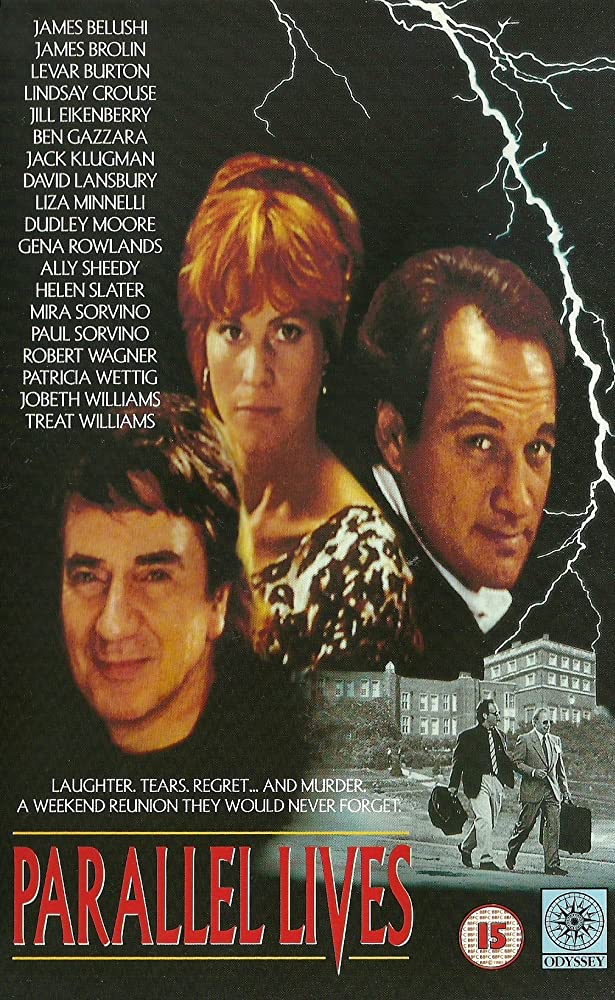
A large group of people gather together one weekend for a fraternity/sorority reunion. Since college, some of them have become rich and powerful. Some of them are now famous. Some of them are now seedy and disreputable. They all have college memories, though there’s such a wide variety of age groups represented that it’s hard to believe that any of them actually went to college together. After the men spend the day playing practical jokes and touch football and the women spend the night talking about their hopes and dreams, they wake up the next morning to discover the someone has murdered Treat Williams. A pony-tailed sheriff (Robert Wagner) shows up to question everyone.
Parallel Lives was made for Showtime with the help of the Sundance Institute. Today, it’s a forgotten film but, for some reason, it was very popular with American Airlines during the summer of 1997. That summer, when I flew to the UK, Parallel Lives was one of the movies that we were shown. (It was the second feature. The first feature was Down Periscope, a submarine comedy starring Kelsey Grammar. Fourteen year-old me enjoyed Down Periscope but, in retrospect, it wasn’t much of a flight.) A month and a half later, when I flew back to the U.S., Parallel Lives was again one of the films shown on the flight! For that reason, I may be the only person on the planet who has not forgotten that a film called Parallel Lives exists.
Parallel Lives, I later learned, was an entirely improvised film. The huge cast were all given their characters and a brief outline of the film’s story and they were then allowed to come up with their own dialogue. Unfortunately, no one did a very good job of it and the men were reduced to bro-ing it up while the women spent most of the movie having extended group therapy. The story doesn’t add up too much and, even when I rewatched it from an adult’s perspective, I wasn’t sure what I was supposed to get out of everyone talking about how different the real world was from college. Technically, the film’s a murder mystery but you can’t improvise a successful murder mystery. This film proves that point.
Of course, it doesn’t help that there are 26 characters, all trying to get a word in at the same time. Some of the roles don’t make much sense. Dudley Moore shows up, playing an imaginary friend. (How do you improvise being a figment of someone’s imagination?) James Brolin introduces himself to everyone as being, “Professor Doctor Spencer Jones” and that appears to be as far as he got with his improv. Ben Gazzara is a gambler and Mira Sorvino is the prostitute that he brings to the reunion while Mira’s father, Paul Sorvino, moons the camera several times. Jack Klugman is a senator with Alzheimer’s and Patricia Wettig is his daughter. The majority of the movie centers around Jim Belushi, playing a reporter and falling in love with JoBeth Williams. Liza Minnelli, Helen Slater, Levar Burton, Lindsay Crouse, Matthew Perry, Ally Sheedy, and Gena Rowlands all have small roles. How did so many talented people come together to make such a forgettable movie and why did American Airlines decide it was the movie to show people on their way to another country? That’s the true mystery of Parallel Lives.
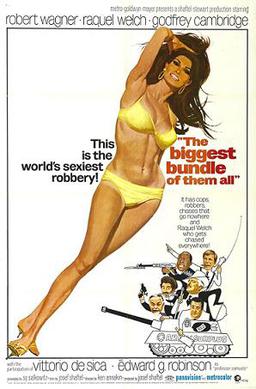
Harry Price (Robert Wagner) is a small-time tough guy with big plans. He and his gang of accomplices fly over to Italy and plot to kidnap Cesare Celli (Vittorio De Sica), a retired mafia don who is reputed to be worth millions. However, after snatching Celli from a wedding, Harry discovers that Celli is actually flat broke. Trying to be helpful, Celli suggests that Harry call up the local gangsters and demand that they pay a ransom for Celli’s release. When everyone refuses to pay, Celli comes up with another plan. Celli takes over Harry’s gang and, with the help of Celli’s old friend, Prof. Samuels (Edward G. Robinson), plots to steal $5,000,000 worth of platinum ingots from a train.
Complicating matters is that Harry and his gang are not exactly master criminals. Benny (Godfrey Cambridge) is a violinist who has moral objections to carrying a gun and who also refuses to cross a picket line, even in the course of a robbery. (“I’m a union man!”) Tozzi (Francesco Mule) is more interested in having a good dinner than pulling off the perfect heist. Davey (Davy Kaye) is short, which is apparently a problem for some reason. Finally, Harry’s girlfriend, Juliana (Raquel Welch), is more interested in dancing than in committing crimes. Still, Celli is determined to use them to pull off the heist of the century and, even more importantly, to help prove that this old criminal has still got what it takes.
The Biggest Bundle of Them All was an attempt at a wacky heist film. Unfortunately, at the time that the film was made, Robert Wagner and “wacky” didn’t belong anywhere near each other. Wagner stiffly delivers lines like, “I’ve had it, baby. Can you dig it?” and looks thoroughly out-of-place. Godfrey Cambridge and Edward G. Robinson have a few funny scenes but both Kaye and Mule are wasted in one-note role while De Sica looks like he’s trying to figure out how he went from Bicycle Thieves to this. Everyone in the movie just goes through the motions. Even while they’re robbing the train, the cast seems to be indifferent.
It almost doesn’t matter, though, because this is a Raquel Welch film. Welch doesn’t have much of a character to play but she looks amazing while doing it and that really is the appeal of any film that Welch made in the late 60s and early 70s. Welch spends a good deal of the film in a bikini and is undeniably sexy, particularly in the scene where Wagner sends her to seduce De Sica. She also gets to share a dance with Edward G. Robinson, which is such a goofy and fun scene that it’s almost worth the price of admission. (Regardless of what fun they may have been having on-screen, Robert Wagner later wrote in his autobiography that, off-screen, Robinson grew so annoyed with Welch’s chronic lateness on the set that he yelled at her until she was in tears.)
Even Raquel Welch in a bikini can only carry a film so far and The Biggest Bundle of Them All is ultimately too disjointed to work. Director Ken Annakin tries to recreate the same sort of frantic comedy that was at the heart of his previous film, Those Magnificent Men in Their Flying Machines, but the end result falls flatter than 5 million dollars worth of platinum ingots sliding out of an airplane.
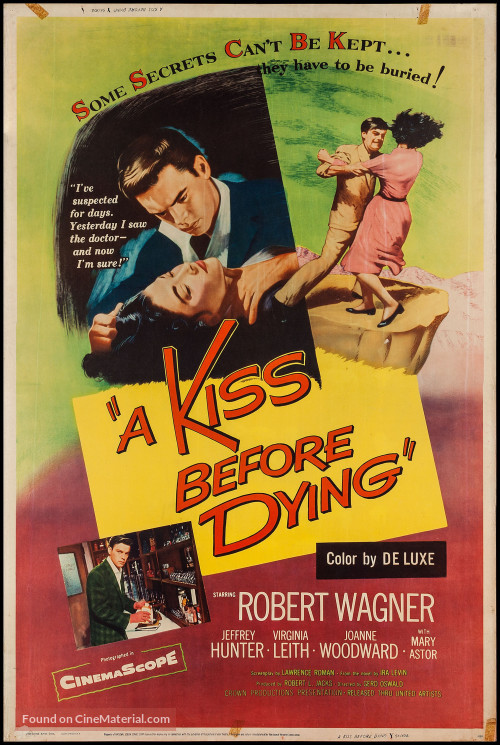
A KISS BEFORE DYING is part soap opera, part film noir, and 100% 50’s kitsch! Based on the best selling debut novel by Ira Levin (who went on to give us ROSEMARY’S BABY and THE STEPFORD WIVES), it’s also the debut of director Gerd Oswald (who went on to give us AGENT FOR HARM and BUNNY O’HARE !). Lawrence Roman’s screenplay has some suspense, but his characters are all pretty dull and dumb, except for Robert Wagner’s turn as a charmingly sick sociopath.
Wagner is college student Bud Corliss, from the wrong side of the tracks, dating rich but naïve Dorie Kingship (Joanne Woodward) to get his hands on dad’s copper mine loot. And when I say naïve I’m not just whistling Dixie; this girl’s downright dense! Bud, after learning she’s pregnant, decides the best thing to do is not marry her, but bump her off. He whips up some poison…
The Longest Day is a pain-staking and meticulous recreation of invasion of Normandy, much of it filmed on location. It was reportedly something of a dream project for the head of the 20th Century Fox, Darryl F. Zanuck. Zanuck set out to make both the ultimate tribute to the Allied forces and the greatest war movie ever. Based on a best seller, The Longest Day has five credited screenwriters and three credited directors. (Ken Annakin was credited with “British and French exteriors,” Andrew Marton did “American exteriors,” and the German scenes were credited to Bernhard Wicki. Oddly, Gerd Oswald was not credited for his work on the parachuting scenes, even though those were some of the strongest scenes in the film.) Even though he was not credited as either a screenwriter or a director, it is generally agreed that the film ultimately reflected the vision of Darryl F. Zanuck. Zanuck not only rewrote the script but he also directed a few scenes as well. The film had a budget of 7.75 million dollars, which was a huge amount in 1962. (Until Steven Spielberg’s Schindler’s List, The Longest Day was the most expensive black-and-white film ever made.) Not only did the film tell an epic story, but it also had an epic length. Clocking in at 3 hours, The Longest Day was also one of the longest movies to ever be nominated for best picture.
The Longest Day also had an epic cast. Zanuck assembled an all-star cast for his recreation of D-Day. If you’re like me and you love watching old movies on TCM, you’ll see a lot of familiar faces go rushing by during the course of The Longest Day. American generals were played by actors like Robert Mitchum, Robert Ryan, Henry Fonda, and John Wayne. Peter Lawford, then the brother-in-law of the President of the United States, had a memorable role as the Scottish Lord Lovat, who marched through D-Day to the sounds of bagpipes. When the Allied troops storm the beach, everyone from Roddy McDowall to Sal Mineo to Robert Wagner to singer Paul Anka can be seen dodging bullets. Sean Connery pops up, speaking in his Scottish accent and providing comic relief. When a group of paratroopers parachute into an occupied village, comedian Red Buttons ends up hanging from the steeple of a church. When Richard Beymer (who is currently playing Ben Horne on Twin Peaks) gets separated from his squad, he stumbles across Richard Burton. Among those representing the French are Arletty and Christian Marquand. (Ironically, after World War II, Arletty was convicted of collaborating with the Germans and spent 18 months under house arrest. Her crime was having a romantic relationship with a German soldier. It is said that, in response to the charges, Arletty said, “My heart is French but my ass is international.”) Meanwhile, among the Germans, one can find three future Bond villains: Gert Frobe, Curt Jurgens, and Walter Gotell.
It’s a big film and, to be honest, it’s too big. It’s hard to keep track of everyone and, even though the battle scenes are probably about an intense as one could get away with in 1962 (though it’s nowhere near as effective as the famous opening of Saving Private Ryan, I still felt bad when Jeffrey Hunter and Eddie Albert were gunned down), their effectiveness is compromised by the film’s all-star approach. Often times, the action threatens to come to a halt so that everyone can get their close-up. Unfortunately, most of those famous faces don’t really get much of a chance to make an impression. Even as the battle rages, you keep getting distracted by questions like, “Was that guy famous or was he just an extra?”
Among the big stars, most of them play to their personas. John Wayne, for instance, may have been cast as General Benjamin Vandervoort but there’s never any doubt that he’s playing John Wayne. When he tells his troops to “send them to Hell,” it’s not Vandervoort giving orders. It’s John Wayne representing America. Henry Fonda may be identified as being General Theodore Roosevelt II but, ultimately, you react to him because he’s Henry Fonda, a symbol of middle-American decency. Neither Wayne nor Fonda gives a bad performance but you never forget that you’re watching Fonda and Wayne.
Throughout this huge film, there are bits and pieces that work so well that you wish the film had just concentrated on them as opposed to trying to tell every single story that occurred during D-Day. I liked Robert Mitchum as a tough but caring general who, in the midst of battle, gives a speech that inspires his troops to keep fighting. The scenes of Peter Lawford marching with a bagpiper at his side were nicely surreal. Finally, there’s Richard Beymer, wandering around the French countryside and going through the entire day without firing his gun once. Beymer gets the best line of the film when he says, “I wonder if we won.” It’s such a modest line but it’s probably the most powerful line in the film. I wish The Longest Day had more scenes like that.
The Longest Day was nominated for best picture of 1962 but it lost to an even longer film, Lawrence of Arabia.
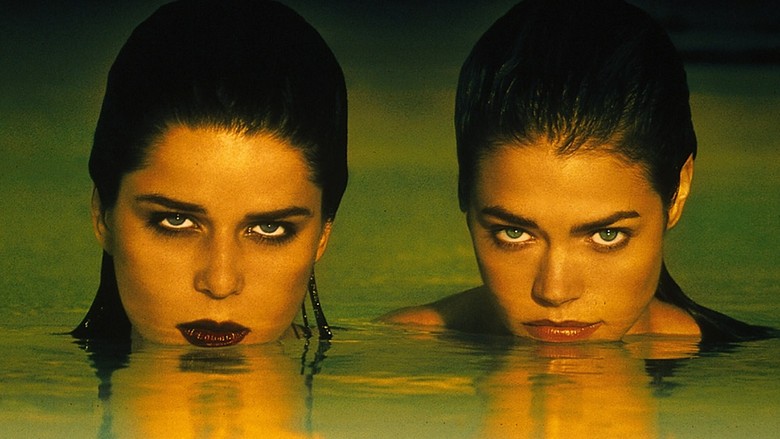
The 1998 film Wild Things starts out like a standard B-movie. It take place in Florida so, of course, we get a lot of shots of the sun setting on the bayous and crocodiles staring at the camera as if to ask, “What are you looking for?” Boats skim the water. High school guidance counselor Sam Lombardo (Matt Dillon) walks across campus while all of the toned and tanned students stop to admire him. Local rich girl Kelly Von Ryan (Denise Richards) smirks and says something snarky. Detective Ray Duquette (Kevin Bacon) shows up in the background and stares at the world from behind dark glasses and a serious expression. Meanwhile, local poor girl Suzie (Neve Campbell) goes back to her home, which happens to be located right behind an alligator farm.
Judging from the first few minutes, Wild Things could just as easily be an episode of CSI Miami.
But then Bill Murray shows up as Kenneth Bowden, a hilariously sleazy attorney who spends most of the movie wearing a neck brace, just in case the insurance company is watching him.
And then Theresa Russell shows up Kelly’s mother, standing on a balcony in a gold bikini and hitting on every passing man like the world’s most hyperactive cougar.
And then Carrie Snodgress shows up as Suzie’s mother, complete with an over-the-top white trash accent.
By the time that Robert Wagner shows up and literally growls at Matt Dillon: “You’re finished, Lombardo! Finished!,” you realize that Wild Things is probably the most self-aware B-movie ever made and it’s all the better for it.
As for the plot — well, let’s see if I can keep track. Suzie and Kelly both accuse Sam of rape. Sam claims to be innocent but nobody in town believes him. Sam is forced to hire the disreputable Kenneth Bowden to defend him. During the trial, Kenneth is able to prove that Kelly blamed Sam for the suicide of her father while Suzie is angry that Sam once refused to bail her out of jail on a drug charge. To get revenge, Kelly and Suzie decided to frame Sam. Sam is acquitted and, again with Bowden’s help, is able to negotiate an 8 million dollar settlement for defamation. True, Sam does lose his job but at least he’s a rich man now…
But wait a minute.
The movie still has a little over an hour to go.
Could it be that there’s more to this story?
Well, of course, there is. It turns out that Sam, Kelly, and Suzie have been working together all the time. The accusations, the trial, the defamation suit — it was all a part of a grand scheme to get the money. Sam, Kelly, and Suzie celebrate their success with champagne and a threesome.
While everyone else in town seems to be ready to move on from the entire scandal, Detective Ray Duquette is telling anyone who will listen that he thinks that Sam, Kelly, and Suzie were all in on it together. Even when Ray is ordered by his superiors to back off, Ray continues to investigate the case.
And why?
Because Ray Duquette is a cop who gets results!
Well, maybe.
Actually, it doesn’t take long to realize that there’s something off about Ray. For one thing, his obsession with Sam really does seem to be a personal thing. On top of that, Ray has a past connection with Suzie…
Wild Things has everything that you could hope for from a good exploitation film: a script that is full of double and triple crosses, unapologetically pulpy dialogue, over-the-top performances, and lots of sex. Yesterday, I reviewed Normal Life and praised John McNaughton’s decision to play up the banality of the film’s characters and locations. With Wild Things, McNaughton takes the exact opposite approach, playing up every sordid and tawdry detail to such an extent that the film itself eventually transcends such mundane concepts as good and bad.
Wild Things is a lot of fun and it’s also one of the best films of the 1990s.
I have a weakness for the old, all-star disaster movies of the 1970s. It could be because those movies remind me of how fragile life really is and encourage me to make the most of every minute. Or maybe it’s because I have my phobias and, by watching those movies, I can confront my fears without having to deal with a real-life tornado, hurricane, tidal wave, avalanche, or fire.
Or maybe I just have a weakness of glitz, glamour, and melodrama — especially when it involves a huge cast of stars and character actors. Yes that’s probably the reason right there.
Case in point: the 1974 best picture nominee, The Towering Inferno.
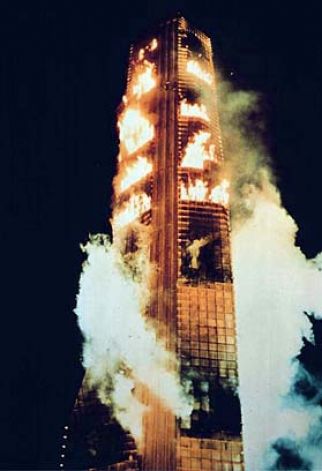
As is the case with most of the classic disaster films, The Towering Inferno is a long and big movie but it has a very simple plot. The world’s tallest building — known as the Glass Tower — has been built in San Francisco. On the night of the grand opening, a fire breaks out, trapping all the rich and famous guests on the 135th floor. Now, it’s up to the fire department to put out the fire while the trapped guests simply try to survive long enough to be rescued. Some will live, some will die but one thing is certain — every member of the all-star cast will get at least 15 minutes of screen time and at least one chance to scream in the face of the film’s still effective special effects.
As for the people trapped by the towering inferno, we don’t really get to know them or their motivations. (Add to that, once the fire breaks out, everyone pretty much only has one motivation and that’s to not die.) As a result, we don’t so much react to them as characters as we do to personas of the actors who are playing them.
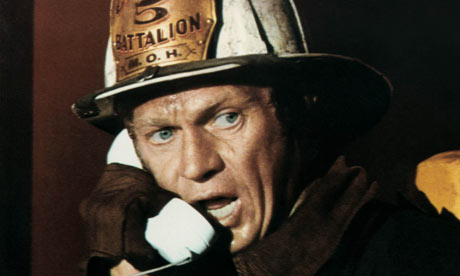
For instance, we know that Fire Chief O’Halloran is a fearless badass and a natural leader because he’s played by Steve McQueen. McQueen brings a certain blue collar arrogance to this role and it’s a lot of fun to watch as he gets progressively more and more annoyed with the rich people that he’s been tasked with rescuing.
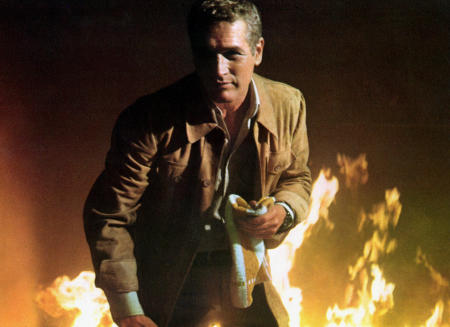
We know that architect Doug Roberts is a good guy because he’s played by Paul Newman. Reportedly, Newman and McQueen were very competitive and, in this movie, we literally get to see them go-head-to-head. And, as charismatic as Newman is, McQueen pretty much wins the movie. That’s because there’s never a moment that O’Halloran isn’t in charge. Doug, meanwhile, spends most of the movie begging everyone else in the tower to exercise the common sense necessary to not die. (Unfortunately, despite the fact that he looks and sounds just like Paul Newman, nobody in the tower feels like listening to Doug. If Towering Inferno proves anything, it’s that most people are too stupid to survive a disaster.)
The tower’s owner, James Duncan, is played by William Holden so we know that Duncan may be a ruthless businessman but that ultimately he’s one of the good guys. Holden gets one of the best scenes in the film when, after being told that people in the building are catching on fire, he replies, “I think you’re overreacting.”
Roger Simmons is Duncan’s son-in-law and we know that he’s ultimately to blame for the fire because he’s played by Richard Chamberlain. Roger might as well have a sign on his back that reads “Doomed.” The same can be said of publicity executive Dan (Robert Wagner) and his girlfriend, Lorrie (Susan Flannery).
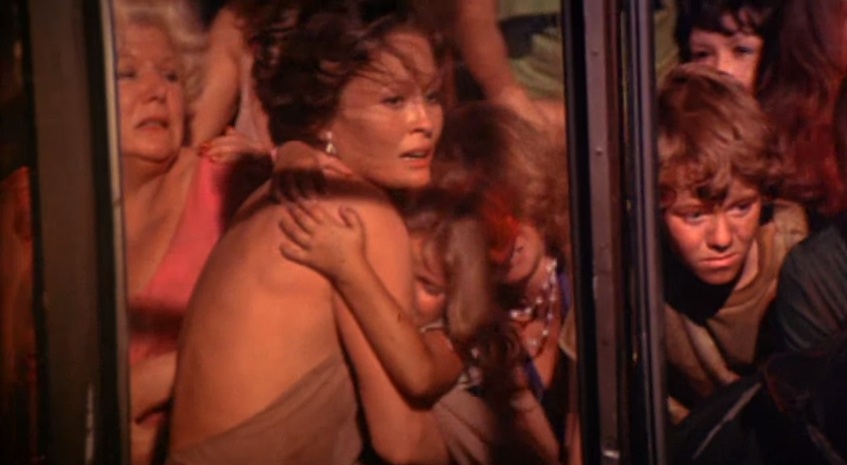
Faye Dunway is Susan. She is Doug’s fiancée and she really doesn’t do much but she does get to wear a really pretty dress. The same can be said of Susan Blakely, who plays Roger’s dissatisfied wife, and Jennifer Jones, who plays a recluse. And good for them because if you’re going to be stuck in an inferno without much to do, you can at least take some comfort in looking good.
Then there’s Fred Astaire, who does not dance in this film. Instead, he plays a kind-hearted con artist who ends up falling in love with Jennifer Jones. Fred Astaire received his only Oscar nomination for his brief but likable performance in The Towering Inferno.
And finally, there’s the building’s head of security, Jernigan. We know that he’s a murderer because he’s played by O.J. Simpson and … oh wait. Jernigan is actually probably the second nicest guy in the whole film. The only person nicer than Jernigan is Carlos, the bartender played by Gregory Sierra.
The real star of the film, of course, is the fire. In the 40 years since The Towering Inferno was produced, there’s been a lot of advances in CGI and I imagine that if the film was made today, we’d be watching the fire in 3D and it would be so realistic that we’d probably feel the heat in the theater. That said, the fire effects in The Towering Inferno are still pretty effective. Now, I have to admit that I have a phobia (and frequent nightmares) about being trapped in a fire so, obviously, this is a film that’s specifically designed to work itself into my subconscious. But that said, the scenes with various extras thrashing about in the flames are still difficult to watch. There’s a scene where Robert Wagner and Susan Flannery find themselves trapped in a blazing reception area and it is pure nightmare fuel.
The Towering Inferno is an undeniably effective disaster film. At the same time, when one looks at the 1974 Oscar nominees, it’s odd to see The Towering Inferno nominated for best picture along with The Godfather Part II, Chinatown, and The Conversation. Unlike those three, The Towering Inferno is hardly a great film.
Sometimes, you have to be careful which films you choose to watch over the course of the day.
Such as, last Friday night, I heard the news that Jill Clayburgh had died and I ended up watching An Unmarried Woman. This, along with the fact that I also watched the Black Swan trailer, led to me dancing around the house in my underwear, en pointe in bare feet, and doing a half-assed pirouette in the living room. And I felt pretty proud of myself until I woke up Saturday morning and my ankle (which I don’t think has ever properly healed from the day, seven years ago, that I fell down a flight of stairs and broke it in two places) literally felt like it was on fire. That was my body’s way of saying, “You ain’t living in a movie, bitch. Deal with it.”
So, come Sunday, I decided to play it safe by watching something that I was sure wouldn’t lead to any imitative behavior on my part. Since I had previously reviewed Earthquake on this site, I decided that I would devote some time to the movies that started the entire 1970s disaster movie genre — Airport. Watching Airport led to me watching Airport’s three sequels.
I was able to do this largely because I own the Airport Terminal Pack, a two-disk DVD collection that contains all four of the Airport films and nothing else. There’s no special features or commentary tracks. That’s probably a good thing because these films are so extremely mainstream that I doubt the commentary tracks would be all that interesting except to people who love “Me and Jennings Lang had the same lawyer…” style stories.
The movies are a mixed bag of ’70s sexism, mainstream greed, and casts that were described as being “all-star” despite the fact that they featured very few stars. They’re all worth watching as time capsules of a past time. Some of them are just more worthy than others.
Below are my thoughts on each individual film in the collection…
Airport (directed by George Seaton)
First released in 1970, Airport was nominated for 10 Academy Awards (including best picture), broke box office records, and started the whole 70s disaster movie trend. It also has to be one of the most boring, borderline unwatchable movies ever made. The fact that I managed to sit through the whole thing should be taken as proof that I’m either truly dedicated to watching movies or I’m just insane. Take your pick.
Anyway, the film is painstakingly detailed account of the every day operations of an airport. Yeah, sounds like a lot of fun, doesn’t it? Burt Lancaster runs the airport. His brother-in-law Dean Martin flies airplanes. Both of them have mistresses but we’re told that’s okay because Lancaster’s wife expects him to talk to her and Martin’s wife is cool with him fucking around as long as he comes home at night. I would be tempted to say that this is a result of the film having been made in 1969 and released in 1970 but actually, it’s just an introduction to the sexual politics of the typical disaster film. Men save the day while women get in the way. And if you think things have changed, I’d suggest you watch a little film calledf 2012…
The only interesting thing about the film is that Lancaster’s mistress is played by Jean Seberg who, ten years earlier, had helped change film history by co-starring in Jean-Luc Godard’s classic film Breathless. Nine years later, after years of being hounded by the American press and the FBI for her radical politics, Seberg committed suicide.
Airport 1975 (directed by Jack Smight)
As opposed to its predecessor, Airport 1975 is actually a lot of fun in its campy, silly way. This is the one where a small private plane (flown by Dana Andrews, the star of the wonderful film noir Laura) collides with a commercial airliner. The entire flight crew is taken out and head stewardess Karen Black has to pilot the plane despite the fact that she’s obviously cross-eyed. Luckily, since Black is a stewardess, she has a pilot boyfriend who is played by Charlton Heston. Heston talks her through the entire flight despite the fact that she was earlier seen trying to pressure him into not treating her like an idiot. Anyway, Heston does his usual clench-jaw thing and if you need a drinking game to go with your bad movie, just take a shot every time Heston calls Black “honey.” You’ll be drunk before the plane lands.
There’s some other stuff going on in this movie (for instance, Gloria Swanson appears as “herself” and doesn’t mention Sunset Boulevard or Joseph Kennedy once!) but really, all you need to know is that this is the film where Karen Black acts up a storm and random characters keep saying, “The stewardess is flying the plane!?”
Odd trivia fact: Airport 1975 was released in 1974.
Airport ’77 (directed by Jerry Jameson)
In Airport ’77, a group of art thieves attempt to hijack an airplane which, of course, leads to the airplane crashing into the ocean and somehow sinking down to the ocean’s floor without splitting apart. The crash survivors have to try to figure out how to get to the surface of the water before they run out of oxygen.
In this case, our resident sexist pilot is Jack Lemmon who has a really ugly mustache. He wants to marry head stewardess Brenda Vaccarro. Vaccarro doesn’t understand why they have to get married to which Lemmon responds, “Because I want a wife and kids!” The film also gives us Lee Grant as a woman who is married to Christopher Lee but who is having an affair with another man. She also drinks a lot and dares to get angry when she realizes that the airplane is underwater. While this sort of behavior is acceptable from Dean Martin, Charlton Heston, and Jack Lemmon, the film punishes Lee Grant by drowning her in the final minutes.
Technically, Airport ’77 is probably the best of the Airport films. The cast does a pretty good job with all the melodrama, the film doesn’t drag, and a few of the scenes manage to generate something resembling human emotion. (For instance, when the blind piano player died, I had a tear in one of my freaky, mismatched eyes.) Unfortunately, the movie’s almost too good. It’s not a lot of fun. Everyone plays their roles straight so the silly plot never quite descends into camp and the key to a good disaster film is always camp. This film also has the largest body count of the series, with most of the cast dead by the end of the movie. (And, incidentally, this film did nothing to help me with my fear of water…)
The Concorde: Airport ’79 (directed by David Lowell Rich)
The last Airport movie is also the strangest. Some people have claimed that this film was meant to be a satire of the previous Airport films. I can understand the argument because you look at film like Concorde and you say, “This must be a joke!” However, the problem with this theory is that there are moments of obvious “intentional” humor in this film (i.e., J.J. from Good Times smokes weed in the plane’s bathroom, another passenger has to go to the bathroom whenever she gets nervous) and none of them show any evidence of the type of wit and outlook necessary to come up with anything this silly on purpose. Add to that, the film’s story is credited to Jennings Lang, a studio executive. Studio execs do not take chances. (Plus, the actual script was written by Eric Roth, who went on to write the amazingly humorless The Curious Case of Benjamin Button).
No, this film is meant to be taken seriously and oh my God, where do I start?
Our pilots are George Kennedy and Alain Delon. The head stewardess (and naturally, Delon’s girlfiend) is played by Sylvia “Emanuelle” Kristel who, at one point, says, “You pilots are such men!” “Hey, they don’t call it a cockpit for nothing, honey,” Kennedy replies.
Meanwhile, Robert Wagner is trying to destroy the Concorde because one of the passengers is his girlfriend who has proof that Wagner has been selling weapons to America’s enemies. So, he attempts to blow the plane up with a guided missile and when that fails, he sends a couple of fighter planes after them. Kennedy responds by opening up the cockpit window — while breaking the sound barrier mind you — and firing a flare gun at their pursuers.
After this, there’s stop over in Paris where Delon arranges for Kennedy to sleep with a prostitute who assures Kennedy that he made love “just like a happy fish.”
The next day, everyone returns to the exact same Concorde — despite the fact that just a day earlier they’d nearly been blown up by a squadron of fighter planes — and take off on the second leg of the flight. Let me repeat that just to make sure that we all understand what this film is asking us to believe. After nearly getting blown up by a mysterious squad of fighter planes, everybody shows up the next morning to get on the exact same plane.
Oh, and it never occurs to Wagner’s ex-girlfriend that Wagner might have something to do with all of this.
Now sad to say, Concorde is the one of those films that’s a lot more fun to talk about than to actually watch. It should be a lot more fun in its badness than it actually is. Still, the movie has just enough camp appeal to make it fun in a “what the fuck…” sorta way.
And that’s how the Airport series comes to an end.