Insomina File No. 16: Kill The Messenger (dir by Michael Cuesta)


What’s an Insomnia File? You know how some times you just can’t get any sleep and, at about three in the morning, you’ll find yourself watching whatever you can find on cable? This feature is all about those insomnia-inspired discoveries!
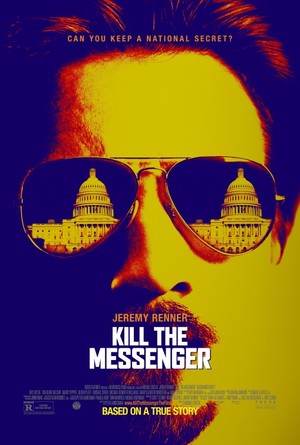
Kill_the_Messenger_poster

Last night, if you were awake and unable to get any sleep at 1:45 in the morning, you could have turned over to Cinemax and watched the 2014 conspiracy thriller, Kill The Messenger.

Kill The Messenger opens with one of those title cards that assures us that the movie we’re about to see is based on a true story.  We are then introduced to Gary Webb (Jeremy Renner), a California-based reporter who we know is a rebel because he has a precisely trimmed goatee.  Gary is interviewing a suspected drug smuggler (Robert Patrick) at the smuggler’s luxurious mansion.  Suddenly, the DEA storms the house, shouting insults and roughly throwing everyone to the ground, including Gary.  It’s actually exciting and promising opening, one that perfectly establishes both Gary as a truth seeker and the U.S. government as an invading army that’s fighting a war that’s full of collateral damage.

Gary, of course, has nothing to do with smuggling drugs.  He was just in the wrong place at the wrong time.  If he was treated unfairly by the DEA, it’s just because the government is serious about winning the war on drugs!

Or is it?

Following up on a tip, Gary comes across evidence that, in order to raise money for pro-Amercian rebels in Central America, the CIA not only helped to smuggle drugs into the U.S. but also arranged for the drugs to largely be sold in poor, minority neighbors where, in theory, no one would notice or care.

When the story is finally published, Gary is briefly a celebrity.  Not surprisingly, the government denies his accusations and start tying to discredit him.  However, Gary also finds himself being targeted by his fellow journalists.  Angry over being outscooped by a relatively unknown reporter, The Los Angeles Times and The Washington Post both launch their own investigations.  Instead of investigating Gary’s allegations, they jealously and viciously investigate Gary himself.

Soon, both Gary’s career and his family are falling apart and Gary finds himself growing more and more paranoid…

Remember when everyone was expecting Kill The Messenger to be a really big deal?  It was due to come out towards the end of 2014, right in the middle of Oscar season.  Jeremy Renner was being talked up as a contender for best actor.  Then the film came out, it played in a handful of theaters for a week or two, and then it sunk into obscurity.  Some commentators even complained that Focus Features buried the release of Kill The Messenger and that the film was ignored because of its leftist politics…

Of course, it’s just as probable that Focus Features realized that The Theory of Everything was more likely to charm audiences than a movie that suggested the U.S. government was behind the drug epidemic.

Or it could have just been that, despite telling a potentially intriguing story, Kill The Messenger was an oddly bland film.  Other than one scene in which he admits to cheating on his wife, Gary Webb is portrayed as being such a saint that it actually causes the film to lose credibility.  (Don’t get me wrong.  For all I know, he was a saint.  But, from a cinematic point of view, sainthood is never compelling.)  This is one of those earnest films that gets so heavy-handed that, even if you agree with what the movie is saying, you still resent being manipulated.  (Of course, some of us have grown so cynical about the media that we automatically doubt the veracity any movie that opens with those dreaded words: “Based on a true story.”)  Watching Kill The Messenger, one gets the feeling that a documentary about Gary Webb would probably be more compelling (and convincing) than a fictionalized dramatization.

(Unfortunately, if you think it’s difficult to get an audience to watch a movie that suggested the U.S. government was behind the drug epidemic, just try to get them to watch a documentary about … well, anything.  I know most of our readers would probably happily watch a documentary but that’s because y’all are the best and a thousand times better than the average person.  Love you!)

Here’s what did work about Kill The Messenger: the performances.  Jeremy Renner, who also produced this film, gives an excellent performance as Gary, especially in the scenes where he realizes that both the government and the press are now conspiring about him.  Rosemarie DeWitt has the traditionally thankless role of being the supportive wife but she still does a good job.  And finally, Ray Liotta shows up for one scene and is absolutely chilling in that way that only Ray Liotta can be.

Kill The Messenger doesn’t quite work but, thanks to the cast, it is, at the very least, a watchable misfire.

Previous Insomnia Files:
  1. Story of Mankind
  2. Stag
  3. Love Is A Gun
  4. Nina Takes A Lover
  5. Black Ice
  6. Frogs For Snakes
  7. Fair Game
  8. From The Hip
  9. Born Killers
  10. Eye For An Eye
  11. Summer Catch
  12. Beyond the Law
  13. Spring Broke
  14. Promise
  15. George Wallace

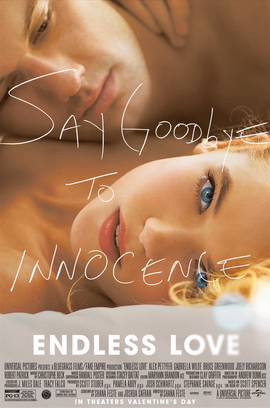
Film Review: Endless Love (dir by Shana Feste)


EDL_31_5_Promo_4C_2F.indd

Oh, what a disappointing film this turned out to be!

When the trailer for Endless Love came out way back in the closing days of 2013, both me and my BFF Evelyn were seriously excited about seeing it.  The trailer was great!  It featured Florence + The Machine!  The movie looked hot and sexy and fun and…

Well, let’s just rewatch the trailer, shall we?

Here’s the thing:  Sometimes, trailers lie.

I saw Endless Love when it was originally released in February but I didn’t review it.  I meant to review it but somehow I never got around to doing so.  And, unfortunately, the film itself was so bland and forgettable that I actually struggled to think of anything to say about it.  Some movies make you laugh.  Some movies make you cry.  Some movies make you mad.  And some movies are just there.

Endless Love is a just there type of movie.

That said, when I saw that Endless Love would be making its cable debut on Cinemax on Saturday night, I decided to give it a second chance.  “Who knows?” I thought to myself, “Maybe I just went into the film with unrealistic expectations.  Maybe I was just in a bitchy mood when I saw it.  Maybe, on a second viewing, I’ll discover that Endless Love works on a purely emotional level…”

No such luck!  Having watched Endless Love a second time, I can now actually remember enough about the film to finally get around to writing a review.  However, I have also now been reminded why I didn’t care much about the film the first time I saw it.

Endless Love is essentially a collection of generically pretty scenes that all feature pretty performers thinking about love, talking about, and making love.  Recent high school graduates David (Alex Pettyfer) and Jade (Gabriella Wilde) start going out.  Jade comes from a wealthy family.  David does not.  Jade’s overly protective father, Hugh (Bruce Greenwood), does not approve of the relationship because Jade has an ivy league future ahead of her while David has no plans to attend college at all.  Jade becomes more rebellious.  David lectures Hugh on the fact that nothing is more important than love.  Hugh takes out a restraining order against David.  Jade goes off to college.  David tries to secretly see her.  And, of course, there’s a fire.

(Though, unlike in the original Endless Love, the fire is not deliberately set.  This is Endless Love  reimagined as a Nicholas Sparks novel.)

And who really cares?

The problem with Endless Love is that we’re supposed to care about David and Jade and we’re supposed love how obsessed they are with each other but David and Jade are two of the most boring people ever so who cares?  Alex Pettyfer is nice to look at.  Gabriella Wilde is pretty.  But, as a couple, they have next to no chemistry.  Instead, they come across like one of those vapid couples that my boyfriend and I always worry we’re going to end up getting trapped in an endless conversation with.

(“How did you two meet?  Wait, before you start — let me tell you how we met… It’s a great story…you guys are going to love this…we were both attending kindergarten on a dance scholarship but the ballet kids all hated the ballroom kids.  Then they moved to Iceland and I asked my dad if we could move to Greenland and then…”)

And again, this just shows the power of a good trailer.  Watching the trailer, you would never guess how boring David and Jade truly are.  Incidentally, the best parts of the trailer are all taken from a “David and Jade dating” montage that occurs about halfway through the film.  As such, the scenes that made me want to see Endless Love pretty much just serve as filler in the actual film.

Also, Florence + The Machine are nowhere to be heard in the actual film.  And their haunting, atmospheric music would have been out of place anyway.  Florence + The Machine embraces the power of ambiguity and Endless Love takes place in a world where there is no ambiguity.

However, there is a lot of blue.

Seriously!  (And yes, I do realize that there’s a typo in my tweet but everyone is allowed to be illiterate on twitter so get off my back.)  This movie opens with a high school graduation where everyone is wearing a blue robe and the entire cast is so oppressively cheerful and overwhelmingly pleasant-looking that I briefly wondered if they were supposed to be a graduating class or a cult.  Later on, David works at a valet at a country club and, of course, he wears a blue shirt.  Everyone who belongs to the club also appears to be wearing a blue shirt, except that it’s a lighter shade of blue than David’s blue.  It’s just odd-looking and reinforces the feeling that Endless Love is less a movie and more a collection of commercial outtakes.

Endless Love, of course, is a remake of a film from the early 80s.  The first Endless Love isn’t very good but it’s at least a lot of unintentional fun!  And you can read my review of it (and even watch the film!) by clicking here.

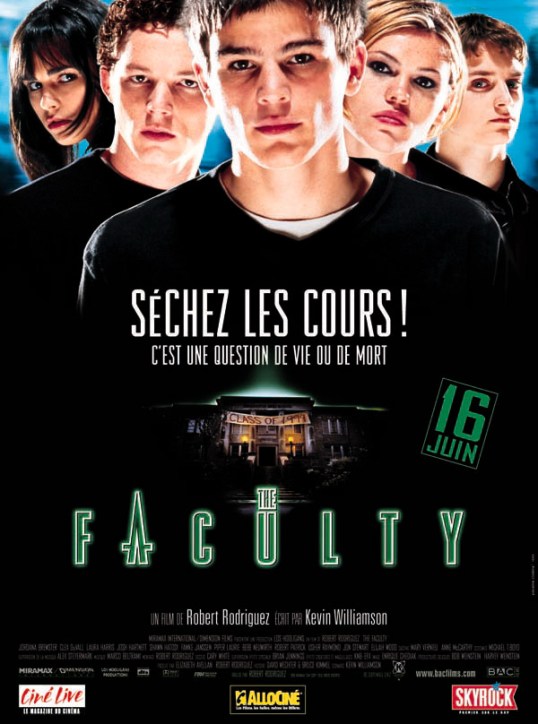
Back to School #52: The Faculty (dir by Robert Rodriguez)


3494-b-the-faculty

Have you ever wanted to see Jon Stewart get stabbed in the eye with a hypodermic needle?

If you answered yes, then 1998’s The Faculty might be the film for you!

The Faculty takes a look at what happens when a new alien species happens to turn up outside of a painfully normal high school in Ohio.  By painfully normal, I mean that Herrington High School is just as messed up as you would expect a suburban high school to be.  The teachers are all underpaid and resentful of their principal (Bebe Neuwrith).  Prof. Furlong (Jon Stewart) is the overqualified science teacher who will perhaps be a little too excited about the chance to examine a new alien species.  Coach Willis (Robert Patrick) is the emotionally shut off coach of the school’s losing football team.  Mrs. Olson (Piper Laurie) is the drama teacher who struggles to promote creativity in a school that’s more interested in blind conformity.  Miss Burke (Famke Janssen) is the teacher who cares too much.  And, finally, there’s Nurse Harper (Salma Hayek), who looks a lot like Salma Hayek.

And, as typical as the teachers may be, the students are even more so.  We get to know a few and they all neatly fit into the expected stereotypes.  Casey (Elijah Wood) is the nerdy outcast who is regularly picked on by … well, by everyone.  Deliliah (Jordana Brewster) is the status-obsessed head cheerleader who has just broken up with her boyfriend, Stan (Shawn Hatosy), because he quit the football team.  Zeke (Josh Hartnett) is the school rebel, the kid who is repeating his senior year and who sells synthetic drugs out of the trunk of his car.  Stokes (Clea DuVall) is an intentional outcast who pretends to be a lesbian and has a crush on Stan.  And finally, there’s Marybeth (Laura Harris), a new transfer student who speaks with a Southern accent.

These students would seem to have nothing in common but they’re going to have to work together because the entire faculty of Herrington High has been taken over by aliens!  Fortunately, the aliens are vulnerable to Zeke’s drugs, which is something that is learned after Jon Stewart takes a hypodermic to the eye…

When one looks over the top Texas filmmakers (director like Terrence Malick, Richard Linklater, Mike Judge, and David Gorden Green), Robert Rodriguez often comes across as being both the most likable and the least interesting.  Like his frequent collaborator Quentin Tarantino, Rodriguez fills his movies with references and homages to other films but, unlike Tarantino, there rarely seems to be much going on behind all of those references.  However, Rodriguez’s referential style works well in The Faculty because, along with acting as an homage to both Invasion of the Body Snatchers and John Carpenter’s The Thing, The Faculty also manages to tap into a universal truth.

Teachers are weird!

Or, at least, they seem weird when you’re a student.  Now that I’m out of high school, I can look back and see that my teachers were actually pretty normal.  They were people who did their jobs and, as much as I like to think that I was everyone’s all-time favorite, I’m sure that there have been other brilliant, asthmatic, redheaded, aspiring ballerinas who have sat in their class.  My teachers spent a lot of time talking about things that I may not have been interested in but that wasn’t because they were obsessed with talking to me about algebra or chemistry or anything like that.  They were just doing their job, just like everyone else does.

But, seriously, when you’re a student, it’s easy to believe that your teachers have been possessed by an alien life form.

Probably the best thing about The Faculty is the fact that the aliens cause the teachers to act in ways that are the exact opposite of their usual personalities.  For most of the teachers, this means that they turn into homicidal lunatics.  But, in the case of Coach Willis, this actually leads to him not only becoming a happy, well-adjusted human being but it also turns him into a good coach.  Suddenly, Willis is getting emotional about the games, his team loves him, and he even gets a win!

Go Coach Willis!

As for the film itself, it’s not bad at all.

Lisa’s rating: 7 out of 10.

Film Review: Gangster Squad (dir by Ruben Fleischer)


Gangster Squad

Do you remember Gangster Squad?

This film, which tells the story of hard-boiled cops and psychotic gangsters in 1940s Los Angeles, was originally meant to be released in September of 2012 but the release date was moved back because the film originally featured a gun battle in a movie theater.  After the real-life movie theater shooting in Aurora, Colorado, that scene was reshot and the release of Gangster Squad was delayed until January of this year.  The critics absolutely hated it, audiences stayed away, and Gangster Squad was the first high-profile flop of 2013.

I was among those who ignored the film when it was first playing at theaters.  After all, it was January and I was more interested in following the Oscar race than going to see a film that, by all accounts, was somewhat terrible.  However, now that Gangster Squad is showing up on a nearly nightly basis on Cinemax, I recently got a chance to see the movie and you know what?

The critics were wrong.

Gangster Squad tells a familiar story.  In fact, the film features not a single character or plot twist that hasn’t shown up in another movie.  The setting is Los Angeles in the 1940s.  Ruthless gangster Mickey Cohen (a totally over-the-top Sean Penn) is the king of the city’s underworld.  How crazy is Mickey Cohen?  He’s so crazy that, when we first see him, he’s watching as another gangster is literally ripped in half.  He’s so crazy that, in the middle of a gun battle, he yells, “Here comes Santy Claus!” as he fires his machine gun.  That’s how crazy Mickey Cohen is.

Sean Penn in Gangster Squad

Seriously crazy.

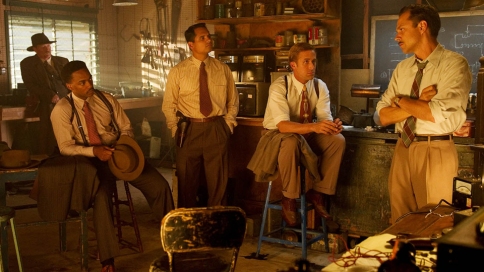
Fortunately, righteous police chief William H. Parker (Nick Nolte) refuses to allow a little thing like due process to keep him from pursuing Mickey.  Parker calls Sgt. John O’Mara (Josh Brolin) to his office and, after delivering a long and flowery monologue that verges on incoherence, he finally explains that O’Mara’s mission is to put together an elite squad of cops and to take Mickey out by any means necessary!  (Usually, I try to exercise some restraint when it comes to punctuation but Gangster Squad is one of those films that demands exclamation points.)

This is followed by a series of properly colorful scenes in which O’Mara recruits his gangster squad.

Jerry Wooters (Ryan Gosling) is a cynical World War II veteran who is, at first, skeptical of O’Mara and his squad.  Wooters, however, changes his mind after a saintly shoeshine boy is gunned down in front of him.  Wooters is also having an affair with Grace Faraday (Emma Stone), who happens to also be Cohen’s girlfriend.

Coleman Harris (Anthony Mackie) is a black cop who is good with a knife and who lost his cousin to the heroin distributed by Cohen’s mob.  Watching the friendly and playful interaction between Harris and all of the film’s white characters provides us with one of our first clues that Gangster Squad is not necessarily aiming to be a historically accurate portrait of America in the 1940s.

Conway Keeler (Giovanni Ribisi) is a wiretapper and a family man.  Keeler’s fate is pretty much sealed the minute that he tells O’Mara that he’s willing to risk death just to make the world a better place for his son.

Max Kennard (Robert Patrick) is a former old west gunslinger who now spends his time killing gangsters.  Max, we’re told, may be old but he’s also personally shot over a 100 gangsters.  Max also has a younger partner, an honest cop named Navidad Ramirez (Michael Pena).

GANGSTER SQUAD

The Gangster Squad

As you can probably guess at this point, there’s not a single cliché that is not employed by Gangster Squad.  However, and this is what I think several critics missed, the film deliberately takes its clichés to such an extreme that they go from being flaws to being strengths.  By so enthusiastically going overboard in its embrace of the conventions of the gangster film genre and, at the same time, acknowledging the fact that the audience is also familiar with those clichés, Gangster Squad creates its own vibrant and compulsively watchable fantasy world.  The world of Gangster Squad has little to do with any sort of historical reality.  Instead, it’s a  world constructed solely out of other gangster movies.

Taking all of this (and the fact that the film is directed by Ruben Fleischer of Zomieland and 30 Minutes or Less fame) into consideration, it’s pretty obvious that Gangster Squad is not a film that’s meant to be taken seriously.  And yet, that’s what so many critics did when the film was first released in January.  Instead of appreciating the film for paying over-the-top homage to the gangster films of the past, critics attacked it for being an example of style over substance.

And, to give the critics their due, they were exactly right.  There is no substance to Gangster Squad.  Instead, the film is a total celebration of style.

And what style!  In Fleischer’s hands, 1940s Los Angeles is a colorful wonderland of pure excess, a vibrant landscape of dark alleys and swanky nightclubs that literally glow on-screen and are populated by tough men and sultry women in clothing that might not have been found hanging in every closet in the 40s but should have been.  (Seriously, when Emma Stone first appears on-screen, she’s wearing a red gown that is simply to die for.)

This Christmas, I want both Ryan Gosling and the dress.

This Christmas, I want both Ryan Gosling and the dress.

For the viewer who is willing to give themselves over to the film’s over-the-top aesthetic and are willing to appreciate it for what it is (as opposed to condemning it for what it isn’t), Gangster Squad is a watchable, entertaining, and fun movie.  And what’s so bad about that?

I’m glad that I finally got a chance to see Gangster Squad.  Is it one of the great gangster films?  No.  The great gangster films have both style and substance but, quite frankly, if I can only have one than I would prefer something stylish and fun like Gangster Squad to something like Killing Them Softly.

(Then again, I would prefer just about anything to sitting through Killing Them Softly for a second time.)

So, enjoy Gangster Squad.  Watch it for the style.  Have fun.  And most importantly, remember that critics are as often wrong as they are right.

Emma Stone in Gangster Squad

Film Review: Lovelace (dir by Rob Epstein and Jeffrey Friedman)


About halfway through the new biopic Lovelace, there’s a scene where former porno actress Linda Lovelace (played by Amanda Seyfried) is hooked up to a lie detector.  The polygraph examiner explains that he’s going to ask Linda a few test questions to get a reading.

“Is your name Linda Lovelace?” he asks.

Visibly nervous, Linda replies, “Can you ask something simpler?”

It’s a great scene because it establishes the central mystery of both the film and the title character.

Just who exactly was Linda Lovelace?

A girl whose main talent was apparently giving head, Lovelace became a star in the 70s when she starred in Deep Throat, the first (and perhaps only) hardcore film to become a legitimate mainstream hit.  For a brief while, Lovelace was the face of the American sex industry.  However, her attempts to have a mainstream film career failed and Lovelace retreated into obscurity.

Several years later, she wrote a book called Ordeal.  In Ordeal, Lovelace claimed that she was forced, by her abusive husband, to perform in Deep Throat.  Whereas Lovelace, during her brief stardom, originally claimed to simply be a sexual adventurer who performed on camera because it was liberating, the post-stardom Lovelace presented herself as being a brainwashed victim.  Or, as Lovelace herself put it, “When you watch Deep Throat, you’re watching me getting raped.”  While several people disputed the authenticity of Ordeal, Lovelace herself passed a polygraph examination.  Lovelace then became an anti-pornography activist before, once again, descending into obscurity and eventually dying in an automotive accident in 2002.

Lovelace deals with the issue of figuring out just who Linda Lovelace was by basically telling her story twice.

During the first 45 minutes of the film, we see how young Linda Boreman first meets Chuck Traynor (Peter Sarsgaard).  Everything about Chuck — from his mustache to his perm to his flashy clothes — practically screams sleaze but, since he’s played by Peter Sarsgaard, he also has an undeniable charm.  (With this film and An Education, Sarsgaard has proven himself to be the definitive older man who your parents warned you about.)  Chuck and Linda eventually marry and, when they need money, Linda turns to “acting” in order to pay the bills.

Under the watchful eye of producers Bobby Cannavale and Chris Noth, director Hank Azaria, and co-star Adam Brody, Linda stars in Deep Throat and becomes the face of the sexual revolution.  While there are occasional hints that things might not be perfect (bruises are often visible on Linda’s arms and legs), Linda seems to truly love the spotlight.  Even Hugh Hefner (played by James Franco, who is way too hot to only have a cameo) says she’s going to be a huge star.

And then, rather abruptly, we jump forward six years.  Linda is now writing Ordeal and we once again see how she first married Chuck Traynor, starred in Deep Throat, and came to be a star..  However, we now see the story through her eyes.  We see that Chuck wasn’t just controlling but that he was also an abusive psychopath who would hold a gun to her head in order to get a performance out of her.  We see that, during the shooting of Deep Throat, she was regularly beaten by her husband.  We see Linda attempting to reconnect with her strict and tradition parents (played by Sharon Stone and Robert Patrick).  We see the ugliness that was hidden underneath the glamour.

Considering the subject matter and the talent involved, Lovelace should have been one of the most interesting films of 2013 but, unfortunately, the two separate halves of the film just don’t come together.  While the first half of the film does a good job of capturing the absurdity of sudden fame, the second half of the film falls apart.

Oddly enough, Chuck Traynor and Linda Lovelace only come across as real human beings during the superficial first half of the film.  During the second half of the film, both Chuck and Linda come across as one-dimensional ciphers.  Linda becomes such a total victim and Chuck becomes such a melodramatic villain that neither one of them is all that compelling as a character.  Instead of being disturbing and revealing, the second half of the film just feels like another generic film about the price of fame.

Most of what I know about Linda Lovelace and Chuck Traynor comes from two sources — the 2005 documentary Inside Deep Throat and Legs McNiel’s and Jennifer Osborne’s book The Other Hollywood.  In both the book and the documentary, Lovelace comes across as being a rather pathetic figure who was exploited by both the adult film industry and the anti-pornography activists who used her as a symbol.  Both the industry and the activists abandoned Linda once her novelty was gone.  Ironically, even though both the documentary and the book are rather critical of her, it is there that she comes across as a far more interesting, sympathetic, and ultimately tragic figure than she does in this biopic.

With all that in mind, Lovelace is not necessarily a failure as a film.  The 70s are convincingly recreated and there’s a few scenes that hint at the type of film that this could have been if the filmmakers had been willing to take a few more risks.

The film is also full of excellent performances.  Seyfried is sympathetic and believable as Linda and, up until the second half of the film requires him to abandon all shades of ambiguity, Sarsgaard perfectly captures the sleazy charm that someone like Chuck Traynor would need to survive.  As Linda’s strict mother, Sharon Stone  is surprisingly strong.  Just watch the scene where Linda’s mom explains to her that she has to go back to abusive husband because that’s what marriage is all about and you’ll see an example of great acting.  Even better is Robert Patrick, who brings a poignant sadness to the role of Linda’s father.  The scene where he tells Linda that he saw her on film is heartbreaking.

Lovelace is a film of hits and misses.  Sadly, it misses the big picture but a few individual parts and performances are strong enough to justify sacrificing spending 93 minutes to watch it.

Review: True Blood 6.8 “Dead Meat”


True Blood

If nothing else, this episode will always be remembered for confirming what all of us ladies already knew.  High heels are murder!

Seriously, if you had any doubts about whether or not Sarah Newlin (played, with manic glee, by Anna Camp) truly was batshit crazy, all you had to do was watch tonight’s episode.

First off, she’s refusing to tell anyone that Gov. Burrell is dead and it wouldn’t surprise me if she’s got his severed head in the trunk of her car.

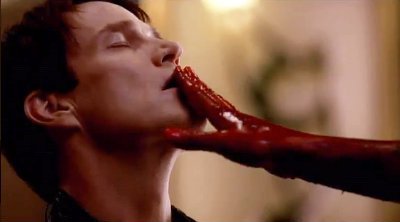
Secondly, when Mrs. Suzuki came by Vamp Camp to check out what was going on with the Tru Blood production, Sarah ended up chasing her through the prison.  Now, I’ve seen enough horror movies to know that it is next to impossible to successfully run away from a crazed maniac while wearing high heels.  That still doesn’t stop Mrs. Suzuki from trying but, once she ends up tripping on a steel grating, Sarah proceeds to beat her to death with one of her own high heels.  Underneath the grating, a grateful group of male vampires feast on Suzuki’s blood.  “Thank you, Jesus!” an orgasmic Sarah proclaims.

This macabre chase scene — coming towards the end of tonight’s episode — perfectly sums up season 6 of True Blood.  It was over the top, silly, melodramatic, vaguely sordid, and yet definitely effective.

Mrs. Suzuki was murdered to prevent her from telling the FDA about Sarah’s plan to give all the vampires Tru Blood that’s been spiked with Hep V.  The first batch of infected Tru Blood was given to the prisoners during tonight’s episode.  James, the hot new vampire who Jessica is now in love with, warned the Rev. Newlin not to drink the infected blood.  This led to Sarah demanding to know why Newlin was refusing to drink the blood.  Since Newlin is a weasel, he quickly revealed the names of every vampire who knows the truth about the new Tru Blood.

As a result, Newlin, James, Pam, Tara, Willa, and Jessica all found themselves in that white death chamber that Bill keeps seeing in his visions of the future.  As Jessica quickly figures out, this is where they’re going to stay until the sun rises, the ceiling opens up, and they’re all burned to death.

Bill, however, has a plan.  As he tells Sookie, he wants to allow all the vampires at Vamp Camp to drink Warlow’s blood so that they can be immune to the sunlight.  Warlow tells Sookie that he’ll only do it if Sookie agrees to be “his.”  So, once again, the future of the vampires pretty much depends upon Sookie surrendering any shred of independence from the whims and needs of the men in her life.

So, as must happen at least once during every season of True Blood, Sookie prepared to sacrifice herself.  She took Bill to the faerie dimension so that she could give herself over to Warlow and then Warlow could give himself over to Bill.  However, as soon as she and Bill arrived, they discovered that Eric had gotten there first and had already drained Warlow.

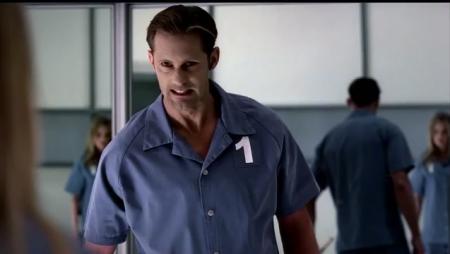
And that, quite simply, is why I love Eric.  While everyone else talks and broods, Eric gets stuff done.

Finally, in case you were wondering how long it would take Sam to get over Luna, the answer is eight episodes.  Sam returned to Bon Temps for Terry’s funeral and, upon arrival, he discovered that Alcide had rescued Nicole from the werewolves (and, in the process, had surrendered the title of pack leader to Rikki).  Sam discovered that Nicole’s pregnant and, within a few scenes, the two of them were declaring their love for each other.  Nicole is a boring character and werewolf politics tend to put me to sleep unless they involve Alcide getting naked.  Since Alcide kept his clothes on tonight, I have to admit that I pretty much zoned during the majority of the Sam/Nicole/Alcide scenes.

But no matter!  Between Sookie preparing (yet again) to sacrifice herself and Sarah getting crazier by the minute, tonight’s episode was a lot of fun.  I assume that Eric is now heading towards the Vamp Camp and I can’t wait to see what happens once he arrives.

Random Thoughts and Observations:

  • Tonight’s unofficial scene count: 48
  • I always enjoy it when Bill and Eric get to argue.  Alexander Skarsgard and Stephen Moyer really throw themselves into those scenes.
  • Nora may be dead by Lucy Griffiths — much like Arliss Howard and Todd Lowe — is still listed in the opening credits.
  • Rev. Newlin seemed to have a thing for people who have had sex with Jessica.
  • I was a little surprised that Alcide didn’t know who Terry was.
  • I’m proud to say that, in last week’s review, I totally guessed Bill’s plan for Warlow’s blood.
  • “Mother, I can fly!”
  • “The only way he’ll agree to help you is if I agree to become his faerie vampire bride!  So there!”
  • “How about that, you motherfucking monster!?”
  • “I’m trying to decide if I’ll be more uncomfortable in here or out there!”
  • “Sarah Newlin!?”  “Don’t tell me you’re a fan!”

Review: True Blood 6.7 “In The Evening”


Bill_embraces_lilith

Poor Eric!

Going into tonight’s episode of True Blood, I knew that another major character was expected to die but I was really hoping that it wouldn’t be Nora.  Not only did I feel that the character (and Lucy Griffiths) has never quite been used to her potential (not an uncommon occurrence on a show that has a huge ensemble, like True Blood) but it also seems like Eric is always losing the vampires who are most important to him.

However, I also knew that, story-wise, Nora had to die if just so we could understand how dangerous Hep-V truly is.

And so, after bringing Nora to Bill’s mansion and even going so far as to pray for her recovery, Eric ended up holding Nora while she literally melted in his arms.  Adding to the pathos of the situation, we were treated to a flashback to 1666 where we saw how Eric originally turned Nora into a vampire in order to save her from falling victim to the Great Plague.

It was a highly effective moment in an otherwise average episode of True Blood.  If the show often struggled to figure out what exactly to do with Nora, it at least allowed her to make a powerful exit.

Tonight’s episode was all about death.  While Eric watched Nora die, the rest of Bon Temps struggled to deal with the demise of Terry.  Sookie abandoned the post-coital bliss of Warlow so that she could comfort the grief-stricken (and quite drunk) Arlene.

Sookie’s return allowed Bill to track her down and, in a wonderfully tense scene that was very well-acted by real-life husband and wife Anna Paquin and Stephen Moyer, Bill told Sookie that if she doesn’t lead Bill to Warlow than all the other vampires will die.  I imagine that Bill’s plan is for all the other vampires to drink Warlow’s blood.  Once they, like Bill, are immune to the sunlight, the LAVDF will no longer be able to burn all the vampires to death.

Back at Vamp Camp, Jessica, Pam, and WIlla are aware that the new tru blood is tainted with Hep-V but, as Pam explained, they can’t say anything because, if all the vampires refuse to drink the tru blood, then the authorities will know that the secret is out.  That said, Jessica still asked Jason to arrange a meeting between her and the surprisingly sensitive vampire James (Jake Grimes).   Jessica informed James about the tainted tru blood and then proceeded to lose her vampire virginity to him.  And good for her because James is seriously superhot!

Meanwhile, Sarah Newlin discovered the massacre at the Governor’s mansion and, after kissing the Governor’s severed head, she took command of his plan to destroy all of the vampires.  She returned to the Vamp Camp where she tracked down Jason, cut his wrist, and then tossed him into a cell full of female vampires.  Tara jumped up to defend him but then, a vampire named Violet announced that Jason was hers.

FInally, Sam found out about Terry’s death and is now planning on returning to Bon Temps, despite the fact that he promised Alcide that he wouldn’t.  Alcide, it turns out, lied to the rest of the pack and told them that he had killed both Sam and Nicole.  As tonight’s episode ended, Alcide discovered that Nicole and her mother had been captured by the pack and his lie had been exposed…

(Seriously, I can understand why Alcide didn’t want to be packmaster.  The werewolves are way too much drama!)

As I said, this was an average episode of True Blood.  It featured a few memorable moments (Nora’s death, Arlene getting drunk, and the James/Jessica sex scene) but, for the most part, it felt like the main purpose of this episode was to set things up for the season finale.  There’s only 3 more episodes left before the end of season 6 and there are rumors that at least one more major character might be leaving before the end of the season.

Here’s hoping it’s not Eric!

Random Thoughts and Observations:

  • Tonight’s unofficial scene count: 49
  • I noticed that Todd Lowe is still listed in the opening credits.  Was Arliss Howard listed as well?
  • Willa really does look a lot like Nora.   It’s a bit distracting.
  • In my notes, I wrote: “Ewwwwwww!” when Sarah Newlin kissed the Governor’s head.
  • The attempts to provide therapy for the vampires are a pretty obvious comment on the whole “ex-gay” movement.
  • Alexander Skarsgard made me cry tonight.
  • During tonight’s show, I tweeted the following: “When Sheriff Andy is the voice of reason, you know bad things are going to happen in Bon Temps. #TrueBlood”  As of this writing, it’s been retweeted 77 times and favorited by 52 people.  That’s a personal best for me so yay!
  • “How deep do you want to go?”

Review: True Blood 6.6 “Don’t You Feel Me”


450x254xtrue-blood-promo-dont-you-feel-me_450x254.jpg.pagespeed.ic.APWbfzSQrC

Before I review tonight’s episode of True Blood, I have to apologize for not reviewing last week’s episode.  For the past six months, I have been basically working, writing, and dancing nonstop and last week, it finally caught up with me and I nearly collapsed from exhaustion.  I’m still in the process of recovering but hopefully, I’ll be more active this week than last week.

Going into tonight’s episode, I knew that there had been a lot of speculation online about the possibility of one or more major characters dying.  A lot of people though that it might be Lafayette, especially since he was in the process of trying to drown Sookie when last week’s episode ended.  Some people thought Alcide would kill Sam and still others insisted on breaking my heart by speculating that Eric might experience the true death.

Instead, it turned out to be Terry.  That’s right.  After spending all of last season dealing with that stupid Iraqi fire demon and then spending most of this season feeling guilty for having murdered his friend Patrick, Terry appeared to have finally found some peace tonight.  Arlene and Holly recruited a vampire to erase Terry’s memory (which is really what they should have done in the first place) and Terry was cheerfully taking out the trash when his friends kept their promise to him and shot him in the neck.  Arlene rushed outside and held Terry as he died, no longer aware of why he had asked to be killed in the first place.

To a certain extent, Terry’s death was not that surprising.  If there was any major character that True Blood could afford to lose, it was Terry.  And, hopefully, his death will mean we won’t ever have to hear about that Iraqi fire demon ever again.  However, even if it wasn’t totally unexpected, it was still a perfect example of how True Blood, at its best, can so gracefully walk across the thin line between heartfelt melodrama and over-the-top satire.  We all knew that Terry was doomed as soon as he told Arlene that he had never been happier but the scene worked because both Todd Lowe and Carrie Preston gave such heartfelt performances in the roles of Terry and Arlene.  Even if there was little left for the show to do with Terry as a character, I will still miss Todd Lowe’s likable presence.

However, Terry was not the only character to meet an abrupt end tonight.  After putting himself into a coma and having a typically cryptic meeting with Lilith, Bill drank a vial of Warlow’s blood.  Now even more powerful than before, Bill confronted Governor Burrell and demanded to know why he had been having visions of all of the vampires being burned to death in a white room.  When Burrell didn’t answer quickly enough, Bill responded by ripping the Governor’s head off of his body.  And while Burrell certainly deserved the punishment, I doubt that’s going to do much to help human/vampire relations.

Governor Burrell was played by Arliss Howard and, in just six episodes, Howard had transformed Burrell from simply being a standard evil politician to being one of the best villains in the history of True Blood.  While I knew that Burrell was too evil to eventually not suffer some sort of violent death, I was surprised that it occurred at the mid-point of this season as opposed to the end of it.  I have a feeling that Sarah Newlin will take his place as the main human villain and I’m sure that Anna Camp is more than up to the job but I’m still going to miss Arliss Howard’s brand of evil.

Meanwhile, Sookie continues to consistently make the worst choices in men.  After Warlow saved Sookie from being drowned by the possessed Lafayette, Sookie took Warlow to a fairy dimension where, after she tied him up to keep him from losing control, she proceeded to let him feed on her and then did the same to him.  As they made love, their respective lights glowed together and it would have been a beautiful image if not for the fact that we know that the only Sookie gave herself over to Warlow was because Bill’s found religion, Eric’s prison, and Alcide’s off searching for Sam.

As for Eric, after he and Pam refuses to fight to death gladiator-style, Gov. Burrell forced him to watch as Nora was injected with some sort of vampire virus known as Hep V.  Then, like a typical short-sighted villain, Burrell left before Nora actually died.  While Burrell was busy having his head ripped off, Eric was summoning Willa and getting her to free both him and Nora.  Disguised as a guard, Eric discovered that the all of the new Tru Blood is being spiked with Hep V.

Jessica is also in the prison.  Sarah Newlin attempted to force her to have sex with a new vampires named James.  I don’t know if we’ll ever see James again but I hope that we do because, seriously, he’s really hot and, as opposed to every other male character on this show, he actually seems to respect women.

Meanwhile, Jason has infiltrated the LAVPD.  I just loved Ryan Kwanten’s performance tonight as he attempted to out-fascist the fascists.

Finally, Sam and Nicole … wow.  Just typing the words “Sam and Nicole” makes me want to close my eyes and go to sleep.  Seriously, I love Sam and all but he doesn’t need to be running around with a new girlfriend when Luna hasn’t even been dead for more than a week.  Anyway, Sam ended up giving Emma back to Martha and Alcide allowed Sam and Nicole to leave town but told them that if they ever returned, they would be killed by the pack.

Tonight’s episode pretty much epitomized everything that I love about True Blood.  It was over-the-top and melodramatic but, if you weren’t touched by Arlene singing as Terry died, then you just don’t have a heart.  That was True Blood at its best.

Finally, the Emmy nominations were announced last Thursday and, not surprisingly, both the Walking Dead and True Blood were pretty much ignored.  (Instead, space was made to honor the predictable political blathering of House of Cards because I guess the Emmy voters love to feel smart without actually being challenged.)  The lack of respect for televised horror ultimately say nothing about the quality of shows like True Blood and everything about the lack of guts on the part of the Academy of Television Arts and Sciences.

What’s important is that we, the viewers, know what the best shows on television truly are.

Random Thoughts and Observations:

  • Tonight’s unofficial scene count: 42
  • Before I watched True Blood, I had to sit through a  commercial for the Newsroom.  I was just like, “Oh yay!  A chance to relive Occupy Wall Street!”  BLEH!
  • Can Lafayette ever go for two episodes without getting possessed?
  • I want to do bad thing with you, Eric.
  • I love that Jason responds to his name by saying, “The one and only.”
  • That was a sweet scene between Andy and his last remaining faerie daughter.  I would have named her Bernadette, after the patron saint of asthma sufferers.  (I’ve been praying to Bernadette a lot this past week…)
  • Arliss Howard made a wonderfully hissable villain.
  • “I just think we have the type of friendship where we  can give each other keys!”
  • “I love you, brother.”  “I love you, sister.” *Sob*

Review: True Blood 6.2 “The Sun” (dir by Daniel Attias)


1371435960_6152_1

After last week’s anemic season premiere, I have to admit that I was a bit worried about the direction of season 6 of True Blood.  I watched that episode and I thought to myself, “I don’t want to have to spend an entire season with Bill acting weird, Eric not having sex with Sookie, and Jason chasing around Rutger Hauer.”

What a difference a week can make!

Tonight’s episode was a return to form for True Blood.  Tonight’s episode reminded me of what made me fall in love with this show in the first place.  In short, tonight’s episode was True Blood the way I wanted it to be.

It helps that this episode featured a lot of Eric acting like Eric.  But I’ll get to that in a minute.

First off, tonight’s biggest revelation was that, despite what he said last week, Rutger Hauer is not Warlow.  Instead, he’s Sookie and Jason’s faerie grandfather and he’s specifically come to help Sookie defeat Warlow.

And I have to say that this is brilliant casting.  We, as viewers, have been so conditioned to automatically view Rutger Hauer as a villain that it’s actually surprisingly refreshing to see him playing a good guy and Hauer seems to be having a lot of fun with the role.

Anyway, Grandpa explains to Sookie and Jason that Warlow is obsessed with the Stackhouse family, specifically because the Stackhouses are actual royalty (making Sookie into a literal faerie princess).  However, Grandpa explains, Sookie can defeat Warlow by harnessing all of her light and literally going supernova.  The only side effect is that Sookie can only do this once and she’ll no longer be a faerie after doing so.  Sookie, who spent most of last season trying to deplete all of her power, immediately starts practicing harnessing her light.

And that’s probably a good idea because Warlow is already in Bon Temps.

Speaking of Sookie, before she meets her grandfather, she meets another faerie.  This one is named Ben (Rob Kazinsky) and when Sookie comes across him, he’s lying on the ground after being attacked by vampires.  Sookie nurses him back to health and it becomes obvious that the two of them are attracted to each other.  I have to admit that I groaned a little when Ben showed up.  It’s not that Rob Kazinsky isn’t cute, because he is.  And it’s not that he and Anna Paquin don’t have a lot of chemistry because they do.  However, Ben is not Eric.  For that matter, he’s not even Bill.

Speaking of Bill, he began tonight by going into a catatonic state and he remained that way for most of the episode, despite the best efforts of Jessica to wake him up.  At one point, Jessica even brought in a hilariously trashy prostitute named Veronica so that Bill could feed.  Even in his catatonic state, Bill still ended up graphically drawing out every drop of blood from her body.

While catatonic, Bill has a vision where he stands in the middle of sun-drenched field and talks to Lillith.  Lillith explains that Bill’s purpose is to save all the vampires from destruction.  The scenes between Bill and Lillith were perfectly filmed and acted, with an obvious emphasis being put on the fact that the bright sun was effecting Bill and Lillith not at all.  When Bill finally does wake up, he tells Jessica that he can now see the future.

And what is that future?

Every vampire in Bon Temps being herded into a stark, white room where, once the roof opens up, they are all burned to death by the sun.

Meanwhile, Eric has also taken it upon himself to try to prevent the future that Bill has seen.  Eric sneaks into the Governor’s mansion, confronts the governor, and attempts to hypnotize him.  The Governor (and have I mentioned how much I love Arliss Howard’s villainous performance) responds by laughing.  It turns out that the Governor is wearing special contact lenses that make it impossible for him to be hypnotized.

After managing to escape the Governor’s armed guards, Eric tracks down the Governor’s daughter, Wilma.  In a nicely gothic touch, Wilma looks out her bedroom window and sees Eric floating outside her window.  Eric asks for permission to enter and she gives it.

And seriously, who wouldn’t?

I got so caught up with the vampires tonight that I nearly forgot that some pretty important things happened to Sam as well.  I always feel bad for Sam because he literally cannot catch a break and tonight was not any different.  First off, he found himself being harassed by Nicole, a political activist from L.A. who wants Sam to come out publicly as a shape shifter.  (I have to admit that I have a sinking feeling that, with Luna dead, Nicole is going to become Sam’s new love interest.  I’m not looking forward to this development because Nicole is kind of self-righteous and annoying.)  Then, Sam ended up getting beaten up by Alcide, who has taken it upon himself to make sure that Emma is raised among the werewolves.

Seriously — bad Alcide!

I loved tonight’s episode.  If last week’s premiere felt like True Blood fan fiction, The Sun felt like true True Blood.  Hopefully, the rest of Season 6 will follow its example.

Random Thoughts and Observations:

  • Unofficial Scene Count: 53
  • That precredits sequence with Warlow appearing on the bridge was pretty effective, I thought.
  • Rutger Hauer deserves an Emmy for his delivery of the line “I am your fucking faerie grandfather.”
  • Alexander Skargard is so hot and sexy!  Oh.  My.  God.
  • The sudden appearance of Patrick’s wife reminded me of how much I disliked last season’s Iraqi smoke monster subplot.
  • I’m sure that the writers of True Blood meant for the Governor to come across as some sort of right-wing boogeyman but, to be honest, he reminds me more of our current President.
  • I love the way Jason got so excited when he said, “That makes me a faerie prince!”
  • It’s interesting to note that both True Blood and the Walking Dead feature a villain called “The Governor.”
  • “They attacked the Chuck E. Cheese yesterday.”
  • “You’re not going to read me my rights?” “You don’t have no rights, vampire.” “Well, that’s not nice.”
  • The performers on True Blood never get enough credit.  Tonight’s standout was Deborah Ann Woll.  Jessica’s episode ending prayer is definitely the highlight of the season so far.

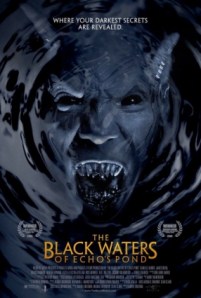
Review: The Black Waters Of Echo’s Pond (dir. by Gabriel Bolongna)


I’m going to start this review with a disclaimer.  Yesterday, I nearly died trying to see this movie.  As I was driving to the theater, I nearly collided with another car.  One of us (okay, it me) wasn’t paying attention and ran a stop sign.  We handled the near accident with the usual mix of car horns and profanity and, my heart still racing, I drove on to the theater and saw The Black Waters of Echo’s Pond.

As a result of my near death experience, I sat through this movie with one thought in my head: was seeing it worth losing my life?  While there are some movies (Suspiria, Beyond the Darkness, Zombi 2, and the Living Dead Girl, for example) that I would happily sacrifice a few years in order to see on the big screen, Black Waters is not one of them.

The film actually starts out well with a 9-minute prologue.  An archeological expedition in Turkey discovers an ancient tomb.  Inside the tomb, they find a map that is somehow linked to the Greek God Pan.  For nine minutes, we’re treated to clunky exposition (“Why, it’s what we’ve been here looking for!”  “Professor, do you mean that it’s the ancient map of Pan’s Arcadia?”  “Yes, the same Pan who was the Greek God of fertility and…”) and it seems like this movie might actually turn out to be a fun, cheerfully stupid take on the old Mummy movies that Hammer Studios released in the late 60s.

No such luck.  All the members of the expedition are promptly killed off-screen.  We jump forward to the “present day” and the entire movie quickly goes downhill.

In the present day, nine college friends get together to spend a weekend in an isolated mansion on an even more isolated island.  Why they would want to do this is never really addressed nor do you ever believe that any of the characters have a shared history or would actually be friends if not for the fact that the film demands it.  While there are some talented actors in the cast, they have absolutely no chemistry when they’re on screen together.  Since the rest of the film is pretty much dependent upon us believing that these people are all old friends, this lack of chemistry pretty much dooms the entire movie. 

(Add to that, the men in this group all appear to be having the worst bad hair day in recorded history.)

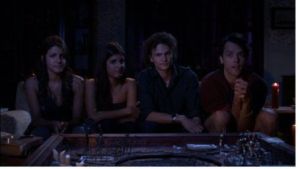
Once they’re in the mansion, the power promptly dies.  While attempting to find a fuse box, one of the friends instead discovers a board game.  Our group proceeds to play the game and soon, they’re seeing visions of murder, illicit sexual activity, and a big-horned demon.  However, none of them find this to be all that curious because they are 1) stoned and 2) incredibly stupid.

As I watched them play this cursed Jumanji death game, I found myself wondering if nobody in this film had ever seen a horror movie before.  Surely, if they had, they would realize that getting together in an isolated location, joking about sex, smoking weed, and then playing with the mysterious game that was previously walled up in the cellar is a good way to guarantee that you’re not going to be alive in the morning. 

To a certain extent, you have to be willing accept a lot of stupidity on the part of the characters in a horror film.  After all, we all know that our poor victims are always going to end up running up a flight of stairs in order to escape the killer (as opposed to going out the front door) and we forgive them for that because we know that if their actions were logical, then there would not be a movie.  However, the victims of the Black Waters of Echo’s Pond simply require us to forgive too much. 

Anyway, the game quickly starts to get weird as everyone draws cards that require them to answer increasingly personal questions.  Old resentments boil up to the surface.  One guy admits to wanting to have sex with both his girlfriend and her sister while the token responsible girl finds herself compelled to flirt with the token slut.  All of this goes on until finally, one member of the group snaps and, while everyone else is busy getting it on, proceeds to cut his best friend in half with a chainsaw.  (And no, nobody in the house hears the screams or the chainsaw because, as I mentioned earlier, they’re all incredibly stupid.)

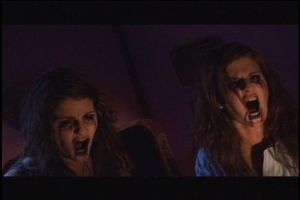
Once that first murder is committed, everyone is soon trying to kill everyone else.  In this regard the film is remarkably similar to Mario Bava’s classic Bay of Blood (a.k.a. Twitch of the Death Nerve).  However, the constant carnage in the Bava film worked because Bava made it clear that his many murderers were all working independently from each other with just their own greed to motivate them.  Whereas in Black Waters, it is made clear from the start that everyone has been possessed by Pan.  In short, the murders have nothing to do with the people being killed or those who do the killing.  And while the murders are nicely brutal and bloody (I hate bloodless horror films), they don’t have any meaning beyond the mechanics of the film.

Pan (or at least I assume that its meant to Pan because it looks more like a Minotaur than anything else) shows up fairly early in the movie and he is an impressive creature with a goat’s head that features glowing eyes and long, dirty talons at the end of his fingers.  Still, I think it was a mistake on the part of the filmmaker’s to reveal him as early (and as often) as the film does.  Once Pan shows up, the movie loses all of its mystery.  We now know, for sure, that all the ensuing mayhem is the result of Pan’s supernatural malevolence.  By revealing Pan as early as it does, the film sacrifices whatever chance it may have had to be truly scary.  Instead Pan, just becomes another faceless killer and the movie, which has been advertised as a “psychological thriller,” loses its edge.

Outside of Pan, the cast is largely forgettable and they’re certainly not helped by how unlikable the majority of the characters are.  A few members of the cast do occasionally manage to offer up a few good (or, at least, memorable) moments but their efforts are sabotaged by some of the most leaden dialogue I’ve ever heard.  (It’s not a good sign that the film feels like it was dubbed into English even though it’s not.) 

The Babysitter twins from the Planet Terror segment of Grindhouse show up for instance and, even though their characters are wildly inconsistent, they both bring a lot of energy to their roles.  Incidentally, one of them gets the worst the line of the dialogue in the entire film when she says, “Shakespeare is Shakespeare!  B-movies are porn!”

Robert Patrick plays Pete, the grizzled old-timer who gets to do the whole “Some people say the killer is still out there…” thing.  It’s not much of a role but Patrick has fun with it.

Speaking of horror film tropes, Mircea Monroe plays Veronique, the token slut.  From the minute she shows up on-screen, you know she’s doomed because she’s flirtatious, openly bisexual, and likes to show off her boobs.  (Come to think of it, if I ever find myself in a slasher film, I am fucked!)  It’s a thankless role but Monroe does her best with it and actually give Veronique a personality that goes beyond the puritan stereotype of the slasher film slut.  Her best scene is her last.  The look of mournful resignation on her face make her final fate rather sad and suggests the type of film that Black Waters could have been.

The two nominal leads are played Danielle Harris and James Duval and they both occasionally manage to transcend the shallowness of their roles.  Harris, of course, is a horror film veteran who could play her role in her sleep.  To her credit, she doesn’t.  James Duval is best known for playing Frank the Bunny in Donnie Darko.  Here, he plays ne’er-do-well Rick.  If for no other reason, the movie is worth seeing just for the way Duval delivers the line “Shit!  We’re fucked!”  It’s a line that he repeats several times and he says it with just the right combination of genuine frustration and stoner pathos.

In many ways, Black Waters On Echo’s Pond feels a lot like one Lucio Fulci’s post-Manhattan Baby efforts.  You have no doubt that the movie was made by talented people and you keep wanting it to be better than it actually is.  You find yourself clinging onto the few isolated moments that are actually effective and hoping that maybe they’ll carry you to the light at the end of the tunnel.  Unfortunately, by the end of the movie, you realize that the light was actually the train that’s just bisected you because you were too stupid to jump off the tracks.

Ultimately, the main problem with The Black Waters of Echo’s Pond is that it just is not a scary movie.  I can usually forgive a lot from a horror movie as long as there’s a handful of shocking “jump” moments.  Unfortunately, Black Waters doesn’t feature a single one.  While the gore effects are occasionally impressive, it takes more than blood to make a horror movie.  All the material was there for this to be a fun little B-movie (and not a porno, regardless of what that Babysitter Twin claims) but it just doesn’t happen.

I recently posted some of my feelings about this film over on a message board.  I quickly received a reply from a gentleman who disagreed with me.  He informed me that not only did I not have the slightest idea how difficult it is to make a movie but by criticizing this film, I was failing to support “independent film.”  “Why don’t you just go spend more of your money on Avatar again?” he asked.  Well, for the record, I hated Avatar and I do support independent film.  Just because this movie was made outside of the studios, that doesn’t make it a good film.  If you want to see a good, independent horror and/or fantasy film, go track down Baghead or Primer.  Leave the Black Waters of Echo’s Pond undisturbed.