Late Night Retro Television Review: CHiPs 6.1 “Meet The New Guy”


Welcome to Late Night Retro Television Reviews, a feature where we review some of our favorite and least favorite shows of the past!  On Mondays, I will be reviewing CHiPs, which ran on NBC from 1977 to 1983.  The entire show is currently streaming on Prime!
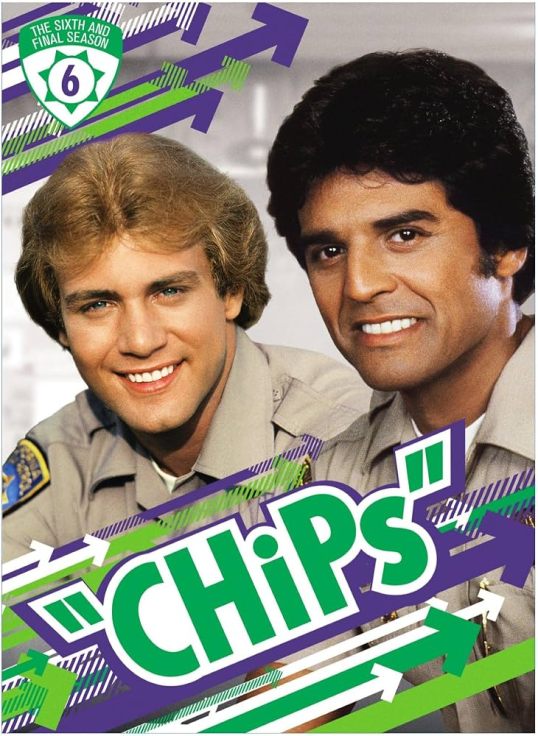
This week, we start the sixth and final season of CHiPs.

Episode 6.1 “Meet the New Guy”

(Dir by John Astin, originally aired on October 10th, 1982)

The sixth season of CHiPs opens up with some changes.  Bonnie, Bear, and Turner are all gone.  They’ve been replaced by Kathy (Tina Gayle) and Officer Webster (Clarence Gilyard, Jr.)  Grossman (Paul Linke) is still providing comedic relief.  Harlan (Lou Wagner) is still running the garage.  Getraer (Robert Pine) is still the sarge.  And Ponch (Erik Estrada) is still riding his motorcycle and flashing his grin.

However, this episode finds Ponch riding solo.  Officer Baker is no longer his partner.  This was because Larry Wilcox declined to return for another season, specifically because he felt that the producers only cared about keeping Estrada happy.  On the show, it’s mentioned that Baker has relocated to Wyoming and he is now working on his father’s ranch.  Ponch, however, is not without a partner for long.  At the start of the episode, he meets Baker’s replacement.  Bobby Nelson (Tom Reilly) is blonde and kind of spacey and he’s nicknamed “hot dog” because he likes to take risks.  Ponch has been assigned to work as Nelson’s partner throughout Nelson’s probationary period.  Getraer explains that Nelson reminds him of Ponch.

And really, that’s the problem.  Ponch is a flamboyant motorcycle cop who smiles a lot and likes to take risks.  Bobby is another flamboyant motorcycle cop who smiles a lot and likes to take risks.  There’s not much difference between them.  Even though Larry Wilcox and Erik Estrada didn’t get along behind the scenes, Baker and Ponch worked as a team because Baker was the opposite of Ponch.  Baker was serious and by-the-book and he didn’t take unnecessary risks.  Bobby, on the other hand, is pretty much just a blonde version of Ponch.

There is another problem as far as Bobby Nelson is concerned.  Judging from this episode, Tom Reilly doesn’t appear to have been much of an actor.  Larry Wilcox may not have had the most expansive emotional range but he was totally believable as a cop.  Reilly, meanwhile, spends the entire episode looking somewhat spaced out.  He delivers his lines in a flat monotone.  From the start, there’s very little chemistry between him and Estrada.  When Ponch complains about getting a new partner, one gets the feeling that he was expressing Estrada’s own feelings.

That said, this episode isn’t all bad.  It opens with one of the most spectacular crashes in the show’s history.  The tragic Dominique Dunne gives a strong performance as a teenage mother who sells her baby to a couple but then decides that she wants him back.  This episode even manages to work quicksand into its finale.  How can you not appreciate a show that makes use of quicksand?

Finally, this episode has one extended sequence that is so ludicrous that you just can’t help but smile while watching it.  Two thieves have been robbing health clubs.  They just happen to rob the one where Ponch is a member.  (Fitness guru Richard Simmons plays Ponch’s teacher.)  Ponch, clad only in a pair of black shorts and a motorcycle helmet, jumps on his motorcycle and chases after the robbers.  The site of a half-naked Erik Estrada riding his motorcycle down the streets of Los Angeles is the perfect combination of silly and stupid.

This episode had its moments but I’m not really sold on Tom Reilly as a replacement for Larry Wilcox.  We’ll see what happens!

Cleaning Out the DVR: Lady In The Lake (dir by Robert Montgomery)


(Lisa is once again in the process of cleaning out her DVR!  She recorded the 1947 film noir Lady In The Lake off of TCM on June 17th!)

You are Raymond Chandler’s world-famous private detective, Phillip Marlowe!

Well, no.  Actually, you aren’t.  Lady in the Lake is best-known for being one of the first (if not the first) film to be shot from the viewpoint of the main character but actually, the film goes out of its way to remind you that you’re seeing the story through Marlowe’s eyes but you’re not Marlowe yourself.  There are three scenes in which Marlowe (played by Robert Montgomery, who also directed the film) is seen sitting behind a desk and directly addressing the audience.  He shows up to fill in a few plot details and to assure the audience that, while the film they’re watching may be experimental, it’s not too experimental.  For his part, Montgomery looks and sounds absolutely miserable whenever he has to speak directly to the audience.  One gets the feeling that these scenes were forced on him by nervous studio execs, who were probably worried that the film would be too weird for mainstream audiences.

However, the rest of the film is seen totally through Marlowe’s eyes.  When Marlowe gets punched, we see the fist flying at him.  When Marlowe smokes a cigarette, we see the smoke float away from him.  When Marlowe leers at every single woman that he meets, the camera leers as well.  When Marlowe looks at himself in a mirror, we see his reflection.  When Marlowe passes out after a beating or a car accident, the image grows blurry before fading to black.  There’s even a rather clever scene when Marlowe leans in for a kiss, just to suddenly change his mind and pull back.

Today, of course, the film’s technique doesn’t seem quite as revolutionary.  We’re used to point of view shots and moving cameras.  Last year, Hardcore Henry told its entire stupid story through a point of view shot and the shaky cam effect actually made me physically ill.  In Lady in the Lake, there is no shaky, hand-held camera work and I was happy about that.  Marlowe may turn his head left and right and he may walk forward but he apparently has nerves of steel because the image stays steady and only shakes when Marlowe’s getting beat up.

As for the film’s plot, it opens with Marlowe explaining that, since he’s not making enough money as a P.I., he’s decided to try his hand at writing for a pulp magazine.  While his stories are not accepted, publishing executive Adrienne Fromsett (Audrey Totter) does hire him to track down the missing wife of her boss, Derace Kingbury (Leon Ames).  As Marlowe quickly figures out, nobody’s motives are exactly pure.  Adrienne wants to marry her boss and get her hands on his money.  The wife’s lover (Richard Simmons) claims that he hasn’t seen her in weeks but still lets slip that she may no longer be alive.  The police (represented by Lloyd Nolan and Tom Tully) are corrupt, rather rude, and may know more than they are letting on.  Even a seemingly innocent landlady (Jayne Meadows) might have a secret or two.

And, of course, there’s the dead woman who is discovered in a nearby lake.  Her identity holds the key to many mysteries…

It’s an intriguing puzzle and it actually helps to see everything through Marlowe’s eyes.  If nothing else, it cuts down on the red herrings.  If Marlowe stops to stare at something, you know exactly what he’s staring at and you can be sure that it will prove to be important at some point in the story.

By the way, did I mention that Lady In The Lake is not just an experimental film noir but a Christmas movie?  Seriously, it opens with holiday music playing in the background and the opening credits are printed on cheery Christmas cards.  It’s only after the credits are over that we see that there’s a gun underneath the cards.  As a director, Montgomery does a great job juxtaposing the cheeriness of Christmas with the sordidness of the people who Marlowe has to associate with on a daily basis.  He may be dealing with a bunch of murderers and greedy con artists but almost everyone has a Christmas tree in their apartment.

In fact, it’s so easy to get so wrapped up in the film’s technique that the viewer runs the risk of not noticing just how dark and cynical Lady in The Lake truly is.  Everyone that Marlowe meets is sleazy.  Marlowe, himself, does not come across as being particularly likable.  Every room that Marlowe enters is underlit.  Interestingly, with the exception of the opening credits and a driving montage, there’s not much music to be heard in the film, a reminder that we’re only hearing what Marlowe hears.  And, in Marlowe’s world, there’s no music playing in the background to provide relief from the tension.  There’s just a mix of lies and threats.

Lady in the Lake is an intriguing film and it shows up on TCM fairly frequently.  Keep an eye out for it.