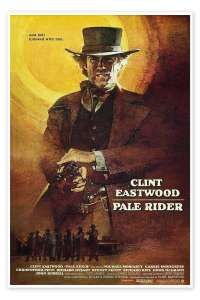
Pale Rider (dir. by Clint Eastwood)


We continue the Shattered Lens’ celebration of Clint Eastwood with 1985’s Pale Rider, one of my favorites. This was a film my long time friend Jay shared with me many years ago, as he owns most of Eastwood’s library of films. I like to think of it as a softer version of Eastwood’s own High Plains Drifter, which my father loved, but I couldn’t really get. It’s a tale of vengeance, but wrapped more in miracles. 

You should first know that Westerns aren’t really my genre when it comes to film types I often watch. I don’t have a lot of historical background when it comes to Westerns overall. If you asked for a short list of my favorites, I’d give up Rustler’s Rhapsody (it’s a fun comedy), The Good, The Bad & The Ugly (my Dad watched it often), Blazing Saddles, and in terms of books, the first few books of Stephen King’s The Dark Tower. I only recently watched Shaneafter Logan was first released, and I love the Red Dead Redemption games.

Pale Rider takes place in California around the time of the gold rush. Outside the town of LaHood, named after the wicked Coy LaHood (Richard Dysart, The Thing), we have a group of miners settled in that are hoping to strike it rich. It’s somewhat difficult with LaHood’s henchmen trying to drive them out at every turn, to steal the land. Hull Barrett (Michael Moriarty, Q The Winged Serpent) hopes to be successful, living with his fiancé Sarah (Carrie Snodgress, The Fury) and her daughter, Meghan (Sydney Penny, The Wife He Met Online). The most recent attack from LaHood’s men has shattered the miners’ morale and few are spared. Even Meghan’s dog is killed, causing her to wish for a miracle.

When LaHood’s son, Josh (Chris Penn, True Romance) and some other baddies (including The Thing‘s Charles Callahan, reuniting with Dysart) confront Hull, a stranger steps in. He handles them all easily with an axe handle, and as thanks, Hull welcomes him to the Miners area for room and board. Of course, having a stranger brings up all sorts of questions from the townsfolk, who don’t appear to be too trusting. Is he an outlaw, possibly? Even Meghan’s a little apprehensive at first, with her quote from Revelations 6:8 forshadowing the Pale Rider’s presence. Everyone is put at ease when they find our stranger is actually a Preacher, though Hull is still a bit curious about the six bullet sized scars on the man’s back. Can the Preacher help the Miners keep their land and stop LaHood? 

From a casting standpoint, Pale Rider is damn near perfect. Although Eastwood is the main star in his own film, he comes across more as an accessory for everyone else in scenes. Moriarty does most of the heavy lifting, as does Snodgress and Penny. Their characters are all easily likable and the supporting cast (particularly Doug McGrath’s Spider) shine in their parts. Dysart’s LaHood is a dark character and there’s a wonderful verbal conflict between him and Eastwood in one scene that’s just sweet to watch to see who loses their cool first. 

Pale Rider is both pretty simple and well executed from a story standpoint. It bears some similarities to Eastwood’s other film, High Plains Drifter. Though the town isn’t painted in red, there are allusions to the idea that the Preacher may be something of.a specter or ghost of vengeance. We’re not given any kind of full story as to why the Preacher’s here. We are shown that both The Preacher and LaHood’s Marshall, Stockburn (John Russell, The Outlaw Josey Wales) share a history, but that’s it. The story, like the Preacher and the events around him, moves in mysterious ways. 

What I love the most about Pale Rider is the way the Preacher changes the minds (and hearts) of those around him. The miners learn to fend for themselves. His enemies are often in shock over what he does (and at least one flips from bad to good). It kind of reminds me of Wild West version of John Wick or Nobody, with a character whose reputation precedes him. 

Bruce Surtees was the Cinematographer for Pale Rider, who also worked on a number of Eastwood’s earlier films, including The Outlaw Josey Wales and Play Misty for Me. Pale Rider has some beautiful landscape shots of the West (as the film was filmed in Idaho). Despite all the well lit shots, there are still moments where faces are obscured by the brim of a hat or the contrasts in a candlelit room. 

The story isn’t without some dark areas or some odd moments. A dog is killed, and there’s a scene where Meghan is nearly raped, but there’s some intervention before things can get out of hand. Both instances help to show how dark the villains are in the overall tale. Both Sarah and Meghan seem to take their own shine to The Preacher, one already in a relationship and the other too young for what she’s asking for, but I took it to just be that their both a bit mesmerized by the Preacher’s presence in different ways. 

Overall, Pale Rider is a wonderful offering by Eastwood, with fine performances by everyone involved. The Preacher does what he can to make things better around him with a peaceful approach. When push comes to shove, however, the guns come out blazing. 
Guilty Pleasure No. 83: Meteor (dir by Ronald Neame)


1979’s Meteor is about a big rock that is tumbling through space.  Earth is directly in its path and, if it hits the planet, it could be an extinction-level event.  Unfortunately, little bits of the rock keep breaking off and crashing into Earth, destroying cities and fleeing extras.  Goodbye, Hong Kong.  Goodbye, Switzerland, which is destroyed via stock footage lifted from Avalanche.  Goodbye, New York, which blows up in such spectacular fashion that the scene was later re-used in The Day After.

It might seem like the planet is doomed.  The meteor is unstoppable.  Bruce Willis hasn’t become a star yet.  But fear not!  Some of the brightest faces of the 70s have been recruited to stop the meteor.  Natalie Wood, in one of her final films, plays a translator and gets covered in muddy river water.  Sean Connery wears a turtleneck and curses in that Scottish way of his.  Karl Malden wears a hat and tells people to calm down while he calls the President.  Brian Keith plays a Russian with all the grace and skill of a cat trying to rip open a bag of treats.  Martin Landau is the military official who doesn’t think that the scientist know what they’re talking about.  Henry Fonda is the president.  That’s a lot of balding men for one movie and it’s hard not to notice that both Malden and Keith often seem to be wearing a hat whenever they share a scene with Connery.  My personal theory is that the production, having spent all of their money on blowing up New York, couldn’t afford more than two toupees so everyone had to take turns wearing them.  (The few scenes where Malden is hatless while in Connery’s presence are often oddly filmed, with either Connery on Malden standing with their back to the camera, almost as if the scenes were actually done with a stand-in.)

We’re supposed to breathe a sigh of relief when we see that Henry Fonda is playing the President but I’ve seen Fail Safe and I remember him allowing the Russian to nuke New York City.  Interestingly enough, New York gets destroyed in this film too.  Why didn’t President Fonda care about New York City?  Of course, the scientists and the military folks are all located in a control center that’s located under the city.  Malden mentions that they’re right next to the Hudson River.  It doesn’t seem to occur to anyone that this is a bad idea but, then again, they also elected Henry Fonda president again.

My late friend and colleague Gary Loggins described Meteor as being a “crashing bore.”  I have to admit that this is one of the few times that I have ever disagreed with Gary.  Meteor is a tremendous amount of fun, as long as you’re watching it with a group of people and nobody takes it seriously.  (The first time I saw it was at one in the morning while I was in college.  Jeff and I watched it in the lounge of one of the dorms.  We may be the only two people to have romantic memories of Meteor.)  Meteor features a cast of champion scenery chewers.  Karl Malden, Sean Connery, Martin Landau, Brian Keith, none of them were exactly subtle actors and giving them an excuse to argue about how to deal with a meteor allows for a lot of very enjoyable overacting.  As well, the special effects are so cheap and obviously fake that it’s hard not to laugh out loud whenever the film cuts to that shot of the meteor rolling through space or the incredibly shiny American and Russian missiles slowly heading towards it.

Meteor’s a lot of fun, even if it is one of those movies where no one points out that our heroes inevitably seem to make every situation worse with their own stupidity.  It’s very much at the tail-end of the 70s disaster boom.  Watch it for the stars.  Watch it for the rock.  And watch it for the hairpieces.

Previous Guilty Pleasures

  1. Half-Baked
  2. Save The Last Dance
  3. Every Rose Has Its Thorns
  4. The Jeremy Kyle Show
  5. Invasion USA
  6. The Golden Child
  7. Final Destination 2
  8. Paparazzi
  9. The Principal
  10. The Substitute
  11. Terror In The Family
  12. Pandorum
  13. Lambada
  14. Fear
  15. Cocktail
  16. Keep Off The Grass
  17. Girls, Girls, Girls
  18. Class
  19. Tart
  20. King Kong vs. Godzilla
  21. Hawk the Slayer
  22. Battle Beyond the Stars
  23. Meridian
  24. Walk of Shame
  25. From Justin To Kelly
  26. Project Greenlight
  27. Sex Decoy: Love Stings
  28. Swimfan
  29. On the Line
  30. Wolfen
  31. Hail Caesar!
  32. It’s So Cold In The D
  33. In the Mix
  34. Healed By Grace
  35. Valley of the Dolls
  36. The Legend of Billie Jean
  37. Death Wish
  38. Shipping Wars
  39. Ghost Whisperer
  40. Parking Wars
  41. The Dead Are After Me
  42. Harper’s Island
  43. The Resurrection of Gavin Stone
  44. Paranormal State
  45. Utopia
  46. Bar Rescue
  47. The Powers of Matthew Star
  48. Spiker
  49. Heavenly Bodies
  50. Maid in Manhattan
  51. Rage and Honor
  52. Saved By The Bell 3. 21 “No Hope With Dope”
  53. Happy Gilmore
  54. Solarbabies
  55. The Dawn of Correction
  56. Once You Understand
  57. The Voyeurs 
  58. Robot Jox
  59. Teen Wolf
  60. The Running Man
  61. Double Dragon
  62. Backtrack
  63. Julie and Jack
  64. Karate Warrior
  65. Invaders From Mars
  66. Cloverfield
  67. Aerobicide 
  68. Blood Harvest
  69. Shocking Dark
  70. Face The Truth
  71. Submerged
  72. The Canyons
  73. Days of Thunder
  74. Van Helsing
  75. The Night Comes for Us
  76. Code of Silence
  77. Captain Ron
  78. Armageddon
  79. Kate’s Secret
  80. Point Break
  81. The Replacements
  82. The Shadow

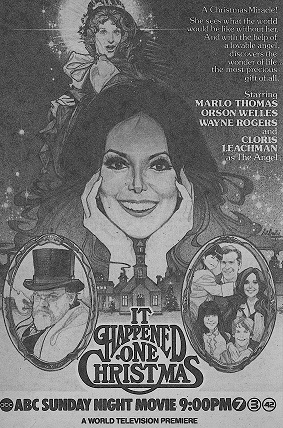
Holiday Film Review: It Happened One Christmas (dir by Donald Wyre)


The 1977 made-for-TV movie, It Happened One Christmas, opens in Heaven.  We hear the voice of Joseph (Charles Grodin), one of the top angels.  Joseph has noticed that, in the town of Bedford Falls, a lot of people seem to be praying and all of their prayers concern one person.  They are all worried about Mary Bailey Hatch (Marlo Thomas).

He requests that an angel be sent down to Earth to help Mary with her problems.  Unfortunately, the only angel available is Clara (Cloris Leachman) and Clara, despite her optimistic outlook and upbeat personality, is not considered to be a particularly smart angel.  She hasn’t even gotten her wings yet!  However, Joseph promises her that, should she convince Mary Hatch not to toss away her life on Christmas Eve, Clara will get her wings.

But first, Joseph shows Clara all of the important events in Mary’s life.  Clara watches as young Mary saves the life of her brother, Harry.  A few weeks later, Mary manages to keep Dr. Gower from accidentally poisoning a patient.  Though Mary dreams of leaving Bedford Falls and pursuing a career as a writer, she instead ends up taking over her late father’s old Building and Loan company.  With the help of her husband, George (Wayne Rogers), she helps hundreds of people move into affordable housing.  She is also one of the few people in town willing to stand up to Old Man Potter (Orson Welles)….

What was that?

Yeah, I know.  Just hold on.  I’m getting to that.

Anyway, everything is going great in Mary’s life until her irresponsible Uncle Willie (Barney Martin) accidentally loses a deposit on Christmas Eve.  Facing embezzlement charges and having yelled at her family, Mary considers jumping off a bridge.  Fortunately, Clara is there to show her what her life would be like if she had never been born….

Excuse me?  Did you say that this sounds familiar?

Yes, It Happened One Christmas is a remake of It’s A Wonderful Life.  The main difference is that the genders are swapped.  Jimmy Stewart’s role is played by Marlo Thomas.  Wayne Rogers plays the Donna Reed role.  This leads to a few changes in the story.  For instance, Mary still yells at ZuZu’s teacher but she doesn’t get sucker punched as a result.  Whereas the original Mr. Potter treated George Bailey with outright hostility, the remake’s Mr. Potter tends to use a tone of condescending concern when talking to Mary.  Since George Hatch doesn’t lose his hearing in one ear, he’s able to serve in World War II and he returns on crutches.  In the world where Mary was never born, George still never marries but, instead of working at the library, he becomes a boorish auto mechanic.  Violet is no longer an important character and Mary never tries to blame her visions of Pottersville on “bad liquor.”  These are cosmetic differences but, otherwise, it’s pretty much the exact same story.

To be honest, it probably sounds more interesting than it actually is.  It’s not that It Happened One Christmas is a poorly made or a badly acted film.  It’s fine, really!  But it’s not It’s A Wonderful Life.  Marlo Thomas plays her role with a lot of energy but she’s still no Jimmy Stewart.  Stewart, who was still dealing with his own World War II experiences, played up the haunting sadness behind George’s mild-mannered facade and that’s something that Thomas never accomplishes.  If Stewart’s George seems like he’s been beaten down by one lost dream after another, Marlo Thomas’s Mary just seems like she’s having a really bad night.  By that same token, Wayne Rogers is likable a the love of Mary’s life but he’s no Donna Reed.  Even the great Orson Welles can’t escape the shadow of Lionel Barrymore.  Barrymore’s Mr. Potter was a pure misanthrope who was at his happiest mocking the dead and approving men for the draft.  Oddly, Orson Welles brings an almost avuncular style to Mr. Potter.  One gets the feeling that Welles simply couldn’t resist winking at the audience and assuring them that he was still the bigger-than-life showman that they had grown up with.

So, you may be wondering ….. why remake It’s A Wonderful Life in the first place?  I was wondering about that so I did a little research and thanks to an obscure web site called Wikipedia (not many people have heard of it), I discovered that It Happened One Christmas was actually made before It’s A Wonderful Life started to regularly air during the holidays.  At the time it was made, it was aactually remake of a classic film that was no longer regularly watched.  Frank Capra angrily denounced It Happened One Christmas as being “plagarism” but, in 1977, it was enough of ratings success that it was re-aired in both 1978 and 1979.  But, by that time, It’s A Wonderful Life had started to regularly air during the holiday season and was being rediscovered by audiences young and old.  As a result, the okay remake was soon overshadowed by the vastly superior original.

And really, that’s the way it should be.  It Happened One Christmas isn’t a bad movie but it just no replacement for Capra’s Wonderful film.

Horror Film Review: Prophecy (dir by John Frankenheimer)


First released way back in 1979, Prophecy is one of those films where a big evil corporation is selfishly polluting the environment and a group of noble Native Americans is convinced that a vengeful spirit of the forest has been awakened as a result.

We’re told that the vengeful spirit is named Katahdin and that it’s “as large as a dragon and has the eyes of a cat.” We’re also told, by someone who claims to have actually seen it, that the Katahdin is a combination of several different creatures, “a part of everything that is God’s creation.”

Sound pretty scary, right?

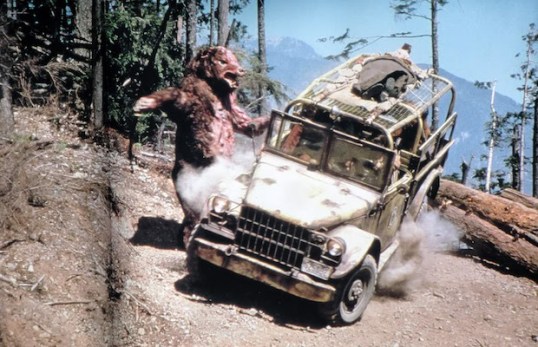
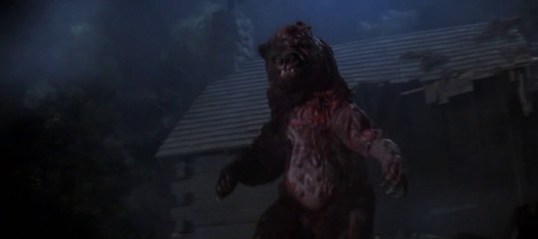
Well, it is until the bear itself actually shows up on screen. That’s when we find ourselves confronted with this:

I mean, don’t get me wrong. He certainly is ugly. But he just looks so silly and …. well, fake.

The lesson here, and it’s an important one, is that you should never put your monster onscreen unless it can actually live up to all the hype. Take a lesson from Spielberg. When it became obvious that the shark in Jaws looked like a tin model, Spielberg made the decision to not show the shark. Instead, he gave us a lot of point of view shots and, by the time the shark did appear, audiences were so frightened that it didn’t matter whether it looked convincing or not. Prophecy makes the mistake of having its monster all over the place and it just doesn’t work.

Of course, once the EPA’s Dr. Robert Verne (Robert Foxworth) shows up with his pregnant wife (Talia Shire, who somehow went from The Godfather and Rocky to this), he discovers that one reason why the Katahdinh doesn’t live up to all the hype is because it’s just a mutant bear. It turns out that all that pollution led to some crazy results and now every logger, Native American activist, and camper in the area is in danger! Can Dr. Verne and a team of disposable, forgettable characters end the threat of Katahdinh!?

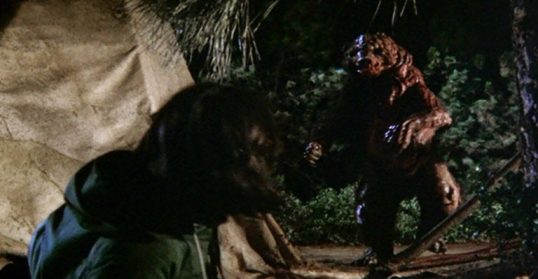
Prophecy is a big, dumb movie that’s never as much fun as you want it to be. There is one early scene that features a camper trying to hop away from Katahdinah while zipped up in a sleeping bag. That scene — which ends with one ruined sleeping back and lot of feathers floating around — is just demented enough to be kind of fun:

Otherwise, the entire film is slow-moving and rather dull. Part of the problem is that it was directed by John Frankenheimer, a major and important filmmaker who had entirely the wrong sensibility for this film. Frankenheimer was a legitimately great director (among his good credits: The Manchurian Candidate, Birdman of Alcatraz, Ronin, Seconds) but he takes the material too seriously. He spends so much time trying to sell the film’s environmental message that he forgets that the majority of the audience for a film like this isn’t watching because they want to become a better person. They’re watching for mutant bear mayhem! This is the type of film that needed to be directed by someone from the Roger Corman school of quick thrills and shameless shlock.

So, here are the twin lessons of Prophecy: know your audience and make sure your monster can live up to its reputation! Otherwise, you’ll just be known for that one scene with the exploding sleeping bag.

18 Days of Paranoia #4: The Falcon and the Snowman (dir by John Schlesinger)


http://www.youtube.com/watch?v=y8HE_mHphZk

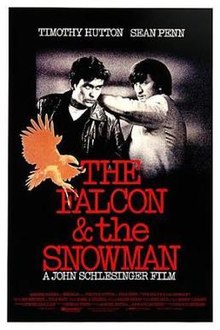
The 1985 film, The Falcon and the Snowman, tells the story of two friends.  They’re both wealthy.  They’re both a little bit lost, with one of them dropping out the seminary and the other becoming a drug dealer who is successful enough to have a lot of money but inept enough to still be treated like a joke by all of other dealers.

Chris Boyce (Timothy Hutton) is the son of a former FBI agent (Pat Hingle).  He has a tense relationship with his father.  It’s obvious that the two have never really been sure how to talk to each other.  While his father is sure of both himself and his country, Chris is far more sensitive and quick to question.  While his father plays golf and attends outdoor barbecues, Chris becomes an expert in the sport of falconry and spends a lot of time obsessing about the state of the the world.  While his father defends Richard Nixon during the Watergate investigation, Chris sees it as evidence that America is a sick and corrupt country.  Because his father doesn’t want Chris sitting around the house all day, he pulls some strings to get Chris a job working at the “Black Vault,” where Chris will basically have the ability to learn about all sorts of classified stuff.

Daulton Lee (Sean Penn) was Chris’s best friend in school.  Daulton’s entire life revolves around cocaine.  He both sells and uses it.  He’s managed to make a lot of money but his addiction has also left him an erratic mess.  Daulton’s father wants to kick him out of the house.  Daulton’s mother continually babies him.  Chris and Daulton may seem like an odd pair of friends but they’re both wealthy, directionless, and have a difficult time relating to their fathers.  It somehow seems inevitable that these two would end up as partners.

Chris Boyce and Daulton Lee, together …. THEY SOLVE CRIMES!

No, actually, they don’t.  Instead, they end up betraying their country.  (Boooo!  Hiss!  This guy’s a commie, traitor to our nation!)  After Chris discovers that the CIA has been interfering in the elections of America’s allies (in this case, Australia), he decides to give information to the Russians.  Since Daulton already has experience smuggling drugs over the southern border, Boyce asks Lee to contact the KGB the next time that he’s in Mexico.  Despite being a neurotic and paranoid mess, Lee manages to do just that.

Of course, as Chris soon comes to discover, betraying your country while working with a greedy drug addict is not as easy as it seems.  While Chris wants to eventually get out of the treason game, marry his girlfriend (Lori Singer), and finish up college, Daulton wants to be James Bond.  The Russians, meanwhile, soon grow tired of having to deal with Lee and start pressuring Chris to deal with them directly….

And it all goes even further downhill from there.

Based on a true story, The Falcon and the Snowman tells the story of how two seemingly very different young men managed to basically ruin their lives.  Boyce’s naive idealism and Lee’s drug-fueled greed briefly makes them a powerful duo but they both quickly discover that betraying your country isn’t as a simple as they assumed.  For one thing, once you’ve done it once, it’s impossible to go back to your normal life.  As played by Hutton and Penn, Chris and Daulton are two very interesting characters.  Boyce is full of righteous indignation and sees himself as being a hero but the film hints that he’s mostly just pissed off at his Dad for never understanding him or caring that much about falconry.  Daulton, meanwhile, is a lunatic but he seems to be aware that he’s a lunatic and that makes his oddly likable.  At times, it seems like even he can’t believe that Chris was stupid enough to depend on him.  The film provides a convincing portrait of two men who, because of several impulsive decisions, find themselves in over their heads with no possibility of escape.

The Falcon and the Snowman is an entertaining and occasionally thought-provoking time capsule of a different age.  If the film took place in 2020, Daulton would be hanging out with the Kardashians and Chris would probably be too busy working for the Warren campaign to spy for America’s enemies.  If only the two of them had been born a few decades later, all of this could have been of avoided.

Previous Entries In The 18 Days of Paranoia:

  1. The Flight That Disappeared
  2. The Humanity Bureau
  3. The Privates Files Of J. Edgar Hoover

The TSL’s Horror Grindhouse: The Terminal Man (dir by Mike Hodges)


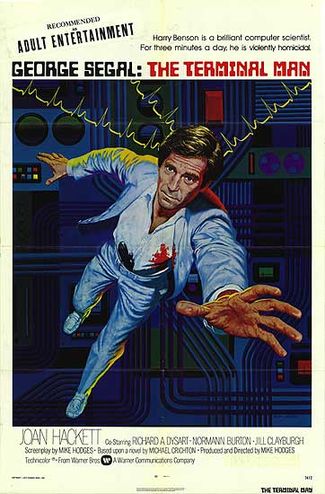
Check out the poster for 1974’s The Terminal Man.

Look at it carefully.  Examine it.  Try to ignore the fact that it’s weird that George Segal was once a film star.  Yes, on the poster, Segal has been drawn to have a somewhat strange look on his face.  Ignore that.  Instead, concentrate on the words in the top left corner of the poster.

“ADULT ENTERTAINMENT!” it reads.

That’s actually quite an accurate description.  The Terminal Man is definitely a film for adults.  No, it’s not pornographic or anything like that.  Instead, it’s a movie about “grown up” concerns.  It’s a mature film.  In some ways, that’s a good thing.  In some ways, that’s a bad thing.

Taking place in the near future (and based on a novel by Michael Crichton), The Terminal Man tells the story of Harry Benson (played, of course, by George Segal).  Harry is an extremely intelligent computer programmer and he’s losing his mind.  It might be because he was in a serious car accident.  It may have even started before that.  Harry has black outs and when he wakes up, he discovers that he’s done violent things.  Even when he’s not blacked out, Harry worries that computers are going to rise up against humans and take over the world.

However, a group of scientists think that they have a way to “fix” Harry.  It’ll require a lot of brain surgery, of course.  (And, this being a film from 1973, the film goes into excruciating details as it explains what’s going to be done to Harry.)  The plan is to implant an electrode in Harry’s brain.  Whenever Harry starts to have a seizure, the electrode will shock him out of it.  The theory is that, much like Alex in A Clockwork Orange 0r Gerard Malanga in Vinyl, Harry will be rendered incapable of violence.

Of course, some people are more enthusiastic about this plan than others.  Harry’s psychiatrist (Joan Hackett) fears that implanting an electrode in Harry’s brain will just make him even more paranoid about the rise of the computers.  Other scientists worry about the ethics of using technology to modify someone’s behavior.  Whatever happens, will it be worth the price of Harry’s free will?

But, regardless of the risks, Harry goes through with the operation.

Does it work?  Well, if it worked, it would be a pretty boring movie so, of course, it doesn’t work.  (Allowing Harry’s operation to work would have been like allowing King Kong to enjoy his trip to New York.)  Harry’s brain becomes addicted to the electrical shocks and, as he starts to have more and more seizures, Harry becomes even more dangerous than he was before…

The Terminal Man is a thought-provoking but rather somber film.  On the one hand, it’s a rather slow movie.  The movie does eventually get exciting after Harry comes out of surgery but it literally takes forever to get there.  The movie seems to be really determined to convince the audience that the story it’s telling is scientifically plausible.  On the other hand, The Terminal Man does deal with very real and very important issues.  Considering how threatened society is by people who cannot be controlled, issues of behavior modification and free thought will always be relevant.

Though the film may be slow, I actually really liked The Terminal Man.  Judging from some of the other reviews that I’ve read, I may be alone in that.  It appears to be a seriously underrated film.  As directed by Mike Hodges, the film is visually stunning, emphasizing the sterility of the white-walled hospital, the gray blandness of the doctors, and the colorful vibrancy of life outside of science.  Though he initially seems miscast, George Segal gives a good and menacing performance as Harry.

The Terminal Man requires some patience but it’s worth it.

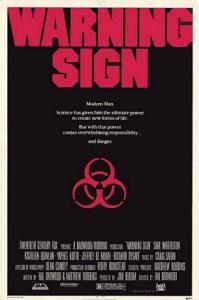
A Movie A Day #166: Warning Sign (1985, directed by Hal Barwood)


The world might end, again.

There is a laboratory in the middle of the desert.  While everyone thinks that the lab is developing pesticides, it is actually a secret government facility where the scientists have developed a chemical that will turn anyone exposed to it into a homicidal maniac.  While the scientists are celebrating the success of their project, Dr. Tom Schmidt (G.W. Bailey — yes, Captain Harris from the Police Academy movies) steps on a vial and releases the chemical.  The lab locks down and the army (led by Yaphet Kotto) arrives.  The government wants to let the scientists kill each other off but a pregnant security guard (Kathleen Quinlan) is also trapped in the lab and her husband, the county sheriff (Sam Waterston), is determined to get her out.

Warning Sign was blandly directed by Hal Barwood, a longtime associate of both George Lucas and Steven Spielberg.  (Barwood wrote the script for Spielberg’s The Sugarland Express and designed the title sequence for Lucas’s THX 1138.)  Barwood tried to take a very Spielbergian approach to Warning Sign, a mistake because successfully imitating Spielberg is easier said than done.  Replace the shark with germs and the ocean with a lab on lock down and Warning Sign is  like Jaws, without any of the suspense or humor.  Sam Waterston’s germaphobic sheriff feels like a knock off of Roy Scheider’s aquaphobic police chief while Jeffrey DeMunn, as an alcoholic scientist, stands in for both Richard Dreyfuss and Robert Shaw.    With the violence and the gore kept to a minimum, this is one of the most tasteful zombie films ever made.  Just compare it to George Romero’s The Crazies (or even the remake) to see how needlessly safe Warning Sign is.

When McQueen Met Ibsen: An Enemy of The People (1978, directed by George Schaefer)


What happened when famed action star Steve McQueen met playwright Henrik Ibsen?

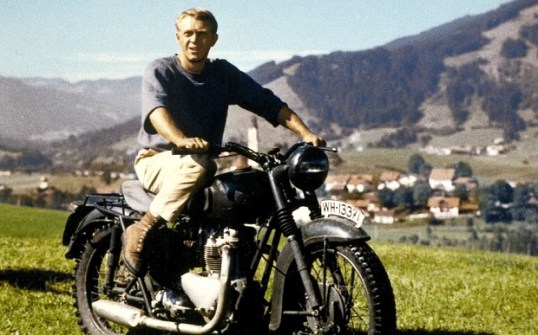
Here’s Steve McQueen in The Great Escape:

Steve McQueen In The Great Escape

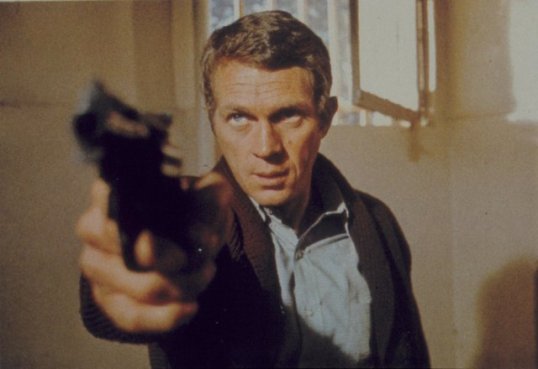
This is Steve McQueen in Bullitt:

Steve McQueen in Bullitt

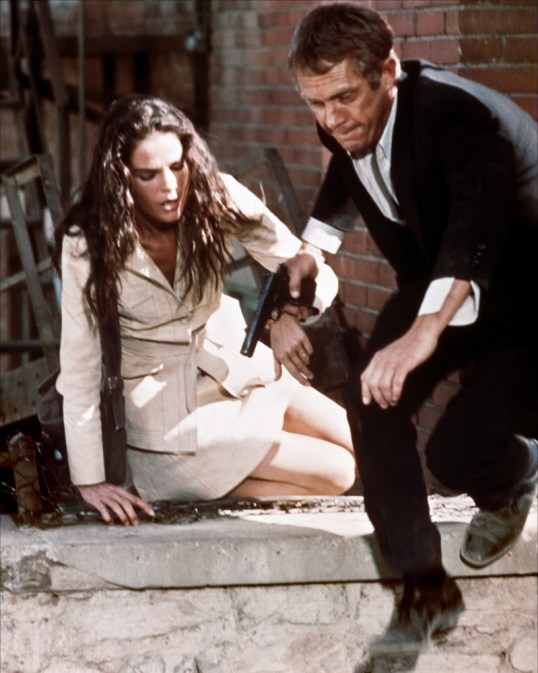
Here’s Steve McQueen with his future wife, Ali MacGraw, in The Getaway:

Steve McQueen in The Getaway

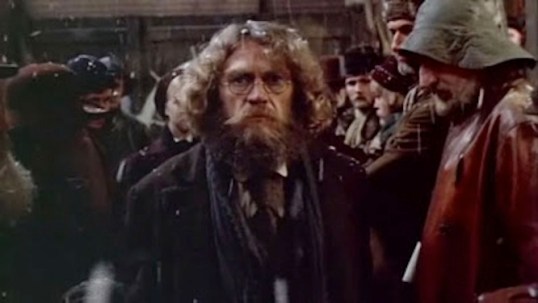
And finally, here’s Steve McQueen starring in An Enemy of the People:

Steve McQueen in Enemy of the People

In the four years between appearing in the Oscar-nominated The Towering Inferno and starring in An Enemy of the People, McQueen notoriously turned down several high-profile projects.  He turned down the lead role in Sorcerer because director William Friedkin would not write a role for MacGraw.  He turned down the lead role in Steven Spielberg’s Close Encounters of The Third Kind because he felt that he would not be able to cry on cue.  (When Spielberg offered to take out the crying scene, McQueen replied that it was the best scene in the script.)  Francis Ford Coppola could not afford his salary and McQueen missed out on the chance to play Capt. Willard in Apocalypse Now, a role he would have been perfect for.

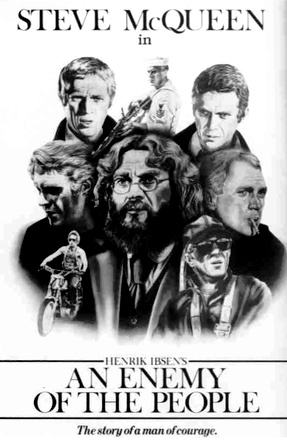
AnEnemyOfThePeople_posterInstead, after a four years absence, McQueen returned to the screen in one of the least expected films of his career.  Based on Arthur Miller’s adaptation of Henrik Ibsen’s original play, An Enemy of the People featured McQueen playing Dr. Thomas Stockmann, a scientist who discovers that his town’s local spring has been polluted by a tannery.  When Stockmann reveals his findings, the town turns against him and his family.  Stockmann has to decide whether to give into pressure from the town or to stay true to his principles.
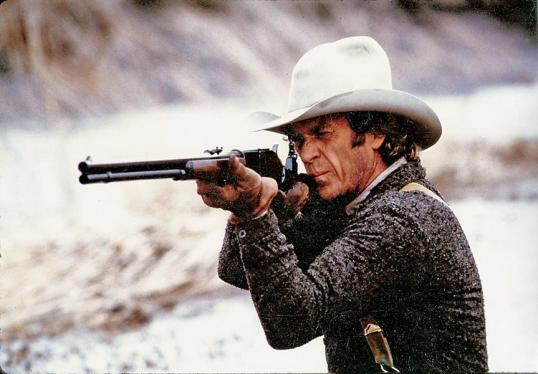
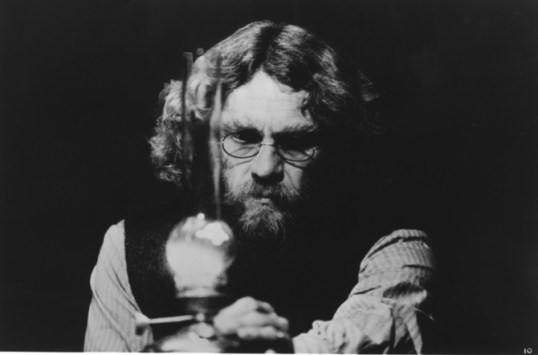
As a star who was best known for playing stoic men of action, Steve McQueen was the last actor that anyone expected to appear in a film based on an Ibsen play.  McQueen also insisted on playing the role with a heavy beard and a stocky build, making him virtually unrecognizable on-screen.  Warner Bros. had no idea how to advertise An Enemy of The People so they didn’t.  After a year of sitting on the shelf, An Enemy of the People was given a limited run in a few college towns.  Many critics assumed that McQueen deliberately made an uncommercial movie just to get out of his contract with Warner Bros but, according to both Ali MacGraw and Marshall Terrill’s Steve McQueen: An American Rebel, McQueen was actually very enthusiastic about making An Enemy of the People and extremely disappointed when it was not a success.  After the film failed to find an audience, Steve McQueen returned to appearing in action films and westerns.

Steve McQueen in Tom Horn (1980)

Steve McQueen in Tom Horn (1980)

I recently saw An Enemy of the People on TCM and I thought it was slow and didactic.  (It did not help that An Enemy of the People is Ibsen’s weakest play.)  Especially in the beginning, there are a few scenes where McQueen struggles to hold his ground against co-stars Charles Durning and Richard Dysart, both of whom had far more theatrical experience.  But McQueen gets better as the film goes on and proves that his deceptively casual approach can still be effective even when he is playing an intellectual who chooses to make his point with his words instead of his fists.  He does a good job handling Ibsen’s notoriously wordy speeches.  By the end of the movie, the idea of Steve McQueen in an Ibsen play no longer seems strange at all.

After An Enemy of the People, McQueen would only make two more movies before dying of cancer at the age of 50.  Based on his performance as Dr. Stockmann, I believe that if McQueen had not died, he would have aged into being a great actor, in much the same way as Clint Eastwood.  It’s unfortunate that McQueen never got that chance.

bfi-00o-4ni

Shattered Politics #43: Being There (dir by Hal Ashby)


Original_movie_poster_for_Being_There

As a general rule, I don’t watch the news.  However, a few nights ago, I made an exception and I watched CNN.  The reason was because it was snowing in New York City and apparently, CNN anchorman Don Lemon was broadcasting from something called the Blizzardmobile.  I just had to see that!

Well, the Blizzardmobile turned out to be huge letdown.  I was hoping for something like the Snowpiercer train but instead, it just turned out to be a SUV with a camera crew and a pompous anchorman who hilariously kept insisting that he was knee-deep in a blizzard when even a Texas girl like me could tell that the Blizzardmobile was only encountering a few snow flurries.

So, I flipped around to see if any of the other news stations had anyone in a blizzardmobile.  What I discovered was that only CNN had a blizzardmobile but one thing that every news station did have was a panel of experts.  An anchorperson would say something like, “What does the future look like?” and the panel of experts would tell us what the future looked like to them.  What I found interesting was that I had no idea who these experts were but yet I was supposed to just believe that their opinions were worth considering.

I mean, for all I knew, those experts could have just been people who were spotted wandering around New York at night.  But, because they were introduced as experts and looked directly at the camera whenever they spoke, they were suddenly authoritative voices.

Oddly enough, the very next night, I watched a movie from 1979 that dealt with the exact same issue.

Being There tells the story of Chance (Peter Sellers), a dignified, middle-aged man who lives in Washington, D.C. and works as a gardener for a wealthy older man.  Chance cannot read.  Chance cannot write.  Chance goes through life with a blank smile on his face.  Chance has never experienced the outside world.  Instead, he spends all of his time working in the old man’s garden and obsessively watching TV.  When the old man dies, Chance finds himself exiled from the house.  Wandering around Washington D.C., Chance asks a random woman to make him dinner.  He politely speaks with a drug dealer who pulls a knife on him.  Finally, he finds himself entranced by a window display of televisions.  Backing away from the window, Chance stumbles into the street and is struck by a car.

Though he’s not seriously injured, the owner of the car, Eve Rand (Shirley MacClaine), insists that Chance come back to her mansion with him so that he can be checked out by her private physician (Richard Dysart).  As they drive back to the house, Eve asks Chance for his name.

“Chance the Gardner,” Chance replies.

“Chauncey Gardiner?” Eve asks.

Chance blankly nods.

Back the house, Chance meets Eve’s husband, Ben (Melvyn Douglas).  Ben is a wealthy industrialist who is dying of leukemia.  Ben takes an immediate liking to Chance.  Because Chance is wearing the old man’s suits, everyone assumes that Chance is a wealthy businessman.  When Chance says that he had to leave his home, they assume that his business must have failed due to government regulation.  When Chance talks about his garden, everyone assumes that he’s speaking in metaphors.

Soon, Ben is introducing Chance to his friend, Bobby (Jack Warden).  Bobby happens to be the President and when he quotes Chance in a speech, Chance the Gardner is suddenly the most famous man in the country.  When he appears on a TV talk show, the audience mistakes his emotionless comments for dry wit.  When he talks about how the garden reacts to different seasons, they assume that he’s an economic genius.  By the end of the film, Bobby has become so threatened by Chance’s popularity that he’s been rendered impotent while wealthy, rich men plot to make Chance the next President of the United States.

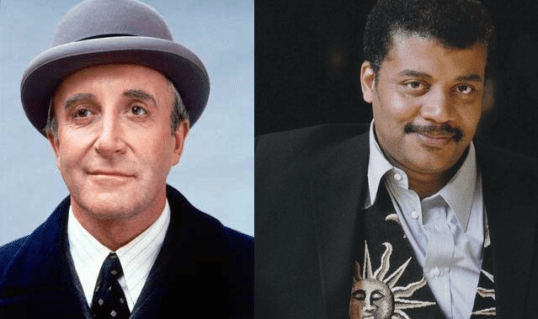
Chance and Neil

In many ways, Chauncey Gardiner was the Neil deGrasse Tyson of his era.

Being There is a one joke film and the idea of someone having no emotional skills beyond what he’s seen on television was probably a lot more mind-blowing back in 1979 than it is in 2015.  But I still enjoyed the film.  Peter Sellers gave a great performance as Chance, never sentimentalizing the character.  As well, the film’s point is still relevant.  If Being There were made today, Chance would be the subject of clickbait articles and Facebook memes.  (Chauncey Gardiner listed his ten top movies and number 8 will surprise you!  Or maybe This boy asked Chauncey Gardiner about his garden and his response was perfect.)

At its best, Being There is a film that will encourage you to question every expert you may see.  Especially if he’s just stepped out of a blizzardmobile…


Quick Review: John Carpenter’s The Thing


When I was little, my family used to have this cable service called WHT. I can’t remember what it stood for, but recall that it was a one channel station that would constantly show movies. It was like Starz for anyone who didn’t want to pony up the extra money for actual HBO at the time. Since it was set up at my Grandparents house (where I lived), sometimes we’d all gather around for a Movie Night on Saturdays. This is something my family’s done often during the years, and the current part of my family does this on Sundays now, premiering films we haven’t seen yet.

It was one of these Saturday nights that I first witnessed John Carpenter’s The Thing. I had to go to bed for it, being as young as I was for the film, but with the door open I could hear the music and sounds from my bed. At one point, I climbed out of the top bunk and snuck to the stairs, watching the film in my PJ’s. My family would get pretty engrossed with movies, so they never bothered to glance in my direction. After all, this was the first time any of them were seeing this film, and they all loved the original.

I was doing fine until that Husky’s head split open. If I just kept my mouth shut, I could have seen the whole film. After that, I couldn’t stop screaming, “Omigod! The doggie!!” I was met with cries of “Go to Bed!!” from just about everyone. Even though I climbed back into bed, there was no way I was able to fall asleep. Every gunshot, every yell caused me to bundle myself under my blankets with my eyes wide open.

Since then, The Thing has become a family favorite, a reliable go to film for any time it’s cold or rainy or dark. I even showcased it for my friends in Oregon who hadn’t seen it before and they also had almost the same reaction to that poor dog.

So, what is The Thing?

Other than maybe being John Carpenter’s strongest film (which many will argue, because there’s always a place for Big Trouble in Little China for me), it’s a great example of a work in progress that was just done and put to print. Like Jaws, the film ran into some problems. Special FX member Rob Bottin suffered from exhaustion from working so hard on the film. They had some issues with coming up with the final representation of The Thing that wouldn’t appear too cartoon-like or animatronic. There was even a fire during the taping of a huge effect shot involving a body ripping open because of the chemicals that were put into the latex workup. Even though the movie takes place in Antarctica (which I believe roughly 6 months of night), the film actually has a day and night cycle, having filmed in Juneau, Alaska. On top of that, with all of the money thrown at the film, it pretty much tanked at the box office. As quirky as all those elements are, the movie just works because of both the isolation of the characters, the trust issues that occur as a result of the events, and the claustrophobic space they live in. In some ways, it’s very similar to Ridley Scott’s Alien to me (sans the trust issues), but with much better lighting. The Thing is pretty much a cult classic at this point.

The story of The Thing is boosted if you’ve seen the original The Thing From Another World with the late James Arness, but it’s not a requirement. It starts off with a dog being chased by a helicopter, who manages to reach a Research Outpost in Antarctica, occupied by Twelve members. The crew soon discovers that that things aren’t exactly what they seem, but neither are they. Unlike the original movie, the creature in this film has the ability to absorb and mimic whatever organism comes into contact with (which actually is pretty creepy in its own right, that sense of violation). Trust plays a huge part in the story as the crew fight to save themselves while still trying to keep a close eye on who’s walking among them.

The atmosphere of the film is really augmented by the sound. As old as the film is, the sound quality holds up incredibly well on a surround system. The wind from the snow, bullets ricocheting, the panting of dogs and of course the dripping of blood all sound like someone put a microphone right up to all of them to capture it as best they could. The outpost, as big as it is, actually has a lot of narrow hallways with canisters stacked to the sides in many places, giving the place a cramped feel. Add to that Ennio Morricone’s haunting theme and you’ve got a recipe for horror. I mean, for someone who’s scored fantastic Westerns, one would think that Morricone and a Carpenter film might not gel well, but it really does.

Visually, compared to films today, The Thing is pretty tame for it’s effects, and some (the final rendering of the Thing itself, in particular) can be a little dated, but not so much that you should groan about it. At the time, however, it was considered gory (and I guess when you’re in shock on seeing a dog’s face split open, there’s someone smiling somewhere saying to themselves..”Yeah, that worked right there”).

The Thing marks another John Carpenter / Kurt Russell pairing. Russell’s R.J. MacReady is the figure we follow through the film. It’s through him that we try to make sense of everything going on. In one scene that involves him huddled in a corner with a flamethower and some dynamite, defending himself from his friends, you get the notion that you want to be on that guy’s side. Even if following him means getting blown up to a million pieces, because it really becomes difficult to trust anyone in this film. Paranoia plays a huge role.

The cast is rounded out by a few other notable members. Richard Dysart (L.A. Law, Prophecy) plays Doc Copper, and is actually pretty good here. Keith David (Requiem for a Dream, They Live) plays Childs, who really doesn’t believe in any of that “voodoo bullshit”. Thomas Waites (The Warriors) is Windows, who for me, represents the scared kid of the group. He’s not sure what’s up, he just wants to be away from it. Then, of course, you have Wilford Brimley, who seems to realize the problem but takes measures in his own hands rather telling the others just how bad things could get.

Overall, The Thing is highly recommended. I know there’s a remake in the works, and part of me is a little excited for it, hoping that it’s done well. I can’t imagine the filmmakers today running into half of the issues they had in the original.

The Thing also marks one of the best Director commentaries I’ve heard. If you have a chance to watch the film with the Director track on (which I believe Russell also has a hand in with Carpenter in talking about the film), it’s pretty interesting what they elaborate on. Also noteworthy (and funny) is Rob Bottin’s story on the effect sequence that started a fire.  That’s definitely worth a listen.