The Daily Horror Grindhouse: The Manipulator (dir by Yabo Yablonsky)


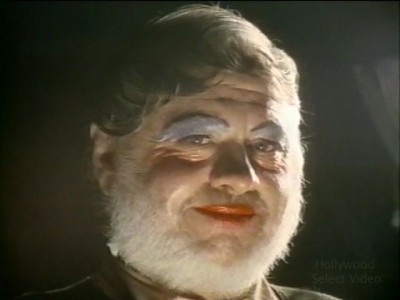
Mickey Rooney is ... THE MANIPULATOR!

Mickey Rooney is … THE MANIPULATOR!

Up until recently, I firmly believed that Love and Other Drugs was the most annoying movie ever made.  But then, a few nights ago, I cracked open my Mill Creek 50 Drive In Movie Classic box set and I watched a little film from 1971.  I was just looking for a horror film to review for October.  Little did I know that I would soon be watching the most annoying movie ever made!

The name of that movie?

The Manipulator.

The star of that movie?

Mickey Freaking Rooney.

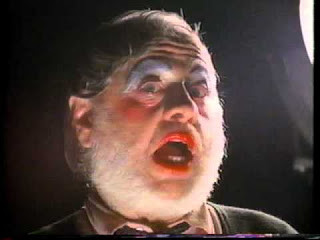
In The Manipulator, Mickey plays B.J. Lang, a former Hollywood makeup artist who has had a mental breakdown.  He now lives in a dusty warehouse, surrounded by old movie props and mannequins.  B.J. spends a lot of time talking to himself and trying on makeup.  Sometimes, he wears a fake nose and pretends that he’s Cyrano de Bergerac.  And then, at other times, he imagines all of his mannequins coming to life and taunting him.  (It’s kind of like the final scene of Maniac, except nobody’s head gets ripped off.)  Occasionally, he has weird flashbacks, which are all about giving the filmmaker an excuse to utilize the fish-eye lens and psychedelic lighting.

Eventually, we learn that BJ (and, as I watched the film, I kept wondering if his name was supposed to make viewers think about oral sex) is not alone in his warehouse.  There’s a woman (Luana Anders) who is being held prisoner.  He has her tied up in a chair and, whenever she begs to eat, he feeds her baby food.  BJ calls her Carlotta, though that’s apparently not actually her name.  The woman yells a lot.  Her first five minutes of screen time consist of her repeating, “MR. LAAAAAAAAAANG” over and over again.

BJ spends most of his time delivering monologues about how Hollywood used to be and occasionally, he demands that Carlotta help him put on a play.  At one point, BJ appears to have a heart attack and this leads to Carlotta going, “DON’T DIIIIIIIIIIIIIIIIIEEEEEE, MR. LAAAAAAAAANG” over and over again.

And then a homeless bum (Keenan Wynn) shows up and wanders about for five minutes before dying.

The problem with writing about a film like The Manipulator is that, just by describing the plot, you make it sound more interesting than it actually is.  You’re probably reading this and thinking, “Wow, this sounds really weird!  I need to see it at least once…”

No, you don’t.  It may sound weird but ultimately, it’s more emptily pretentious than anything else.  This was both director Yabo Yablonsky’s first and final film and there is not a single camera trick that he does not employ.  We get the weird angles, the random moments of slow motion, the even more random moments when the film is suddenly sped up, the extreme close-ups, the sudden blackouts, the ragged jump cuts, and, of course, lots of rack focus and zoom lens use.  Compared to The Manipulator, the direction of Getting Straight appears to be mild and conventional!  The film does feature three talented performers but none of them seem to have the slightest idea what the movie is about or who they are supposed to be playing.  In particular, both Rooney and Wynn seem to be making up their dialogue as they go along.

And really, that’s why The Manipulator is so annoying.  It should have, at the very least, been an insane misfire.  Instead, it’s just boring.

Sorry, Mickey.
Mickey Rooney Again


Icarus File No. 2: Maximum Overdrive (dir by Steven King)


mo

There is exactly one effective sequence to be found in Maximum Overdrive, a horror film from 1986 that attempts to show us what would happen if all of Earth’s machines decided to destroy humanity.

It takes place at the end of a little league game.  The coach, happy that his team has won, declares soda for everyone!  He walks over to the soft drink machine and puts in his coins and…nothing happens.  The coach stares at the machine perplexed.  His team gathers around him.

Suddenly, a can flies out of the machine and hits the coach in the groin.  Coach falls to his knees, just to get another can driven straight into his skull, leaving him with a big bloody hole in his head.  As the coach twitches, his teams starts to run away.  Suddenly, the machine is shooting cans out at them.  Some of the kids escape but quite a few don’t.

Suddenly, as the kids flee, a driverless steamroller crashes through a fence and drives across the field, graphically flattening one of the players…

It’s over-the-top, it’s kind of scary, it’s fun in a naughty sort of way, and it’s exciting to watch.  It’s totally absurd and yet it’s effective at the same time.  It’s a really brilliant scene, one that hints at what Maximum Overdrive could have been.  It hints that Maximum Overdrive‘s first-time director did have some potential and watching it, one is tempted to feel a pang of regret over the fact that he never directed another film after this one.

However, then you watch the rest of Maximum Overdrive and you realize that one effective scene was a total fluke.  To your horror, you realize that this film’s director (and screenwriter) has decided to set nearly the entire film in the ugliest and most disgusting truck stop in the world.  You realize that the director has no idea how to maintain suspense and that his idea of horror appears to be having a lot of trucks constantly circling the truck stop.  And then, worst of all, you realize that the unlikable caricatures inside the truck stop are meant to be our heroes!

And you find yourself wondering if things could possibly get any worse.  Well, believe me — they can.

First off, a guy named Camp Loman (Christopher Murney) shows up and reveals himself to be a total lech and then starts trying to sell bibles and really, what do you expect from someone named Camp Loman?  And, what’s annoying, is that the film’s director seems to think that he’s blowing our mind by presenting us with an hypocritical bible salesman.  I mean, seriously — the amount of time devoted to Camp Loman will make you nostalgic for scenes of a steamroller crushing a child.

And then Emilio Estevez shows up as our hero but he scowls through the entire movie and delivers all of his lines through gritted teeth, as if he’s pissed off about appearing in Maximum Overdrive and really, who can blame him?  That said, it doesn’t really make for an enjoyable performance.

But hey — Emilio’s not the only person in the truck stop.  There’s also Pat Hingle, playing the owner of the truck stop.  He’s overweight, wears a tie, smokes a cigar, and speaks with a vaguely Southern accent.  Hmmmmm, do you think he’s going to be a bad guy?

Oh!  And let’s not forget the waitress played by Ellen McElduff.  “WE MADE YOU!” she shouts at the machines and then she shouts it again and again and again and again and it’s almost as if the film is being directed by a guy so in love with his own dialogue that he doesn’t realize how annoying the same line gets when it’s screeched over and over again.

And I haven’t even gotten to the helium-voiced newlyweds yet…

When I recently watched Maximum Overdrive on Encore, there were a lot of things that annoyed me, such as the bad pacing, the bad acting, the bad dialogue, the bad special effects, the bad cinematography, and the bad everything else.  But what really got to me was just how inconsistent this movie was.  Some machines turned into killers but oddly, others did not.  At one point, a machine gun starts shooting at the people in the truck stop but the weapons that Pat Hingle keeps in the truck stop never turn on their human masters.  Seriously, if you’re going to make a terrible movie, at least be consistent.

So, you may be asking, why is this an Icarus File?  Well, it was directed by Stephen King, the writer who is routinely called the “master of horror.”  King may be a great writer but, judging from this movie, he was a really crappy director.  I imagine, when the film was in pre-production, the logic was that if King could write a scary book then he could definitely direct a scary movie.

Nope.

It turns out that, just as Icarus should never have gotten so close to the sun, Stephen King should never have directed a movie.

Previous Icarus Files:

  1. Cloud Atlas

Horror Film Review: The Green Inferno (dir by Eli Roth)


The_Green_Inferno_poster

AGCK!

Seriously, it’s hard for me to think of any recent film that has made me cringe as much as Eli Roth’s cannibal epic, The Green Inferno.  A film about a bunch of Occupy activists who end up getting eaten by a native tribe in the jungles of Peru, The Green Inferno does not shy away from showing us all the icky cannibal action.  Eyes are scooped out of heads.  Heads are removed from bodies.  Flesh is ripped off of a bones.  Blood flows everywhere and …. well, let’s just say that I didn’t have much of an appetite after watching The Green Inferno.

And, to be honest, I have no idea whether or not the gore effects were realistic or not.  It always amuses me when some of my fellow film bloggers say, “That’s not what the inside of a human body really looks like.”  Like we would know!  Listen, I have no idea what it’s like to cook a human body and I never will.  It may have been realistic or it may not have been.  It doesn’t matter.  All I know is that, in a very visceral and frightening way, the effects worked.  They made me look away from the screen.  They inspired me to say, “Agck!” and I imagine that’s the exact response that Roth was going for.

If The Green Inferno was a box office success, I imagine that thousands of people would leave the movie and promptly google, “Can you get cannibals high by stuffing a baggie of marijuana in a dead body?”  (The Green Inferno certainly argues that you can but it also suggests that, once a cannibal tribe gets the munchies, bad things will happen as a result.)

However, I doubt that The Green Inferno is going to be a box office success, at least not during its theatrical run.  The film was originally made in 2013 and it’s taken two years for it to finally get a theatrical release and it’s pretty much being dumped into theaters with little fanfare.  Not surprisingly, it’s currently getting slammed by most mainstream critics and it’s hard to imagine anyone who doesn’t review films online waking up and spontaneously saying, “I want to see that movie about people being eaten alive!”  (Myself, I had no great desire to see it but I felt somewhat obligated, considering that I’m a self-described grindhouse fan and horror lover.)  Jeff and I saw The Green Inferno on Tuesday, at the Cinemark 14 in Denton, Texas.  The theater was nearly deserted.

And, in many ways, it is a difficult film to recommend, though that’s exactly what I’m doing.  It’s not an easy film to watch but it does what it does well.  Back in the day, many grindhouse films were advertised as being “a film that goes all the way” and, for better or worse, The Green Inferno goes all the way.  At a time when so many horror films are either watered down or just the usual found footage rehash, The Green Inferno is a film that actually made me squirm in my seat.  It’s a film that delivered exactly what it promised and that does count for something.  The Green Inferno is being advertised as being nightmare fuel and that’s exactly what it is.

(SPOILER ALERT!  READ NO FURTHER IF YOU’RE GOING TO WHINE ABOUT SPOILERS AS A RESULT!)

There’s an interesting and unexpected political subtext to The Green Inferno and, I would argue, that political subtext is exactly why so many online critics are having such a violently negative reaction to the film.  The Americans who end up getting eaten by the cannibals are all Occupy-style political activists.  The reason that they are in Peru is to protest a company that is chopping down the rain forests.  When they do their protest, they all wear masks (which makes the Occupy comparison obvious) and they use social media to make sure that the whole world is watching.  It’s only later, once the surviving activists are all locked away in a cage and waiting to be eaten, that they learn that their leader, the arrogant Alejandro, was actually working for a rival logging company.  And now, they’re desperately waiting for that rival company to show up, tear down the rain forest, and save their lives.

And, oh my God — some reviewers (mostly the ones that write at sites like the A.V. Club)  are so upset about this!  But, honestly, those reviewers are missing the point.  The Green Inferno is not attacking the politics of the activists.  Instead, the film is attacking the shallowness of the activists themselves.  Almost all of them are caucasian, all of them come from privileged backgrounds, and all of them are so high on their own self-righteousness that they don’t even realize that they’re being manipulated by the same system they claim to be destroying.  And, just like the college students who spent a few months doing the Occupy thing and then went on to get a job on Wall Street, they ultimately expect the system to protect them even as they play revolutionary.  At the end of the film, hundreds of new white, privileged protestors are wearing t-shirts decorated (Che-style) with Alejandro’s face.  It’s a deeply cynical vision of political activism but, in many ways, it’s far more realistic than a lot of people want to admit and it makes The Green Inferno a bit more interesting than your typical gore film.

(Add to that, there are thousands of movies about heroic political activists so what’s wrong with having one film where they all get eaten in the Amazon rain forest?  Seriously, it’s not the end of the world…)

Admittedly, the film does make a huge mistake.  It features a mid-credits scene which sets up a sequel.  (And a sequel was announced way back in 2013 but has apparently been abandoned.)  That mid-credits scene — which feels more appropriate for a Marvel film — is totally unnecessary.  There’s no need for a sequel.  The Green Inferno accomplishes exactly what it set out to do.

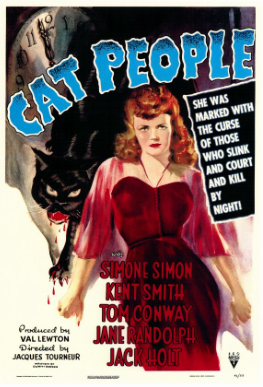
Horror Film Review: Cat People (dir by Jacques Tourneur)


Cat_People_poster

The 1942 horror classic Cat People is often described as being a horror film where, up until the last few minutes, the monsters are mostly psychological.  And there is some definite truth to that.  The title creatures remain a mystery for the majority of the film and, up until those final minutes, the audience would have every right to wonder whether or not they actually existed.  This is a film that seems to take place almost totally in the shadows, a film noir without detectives or gangsters but featuring a memorable and compelling femme fatale.

However, I would argue that there is a monster who is present on-screen long before the audience first sees the shadowy form of a cat person.  That monster is named Louis Judd and he’s the true villain of this story.  As played by Tom Conway, Louis Judd is a psychiatrist and, from the minute we first see him, we know that he’s not to be trusted.  He’s far too smooth for his own good and his soothing tones barely disguise the arrogant condescension behind his words.  If his pencil-thin mustache didn’t make him sinister enough, Dr. Judd also keeps a sword concealed inside of his walking stick.

Irena Reed (Simone Simon) is one of Dr. Judd’s patients.  A fashion designer from Serbia, Irena has recently married an engineer named Oliver Reed (Kent Smith).  Despite the fact that she loves Olivier, she cannot bring herself to be intimate with him.  As Dr. Judd discovers, Irena fears that she has been cursed and, if she ever allows herself to become aroused, she will be transformed into a panther.  Dr. Judd repeatedly tells her that her belief is just superstition and that her fears are the result of repressed trauma from her childhood.  When Irena refuses to accept his diagnosis and continues to insist that she is cursed, Dr. Judd assumes that he can prove her wrong by forcing himself on her.  (Big mistake.)

Meanwhile, Oliver loves Irena but her refusal to consummate their marriage is driving him away.  He finds himself growing more and more attracted to his co-worker, Alice (Jane Randolph).  At first, Irena is upset to discover that Oliver has been telling Alice about their problems.  But eventually Irena realizes that all she can do is watch as Oliver and Alice grow closer and closer.  Irena knows that she can’t give Oliver what he desires but the confident and outspoken Alice can.  As Irena grows more and more jealous, Alice starts to feel as if she’s being watched and followed.  She starts to hear growls in the shadows and when she’s at her most vulnerable — swimming alone at night — she is shocked when Irena suddenly appears and demands to know where Oliver is.

And really, that’s what makes Cat People such a great film.  It’s not necessarily a scary film, at least not to modern audiences.  Sadly, we have seen so much graphic real-life horror and have become so jaded by CGI that we’re no longer scared by the mere cinematic suggestion of a monster.  But the film still works because we can relate to both Irena and Alice.  When I look over my relationships, I can see times when I’ve been both the insecure Irena and the confident Alice.  For a film where the word “sex” is never uttered once, Cat People is a penetratingly honest look at relationships, love, and sexuality.

And it also features a truly memorable monster.

Seriously, that Dr. Judd is the worst!

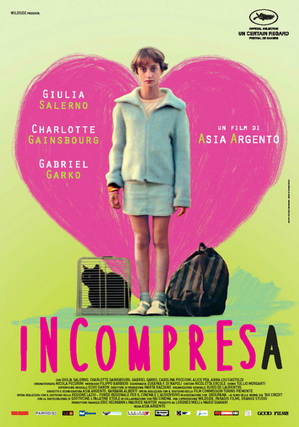
Film Review: Misunderstood (dir by Asia Argento)


Misunderstood_(2014_film)

I’ve always loved Asia Argento because, as both an actress and a public personality, she is tough, hard, and sexy all at the same time.  She’s not one of those actresses who feels the need to hide who she really is.  Watching her on-screen, you realize that she doesn’t give a fuck whether you like her or not.  Instead, she’s going to do whatever it is that she wants to do and, if you’re lucky, you might get to watch.  Some hold her responsible for the erratic output of Dario Argento’s post-Opera career but those people far too often fail to take into account that Asia, with her naturally off-center presence, has often been the most interesting thing about Dario’s later films. (Say what you will about Trauma, The Stendhal Syndrome, and Mother of Tears, they’re all better with Asia than without her.)  Asia Argento is one of those talented actresses who could never have played Ophelia because no one would ever believe that she would so easily drown.  Instead, she’d simply pull herself out of the water and then go kick Hamlet’s ass for being so indecisive.

If that paragraph sounds familiar, it’s because it’s the exact same paragraph that I used to start my review of Asia Argento’s directorial debut, Scarlet Diva.  I have no shame about recycling that paragraph for my review of Asia Argento’s third directorial effort, Misunderstood, largely because Misunderstood is, in many ways, a companion piece to Scarlet Diva.  Whereas Scarlet Diva was based on Asia Argento’s life as an international film star, Misunderstood is based on her famously dysfunctional childhood.  And, much as your enjoyment of Scarlet Diva was dependent upon how much you already knew about Asia’s life, how you feel about Misunderstood depends on whether you know that nine year-old Aria (Giulia Salerno) will eventually grow up to be Asia Argento.

Aria is the daughter of celebrities.  Her father (Gabriel Garko) is a famous actor who appears to be incapable of maintaining any sort of emotional attachment with his family.  Her mother (Charlotte Gainsbourg, made up to look like Asia’s real-life mother, the actress Daria Nicolodi) is an unstable and emotional musician who bitterly feels that she’s sacrificed her career for both her husband and her children.  She spends her time dramatically playing her piano and angrily arguing with the neighbors.

When we first meet Garko and Gainsbourg, they’re shouting at each other while eating dinner, a scene that should be painfully familiar to far too many of us.  It’s not surprising when Gainsbourg and Garko tell their three daughters that they are getting a divorce.  One of the daughters — who is obsessed with the color pink — goes to live with Garko.  Another daughter stays with Gainsbourg.  As for Aria, she finds herself constantly shuttling back and forth between her parents.  The film’s dominant image becomes one of Aria walking down a street, often between homes, while carrying a black cat with her.  (Her cat, by the way, is named Dac.  My black cat is named Doc.  That’s just one of the many things that made me relate to poor Aria.)  Aria is desperate to be loved but she’s almost too desperate.  Even her best friend eventually says that Aria is too clingy.

Misunderstood has been getting mixed reviews here in the States but anyone who has ever had to watch her parents split up will be able to relate to Misunderstood.  As I said, it helps to know that Aria will eventually grow up to be Asia Argento because, otherwise, parts of the film would be almost unbearably sad.  For those unfamiliar with Argento’s previous directorial efforts (Scarlet Diva and The Heart Is Deceitful Above All Things), it may take a while to get used to her exaggerated directorial style but, ultimately, it must be remembered that the film is not meant to be a literal representation of reality.  Instead, we are seeing things through the prism of the adult Asia’s memories of her dysfunctional childhood.  Asia Argento also proves herself to be a great director of actors and Charlotte Gainsbourg gives an amazing performance as an all-too human monster.

Reading some of the reviews of this film, all I can say is that many critics have misunderstood Misunderstood.  Is Aria always likable?  Of course not.  Does the film occasionally attempt to alienate the audience?  Yes, it does.  However, that’s always been the appeal of Asia Argento.  Largely as a result of the childhood that inspired Misunderstood, she never feels the need to pander as a filmmaker.  For those willing to give the film a chance, Misunderstood is an insightful look at what it’s like to grow up unwanted.  Asia is proving herself to be just as memorable a director as her famous father at his considerable best.

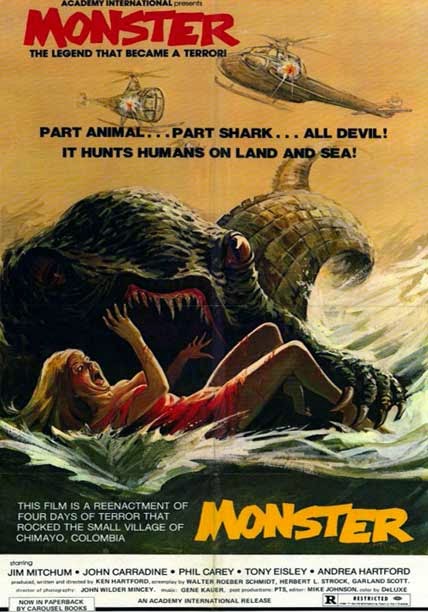
Horror On The Lens: Monstroid: It Came From The Lake (dir by Kenneth Hartford)


Monster_aka_-Monstroid,_It_Came_from_the_Lake-_poster_1980

Hi there and welcome to October!  This is our favorite time of the year here at the Shattered Lens because October is horror month.  For the past three years, we have celebrated every October by reviewing and showing some of our favorite horror movies, shows, books, and music.  That’s a tradition that I’m looking forward to helping to continue this year.

So, let’s start things off with a little indie film from 1980.  This film was released under several names, including Monster.  However, I prefer the title under which it has been included in several Mill Creek box sets: Monstroid: It Came From The Lake!

Monstroid tells the story of what happens when a monster emerges from a lake and starts killing people in Columbia.  Superstitious villagers blame a local woman whom they believe to be a witch.  Even though the town priest (and no horror fan should be surprised to discover that the priest is played by John Carradine) claims that he can exorcise the evil spirits that have possessed her, the villagers would rather burn her at the stake.  Meanwhile, the local Big Evil Corporation has sent in Travis (James Mitchum) to take care of the monster!

And what a monster!  Listen, there’s a lot of negative things that I could say about this low-budget film but the monster is simply adorable and must be seen by anyone who appreciates the rubber monsters that populated horror films in the days before CGI.

Plus, how can you resist a film that features not only Robert Mitchum’s son but John Carradine as well?

Enjoy Monstroid: It Came From The Lake!

Happy October!

A Blast From The Past: Rural Holidays


Hi there!

So, as you may know, I am on vacation for the next two weeks.  However, even though I’m off and having fun, I didn’t want to forget about our site’s wonderful readers!  So, I thought about it and I decided, why not share a blast from the past called Rural Holidays?

I haven’t been able to find out much background info on this little film.  It was obviously made in the 1960s and it’s meant to encourage city people to go out to the country on vacation.  I have to admit that the main reason that I like this film is because I’ve always been a secret history nerd.  I’m fascinated by how people used to live!

And that’s what Rural Holidays provides.  It’s a time capsule and you know how much I love those!

What Lisa Watched Last Night #140: Murder in Mexico (dir by Mark Gantt)


Last night, I watched the latest Lifetime original film, Murder in Mexico!

MiM

Why Was I Watching It?

I may be on vacation but that doesn’t mean that I’m not going to watch and live tweet the latest Lifetime film!

What Was It About?

This was one of those based-on-a-true-crime-story Lifetime productions!  Bruce Beresford-Redman (Colin Egglesfield) is a successful reality TV producer who has trouble being loyal to his wife (Leonor Varela).  When they take a vacation in Cancun, Bruce’s wife is murdered and Bruce quickly becomes the number one suspect.

What Worked?

Colin Egglesfield and Leonor Varela were both well-cast.  Also, the scene where Bruce crosses the Mexico-US border reminded me of the border scenes from No Country For Old Men.

What Did Not Work?

Just speaking as somebody who enjoys live tweeting Lifetime films, it’s always hard to know how to deal with these “true crime” movies.  The whole point of live tweeting is to be snarky and that can be difficult when you’re talking about real murderers, real victims, and real children who will now grow up without their mom and knowing their dad is in prison.  For that reason, Murder in Mexico was not as fun to live tweet as A Deadly Adoption or The Unauthorized Full House Story.

Beyond that, it was hard not to feel that Bruce Beresford-Redman and his crimes were not worthy of the attention that this movie gave to him.  The film attempted to make him interesting by playing up his past as a reality tv producer and trying to maintain some ambiguity as to whether or not Bruce was actually guilty but, ultimately, Bruce just came across as your standard cheating asshole.  In the end, both his guilt and his motives were too obvious to be intriguing.

“OH MY GOD!  Just.  Like.  Me!” Moments

In 2008, I went to Cancun for Spring Break and it was a blast!  Seriously, I had a great time and did a lot of things that I probably shouldn’t post in public.  However, none of those things involved murder and I suppose that’s a good thing.

Lessons Learned

Once a cheater, always a cheater.

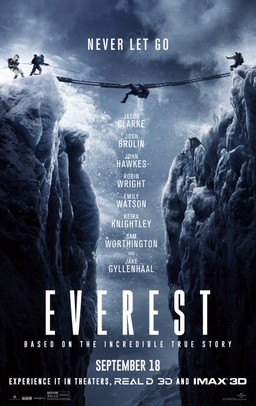
Film Review: Everest (dir by Baltasar Kormákur)


Everest_poster

If I wasn’t already scared of heights, I definitely would be after seeing Everest.

Based on a true story, Everest tells the story of two expeditions attempting to climb to the top of Mt. Everest.  One expedition is led by a New Zealander named Rob Hall (Jason Clarke), an experienced climber who, we’re told, pretty much invented the entire industry of taking commercial expeditions up to the top of Mt. Everest.  Criticized by some for being a “hand holder” who gets too emotionally involved with his clients and, as a result, cheapens the Everest “experience” by helping weaker clients make it to the top of the summit, Rob is married to a fellow climber, Jan Arnold (Keira Knightley).  While Rob tries to lead his clients to the highest place on Earth, the pregnant Jan stays home and waits for his return.

The other expedition is led by Scott Fischer (Jake Gyllenhaal).  Scott and Rob are friendly rivals, with Scott taking a much more hands off approach to his clients.  (It’s not a coincidence that Rob’s company is called Adventure Consultants while Scott works for Mountain Madness.)

Everest details what happens when the two expeditions are both caught in a sudden blizzard and find themselves trapped at the top of Everest.  The rest of the film is about the attempts of a stranded few to make it back to civilization.  A few make it, though not without suffering a good deal of pain and, in one particularly case, sacrificing a few body parts as a result.  Tragically, several others fall victim to the whims of nature, some dying of hypothermia while others, hallucinating from the lack of oxygen, literally walk off the side of the mountain.

Everest is one of those films where men die tragically but we’re supposed to find some sort of comfort from the fact that they died doing what they loved.  To be honest, I usually have a hard time buying into these type of narratives.  For instance, I love shopping but I wouldn’t expect anyone to be happy for me if I died while looking for a new purse.  (In fact, that’d probably upset me if not for the fact that I’d be too dead to know about it.)  At the same time, guys seems to love movies like this and I think, in the future, Everest will probably be remembered for being the epitome of a guy movie.

And that’s not meant to be a criticism on my part!  Everest does what it does with a lot of skill and confidence.  It’s an exciting film that, once the disaster hits, will leave you breathless.  And yes, at the end of the film, I did shed a tear or two.  Narratively, there’s really not a surprising moment to be found in the entire film.  I went into Everest not even knowing it was a true story and I was still able to guess who would survive and who would not.  But Everest‘s amazing visuals make up for the predictable narrative.  The term “visually stunning” is probably overused (especially by me!) but Everest is truly a visually stunning film.  For someone like me — who has asthma, a huge fear of heights, and who lives in North Texas (where, regardless of what you may see in the movies, the land is remarkably flat) — Everest is probably as close as I’ll ever get to climbing a mountain.

I should also mention that it never ceases to amaze me that Josh Brolin was born in Santa Monica, California because, on the basis of this film and No Country For Old Men, he is one of the most convincing Texans to appear in the movies.  In this film, he plays Beck Weathers, a Dallas doctor who is a member of Rob’s expedition team.  Usually, of course, if a Texan (especially one who is specifically identified as being a Republican, as Beck is at the beginning of a film) shows up in a movie, you know he’s going to end up being the villain.  Fortunately, Everest was based on a true story and, as a result, Beck turned out to be one of the most compelling characters in the film.  (If you know the story behind the film, you already knew that.  However, I went into Everest blind.)  Josh Brolin brings a lot of strength to his role and to the film overall.

Everest may predictable but it’s still an exciting film.  Make sure that you have someone beside you to whom you can hold on and that you see it in 3D!

The Things You Find On Netflix: The Loft (dir by Erik Van Looy)


The_Loft_film_poster

The Loft‘s journey to Neftlix was a long one.

A remake of a Belgian film, The Loft was originally filmed in 2011 and was meant to come out in that year.  It was due to be released by Joel Silver’s Dark Castle Entertainment and Warner Bros.  However, when Silver had a falling out with Warner Bros and moved his operations over to Universal, he took The Loft with him.  And it turned out that Universal was in no hurry to distribute The Loft.  After sitting on the film for three years, Universal announced that they would release it in August of 2014 but, at the last minute, they changed their mind and instead released the horror film As Above, So Below in the spot that was originally set aside for The Loft.  Dark Castle then dropped the film, leaving The Loft in limbo until Open Road Pictures picked up the distribution rights and gave it a limited release in January of 2015.  The critics hated it, audiences were indifferent, and The Loft quickly vanished from theaters.  It’s now available on Netflix.

And, having watched the film, I can understand why the studios weren’t exactly enthused about it.  It’s not the type of film that works on the big screen.  The characters are too unlikable.  The plot is an unstable combination of silliness and melodrama.  The big twists are more likely to inspire groans than cheers.  It’s just not the type of film that you want to spend too much money on.

And yet, it’s the perfect film for Netflix.  What may seem over-the-top and annoying when viewed in a public theater becomes a lot more entertaining when viewed in the privacy on your own home.  The Loft is a film that works best if you don’t spend too much time thinking about how little sense it all makes.  It’s the perfect film to watch while you’re doing something else.

And if that sounds like faint praise, it’s not.  I thoroughly enjoyed The Loft without once mistaking it for being a “good” film.  Instead, it’s an over-the-top melodrama, with all that entails.  It’s ludicrous, it’s silly, and — when taken on its own terms — it’s also a lot of fun.

The film is about five friends and the loft to which they all have a key.  All five of the friends are married and all five of them have secrets.  Vincent (Karl Urban) is the unofficial leader of this group of friends, an architect who is also a compulsive cheater.  Luke (Wentworth Miller) is a nervous guy who appears to worship Vincent.  Marty (Eric Stonestreet) is an alcoholic who always manages to say the wrong thing.  Chris (James Marsden) is a psychiatrist who often seems to feel that he’s morally superior to his other friends.  And Phillip (Mattias Schoenarts) is Chris’s half-brother, a mentally unstable and violent guy who snorts cocaine and may have incestuous feelings towards his younger sister.

The five men use the loft to cheat on their wives.  The men are all confident that only they know about the existence of the loft and that they are the only ones who have a key.  So, naturally enough, they are all a little shocked when a woman turns up dead in the loft.  As the men gather in the loft, they debate who killed her and we get numerous flashbacks to how this all came to be.

Of course, it all leads to many secrets being revealed.  This is one of those films that simply cannot stop with one plot twist.  Instead, every twist leads to another twist until eventually, it becomes nearly impossible to keep up with who knows what.  In fact, the film features so many twists that it all quickly gets a bit silly.  But, at the same time, it’s also undeniably entertaining.  Strangely enough, the fact that it doesn’t make much sense only add to the film’s melodramatic charm.

As for the five men — well, none of them are particularly likable but at least they’re all interesting to watch.  Wentworth Miller is properly strange, Matthias Schoenarts is properly sleazy, and Eric Stonestreet is properly pathetic.  James Marsden often seems wasted in mainstream films (like Straw Dogs and The Butler) but he’s actually very charming when he appears in B-movies like this one and Walk of Shame.  And finally, you’ve got Karl Urban, doing great work and turning Vincent into the epitome of every middle-aged guy who has ever tried to flirt with me while I was waiting at a red light.

The Loft may not have got much respect when it was released into theaters but it’s entertaining enough for Netflix.