This video is kind of weird and disturbing, which is why I liked it. I think if you’re going to do a music video, you have to do one of two things. You either have to make the viewer feel good or you have to give the viewer nightmares. If you can do both, then you will have truly succeeded.
Awwwwwwww! What an incredibly sweet video! Not only do we get to meet Marshmello’s family but we also see what a happy and friendly family that he comes from. There’s nothing more nerve-wracking than meeting your significant other’s family for the first time. When they welcome you with open arms and let you know that they accept you and that you belong, it’s such a great feeling.
As Marshmello put it: “This video is a reminder that no matter where you’re from, there is always room for acceptance. ❤”
That’s a good message, don’t you think? If nothing else, it’s good to see that humans and marshmallows can treat each other as equals. This, despite the long and sordid history of humans burning them over camp fires. I mean, if that can be forgiven then it seems like anything’s possible.
For those curious, in the real world, Marshmello is not actually a marshmallow. Instead, he’s a DJ named Chris. His distinctive look was inspired by Deadmau5. As well, if you’re really into Marshmello, you can go on YouTube and watch Cooking with Marshmello.
For instance, here Marshemllo shows us how to make Friend cookies:
And here, you can watch Marshmello play Fortnite blindfolded:
Welcome to the world of Motorcross, which is apparently the most fun you can have when you combine motorcycles and drunk people. (Of course, the majority of the drunk people are in the stands, watching. Or, at least, that’s the way things tend to be down here in Texas, where people are responsible drivers but irresponsible observes. Unless, of course, the driver has presidential ambitions and is the son of an extremely wealthy local politician. Then, he can pretty much do whatever the Hell he wants behind the wheel of a car….)
Anyway, I like this video because not only does it capture the blue collar swagger of a local sporting event but it also ends with a hint that everyone’s dead. At least, that’s what I assume the final image means. Did they die during the race or before? It’s totally possible that they could in Purgatory and maybe we’re just watching them pass the time while they wait for a final judgment.
I appreciate the dusty atmosphere of this video. I like the suggestion of a melodrama that we can observe but perhaps not quite understand. It’s a deceptively simple video. What looks like a simple race might actually be a journey to something else. It’s up to the viewer to decide just where exactly that journey is going.
I’m a Texas girl so I guess it’s kind of inevitable that I would love this video (not to mention the song!). I’ve spent some time in the desert though I haven’t spent as much time on the back of a horse as some members of my family. Some of that’s because, one of the few times that I did ride a horse, we ended up running straight through a giant spider web. Fortunately, the spider wasn’t home at the time but that still didn’t keep me from screaming all the way from Benavides to San Antonio.
I know that non-Texans tend to assume that everyone down here owns a horse and wears a cowboy hat but that’s not really true. That said, a Texas horse is still better than every other horse in every other state of the union.
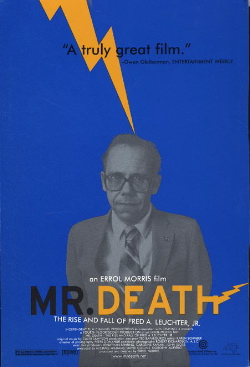
This 1999 documentary provides a disturbing portrait of an absolute moron.
Of course, when we first see and hear Fred Leuchter, Jr., he doesn’t seem like a moron. He definitely comes across as being a bit eccentric and maybe just a little bit off but, at first sight, he’s actually kind of likable. As he explains it, he grew up in the United States prison system. His father worked in prison administration and one of Fred’s earliest memories was sitting in an electric chair. Fred grew up to be an engineer and, concerned that America’s execution methods were cruel and potentially dangerous to even those who weren’t being executed, he decided to dedicate his life to redesigning electric chairs and gas chambers. He even built his own lethal injection machine, all designed to make sure that the condemned felt as little pain as possible while dying. As Fred explains it, he supports capital punishment but “I don’t support torture.”
Fred Leuchter soon came to be recognized as one of America’s leading experts on execution devices. As he himself admits, that’s largely because he was American’s only expert on the way that people are legally executed. Whereas most people deliberately went out of their way not to learn the specifics of what happens when someone is put to death, Fred made it his life’s purpose. After redesigning an electric chair in Tennessee, Fred was soon being summoned to other states so that he could refurbish and, in many cases, redesign their execution machinery. For the first 30 minutes of the documentary, Fred explains what it’s like to be an expert on executions and it’s hard not to like this nerdy, self-described “humanitarian.” If anything, you spend the first part of this documentary considering the oddness of finding a humane way to execute the condemned. America prides itself on both it’s rejection of cruel and unusual punishment and it’s willingness to put criminals to death. It’s an odd combination and, briefly, Leuchter seems like the embodiment of those two contrasting positions.
This changes during the documentary’s second half. That’s when we learn how, in 1988, Leuchter was hired by a German anti-Semite named Ernst Zundel. Zundel was being tried in Canada, charged with publishing and shipping works of Holocaust denial. For a fee of $30,000, Leuchter spent his honeymoon in Poland, went to Auschwitz, and personally “inspected” the gas chambers. Because Leuchter brought a camera crew with him, his every action was recorded.
We watch as Leuchter and his assistants sneak into the gas chamber and proceed to clumsily start chipping away at the walls. We listen as Leuchter goes on and on about how he doesn’t feel that the gas chamber was actually a gas chamber because it just seems too impractical to him. If they wanted to executed a large group of people at once, why didn’t the Nazis use the gallows? Leuchter wonders. (They did.) Why didn’t the Nazis use firing squads? Leuchter asks. (They did.) Even before Leuchter returns to America, he’s made it clear that his mind is made up. He can’t understand why the Nazis would have done what they did and therefore, in his mind, that means they didn’t do it. After all, Leuchter’s an expert. He’s Mr. Death.
He’s also a moron and, by the time he starts cheerfully talking about all the effort that went into smuggling the wall chips out of Germany, whatever likability he once had has vanished. Watching this film, I found myself wishing for a time machine so that I could go back in the past and throw something at him. You just want him to shut up for a minute and realize that what he’s saying makes no sense. Not that it would make any difference, of course. Leuchter is too proud of himself for having discovered “the truth” to actually consider that he could be wrong.
When Leuchter’s samples are tested for trace amounts of poison gas, they come back negative. Leuchter announces that this means that the Holocaust never happened and he writes up the infamous Leuchter Report, which is still regularly cited as evidence by Neo-Nazi groups and anti-Semitic historians like David Irving. However, as Dutch historian Robert Jan van Pelt explains (and, as we’ve already seen in the video that Leuchter himself shot at Auschwitz), Leuchter not only did not take a big enough sample but he was so clumsy in the way that he transported it that he diluted the sample as well. Even beyond all that, it would be very unusual for cyanide residue to still present after forty years of everyday wear and tear.
None of this matters, of course, to Fred Leuchter. With the publication of the Leuchter Report, he becomes a fixture on the Holocaust denial circuit. (We see an edition of the Leuchter Report that was published and distributed by the Aryan Nations.) Suddenly, Leuchter has fans. In his own sad and pathetic way, he’s become a celebrity and we see him beaming as he stands on the stage of a Neo-Nazi conference. Meanwhile, his wife leaves him. And prisons stop using him as a consultant, especially after they discover that he was never actually licensed to practice engineering. Financially bereft, Leuchter even resorts to trying to sell one of his beloved “execution devices,” putting an ad in the classifieds. (Needless to say, things don’t go well.) Looking over the ruins of his life, who does Leuchter blame for his troubles? “Jewish groups,” he says before then going on to assure us that some of his best friends were and are Jewish. Was Leuchter always an anti-Semite or did he become one because he needed someone to blame for his own self-destruction? That’s a question that the viewer will have to answer for themselves.
Mr. Death is a disturbing portrait of a rather sad and pathetic figure, a man who fell victim to his own arrogance and hubris and who, as opposed to seeking redemption, instead allied himself with the only people ignorant and hateful enough to still embrace him. As is his style, documentarian Errol Morris interviews Leuchter’s critics but refrains from personally arguing with Leuchter, instead basically giving the self-described execution expert just enough rope to hang himself. (Morris does, at one point, ask Leuchter if he’s ever considered that he might be wrong. Not surprisingly, Leuchter claims that he has not and seems to be confused by the question.) In the end, it’s impossible to feel sorry for Leuchter. The nerdy humanitarian who opposed torture had been replaced by a self-pitying Holocaust denier. By the end of the film, Fred A Leuchter, Jr. and his report have become a reminder of the damage that can be done by one dangerously ignorant man.
Today’s music video of the day is the story of two Swedish woman, one Italian man, and the city of lights. Just Another Night was filmed in Paris and it’s an enjoyable little 3-minute mini-film. Love, sex, betrayal, cool cigarette smoking, and film noir homages are all present in this video and we’re all the better for it.
This was directed by Marc Klasfeld, who has directed videos for — deep breath: Katy Perry, Jay-Z, Red Hot Chili Peppers, Britney Spears, Kid Rock, Michael Bublé, Nelly, Foo Fighters, Kelly Clarkson, Charli XCX, Little Mix, Nick Jonas, Twenty One Pilots, Avril Lavigne, Aerosmith, and Big Time Rush. So, in short, if you need someone to direct your music video, Marc Klasfeld is one of the people that you call. And if you can’t get him to do it, you can always go down to the local community college and get one of the aspiring film students to do it. It all depends on how much money you have to spend, I suppose.
One minute, you’re sitting in a hotel room and drinking from a bottle cheap wine and looking at a bunch of old, black-and-white photographs on the wall. You’re looking and you’re thinking, “When were these photos taken? Why are they in my hotel room? Is that what the hotel used to look like? Are the people in these pictures going to haunt my dreams? Is this like The Shining? Is Jack Torrance celebrating New Year’s in 1921?” And then you look at your bottle of wine and you ask yourself, “Why do I have this? I don’t even drink. Is my life a music video? Am I part of your dream or are you a part of mine? Forget it, Lisa Marie, it is what it is….”
And then, the next thing you know, you’re hanging from the ceiling and you’re singing a song that sounds like it should have been the theme song for an old WB show. It’s happened to all of us. We’ve all been a hot mess. We’ve all been haunted by thoughts of ghosts. And we’ve all held a bottle of wine and used it as a microphone while singing a tragic song.
(It’s kind of like that episode of Degrassi where Craig and Ashley got the hotel room before going to Ashley’s father’s wedding. And then Craig asked Ashley to marry him and, when she said she thought they should wait until they had at least graduated high school, he went back and destroyed the hotel room. It was kind of scary but, because it was taking place in Toronto, everyone was really polite about it.)
One thing that I’ve noticed about music videos is that the future is always a dystopia. It’s always full of people scurrying around dark alleys and sneaking into hidden laboratories and clubs. It appears that, in the future, people just decided to stop picking up after themselves. I think that’s what really bothers me about the whole concept of dystopia. I can handle a lot but I can’t stand the idea of being surrounded by garbage. Clean up after yourself and others. I guess that’s my way of looking at things.
Speaking of which, today is Earth Day. On the one hand, that makes this a great day to actually go out and do some cleaning. I mean, you’ve got a perfect excuse and everyone who sees you doing it will be like, “Go Earth Day! Woo hoo!” On the other hand, Earth Day seems to bring out the worst, most sanctimonious of impulses in some people. Whenever anyone starts bragging about how proud they are of themselves for observing Earth Day, I always want to ask them if they’re aware that the holiday was founded by a hippie who subsequently murdered his girlfriend and kept her decomposing body in a trunk for two years before fleeing to France. That’s a true story, by the way. Someone should make it into a movie.
So, I guess my point is that we should all do our part to pick up litter but, at the same time, don’t act like a self-righteous ass about it, okay? And don’t leave dead people in your closet or trunk. That’s just gross.
The other thing that I’ve noticed about music videos is that, regardless of how dystopian the future gets, people still want to dance. That’s understandable. It’s our ability to dance that makes us human.
Oh! And one more thing I’ve noticed about life in a music video dystopia: there’s a lot of neon around. Regardless of how dark the world may be, everyone’s still got a enough neon to light up the night.
This is a case where I like the song more than the music video. This video was actually filmed three years after Johnny Cash’s death. As far as “official” music videos are concerned, I always feel like a musician should have some sort of say into how their music is visually interpreted. Obviously, Johnny Cash wasn’t around to have anything to say about the video for God’s Gonna Cut You Down.
Since Cash wasn’t available, director Tony Kaye filled the video with cameos from other actors and musicians, a few of whom (though not many) were previous Cash collaborators. Among the celebs who make an appearance in this video: David Allan Coe, Patricia Arquette, Travis Barker, Peter Blake, Bono, Sheryl Crow, Johnny Depp, the Dixie Chicks, Flea, Billy Gibbons, Whoopi Goldberg, Woody Harrelson, Dennis Hopper, Terrence Howard, Jay-Z, Mick Jones, Kid Rock, Anthony Kiedis, Kris Kristofferson, Amy Lee, Adam Levine, Shelby Lynne, Chris Martin, Kate Moss, Graham Nash, Busy Philipps, Iggy Pop, Lisa Marie Presley, Q-Tip, Corinne Bailey Rae, Keith Richards, Chris Rock, Rick Rubin, Patti Smith, Sharon Stone, Justin Timberlake, Kanye West, Brian Wilson, and Owen Wilson. Some of the celebs — like Dennis Hopper and Kris Kristofferson — seem like they naturally belong there. Others seem so out-of-place that you’ll want to throw something. You know how that works,
God’s Gonna Cut You Down is a traditional folk song. I’ve heard countless versions of it. I prefer Cash’s version to the more traditional gospel arrangement but, then again, I tend to find gospel music to be dull in general. Cash’s arrangement brought new life to an old song.
It was a year ago today that we learned of the passing of Tim Bergling, who was better known as Avicii. For those of us who loved Avicii’s music and who followed him throughout not only his career but also through his multiple health issues and his widely publicized retirement from touring, the loss of Avicii is one that we have yet to recover from.
On this sad anniversary, I’m thinking about the first time that I watched Avicii: True Stories on Netflix. This documentary, which covered the majority of Avicii’s career — from his rise to his eventual retirement, was released in Europe six months before his death. In the U.S., it was released on Netflix on December 14th, 2018. It’s not always an easy documentary to watch but I recommend it to anyone who loved Avicii’s music or to anyone who is just curious about the pressures that go with being a star.
Featuring interviews with not only Avicii but also his collaborators, the film follows Avicii as he quickly goes from being just being one of the many people posting remixes on online forums to being one of the top and most important DJs in the world. We watch as Avicii maintains a hectic schedule of nonstop touring, often sacrificing both his physical and mental health in the process. Avicii ends up in the hospital, suffering from acute pancreatitis. Later, he again ends up in the hospital, this time to have both his appendix and his gall bladder removed. The film makes no attempt to hide the decadence that goes along with touring but, in its best moments, it also highlights the conflict that arises from having to be both Tim Bergling, an anxious young man who finds a much-needed escape in music, and Avicii, the superstar who has to be on every night.
When we first meet Tim, he seems young and hopeful and enthusiastic. Halfway through the film, an exhaustion starts to creep into his voice and, by the end of the film, he’s become far more world-weary. As we watch Tim struggle with the weight of being Avicii, we’re also aware of the people around him, whose careers and finances are pretty much dependent on making sure that Tim never stops being Avicii, regardless of how much damage it does to him mentally and physically. Throughout it all, one thing remains consistent and that is Tim’s love of music. It’s only when creating and talking about music that Tim seems to be truly happy. It’s his escape from a world that often seems like it’s conspiring to swallow him whole.
The film ends on what should have been a happy note. Tim announces his retirement from touring and the film ends with him, in good spirits, on a beautiful beach. Tim seems like he’s finally found some happiness and a chance at the inner peace that stardom often denied him. Beyond a title card (which was added for the film’s U.S. release), Avicii: True Stories does not deal with Tim’s death but it still haunts every minute of the film. Watching this documentary, it’s impossible not to mourn what the world lost when it lost Tim Bergling. The film stands as both a tribute to his talent and a portrait of a good and likable man struggling to escape his demons.

 Through the Shattered Lens