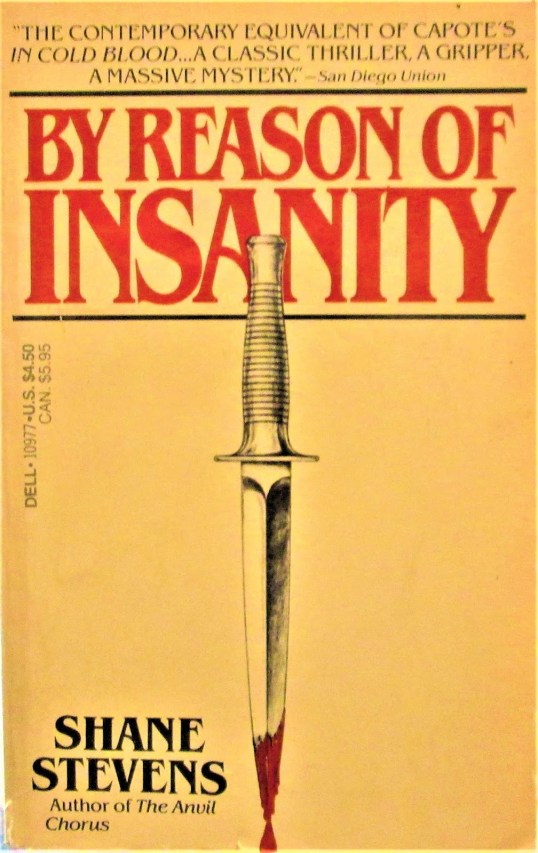
Horror Book Review: By Reason of Insanity by Shane Stevens


By Reason of Insanity, a novel from 1979, tells the story of a truly terrifying killer.

Institutionalized for murdering his own mother, Thomas Bishop manages to escape from the asylum and proceeds to travel across the United States, murdering almost every woman he meets.  For all of Bishop’s attempts to justify his homicidal impulses, it mostly appears that he kills because he enjoys it.  It’s what he’s good at.  It’s what comes naturally to him.  Bishop is a clever and meticulous killer but he’s hardly super human.  That’s what makes him so disturbing.  Unlike someone like Dr. Hannibal Lecter or any of the fictional killers that have been spawned by his popularity, Bishop isn’t some sort of erudite, witty genius with a gimmick and a tendency to only kill the unsympathetic.  He’s just someone who is very good at what he does.  He’s a believable killer and all the more frightening because of it.

The novel, however, isn’t just about Thomas Bishop.  Thank God for that because Bishop is such a nihilistic and misogynistic character that, if this rather lengthy novel took place entirely in his head, it would probably be almost impossible to actually get through it.  The novel also explores the lives of the people who are effected by Bishop’s crimes.  We meet the reporter that follows his crime spree and the detectives who want to stop him.  We meet the ambitious politician who thinks that he can use Bishop’s notoriety as a stepping stone to the White House.  New characters are constantly entering the narrative, some staying for the entire length of the novel and some ducking out almost as quickly as they arrived.  Sometimes, it can be difficult to keep track of everyone but their presence reminds us that the actions of someone like Thomas Bishop do not occur in a vacuum.  They create a ripple effect that eventually touches everyone.

Throughout the book, Bishop obsesses on the identity of his father.  He believes that his father was Caryl Chessman, a real-life criminal who, in the 50s, became a cause celebre for some when he was sentenced to death after being convicted on 17 counts of kidnapping and rape.  (Though Chessman confessed to being the infamous “Red Light Bandit,” he later said that he did so only after being beaten and tortured by the cops.)  From his cell in San Quentin, Chessman protested his innocence and wrote books about his life both outside and inside of prison.  Chessman was eventually executed in 1960.  Bishop, who has spent his entire life under the impression that Chessman was his father, feels that he’s continuing the family legacy.  However, the book’s brilliant final line leaves it to the reader to decide not only whether Bishop was correct in his belief but also as to whether it would have made any difference.  If Thomas Bishop had grown up believing that his father was Pat Brown, the governor who eventually oversaw Chessman’s execution, would he have still become a murderer or would he have instead felt he was destined for a career in politics?  It’s an interesting question.

By Reason of Insanity is a well-written and nightmare-inducing serial killer novel.  With its straight-ahead approach and refusal to try to turn Bishop into an antihero, it’s quite a contrast to the serial killer novels that would follow.  Read it but keep the lights on.
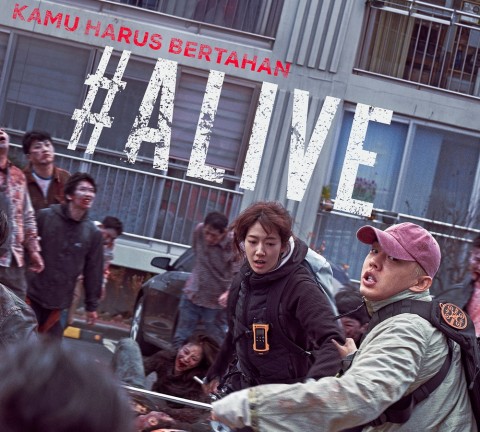
International Horror Film Review: #Alive (dir by Cho Il-hyung)


My feelings on the zombie genre are so mixed.

On the one hand, zombies are scary and zombie movies, when done well, can be genuinely disturbing.  Zombie movies deal with the inevitably of death.  Whenever someone dies, we always say that they’re at peace.  “At least, they’re not suffering anymore,” we say.  Zombie movies suggest that there is no peace after death.  Instead, the suffering of life is just replaced with nonstop hunger and savagery of death.  Meanwhile, the living don’t even get a chance to mourn their dead before they’re forced to kill them again.  Zombies are relentless and they used to be our friends and family.  That’s one reason why zombies haunt us in a way that certain other monsters never will.

At the same time, when it comes to zombie movies, there’s just so many of them!  Seriously, it seems like there must be at least a hundred zombie movies released every year.  We’ve seen so many scenes of the dead running through empty city streets that it’s hard not to get cynical.  The first time you see a reanimated corpse eat its parents, it’s disturbing.  But, by the hundredth time you’ve seen it, it’s just expected.  We now live in an age where every disaster is compared to a “zombie apocalypse.”  Even non-horror fans know about zombies.  The days of zombies being obscure are over.  They’re now firmly a part of pop culture and, as a result, they’ve become a bit annoying.

I say all this because, in many ways, #Alive is a standard zombie film.  This South Korean film opens with Joon-woo
(Yoo Ah-in) in his apartment, playing video games.  When reports come in of something strange happening in the streets of Seoul, Joon-woo goes out to his balcony to see what’s happening.  What he sees is a world gone mad, one in which hordes of growling people run through the streets, biting down and feeding on anyone who gets to close to them.  Yes, the zombie apocalypse has begun and Seoul is apparently right in the middle of it.

And don’t get me wrong.  The zombies are indeed frightening and there’s an exciting sequence where Joon-woo has to force one out of his apartment.  It’s all very well-directed and well-acted by Yoo Ah-in but it’s not anything that we haven’t seen before.  At this point, audiences have seen so many zombie rampages that if a real one ever breaks out, the uninfected will probably start bitching about how different it is from what the movies led them to expect.

What sets #Alive apart is the way it captures the feeling of being totally isolated and alone.  Trapped in his apartment with only a limited amount of food and with no way of knowing whether or not his family is still alive, Joon-woo tries to maintain his sanity.  Joon-woo is isolated from the outside world.  He’s quarantied himself.  Occasionally, he steps out on the balcony and sees if the zombies are still outside.  (They are.)  Occasionally, he checks the news to see if there’s an end in sight.  (There’s not.)  As the days pass, Joon-woo finds himself tempted to surrender to his despair.

But what if Joon-woo isn’t the only person left alive in his apartment complex?  What if, on the other side of the complex, there’s a woman named Kim Yoo-bin (Park Shin-hye) who is trying to catch Joon-woo’s attention so that he’ll know that he’s not alone and that she’s willing to help?  And just how much of a risk is Joon-woo willing to take to end his isolation?

That’s a question that feels especially relevant today, at a time when so many people are isolated, either voluntarily or by doctor’s orders.  When a newscaster describes the zombies as being infected, it’s impossible not to think about what’s currently going on in the world.  When Joon-woo discovers how truly difficult it is to be alone and unable to leave your home …. well, that’s the way many people have felt this entire year.  Though #Alive was filmed before the pandemic lock-downs, it feels like a movie about our current times.  As such, it has a power to it that it might not have had if it had been released at a different time.  Like everyone, Joon-woo struggles with fear and despair.  But, at the same time, he never allows himself to forget that he’s not dead yet.  He’s still alive and there’s still hope.

#Alive is a film about how difficult it can be to live while everyone around you is obsessing on death but it’s also a film that encourages its viewers to embrace life, no matter how difficult or frightening the situation.  It’s a film about the dead that ultimately has a lot to say about what it means to be alive.

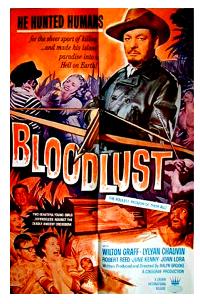
Horror on the Lens: Bloodlust! (dir by Ralph Booker)


In this 1961 version of The Most Dangerous Game, two vacationing couples find themselves trapped on a tropical island and hunted by the insane Dr. Albert Balleau (Wilton Graf).  Dr. Balleau loves to hunt people.  Why, you could even say that Dr. Balleau has a …. BLOODLUST!

Anyway, this is an undeniably low-budget film and it’s kind of silly but that’s actually what makes it watchable.  There’s a thousand different versions of The Most Dangerous Game out there but this is the only one to feature Robert Reed, the dad from The Brady Bunch, being hunted through the jungle.  If you’re like me and you think that Mike Brady was an authoritarian fascist, this film is for you.

Enjoy!

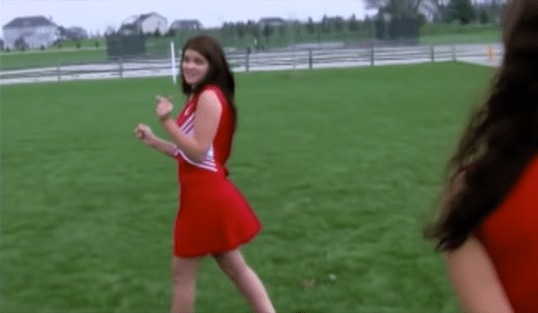
The TSL’s Horror Grindhouse: Die Cheerleader Die! (dir by Jerry Patterson)


Hey, what do you think this film is about?

Die Cheerleader Die! is a film that was first released in 2008. It’s an independent film out of Chicago and it’s about cheerleaders. It’s also about someone who is murdering all of the cheerleaders at a …. well, I’m not sure if they were supposed to be in high school or college. All of the cheerleaders appeared to be grad student age but all the classrooms looked like they belonged in a high school.

Anyway, Tiffany (Inga Draper) is in charge of the cheerleading squad at this high school or college and she basically runs it like a dictator. She tells everyone what they can and cannot do. For instance, she orders Robin (Maria Perez) to starve herself, even though Robin is not overweight at all. Robin finds herself being tempted away from the cheerleaders by a group of body acceptance activists who are referred to as being “Pretty Intelligent Girls” or …. well, you can figure out the acronym for yourself. When cheerleaders start to turn up dead, the Pretty Intelligent Girls are the number one suspects but could it be someone else?

Who knows? This film is a difficult one to sit through, largely because it was shot on video with amateur actors, fluorescent lighting, and natural sound. That’s another way of saying that Die Cheerleader Die is essentially a 90-minute YouTube video and it’s perhaps appropriate that that’s where I saw it. There’s no suspense, the kills aren’t particularly interesting, and the whole thing just gets kinda boring pretty quickly.  As I always do whenever watching a horror film about cheerleaders, I forced my sister to watch it with me so that I could get her thoughts on whether or not the film accurately captured the high school cheerleader experience.  Erin abandoned the film after about seven minutes but I stuck with it because I though it might turn out to be a Coen Brothers-style commentary on high school films.  It wasn’t.

But, I don’t like being totally negative in any review so I am going to point out two good things. Number one, Inga Draper gave a pretty good performance as Tiffany. She was like every aspiring dictator that you ever knew in high school. Secondly, regardless of whether the film is any good or not, you can’t deny that it actually got made. The filmmakers may have made some poor production choices but they still got their film made and, 11 years later, it’s still being watched and reviewed. That’s more than most people who have, at some point, said, “I’m going to make a movie!” have accomplished.

Finally, cheerleaders always seem to be at a disadvantage in horror movies. I’ve always found that pretty strange because most of the cheerleaders that I’ve known were tough-as-nails athletes who, because they were constantly having to deal with snarky comments and pervy flirtation, knew how to take care of themselves. In a real life horror movie, the cheerleaders would probably be the only ones to survive.

Trust me, when the apocalypse hits and the world is burning all around you, you’re going to be looking to the cheerleaders to not only keep up your spirits but save the world as well.

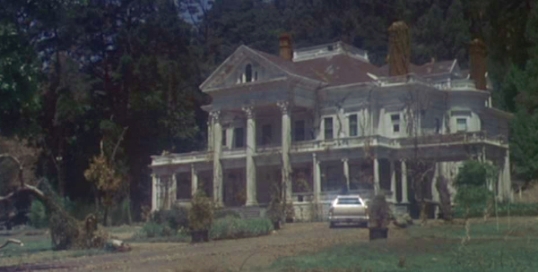
Horror Film Review: Burnt Offerings (dir by Dan Curtis)


This 1976 film is about a family so obnoxious that their own house tries to kill them!

Well, maybe it’s not entirely the family’s fault. The film suggests that the house would have tried to kill anyone who lived there because the house itself is possessed by ghosts or Satan or something of that nature. Still, you can’t help but feel that the house took some extra joy out of destroying the Rolf family.  I know that I got some extra joy out of watching them get destroyed.

Ben (Oliver Reed) is a writer. Ben’s wife, Marian (Karen Black), is a flake who becomes obsessed with the house as soon as she sees it. Their son 12 year-old son, Davey (Lee Montgomery), is …. well, there’s no nice way to say this. He’s a brat. He’s the type of kid who you would be terrified of your kid befriending at school because then he’d want to come hang out at your house all the time. The movie doesn’t seem to realize that he’s a brat but the audience does. And finally, Aunt Elizabeth (Bette Davis) is Bette Davis, which means that she spends most of the movie delivering her lines in the most overdramatic and arch way possible.

The Rolfs are renting the house for the summer. The owners of the house are the Allardyces (Burgess Meredith and Eileen Heckart) and you would think that people would know better than to rent a house from Burgess Meredith. I mean, how many horror films in the 70s specifically featured Meredith as some sort of emissary of the devil? The Rolfs are asked to do two things: look after the house and look after Mrs. Allardyce, who lives on the top floor and never wants to be disturbed. The Rolfs are assured that they’ll never see Mrs Allardyce and the Rolfs are like, “Sure! That makes sense!”

Anyway, as soon as the Rolfs move in, the house starts to make weird noises and shingles start flying off the roof and, at one point, Ben nearly drowns his son in the pool.  And while it’s kind of understandable, considering how annoying his son is, it’s still not a good look.

Yep, it’s pretty obvious that the house is evil but Marian loves it, almost as if she’s becoming …. possessed! Meanwhile, Ben keeps having visions of a sinister looking chauffeur (Anthony James, whose creepy smile is the only memorable thing about this film) and Davey keeps standing too close to the outside chimney. You don’t want to do that when a house hates your guts.

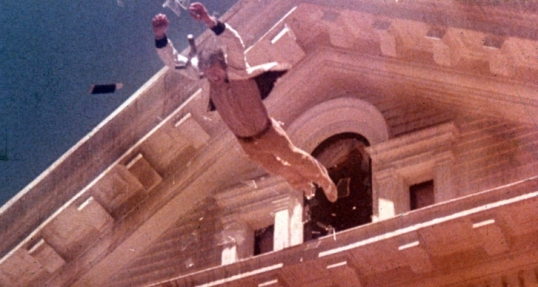
It all leads to the inevitable ending, which involves people getting tossed out of windows and *ahem* crushed by chimneys. The family’s so obnoxious that you can’t help but cheer when that chimney comes down.  In fact, to be honest, as little as I think of this movie, I always specifically watch it just to see that chimney come down on one certain character.  Things might not work out well for the Rolfs or anyone else watching this rather slow and predictable movie but at least the house survives.

Fly, baby, fly!

Now, I will admit that I do own this film on DVD, simply because I love the commentary track.  Director Dan Curtis, star Karen Black, and the film’s screenwriter, William F. Nolan, watch and discuss the film and it quickly becomes obvious that none of them remember much about making it.  While Karen Black tries to keep the peace, Curtis and Nolan bicker over who is most responsible for the parts of the film that don’t work.  When Anthony James shows up as the creepy chauffeur, Dan Curtis says that he doesn’t remember his name and then gets visibly annoyed when Karen Black spends the next few minutes talking about what a good actor Anthony James is.  It’s all enjoyably awkward and, as someone who has hosted her share of live tweets, I couldn’t help but sympathize with everyone’s efforts to find something positive to say about Burnt Offerings.

Horror on The Lens: Where Have All The People Gone? (dir by John Llewellyn Moxey)


For today’s horror on the lens, we have a 1974 made-for-TV movie about what happens when a family comes down from the mountains and discovers that everyone’s disappeared.

“Where have all the people gone!?” is the obvious question and it’s also the title of this film.  Our own Jedadiah Leland reviewed this movie back in March and he described it as being “effectively creepy.”  I watched it with my friends in the Late Night Movie Gang a few months later and we described as being perhaps the best Peter Graves film we had seen since we watched that one where everyone was a clone.

So, after those recommendations, how can you not watch Where Have All The People Gone?

Enjoy!

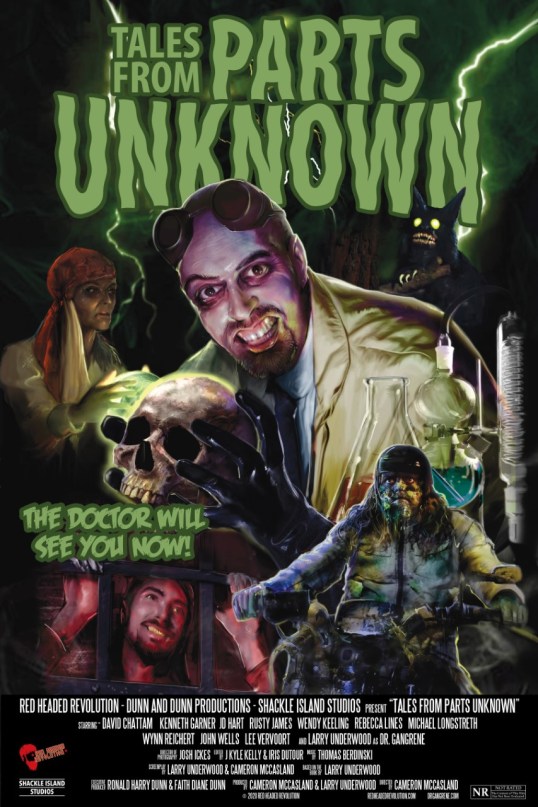
Horror Film Review: Tales From Parts Unknown (dir by Cameron McCasland)


On Shackle Island, there’s a somewhat dilapidated-looking mansion.  And inside that mansion, there’s a friendly and talkative scientist by the name of Dr. Gangrene (played by Larry Underwood).  If you need shelter from the rain, Dr. Gangrene will be more than happy to accommodate you.  Of course, if you do accept Dr. Gangrene’s hospitality, you’ll have to visit the lab and take a look at the doctor’s truly impressive collection of brains.  For every brain, there’s a different story.  In the new horror anthology film, Tales From Parts Unknown, Dr. Gangrene introduces four of those stories.

The first brain, Tailypo, tells the story of a hunter and his dog and what happens when their prey escapes from them but loses its tail in the process.  Let’s just say that some creatures don’t take well to losing their tails and that, if you ever do happen to come across a tail out in the middle of the wilderness, it’s probably best to just leave it where you found it.  I originally reviewed Tailypo back in 2015 and it was interesting to get a chance to rewatch it.  (From my review: Tailypo is the first in a series of short films that McCasland is planning to put together for an anthology film that I hope I will someday get a chance to review.)  Tailypo holds up well to a second viewing.  Not only does David Chattam give a good and sympathetic performance as the Hunter but Tailypo really does capture the feel of being the type of story that someone would tell while sitting in front of a campfire.

The second story was Retrieval Service, which told the tale of two gravediggers who eventually make the mistake of trying to rob the dead.  Retrieval Service had a nice Southern gothic feel to it.  It was set (and filmed) in Tennessee and it really captured the unique feel of the region.  The two grave diggers (played by Kenneth Garner and J.D. Hart) got some good lines and had some enjoyably surreal nightmares on their way to digging up graves in search of treasure.  Don’t disturb the dead, the story tells us, no matter how much jewelry they’re wearing.

For The Prisoner of Perdition, we take a trip back to the old west.  In the small town of Perdition, an outlaw named Thorne (John Wells) waits in jail.  An angry mob wants to play jury and executioner but Marshal Tom Clanton (Rusty James) is determined to keep him safe.  However, Thorne has plans of his own and, as becomes apparent throughout the night, he’s also very good at manipulating people.  In fact, he’s a little too good at it.  It’s almost as if he’s not quite human….

The Prisoner of Perdition may not be the most historically accurate western ever made but that’s actually accounts for a good deal of the segment’s charm.  It’s not taking place in the real old west as much as it’s take place in the public’s popular imagination of what the old west was like.  As a result, you’ve got panicky townspeople, women posing on the saloon’s balcony, a tough-talking marshal, and a coldly manipulative prisoner.  The Prisoner of Perdition looks like it was an enjoyable segment to film, which makes it an enjoyable segment to watch.  John Wells does a good job as the charming but evil Thorne.

The Prisoner of Perdition is followed by my favorite story, The Rider.  The Rider is about a greedy writer (Wendy Keeling), her henpecked husband (Wynn Reichert), and the Biker (Lee Vervoort) that the writer accidentally runs over while she’s trying to drive and yell at her husband at the same time.  In its way, The Rider provides a nice tail-end to Tailypo, though the greedy writer is a far less sympathetic character than the unfortunate hunter.  Like Tailypo, The Rider has a lot of atmosphere and an appropriately dark conclusion.

Tales From Parts Unknown is a horror anthology that has an enjoyably retro feel to it.  Larry Underwood (a.k.a. Dr Gangrene) is a veteran horror host and he’s a lot of fun to watch as he holds up each brain to the camera and as he explains why the viewer can’t leave the laboratory just yet.  Tales From Parts Unknown is an entertaining film, perfect for the Halloween season.

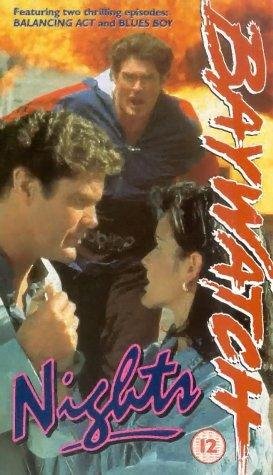
Horror on TV: Baywatch Nights 2.2 “Creature” (dir by David W. Hagar)


In tonight’s episode of televised horror, it’s David Hasselhoff vs. a mermaid.  Basically, the mermaid wants to procreate but it also wants to kill and that leads to all sorts of conflicts and….

Well, listen, this episode is pretty silly.  To be honest, they’re all pretty silly.  But that’s kind of the fun of it all, isn’t it?

This episode of Baywatch Nights originally aired on October 6th, 1996.

Enjoy!

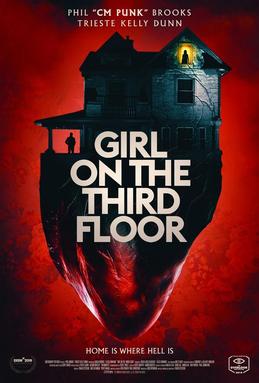
The TSL’s Horror Grindhouse: Girl on the Third Floor (dir by Travis Stevens)


The 2019 film, Girl on the Third Floor, tells the story of Dan Koch (Phil Brooks), a former criminal who says that he’s trying to turn his life around.  Phil is married to Liz (Trieste Kelly Dunn) and they’ve not only got a baby on the way, they’ve also got a new house!  It’s a surprisingly big house and you have to kind of wonder why no one else has bought it.  Maybe it’s because there’s an Episcopalian church right across the street.  That definitely would have kept me from moving in.

Still, despite the presence of Anglicans in the neighborhood, Phil moves into the house.  He wants to get the house ready before his pregnant wife comes out to join him.  Helping Phil out are his dog Cooper and his best friend, Milo (Travis Delgado).  Ellie (Karen Woditsch), the rather judgmental pastor who lives in the church, also comes by and visits.

Of course, any old house is going to have its issues.  There’s the mysterious sludge that pours out of the walls.  There’s the mysterious marbles that keep rolling through the house.  There’s the mysterious bumps in the nights and the fact that Cooper seems to be weary of the new home.  Dogs can always pick up on evil.  Of course, along with being a bit of an idiot, Don is too busy banging his new neighbor, Sarah (Sarah Brooks), to notice.

Don, if you haven’t guessed, is a bit of a jerk.  Even though he swears that he feels guilty for cheating on his wife, he still does it.  When his friends mysteriously disappear while helping out around the house, Don doesn’t make much of an effort to find them.  When Don thinks that there’s a chance his wife might find out what’s been going on at the house, he goes to extreme methods to try to cover everything up.  Don thinks that he can control every situation but Sarah and the House both appear to be intent to prove him wrong.

Girl on the Third Floor is a deliberately-paced …. well, I guess you’d call it a haunted house story.  I was tempted to call it a ghost story but the film is frequently ambiguous as to whether or not the house is haunted by ghosts or by something far worse.  Eventually, we do learn a bit about the house’s past but Girl on the Third Floor is at its best when it leaves you wondering what exactly is going on.  Not all questions have to be answered, especially not in a horror movie.  In fact, the key to most successful horror tales is the knowledge that some questions will never be answered, no matter how effort we put in to  searching for a solution.

Phil Brooks, who wrestled under the name CM Punk, is well-cast as the frequently brutish Don.  Brooks convinces us that he does want to be a better person while also showing that he doesn’t really have the inner strength necessary to do so.  Trieste Kelly Dunn also does a good job as Don’s wife, who seems like she really does deserve better.  Not surprisingly, the film is stolen by Sarah Brooks as the mysterious neighbor.  Not only does she get to wear all the best clothes but she also gets all of the best lines and her confidence that Don will fail whatever test she puts before him is both chilling and understandable.

Despite being a little bit slow-paced (especially early on in the film), Girl on the Third Floor has enough atmosphere to hold one’s attention and the final third of the film is enjoyably surreal.  Girl on the Third Floor is currently on Netflix.  Watch it the next time you’re wondering whether or not to start a home improvement project.


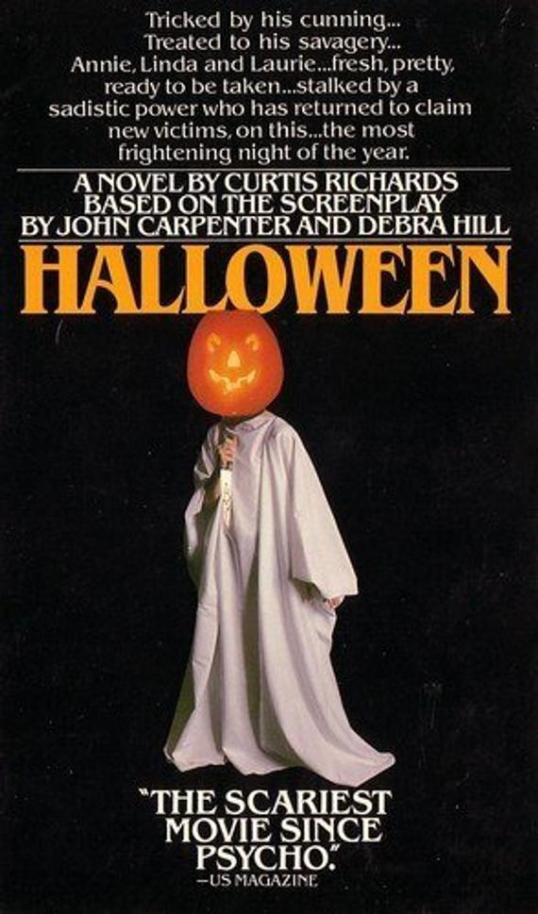
Horror Book Review: Halloween by Curtis Richards


This is not an easy book to find.

Based on John Carpenter and Debra Hill’s original script for Halloween (which is a fancy of saying that it features scenes that were either not shot or left on the cutting room floor), Curtis Richards’s novelization of Halloween was published in 1979 and it went out of print in the 80s.  It’s subsequently become popular with both horror fans and paperback collectors.  On Amazon, you can order it used for $123.

Of course, if you’re lucky like me, your cousin might have a copy and he might be willing to loan it to you for the weekend.  Boom!

The novelization of Halloween tells the same basic story as the film, just with a few important differences.  For instance, the novelization doesn’t open in Haddonfield, Illinois.  Instead, it opens in Northern Ireland, at the “dawn of the Celtic race.”  It tells about how a disfigured young man named Enda went mad and killed the king’s daughter on the eve of Samhain.  Enda’s murderous spirit was cursed to wander the Earth.

Jump forward several centuries and we’re in Haddonfield!  However, instead of opening with Michael murdering his sister, the novel spends a bit of time telling us about Michael’s family.  Much like Rob Zombie’s version of the story, the novelization of Halloween spends almost as much time detailing Michael’s background as it does “the night he came home.”  His grandmother fears that little Michael Myers might be dangerous.  Michael says that he hears voices, telling him to hurt people.  Could that be the voice of Edna?   It’s also revealed that Michael’s grandfather was a murderer who also heard voices, suggesting that the entire family is cursed.

Along with more information about Michael’s background, we find out more about Michael’s time at Smith’s Grove Sanitarium.  We learn more about Dr. Loomis, as well.  We discover that Loomis is married and that his son thinks that Loomis is kind of lame.  (Reportedly, during filming, Donald Pleasence specifically objected to a scene that would have established Loomis as a family man because he felt that Michael should be Loomis’s sole obsession.)  Michael, who actually does a talk a bit in the early part of the book, comes to control his wing of the sanitarium, largely because everyone is scared to death of him.  The book does a good job of showing how Loomis came to be convinced that not only was there no way to get through to Michael but that he was also pure evil.  Basically, if you’re a Sam Loomis fan, this is the book to read.

Once Michael escapes, the film pretty much settles into the story that we all know from the original film.  Laurie Strode and her friends are stalked by Michael on Halloween night while Loomis desperately searches for him.  The book does a good job of getting into Laurie’s mind while she’s being pursued by Michael.  If you’ve ever wondered why Laurie kept doing illogical things while being pursued by Michael, this book makes clear that she was in a state of shock.  Trust me — if you were being chased by Michael, you’d probably be so scared that you would make a lot of the same mistakes.  I know I would.

The Halloween novelization is surprisingly well-written.  Curtis Richards does a good job of bringing the characters to life, beyond just transcribing their dialogue.  He gets into the heads of Michael, Loomis, and Laurie and forces us to see the story through their eyes.  That said, the most interesting thing about the book is the chance to see what Carpenter’s original vision of the film would have looked like.   Whereas the finished film is a masterpiece of editing that keeps the focus almost entirely on Laurie being stalked, the book is just as concerned with what makes Michael tick.

It’s interesting to contrast why both the film and the book work.  The film works because Michael is largely motiveless.  He’s a force of malevolence and you can understand why Carpenter cut the scenes that went into Michael’s time at Smith’s Grove.  Those scenes aren’t necessary because all of that information is supplied to as visually and, by cutting the store down to only its absolute essentials, the film duplicated Michael’s relentless pace.  In the book, of course, you don’t have the benefit of Carpenter’s visuals.  The book would be pretty boring if it was just Michael showing up and killing people.  Instead, the book works because Richards takes the time to get into the heads of his characters and make them more than just killer and victim.  What wouldn’t have worked for the film works wonderfully for the book.  And vice versa.

Anyway, this novelization of Halloween is not easy to find but if you’re a horror fan, it’s worth the effort.