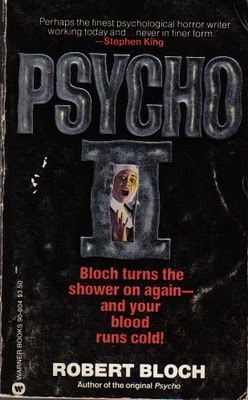
Horror Book Review: Psycho II by Robert Bloch


So, first things first.

This 1982 novel by Robert Bloch is indeed a sequel to the novel that inspired Alfred Hitchcock’s legendary horror film.  Yes, Norman Bates does return.  For that matter, so do Lila and Sam Loomis.  However, this novel should not be mistaken for Richard Franklin’s film, Psycho II, which came out a year later.  In fact, according to a later interview with Robert Bloch, Universal actually pressured him not to release this novel because they disliked the story Bloch had come up with and they also felt it would harm the financial prospects of their sequel.  Bloch, of course, did what he wanted to and was subsequently not invited to any screenings of Franklin’s film.

As for Bloch’s novel, it’s easy to see why Universal wasn’t enthusiastic about it.  It’s perhaps one of the most anti-Hollywood books ever written.  When Norman Bates escapes from a mental asylum and goes on another rampage, his doctor, Adam Claiborne, is convinced that Norman is heading to Hollywood to try to stop production of a movie called Crazy Lady, a movie that’s based on Norman’s crimes.  Even though everyone else is convinced that Norman’s been killed, Claiborne remains convinced that Norman faked his own death and is still out there.

Needless to say, the book’s Norman is considerably different from the vulnerable manchild that Anthony Perkins played in the films.  However, Norman is off-stage for the majority of Bloch’s sequel, the better to keep you wondering whether or not he actually is dead.  The majority of the book is dedicated to Claiborne getting to know the cast and crew of Crazy Lady, the majority of whom turn out to be sleazy Hollywood stereotypes.  Reading the book, it’s easy to see why Universal didn’t care much for it but, at times, Bloch occasionally comes across as if he think he’s the first person to ever be critical of Hollywood.

Another reason why Universal may have balked at adapting Bloch’s novel was because of a surreal chapter in which Paul Morgan, the actor who has been cast to play Norman, goes undercover at a brothel where all of the escorts look like then-Hollywood stars.  Since each escort is referred to by his star’s name, the entire chapter is basically Robert Redford, Clint Eastwood, and John Travolta making bitchy comments about Hollywood and religion.  It’s an odd chapter that doesn’t advance the story but, at the same time, it’s also Bloch at his most subversive.

Though the book’s take on Hollywood was hardly revolutionary, Bloch was a born storyteller and the story moves at a good pace.  It all ends with an effective twist, one that provides a proper ending to Bloch’s version of the Norman Bates story.  For Psycho and Bloch fans, it’s a must read.
A Blast From The Past: The Griper (dir by Herk Harvey)


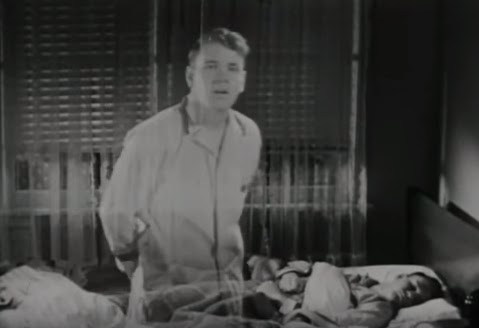
Oh my God, it’s a ghost!

No, actually, that’s not a ghost.  That’s George’s conscience, who apparently leaves George’s body while George is asleep and tells strangers all of the sordid details of George’s home life.  Hmmm …. actually, that sounds scarier than a ghost.

Anyway, George is the anti-hero of the 1954 educational short film, The Griper.  George’s problem can be found right in the title.  He’s a teenager who complains about everything and he’s ruining high school for not only his classmates but for his teachers as well!  George isn’t happy during the basketball game.  George isn’t happy about his class assignment.  Even when his only friend, Betty, tries to show him a cute cartoon, George snaps at her.

George’s problem, of course, is that he was born 60 years too early.  If he had been born several decades later, he could have just joined twitter and then he could spend all day cancelling people and getting all of the likes and retweets that come along with being a judgmental jackass.  But sadly, George is a teenager in the 50s and he’s expected to be a lot more positive.

Personally, I think everyone in the film’s being a bit too judgmental of George.  I mean — yes, he’s a jerk.  And yes, I would probably avoid him because I love snark but I hate negativity.  But if George is always in a bad mood, that’s his right!  He can always make new friends or pursue a career as a film critic.

George is going to be alright.

This short film was directed by Herk Harvey.  Harvey made a career out of doing short films like this but horror fans will always know him as being the director of the incredibly influential Carnival of Souls.  We’ll be watching that movie later this month but for now, enjoy watching George isolate himself while destroying everyone else’s happiness and be sure to ask yourself,

“What would you do?”

International Horror Film Review: Incubus (dir by Leslie Stevens)


The 1966 film Incubus is unique for being one of the few films to have been made in the international language.

What?

No, not love!  WE’RE TALKING ABOUT ESPERANTO!

Esperanto is a language that was invented in 1887 by a Polish idealist who wrote under the name — I kid you not — Dr. Esperanto.  The idea behind Esperanto was that it was a simple language that anyone could learn and, if the whole world learned to speak this one language, there would be far less misunderstandings, conflicts, and wars.  There’s probably some truth to that idea and the language has gone through the occasional period of popularity.  (If Lincoln Chafee runs for President again, I’m sure he’ll probably make learning Esperanto a part of his platform.)  Still, Esperanto never really caught on.  I imagine that most people were like, “But what if I go through the trouble to learn a new language but no one else does?  Then I’d look stupid!”  That’s what kept me from learning trigonometry.

Still, when director Leslie Stevens and producer Anthony Taylor was trying to decide what gimmick they could use to set Incubus apart from other low-budget horror films, they decided that the entire film would be in Esperanto.  Since the film was about a succubus trying to steal soul of a “pure man,” the feeling was that Esperanto would give the film an otherworldly feel.  The idea of having the demons all speaking Esperanto actually worked out well because, seriously, why wouldn’t otherworldly denizens have their own language?  But of course, then William Shatner shows up as the pure man and he’s speaking Esperanto too.  It gets a bit confusing.

The film takes place in the village of Nomen Tuum, where there’s a well that can both heal the sick and make the ugly look reasonably more appealing.  As a result, the village has become a popular spot for not only those who are dying but also those who are incredibly vain.  Kia (Alyson Ames) is one of the many succubi who hang out around the village, leading arrogant and foolish men into the ocean where their souls are claimed by the Incubus (played by Milos Milos).  Kia, however, has grown bored with only tempting the morally corrupt.  She wants a challenge!  She wants to tempt someone pure of heart!  All the other succubi tell her to be careful because dealing with the pure of heart might make it difficult for her to retain her demonic nature, which would upset the Incubus.  Kia shrugs them off and heads out to seduce a clergyman….

Unfortunately, all the available clergymen turn out to be just as vain, greedy, and corrupt as the people drinking from the well!  Whatever is a succubus to do!?  Kia is on the verge of giving up when she spies a wounded soldier named Marc (William Shatner) and his sister, Arndis (Ann Atmar).  They’ve come to the village to heal Marc of his wounds.  And yes, they are “pure of heart.”

It would be easy (and, let’s be honest, a bit tempting) to glibly dismiss Incubus as being the film that proves that, in the 60s, William Shatner could overact even in Esperanto.  And William Shatner does give a very Shatneresque performance.  But Incubus is actually a surprisingly effective film.  The film’s black-and-white cinematography was by Conrad Hall (with the uncredited assistance of William A. Fraker) and the film is full of wonderfully atmospheric images.  When Marc dreams, he sees haunting images of dead men floating in the ocean.  When the Incubus abducts Arndis, they travel through a shadowy landscape before finally arriving at a house that that appears to be on fire with demonic evil.  As the film progresses, the imagery becomes more and more surreal, as if we’ve entered into a dream, a filmed nightmare of sorts.  And, long before The Witch, Incubus features a character wrestling with a Satanic goat.

Incubus was filmed with the actors learning their lines phonetically and with no one on set to correct their pronunciations.  When the film was previewed for 60 people who spoke Esperanto, the audience laughed at how the actors butchered their precious little international language.  After that, Milos Milos — the actor who played the Incubus — was found dead with his girlfriend in what was assumed to be a murder/suicide, though many continue to claim that it was a murder/murder.  (Milos’s girlfriend was also Mickey Rooney’s wife and both were discovered dead at Mickey’s house and, well …. I don’t like where this is heading.  Sorry, Mick!)  As a result of all of the scandal, no reputable U.S. distributor would handle Incubus.  (This was 1966, after all.)  So, the film was only released in France.  Though I have no evidence to say for sure, I choose to believe that the French got it.

The film was long believed to be lost until the last remaining print was discovered in the collection of the Cinematheque Francaise in Paris.  From that badly damaged print, Incubus was restored and, as a result, history’s first Esperanto horror film can once again be appreciated by audiences everywhere!

Mi amas feliĉan finon!

Horror Film Review: Psycho II (dir by Richard Franklin)


Norman Bates is back!

No, I don’t mean Freddie Highmore from Bates Motel or Vince Vaughn from the odd Psycho remake that I keep seeing on Showtime.  No, I’m talking about the original Norman Bates, Anthony Perkins!

First released in 1983, Psycho II is a direct sequel to the classic shocker from Alfred Hitchcock.  The film opens with a replay of the original film’s famous shower scene and then immediately jumps forward 22 years.  Having been found not guilty by reason of insanity, Norman Bates has been in a mental institution ever since he was arrested for the murders of Marion Crane and Milton Arborgast.  However, Norman’s psychiatrist, Dr. Raymond (Robert Loggia, who was considered for the role of Sam Loomis in the original film), now feels that Norman has been cured and is no longer a danger to himself or others.  A judge agrees.  Marion Crane’s sister, Lila Loomis (Vera Miles, reprising her role from the original) does not.  She presents the judge with a petition demanding that Norman not be released.  When the judge ignores her, Lila yells that Norman will murder again!

Now free, Norman returns to the Bates Motel and discovers that it’s now being run by the sleazy Warren Toomey (Dennis Franz).  When Norman finds various party favors in the motel rooms and asks Warren what they are, Warren laughs and says, “They’re drugs, Norman.”  Norman’s not too happy about that.  As Dr. Raymond tells him, the world has changed considerably over the past two decades.

However, Norman has other issues to deal with.  For the most part, most of the people in town are not happy that their most famous resident has returned.  Emma Spool (Claudia Bryar) gets Norman a job at a local diner because, in her words, she believes in forgiveness and second chances.  Norman gets to know the new waitress, Mary Samuels (Meg Tilly) and, when Mary tells him that she’s had a fight with her boyfriend, he invites her to stay at the hotel until she can get things together.

From the minute that he returns home, Norman is struggling to keep it together.  When he first reenters his former house, he hears his mother’s voice but he tells himself that she’s not really there.  But if his mother isn’t there, then who keeps calling him on the phone and yelling at him about the state of the motel?  Who keeps taunting him about his awkward (yet rather sweet) relationship with Mary?  And when two teenagers are attacked after breaking into the house, who else could it possibly be but Norman’s mother?

I was really surprised by Psycho II, which turned out to be a really entertaining little movie, an effective thriller with a healthy dash of dark humor.  It’s a very plot-heavy film, with almost every scene introducing a new twist to the story.  With the exception of the sleazy Warren Toomey, no one in this film turns out to be who you initially expected them to be, including Norman.  Meg Tilly does a good job in the somewhat oddly written role of Mary Samuels and even manages to make an awkward line like “Norman, you’re as mad as a hatter” sound natural.  Not surprisingly, the film is dominated by Perkins’s performance as Norman Bates and what a great performance it is.  The best moments are the ones where Norman awkwardly tries to fit back in with society, nervously laughing at his own jokes and struggling to maintain eye contact with whoever he’s talking to.  You really can’t help but feel sorry for him, especially as the film progresses.

Wisely, Psycho II set out to establish it own identity as a film, as opposed to just trying to duplicate the shocks of Psycho.  (There is a shower scene that’s filmed similarly to the one from the first scene, with a key difference that I won’t spoil.)  It’s what a sequel should be, not a remake but a continuation of the original’s story.  This is definitely a film that’s far better than you may expect.


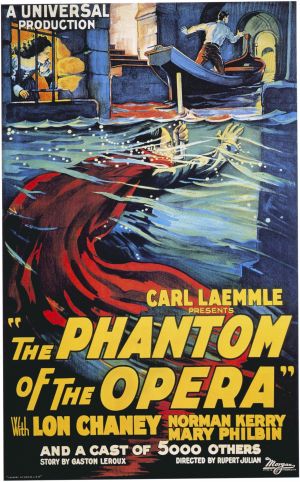
Horror On The Lens: The Phantom of the Opera (dir by Rupert Julian)


Today’s horror movie on the Shattered Lens is both a classic of silent era and one of the most influential horror films ever made.  It’s one that I previously shared in 2013, 2015, 2016, and 2108 but it’s such a classic that I feel that it is worth sharing a second (or fifth) time.

First released in 1925, The Phantom of the Opera is today best known for both Lon Chaney’s theatrical but empathetic performance as the Phantom and the iconic scene where Mary Philbin unmasks him. However, the film is also a perfect example of early screen spectacle. The Phantom of the Opera was released during that period of time, between Birth of the Nation and the introduction of sound, when audiences expected films to provide a visual feast and Phantom of the Opera certainly accomplishes that. Indeed, after watching this film and reading Gaston Leroux’s original novel, it’s obvious that the musical was inspired more by the opulence of this film than by the book.

This film is also historically significant in that it was one of the first films to be massively reworked as the result of a poor test screening. The film’s ending was originally faithful to the end of the novel. However, audiences demanded something a little more dramatic and that’s what they got.

Music Video of The Day: Ghost by ERAAS (2013, dir by ????)


Daaaaaaamn….

Seriously, this video is dark but it’s so good!

The message appears to be that you should be careful who you murder because he might have a bunch of friends who will all form a drum circle and bring his ghost back to life to get revenge.  That’s actually a pretty important message.  There would be a lot less violence in the world if everyone took it to heart.

Enjoy!

Horror on TV: One Step Beyond 1.2 “Night of April 14th” (dir by John Newland)


For today’s televised horror, we have an episode of the 1960s anthology series, One Step BeyondOne Step Beyond was like (and aired at the same time as) The Twilight Zone, except that it often claimed that it’s stories were all based on fact.

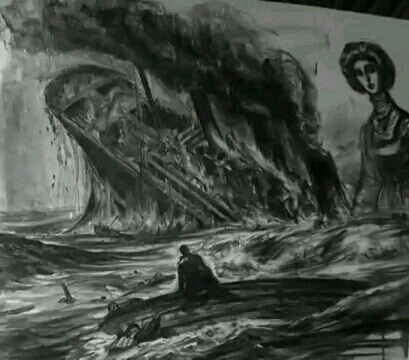
In this episode, a young Englishwoman is haunted by dreams of drowning.  Try as she might, she can’t get the feeling of doom out of her mind.  Perhaps her upcoming trip to New York will help to relax her.  Her fiancee even tells her that they’ll be traveling to New York on the most luxurious ship ever built.  The name of that ship?  Why, the Titanic, of course.

For the record, there actually were quite a few people who apparently did have psychic premonitions of doom when it came to the Titanic.  Perhaps the most infamous example was the author Morgan Robertson, who wrote a novel in 1898 that was called The Wreck of the Titan: Or, Futility.  That book managed to perfectly predict that sinking of the Titanic, right down to the iceberg and the number of lives lost.

This episode originally aired on January 27th, 1959.

Enjoy!

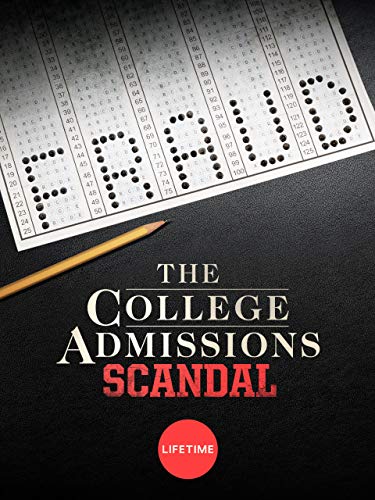
What Lisa Watched Last Night #200: The College Admissions Scandal (dir by Adam Salky)


Last night, like all good Americans, I watched The College Admissions Scandal on Lifetime!

Why Was I Watching It?

How could I not watch it!?

Seriously, Lifetime has been advertising the Hell out of this thing for the past few months.  I haven’t been able to turn on the channel without seeing a few hundred commercials for The College Admissions Scandal.

Add to that, I have to admit that this is the rare national scandal that I’ve actually been following.  When the news first broke that certain rich people had cheated and broken the rules to get their child into a good college, my initial reaction was, “Well, isn’t that what a parent’s supposed to do?”  Of course, I made the mistake of saying that on twitter and I immediately ended up with a bunch of finger-wagging nags screaming at me about how it wasn’t something to make a joke about and how it wasn’t fair and blah blah blah.  They sure told me!  Of course, it didn’t really change my mind or anything but at least everyone else got to feel like they had stuck up for truth and justice.  That said, I think my point remains valid.  Don’t get mad at the parents for taking advantage of the system.  They’re just trying to look after their kids.  Instead, get mad at the colleges that were willing to be bribed.  Get mad at a system that’s been specifically set up to be corrupted.  The solution is reform, not necessarily imprisonment.

Perhaps not surprisingly, I kinda love the fact that, while Felicity Huffman basically begged everyone to forgive her, Lori Loughlin pretty much said, “Fuck you, I’m not apologizing for anything.” That’s the spirit!

What Was It About?

Penelope Ann Miller plays a character who is definitely not Felicity Huffman, just as Mia Kirshner is playing someone who is definitely not Lori Loughlin.  That said, like Miller and Loughlin, they’re two wealthy mothers who are concerned about getting their children into the right school.  Fortunately, Rick Singer (Michael Shanks) is willing to sell his services as an admissions consultant.  Pay him enough money and he’ll fix your child’s grades, improve their test scores, and even make them look like athletes!

It sounds like a great plan!  Of course, it’s also illegal and, even as the parents are looking forward to sending their kids to Stanford and Harvard, the FBI is looking forward to sending the parents to prison!

What Worked?

Miller and Kirshner were both well-cast and Kirshner was especially good as the mother who definitely was not Lori Loughlin.  Michael Shanks was also wonderfully repellent in the role of Rick Singer.

It was fascinating to watch the lengths that Singer and the families went to remaking their children.  My main memory of this film will probably always be Sarah Dugdale standing in front of a blue screen and kicking a soccer ball so that she can later be photoshopped into a picture of an actual soccer game.

What Did Not Work?

Where were the real people!?  Yes, Rick Singer is a real person but why were all the parents fictional?  I assume for legal reasons.  For instance, Lori Loughlin has yet to be convicted of anything and I imagine that Lifetime didn’t want to get on the bad side of either Felicity Huffman or William H. Macy by portraying them in the movie.  But seriously, it was hard not to be disappointed by the lack of real world gossip.

“Oh my God!  Just like me!” Moments

Hmmmm …. I got into college legally but then again, I also didn’t go to an Ivy League school, nor did I ever particularly want to.  To be honest, it didn’t really occur to me that college was actually that important until my senior year.  That’s when I was like, “Oh, I’m actually supposed to do something with this art history degree….”

Lessons Learned

If you want to send your child to a good college, get them interested in soccer early.

Horror on the Lens: Hotline (dir by Jerry Jameson)


Yay!  Brianne O’Neill (Lynda Carter) has a got a new job, working at a crisis hotline!

Boooo!  The serial called known as the Barber is now obsessed with calling her!

The Barber is known as the Barber because he cuts his victims’s hair before killing them, which as far as I’m concerned, make him even worse than a normal serial killer.  You have to wonder if he resents being known as the Barber as opposed to The Stylist.

Anyway, it’s up to Brianne to figure out why The Barber keeps calling her and to hopefully discover his identity.  For whatever reason, no one else seems to be that concerned about it.

That’s the plot of Hotline, a 1982 made-for-TV movie that is today’s horror on the lens.  It’s not a bad film, though it does inspire a certain amount of snarkiness while you’re watching it.  For the most part, though, it’s well-acted and effectively directed.  If you’ve got 95 minutes to kill, why not kill them with Lynda Carter, The Barber, and Frank Stallone?

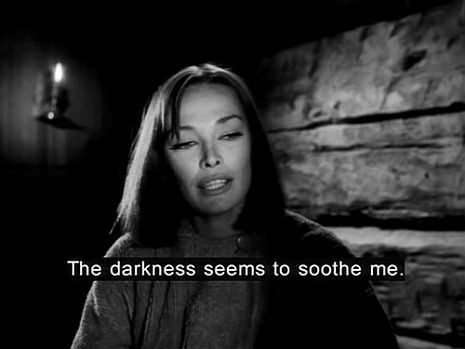
Music Video of the Day: Darkness by Fantastic (2014, dir by ????)


I like this video because it’s full of atmosphere and the whole time that you’re watching it, you’re just waiting for the world to end.

It kind of reminds me of when I was in Rome, the summer after I graduated high school.  It was around 3 in the morning and because I was a hyperactive little insomniac, I was exploring the hallways of our hotel.  I figured everyone else in the hotel was asleep but then I turned a corner and there was a dark-haired woman with ashen skin standing in the middle of the hallway, staring at me.

“What are you doing here?” she asked and I immediately noticed that 1) she had a British accent and 2) she was glaring at me with pure hatred in her eyes.

When I didn’t reply, she said, “I own this hotel, what are you doing here?”

I started to back away from her.

“I OWN THIS HOTEL!” she shouted.

And that’s when I took off running and I didn’t stop running until I got back to my room.

What was scary was that I had already met the owner of the hotel and I know it wasn’t that woman.  For the rest of my stay in Rome, I was terrified of running into that woman but I never saw her again.  Perhaps she was a ghost or maybe she was just an angry sleep walker.  Who knows?

Anyway, enjoy!