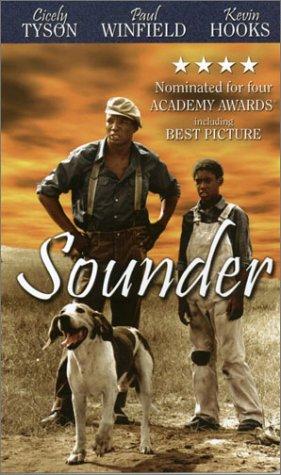
The 1972 film Sounder follows the Morgans, a family of black sharecroppers living in 1930s Louisiana.
When we first see Nathan Lee Morgan (Paul Winfield) and his young son, David Lee (Kevin Hooks), they’re hunting. Accompanying them is their loyal dog, Sounder. As they hunt, two things become very obvious. Number one, David Lee is a good father who is doing his best to provide for his family under the most difficult circumstances possible. Number two, the family is desperately poor. When Nathan finally gives in to temptation and steals a ham to feed his family, the local Sheriff (James Best) shows up at the farmhouse the next day and arrests him. Nathan is taken away to prison and one of the deputies even shoots Sounder.
Fortunately, Sounder survives and so do the Morgans. Under the stern but loving leadership of their mother, Rebecca (Cicely Tyson), the Morgan children manage to bring in the season’s crops. Unfortunately, having to work out in the fields doesn’t leave much time for David Lee to get an education. When he does go to school, he and the other students listen as a middle-aged, white teacher reads to them from Huckleberry FInn.
After the wounded Sounder finally returns to the Morgan family and recovers from his wounds, David Lee decides that he wants to go to the prison and see his father. Unfortunately, the sheriff refuses to even tell the family where Nathan has been incarcerated. None of the white authority figures in town care that the Morgans are struggling or that they’ve managed to bring in the crops themselves. None of them cares or seems to even understand that David Lee is missing his father. The sheriff presents himself as being a reasonable man and is never heard to the use the n-word. Instead, he and every other white person in town refers to David Lee as being “boy,” diminishing everything that he’s done since his father was arrested.
David Lee finally figures out the location of a prison that might (or might not) currently be housing his father. It’s several miles away. Accompanied by Sounder, David Lee sets out to make the long journey to the prison. Along the way, he discovers another school and a far more empathetic teacher named Camille (Janet MacLachlan). David Lee is forced to make a decision that will effect not only his future but also the future of his family.
Sounder is a heartfelt film. It’s a film that’s less interested in telling a story with a traditional beginning and end as opposed to just sharing scenes of everyday life. In this case, it’s the life of family that manages to survive despite it often seeming as if the entire world is arrayed against them. The film was based on a book that pretty much centered around the dog. The movie, on the other hand, is more about the family and, despite the fact that the film is still named after him, the dog is pretty much superfluous to the plot. That said, Sounder still plays an important role because, just as Sounder survives being shot at and remains loyal to the people that he loves, the Morgans survive whatever adversity is tossed at them. Watching the film, the viewer is very much aware that life is never going to be easy for the Morgans but, at the same time, it’s impossible not take some comfort in the fact that they have each other. Paul Winfield and Cicely Tyson both give strong performances as the resilient Nathan Lee and Rebecca and the entire film is the type of movie that’ll inspire tears even as it inspires happiness.
At the Oscars, Sounder was nominated for Best Picture, where it provided a gentle contrast to the other nominees, Cabaret, Deliverance, The Emigrants, and The Godfather. Paul Winfield and Cicely Tyson were nominated for Best Actor and Best Actress, making 1972 the first year in which black performers were nominated in both of the lead categories. (It was also the first year in which more than one black actress was nominated for Best Actress as Tyson ended up competing with Lady Sings The Blues‘s Diana Ross.) In the end, Tyson lost to Cabaret‘s Liza Minnelli while Winfield lost to The Godfather‘s Marlon Brando. And, of course, The Godfather also went on to deservedly win the award for Best Picture.
In his memoir, Room to Dream, Lynch wrote that he was sent the film’s script while he was looking for a project to serve as his follow-up to The Elephant Man. Lynch wrote that he liked the script, which was written by Horton Foote (who had previously won an Oscar for adapted To Kill A Mockingbird), but that Lynch also felt that it just wasn’t the right project for him at the time. Tender Mercies was eventually directed by Bruce Beresford and Lynch mentioned that he felt that Beresford did a “brilliant” job.
After I posted the article, it occurred to me that Tender Mercies is not a film that’s as well-known as it deserves to be. It received five Oscar nominations, including one for Best Picture. Robert Duvall won his first (and, to date, only) Oscar for playing the lead role. It’s an acclaimed film but it also plays it in a rather low-key style, particularly when compared to some of the other films that were released in the early 80s. (1983 may have been the year of Tender Mercies but it was also the year of Scarface, Flashdance, Return of the Jedi, and Risky Business.) As such, it’s a film that’s been a bit overshadowed over the years.
Tender Mercies takes place in rural Texas. Mac Sledge (Robert Duvall) is a former country-western star whose career has collapsed due to his alcoholism and his own self-destructive behavior. One morning, a hungover Mac wakes up in a roadside motel. Not having any money on him, Mac asks the motel’s owner — Rosa Lee (Tess Harper), who lost her husband in Vietnam — if he can work at the motel in return for a room. Rosa Lee agrees, on the condition that Mac not drink while he’s working.
As the days pass, Mac and Rosa Lee grow closer and Mac becomes a surrogate father to Rosa Lee’s young son, Sonny (Allan Hubbard). Eventually, Mac and Rosa Lee marry and Mac becomes an accepted member of the community. However, Mac remains troubled. His ex-wife, Dixie (Betty Buckley), has built a career on singing the songs that he wrote for her but she refuses to consider anything new that he’s written. His teenage daughter (Ellen Barkin) stops by the motel and announces that she’s running away to get married. There’s tragedy but there’s also hope and forgiveness.
Tender Mercies is a simple but affecting film about a good man who is struggling to deal with the fact that he was once a very bad man. What makes Tender Mercies interesting is what doesn’t happen. The first time I saw it, I spent the entire movie expecting Mac to fall off the wagon and break everyone’s heart. Instead, Mac manages to keep his promise to his new family but what he discovers is that being sober doesn’t automatically exempt one from pain or guilt. He still has to deal with sadness and disappointment but now, he has to do it without using alcohol as a crutch. Instead of getting his strength from booze, he now gets it from love.
It’s a wonderfully sweet movie, featuring naturalistic performances from Harper, Hubbard, and especially Robert Duvall. It seem appropriate that, after making his film debut as Boo Radley in a film written by Horton Foote, Duvall would win his first Oscar for another film written by Foote. Duvall plays Mac as a plain-spoken and weary soul who is still just enough of a romantic to find some sort of redemption in the world. It’s a great performance and it’s a good film and I’d suggest checking it out if you ever need a good cry.
When I first watched this video, it took me a while to figure what it was reminding me of. I finally realized that the film was making me think of an 80s zombie film called The Dead Pit, in which an amnesia victim finds herself locked up in a mental hospital that is so overrun by zombies.
Visually, the video really does have a retro feel to it. With the grainy cinematography and the relatively small group of patients, it’s easy to imagine that this video could be an old Italian or French horror film from the early 80s. One could easily imagine bits and pieces of the video appearing in one of Lucio Fulci’s post-Zombi, pre-Manhattan Baby films or perhaps one of the films that Jean Rollin did around the time that he directed The Night of the Hunted. For a while there, psych wards were a very popular film setting. I imagine that had something to do with the success of One Flew Over The Cuckoo’s Nest.
It’s time for me to finally post my picks for the best (and worst) of 2019. This is something that I do every year. Usually, I manage to do it before the third week of January but I’ve been running behind. I’ll be posting my film, television, book, and music picks throughout today and maybe into tomorrow, depending on how long it takes me to narrow down my choices.
Let’s start with my picks for the 10 worst films of 2019! Below are my picks for the worst. Some of you will agree and some will disagree. In the end, what truly matters is that I’m right.
10. The Upside (dir by Neil Burger)
9. Glass (dir by M. Night Shyamalan)
8. X-Men: Dark Phoenix (dir by Simon Kingberg)
7. The Kitchen (dir by Andrea Berloff)
6. The King (dir by David Michod)
5. Miss Bala (dir by Catherine Hardwicke)
4. The Dirt (dir by Jeff Tremaine)
3. Backdraft 2 (dir by Gonzalo López-Gallego)
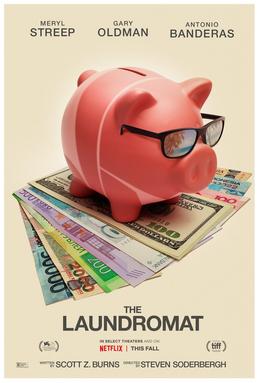
2. The Laundromat (dir by Stephen Soderbergh)
1. After (dir by Jenny Gage)
On the one hand, more people were going to the movies than ever. The studio moguls were getting rich and directors, many of whom were influenced by German expressionism, were experimenting with new ways to visually tell their stories. The days when an motionless camera would just be planted on the floor so that it could record actors moving in and out of the frame were over.
At the same time, Hollywood was also struggling to adjust to the arrival of sound. Though many assumed that sound would just be a fad, it quickly turned out that audiences preferred sound pictures to the old silent melodramas. Films that had been originally conceived as being silent were reshot with sound and the results were often mixed as Hollywood technicians struggled to figure out how to get the best and clearest recording possible. Even harder hit were the actors, who had spent decades giving silent performances but who were now expected to adapt, overnight, to an entirely new style of acting. Some actors saw their career abruptly end because their voice didn’t match their appearance or because they simply couldn’t memorize the dialogue that they were now required to actually speak. Even the actors who could handle delivering their dialogue often struggled to find the right balance between acting too much and acting too little.
Take Alibi, for instance. This crime film was released in 1929 and visually, it’s often a marvel. But whenever the actors open their mouths and start to recite their dialogue …. yeesh!
Based on a Broadway play, Alibi tells the story of Chick Williams (Chester Morris, whose brooding good looks go a long way towards making up for his awkward screen presence). Chick is a career criminal who has just been released from prison. Because he’s a “jailbird,” (as they used to put it in 1929), Sgt. Pete Manning (Purnell Pratt) is convinced that Chick has hooked back up with his old gang and that he’s responsible for a recent robbery that left one policeman dead. However, Chick has an alibi. It turns out that, after getting out of prison, one of the first that Chick did was get married. Chick’s new wife is Pete’s daughter, Joan (Eleanor Griffith)! And Joan swears that, on the night of the crime, Chick was with her at the theater.
Despite his alibi, Pete is convinced that Chick had something to do with both the robbery and the murder. Pete decides to send in an undercover cop, Danny McGann (Regis Toomey). Pretending to be a permanently drunk businessman, Danny works his way into Chick’s mob. But can Danny find the proof needed to take Chick down?
So, here’s what’s good about Alibi. First off, it’s a pre-code film, which means that the characters are allowed to occasionally curse and that the gangsters all spend their time at a nightclub, watching the floor show. It also means that Joan is allowed to openly discuss why she distrusts the police and the film shows the police being brutal in a way that would never be allowed during the production code years. Secondly, from the very first scene, director Roland West creates an almost dream-like atmosphere, full of looming shadows and art deco sets and close-ups of menacing faces. West’s camera prowls through the streets and clubs with a restless energy.
But then, as I mentioned earlier, someone will open their mouth and start to speak and the entire film comes to a halt. The cast — some of whom went on to have long and successful careers — was obviously still struggling to figure out how to act in a sound film and the results are definitely mixed. Eleanor Griffith delivers all of her lines in the same angry tone while Purnell Pratt stiffly defends the police force. Regis Toomey, meanwhile, goes so overboard as Danny that you find yourself hoping that he’ll blow his cover and be forced out of the film. Though he’s occasionally awkward, Chester Morris probably does the best out of the entire cast. At the very least, he manages to communicate some genuine menace.
Seen today, Alibi is mostly interesting as a historical document. It represents both the best and the worst of the early sound era. When it was first released, Alibi was a hit at the box office. Though no official nominees were announced for the 2nd Academy Awards, notes from the era indicate the Alibi was among the films considered for Best Picture and it’s usually listed as being a nominee. The award itself was given to Broadway Melody.
Well, maybe not everything. This video, for instance, suggests that some things have changed but that it might not have been as easy a change as the lyrics suggest. The thing I like about this video is that, even though the subject matter is change, it still has this weird retro feel. So, it’s like, “Everything’s changed …. back!”
I do have to say, though, things have certainly changed for me over the past few years. I was just thinking about it earlier today. Way back in 2010, when I first started writing for this site, I was a neurotic and self-destructive and maybe just a little bit insecure. I was one of those people who would specifically start arguments and fights with people just so I could revel in the drama. It was my way of acting out at the world, largely because I was just in a really angry place at the time.
But the years have passed and the times have changed and I’m in a much better place today. A lot of it, I know, had to do with just growing up and discovering that being an immature brat wasn’t as fulfilling (or as cute) as I had been led to believe. A lot of it had to do with writing for this site and discovering that I didn’t have to act out to get attention. I could just state my opinions and make my arguments and people would actually respond. That was a big lesson for me and it played a big role in me gaining the confidence necessary to become a …. well, I wouldn’t say a grown-up. I still don’t consider myself to be a grown-up. I’ve still got a lot of maturing to do. But I’m definitely a much happier person today than I was in 2009.
So remember! Be supportive of the writers and film reviewers in your life because, in a way, you’re helping them become better people.
Suck it, The Big Short. The Wolf of Wall Street is the best film to be made about Wall Street this century.
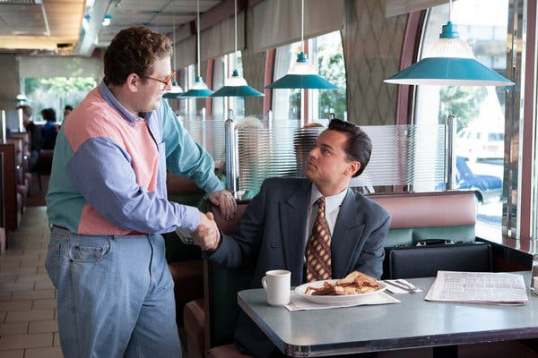
Martin Scorsese’s 2013 financial epic tells the true story of a group of rather sleazy people who got rich and who basically, to quote Robert De Niro from an earlier Scorsese film, “fucked it all up.” Jordan Belfort (Leonardo DiCaprio, giving what I still consider to be the best performance of his career) is the son of an accountant named Max (Rob Reiner). Fresh out of college, Jordan gets a job on Wall Street. Under the mentorship of the eccentric (but rich) Mark Hanna (Matthew McConaughey), Jordan discovers that the job of a stock broker is to dupe people into buying stock that they might not need while, at the same time, making a ton of money for himself. With the money comes the cocaine and the prostitutes and everything else that fuels the absurdly aggressive and hyper-masculine world of Wall Street. Jordan is intrigued but, after the stock market crashes in 1987, he’s also out of a job.
Fortunately, Jordan is never one to give up. He may no longer be employed on Wall Street but that doesn’t mean that he can’t sell stocks. He gets a job pushing “penny stocks,” which are low-priced stocks for very small companies. Because the price of the stock is so low, the brokers get a 50% commission on everything they sell. Because Jordan is such an aggressive salesman, he manages to make a fortune by convincing people to buy stock in otherwise worthless companies. As Jordan’s boss (played, in an amusing cameo, by Spike Jonze) explains it, what they’re doing isn’t exactly regulated by the government, which just means more money for everyone! Yay!
Working with his neighbor, Donny Azoff (Jonah Hill, at his most eccentric), Jordan starts his own brokerage company. Recruiting all of his friends (the majority of whom are weed dealers who never graduated from high school), Jordan starts Stratton Oakmont. Using high-pressure sales tactics and a whole lot of other unethical and occasionally illegal techniques, Jordan soon makes a fortune. When Forbes Magazine publishes an expose that portrays Jordan as being little more than a greedy con man, Stratton Oakmont is flooded by aspiring stock brokers who all want to work for “the wolf of Wall Street.”
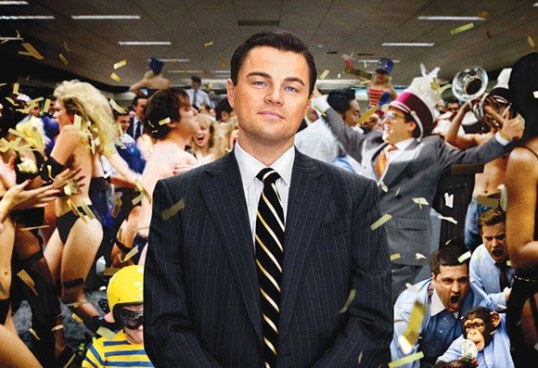
And, for a while, Jordan has everything that he wants. While the Stratton Oakmont offices become a den of nonstop drugs and sex, Jordan buys a huge mansion, a nice car, and marries a model named Naomi (Margot Robbie). His employees literally worship Jordan as he begins and ends every working day with inspirational (and often hilariously profane) sermons, encouraging his people to get out there and sell no matter what. Of course, making that much money, Jordan has to find a way to hide it from the IRS. Soon, with the help of Naomi’s aunt (Joanna Lumley), he is smuggling millions of dollars into Switzerland where a banker (Jean Dujardin, who is both hilariously suave and hilariously sleazy a the time) helps him hide it all.
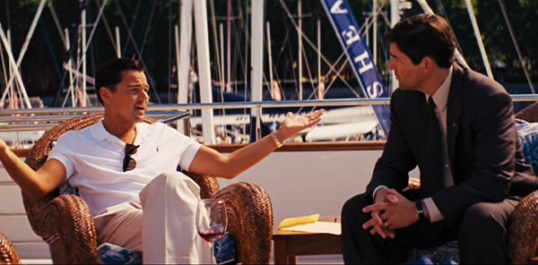
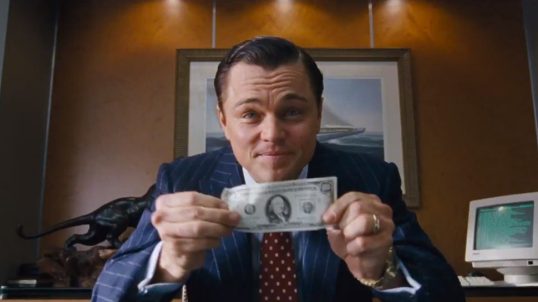
When Jordan learns that the FBI and SEC are looking into his dealings, Jordan invites Agent Patrick Denham (Kyle Chandler) to come visit him on his yacht and, in a scene that launched a thousand memes, the two of them have a friendly conversation that’s largely made up of passive aggressive insults. Jordan taunts Denham over the fact that Denham washed out when he tried to get a job on Wall Street. Denham laughingly asks Jordan to repeat something that sounded like it may have been a bribe. When Denham leaves the boat, Jordan taunts him by tossing a wad of hundred dollars bills into the wind….
And here’s the thing. Yes, the media and our political class tells us that we’re supposed to hate that Jordan Belforts of the world. One can imagine Bernie Sanders having a fit while watching Jordan brag about how he cheated the IRS. If Adam McKay or Jay Roach had directed this film, one can imagine that they would have used the yacht scene to portray Jordan Belfort as pure evil. (McKay probably would have tossed in Alfred Molina as a waiter, asking Belfort if he wants to feast on the lost future of the children of America.) But the truth of the matter is that most viewers, even if they aren’t willing to admit it, will secretly be cheering for Jordan when he throws away that money. DiCaprio is so flamboyantly charismatic and Scorsese, as director, so perfectly captures the adrenaline high of Jordan’s lifestyle that you can’t help but be sucked in. He may be greedy and unethical but he just seems to be having so much fun! Just as how Goodfellas and Casino portrayed life in the mafia as being an intoxicating high (as well as being more than a little bit dangerous), The Wolf of Wall Street refrains from passing easy judgment and it steadfastly refuses to climb onto a moral high horse. Jordan narrates his own story, often talking directly to the camera and almost always defending his actions. As a director, Scorsese is smart enough to let us make up own minds about how we feel about Jordan and his story.
Of course, when Jordan falls, it’s a dramatic fall. That said, it’s not quite as dramatic of a fall as what happened to Ray Liotta in Goodfellas or Robert De Niro in Casino. No one gets blown up, for instance. But Jordan does lose everything that gave his life meaning. By the end of the film, he’s been reduced to giving seminars and challenging attendees to sell him a pen. (“Well,” one hapless gentleman begins, “it’s a very nice pen…..”) During the film’s final scenes, it’s not so much a question of whether Jordan has learned anything from his fall. Instead, the movie leaves you wondering if he’s even capable of learning. At heart, he’s the wolf of Wall Street. That’s his nature and it’s really the only thing that he knows how to do. He’s a bit like Ray Liotta living in the suburbs at the end of Goodfellas. He’s alive. He has his freedom and a future. But he’s still doesn’t quite fit in. Much like Moses being denied the opportunity to physically enter the Promised Land, Jordan’s punishment for his hubris is to spend his life in exile from where he truly belongs. And yet, you know that Jordan — much like Henry Hill — probably wouldn’t change a thing if he had the chance to live it all over again. He’d just hope that he could somehow get a better ending while making the same decisions.
Unlike something like The Big Short, which got bogged down in Adam McKay’s vapid Marxism, The Wolf of Wall Street works precisely because it refuses to pass judgment. It refuses to tell us what to think. I imagine that a lot of people watched The Wolf of Wall Street and were outraged by the way Jordan Belfort made his money. I imagine that an equal number of people watched the film and started thinking about how much they would love to be Jordan Belfort. The Wolf of Wall Street is a big, long, and sometimes excessive film that dares the audience to think of themselves. That’s one reason why it’ll be remembered after so many other Wall Street films are forgotten.
The Wolf of Wall Street was nominated for best picture of the year. It lost to 12 Years A Slave.
I’ve never really gotten the obsession that some people have with wine.
Some of that may be because I hardly ever drink. I’m not quite a teetotaler but I seem to be getting closer with each passing year. But, beyond that, I just don’t get the whole culture that’s sprung up around wine snobbery. I don’t get the people who sit around and say, “Oh, this is an amazing Australian wine and, someday, my great-great grandchilden will get to open it when they’re 90 and on their deathbeds.” Everything that I’ve seen about wine tastings annoys me, from the overdramatic sniffing to the big bowls of spit-out wine. (I’m not a big fan of spitting in general.)
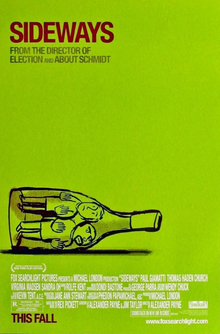
The 2004 film Sideways is a film that’s all about wine snobs. It follows two friends as they take a week-long vacation in the Santa Barbara wine country. Miles (Paul Giamatti) is a depressed English teacher who loves wine and who has never gotten over his divorce. He’s also a writer, though a remarkably unsuccessful one. He’s waiting to hear back on his latest manuscript, an autobiographical novel that he fears might not be commercial enough. Jack (Thomas Haden Church) was Miles’s college roommate and they’ve remained friends, despite Miles feeling that they have nothing in common. Jack is a former semi-successful actor who now works as a voice over artist. Jack knows little about wine. He’s just looking for a chance to indulge in some meaningless, commitment-free sex before getting married.
Miles attempts to teach Jack to appreciate wine. Jack attempts to get Miles to actually enjoy life for once. Together …. THEY SOLVE CRIMES!
Actually, they don’t solve crimes. That’s not the type of film that Sideways is. This is an Alexander Payne film, which means that it’s essentially a road film in which two different characters consider their own mortality and question whether or not there’s more to life than just what they see around them. The difference between the two characters is that Miles obsesses on the meaning of it all while Jack doesn’t exactly ignore Miles’s concerns but he’s much better at shrugging them off and blithely moving from one experience to another. Miles wears his neurosis on his sleeve while Jack is slightly better at hiding them.
During their week-long excursion into wine country, Miles and Jack fall for two women who undoubtedly deserve better. Maya (Virginia Madsen) is a waitress who is working on her master’s degree in horticulture. Maya shares Miles’s love of wine and is one of the few people to show any genuine interest in Miles’s book. Stephanie (Sandra Oh) is as much of a free spirit as Jack and, after spending two days with her and her daughter, Jack starts talking about canceling (or, at the very least, delaying) his upcoming wedding. Miles, meanwhile, is falling in love with Maya but there’s a problem. Jack lied to Maya and told her that Miles’s book is about to be published and Jack has failed to tell Stephanie that he’s engaged….
And really, it would be very easy to be dismissive of both Miles and Jack if they were played by anyone other than Paul Giamatti and Thomas Haden Church. If you ever need a movie to cite as an example of how perfect casting can inspire you to forgive characters who do rotten things and make stupid mistakes, Sideways would be a good film to go with. Thomas Haden Church brings an unexpected sincerity to the role of Jack, one that keeps him from coming across as being malicious but instead suggests that he just can’t help himself. If nothing else, Haden Church’s concern for Miles comes across being genuine. (“I guess because you were wearing your seat belt.”) Meanwhile, in the role of Miles, Paul Giamatti again proves that he’s one of those rare actors who can take a rather annoying character and somehow make him totally sympathetic. It help that Giamatti brings a lot of self-awareness to the role. Yes, Miles can be whiny and self-absorbed but at least he knows that he’s whiny and self-absorbed and he’s just as annoyed with himself as we often are.
The actors even manage to make all of the wine talk palpable for non-wine people like me. During Virginia Madsen’s lengthy monologue about why she loves wine, I found myself thinking, “That’s why I love movies.” Just as wine tastes different depending on who is drinking it and when they opened the bottle, how one experiences a movie can change from time to time and depending on each individual viewing experience. Just as the best wine was cultivated over time, the same can be said of movies, many of which are not recognized for their greatness until years after they were first produced. Just as Maya thinks about all the people who played a part in creating the perfect bottle of wine, I think about all the people who played a part in creating the movies that I love. You don’t have to love wine to enjoy Sideways. You just have to love something.
Sideways was nominated for Best Picture but it lost to Million Dollar Baby. Amazingly, Paul Giamatti was not nominated for Best Actor.



 Through the Shattered Lens