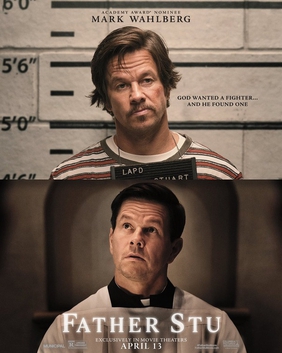
Film Review: Father Stu (dir by Rosalind Ross)


I don’t care what all the other critics said when Father Stu was first released in April.  It’s not that bad.

Now, of course, I should be upfront and mention that I come from a Catholic background.  My father’s side of the family is Irish.  My mother’s side is Italian/Spanish.  Am I saying that you have to have been raised Catholic to appreciate Father Stu?  Not at all.  But it does help.

And when I say that Father Stu is not that bad, what I mean is that’s actually pretty good.

Based on a true story, Father Stu stars Mark Wahlberg as Stuart Long.  When the movie opens, Stu is in a boxing ring, beating up his opponents while taking a lot of punishment himself.  From that opening scene, we learn a few things about Stu.  He’s a fighter.  He’s determined.  He’s willing to take a beating.  And he really doesn’t know when to quit.  We then meet his no-nonsense mother, Kathleen (Jacki Weaver), and his father, Bill (Mel Gibson).  Bill is an alcoholic truck driver, the type who shouts at other drivers and who gets into an argument with a random child about who is the worse driver.

When Stu is informed that he could very well die if he continues to box, he decides that it’s time to pursue another profession.  The 30-something Stu announces to his mother that he’s going to be an actor.  He may not have any training but he has a lot of personality.  Stu’s mother suggests that it might be a little late in life for Stu to pursue a career as a film star but Stu packs up and leaves for Montana for California.

He does manage to land one gig, a commercial for a mop.  But Stu’s acting career never really takes off.  Instead, he gets a job working in a deli.  It’s there that he first spots Carmen (Teresa Ruiz), a Sunday school teacher.  When Carmen tells Stu that she wouldn’t even consider dating a man who was not baptized, Stu begins RCIA at the local parish.  Eventually, he’s baptized into the parish but it’s not until he’s nearly killed in a motorcycle accident and has a vision of Mary that he truly starts to believe.  He also comes to feel that he’s been called to the priesthood, despite the fact that it means ending his relationship with Carmen.  Stu enters the seminary, under the watchful eye of the initially skeptical but eventually supportive Monsignor Kelly (Malcolm McDowell).  However, Stu soon finds himself facing his greatest challenge when he’s diagnosed with inclusion body myositis, a disease that will eventually rob him of his ability to care for himself.

When Father Stu was first released in April, it received a lot of attention for being an R-rated film about faith.  But the fact that the characters frequently (and colorfully) curse is actually one of the best things about Father Stu.  People curse.  Both the religious and the non-religious curse.  Catholics especially curse.  When you find out that you have an incurable disease that’s going to kill you by the time you turn 50, you’re going to curse regardless of how much faith you may or may not have.  Far too many films about religion seem to take place in some strange world where the 50s never ended and people still say, “Darn,” when faced with the world’s problems.  To its credit, Father Stu‘s characters never lose their edge.

Father Stu also received a lot of negative attention for the involvement of Mel Gibson.  That’s understandable but, at the same time, there’s probably no contemporary actor who is more convincing as a self-destructive alcoholic than Mel Gibson.  For better or worse, Gibson brings a certain authenticity to the role and that authenticity is what a film like Father Stu needs.

In the lead role, Mark Wahlberg brings a lot of sincerity to the role of Stu.  When we’re first introduced to Stu, he’s earnest but he’s not particularly smart.  He doesn’t think things through.  He’s the type of guy who will work hard in his job without understanding that it’s still not a good idea to show up at work looking like you’ve spent the weekend fighting people in an alley for loose change.  As a result of Wahlberg’s performance, it’s easy to see why everyone in Stu’s life is skeptical when he announces that he’s going to become a priest.  However, it’s also due to his performance that Stu’s eventual transformation is undeniably moving.  Wahlberg’s rough-edged sincerity keeps the film from becoming overly mawkish after Stu discovers that he’s ill.  He remains a fighter from beginning to end and it’s hard not to want to see him win.

Father Stu is probably the epitome of the type of film that audiences love but critics hate.  But you know what?  Sometimes, the audiences are right and sometimes, critics try way too hard to be cynical.  Father Stu is a touching movie, one that serves as an antidote to the God’s Not Dead-style of movies about religion.  It’s a good movie that, like its protagonist, never stops fighting.
Retro Television Review: City Guys 1.9 “Future Shock” and 1.10 “Easy Money”


Welcome to Retro Television Reviews, a feature where we review some of our favorite and least favorite shows of the past!  On Thursdays, I will be reviewing City Guys, which ran on NBC from 1997 to 2001.  The entire show is currently streaming on Tubi!

Believe it or not, there’s a “lost” episode of City Guys.

According to Wikipedia, an episode called “The Movie” aired on November 1st, 1997.  Here’s the plot description: Jamal and Chris decide to make a film using the school’s video camera. Things gets hairy when Ms. Noble wants to see their progress on the yearbook video.  

Sound like fun, right?  Unfortunately, it appears that “The Movie” was not included in City Guys‘s syndication package and, as a result, it’s also not available to stream on Tubi or anywhere else online.  So, we’ll just have to accept that “The Movie” is lost to us.  That said, it is nice to see that the show apparently attempted to return to the video yearbook storyline.  For something that was supposed to be a big, year-long project, it certainly doesn’t appear that Chris and Jamal spent much time working on it.

For instance, in the two episodes that are reviewed below, they both manage to develop a gambling addiction and Jamal faces his own mortality.  But no one says a damn thing about the video yearbook.

Anyway, roll with the city guys!

City Guys 1.9 “Future Shock”

(Directed by Frank Bonner, originally aired on November 8th, 1997)

“Meet Charlie Gresham,” Ms. Noble tells Jamal after he runs into Charlie (Corey Parker) in Noble’s office, “your class president.”

But wait a minute?  Didn’t they elect a new class president in the previous episode?  As you may remember, Cassidy, Dawn, and El-Train were all running for the office.  Who the Hell is this Charlie Gresham guy?  I’ve already pointed out that, even in its first season, City Guys struggled with continuity but this has got to be one of the show’s most glaring examples of just not keeping track of stuff.  Did no one involved in the production care?  I mean, even Saved By The Bell managed to remember that Jessie was class president.

Charlie is a lovable and charismatic class clown who is also a straight A student.  He’s even got a scholarship to Harvard!  He and Jamal meet and become best friends the same day!  But then, the next morning, Ms. Noble announces that Charlie has been killed by a drunk driver.  Bye, Charlie!

Jamal is so upset over the death of someone who he’s known for less than 24 hours that he decides that there’s no point of studying to do well on his PSATs.  Character actor Clyde Kusatsu shows up as the therapist who is brought in to help everyone come to the terms with the death of a universally loved classmate whom none of them had ever mentioned before.  Kusatsu is always good.

Actually, the entire cast does a good job in this one.  It perhaps would have been more powerful if Charlie had actually been seen (or even referred to) prior to this episode but, given the show’s lack of concern with continuity, I wouldn’t be surprised if Charlie turns up alive in a future episode.  That said, Ms. Noble asking Jamal to deliver the eulogy at Charlie’s memorial service felt a bit weird.  They’d know each other for about 8 hours before Charlie died.  “I don’t know what to say!” Jamal says.  Yeah, I wouldn’t know what to say at a complete stranger’s funeral either.

Anyway, Charlie’s ghost comes back and encourages Jamal to keep on studying.  That was nice of him.  This episode ends with a totally unironic performance of Kumbaya.  That takes guts.

City Guys 1.10 “Easy Money”

(Directed by Frank Bonner, originally aired on November 15th, 1997)

Chris and Jamal start making bets on football games!  They make a ton of money and they’re even able to go out and buy totally happening portable televisions!

Unfortunately, when they try to become bookies themselves (don’t ask), they end up owing $400 to El-Train and his cousin.  Yes, El-Train returns in the episode.  When we last saw him, he was running for class president and determined to turn his life around.  In this episode, he’s back to being the much feared school bully.  He’s so intimidating that Chris and Jamal steal $400 from the school raffle.  These city guys may be smart and streetwise but are they really the neat guys?  I’m having my doubts.

Anyway, everyone confesses in the end and Ms. Noble punishes them by forcing them to clean the school furnace for free.  Unfortunately, Chris and Jamal also had to give back their portable televisions.  What a shame.

The message is don’t gamble but the subtext is that Jamal didn’t learn a damn thing from Charlie Gresham’s death.  Hopefully, next week’s episodes will find him behaving in a way that would have made Charlie proud.

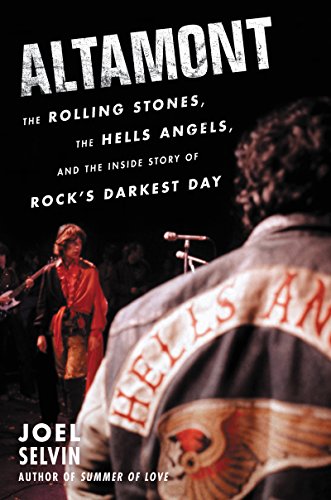
Book Review: Altamont: The Rolling Stones, the Hells Angels, and the Inside Story of Rock’s Darkest Day by Joel Selvin


First published in 2016, Altamont: The Rolling Stones, the Hells Angels, and the Inside Story of Rock’s Darkest Day takes a look at the infamous free concert that was held at California’s Altamont Speedway in 1970.

The Free Concert was meant to be a sequel of sorts to Woodstock, with bands like Jefferson Airplane, Santana, Crosby Stills Nash and Young, The Grateful Dead, and the Flying Burrito Brothers teaming up with the Rolling Stones in order to give everyone a free day and night of good music and good vibes.  While the music may have good (seriously, what a line up!, even if the Dead ultimately refused to take the stage), the vibes were anything but.  Not only was the concert hastily put together but someone came up with the bright idea of getting the Hell’s Angels to provide security.  After a day that was frequently marred by violence (among the victims was Jefferson Airplane’s Marty Balin, who was actually knocked unconscious while the band was performing), Altamont came to an apocalyptic conclusion with the murder of a young concertgoer named Meredith Hunter.  The concert may have been sold as a west coast Woodstock but, instead, it become one of the events that is regularly cited as signifying the end of the 60s.

There’s a spectacular documentary called Gimme Shelter, which contains not only footage of the violence while it happened but also features scenes of lawyer Melvin Belli setting up the concert and performing for the camera.  (“I’m opening for the Stones,” he says at one point.)  While the documentary does a good job of showing what happened, it doesn’t dig into why it happened.  Fortunately, Joel Selvin’s Altamont provides a good, in-depth history of not just what happened at Altamont but also how it all came to be.  Selvin explores what led the Stones to holding a free concert in the first place and also how a mix of 60s naivete and greed led to catastrophe.  While the Stones come across as being a bit too detached from the counter culture to actually understand what they were dealing with at Altamont, the Grateful Dead come across as being in denial about the violence lurking underneath the scene.  Meanwhile, the other performers simply try to complete their set without getting sucked in to the bad vibes all around them.  Jefferson Airplane’s performance, which was vividly captured in Gimme Shelter, is revealed in its full horror in Selvin’s book.  (Having forgotten to put in her contact lenses, Grace Slick found herself trying to calm people who she could barely see.)  Of course, as bad as the Airplane’s experience was, they still had no problem leaving their drummer behind when they finally escaped the concert.  Poor Spencer Dryden.  (Apparently, the other members of the band had decided that they didn’t particularly Dryden so why not abandon him with the Hell’s Angels?  Someday, someone will make a very good movie about Jefferson Airplane.)

Selvin not only writes about the bands and the Hell’s Angels but also about some of the people at the concert, many of whom found themselves in a war zone.  Perhaps most importantly, he writes about Meredith Hunter and the life he led before that terrible night at Altamont.  As a writer, Selvin is compassionate but also honest.  Every character, from the famous to the forgotten, emerges from Selvin’s narrative as a complex and interesting human being.  Selvin humanizes the people involved with Altamont without ever trivializing the tragedy of it all.

Altamont is often held up as being the reverse image of Woodstock.  Of course, Woodstock ’99 ended up having more in common with Altamont than with the original three days of peace, love, and music.  Joel Selvin’s book is a fascinating look at how that happened and what it all means.

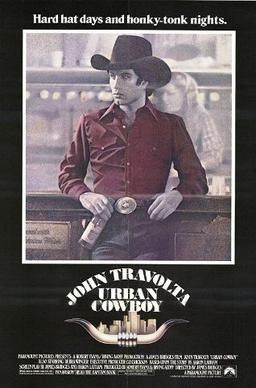
Cleaning Out The DVR: Urban Cowboy (dir by James Bridges)


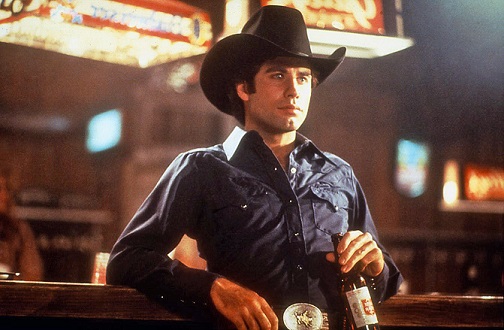
Last night, I watched the 1980 film, Urban Cowboy.  This was a film that had been sitting on my DVR for over a year.  For some reason, I had never actually gotten around to watching it.  There were many times when I started to watch it but I always ended up stopping after a few minutes.  I was never quite sure why as everything that I had heard about the film was positive.  Having finally watched it last night, I think I hesitated because I instinctively knew that John Travolta would look silly wearing a cowboy hat.

And let’s just be honest.  He does.  I mean, Travolta actually gives a fairly good performance in Urban Cowboy.  He plays Bud, a kid from West Texas who moves to Houston so that he can work on an oil rig with his uncle, Bob (Barry Corbin).  At first, he only wants to stay in Houston long enough to raise the money to buy some land back home.  But, he soon falls in love with the Houston nightlife and the local country-western bar.  (He’s Travolta so, of course, he can dance.)  He also falls in love with and eventually marries Sissy (Debra Winger).

Travolta is believable as an impulsive young adult who might not be particularly smart but who makes up for it with a lot of determination.  And he even does an okay job when it comes to capturing the country accent of West Texas.  But that said, whenever he puts on that cowboy hat, the viewer is immediately reminded that Travolta is actually from New Jersey and probably never even attended a rodeo until he was cast in Urban Cowboy.  The hat feels like an affectation, an attempt by a city boy to be more country as opposed to a country boy trying to hold onto his identity in the city.  Ironically, the term “urban cowboy” has come to mean someone who, despite having never left the city, dresses like they’re heading out to herd the cattle and rope some steers.  However, in the film itself, the hat is meant to be a natural part of Bud’s persona but it never quite feels that way.

Far more credible as a cowboy is a youngish Scott Glenn, who plays Wes Hightower.  After Bud’s chauvinistic and abusive behavior drives Sissy away, she ends up with Wes.  Wes teaches Sissy how to ride a mechanical bull, which is something Bud tried to forbid her from doing.  Wes is confident and dangerously sexy and he can even make the fact that he lives in a run-down trailer work for him.  Unfortunately, Wes also turns out to be even more controlling and abusive than Bud.  Even though Bud still loves Sissy and Sissy still loves him, Bud soon hooks up with Pam (Madolyn Smith), the daughter of a wealthy oilman.

Many more complications follow and, of course, there’s one big tragedy that causes Bud to reexamine his life.  Not surprisingly, the film’s conclusion all comes down to who can stay on that mechanical bull for the longest….

The best thing that Urban Cowboy has going for it is not Travolta or Glenn but instead, it’s Debra Winger, who gives a believable and relatable performance as Sissy, playing her as someone who may not have much but who refuses to surrender her pride.  She knows that she deserves better than both Bud and Wes, even if she is hopelessly in love with one of them.  Winger has chemistry with both Travolta and Scott Glenn, which makes the film’s love triangle feel like something more than just a typical story about a girl who can’t resist a bad boy.  She grounds the film in reality and, as such, there are real stakes to the film’s story.  Thanks to Winger, Urban Cowboy becomes about something more than just a fight over a mechanical bull.

The second best thing that Urban Cowboy has going for it is that it does manage to capture the atmosphere of a good country-and-western bar.  It’s place where people go to relax after a hard day’s work.  Unlike the discotheques  that Travolta frequented in Saturday Night Fever, the bars in Urban Cowboy eschew glamour and artifice.  Instead, they’re all about proving yourself not on the dance floor but on the back of a mechanical bull.  For Sissy, the bull symbolizes freedom.  For men like Bud and Wes, it symbolizes survival.  Myself, I’m not a drinker so my bar experience is limited.  And, though I may be from Texas and I spent a lot of time in the country while I was growing up, I’ve never been a fan of country music.  That said, I’ve danced to a few country songs and I’ve certainly stopped by a few bars, even if I was usually the one who annoyed my family and friends by just asking for a glass of water.  I’ve been to the rodeo and I’ve seen people get trampled.  I’ve also seen a few people get tossed off a mechanical bull.  I’ve never been on a mechanical bull myself but I did buy one for my Sims.  (They loved it but, sadly, I had to get rid of it because they spent so much time riding it, they kept missing work and getting fired.)  From my limited experience, I can say that Urban Cowboy got most of the details right.  Even though it was made 42 years ago, it still feels authentic.

That said, Travolta still looks odd wearing a cowboy hat.

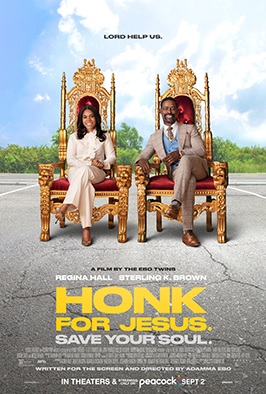
Film Review: Honk For Jesus. Save Your Soul. (dir by Adamma Ebo)


In Honk for Jesus Save Your Soul, Sterling K. Brown plays Lee-Curtis Childs, a once-popular and powerful preacher who is looking to make a comeback after his career and his church were both hit by a scandal.

Regina Hall plays Trinitie Childs, Lee-Curtis’s wife and the “first lady” of Wander The Great Paths Church.  She is just as determined as Lee-Curtis to make a comeback.

Together, they solve crimes!

Actually, they don’t.  They really don’t do much of anything, beyond trying and usually failing to talk people into returning to their church.  In archival footage, we see Lee-Curtis preaching the prosperity gospel and claiming that his faith in God is the reason why he not only has expensive clothes and a big house but that it is also the reason why he deserves them.  We see footage of Lee-Curtis in the past, condemning homosexuality from the pulpit but, in the present, Lee-Curtis seems to hit on almost every man that he meets.  Lee-Curtis is quick to smile and to speak of how he’s made his mistakes but he’s been forgiven by God.  At the same  time, he also always seems to be just one minute away from having a complete meltdown.

Trinitie spends her time trying to keep that meltdown from occurring.  She is someone who knows how to play the loving wife.  A meeting her mother establishes that being a loving wife is what Trinitie was raised to do.  It’s only in private that Trinitie reveals how difficult it is to be married to Lee-Curtis.  She wants the respect that comes from being married to a powerful man, enough so that she’ll even humiliate herself by standing on a street corner while holding a sign that requests for drivers to honk if they love Jesus.  When others attack her over her husband’s infidelities, she smiles and argues with them until she eventually reaches a point where she can smile no longer.

Regina Hall and Sterling K. Brown both give excellent performances, with Hall doing an especially good job of capturing Trinitie’s conflicting emotions over being the wife of Lee-Curtis Childs.  As played by Hall, Trinitie is someone who knows that she deserves better but who has also become addicted to the lifestyle that comes from being the first lady of a megachurch.  As such, she’ll do anything to help Lee-Curtis regain his former popularity.  While Lee-Curtis practices vapid sermons and wallows in self-pity, Trinitie is the one who is left to talk to the people that Lee-Curtis victimized.  Brown has the magnetism necessary to be credible as a man who could convince others that he was without sin.  Hall has the determination necessary to be credible as the power behind the pulpit.

Unfortunately, as good as both Hall and Brown are, the rest of the film is a complete mess.  It starts out as a mockumentary but then it includes scenes that are clearly not meant to have been filmed by the documentary film crew.  Unfortunately, there’s rarely any indication whether we’re watching a mockumentary scene or a “behind the scenes” scene and it’s left to the audience to sort out which is which.  Ultimately, the film’s main flaw is one that is shared by many films that have attempted to satirize the excesses of organized religion.  Honk for Jesus Save Your Soul doesn’t really bring anything new to the table.  At this point, is anyone shocked to discover that some pastors are corrupt?  Is anyone shocked to discover that religious people can also be hypocrites?  None of the criticism is quite as groundbreaking or shocking as the film seems to think that it is.  The movie feels like the equivalent of the atheist who thinks that he’s the first person to make the “But if God created everything, who created God?” argument.  When it comes to making an argument one way or another about organized religion, Honk for Jesus is as shallow and predictable as the God’s Not Dead franchise.  This wouldn’t matter, of course, if the film’s satire had any bite or was, at the very least, consistently humorous.  Unfortunately, this is pretty much a one joke movie.  It is, admittedly, funny the first time that Hall switches from yelling to smiling when she realizes that she’s on camera.  But, at one hour and 40 minutes, a satire needs more than one good joke.

The film is partially redeemed by Hall and Brown but ultimately, there’s little here that hasn’t been done better before.

Retro Television Review: The Love Boat 1.4 “Message for Maureen / Gotcha / Acapulco Connection”


Welcome to Retro Television Reviews, a feature where we review some of our favorite and least favorite shows of the past!  On Wednesdays, I will be reviewing the original Love Boat, which aired on ABC from 1977 to 1986!  The series can be streamed on Paramount Plus!

Welcome aboard, it’s love!

Episode 1.4 “Message for Maureen / Gotcha / Acapulco Connection”

(Directed by Stuart Margolin, Richard Kinon, and Peter Baldwin, originally aired on October 15th, 1977)

Oh no!  It’s a stowaway!  I guess any television show that took place on a cruise ship would have to feature at least one storyline featuring a stowaway.  It’s a bit disconcerting that The Love Boat couldn’t make it for more than four episodes before using the most obvious plotline but then again, the show ended up running for 9 seasons and a movie.  So, apparently, audiences didn’t mind and I have a feeling that there will probably be many more stowaway stories to come.

The stowaway in this episode is April Lopez (played by Charo).  Apparently, April became a recurring character, one who appeared in almost every season.  In this, her first appearance, she sneaks onto the boat in Acapulco.  The captain is not happy when she’s discovered hiding in a laundry hamper but everyone else is charmed by just how loud and talkative she is.  Because there’s no available rooms, April is housed with Doc Bricker until she can be dropped off at the next port.  Of course, Doc falls in love because Doc fell in love with everyone who came into his exam room.  Seriously, Doc was an HR nightmare waiting to happen.

Of course, April is not the only exhausting person to be on the ship.  There’s also Cyril Wolfe (Milton Berle), a nonstop practical joker whose wife (Audra Lindley) is getting sick of dealing with him and really, who can blame her?  Cyril greets a total stranger with a joy buzzer.  He carries around a fake, detachable hand so that he can freak people out.  Cyril can’t even give it a rest during their vacation!  Pretty soon, not only his wife but the crew are pretty sick of him.  (Most of the people watching the show will be sick of him, too.)  Do they conspire to toss Cyril overboard?  They could probably get away with it, seeing as how all of the ship’s nominal authority figures are busy dealing with a stowaway who loves to sing.  Somehow, Cyril survives his trip and he and his wife end up more in love than ever.

Finally, Maureen Mitchell (Brenda Benet) is a former tennis player who is now in a wheelchair.  All she wants is a few days of vacation before she meets with a surgeon who might be able to help her walk again.  Unfortunately, she discovers that an arrogant sportswriter named John (Bill Bixby) is also on the cruise!  At first, she wants nothing to do with him but when John injures his knee and has to use a wheelchair for the rest of the cruise, the two of them fall in love….

Hold on.  You know what just occurred to me?  Last week’s episode featured Robert Reed and Loretta Swit as two people who don’t like each other but just happen to end up on the same cruise.  This episode featured Brenda Benet and Bill Bixby as two people who don’t like each other but just happen to end up on the same cruise …. how long did The Love Boat writers last before they said, “Okay, we’re out of stories.  Let’s start repeating ourselves?”

Anyway, this episode was a mixed bag.  Charo and Milton Berle were not particularly subtle performers and their storylines felt as if they were designed to invite them to indulge in their worst impulses as performers.  But Bill Bixby and Brenda Benet had a lot of chemistry as John and Maureen and their story actually worked as a result.  (Bixby and Benet were married at the time they appeared in this episode.)  Plus, the ship looked lovely.  So did the ocean.  That’s what really matters.

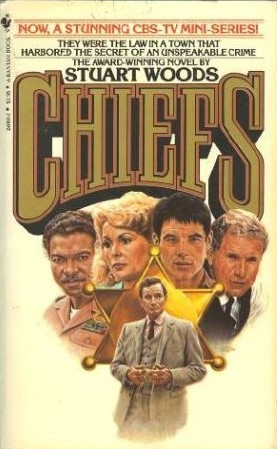
Book Review: Chiefs by Stuart Woods


First published in 1981, Chiefs follows the town of Delano, Georgia over the course of five decades.

Delano starts out as a small, rural town, one that sit uneasily on the dividing line between the old and the new South.  Under the leadership of forward-thinking civic leaders like Hugh Holmes, the town starts to grow.  And, like any growing town, it needs a chief of police to maintain the peace.  In 1919, a simple but honest farmer named Will Henry Lee is selected as the town’s first chief of police.  Not selected is the wealthy Foxy Funderburke.  That’s probably for the best because Will Lee is determined to do a good job and fairly treat all of the town’s citizens, regardless of their race or their economic class.  Foxy, meanwhile, is a serial killer who has been killing young men and dumping their bodies all over the county.

Chiefs tells the story of three men who serve as Chief of Police while Delano grows and Foxy continues to murder anyone that he can get his hands on.  Will Henry Lee is followed by Sonny Butts, a war hero who soon turns out to be a corrupt and racist psychopath.  Sonny is eventually followed by Tucker Watts.  As the town’s first black police chief, Tucker has to deal with both racism and Foxy Funderburke’s murders.  However, Tucker himself has a secret of his own, one that links him back to the very first chief of police.

Chiefs is kind of all over the place.  Not only does the novel follow the growth of Delano and the decades-long investigation into all of Foxy Funderburke’s murders but it also finds time for appearances from Franklin D. Roosevelt and a subplot about Billy Lee, Will Henry Lee’s son, running for governor of Georgia and potentially replacing LBJ as Kennedy’s running mate in 1964.  (The President, of course, explains that he’ll make his decision after returning from Dallas.)  At times, it gets to be a bit too much.  The mystery of the Delano murders too often gets pushed aside for the far less interesting political stuff.  Chiefs was Stuart Woods’s first novel and he makes the common first-timers mistake of trying to cram too much into his story.

The book is at its best when it just sticks to Delano.  Foxy Funderburke is not just a murderer but also a symbol of the times when there law was only arbitrarily enforced in the former Confederacy and wealthy, white landowners could pretty much do whatever they wanted without having to worry about the consequences.  Foxy represents the old ways and each chief, even the evil Sonny Butts, represents just a little bit of progress towards the new way.  Though his prose is rarely memorable, Stuart Woods was a good storyteller and Foxy Funderburke is a memorable villain.  (And, to be honest, Foxy Funderburke is a brilliant name.)  Even if their characterizations aren’t particularly deep (Will Lee is honest, Sonny is narcissistic, Tucker is determined to prove himself), the three men who oppose him are all worthy adversaries and it’s interesting see how, over several decades, the three of them each finds a different piece of the puzzle until Foxy’s true nature is finally exposed.  Will Henry Lee may not have known Sonny Butts and Sonny certainly would never have even spoken to Tucker Watts but, in a way, the three of them work together to solve the town’s greatest mystery.

In the end, the book appealed to the side of me that loves a mystery and it also appealed to my dedicated history nerd side.  Chiefs is flawed but compelling.

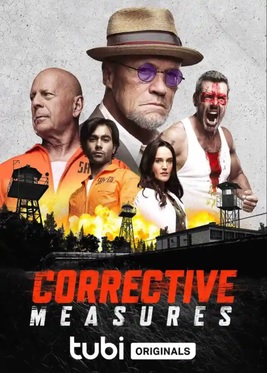
Film Review: Corrective Measures (dir by Sean O’Reilly)


Welcome to the future!

War is raging.  Food is scarce.  At the start of the film, a newscaster officially says farewell to Australia as it’s swallowed by the ocean.  Due to some sort of vaguely defined cosmic event, certain citizens have developed super powers.  Normally, you might think that would be a good thing.  Maybe someone can use their super strength to save Australia.  Instead, it’s led to a rise in supervillains.  People with names like The Conductor and the Lobe are terrorizing the world.  Fortunately (or not), a prison has been designed to hold all of these super villains.

Running that prison is Overseer Devlin (Michael Rooker).  Devlin is quick to correct anyone who calls him a warden.  That said, Devlin runs his prison with a firm and sometimes cruel hand.  All of the inmates are forced to wear a leg brace that neutralizes their powers.  They’re at Devlin’s mercy and Devlin knows it.  A sentence to San Tiburon prison is a life sentence, regardless of what the courts may say.  No one gets parole unless Devlin wants them too and Devlin’s not in the business of giving people freedom.

Corrective Measures follows four inmates in particular.  Diego Diaz (Brennan Meija) is an empath, a super power that will be of little help in a prison where empathy is seen as a weakness.  Gordon Tweedy (Tom Cavanagh) is also known as the Conductor because he can control electricity.  Payback (Dan Payne) is a self-styled vigilante who killed evildoers on the outside and who looks forward to killing more on the inside.  Finally, there’s the Lobe (Bruce Willis), who is the most feared supervillain of all.  The Lobe can control minds, but only if his leg brace is removed.  While the Warden prepares for his retirement and considers who among his staff he should name as a his replacement, the inmates simply try to survive from one day to the next.

Corrective Measures is an episodic film, with the focus continually shifting from one character to another.  When the film begins, Payback seems like he’s going to be the main character but then the focus shifts to Diego and The Conductor.  Towards the end of the film, the focus switches once again and it becomes about The Lobe and his schemes.  The one theme running through the entire film is the struggle to maintain one’s freedom and dignity in even the most difficult of circumstances.  Yes, Corrective Measures might be a low-budget super hero film and yes, it was based on a graphic novel but it’s also a mediation on what it means to be free in a society that persecutes anyone who is perceived as failing to conform.  That theme elevates the film, making it more than just a B-movie.  If Sam Fuller directed a comic book movie, it would probably look something like Corrective Measures.

The actors also do wonders with the material, with Michael Rooker giving an entertainingly evil performance as Warden Devlin and Tom Cavanagh turning The Conductor into a surprisingly poignant character.  That said, I imagine most people will be watching this film because it was one of the final films that Bruce Willis worked on before announcing his retirement from acting.  It is true that Willis does spend the majority of this film in his cell.  It’s rare that he’s ever actually seen in a shot with any of the other actors, leading me to suspect that Willis probably shot all of his scenes in a day or two.  Despite that, Willis is well-cast as The Lobe and there’s even a few scenes where he seems like the Willis of old, smirking at his opponents and dismissing them with a well-timed insult.  While it’s obvious that Willis was not in the best shape when he shot his scenes, Corrective Measures still feels like a better closing act than something like American Siege.

Corrective Measures is a far better film than I think anyone would have expected it to be.  It’s a celebration of freedom that understands why it’s worth celebrating.

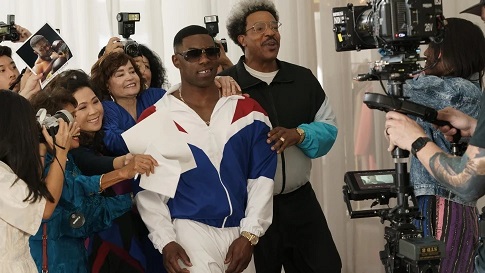
Miniseries Review: Mike (dir by Craig Gillespie, Tiffany Johnson, and Director X)


“Who is Mike Tyson?” is question that’s asked by the new Hulu miniseries, Mike.

The answer to that question is that he’s a boring guy who did some interesting things.

For instance, he became a boxer and was briefly the world champion before he was brought down by his own hubris.  That’s interesting, largely because it’s something that seems to happen to quite a few people who suddenly find themselves on top of the world but don’t have the maturity necessary to handle it.  However, that, in itself, does not Mike Tyson an interesting human being.  It just makes him an example of how history repeats itself.

He bit off an opponent’s ear during a boxing match.  That’s interesting because it was such a savage act and it scandalized people who otherwise have no problem watching two men beat each other until one loses consciousness.  Causing brain damage is okay but God forbid you bite off a piece of someone’s ear.  But the fact that Mike bit off the guy’s ear does not, in itself, make Mike Tyson interesting.  It just makes him a jerk.

Mike Tyson has a facial tattoo that doesn’t really mean anything.  A lot of people have stupid tattoos.

Mike Tyson has a distinctive way of speaking.  So do a lot of other people.

Mike Tyson spent three years in prison after being convicted of raping a contestant in a beauty pageant.  Tyson was and is certainly more famous than the typical convict and, somehow, that conviction has not prevented him from becoming a beloved cultural institution in the United States.  The hypocrisy is interesting.  Mike Tyson is not.

At least, that’s the impression that I got from this 8-episode miniseries.  Seven of the episodes feature Tyson (played by Trevante Rhodes) performing a one-man show in front of an audience in Indiana.  Believe it or not, this is based on fact.  Apparently, Mike Tyson did have a one-man show, in which he would discuss his career and his life.  (Jeff even wrote a review of it for this very site!)  We watch flashbacks as the show’s version of Tyson provides a self-serving narration and, to be honest, it seems like it would be the most boring one-man show ever.  Tyson talks about growing up poor and with a mother who alternated between hating and loving him.  He talks about his first trainer (played by Harvey Keitel, who often seems to be channeling Jonathan Banks) and his first marriage.  Mostly he talks about how he feels that almost everyone in his life betrayed him.  The first two episodes, which deal with Tyson’s youth, are effective because they examine how a childhood of mental and physical abuse can set the course of someone’s entire life.  However, once adult Tyson shows up, Mike becomes far less compelling.  It’s hard not to get tired of listening to him blame everyone else for his own increasingly poor decisions.

The one exception to the show’s format is episode 5, which is told from the point of view of Desiree Washington (Li Eubanks), the woman who Tyson was convicted of raping.  This is a powerful stand-alone episode, both because of Eubanks’s performance and because it’s the only episode to not be seen through Tyson’s eyes.  It’s the episode that allows the viewer to see Tyson the way the rest of the world saw Tyson.  And yet it’s difficult to feel that, when viewed in the context of the entire miniseries, this episode is a bit of a cop-out.  It’s the only episode to focus on someone who was hurt by Tyson but it’s surrounded by episodes that once again portray Tyson as being a victim of his managers, his fans, and society at large.  Desiree is given one episode and then disappears from the narrative whereas the show’s version of Tyson is given seven episodes to justify himself.  One gets the feeling that the show’s producers knew that they had to include Desiree but they also knew that revealing Tyson’s version of the events would have also meant revealing that he continues to insist that he was the victim and that would have totally messed up the show’s final redemption arc.  And so, the narrative burden is temporarily placed on Desiree and Tyson only returns once it is time to discuss what it was like being in prison.

Mike was produced by Craig Gillespie, who also directed I, Tonya.  Like I, Tonya, Mike features characters frequently breaking the fourth wall and talking directly to the audience.  In fact, it happens so frequently that it gets to be kind of annoying.  Breaking the fourth wall really wasn’t even that original when it happened in I, Tonya.  In Mike, it becomes a trick that’s used to try to make Mike Tyson into a more interesting character than he is.  But it feels empty, largely because it doesn’t tell us anything that we don’t already know or couldn’t have guessed on our own.

The miniseries itself was made without the participation of the real-life Mike Tyson.  Tyson condemned the show as being an attempt to make money off of his life and he actually does have a point.  Unfortunately, the miniseries itself doesn’t have anything new to add to the story of Tyson.  It’s an 8 episode Wikipedia entry.  At some point, the streaming services may need to realize that not every celeb needs to be the subject of a miniseries.  Simply being famous does not always make for a compelling story.

Retro Television Reviews: Fantasy Island 1.3 “The Prince/The Sheriff”


Welcome to Retro Television Reviews, a feature where we review some of our favorite and least favorite shows of the past!  On Tuesdays, I will be reviewing the original Fantasy Island, which ran on ABC from 1977 to 1996.  The entire show is currently streaming on Tubi!

Welcome to Fantasy Island!  Is everyone smiling?

Episode 1.3 “The Prince/The Sheriff”

(Directed by Phil Bontelli, originally aired on February 11th, 1978)

The third episode of Fantasy Island is about two men searching for a simpler way of life.

Peter D’Antonoli (Dack Rambo) is the prince of the nation of Andoli.  As Mr. Roarke explains it, Peter is on the verge of becoming one of the last true monarchs, someone who not only wears a crown but who sets governmental policy.  Peter has never known what it’s like to be one of the common people and he feels that he should give it a try before he takes power.

Mr. Roarke arranges for Peter to get a job on a fishing boat.  Apparently, there’s a small fishing village located near the Fantasy Island resort.  I’m just three episodes into the original series and I have to admit that I’m already confused about about how Fantasy Island operates.  The pilot and the first two episodes suggested that Fantasy Island was a magical resort that belonged exclusively to Mr. Roarke.  But, with this episode, it is revealed that there is a fishing village near the resort and that the blue collar fisherman resent all of the people who hang out at the resort.  So, is Fantasy Island actually a nation, one that has many different village and an economic class system?  Is Mr. Roarke the president?  Has Fantasy Island been invited to join the United Nations?  And why is the Fantasy Island fishing village full of people who look like they belong in a second remake of The Fog?  Is Fantasy Island near New England?  Is it off the coast of Maine?  Seriously, this is a confusing place.

Anyway, Mr. Roarke arranges for Peter to get a job on a fishing boat, where he befriends a fisherman named Jamie (Ed Begley, Jr.).  Jamie immediately notes that Peter must be new to the fishing industry because his hands don’t have any callouses.  Jamie explains that he’s been a fisherman his entire life.  (So, did Jamie grow up on the island?)  Peter learns about generosity from Jamie and about rejection from Chris Malone (Lisa Hartman).  Peter falls in love with Chris as soon as he meets her but Chris has lived a tough life and she doesn’t want to marry someone who is just a fisherman.  Peter struggles to explain that he’s actually a prince.  Chris doesn’t believe him.  Peter says that there are things more important than money.  It leads to a big argument but fear not!  Things work out for everyone.  Chis becomes a princess.  Peter learns humility.  And Jamie gets a new boat and remains trapped on the island….well, okay.  Things worked out for almost everyone.

Meanwhile, John Burke (Harry Guardino) is a tough New York cop who wants to go back to a time when there weren’t any liberal DA’s letting criminals out of the street.  He wants to be an old west marshal!  Mr. Roarke mentions that “the old west fantasy” is Fantasy Island’s top seller.  He takes Burke to a western town.  Burke asks about the people who live there.  “They’re not robots, like in that movie, are they?”  No, Mr. Burke, it’s not Westworld!  It’s Fantasy Island!

It turns out that the two men who Burke believes murdered his partner had a similar fantasy and they’re living in the town as well!  Marshal Burke sets out for revenge but, with the help of saloon owner Julie (Sheree North), he learns that upholding the law with mercy is more rewarding than seeking blind vengeance.  Burke and Julie leave the island but fear not.  Mr. Roarke is sure that someone else will show up and request the old west fantasy.  It’s their biggest seller, after all.

(So, Fantasy Island really was just like Westworld….)

The prince storyline was silly.  The old west storyline was also silly but Harry Guardino gave a pretty entertaining performance as John Burke.  This episode also featured a visit to the Fantasy Island disco, which I appreciated.  Why go to the old west when you can dance?

Next week …. more fantasies!