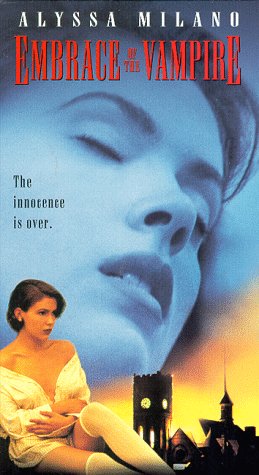
The TSL’s Horror Grindhouse: Embrace of the Vampire (dir by Anne Goursaud)


In this incredibly silly film from 1995, Martin Kemp plays The Vampire.  He doesn’t get a name but he does get a backstory.  Back when he was mortal, the Vampire pursued a secret and forbidden affair with a princess.  One day, after making love, the man who would became the Vampire was laying down next to a stream when he was approached by three naked women who proceeded to bite his neck and vampirize him.

Centuries later, the Vampire is sickly and approaching the end of his existence.  He only has three days to convince the reincarnation of his former lover to allow him to drink her blood so that he can continue to exist.  And apparently it won’t work unless she’s a virgin and unless she rejects all others and loves only him.  That sounds like a lot of rules to me and, to be honest, most of them seem to be kind of arbitrary.  Not only does The Vampire have to find the reincarnation of the Princess but he has to find her before she loses her virginity or otherwise, what?  She’ll cease to be the reincarnation?  Her love will somehow be devalued?  Her blood will no longer be worth drinking?  If this vampire has had to spend centuries only drinking blood from virgins who were in love with him, no wonder he looks so sickly.  I really think that maybe the other vampires were playing a practical joke when they explained the rules to him.  Hazing the new guy, it has consequences!

Anyway, the princess has been reincarnated as Charlotte (a young Alyssa Milano).  Fortunately, for the Vampire, Charlotte was raised in a convent and, even though she is now a college student, she’s still a virgin who blushes when she even hears the word sex.  Unfortunately, Charlotte has a boyfriend named Chris (Harrison Pruett) and she’s thinking about losing her virginity if she can convince herself that she loves Chris more than any other person that she will ever possibly meet.  So, the Vampire not only has to convince Charlotte to fall in love with him but he also has to make sure that she doesn’t have sex beforehand.  It’s going to be difficult because everyone on campus is determined to get Charlotte laid.  This has all the makings of Italian sex comedy but Embrace of the Vampire instead takes its plot very seriously.

The Vampire starts to appear in Charlotte’s dreams.  He gives her an ankh to replace the cross that Chris gave her.  Because the Ankh is a symbol of desire, just wearing it makes Charlotte more sexually aggressive and soon, she’s wearing short skirts, low-cut tops, and white stockings.  She’s also making out with Sarah (Charlotte Lewis), the photographer who lives in the dorm room next to hers.  (As played by Charlotte Lewis, Sarah is actually an interesting character and it’s a shame that the film pretty much just uses her for titillation.)  But since the Vampire’s whole thing is keeping Charlotte from losing her virginity, why would he give her something that would make her more open to sexual experiences?  Again, it’s hard not to think that the Vampire is just the victim of an elaborate practical joke.

As I said at the start of the review, Embrace of the Vampire is incredibly silly.  It’s also a film that seems to be a bit popular with viewers of a certain age.  I’m assuming that’s because of the frequent Alyssa Milano nudity and that one scene with Charlotte Lewis.  For the most part, Alyssa Milano gives a bland performance in Embrace of the Vampire.  It’s not so much that she’s bad as everything about her performance is on the surface.  One gets the feeling that there’s really not much going on with Charlotte’s inner life, both before and after she starts dreaming about The Vampire.  As The Vampire, Martin Kemp appears to be absolutely miserable.  He comes across as if he’d rather be anywhere than appearing in this movie.

That said, the film’s director got her start working with Francis Ford Coppola and she has a good eye for gothic scenery and atmosphere.  A scene where Charlotte imagines a frat party turning into a Hellish orgy is effectively done.  Jennifer Tilly has a small role as a vampire and she has said that Quentin Tarantino approached her at the Oscars to tell her that he enjoyed the movie.  It’s a silly movie (yes, third time I’ve used that specific term and that should tell you just how silly it is) but, for better or worse, it epitomizes an era.
Retro Television Review: California Dreams 1.9 “Mother and Child Reunion” and 1.10 “Romancing The Tube”


Welcome to Retro Television Reviews, a feature where we review some of our favorite and least favorite shows of the past!  On Saturdays, I will be reviewing California Dreams, which ran on NBC from 1992 to 1996.  The entire show is currently streaming on YouTube!

Last week, California Dreams dealt with both racism and misogyny.  It was two heavy episodes, featuring important lessons about the problems of the world.  Would the trend continue?  Let us find out!

Surf dudes with attitude, feeling mellow, let’s get on with it….

Episode 1.9 “Mother and Child Reunion”

(Directed by Don Barnhart, originally aired on November 7th, 1992)

It’s been over a month since the Dreams last had a gig.  Maybe they should break up!  Matt thinks that they just need to practice more.  (Of course, being a music camp kid, he would say that, wouldn’t he?)  Sly thinks that the band need to change its image and be less beach-y.  Considering what was going on in music in the early to mid-90s, Sly probably has a point.  Anyway, Sly goes out and buys a smoke machine so that the Dreams can use it to change their middlebrow image.  Maybe they just need a new lead singer.  WHERE’S JAKE!?

Now, the smoke machine and the edgy image stuff is actually kind of cute but the majority of the show revolves around Tiffani and her mom.  It turns out that Tiffani’s mom essentially abandoned her when Tiffani was only six.  For ten years, Tiffani’s mom worked as a dancer in New York.  Now, she’s back in California.  At first, everyone is shocked by the fact that Tiffani doesn’t seem to be angry at her mom but it turns out that Tiffani is angry and that anger finally comes out at Tiffani’s 16th birthday party when her mom suggests that Tiffany come live with her for a year.

By the standards of California Dreams’s first season, this wasn’t a bad episode.  Kelly Packard did a good job of portraying Tiffani’s anger.  Plus, this episode did have one good joke, in which Sly tried to rename the band The California Nightmares in an attempt to change their image.  They should have stuck with the new name.

Episode 1.10 “Romancing The Tube” 

(Directed by Don Barnhart, originally aired on November 14th, 1992)

This was a weird episode.  I’ve seen plenty of episodes of California Dreams but somehow, I never knew that Sly and Tiffani were a couple for an episode.  Apparently, Tiffany and Sly fell for each other while Tiffany was teaching Sly how to surf.  It all led to a “Surf Soul Swapping” ceremony, which was overseen by Peter Tork of the Monkees.  However, at the last minute, Tiffani realized that she was just using Sly as a rebound to help her get over her ex.  And Sly never really wanted to be in a committed relationship to begin with.  So, they broke up and I guess it all worked out in the end.

Meanwhile, Matt, Jenny, and Tony were supposed to paint a room in the Garrison House in return for Mrs. Garrison paying them $300 so they could get a new lighting system.  But then they got bored and abandoned the job.  Fortunately, the new lighting system turned out to be a bust so they tricked Mrs. Garrison into taking it off their hands.  No one learned a thing, which was probably about as realistic as California Dreams ever got.

Weird episode.

Novel Review: Capital Crimes by Lawrence Sanders


Tell me if the plot of the 1990 novel, Capital Crimes, sounds familiar.

The President of the United States is struggling.  The economy is bad.  The U.S. is long ground internationally.  The President’s approval ratings are plummeting.  The members of his own party are searching for a way to get rid of him.  However, the President himself is more concerned about the health of his son, a hemophiliac who seems destined to suffer an early death if he’s not somehow cured of his condition.

Everything looks hopeless until the President meets Brother Kristos.  Brother Kristos is a wild holy man from the backwoods, a sensualist who drinks vodka, believes that the best way to worship is to have an orgy, and who claims that he has a direct line to God and that he can heal the President’s son.  Kristos not only makes the claim but he backs it up by actually doing it.  The President and his wife soon become dependent on the mysterious Kristos.  Kristos goes from being an obscure cult leader to one of the most powerful men in the country but is he a servant of God or the Devil?  While Kristos sets about seducing all of the women in Washington, others try to investigate his background.  Is Kristos a charlatan or does he truly have magical powers?

If this sounds familiar, that’s probably because you’re familiar with Rasputin, the Russian monk who became a shadowy and much-feared influence on the family of Nicholas II, the final Tsar of Russia.  In fact, Capital Crimes so closely follows the story of Rasputin that you kind of have to wonder why no one in the book ever seems to pick up on the connection.  Russia exists as a rival to the United States in Capital Crimes and, as such, one assumes that Rasputin must have existed as well.  And yet no one in the book ever says, “Hey, remember when this happened before and it didn’t end well?  Maybe we shouldn’t invite the unwashed holy man to live in the White House?”

Capital Crimes is one of the books that I found in my aunt’s paperback collection.  I read it a few weeks ago and, beyond the fact that it was so obviously based on the story of Rasputin, there wasn’t anything particularly memorable about it.  The reader is continuously told that Brother Kristos is incredibly charismatic and that his piercing stare can hypnotize almost anyone but telling and showing are two different things and Kristos is such a ludicrous figure that it’s hard to take him seriously.  (Then again, I imagine many initially said the same thing about Rasputin.)  The book flirts with suggesting that Kristos actually does have supernatural powers but it neve really commits to the idea, which is a shame.  If you’re going to write a book about a Rasputin in the White House, you might as well go all out and fully embrace the supernatural aspect of the story.  Instead, the book gets bogged down in the political machinations of all the people who would like to replace the president.  It’s a bit dull.

The book is credited to Lawrence Sanders, who I know wrote quite a few best sellers and who is usually listed among the better thriller writers.  Capital Crimes feels extremely sloppy and derivative so I’m going to assume that it was written strictly for the money.  That’s not necessarily a criticism, of course.  Money’s a good thing!  But so is an interesting plot.

Book Review: Blood, Sweat & Chrome: The Wild and True Story of Mad Max: Fury Road by Kyle Buchanan


Wow, I thought as I read Kyle Buchanan’s oral history of the making of Mad Max: Fury Road, Charlize Theron and Tom Hardy really did not like each other.

I have to admit that I feel a little bit bad that my main reaction to Blood, Sweat, & Chrome centered around the most “gossipy” part of the book, the chapter in which everyone interviewed talked about how Theron and Hardy simply did not get along during filming.  That, of course, is also the part of the book that got the most media attention when it first came out.  Overall, it’s really a very small part of the overall story.  The books deals with much more than just Charlize and Tom.  It discusses how the stunts were achieved.  It documents just how much time George Miller spent planning Fury Road and also how the project was changed by Mel Gibson’s very public fall from grace.  There’s a very touching chapter that deals with Hugh Keays-Bryne, the Australian actor who played memorable villains in both the first and, to date, the last of the Mad Max films.  There’s a lot of good stuff in Blood, Sweat & Chrome but it’s the chapter about Hardy and Theron that will probably capture the attention of most readers.  They’re movie stars, after all.  We’re all fascinated by stars, especially when they don’t get along.

As for why Theron and Hardy didn’t get along, the people interviewed for the book all have their theories.  Some say that Hardy was not only feeling pressure over stepping into Mel Gibson’s shoes but that he was also miffed to realize that he was primarily going to be a supporting player in his own movie.  Others say that it was a conflict in working styles, with Theron going out of her way to always be professional and on time while Hardy was a bit more relaxed when he would show up on the set.  Nicholas Hoult (who comes across as being both a professional and a gentleman) says that being on set with them often felt like being in the back seat of a car while your parents are fighting up front.  Whatever the reason, Hardy and Theron did not enjoy either’s company while filming.  Shouting matches were followed by meetings with George Miller, who Theron observes was not necessarily always on her side when it came to her conflict with Tom Hardy.  And while actors arguing during filming is hardly a unique event, what stands out about Theron and Hardy is that they both appeared to continue to dislike each other even after filming ended.  Even with the success of the film, one gets the feeling that the two of them will never voluntarily star opposite each other again.  Or, at the very least, they’ll get a lot of money before agreeing to do so.

What’s interesting though is that Hardy and Theron’s dislike for each other was probably a major factor in Mad Max: Fury Road‘s success.  One reason why Fury Road stands out is because neither Furiosa nor Max end up having the type of relationship that you might otherwise expect.  Though they eventually work together, they never become a couple.  Neither surrenders to the other.  Furiosa never stops fighting and Max never stops wandering.  Even when they become allies, there’s still that tension there.  Neither one really trusts the other.  As was so often the case with the production of Mad Max: Fury Road, Theron and Hardy’s contentious relationship, something that should have led to disaster, actually served to make the film better.

Reading Buchanan’s book, one comes away with the impression that, for all the difficulties that were encountered during filming, Mad Max: Fury Road was almost a blessed production.  Everything that went wrong only served to make the final product better.  George Miller’s struggles to get the film into production gave him the time he needed to create a film that had a good deal more thematic depth than the average action sequel.  The harsh working conditions were the perfect backdrop for the film’s equally harsh world.  Mel Gibson’s troubles allowed Miller to rethink the character of Max and also gave Miller room to make Furiosa an equally important character.  That few people were expecting much from Mad Max: Fury Road allowed Miller to take the world by surprise.  Even the fact that many were surprised when Fury Road won Best Picture from the National Board of Review allowed the film to enter the Oscar season as an appealing underdog.  Of course, while Mad Max: Fury Road did win the most Oscars that year, it did not win Best Picture.  But I can promise you that, as you sit here reading this, more people are currently watching Mad Max: Fury Road than are watching Spotlight.

Mad Max: Fury Road is a great film and Blood, Sweat, & Chrome provides an in-depth look at how that happened.  It’s hard not to be inspired by George Miller and he refusal to give up on the project.  Much like Furiosa, Miller never stopped fighting.  Neither Furiosa nor Miller found what they were initially expecting at the end of their journey.  Instead, they discovered something better and, as a result, their stories will never be forgotten.

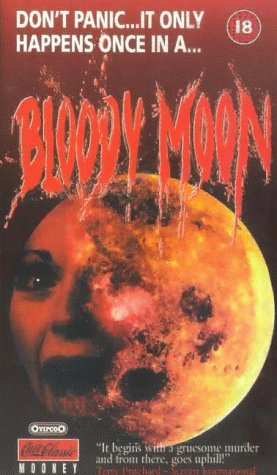
International Horror Film Review: Bloody Moon (dir by Jesus Franco)


A 1981 West German/Spanish co-production, Bloody Moon open with a disfigured man named Miguel (Alexander Waechter) putting on a Mickey Mouse mask and sneaking into a party being held on the campus of a private school that is known as (deep breath) Europe’s International Youth-Club Boarding School of Languages.  It’s a school that is meant for the young, the rich, and the unburdened.  In short, it’s not a place for Miguel at all.

With his face safely hidden behind the smiling image of Disney’s favorite mouse, Miguel meets a young woman who is dancing by herself.  She mistakes him for her boyfriend and heads into a nearby bungalow with him.  They start to make love but — uh oh! — the mask falls off!  The woman screams at the sight of Miguel’s scarred face.  Miguel grabs a pair of scissors and stabs her to death while Mickey Mouse’s smiling face smiles on the floor.  (One can only imagine how Disney reacted to this film.)

A few years later, Miguel is being released from a mental hospital.  He’s released into the custody of his sister, Manuela (Nadja Gerganoff).  Miguel’s doctor (played by the film’s director, Jesus “Jess” Franco) says that Miguel should be fine as long as he’s not around anything that reminds him of the incident.  Manuela says that she’ll look after him and then promptly takes him back to the school where he committed the murder.  What part of not reminding him did she fail to understand?

Manuela does actually have an excuse for bringing Miguel to the school with her, though.  She and her aunt, Countess Maria (Maria Rubio), own the school.  Countess Maria is an angry, wheelchair-bound woman who is convinced that Manuela wants to kill her so that she can take over the school and it does seem that Manuela does have some hostility towards her aunt.  Of course, another reason for bringing Miguel back to the school to live with her is that he and Manuela have an incestuous relationship …. or, at least, they did.  Now that Manuela refuses to sleep him, Miguel is reduced to lurking around campus and staring at all the students while they sunbathe topless at the pool.  While Manuela stands naked in her room and stares at the moon (the bloody moon?), Miguel is hunched down in the shrubbery and peeping through windows.

Among the students is Angela (Olivia Pascal).  Angela is upset because she discovered a dead body but no one’s willing to believe her because she also enjoys reading mystery novels.  Angela knows that someone is committing murders on campus but is it Miguel or it is Professor Alvaro (Christoph Moosbrugger) or could it even be the enigmatic Bueno (Otto Retzer), a bald guy who seems to randomly pop up around campus?  Can Angela convince her remarkably stupid classmates that there’s a murderer on campus before it’s too late?

Bloody Moon was one of the many films directed by the Spanish auteur and former Orson Welles collaborator, Jesus Franco.  In a career that lasted over 60 years, Franco directed at least 173 feature films.  (It’s felt that he actually directed quite a bit more, usually under a pseudonym.  Franco, himself, claimed that he didn’t really remember how many films he had directed.)  As a director, Franco is remembered for his low budgets, his unapologetic embrace of the sordid, his rather casual attitude towards maintaining continuity from one scene to another, and for occasionally framing an interesting shot or two.  By his own admission, Bloody Moon was not a personal project for Franco.  It’s something that he did for the money, as a director-for-hire.  However, Bloody Moon is unmistakably a Franco film.  The budget is low.  The subject matter is often so sordid that it borders on parody.  As far as continuity goes, Angela goes from wearing a nightshirt when she discovers a dead body inside her bungalow to wearing a colorful sweater when she runs outside in a panic.  (I guess she could have stopped to change clothes with a dead body on the bed and a killer lurking somewhere in the bungalow but I doubt it.  When there’s a dead body on your bed, modesty should be the least of your concerns.)  And yet, as silly as it all is, there are moments when Bloody Moon does achieve a certain dream-like intensity.  The mix of badly dubbed performers, sudden jump cuts, bloody violence, and the total lack of narrative logic makes Bloody Moon feel a bit like a filmed nightmare.  It works despite itself.

Bloody Moon is one of the films that was, for a while, banned in the UK due to its violence and bloodshed.  And indeed, there is a lot of blood and the violence is a bit more graphic than what one might expect to find in the American slasher films that Bloody Moon was obviously meant to capitalize upon.  This film is notable for just how cruel the killer is.  Not even Michael Myers or Jason Voorhees resorted to using a giant radial saw.  That said, this is one of those films that has a reputation for being bloodier than it actually is.  The majority of the film is taken up with scenes of people wandering around campus, either searching for their friends or stalking a potential victim.  Personally, I felt the nonstop searching scenes added to the film’s dreamlike feel but I imagine those who only watch films like this for the kills will find it all to be a bit slow.

Bloody Moon was clearly made to capitalize on the success of American slasher films like Halloween and Friday the 13th.  That said, Bloody Moon has more in common with the Italian giallo genre, right down to the whodunit nature of the plot, the ludicrously sleazy motives of the killer, and the total lack of intentional comic relief.  Like so many giallo films, Bloody Moon takes place in a world where everyone’s either a victim or a killer and no one’s particularly likable.  It’s not one of Franco’s personal films but there’s still enough of his signature style to appeal to his fans.  As with most of Franco’s film, it will be best appreciated by those who like a little ennui mixed with their horror.

Horror Film Review: Await Further Instructions (dir by Johnny Kevorkian)


The 2018 film, Await Further Instructions, takes place in the United Kingdom during the Christmas season.  However, it tells a story that could take place anywhere and at any time.  That’s even more obvious today than when the film was first released.

A dysfunctional family has gathered for the holidays.  Nick (Sam Gittins) brings his girlfriend, Annji (Neerja Naik).  Nick’s sister, Kate (Holly Weston), is both pregnant and a racist.  She brings her husband, Scott (Kris Saddler).  Tony (Grant Masters) and Beth (Abigail Cruttendon) are the parents, trying to keep some sort of order as dinner is served.  Finally, Granddad (David Bradley) dislikes everyone as grandfathers are allowed to do.  Once someone reaches a certain age, bad behavior is casually dismissed as someone just having a bad day.

The family dinner is interrupted by reports of some sort of ill-defined disaster.  A dark substance appears to have surrounded the house, trapping them inside.  Bizarre messages start to appear on the television, telling the family to obey orders and to await further instructions.  Some members of the family dare to unplug the television, just for Tony quickly plug it back in.  Hypodermic needles are dropped through the chimney, along with a message that one of them is infected and that they have to take the vaccine if they’re going to survive.  Even after taking the shot leads to one member of the family vomiting to death, Tony continues to insist that everyone has to follow the instructions coming from the television.  The television accuses one of them being a sleeper agent.  The television demands a sacrifice.  The television warns of terrible consequences if its instructions are not followed.  Those who try to resist find themselves being attacked by the other members of the family.  “Worship me,” the television suggests at one point and much of the family is willing to do just that.

Await Further Instructions was made in 2018 but it’s a film that feels as if it was specifically made for the COVID era.  (I write this as someone who is voluntarily vaccinated and who is still more than happy to put on a mask if someone politely requests that I do so.)  While a good deal of the film’s horror does come from grotesque imagery and Cronenberg-style body horror, the reason why the film sticks with the viewer is because it perfectly captures the paranoid atmosphere that everyone has had to deal with over the past two years.  (Indeed, if this film had been made today, critics would probably say that the film was a bit too on the nose in its portrayal of people putting blind faith in instructions coming from unseen forces.)  Tony goes from being a slightly addled father to being a monster, precisely because that’s what he’s ordered to do and he doesn’t have the courage or the imagination to question why.  This is the story of a family that’s destroyed because they put more faith in authority than in their own common sense.  It’s a story about family that turns on itself because it’s ordered to do so.  It’s a story that feels very relevant today.  One need only read one of the thousands of self-pitying social media updates from people talking about how they’ve shut their families out of their lives to realize that many people, if they were in the same situation, would probably behave the same way that Tony behaves in this film.

By confining the action to one location, the film creates a visceral atmosphere of claustrophobia.  Even if the family could escape from the house, the viewer has to wonder if there’s anywhere left to go.  The film declines to make clear if the same horror is happening to the rest of the world or if it’s just concentrated on that one house.  Is everyone being told to await further instructions or is just that one family?  Await Further Instructions not only captures the horrors of blind conformity and overwhelming paranoia but also the horror of isolation and again, it’s hard not to feel that this 2018 film predicted the future.  For all the horrors of the COVID era, the isolation was the most psychologically damaging.  Families were destroyed.  Friendships were broken.  Faith in institutions was lost.  All while people were ordered to shut up and await further instructions.

Even more now than when it was first released, Await Further Instructions is a powerful and visceral horror film.

Horror on the Lens: The Horror at 37,000 Feet (dir by David Lowell Rich)


Hi there and welcome to October! This is our favorite time of the year here at the Shattered Lens because October is our annual horrorthon! For the past several years (seriously, we’ve been doing this for a while), we have celebrated every October by reviewing and showing some of our favorite horror movies, shows, books, and music. That’s a tradition that I’m looking forward to helping to continue this year.

To start things off, we have the 1973 made-for-TV movie, The Horror at 37,000 Feet.  This film starts off like a typical disaster film, with a collection of familiar celebrities catching a flight from Heathrow Airport.    What they don’t know is that celebrity is not the only thing flying across the ocean!  There’s a sacrificial altar sitting in the baggage hold and soon, all sorts of strange things are happening!  Truly, it’s a horror at 37,000 feet!

This film is silly and perhaps even a little bit dumb but it’s also definitely a lot of fun.  To be honest, when you’ve got William Shatner playing an ex-priest who is wondering what happened to his faith, how can you go wrong?  Along with Shatner, keep an eye out for Chuck Conners, Buddy Ebsen, Roy Thinnes, Paul Winfield, Tammy Grimes, and France Nuyen.  Basically, every TV actor who needed a job in 1973 boarded The Horror at 37,000 Feet. 

Happy October and enjoy The Horror at 37,000 Feet!

Retro Television Review: One World 1.9 “Two Flew Over The Cuckoo’s Nest” and 1.10 “Ben’s Brother”


Welcome to Retro Television Reviews, a new feature where we review some of our favorite and least favorite shows of the past!  On Fridays, I will be reviewing One World, which ran on NBC from 1998 to 2001.  The entire show is currently streaming on Tubi!

The Cast of One World

This week, Ben discovers he has a brother and Sui and Jane discover that they have no choice but to live together, regardless of how little they have in common.  It’s all a part of living in …. one world!

Episode 1.9 “Two Flew Over The Cuckoo’s Nest”

(Directed by Chuck Vinson, originally aired on November 14th, 1998)

“You’re not a better parent than our Dad,” Neal says at one point in this episode, “When we kids aren’t in jail, we’re pretty great.”

And he’s got a point.  The Blake children are a good group of people but they certainly do seem to spend a lot of time in jail.

When they’re not in jail, they’re getting visited by social workers who are trying to figure out why they’re still free.  In this episode, a social worker suggests that Jane and Sui see a therapist to determine why they’re incapable of getting along.  Jane thinks that Sui is spoiled.  Sui thinks that Jane is unstable and destructive.  It turns out that they’re both right!  But it also turns out that, underneath their hostility, they secretly care about each other and neither wants to see the other kicked out of the house.

Meanwhile, Mr. Blake is challenged to a bowling game by another coach and Ben tries to convince Marci to include him in a calendar of sexy Miamians.  It’s all a bit disjointed, to be honest.  This is another one of those episodes that seems to have been randomly pieced together with footage that was found on the editing room floor.  Still, I’ll give the episode some credit for its title.

Episode 1.10 “Ben’s Brother”

(Directed by Chuck Vinson, originally aired on November 21st, 1998)

“I just can’t believe I’ve got an identical twin brother!” Ben declares, shortly after meeting Bryan (Denny Kirkwood).

It’s true.  Even though Ben didn’t know it, he had a twin brother who was adopted by another family.  When Bryan learned of Ben’s existence, he came out to Miami to find him.  When they happen to run into each at The Warehouse (a.k.a., Miami’s Hottest Under-21 Club), they’re both overjoyed.  Bryan is even happier when he meets Jane.  It turns out that Bryan likes bad girls and, as was casually mentioned a few episodes ago, Jane is kind of in love with Ben.  Since Ben is dating Alex, why not just go out with someone who shares his face and his DNA?  Besides, the audience keeps going, “Woooo!” whenever Bryan and Jane talk to each other.

Unfortunately, it turns out that Bryan has a gambling addiction.  Bizarrely enough, City Guys also did a show about being addicted to gambling and I’m pretty sure that Hang Time eventually did an episode about gambling as well.  Was teenage gambling a huge problem in the 90s?  Because of the fact that they both look exactly alike, Ben discovers that Bryan is in trouble with some dangerous people but Jane refuses to break up with him because she’s a rebel.  Go, Jane, go!

In the show’s B-plot, Neal and Sui went on a game show.  Sui got mad at Neal for insisting on answering all of the questions himself.  Unfortunately, for the final question, Neal gets asked the name of the “pop singer who wore a cone bra on her Blonde Ambition tour.”  Somehow, Neal doesn’t know that it was Madonna.  Sui tries to answer the question but spends too much time talking and doesn’t beat the buzzer.  Oh well.  At least Sui gets to wear a really cute pair of boots on the game show.

So, in short, Jane is now dating a gambling addict, Ben is dating an alcoholic, and Marci and Sui are the best characters on the show.  What will happen next week?

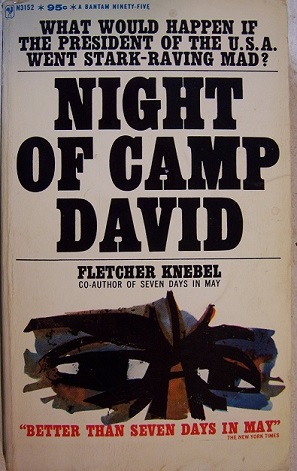
Book Review: Night of Camp David by Fletcher Knebel


The 1966 novel, Night of Camp David, deals with the presidency of Mark Hollenbach.

Mark Hollenbach is an old school Democrat, the type of old-fashioned liberal who would probably not have much of a place in today’s party.  Hollenbach is known for his competent and loyal staff and his demand that everyone around him be just as morally upright as he feels that he is.  Therefore, when Hollenbach’s Vice President gets caught up in a minor scandal, everyone knows that Hollenbach is going to eventually pick a different running mate when it comes time to run for reelection.

But who will Hollenbach pick?  The Speaker of the House is viewed as being too much of an old-style political boss.  The Secretary of State might be the smartest man in Washington, D.C. but Hollenbach is convinced that the voters are not ready for a Jewish vice president.  After a night of lukewarm jokes at the Gridiron Dinner, Hollenbach invites Sen. Jim MacVeagh of Iowa to come talk to him at Camp David.  During their conversation, Hollenbach reveals that he’s planning on naming MacVeagh to the ticket.

This takes MacVeagh by surprise because even he realizes that he’s not really qualified to be president.  He’s too young and, as more than one character points out over the course of the book, he has a reputation for being rather lazy.  An even bigger problem is that the married MacVeagh has a mistress named Rita and there’s no way that Hollenbach would accept an adulterer on his ticket….

(Okay, I heard that.  Stop laughing.  This book was published in 1965.  Obviously, it was a more naïve time.)

Of course, there’s an even bigger problem than Jim MacVeagh not living up to the president’s moral standards.  It also appears that Mark Hollenbach is losing his mind.  MacVeagh soon discovers that Hollenbach has decided that Europe can no longer be trusted and that it’s time for America to make peace with Russia!  As well, Hollenbach feels that the media is trying to sabotage his presidency and, as such, it’s time to maybe rethink that whole freedom of speech thing.  MacVeagh realizes that the pressures of the office have gotten to Hollenbach and that he’s becoming dangerously paranoid.  But only MacVeagh knows it and how can he reveal the truth without destroying his career and his marriage?

Today, of course, the idea of the President being a paranoid buffoon is not that shocking.  For that matter, a lot of Hollenbach’s delusions are today pretty much a part of the standard political discourse.  One gets the feeling that there’s quite a few people who would happily embrace Hollenbach’s desire to destroy the First Amendment.  (“YoU cAn’T yElL fIrE iN a ThEaTeR!” someone is tweeting at this very moment.)  But again, this book was published in 1965.  Joe Biden wasn’t even in the Senate when this book was published, that’s how old it is.  In many ways, Night of Camp David feels prophetic.  Today, of course, it’s interesting to read a book like this and marvel at the idea that people were once shocked by the idea of a paranoid president.

Though it gets off to a slow start, Night of Camp David picks up steam once MacVeagh discovers that Hollenbach is using the FBI to investigate anyone who he perceives as being either a potential ally or a potential threat.  (Hmmmm, imagine that….)  Fletcher Knebel was the co-author of Seven Days In May and he obviously knew how to put together a political thriller.  Jim MacVeagh and Rita are both interesting characters, especially Rita.  She can do better than Jim MacVeagh and she knows it.  The book ends on what seems like a note of wishful thinking but, again, it was 1965.

Paul Greengrass has apparently been developing a film adaptation of this book.  I don’t know if that project is still happening, though Greengrass seems like he would be able to do the story justice.  Personally, I would suggest Tom Hanks as Hollenbach and Austin Butler as MacVeagh.  I mean, if it worked for Elvis….

A Blast From The Blast: Rob McElhenney Says Don’t Smoke


I don’t even smoke and I still think anti-smoking commercials are annoying.

Take this one from 1999, in which some weirdo harasses students as they try to leave their high school.  He gets an interview from one student, who seems to be annoyed with the whole thing and …. OH MY GOD, THAT’S ROB MCELHENNEY FROM IT’S ALWAYS SUNNY IN PHILADELPHIA!

We finished?