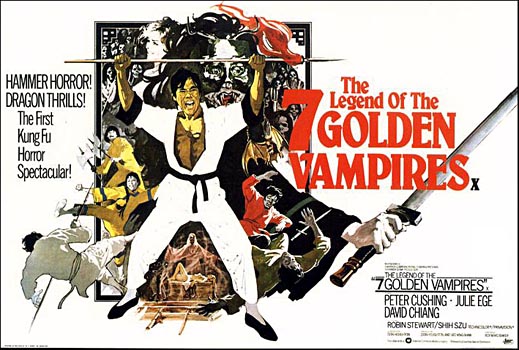
Horror On The Lens: The Legend of the 7 Golden Vampires (dir by Roy Ward Baker)


Legend_of_the_7_golden_vampires

Today’s horror movie is from Hammer films and, needless to say, it’s lot of fun.  In The Legend of the 7 Golden Vampires, an ennui-stricken Count Dracula (James Forbes-Robertson) leaves his castle and travels all the way to China.  Once in China, he resurrects the legendary 7 golden vampires and uses them to raid a nearby village.  One villager (played by David Chiang) goes to the legendary Prof. Van Helsing (Peter Cushing, of course) for help.  Van Helsing, along with his son (Robin Stewart) and a wealthy widow (Julie Ege, who decorated several Hammer films), goes to the village to battle the vampires.  Providing protecting for Van Helsing’s group is Chiang’s sister (Szu Shih) and six other brothers.

First released in 1974, The Legend of the 7 Vampires was Hammer’s attempt to revive the failing fortunes of their most iconic monster by collaborating with Hong Kong film producer Sir Run Run Shaw.  The result is an entertaining hybrid of a traditional Hammer vampire film and a Hong Kong kung fu movie.  While James Forbes-Robertson makes for a poor replacement for Christopher Lee, Cushing is perfect as always.

Horror Review: The Walking Dead: “The Oath” 3-Part Webisode


TheOath

What has become a yearly ritual, whenever a new season of The Walking Dead inches closer to it’s premiere AMC and the folks running the show shoot a series of webisodes telling the story of a group of survivors outside of the show’s main cast. These individuals never come into contact with Rick and his band of survivors, but they do come across similar places that we’ve seen in past episodes.

The first webisode series was the 6-parter “Torn Apart” arrived just prior to Season 2 and told of the origins of the so-callled “Bicycle Girl” zombie Rick comes across soon after waking up from his coma. Then we had the 4-parter “Cold Storage” preceding Season 3’s premiere. Now we have the 3-parter “The Oath” which extends each webisode and deals with a surviving couple whose camp have been overrun by a swarm the night before.

“The Oath” stars Ashley Bell (The Last Exorcism) as Karina with Wyatt Russell (Cowboys & Aliens) playing Paul. The duo races to find medical help in the early months of the zombie apocalypse and they soon come across an abandoned hospital that should be familiar to fans of the show from the very beginning. We even see the origin of the barricaded door in the hospital with the ominous warning to keep any passer-by away.

While the webisodes themselves have been hit-or-miss when it comes to the casts performances they do fill in some backstory on the fringes of the main show. With “The Oath” we see that the Governor and Michonne may not be the only ones to have found a way to use the zombies as a sort of mascot/camouflage.

Overall, “The Oath” was a nice webisode with some average acting from the cast. The teleplay by Luke Passmore was actually quite good and series executive producer Greg Nicotero does a good job directing the whole affair. Some sequences turn out to be very tense and scary. Maybe it’s the nature of the webisode itself that the acting could be uneven, but it was still a good little story that should help whet the appetite of the fans who have been waiting a year for Season 4 to start.

“Alone”

“Choice”

“Bond”

Horror On TV: The Twilight Zone 3.12 “The Jungle”


Along with starting each day of October with a horror film here at the Shattered Lens, we’re going to end each day with a horror-themed television show.

While  I had previously caught a few episodes of the Twilight Zone during one of the annual holiday marathons on SyFy, I didn’t truly appreciate the show until I first exchanged e-mails with my friend in Australia, Mark.  Among other things, Mark expressed a very eloquent appreciation for The Twilight Zone and that inspired me to watch quite a few episodes that have been uploaded to YouTube.  Along with being an essential piece of television history, the best episodes of the Twilight Zone remain watchable and entertaining 50 years after they were first broadcast.

Considering the esteemed place that the Twilight Zone continues to occupy in American culture, it seems appropriate to feature it during Horror Month here at the Shattered Lens.

The episode below is called The Jungle and it first aired on December 1st, 1961.  It was written by Charles Beaumont and directed by William Claxton.  John Dehner plays an engineer who, having recently returned from overseeing a project in Africa, foolishly believes that he’ll be safe from a tribal curse just because he’s in New York.  This is an effectively creepy 23 minutes of television and the ending is a classic.

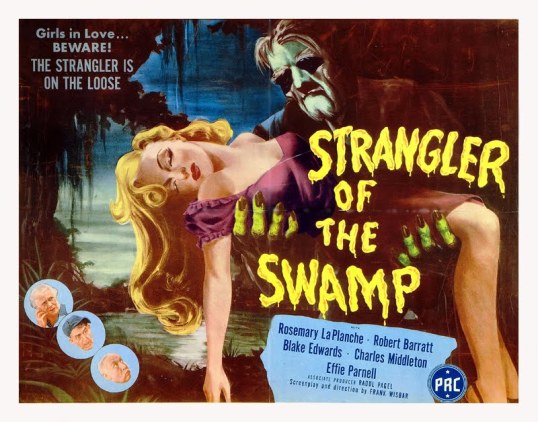
Horror On The Lens: Strangler Of The Swamp (dir by Frank Wisbar)


strangler_of_swamp_poster_02

Traditionally, October is a very special month here at the Shattered Lens.  October is the month that we devote the majority of our attention to the horror genre.  This month, along with all of the reviews that you’ve come to expect from the Shattered Lens, I will also be attempting to share a horror movie a day with all of our wonderful readers.

Let’s start things off with an odd little B-movie from 1946, Strangler Of The Swamp, a story of love, revenge, and ghosts.  A group of swamp men hanged an innocent man.  Now, the ghost of that man is having his revenge by strangling the descendents of the people who killed him.  One of those descendents is Chris Sanders (played by future director Blake Edwards) who just happens to be in love with Maria (Rosemary La Planche), the granddaughter of the vengeful ghost.

Clocking in at little less than an hour, Strangler Of The Swamp tells a familiar story but it’s still worth watching.  Charles Middleton is effective as the strangler and the German-born director Frank Wisbar deals with the restrictions imposed by a minsicule budget by emphasizing the film’s expressionistic atmosphere.  While it would be a mistake to call Strangler Of The Swamp a lost masterpiece (as some critics have done), it’s still an interesting example of low-budget, B-filmmaking.

What Lisa Watched Last Night #92: The Cheating Pact (dir by Doug Campbell)


Late last night, I watched an original Lifetime movie called The Cheating Pact.

the-cheating-pact-premiere-lifetime-thumb-315xauto-66775

Why Was I Watching It?

It was on Lifetime.  How could I not watch it?

What Was It About?

The Cheating Pact is yet another Lifetime movie about upper middle class high school girls murdering each other.  The girls also refuse to appreciate or listen to the advice offered up by their mothers and, in typical Lifetime fashion, the movie doesn’t seem to be certain whether it’s worse to be a murderer or a spoiled brat.

(Personally, I was occasionally accused of being a spoiled brat when I was in high school and I turned out just fine…)

Heather (Daniela Bobadilla) and Kylie (Laura Ashley Samuels) are both feeling pressured to get high scores on the College Entrance Test.  Fortunately, Heather’s former best friend Meredith (Laura Wiggins) is a genius.  (Just in case anyone is doubting Meredith’s intelligence, she wears glasses.  So there.)  Meredith agrees to take their tests for them and soon, she’s getting paid thousands of dollars to help her peers get into college.

However, Kylie isn’t happy with her score and feels that Meredith deliberately did poorly on the test.  And so, as often happens in these films, Kylie shoves Meredith to her death and then tries to frame Heather for the murder,

What Worked?

Whenever you watch a Lifetime movie about a teenage girl doing something wrong and then not going to her mom for advice (or, even worse, ignoring her mom’s advice), you always know that the worst possible thing is going to happen as a result.  In these uncertain times, a film like The Cheating Pact is so predictable that it’s actually rather comforting.

I also love how Lifetime movies always present high school as being ruled by an erratic matriarchal society that’s dominated by secret organizations and melodramatic conspiracies,  If anything, I think Lifetime movies probably offer the most realistic depictions of high school that I’ve ever seen.

What Did Not Work?

Hey, it was a Lifetime movie.  Therefore, it all worked.

“Oh my God!  Just like me!” Moments

Much like Kylie, I once accidentally shoved someone over a stairway railing.  But shhhhhh …. don’t tell anyone.

Lessons Learned

I missed the opportunity to make a lot of easy money in high school.

Film Review: Rush (dir by Ron Howard)


rush-poster-2013

Rush, the latest film from Ron Howard, is the type of film that I usually hate.

It’s big, bombastic, and so extremely mainstream that it actually features Chris Hemsworth uttering the line, “This is what I was born to do,” without a hint of irony.  This is a film about rich boys playing with expensive toys and the movie’s portrayal of women manages to make Aaron Sorkin look enlightened by comparison.  Finally, the film is about a sport that I previously knew nothing about and, after having spent two hours watching this film, I still know very little  about.

And yet, I didn’t hate Rush.  In fact, I really enjoyed it and I think the reason why comes down to one thing.

I have a weakness for hot guys who drive fast cars.

Rush tells the true story about the rivalry between two Formula One racers, the flamboyant Englishman James Hunt (Chris Hemsworth) and the extroverted German Niki Lauda (Daniel Bruhl).  The film follows them from their first meeting in 1970 until they both find themselves competing for the Formula One championship in 1976.  Along the way, we watch how both of them deal with the temptations that went along with being a rich celebrity in the 1970s.  (Lauda resists the majority of them.  Hunt does not.)  Along the way, one of them struggles to recover after a horrifying accident and both of them try to maintain a balance between their personal lives and the fact that each race they run could potentially be their last.  (In one of the film’s best scenes, Niki explains that he’s prepared to accept a 20% chance of dying during a race but not a point more.)

Plotwise, Rush is pretty much a standard sports film, full of men talking about the importance of being men while women stare up at them with adoration.  Inspirational speeches are delivered and everything comes down to one final race.  If, like me, you’re not into Formula 1 racing, the film can occasionally be difficult to follow.  During one extended montage of cars racing across the world and occasionally crashing, I found myself seriously wondering how many races could possibly be run in a Formula One season.  As the film reached its conclusion, James and Niki started talking about which racers have the most points.  Their conversation would have undoubtedly been easy to follow for someone who was into Formula One but for me, it took a few minutes to figure out what they were going on about.

However, none of that matters.

Rush works.

There’s a lot of reasons why Rush works.  The film’s glossy recreation of the 1970s (in all of its frequently tacky glory) is enjoyable to watch and Hans Zimmer’s score is properly loud and majestic.  Both Hemsworth and Bruhl give good performances, with Hemsworth coming across as properly flamboyant and Bruhl bringing some much-needed humor to a character who, in the hands of a lesser actor, could have been insufferable.  Both Olivia Wilde and Alexandra Maria Lara do good work bringing seriously underwritten characters to life.

However, the film’s ultimate success belongs to director Ron Howard.

Ever since Frost/Nixon prevented The Dark Knight from getting a best picture nomination in 2009, there has been a certain loud element of the online film  community that has used Ron Howard as a go-to example of a safe and thoroughly commercial director.  He is often dismissed as being the epitome of a mainstream, conventional filmmaker.

However, as mainstream as Howard’s sensibility may be, Rush proves that he still knows how to craft an exciting scene.  I may have occasionally had trouble keeping track of who was and wasn’t in each car but that didn’t make the races any less thrilling or the accidents any less horrifying.  During the film’s best sequences, you feel the thrill of being in control of the uncontrollable and you understand why Niki and James are willing to risk death just so they can experience being alive.

What Lisa Marie Watched Last Night #91: The Omega Code (dir by Robert Marcarelli)


Early this morning, after waking up and walking into a wall, I watched The Omega Code, an evangelically-themed film from 1999.

Why Was I Watching It?

Earlier this year, my friend Evelyn and I watched a film called Megiddo: The Omega Code 2.  We were both oddly amused by Megiddo so, when I saw that the first Omega Code film was going to be on one of the religious stations, I set the DVR to record it and made plans to watch it at some point in the future.

Last night, I happened to wake up around 3 in the morning.  I got out of bed, I took a few steps forward, and I walked straight into a wall.  After that, I turned on the lights and I was relieved to discover that my nose had protected the rest of my face from the wall.

So there I was at 3 in the morning with my red nose and my bruised pride and, despite my best efforts, I couldn’t get back to sleep.  What’s a girl to do, right?  So, I decided that since I was awake anyway, I would go ahead and watch The Omega Code.

What Was It About?

The world is ending.  People are starving.  Nations are going to war.  Fortunately, the President of the European Union, Stone Alexander (Michael York) has a plan to save us all.  Unfortunately, Stone Alexander also happens to be the Antichrist.

In order to get all of humanity to accept his plan, Stone recruits the world’s most famous motivational speaker (Casper Van Dien).  However, Van Dien find out about the Omega Code, a secret code that uses the bible to predict the future.  And, as Van Dien discovers, the future looks positively apocalyptic….

What Worked?

When I reviewed Megiddo: Omega Code 2, I mentioned that if you’ve got a naturally villainous name like Stone Alexander, you might as well be evil.  The same remains true of The Omega Code.  Stone Alexander is so evil and Michael York is obviously having so much fun playing him that the fun is almost contagious.

Michael Ironside plays Dominic, Stone Alexander’s henchman.  In a rather offensive moment, Alexander reveals that Dominic is both gay and a former priest and the implication (which was probably popular with the film’s target audience) is that Dominic’s villainy is the direct result of both his Catholicism and his sexuality.  But, regardless, Ironside gives a memorably menacing performance.

It’s interesting how the villains in religious films are often more compelling than the heroes…

What Did Not Work?

Though I didn’t realize it at the time, I was spoiled by getting the chance to see the 2nd Omega Code before I saw the first one.  Omega Code 2 was the epitome of a so-bad-that-it’s-good type of film but the first Omega Code was just bad.  Not even the combined villainy of Michaels York and Ironside could make The Omega Code entertaining.

(Add to that, Megiddo: Omega Code 2 featured cameos from both Franco Nero and Udo Kier, while The Omega Code featured … well, no one.)

No review of The Omega Code would be complete without mentioning that, in the lead role, Casper Van Dien gives perhaps one of the worst performances ever captured on film.  It’s oddly fascinating to watch and try to figure out how anybody could give such an incompetent performance.

As I watched the film, one question kept nagging at me.   The Omega Code makes the argument that biblical prophecy should be taken literally.  Therefore, if the bible is itself a literal document that tells you everything that you need to know  than why hide a secret code between the lines?  And, if you’re going to go through all the trouble to come up with a secret code, why use that code to then hide cryptic phrases that could literally be translated to mean anything?  It just seems a bit overly complicated.

(That, incidentally, is the same reason why I don’t have much use for anything that Dan Brown has ever written.)

“Oh my God!  Just like me!” Moments

None.  Seriously, there was not a single moment in this film to which I could relate.  Some of that may be because this film was obviously made to appeal to an evangelical audience, as opposed to a free-thinking fallen Catholic like me.

Then again, it could also be that The Omega Code just wasn’t a very good movie.

Lessons Learned

I really didn’t learn anything.  Sorry, not sorry.

omegacode

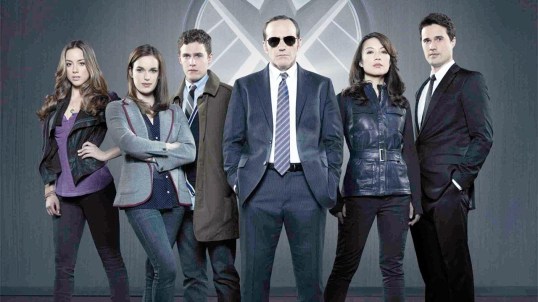
Review: Marvel’s Agents of S.H.I.E.L.D. 1.1 “Pilot” (dir by Joss Whedon)


SHIELD-cast

It would not be an exaggeration to say that Marvel’s Agents of SHIELD has been the most eagerly anticipated new series of the 2013 television season.

Ever since the show was first announced, fans of both Joss Whedon and the Marvel cinematic universe have been waiting to see whether the show would live up to its impressive pedigree.  Every casting announcement has been analyzed and every clip on Youtube has been viewed and debated.

Questions were asked: how would Phil Coulson (played by the wonderful Clark Gregg) manage to be the main character in this series when his death was a major plot point in The Avengers?  Who was the man who was seen jumping out of a burning building and landing without a scratch on his body?  Would Marvel’s Agents Of SHIELD be a prequel or a sequel to The Avengers?  Would the TV show even acknowledge the films from which it spawned?  Would Samuel L. Jackson show up to utter a few badass quips on network television?

But the most important question of all was this: Would Marvel’s Agents of SHIELD live up to all the hype or would it be another case of a show being smothered by the weight of high expectations?

Having just watched the first episode of Marvel’s Agents of SHIELD, I can now answer some of those questions.

How is Phil Coulson still alive?  Well, it turns out that he never died in the first place.  As he explains to newly recruited S.H.I.E.L.D. agent Grant Ward (Brett Dalton), he nearly died when he was attacked by Loki but ultimately, he survived.  Nick Fury told the Avengers that Coulson had died because he understood that Coulson’s “death” would cause the heroes to bond together.

After the end of The Avengers (or, as the show puts it, “the Battle of New York,”), Coulson spent a while recuperating on a beach and “reading Travis McGee novels.”  Now Coulson’s back and he’s in charge of the highly secretive Level 7.  (The Avengers, we’re told, are only Level 6.)  Level 7 investigates “special and strange” cases involving super powered individuals.

Who was the man that we saw jumping out of the burning building?  A lot of people online assumed that he was Luke Cage but instead, he turned out to be Mike Peterson (J. August Richards).  Mike is the show’s first “case,” a decent man who has recently lost his job and is struggling to deal with suddenly being super powered.  In a neat twist, the more powerful Mike becomes, the more easy it is for him to rationalize being destructive.

Coulson and Level 7 track Mike down with the help of Skye (Chloe Bennet), a forcefully recruited hacker and anti-government activist.  At the end of the episode, once Mike has been subdued through a combination of Coulson’s humanity and a tranquilizer dart fired by Grant, Skye is recruited into Level 7.

How direct a sequel is this show to the Marvel films?  It’s such a direct sequel that it would probably be unintelligible to anyone who hasn’t seen the films.  Not only is Mike’s origins story indirectly related to Capt. America’s (both of them owe their powers to a form of the super soldier formula) but the entire series takes place in a world that has been massively changed by the events of The Avengers.  Agents of SHIELD takes place in a world that now knows that there are super powered beings walking among us.

The show is also full of little comments and throw-away references to the characters and events of the films.  Those references are a nice gift to those who have seen all of the films that have seen all of the films that led up to Agents of SHIELD.  At the same time,  I have to admit that pretty much all of my knowledge of the Marvel universe comes from watching the films in the Avengers and X-Men franchises.  My boyfriend, however, grew up reading Marvel comics.  He assures me that, for every film reference that I picked up on, there were dozens of other references that would only be significant to those who have read the comic books.  If nothing else, this shows that Whedon and the show’s other writers respect their audience.  As a result, Agents of SHIELD invites its viewers to join the exclusive club of people who understand the importance of tweeting, “COULSON LIVES!”

No, Samuel L. Jackson does not show up but Cobie Smulders reprises her role from The Avengers, interviewing Grant and introducing him to Agent Coulson.  However, guest star power isn’t necessary because Clark Gregg is such a compelling and likable actor that he perfectly anchors the show.  Gregg brings a much-needed everyman quality to the role of Agent Coulson and, as such, he serves as the perfect guide through the world of super powered flamboyance.

Finally, did the pilot of Agents of SHIELD live up to all the anticipation?

In a word — yes.

Now, I should admit that I am a long-time fan of Joss Whedon’s and a good deal of my positive response to Agents of SHIELD has to do with the fact that it’s clearly a Whedon show.  Not only is the show populated by characters that’ll be familiar to any Whedonite but the self-aware and relentlessly quippy dialogue suggests that, on some level, they are all aware that they are characters on a television show along with being agents of S.H.I.E.L.D.  Along with Clark Gregg, the cast superstar so far is Chloe Bennet, who has a way with a one-liner and, on the basis of the pilot, an appealing chemistry with Brett Dalton.  Personally, I’m hoping that we’ll learn more about the appealingly eccentric Agents Fitz and Simmons (played by Ian De Caestecker and Elizabeth Henstridge).  I’m also hoping that J. August Richards will return in a future episode.  He generated a lot of empathy for the character of Mike and, as the result, prevented Agents of SHIELD from turning into an elaborate inside joke that would appeal only to us Whedonites.

Pilots are strange things.  Not only does a pilot have to introduce all the characters and justify the show’s existence, it also has to find the time to tell a fairly compelling story that will hopefully inspire people to tune in the following week.  Agents of SHIELD succeeded in doing all of that and I look forward to seeing in which direction the show ultimately heads.

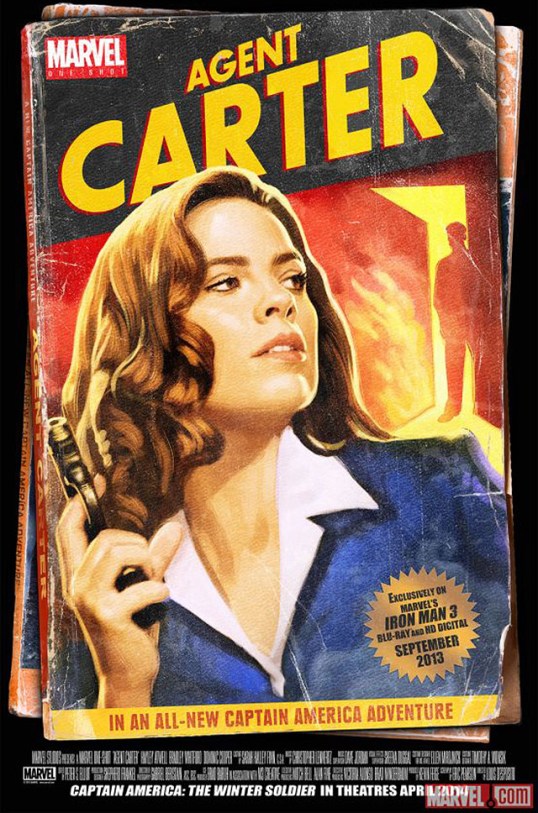
Review: Marvel One-Shot “Agent Carter”


AgentCarterEver since Thor was released on video (DVD/Blu-Ray) the people over at Marvel Studios have added as a special bonus to the video’s extras a small short film they’ve dubbed “Marvel On-Shot”. So far, they’ve either been about the adventures of fan-favorite SHIELD agent Phil Coulson or a brief look at a post-Avengers New York. The short films were cute, but nothing to really write home about.

With the release of Iron Man 3 on DVD and Blu-Ray we get a new Marvel One-Shot and it looks like the creative minds at Marvel Studios have decided to work a tad harder on making this new short film much better. It’s a flashback moment to one Agent Peggy Carter who is still grieving a year after Captain America (aka Steve Rogers) supposedly died trying to save New York from a HYDRA bomber full of tesseract-fueled bombs.

We see how she’s been relegated to doing paper work and kept from doing the field work she’s more adept at. This one-shot film actually shows in it’s short running time how even someone as skilled and heroic as Peggy Carter must still navigate and deal with a male-chauvinistic society that dismisses whatever accomplishments she’s earned in the past and seen more as a sort of “affirmative action” hire.

The film doesn’t try to force-feed this theme, but instead tries (and does so successfully) to blow-up the damsel-in-distress stereotype by showing Agent Carter at her best. And what she does best is doing the sort of field work that earned her not just the respect of the soldiers she worked with during WWII in Europe, but those of Captain America himself.

“Agent Carter” stars the original Peggy Carter in the form of British actress Hayley Atwell and she does a fine job of helping continue her character’s growth. She continues to show that she’s just as useful and skilled as Captain America which she showed in the film of the same name. In this one-shot we’re reminded of it and it also does an interesting thing in making it plausible to create a spin-off around her character.

Marvel has intimated that it’s something they’d be interested in doing and if the quality of this one-shot is anything to go by then a series (tv or web-based) starring Ms. Atwell as Agent Carter would be well-received by fans everywhere. This short film also showed that Marvel Studios has a new secret weapon to keep DC at bay. This was the first one-shot that truly belonged as a prologue to a feature-length Marvel film on the big-screen. Here’s to hoping that attaching future one-shots to full-length features not on video but in the theaters becomes an idea that Marvel Studios allow to happen.

What Lisa Watched Last Night #90: Hostages Episode 1 “Pilot”


Last night, after I got back from dance class, I watched the first episode of the new CBS series, Hostages.
hostages-toni-collette-tate-donovan-cbs

Why Was I Watching It?

I spent the last three months watching and reviewing Big Brother for the Big Brother Blog.  During every episode of Big Brother, CBS would show at least one commercial for Hostages.  It was obvious that CBS was obsessed with the idea of making Hostages into the show that the entire nation would be watching and debating, a bit like a network TV version of Homeland or Breaking Bad.

The commercials, for the most part, all featured Dylan McDermott looking grim while Toni Collette frowned and, occasionally, some old white guy would tell Collette that she was the only doctor he trusted to operate on her and she would reply, “Thank you, Mr. President.”  In short, the commercials made the show look terrible.  The only question was whether or not Hostages would be intentionally bad or unintentionally awful.

Last night, I got my answer.

What Was It About?

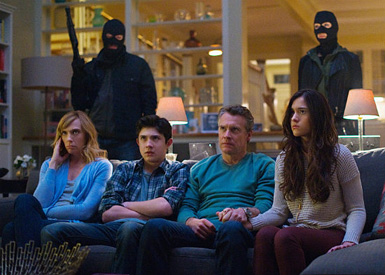
President Paul Kinkaid (James Naughton) needs to have surgery and, of course, only one doctor can perform the operation.  That doctor is Ellen Saunders (Toni Collette).  Ellen is so concerned with the President’s health that she doesn’t realize that her husband (Tate Donovan) is having an affair, her son is selling weed, and her daughter is pregnant.

Meanwhile, Duncan Carlisle (Dylan McDermott) is a FBI hostage negotiator.  When we first see him, he’s gunning down a bank robber and smirking while he does it.  It turns out that Duncan needs money to take care of his sick wife.

Eventually, Duncan and a team of other black-clad operatives end up inside the Saunders home where they take the entire family hostage.  They tell Ellen that, if she wants to save her family, she must assassinate the President…

What Worked?

The show turned out to be just as bad as I was expecting it to be!  Whenever I saw the commercials for Hostages, I would think to myself: “That looks like it’s going to be a really boring, tedious series.”  Judging from the pilot, I was right.  It always feels good to be right.

That said, I do have to say that, alone among the cast, Dylan McDermott seems to understand that he’s playing a ludicrous character in a silly show and — much as he did in American Horror Story — he responds by giving an appropriately melodramatic performance.  While the rest of the cast appeared to be convinced that they were appearing in the next Homeland, McDermott seemed to be enjoying a joke that only he and the viewing audience could understand.

What Did Not Work?

If there’s even been a show that would obviously benefit from an over-the-top, melodramatic approach, it would be Hostages.  So, why did the pilot appear to be taking itself so damn seriously?  As I watched last night’s episode, I found myself wondering if anyone involved in the show (other than Dylan McDermott) understood just how silly this all was.  Instead, the show moved at an almost somber pace and all of the actors (again, with the notable exception of McDermott) delivered their lines with the type of gravity that one would usually associate with Jeff Daniels delivering one of Aaron Sorkin’s pompous polemical speeches on The Newsroom.  Considering all of the melodramatic potential of this show’s plot, Hostages really has no excuse to be as boring and predictable as it was last night.

Toni Collette is one of my favorite actresses so it was kind of sad to see her give such a boring performance in the lead role of Ellen Saunders.  Then again, as written, Ellen Saunders is a pretty boring character.  It’s as if the show’s producers and writers were so proud of creating a professional woman that they didn’t notice that they neglected to give her a personality.

Finally, the President is just some boring old white guy.  What’s up with that?

“Oh my God!  Just like me!” Moments

I was tempted to say that, like the family in Hostages, I would totally freak out if a bunch of people appeared in the house, pointed their guns at me, and announced that they were holding me hostage.  However, it then occurred to me that nobody in Hostages really freaked out about being held hostage.  They were certainly annoyed and occasionally, they even attempted to be defiant.  But they never really freaked out.

Nor could I really see much of myself in the character of Ellen Saunders or her daughter.  Since neither one of them came across as being anything more than a two-dimensional plot device, neither one of them was capable of inspiring any “just like me” moments.

I tried to relate to Sandrine Holt, who plays Maria, the only female hostage taker.  However, Maria spent most of the episode carrying around a gun and, while I’m totally into the 2nd amendment, I’m not really into guns.

Then I remembered that, early on in the episode, Ellen’s daughter talks to her best friend.  The friend takes one look at her and says, “Your eyes are puffy,” which is the exact same thing that I would say if one of my friends had puffy eyes.

So, that was my “Oh my God!  Just like me!” moment.

Lessons Learned

Sometimes, commercials don’t lie.