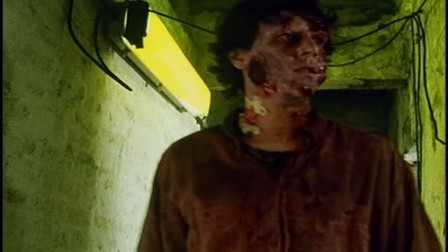
Today’s movie is one of the darkest zombie films ever made.
First released in 1998, I, Zombie tells the story of Mark (Giles Aspen), a likable doctoral candidate who, while on a field trip, comes across a young woman trapped in a shack. Mark rescues the woman but, as he carries her to safety, she suddenly bites him in the neck. As you can probably guess from the title, this bite leads to Mark becoming a zombie.
However, as opposed to what we’ve seen in other zombie films, Mark transformation is a slow process. It starts with Mark realizing that his wounds are not healing and that he has suddenly started to have cannibalistic urges. Realizing that he’s doomed to become a zombie, Mark cuts off all contact with his girlfriend and instead tries to isolate himself from the world. The rest of the film follows Mark as he clinically observes the decay of his both his body and his mind.
To say that I, Zombie is not an easy film to watch is perhaps the highest compliment that you can pay it. Whether one interprets the film as a metaphor for addiction or just as the ultimate acknowledgement of the body horror that rests at the heart of the zombie genre (and I think both interpretations are valid), I, Zombie is one of the best zombie films ever made.
Last night, the Snarkalecs and I watched the SyFy original horror film, Scarecrow.
Why Were We Watching It?
For the first time in several months, SyFy was actually showing an original film on Saturday night (as opposed to episodes of Sinbad). Since the Snarkalecs have sworn to protest SyFy’s decision to make Thursday movie night, we were naturally very happy to have a movie premiering where we felt it belonged. Needless to say, there was no way that we weren’t going to watch Scarecrow and tweet the hell out of it, if just to let SyFy know that there is an audience for original movies on Saturday.
What Was It About?
A high school teacher takes the Saturday morning detention crew out to a deserted farm so that they can perform a community service by taking apart an old scarecrow and transporting it back to town. However, the scarecrow has other ideas…
What Worked?
Overall, Scarecrow was a surprisingly effective little horror film. The filmmakers didn’t attempt to reinvent the genre but that’s okay. They may have told a familiar story but the important thing is that they told the story well. In the best SyFy tradition, Scarecrow moves quickly and is a lot of fun to watch with a group of friends.
As I watched Scarecrow, I quickly came to realize that the filmmakers understood something very important. Farms — especially deserted farms that sit abandoned out of the middle of nowhere — are inherently creepy. When I was little, my family lived near (and occasionally on) several farms and, as my sisters delight in reminding me, I would get scared anytime we walked or drove by a barn. Can you blame me? Barns, after all, were big, dark buildings that were maintained by taciturn, unsmiling men. Anything could be living inside of a barn, just waiting to reach out and grab a little redheaded girl as she tried to walk by. (Not to mention that barns were full of hay and dust and were not the best place for a girl with severe asthma to be near.) The barns in Scarecrow were just as creepy as the ones from my childhood and they contributed nicely to the film’s horrific atmosphere.
The Scarecrow, itself, was a surprisingly effective monster. Considering the film’s limited budget, the Scarecrow was scary and, even more importantly, believable. He was the type of monster who could have easily popped out of one of my many farm-related nightmares.
What Did Not Work?
This was another one of those horror films in which one of the major characters was essentially responsible for getting almost the entire cast killed off. And yet, nobody ever said, “Hmmm…y’know, that person really screwed things up…” Seriously, if we don’t start to hold people accountable then what hope do we ever have of stopping scarecrows from committing mass murder?
“Oh my God! Just like me!” Moments
Whenever I watch a movie like this, where a group of people end up getting killed largely as a result of their own stupidity, I realize that I probably would not survive a horror movie. Seriously, if I was ever confronted by an axe-wielding maniac, I would so be the type of girl that everyone makes fun of whenever they watch a horror movie. I would be the girl who would end up trying to escape by running up a flight of stairs. In the case of Scarecrow, I guess I would the one who would end up running off into the cornfield by herself.
I also appreciated the scene where two future victims start making out on the school bus. It brought back a lot of memories because, as fun as it was to go to speech and drama tournaments and on field trips, you still had to find some way to pass the time on the bus.
Originally broadcast in the UK on September 27th, 1980, this episode of Hammer House Of Horror deals with a sleazy real estate agent (played by Denholm Elliot) who finds himself besieged by dreams about seducing his assistant Lolly (Lucy Gutteridge) and murdering his wife Emily (Pat Heywood).
Featuring an outstanding lead performance from Elliot and strong direction from Peter Sasdy, this is a good one.
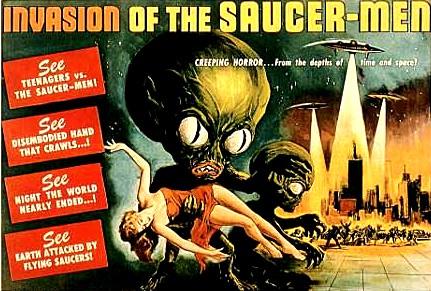
The poster above pretty much epitomizes everything that I love about old B-movies. Between the aliens and the poster’s promise that we’re being given the chance to “SEE (the) night the world nearly ended…!,” it’s hard to resist the temptation to give Invasion of the Saucer Men a chance.
First released in 1957, Invasion of the Saucer Men is, in many ways, a standard alien invasion film. Aliens land in a small town and cause a lot of inconvenience for a bunch of all-American teenagers who are just looking for a place to make out. What sets Invasion of the Saucer Men apart is that it’s meant to intentionally humorous and the aliens totally kick ass.
So, here is today’s edition of Horror On The Lens: Invasion of the Saucer Men!
Since this October began, we have featured ghosts, vampires, a sadist, and some Cambodian zombies. Therefore, it makes sense that, for our latest horror film on the Lens, we should feature a werewolf.
In The Werewolf of Washington, a manic Dean Stockwell plays an aide to the President of the United States who, during an assignment in Hungary, meets some gypsies, and ends up getting attacked by a werewolf. Soon, Stockwell is back in Washington and turning into a wolf under the glow of the full moon…
The Werewolf of Washington features a memorable performance from Stockwell and the werewolf effects are fairly effective. However, The Werewolf of Washington is mostly memorable as a document of its time. The film was first released in 1973 and it’s meant to be a social and political satire along with being a traditional werewolf movie. Admittedly, this is a low-budget and frequently uneven film but it’s worth seeing just for the scene where Stockwell gets his finger stuck in a bowling ball.
Today’s episode of televised horror comes from the UK.
First broadcast on October 11th, 1980, the fifth episode of Hammer’s House of Horror was entitled The House That Bled To Death. It’s about a family who buys and moves into a house that has a sordid past. The family plans to fix the house up and then sell it for a profit. The house has other plans.
(Incidentally, The House That Bled To Death would have been a great title for one of Lucio Fuci’s later films.)
Today’s horror movie is an early take on one of the most iconic of all monsters. First released in 1936, Revolt of the Zombies tells the story of what happens when the French discover that the secret to creating zombies is located in Cambodia. Naturally, they organize an expedition to track down that secret and destroy it.
Simple, right?
Unfortunately, when it comes to the French and zombies, nothing is ever simple…
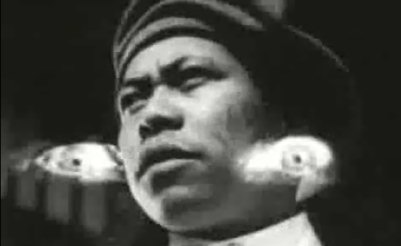
Revolt of the Zombies was directed by Victor Halperin, who had previously directed the atmospheric classic White Zombie. Unfortunately, Revolt of the Zombies is hardly a classic. However, I still find the movie interesting as an example of what a Hollywood zombie film looked like before George Romero revolutionized the genre with Night of the Living Dead. The zombies in Revolt of the Zombies are not the undead cannibals that we’ve all been conditioned to expect. Instead, they’re closer to the original zombies: brainwashed servants without a will of their own.
One final note: the eyes that are frequently superimposed over the action belong to Bela Lugosi.
Tonight’s offering of Horror on TV is another episode of The Twilight Zone.
In The Howling Man, H.M. Wynant plays a rational man who, during a walk across Europe, finds himself in an isolated monastery. Wynant discovers a bearded prisoner (played by Robin Hughes) who explains that he’s being held prisoner because he was caught kissing his girlfriend in public. However, Brother Jerome (played by the legendary John Carradine) claims that Hughes is the devil himself! It’s left up to Wynant whether to set the man free or to leave him imprisoned…
Written by Charles Beaumont and directed by Douglas Heyes, The Howling Man is a favorite of mine. Not only does the show establish and maintain an atmosphere of palpable menace but it also features a brilliant ending.
As scary as all the stories of zombies and vampires may be, the most frightening monsters in the world are the ones that walk among us. I may look away when a monster shows up halfway through a movie but what truly scares me is what my fellow human beings have proven themselves capable of doing.
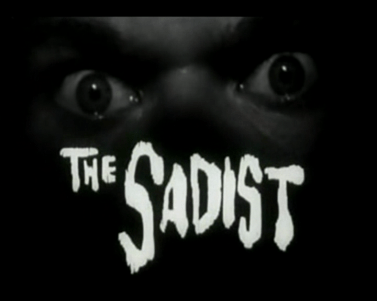
Today’s movie is all about man-made horror. Released in 1963, The Sadist is a dark and rather brutal film about what happens when three teachers have car trouble and find themselves wandering around a seemingly deserted junkyard. They quickly discover that they’re not alone. Watching them and eventually terrorizing them is Charlie (Arch Hall, Jr.), an inartciulate sociopath who quickly proves himself to be a lot more clever than his smugly complacent hostages. This bleak film is memorable for both its starkly effective cinematography and Hall’s disturbingly plausible portrayal of the title character.
Tonight’s televised horror story is Twenty-Two, the fifty-fourth episode of The Twilight Zone.
First broadcast on February 10th, 1961 and written by Rod Serling, Twenty-Two tells the story of a dancer (Barbara Nichols) who is in the hospital, suffering from fatigue. As she tries to recover and get out of the hospital in time to catch a flight to Miami, Nichols finds herself having a reoccurring nightmare. In her dreams, Nichols goes down to the morgue and is told, by a smiling nurse, “Room for one more, honey.”
This episode seriously freaks me out! Perhaps it’s because I’m a dancer who, in the past, has suffered from fatigue or maybe it’s because I’m scared of flying but this episode scares me to death. Though the episode’s final twist may have been spoiled by far too many inferior imitations, Twenty-Two, as directed by Jack Smight, manages to perfectly capture the feel of a nightmare.