A Christmas episode of the Twilight Zone? Yes, such a thing does exist. In Night of the Meek, an unemployed man (Art Carney) is given a chance to be Santa Claus. This is a wonderful episode that truly captures the spirit of the season.
Night of the Meek was written by Rod Serling and directed by Jack Smight. It was originally broadcast on December 23rd, 1960.
For today’s entry in the 44 Days of Paranoia, we’re taking a look at Barry Levinson’s 1997 political satire, Wag The Dog.
Wag the Dog opens with a White House in crisis. With two weeks to go until the Presidential election, it’s been discovered that the incumbent President has had a brief dalliance with a girl scout. Up until the scandal became public, the President was enjoying at 17 point lead in the polls. Now, that lead is about to evaporate unless something can be done to keep the American public from thinking about the President’s personal life.
Significantly, the President himself never appears on-screen. We never learn his position on the issues. We never hear about anything he’s done during his first term. We don’t even know what political party he belongs to. (However, his opponent is played by Craig T. Nelson so I’m going to assume that the President is a Democrat. Because, seriously, it’s hard for me to imagine Nelson being anything other than a Republican…) The President remains a shadowy and insubstantial figure who, in the end, represents nothing.
Instead of getting to know the President, we instead spend the film with the aides who have to clean up after his mess. One of those aides, Winifred Ames (Anne Heche), calls in a legendary (and rather sinister) political PR man, Conrad Bean (Robert De Niro). Conrad announces that the only way to save the campaign is to distract the American public with a quick and totally fake war with Albania. Why Albania? According to Conrad, Albania has a sinister name and nobody knows anything about it.
To help create this fake war, Conrad recruits Hollywood film producer, Stanley Motts (a hilariously manic Dustin Hoffman). Much as Conrad is a legend in politics, Stanley is a legend in Hollywood. Stanley enthusiastically jumps into the project of creating a fake war of Albania, manufacturing everything from fake war footage to patriotic songs to anything else necessary to rally the American public. Denis Leary shows up as a mysterious figure known as the Fad King and schemes how to make war with Albania the latest trend. Willie Nelson sings a song to stir the spirit of every patriotic American. A very young Kirsten Dunst is recruited to play a terrified orphan in staged Albanian atrocity footage. A shell-shocked vet (Woody Harrelson) is cast as the Albanian War’s first hero. Stanley greets every problem with an enthusiastic exclamation of, “This is nothing!”
Along the way, a rather odd friendship develops between the secretive Conrad and the overly verbose Stanley. However, when Stanley, who often laments that he’s never won an Oscar, starts to complain about the fact that he’s never going to get any recognition for his “greatest production,” Conrad finds himself forced to reconsider their relationship.
Wag the Dog was first released in 1997 and, thanks to David Mamet’s darkly comedic script and Barry Levinson’s brisk direction, the film feels incredibly prophetic. Indeed, all the film needs is for someone to mention making the war a trending topic and it would be impossible to tell that it was made 16 years ago. Wag the Dog accomplishes the best thing that any political satire can hope to accomplish: it makes you question everything. Whenever one watches a news report triumphantly bragging about the latest done strike, it’s hard not to feel that Stanley Motts would approve.
Don’t get me wrong. I respect the fact that the movies are important to a lot of my close friends and fellow movie bloggers. My boyfriend loves the first three Star Wars films and I’ve told him that if he ever wants me to wear a gold bikini and a chain around my neck, I’ll do it. It’s just that, on a personal level, the Star Wars films don’t do much for me. When people mention Star Wars, I usually think about how I fell asleep 10 minutes into Attack of the Clones and then when my date woke me up at the end of the movie, my bra had mysteriously been undone.
That said, I still knew that when I started my series of Christmas Past posts, I would have to post something about The Star Wars Holiday Special. The Holiday Special aired way back in 1978 and it was apparently such a disaster that George Lucas has spent the past 3 and a half decades trying to convince people that it doesn’t exist.
Perhaps that’s why, when I did a search for the Holiday Special on YouTube, I came across a lot of videos that had been either taken down or had their audio tracks removed.
However, I was able to find a 15 minutes video from a YouTube user who goes by the name of StarWarsFan1975. The Star Wars Holiday Special Retrospective features some background material on the Holiday Special and some of the special’s more bizarre moments.
For today’s entry in the 44 Days of Paranoia, I want to take a look at the underrated horror/sci-fi/paranoia film, God Told Me To.
This film was first released in 1976. At the time of that initial theatrical run, the film was called God Told Me To Kill. That title proved to be rather controversial and the film was promptly pulled from circulation and then re-released under the new title of Demon. However, since Demon was such a painfully generic title, the name change didn’t do much to help the movie at the box office and, again, it was yanked from circulation and the title was changed for a third time. Under the name God Told Me To, the film was once again re-released.
Not surprisingly, given this chaotic release history, God Told Me To never quite got the attention that it deserved. Over the years, the film has developed a cult following among those (like me) who have discovered the film on DVD or Blu-ray. But God Told Me To still remains something of an unknown film.
In God Told Me To, Tony LoBianco gives an excellent performance as Peter Nicholas, a tough New York police detective and devout Catholic. As the film starts, Nicolas is burned out on his job. He’s separated from his mentally unstable wife (played by Sandy Dennis) but can’t bring himself to divorce her and marry his girlfriend (Deborah Raffin) because it would go against his religious beliefs.
Nicholas finds himself investigating a serious of seemingly random murders that all have two things in common. First, the murderers are all “average” people, the types who would you never expect to commit such terrible crimes. Secondly, when captured, each murderer dismisses his crimes by explaining, “God told me to.” As Nicholas investigates, he discovers that every murderer can be linked with a mysterious figure named Bernard Phillips (played the late, great Richard Lynch).
Nicholas’ investigation leads him to discover that Phillips was the product of a virgin birth, causing Nicholas to both question his own religious faith and to wonder wither or not Phillips is just another crazy cult leader or if he might be God himself…
And that’s about all I can tell you without running the risk of totally spoiling the film. Let’s just say that God Told Me To is one of those films where nothing is quite as it seems. Since the film establishes early on that literally anyone could be a potential killer, the viewer is forced to watch every character who wanders through the scene, looking for any hint that he or she is about to snap. This is a film that keeps you off-balance and, unlike a lot of horror films, it features a twist that’s both plausible and unexpected.
God Told Me To was directed by Larry Cohen, an exploitation veteran who has been responsible for some of the most thought-provoking B-movies in cinematic history. Like many of Cohen’s films, God Told Me To is something of a mess but it’s a fascinating mess. Both Peter Nicholas and Bernard Phillips prove to be fascinating characters and, during the film’s final third, Cohen takes both of them in unexpected directions.
God Told Me To is one of those films that every fan of horror and cult cinema should see at least once. If you haven’t seen it, now is the perfect time for you to discover it for yourself.
For the past few months, I’ve been exploring what I used to dismissively call “the old people stations.” These are television stations like MeTV, Antenna TV, Cozi TV, and TVLand which specialize in showing episodes of old television shows. Of the old shows that I’ve recently discovered, The Jack Benny Program is one of my favorites.
Each episode featured comedian Jack Benny playing himself and being cheap, egocentric, and annoying. In many ways, the show feels like a forerunner for shows like Curb Your Enthusiasm.
With this being the holiday season, what better time than to feature a Christmas episode of the Jack Benny Show. In this episode, Jack attempts to buy a Christmas present.
This episode originally aired on December 15th, 1957.
Today’s entry in the 44 Days of Paranoia is a low-budget British film called Flying Blind. Made in 2012, Flying Blind got a limited release in the U.S. earlier this year and is currently showing up on cable.
Flying Blind tells the story of Frankie (Helen McCrory), an aerospace engineer who designs drones for the British military. She also lectures at Bristol University and this is where she meets the much younger Kahil (Najib Oudghiri). Despite the difference in their ages, Frankie and Kahil start an affair. As Frankie becomes more and more obsessed with her younger lover, she also starts to realize that there’s a lot about his background that he seems reluctant to share with her. Frankie’s prejudiced father (Kenneth Cranham) immediately distrusts Kahil. When MI5 contacts Frankie and tells her that Kahil is “a person of interest,” she starts to do her own investigation into his background. Is Kahil a terrorist or is he just a victim of a paranoid society? The answer, to be honest, is not that much of a surprise.
I really wanted to like Flying Blind because it was obviously made with the best of intentions. It was also made for only £345,000 and we always want to support low-budget, independent films that attempt to tell intelligent stories about intelligent people. Unfortunately, this idealistic desire can sometimes lead people like me to make excuses for films that just aren’t that good. When I look at some of the positive reviews that have been posted online, it’s hard not to feel like there’s a lot of people making excuses for Flying Blind.
The truth of the matter is that Flying Blind takes an interesting premise and then explores it in the least interesting, most predictable way possible. For a film that’s attempting to say something about paranoia and ambiguity, it leaves very little doubt about who is in the right and who is in the wrong. Perhaps the film’s biggest problem is that Helen McCrory and Najib Oudghiri have next to no chemistry. Their relationship never feels genuine and, while I applaud the film’s attempt to portray a mature sexual relationship, the sex scenes themselves are rather awkward. It’s easy to understand why everyone in the film is so quick to assume that Oudghiri must be using McCrory because they never make sense as a couple.
Flying Blind tells an important story. It just doesn’t tell it very well.
Some people are celebrating nothing and won’t shut up about it.
For me personally, this is my favorite time of year. Admittedly, a lot of it is because I love getting presents. But even beyond that, there’s always been something special about the holiday season.
Last October, for Halloween, we shared some old horror-themed television episodes and short films from the past and the reaction we got was pretty good. So, why not do the same for the month of December? From tonight until the end of 2013, I will be sharing a visions of Christmas past. I hope you enjoy them!
Let’s start things out with this short, silent adaptation of Charles Dickens’ A Christmas Carol. First released in 1910, this may very well be the very first film adaptation of the tale of Ebenezer Scrooge. It was directed by J. Searle Dawley, who, that same year, also directed the first film adaptation of Frankenstein. The same actor who played Frankenstein’s Monster in that film, Charles Ogle, shows up here as Bob Cratchit. Scrooge is played by Marc McDermott.
As for the film itself, it’s obviously a very condensed telling of Dickens’ famous tale but the special effects are rather impressive for 1910. Even better, there’s no Tiny Tim. Seriously, Tiny Tim always annoyed me.
I’ve been spending the weekend visiting my sister Megan and her family. Last night, Megan and I watched yet another episode of the mediocre yet oddly entertaining 90s sitcom, California Dreams.
Why Were We Watching It?
So, last night, after everyone else in the house was sound asleep, Megan and I were awake and doing some sisterly bonding, which — when you’re a member of the Bowman clan — usually concludes with watching something silly.
But what to watch? Because I have the greatest big sister in the world, Megan happens to have every season of Saved By The Bell: The New Class on DVD and, at first, I was really tempted to suggest that we watch something from the storied history of Bayside High. But, when I actually thought about it, I knew that we simply had to watch yet another episode of California Dreams.
Last night, we watched a handful of episodes but I specifically decided to review the “Daddy’s Girl” episode because it was the episode that preceded the Family Trees episode, which just happens to also be the last episode of the show that I reviewed for this site.
(As some of our regular readers my remember, it’s been nearly a year since Megan first introduced me to this show when, during the Christmas holidays, we sat down and watched the 4th season episode, Dancing Isn’t Everything. )
What Was It About?
Future steroid addict Tiffani Smith (Kelly Packard) is worried because her father has been alone ever since her parents got divorced. (I assume that the Smiths got divorced though it’s never specifically stated, beyond Mr. Smith saying, “Ever since your mother left…” So, it’s entirely possible that Tiffani’s mom may have joined a cult or something.) Tiffani arranges for her father to meet Ariel (Kristine Sutherland), a woman who claims to be an expert in dolphins. Mr. Smith and Ariel hit it off and, at first, Tiffani is super excited!
However, Mr. Smith is soon spending all of him time hanging out with Ariel and a jealous Tiffani ends up having one of those extremely elaborate and plot-specific nightmares that always seem to happen on California Dreams. So, with the help of Ariel’s criminal record, Tiffani breaks up her dad’s new relationship.
Problem solved, right?
Nope. Now that Mr. Smith is alone again, Tiffani feels guilty and seriously, you have to wonder if there’s ever been a more wishy-washy character than Tiffani Smith. So, Tiffani tries to get Ariel and Mr. Smith back together by singing them a song.
Meanwhile, in the B plot, Mark (Aaron Jackson) has come up with a computer program that tells Samantha (Jennie Kwan), Tony (William James Jones), Jake (Jay Anthony Franke), and Lorena (Diana Uribe) that none of them are compatible. Since this was made in the 1990s, everyone automatically believes anything determined by a computer to be true and, as a result, there are mass breakups.
What Worked?
As soon as Ariel first stepped into Sharky’s, Megan and I immediately exclaimed, “Buffy!” That’s because Ariel was played by Kristine Sutherland who is better known for playing Joyce Summers, the mother of Buffy the Vampire Slayer! This, of course, led to Megan and I imagining a scenario where Tiffani’s dad turned out to be a vampire and Buffy had to destroy him. That was a lot of fun.
I thought it was funny just how terrified Tony was of having to listen to Mr. Smith talk about humpback whales. It made me smile.
What Did Not Work?
To be honest, this episode really had a pretty bad message and I’m glad that I didn’t see it whenever it originally aired because it probably would have given me a lot of false hope. Tiffani’s father goes out with Ariel because Tiffani wants him to. He breaks up with Ariel because Tiffani wants him to. And then, eventually, they get back together again because Tiffani is really sorry and really wants everything to be better.
This episode takes place in a world where a daughter can heal a broken family just through sheer willpower and desire. It’s a world where, even if that daughter screws everything up, all she has to do is let everyone know how sorry she is and then sing a pretty song and magically, everything will be better. It would be nice if that was true but it’s not and that’s one of the hardest lessons to learn when you’re young and convinced that, since everything is somehow your fault, you’re also capable of fixing it all and making everyone happy again.
On a less serious note, do the members of the California Dreams ever do anything other than eat? Seriously! Almost every episode seems to feature them whining about how they don’t have any money and yet, they spend all of their time at Sharky’s eating. If Mark is really struggling financially, maybe he shouldn’t have ordered that expensive desert.
“Oh my God! Just like me!” Moments
As usual, I related to Lorena because she had really pretty hair and the best fashion sense of anyone on the show. Plus, I’ve got a weakness for bad boys who wear big, bulky jackets.
As I told Megan last night, much like Tiffani, I also spent a lot of my teenage years wishing that I could sing a song that would somehow make everything better.
“Lisa Marie,” Megan said, “that’s sweet but you know you can’t sing.”
And she’s right. I can’t carry a tune to save my life.
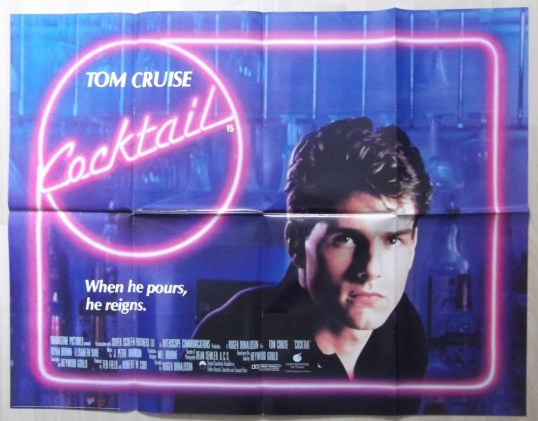
For the past two months or so, Cocktail, a 1988 film that stars Tom Cruise as a bartender with big dreams, has been on an almost daily cable rotation. A few nights ago, my sister Megan and I sat down and watched the film from beginning to end and we laughed ourselves silly.
Seriously, if there’s ever been a film that deserves to be known as a guilty pleasure, it’s Cocktail.
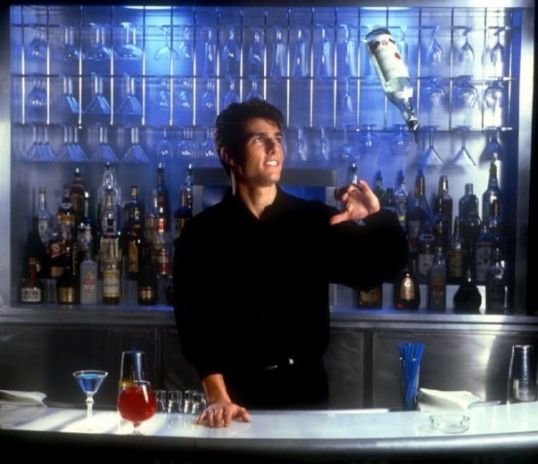
Cocktail tells the story of Brian Flanagan (Tom Cruise), an apparent sociopath who, having just gotten out of the army, is now determined to become a millionaire. During the day, he takes business classes but at night, he and his mentor Doug (Bryan Brown) are dancing bartenders. While customers wait for drinks, Brian and Doug do the hippy hippy shake and toss bottles up in the air. The crowd loves them and Doug educates Brian on how to be a cynical, opportunistic bastard. (Myself, I didn’t think Brian needed any lessons but the film insists that he did.)
When Brian and Doug get into a fight over Gina Gershon, Brian ends up in Jamaica where he eventually meets both Jordan (Elisabeth Shue) and Bonnie (Lisa Banes) and has to choose between love and money. (Guess which one he goes for…) Gee, if only there was a way that Brian could get both love and money…
Why is Cocktail such a guilty pleasure? Just consider the following:
1. Cocktail is an example of one of my favorite guilty pleasure genres. It’s a film that attempts to give an almost religious significance to a profession or activity that, in the grand scheme of things, just isn’t that important. Hence, Tom Cruise and Bryan Brown aren’t just bartenders. No, instead, they are the linchpin that New York nightlight revolves around. If not for the talents of Cruise and Brown, we’re told, thousands of people wouldn’t have a good night. And then who knows what might happen. They might go to a different bar and they might get served by less rhythmic bartenders. Chaos and anarchy might be break out. The living would envy the dead. Fortunately, the super bartenders are there to save the day. (Just consider the film’s tagline: “When he pours, he reigns!” Really?)
2. In the pivotal role of Brian Flanagan, Tom Cruise gives a performance that seems to hint that the character might be a sociopath. Whenever he speaks to anyone, he flashes the same dazzling but ultimately empty smile. Whenever he feels that anyone is failing to treat him with the respect that he deserves, he responds with child-like violence. When he drags Elisabeth Shue out of her apartment, he looks over at Shue’s father and snaps, “It didn’t have to be like this!” It’s a line that makes next to no sense unless you consider that Brian is a pathological narcissist who is incapable of empathy. “It didn’t have to be like this,” Brian is saying, “except you dared to question me so now I’m going to kidnap your daughter…”
3. In the role of Doug, Brian’s mentor, Bryan Brown gives perhaps one of the most openly cynical performances in film history. While everyone else is earnestly reciting the script’s platitudes and trying their best to sound sincere, Brown delivers every line with a hint of resignation and an ironic twinkle in his eye. It’s as if Brown is letting us know that, of the entire cast, he alone knows how bad this film is and he’s inviting us to share in his embarrassment. But Bryan Brown need not worry! The movie may be bad but it’s also a lot of fun.
4. Brian and Doug become New York nightlife sensations by doing an elaborately choreographed dance as they mix their drinks. The other people in the bar absolutely love this, despite the fact that it seems like all the dancing would mean that it would take forever for anyone to actually get a drink.
5. While bartending, Brian also takes a business class that is taught by one of those insanely elitist professors who always seem to show up in movies like this. When he returns student papers, he doesn’t just pass them out. Instead, he literally tosses them at the students while offering up a few pithy words of dismissal. Seriously, this guy has to be the worst teacher ever. No wonder Brian would rather be a bartender than a student!
6. After having a fight with Doug, Brian somehow ends up working as a bartender in Jamaica where he suddenly starts speaking with a very fake Irish accent. The Jamaica scenes serve to remind us that — despite the fact his great-great-great grandfather did come from Dublin — Tom Cruise is one of the least convincing Irishmen in the history of film.
7. In Jamaica, Brian meets and falls in love with Jordan (Elisabeth Shue) but, because he’s a sociopath, Brian cheats on her with Bonnie (Lisa Banes), who is a wealthy TV executive. Bonnie brings Brian back to New York with her but, unfortunately, it turns out that Bonnie and Brian don’t have much in common beyond Bonnie wanting a young lover, Brian being young, Brian wanting a rich woman to take care of him, and Bonnie being rich. What’s particularly interesting about these scenes is that the film doesn’t seem to understand that Brian is essentially coming across like the world’s biggest asshole here. I think we’re meant to feel sorry for him but all we can really think about is how Bonnie could do so much better.
8. Around this time, Bonnie drags Brian to a museum where Brian ends up getting into a physical altercation with a condescending artist. It’s at this point that the audience is justified in wondering if Brian has ever met anyone who didn’t eventually end up taking a swing at.
9. But guess what! It turns out that not only does Jordan live in New York but she’s actually rich as well! And she’s willing to forgive Brian for being a sociopathic jerk. Unfortunately, Jordan’s father objects to his daughter running off with a sociopathic bartender so Brian — as usual — reacts by beating up a doorman and then literally dragging Jordan out of her apartment. One scene later and Brian and Jordan are suddenly married and Brian owns a bar of his own. Where did Brian get the money to open up his own bar? Who knows!? At this point, all that’s important is that the movie is nearly over and, in order for there to be a happy ending, Brian must both be married and a bar owner. That seems to be the film’s message: “Just stay alive for two hours and the film’s script will be obligated to give you a happy ending whether it makes sense or not.”
10. Brian is not only a bartender, he’s a poet! And, amazingly enough, bar patrons are willing to put aside their desire to get a drink so they can listen to their bartender recite poems like this:
” I am the last barman poet / I see America drinking the fabulous cocktails I make / Americans getting stinky on something I stir or shake / The sex on the beach / The schnapps made from peach / The velvet hammer / The Alabama slammer. / I make things with juice and froth / The pink squirrel / The three-toed sloth. / I make drinks so sweet and snazzy / The iced tea / The kamakazi / The orgasm / The death spasm / The Singapore sling / The dingaling. / America you’ve just been devoted to every flavor I got / But if you want to got loaded / Why don’t you just order a shot? / Bar is open.”
Seriously, how can you not enjoy a film like Cocktail? It’s just so totally ludicrous and melodramatic and, best of all, it seems to have absolutely no idea just how over-the-top and silly it really is. Both Tom Cruise and Elisabeth Shue seem to take their roles so seriously that you seriously have to wonder what film they thought they were making.
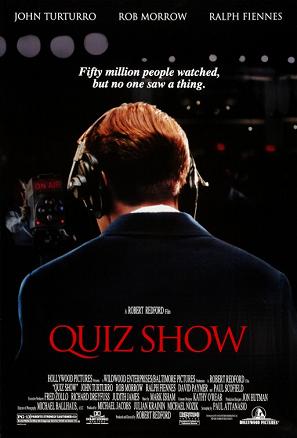
For today’s entry in the 44 Days of Paranoia, I want to take a look at a film that I recently caught on cable — 1994’s Quiz Show.
Directed by Robert Redford and based on a true story, Quiz Show was nominated for the Academy Award for best picture but lost to Forrest Gump. Among those of us who obsess over Oscar history, Quiz Show is often overshadowed by not only Forrest Gump but two of the other nominees as well, Pulp Fiction and The Shawshank Redemption. When compared to Pulp Fiction, Quiz Show certainly feels old-fashioned. At the same time, it’s not quite as much of a sentimental crowd-pleaser as Gump or Shawshank. Perhaps for those reasons, Quiz Show never gets quite as much attention as some other films that have been nominated for best picture. However, taking all of that into consideration, Quiz Show is still one of the best films of the 90s.
Quiz Show takes us back to the 1950s. The most popular show on television is 21, a game show in which two contestants answer questions, win money, and try to be the first to score 21 points. The American public believes that all of the questions asked on 21 are locked away in a bank vault until it’s time for the show. What they don’t know is that the show’s producers have instead been rigging the show, giving the answers to contestants who they feel will be good for ratings.
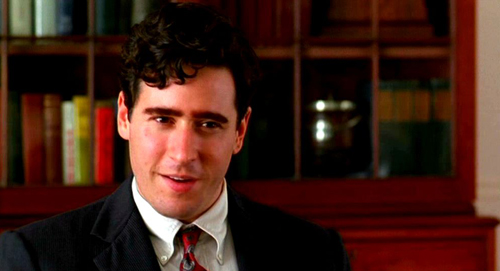
When Quiz Show begins, nerdy Herbie Stempel (John Turturro) has been the champion for several weeks. However, both the show’s producers and sponsors feel that the untelegenic Herbie has peaked. Hence, the handsome and charismatic Charles Van Doren (Ralph Fiennes) is brought on the show and Herbie is ordered to lose to him. Reluctantly, Herbie does so.
Charles is initially reluctant to cheat but, as he continues to win, he finds himself becoming addicted to the fame. Charles is the son of the prominent academic Mark Van Doren (Paul Scofield) and his success on television finally gives him a chance to escape from his father’s shadow. Indeed, the film’s subtle and nuanced portrait of Charles and Mark’s loving but competetive relationship is one of the film’s greatest strengths.
Herbie, however, is bitter over having to lose and has subsequently gambled away all of his winnings. When 21′s producer (David Paymer) refuses to help Herbie get on another TV show, Herbie reacts by going to the New York County district attorney and publicly charging 21 as being fixed. Though the grand jury dismisses Herbie as being obviously mentally unbalanced, his charges come to the attention of a congressional investigator, Richard Goodwin (Rob Morrow).
Goodwin launches his own investigation into 21 and discovers that the show is fixed. (As the ambitious Goodwin puts it, he wants to “put television on trial.”) Along the way, he also meets and befriends Charles Van Doren and finds himself torn between his desire to expose the show and to protect Charles from the bad publicity. Again, the film is to be applauded for the subtle way that it uses Goodwin’s investigation of both Charles and Herbie as a way to explore issues of both class resentment and class envy. Goodwin may have come from the same ethnic background of Herbie but it quickly becomes obvious that Goodwin has more sympathy for the genteel (and very WASPy) world that produced Charles Van Doren. When Goodwin tries to justify protecting Charles, his wife (played by Mira Sorvino) responds by calling him “the Uncle Tom of the Jews” and it’s hard not to feel that she has a point.
While I greatly enjoyed Quiz Show, I do have to say that, on one major point, the film fails. Try as he might, director Redford never convinces us that a rigged game show is really as big of a crime as he seems to be believe it to be. Perhaps in the 1950s, people were still innocent enough to be shocked at the idea of television reality being fake but for cynical contemporary viewers, it’s hard not to feel that the “scandal” was more about Richard Goodwin’s ambition and less about any sort of ethical or legal issue. Towards the end of the film, one character suggests that television will never be truly honest unless the government steps in to regulate it. “What?” I yelled back at the TV.
Seriously, it seemed like a bit of an overreaction.
As I watched Quiz Show, I found it hard not to think about the reality shows that I love. For instance, I know that The Bachelor and The Bachelorette are largely staged. I know that the previous season of Big Brother was largely set up so that Amanda could win. (And, believe me, if Amanda hadn’t sabotaged her chances by turning out to be a mentally unstable racist bully, she would have won and she would probably would have been invited back for the next all-stars season.) I know that shows like Storage Wars and Dance Moms are “unscripted” in name only. I know that reality shows aren’t real but my attitude can basically be summed up in two words: “who cares?” Perhaps I would be more outraged if I lived in the 50s which, to judge from both Quiz Show and a host of other movies, was apparently a much more innocent time.
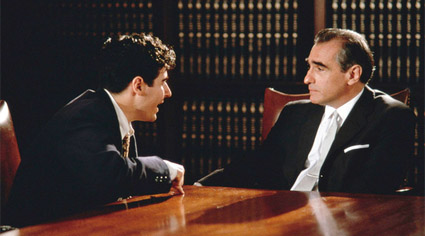
That said, I really enjoyed Quiz Show. A lot of that is because I’m a history nerd and, therefore, I have a weakness for obsessively detailed period pieces. But even beyond that, Quiz Show is a well-made, entertaining film that features three excellent lead performances and several strong supporting turns. If you love to watch great actors playing great roles then Quiz Show is the film for you. Rob Morrow lays his Boston accent on a bit thick but otherwise, he does a good job of suggesting both Goodwin’s ambition and the insecurities that lead him to desire Charles’s friendship even as he tries to expose him as a fraud. John Turturro brings an odd — if manic — dignity to Herbie Stempel while Johann Carlo is well-cast as his wife. Best of all, Ralph Fiennes makes Charles Van Doren into a sad, frustrating, and ultimately sympathetic character while Paul Scofield is the epitome of both paternal disappointment and love as his father. The film is full of great supporting turns as well, with David Paymer and Hank Azaria perfectly cast as the show’s producers and Christopher McDonald playing the show’s host with the same smarmy charm that he brought to a similar role in the far different Requiem For A Dream. Perhaps best of all, Martin Scorsese shows up as the owner of Geritol and gets to bark, “Queens is not New York!”
Even if Robert Redford doesn’t quite convince us that the quiz show scandal was as big a deal as he obviously believes it to be, Quiz Show is still an uncommonly intelligent film and one that deserves to rediscovered.