Film Review: Stay Hungry (dir by Bob Rafelson)


In the 1976 film Stay Hungry, Jeff Bridges plays Craig Blake.

When we first meet Craig, he doesn’t have much of a personality, though we still like him because he’s played by Jeff Bridges.  Living in Alabama, he’s a young rich kid who, after the death of his parents, divides his time between his nearly empty mansion and his country club.  Craig suffers from a good deal of ennui and seems to spend a lot of time writing letters to his uncle in which he promises that he’s going to eventually get his life together.  Craig eventually gets a job at a real estate firm that is managed by Jabo (Joe Spinell).  We know that the real estate firm is shady because Joe Spinell works there.

Craig is assigned to handle the purchase of a small gym so that he can eventually close the place and allow it to be torn down to make room for an office building.  However, Craig soon falls for the gang of colorful eccentrics whose lives revolve around the gym and bodybuilder Joe Santo (Arnold Schwarzenegger, who gets an “introducing” credit, even though this was his fourth film).  The friendly Franklin (Robert Englund) is Santo’s “grease” man.  Anita (Helena Kallianiotes) is tough and can kick anyone’s ass.  The receptionist, Mary Tate (Sally Field), is a free spirit with whom Craig soon falls in love.  In fact, the only less than likable person at the gym is the former owner, Thor Erickson (R.G. Armstrong), a heavy-drinking perv who has a hole in the floor of his office that he uses to peek down at the women’s locker room.

There’s not much of a plot here.  Instead, the film plays out in a rather laid back manner, with Santo befriending Craig and showing him the joy of embracing life.  Arnold Schwarzenegger actually won an award (well, a Golden Globe) for his performance here and it must be said that he’s very good as the gentle and easy-going Santo.  Because he’s huge and he’s Schwarzenegger, we expect him to be intimidating.  Instead, he’s a soft-spoken guy who is quick to smile and who doesn’t even get upset when he finds out that Mary Tate and Craig are now involved.  There’s even a surprising scene where Joe Santo picks up a fiddle and starts playing with a bluegrass band.  Schwarzenegger is so likable here that it’s easy to wonder where his career might have gone if he hadn’t become an action star.  Even early in his career (and when he was still speaking with a very thick accent), Schwarzenegger shows off a natural comic timing.  He’s fun to watch.

In fact, he’s so much fun that the rest of the film suffers whenever he’s not onscreen.  The cast is full of talented people but the film’s loose, plotless structure keeps us from truly getting too invested in any of them.  (Santo is training for Mr. Universe so at least he gets an actual storyline.)  Sally Field and Jeff Bridges are cute together but their romance is never quite as enchanting as it seems like it should be.  The main problem with the film is that, when it ends, one still feels like Craig will eventually get bored with the gym and return back to his mansion and his country club.  One doesn’t get the feeling that Craig has been changed so much as Craig just seems to be slumming for the heck of it.

There are charming moments in Stay Hungry.  I’m a Southern girl so I can attest that the film captured the feel of the South better than most films.  If you’re a Schwarzenegger fan, you have to see this film because it really does feature Arnie at his most charming and natural.  Unfortunately, despite all that, the film itself never really comes together.
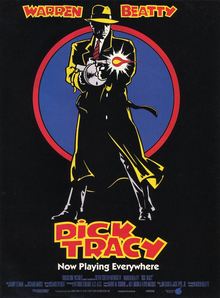
Dick Tracy (1990, directed by Warren Beatty)


The year is 1937 and “Big Boy” Caprice (Al Pacino) and his gang of flamboyant and often disfigured criminals are trying to take over the rackets.  Standing in their way is ace detective Dick Tracy (Warren Beatty), the yellow trench-wearing defender of the law.  Tracy is not only looking to take down Caprice but he and Tess Trueheart (Glenne Headly) are currently the guardians of The Kid (Charlie Korsmo), a young street kid who witnessed one of Caprice’s worst crimes.  Tracy’s investigation leads him through a rogue’s gallery of criminals and also involves Breathless Mahoney (Madonna), who has witnessed many of Caprice’s crimes but who also wants to steal Tracy’s heart from Tess.

Based on the long-running comic strip, Dick Tracy was a labor of love on the part of Warren Beatty.  Not only starring but also directing, Tracy made a film that stayed true to the look and the feel of the original comic strip (the film’s visual palette was limited to just seven colors) while also including an all-star cast the featured Madonna is an attempt to appeal to a younger audience who had probably never even heard of Dick Tracy.  When Dick Tracy was released, the majority of the publicity centered around Madonna’s participation in the film and the fact that she was dating Beatty at the time.  Madonna is actually probably the weakest element of the film.  More of a personality than an actress, Madonna is always Madonna no matter who she is playing and, in a film full of famous actors managing to be convincing as the members of Dick Tracy’s rogue gallery, Madonna feels out of place.  Michelle Pfeiffer would have been the ideal Breathless Mahoney.

It doesn’t matter, though, because the rest of the film is great.  It’s one of the few comic book films of the 90s to really hold up, mostly due to Beatty’s obvious enthusiasm for the material and the performances of everyone in the supporting cast who was not named Madonna.  Al Pacino received an Oscar nomination for playing Big Boy Caprice but equally good are Dustin Hoffman as Mumbles, William Forsythe as Flaptop, R.G. Armstong as Pruneface, and Henry Silva as Influence.  These actors all create memorable characters, even while acting under a ton of very convincing makeup.  I also liked Dick Van Dyke as the corrupt District Attorney.  Beatty knew audience would be shocked to see Van Dyke not playing a hero and both he and Van Dyke play it up for all its worth.  Beatty embraces the comic strip’s campiness while still remaining respectful to its style and the combination of Danny Elfman’s music and Stephen Sondheim’s songs provide just the right score for Dick Tracy’s adventures.  The film can be surprisingly violent at times but the same was often said about the Dick Tracy comic strip.  It wasn’t two-way wrist radios and trips to the Moon.  Dick Tracy also dealt with the most ruthless and bloodthirsty gangsters his city had to offer.

Dick Tracy was considered to be a box office disappointment when it was originally released.  (Again, you have to wonder if Beatty overestimated how many fans Dick Tracy had in 1990.)  But it holds up well and is still more entertaining than several of the more recent comic book movies that have been released.

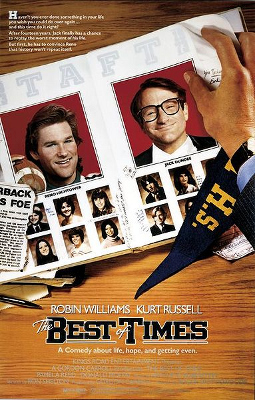
The Best Of Times (1986, directed by Roger Spottiswoode)


For years, banker Jack Dundee (Robin Williams) had been haunted by a pass that he dropped in high school.  The pass was perfectly thrown by quarterback Reno Hightower (Kurt Russell) but Jack couldn’t bring it in and, as a result, Taft High lost to its rival, Bakersfield.  Adding to Jack’s humiliation is that he now works for The Colonel (Donald Moffat), a confirmed Bakersfield fan who also happens to be Jack’s father-in-law.  When Jack visits a “massage therapist” (Margaret Whitton) and tells her about his problems, she suggests that he needs to replay the game.  Getting everyone interested in replaying the game is not easy.  No one wants to be humiliated a second time and Reno, who now fixes vans for a living, fears the he’s lost his edge.  Jack dresses up in the Bakersfield mascot’s uniform and vandalizes the town.  Finally, everyone is ready for the game.  Now, it’s a matter of town pride.

The Best of Times is a likable comedy about getting older and wishing you could have just one more chance to be young again and to have your entire future ahead of you.  Jack is haunted by that one dropped pass, feeling that it has cast a cloud over his entire life.  Reno is still a town hero but he’s struggling financially and in debt to Jack’s bank.  Replaying the game isn’t going to fix their lives but it is going to give them one last chance to relive their former glory and maybe an opportunity to learn that, even if they are getting older, they’re still living in the best of times.  The world that these two men live in is skillfully drawn and believable, with character actors like Moffat, M. Emmet Walsh, R.G. Armstrong, and Dub Taylor adding to the local color.  Jack and Reno’s wives are played by Holly Palance and Pamela Reed and they are also strong and well-developed characters.  Finally, Robin Williams and Kurt Russell are a strong comedic team.  Russell is perfectly cast as the aging jock and Williams gives one of his more restrained performances as Jack, allowing us to see the sadness behind Jack’s smile.

The stakes aren’t particularly high in The Best Of Times.  It’s just a football game between some middle-aged men looking to regain their youth.  But the story sticks with you.

The TSL Grindhouse: Dixie Dynamite (dir by Lee Frost)


Welcome to Georgia!

Yes, the 1976 film Dixie Dynamite is supposedly set in Georgia but it’s hard not to notice that all of the hills and mountains in the background look like they’re from California.  The story features two sisters, Dixie (Jane Anne Johnston) and Patsy (Kathy McHaley), who go into the moonshine business after their father drives his car off a cliff.  Their father was the best moonshiner in the business and they aim to carry on his legacy, despite the efforts of Sheriff Marsh (Christopher George) and banker Charlie White (R.G. Armstrong).  Blowing up their stills and threatening to auction off their land isn’t going to stop these two from doing whatever it is exactly that they’re doing in this film.  Eventually, the sisters steal a bunch of dynamite and start blowing stuff up.  Normally, I’d say “Woo hoo!” but this film even makes random explosions seem as boring as the 4th of July in Canada.

Warren Oates plays Mack, a motocross champion who occasionally helps the daughter’s out.  At least, I think he’s helping them.  To be honest, it’s not always easy to tell what Mack’s purpose actually is in this story.  He tends to show up randomly, usually after all the action has ended.  He’s kind of a useless friend, to be honest.  Warren Oates brings his rough-hewn charm to the roll and you’re usually glad to see him, if just because the actresses playing the sisters are genuinely lousy, but you’re never quite sure what he’s doing there.  Watching the film, one gets the feeling that Oates just dropped by the set whenever he felt like it and filmed a scene or two.

It’s really not that crazy of a possibility.  Actor Steve McQueen makes a cameo appearance in this film, riding a motorcycle and challenging Oates.  McQueen didn’t make many films in the 70s.  Let’s consider some of the films that he turned down: The Great Gatsby, Jaws, Apocalypse Now, The Driver, The French Connection, Sorcerer, and Hard Times.  None of those films appealed to McQueen but he was still willing to show up for a day’s worth of shooting on Dixie Dynamite.  Of course, McQueen does go uncredited.

This is an odd film, full of slow spots that not even actors like Warren Oates, Christopher George, and R.G. Armstrong can make up for.  Director Lee Frost was best-known for his softcore exploitation films and Dixie Dynamite is full of odd transitions and jump cuts, leading me to suspect that the film was originally meant to be a lot more like a typical Frost film before it was decided to go in a PG-direction as well.

Perhaps the oddest part of the film is that the daughter’s final scheme to get revenge on the sheriff and the banker involves stealing two dead bodies from the local morgue.  The bodies are made up and dressed to look like Dixie and Patsy so that the sisters can fake their own death.  I can understand that and even give them credit for hatching a clever plan.  But I still find it weird that the film never really explains how the bodies were stolen or why they were in the morgue in the first place.  What are the chances that Patsy and Dixie would head down to the morgue and find two look-alikes?

The film features dynamite, Warren Oates, and corpse-stealing  but it’s still incredibly dull.  That’s just weird.

Lisa Marie Reviews An Oscar Nominee: Reds (dir by Warren Beatty)


In the 1981 film Reds, Warren Beatty plays Jack Reed, the radical journalist who, at the turn of the century, wrote one of the first non-fiction books about Russia’s communist revolution and then went on to work as a propagandist for the communists before becoming disillusioned with the new Russian government and then promptly dying at the age of 32.

Diane Keaton plays Louise Bryant, the feminist writer who became Reed’s lover and eventually his wife.  Louise found fame as one of the first female war correspondents but then she also found infamy when she was called before a Congressional committee and accused of being a subversive.

Jack Nicholson plays Eugene O’Neill, the playwright who was a friend of both Reed and Bryant’s and who had a brief affair with Bryant while Reed was off covering labor strikes and the 1916 Democratic Convention.

Lastly, Maureen Stapleton plays Emma Goldman, the anarchist leader who was kicked out of the country after one of her stupid little dumbass followers assassinated President McKinley.  (Seriously, don’t get me started on that little jerk Leon Czolgosz.)

Together …. well, I was going to say that they solve crimes but that joke is perhaps a bit too flippant for a review of RedsReds is a big serious film about the left-wing activists at the turn of the century, one in which the characters move from one labor riot to another and generally live the life of wealthy bohemians.  Reed spends the film promoting communism, just to be terribly disillusioned when the communists actually come to power in Russia.  For a history nerd like me, the film is interesting.  For those who are not quite as obsessed with history, the film is extremely long and the scenes of Reed and Bryant’s domestic dramas often feel a bit predictable, especially when they’re taking place against such a large international tableaux.  At its best, the film is almost a Rorschach test for how the viewer feels about political and labor activists.  Do you look at Jack Reed and Louise Bryant and see two inspiring warriors for the cause or do you see two wealthy people playing at being revolutionaries?

Reds was a film that Warren Beatty spent close to 20 years trying to make, despite the fact that the heads of the Hollywood studios all told him that audiences would never show up for an epic film about a bunch of wealthy communists.  (The heads of the studio turned out to be correct, as the film was critically acclaimed but hardly a success at the box office.)  It was only after the success of the 1978, Beatty-directed best picture nominee Heaven Can Wait that Beatty was finally able to get financing for his dream project.  He ended up directing, producing, and writing the film himself and he cast his friend Jack Nicholson as O’Neill and his then-romantic partner Diane Keaton as Louise Bryant.  (Gene Hackman, Beatty’s Bonnie and Clyde co-star, shows up briefly as one of Reed’s editors.)  One left-wing generation’s tribute to an early left-wing generation, Reds is fully a Warren Beatty production and, for his efforts, Beatty was honored with the Oscar for Best Director.  That said, the Reds lost the award for Best Picture to another historical epic, Chariots of Fire.  Chariots of Fire featured no communists and did quite well at the box office.

The film is good but a bit uneven, especially towards the end when we suddenly get scenes of Louise Bryant trudging through Finland as she attempts to make it to Russia to be reunited with Reed.  The film actually works best when it features interviews with people who were actual contemporaries of Reed and Bryant and who share their own memoires of the time.  In fact, the interviews work almost too well.  The “witnesses,” as the film refers to them, paint such a vivid picture of the Reed, Bryant, and turn of the century America that Beatty’s attempt to cinematically recreate history often can’t compete.  One can’t help but feel that Beatty perhaps should have just made a documentary instead of a narrative film.

(Interestingly enough, many of the witnesses were people who were sympathetic to Reed’s politics in at the start of the century but then moved much more to the right as the years passed.  Reed’s friend and college roommate, Hamilton Fish, went on to become a prominent Republican congressman and a prominent critics of FDR.)

That said, Jack Nicholson gives a fantastic performance as Eugene O’Neill, adding some much needed cynicism to the film’s portrayal of Reed and Bryant’s idealism.  Keaton and Beatty sometime both seem to be struggling to escape their own well-worn personas as Bryant and Reed but Beatty does really sell Reed’s eventually disillusionment with Russia and the scene where he finally tells off his Russian handler made me want to cheer.  Fans of great character acting will want to keep an eye out for everyone from Paul Sorvino to William Daniels to Edward Herrmann to M. Emmet Walsh and IanWolfe, all popping up in small roles.

Reds is not a perfect film but, as a lover of history, I enjoyed it.


Film Review: The Pursuit of D.B. Cooper (dir by Roger Spottiswoode and Buzz Kulik)


The story of D.B. Cooper has always fascinated me.

D.B. Cooper is the name assigned to a man who, in 1971, hijacked an airplane, demanded $200,000, and then jumped off the plane after he got the money.  Reportedly, he was well-dressed and unfailingly polite during the entire hijacking.  When he jumped off the plane, he was about 10,000 feet over the Washington wilderness.  After he jumped, no further trace was found of him.  Over 50 years after the incident, the identity and the location of D.B. Cooper remains a mystery.

It’s been said that, even though Cooper had a parachute with him when he jumped, there’s no way that he could have survived the jump.  And yet, no body has ever been found.  (Of course, finding a body in the wilderness is not as easy as some people assume.)  Nine years after the the skyjacking, some of the money that Cooper received was found on the banks of the Columbia River, which was several miles away from the area that Cooper jumped over.  Did Cooper survive the jump and lose the money?  No one can say for sure.

Over the years, many people have come forward to say that they know the identity of D.B. Cooper.  Many distant fathers and secretive boyfriends and long lost friends have been accused of being D.B. Cooper.  Some of those suspects are more likely than others.  Even John List, the murderer who inspired the Stepfather films, was suspected at one point.

D.B. Cooper remains a fascinating character precisely because he’s never been captured and the mystery itself will probably never be solved.  Because he remains an enigma, it’s easy to project your own pet obsessions on him and his story.  Myself, I always imagine D.B. Cooper as being some sort of clever, fun-loving international rogue, even though there’s not really any evidence to back that up.  But, the fact of the matter is that I have a weakness for clever, fun-loving international rogues so, of course, that’s who I’m going to imagine D.B. to be.

I certainly would never imagine him to be like the character at the center of 1981’s The Pursuit of D.B. Cooper.

In this film, D.B. Cooper turns out to be Jim Meade (Treat Williams), a Vietnam vet and all around jackass who steals the money so that he can get back together with his estranged wife, Hannah (Kathryn Harrold).  Hannah does take him back because, seriously, who is going to say no to that much money?  Jim and Hannah spend the entire film running from one wilderness location to another.  They steal cars.  They steal trucks.  Meade steals an airplane at one point.  Hannah gets worried often and Jim tends to yell, “Woo hoo!” whenever he gets excited about anything.  At one point, Jim and Hannah are chased across some white water rapids.  When Hannah and Jim reach dry land, Jim gives the finger to the river.  I will say that, as someone who grew up in the South, Jim is a type of character who seems very familiar to me.  I’ve known a lot of Jim Meades and Treat Williams doesn’t do bad job playing Meade as being an impulsive, loud-mouthed good old boy.  The only problem is that, at no point, does Jim Meade come across like someone who could have pulled off what D.B. Cooper pulled off.

Jim is being pursued by two old army buddies.  The scruffier of the two is Remson (Paul Gleason), who somehow manages to keep popping up like a cartoon character at the most inopportune of times.  No matter what bad thing happens to Remson, he still shows up good-as-new a few minutes later.  Paul Gleason gives an energetic performance as Remson, a character who has little in common with the uptight authority figures that Gleason later played in The Breakfast Club and Die Hard.

The other person chasing Jim is Bill Gruen (Robert Duvall), who served with Meade in Vietnam but who is now working as an insurance investigator.  Gruen says that he knew Meade had to be D.B. Cooper because only Meade could survive jumping out of a plane over wilderness terrain.  Gruen wants some of the money for himself.  Despite his greed, it’s hard not to like Gruen because he’s played by Robert Duvall.  The best scene in the film is one where Duvall and Williams, exhausted from chasing each other, have a weary but friendly conversation.  It’s the one moment where Williams actually calms down and provides some hint that there’s actually something going on underneath Meade’s manic exterior.  Acting opposite Duvall brings out the best in him.

The Pursuit of D.B. Cooper had a notoriously troubled production and apparently, there was never a completed script during shooting.  Reportedly, bits of the film were directed by Robert Mulligan, John Frankenheimer, and Buzz Kulik before Roger Spottiswoode took over.  It’s a film that was obviously inspired by 70s chase films like Smokey and the Bandit but it also somehow managed to attract actors like Robert Duvall, who does his best to class up the joint.  The action quickly gets repetitive and the movie never seems to know if it wants to be a comedy or a drama.  On the plus side, Treat Williams and Kathryn Harrold make for a cute couple.

When this picture first came out, Universal Pictures offered a million dollar reward for any information that would lead to the capture and arrest of the real D.B. Cooper.  No one collected.

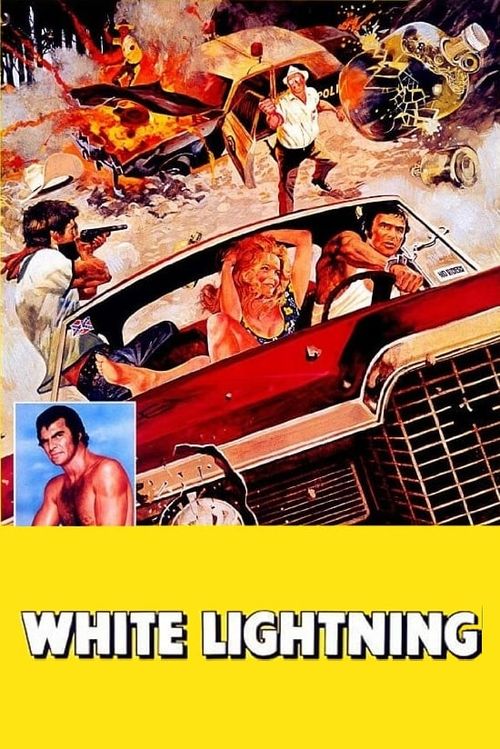
WHITE LIGHTNING – #ArkansasMovies, my celebration of movies filmed in the Natural State!


I love watching movies that are filmed in my home state of Arkansas. There’s something cool about seeing places I’ve been before showing up on the big screen, and if I haven’t been there before, I can go visit. We’ve had our share of big stars show up in the Natural State. Burt Reynolds, Billy Bob Thornton, Bill Paxton, Robert De Niro, Dennis Quaid, Matthew McConaughey, Tom Cruise, and Andy Griffith have all filmed really good movies here. Heck, Martin Scorsese directed one of his very first movies in southern Arkansas. It’s going to be fun revisiting some of my favorites and sharing them with you!

I’m kicking off #ArkansasMovies with WHITE LIGHTNING, the 1973 film from director Joseph Sargent that was filmed almost entirely within 30 minutes of my house in central Arkansas. Burt Reynolds is Gator McKlusky, a good ol’ boy who happens to find himself serving a stint in prison for “stealin’ cars, runnin’ cars, and runnin’ moonshine whiskey.” One day a cousin comes to visit him in prison and tells him that his younger brother Donny has been killed in Bogan County. Suspecting foul play, Gator first tries to escape. When that doesn’t work, he agrees to go stool pigeon and work with the federal authorities to infiltrate the world of illegal moonshining in Bogan County and provide them the names of the big money people in the area. This includes the crooked county Sheriff J.C. Connors (Ned Beatty), who Gator immediately zeroes in on as the key person responsible for his brother’s death.

In my opinion, WHITE LIGHTNING is one of the best of the good ‘ol boy, southern redneck films that were so popular in the 1970’s. One of the main reasons I like WHITE LIGHTNING so much is that while it does has some of the clowning that’s expected in these types of films, the tone gets deadly serious as McKlusky zeroes in on what happended to his brother. Reynolds is especially badass when he stops his signature laughing and goes into vengeance mode. And Ned Beatty is perfect casting as the small-town sheriff who is completely and irredeemably evil. The opening scene shows Beatty boating a couple of bound and gagged young men out into the middle of the lake, shooting a hole in the their boat, and then casually paddling away as the boat sinks. If you came up on him a little later, you’d think he was just heading in from a day of crappie fishing. For a guy that doesn’t look menacing at all on first glance, we know just how dangerous Sheriff J.C. Connors is. And so does Gator. We have a rooting interest in seeing Gator get his revenge.

The primary filming locations in WHITE LIGHTNING are practically in my backyard. My wife and I got married at the Saline County Courthouse in downtown Benton, which is featured very prominently in the film. It’s a beautiful courthouse, with a distinctive clock tower. They decorate it so beautifully for the Christmas season (see picture below). Burt also spends time at the “Benton Speedway” in the film.  This is actually the old I-30 Speedway that was in operation in Little Rock for 66 years. Sadly, the Speedway held its final race on October 1, 2022, which is almost 50 years after filming completed. The rest of the locations used were also in central Arkansas in the towns of North Little Rock, Keo, Scott, Wrightsville, and Tucker. FYI, I don’t recommend poking around Tucker if you’re into film tourism. Tucker is the primary prison unit for the Arkansas Department of Corrections. If you do head that way, just don’t pick up any hitchhikers!

All in all, WHITE LIGHTNING is a movie I whole-heartedly recommend, and it’s especially meaningful to me since it’s so close to home. Billy Bob Thornton would be back in this same area in 1996 to film SLING BLADE.

Late Night Retro Television Review: Friday the 13th: The Series 2.10 “Night Hunger”


Welcome to Late Night Retro Television Reviews, a new feature where we review some of our favorite and least favorite shows of the past! On Fridays, I will be reviewing Friday the 13th: The Series, a show which ran in syndication from 1987 to 1990. The show can be found on YouTube!

This week, we’ve got the saddest episode of Friday the 13th yet!

Episode 2.10 “Night Hunger”

(Dir by Martin Lavut, originally aired on January 9th, 1989)

As a young boy, Michael Firono was constantly told by his father, Dominic (Nick Nichols), that he should always play to win and that, if he lost, it was because he was a wimp.  Needless to say, once Mike became a teenager, he did not have a great relationship with his father.  Seeking an escape from his abusive household, Mike spend all of his time at the local antique store where, on his 16th birthday, the store’s owner, Lewis Vendredi (R.G. Armstrong), gave him a special silver chain.

Mike (played by Richard Panebianco) has grown up to be an angry young man.  He always wears the chain around his neck.  Hanging on the chain is the key to his car.  Mike loves to race his car and, far from being the loser that his father claimed he would grow up to be, Mike cannot be beat.  His car is amazingly fast and Mike is incredibly (one might even say supernaturally) skilled behind the wheel.  His main goal is to defeat his childhood rival, Deacon (Real Andrews), who is now a street racer himself.  Deacon is hesitant to race Mike, precisely because Mike seems to be so driven to win that racing with him can be even more dangerous than usual.  To Deacon, street racing is fun.  For Mike, it’s an obsession.

Of course, Mike has a secret.  As long as he’s wearing the silver chain, he can’t be defeated.  But he has to kill people and dip the key in their blood for the chain to work.  Jack, Micki, and Ryan set out to reclaim the silver chain but an accident results in both the chain and the key being absorbed into Mike’s body.  With the chain and the key now sitting next to Mike’s heart, Mike’s eyes not only glow red but his car seems to have a mind of its own….

This is another one of those episodes of Friday the 13th where the villain is himself a victim.  Even before he met Lewis and received the silver chain, Mike was doomed.  His abusive father left Mike feeling so insecure and so obsessed with winning that there was really no way Mike wasn’t going to end up snapping eventually.  In the present day, Dominic finally understands how much he hurt Mike and he feels guilty about it but it’s too late to undo the damage that’s been done.  Like a pusher befriending people most likely to get addicted to his product, Uncle Lewis saw Mike as someone who would easily succumb to a cursed antique.  Mike becomes addicted to using the key and that leads to him doing a lot of bad things.  But the real curse here is not the silver chain but instead Mike’s abusive childhood.  Mike never had a chance.

This is a genuinely sad and well-acted episode, with Mike’s obsession eventually destroying him.  As happen so often with this show, Ryan and Micki are left with the knowledge that, while they can reclaim the cursed objects, they can never repair the damage that they’ve done.

Late Night Retro Television Review: Friday the 13th: The Series 2.1 “Doorway to Hell”


Welcome to Late Night Retro Television Reviews, a new feature where we review some of our favorite and least favorite shows of the past! On Fridays, I will be reviewing Friday the 13th: The Series, a show which ran in syndication from 1987 to 1990. The show can be found on YouTube!

This week, the second season beings with the return of Uncle Lewis!

(For a dead guy, Lewis sure does return a lot.)

Episode 2.1 “Doorway to Hell”

(Dir by William Fruet, originally aired on September 26th, 1988)

The second season begins in much the same way that the first one ended, with Uncle Lewis (played, as always, be R.G. Armstrong) trying to re-enter the world of the living.

This time, he’s doing it through mirrors.  According to Jack, a mirror that “witnesses” an occult ceremony becomes a doorway to the dark realms that sit between Heaven and Hell.  Lewis lives in the dark realms and, since he was a big fan of mirrors, his reflection occasionally appears in the a mirror at Curious Goods.  When Micki and Ryan find evidence that Lewis owned a house, they ignore Jack’s warning and go to investigate on their own.

They discover that the decrepit house is being used as a hideout by Buddy (Charle Landry) and Eddie (Louis Ferreira), two criminals who have just held up a gas station and killed an attendant.  Buddy wants to go straight and was pretty much coerced into taking part in the robbery.  Eddie, on the other hand, is a total psychopath who ties up both Micki and Ryan and laughs when they try to warn him about Uncle Lewis.

The house, not surprisingly, is full of mirrors and soon, Buddy gets sucked into one of them.  When Buddy returns to the house, he’s possessed and shooting electricity from his fingertips.  He kills Eddie and then chases Ryan and Micki around both the house and the dark realms.

Jack and his friend Rashid (Elias Zarou) watch all of this reflected in a shard of reflective glass that they found at the antique store.  Whenever things start to get really exciting or scary at the mansion, we cut to Jack and Rashid staring at shard of glass and saying, “Get out of there, Ryan!”

Eventually, Jack goes to the house, enters the dark realms and distracts Lewis long enough for Ryan and Micki to destroy all of the mirrors in the house.  Jack manages to escape just in time, Buddy apparently become unpossessed and the ghost of Uncle Lewis declares that he will return.  Lewis’s constant shouts of “I’ll be back” are such a cliche that they can’t help but be a bit charming, especially since R.G. Armstrong always seems to be having so much fun chewing the scenery whenever he shows up as Lewis.

The second season premiere did an effective job of reminding old viewers and informing new viewers about what the show was about.  The haunted house was an effectively creepy location and the dark realms were nicely atmospheric.  I do wish that the premiere had not once again deployed the tired idea of Micki and Ryan ignoring Jack’s warning about impulsively investigating something on their own.  I mean, that has never worked out for them.  You would think that Ryan and Micki would have learned the lesson by now.  Otherwise, this episode got the second season off to a good start.

Late Night Retro Television Review: Friday the 13th: The Series 1.26 “Bottle of Dreams”


Welcome to Late Night Retro Television Reviews, a new feature where we review some of our favorite and least favorite shows of the past! On Fridays, I will be reviewing Friday the 13th: The Series, a show which ran in syndication from 1987 to 1990. The show can be found on YouTube!

This week, season one comes to a close with a trip down nightmare lane.

Episode 1.26 “Bottle of Dreams”

(Dir by Mac Bradden, originally aired on July 25th, 1988)

It’s clip show time!

To be fair, the first season finale of Friday the 13th does come up with a clever way to justify being a clip show.  Micki and Ryan get trapped in the vault of Curious Goods with an ancient, Egyptian urn that causes people to confront the memories of their worst fears.  Not surprisingly all of Micki and Ryan’s worst fears are connected to the cursed antiques that they’ve spent the past year seeking out and dealing with.

So, once again, we get to see the cursed doll that started the series.  We see the weirdo wandering around with his cursed cupid statue.  We see the vampire.  Oddly enough, we don’t see the pirate ghosts or the gangster who killed Micki’s boyfriend, even though both of those events were very traumatic for Micki.  We don’t see the magic pipe that killed Ryan’s father, despite the fact that episode ended with Ryan in tears.  We don’t see the newscaster who killed Ryan’s girlfriend or the cursed quilt that nearly caused Ryan to get burned at the stake.  In short the clips seem to be a little bit arbitrary and they also all seem to come from early in the season, which leads me to suspect that this episode was put together long before it actually aired.

The cursed urn and the flashbacks are all a part of yet another attempt by Uncle Lewis (R.G. Armstrong) to return to the world of living.  Fortunately, Jack’s friend Rashid (Elias Zarou) shows up and helps to push Lewis back into the netherworld.  It’s always nice when one of Jack’s associates shows up to help.  It creates the feeling that there’s an entire magical underground out there, all dealing with cursed antiques and malevolent spirits.  While Ryan and Micki deal with their bad memories, Jack and Rashid are the ones who save the day and it makes for a nice conclusion for the first season.  Our heroes may have started out as skeptical amateurs but now they’re a strong team.  Micki and Ryan know that they can count on Jack, which is good considering that almost everyone else that that they get close to ends up dead.

The first season of Friday the 13th: The Series was pretty good.  The horror was effective.  The cast had a lot of chemistry.  With a few exceptions, the cursed antiques were all interesting and worked in genuinely clever ways.  The show had a sense of humor but it never let it get in the way of mayhem.  Even the fact that the show claimed to be set in America even though it was clearly filmed in Canada and filled with Canadian actors only served to increase the dream-like atmosphere.

Will the second season live up to the first?  We’ll start to find out next week!