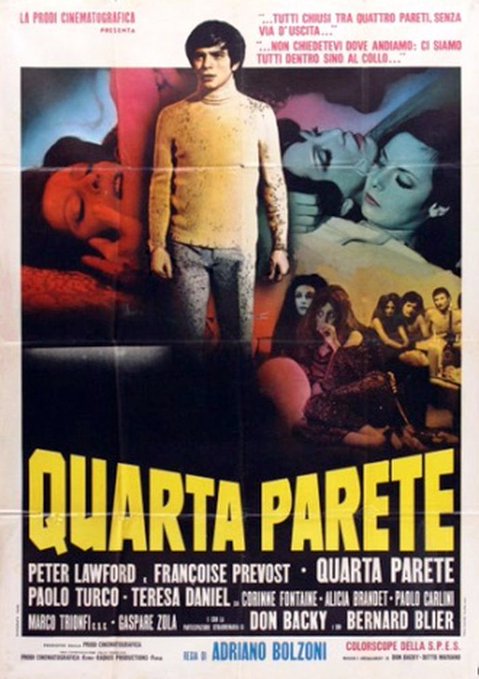
14 Days of Paranoia #1: The Fourth Wall (dir by Adriano Bolzoni)


First released in 1969, The Fourth Wall opens with a series of photographs.

The grainy photographs all appear to have been taken at a political protest in London.  The protestors are holding signs that say something about leaving Nigeria alone but the exact cause that is being supported is still left vague.  Eventually, after viewing several photographs of long-haired college students holding signs, we reach some photographs of the police violently breaking up the protest and carting several of the protestors off to jail.

Amongst the protestors is a young Italian named Marco Baroni (Paolo Turco).  Marco has spent the past four years in London, studying and apparently becoming politically active.  However, it is time for him to return to Italy.  When he reaches his home, we discover that, for all of his talk of protest and revolution, Marco comes from a wealthy, upper class family.  Papa Baroni (Peter Lawford) is a businessman who is willing to bankrupt even his best friends and who openly flaunts the affair that he’s having with his Swedish secretary.  Marco’s mother, Christiana (Francoise Prevost) spends her time in a haze of alcohol and ennui.  Marco’s younger sister, Marzia (Tery Hare), is a fashion model who has become infamous for a serious nude photographs that were taken by the enigmatic Lona (Corraine Fontaine).  Marzia’s room is full of picture of herself.  When Marco returns home, she greets him more as if he were long-distance boyfriend than her brother.  As the film progresses, it becomes clear that there is more to Marco and Marzia’s relationship than just sibling closeness.

It’s an odd and meandering film.  Marco, having had his consciousness raised in London, is disgusted by his family’s decadence and hates the fact that his father seems to represent everything that he was arrested for protesting in the UK.  At the same time, as much as Marco whines about the sins of his family, he finds himself repeatedly drawn to Marzia and her wild lifestyle.  At one point, Marco finds himself observing a group of student radicals who can’t even agree on what they want to protest.  At another point, he walks in on one of Marzia’s parties and watches as a rather tame orgy breaks out.  This is the type of film where Marco spends a lot of time complaining about Marzia being more interested in hedonism than politics but the camera itself lingers on the nonstop nudity and the sight of Lona and Marzia kissing.  For all of the film’s political pretensions, director Adriano Bolzoni obviously understood that sex sells better than speeches.

Bolzoni, himself, was not primarily a political filmmaker.  The majority of his films were a mix of giallo thriller and spaghetti westerns.  There are hints of the giallo genre in this film, with its vibrant colors and its shots of Marco slowly losing his mind as the full extent of his family’s decadence becomes clear to him.  (That said, it’s hard not to laugh at the scene in which Marco runs through the rain while screaming, “NO!” over and over again.)  The instrumental score is pure Spaghetti western, leading to some unintentionally funny moments.  When Marco spots his father with his mistress, the mix of a zoom lens and a musical sting that sounds like it was lifted from a Sergio Leone showdown is more likely to leave you laughing than gasping.  There are other scenes that are scored to songs that were apparently written to sound like Simon & Garfunkel’s contributions to The Graduate soundtrack.

As pretentious as the film is — and make no mistake, this is a very pretentious film — The Fourth Wall does do a good job of capturing Marco’s growing sense of unease as he returns home convinced that he’s figured out the world just to discover that no one else really cares about his politics, his ideals, or his outrage.  Marco goes from being stridently idealistic to drowning in his own paranoia and it’s hard not to regret that Paolo Turco was a bit of a dull actor because, with better casting, the character’s descent would have been truly heartbreaking.  Peter Lawford plays Papa Baroni with just the right amount of ruthless charm.  He might be the epitome of everything that Marco is against but just watching him, you know that Papa Baroni is always going to get exactly what he wants.  It doesn’t matter how much Marco whines or how many meetings Marco goes to or even how the film’s final burst of violence plays out.  Papa Baroni will always thrive and survive.
Film Review: Exodus (dir by Otto Preminger)


First released in 1960 and based on a novel by Leon Uris, Otto Preminger’s Exodous is two films in one.

The first half of the film takes place in Cyprus in the days immediately following World War II.  A young war widow named Kitty (Eva Marie Saint) is sightseeing when she learns of the Karaolos Internment Camp, where the British are interning thousands of Jewish refugees who demand to be allowed to go to the land that will eventually become the State of Israel.  Kitty visits with General Sutherland (Ralph Richardson), who oversees the camp and who is rumored to secretly be Jewish because of his relatively benevolent attitude towards the internees.  Disgusted by the anti-Semitism displayed by many of the British officers (one of whom is played by Kennedy in-law Peter Lawford), Kitty volunteers at the camp and learns about the Holocaust from those who survived it.  She also meets Ari Ben Caanan (Paul Newman), a former officer in the British army.  Ari manages to get control of a cargo ship, one that is renamed Exodus.  Six hundred refugees stage a hunger strike, vowing that they will willingly starve to death rather than be returned to Europe.

The second part of Exodus takes place in what will become the modern State of Israel.  It follows Ari, Kitty, and several of the passengers of the Exodus as they adjust to life and continue to fight for a land of their own, despite the opposition of the British and much of the rest of the world.  Karen (Jill Haworth) is a young woman who searches for her father, a brilliant man who has been driven into a nearly catatonic state by the horrors of the Holocaust.  Dov Landau (Sal Mineo) is an explosives expert who survived Auschwitz as a Sonderkommando and who was repeatedly raped by the guards at the camp.  Dov joins the Irgun, a paramilitary organization that the British consider to be terrorists.  Leading the Irgun is Ari’s uncle, Akiva (David Opatoshu), and Dov soon finds himself being targeted by both the British and the Arabs who, despite the moderating efforts of men like Taha (John Derek, who would later direct Ghosts Can’t Do It), want to violently force the Jews out of the land.

Legend has it that, after a private screening on Exodus, comedian Mort Sahl turned to director Otto Preminger and said, “Otto, let my people go.”  And it’s true that Exodus is a very long film.  Preminger, who started out making film noirs like Laura, spent the latter part of his career making “important” epics and, like many Golden Age directors struggling to compete with television and the 60s counterculture, he tended to make long, star-studded films that dealt with current events and which pushed the envelope just enough to be controversial without actually being radical.  However, I would argue that the three-hour running time of Exodus is justified.  To understand why Ari, Dov, Karen, and the other passengers of the Exodus would rather risk their lives by staying in what will become the State of Israel, one has to understand both what they went through to get there and also the anti-Semitism that they faced even in post-World War II Europe.  If Exodus were made today, it would be a mini-series.  Since it was made in 1960, it was instead a 3-hour film with an intermission.

Exodus holds up relatively well, with the sprawling action anchored by the presence of a cast of familiar faces.  Paul Newman and Eva Marie Saint bring a good deal of movie star glamour to scenes that would have otherwise just been dry exposition.  The film’s heart truly belongs to Jill Haworth and Sal Mineo, both of whom bring two life characters who have very differing views of the world.  Karen remains an optimist, one who is convinced that people can live together.  Dov, fueled by his own guilt and anger, has no room for negotiations and compromises.  Mineo received his second and last Oscar nomination for his performance in Exodus, though he lost to Peter Ustinov’s showy turn in Spartacus.  Exodus itself was clearly made with a hope for Oscar glory.  While Exodus did pick up a handful of nominations, it was left out of the five movie Best Picture slate.  The Academy only had room for one historical epic and they went for John Wayne’s The Alamo.  The eventual winner was The Apartment, the best of the nominated films.  (Indeed, even if Exodus had taken the Alamo’s spot, The Apartment would still be the best of the nominees.)  The Oscars aside, Exodus remains a good example of the type of epic filmmaking that once defined the Hollywood studios.

Retro Television Review: Fantasy Island 5.15 “The Case Against Mr. Roarke/Save Sherlock Holmes”


Welcome to Retro Television Reviews, a feature where we review some of our favorite and least favorite shows of the past!  On Tuesdays, I will be reviewing the original Fantasy Island, which ran on ABC from 1977 to 1984.  Unfortunately, the show has been removed from most streaming sites.  Fortunately, I’ve got nearly every episode on my DVR.

This week, Mr. Roarke might be a father!

Episode 5.15 “The Case Against Mr. Roarke/Save Sherlock Holmes”

(Dir by Don Weis, originally aired on February 6th, 1982)

After last week’s episode with Julie, Tattoo returns this week and Julie is nowhere to be seen.  When Mr. Roarke asks where Julie is, Tattoo mentions that Julie is helping with the Custer’s Last Stand fantasy.  At this point, I can only assume that a life insurance policy has been taking out on Julie and Roarke or Tattoo, or maybe both are trying to get her killed so they can collect.

Julie not being present means that she misses out on one of the biggest scandals in Fantasy Island history.  A former guest, Fran Warner (Laraine Stephens), returns to the Island after seven years.  Accompanying her is her six year-old daughter, Nancy (Nicole Eggert).  Fran loudly declares that Mr. Roarke is Nancy’s father and that he now has an obligation to take care of her.  Fran even has a birth certificate where, under the father’s name, someone has written — and I kid you not — “Mr. Roarke.”

Is Mr. Roarke the kid’s father?  As is his habit, he refuses to answer the question directly when Tattoo asks it.  But it soon turns out that no, Mr. Roarke is not Nancy’s father.  Instead, Fran is sick and may be dying and she wants to make sure that Nancy is cared for.  When Nancy learns the truth, she runs away and Tattoo leads a search party across the Island.  Fear not, of course.  Nancy is found and a very forgiving Mr. Roarke allows Nancy and Fran to stay on the Island.  And Fran’s terminal disease suddenly becomes less terminal!

While this is going on, security guard Kevin Lansing (Ron Ely) gets to live his fantasy of helping a great detective.  Kevin doesn’t care which detective he gets to help so Roarke sends him back to Victorian-era London so that Kevin can work with Dr. Watson (a charming Donald O’Connor) to save Sherlock Holmes (Peter Lawford, not looking well in one of his final performances) from the clutches of Moriarty (Mel Ferrer, being as sinister here as he was in countless giallo films).  Kevin also falls for Nurse Heavenly (RIta Jenrette, the wife of a corrupt Democrat member of Congress) and is pleased to discover that she’s not really Moriarty’s assistant.  Instead, she was just another guest on the Island having a fantasy.

The Sherlock Holmes story was silly but fun, in the way that Fantasy Island often is.  It’s always interesting when this show goes into the past and we get to see how the show’s crew dressed up the show’s sets to try to make them look historically accurate.  The same street appears in every episode but sometimes, that street is in 1890s London and sometimes, it’s in 1690s Salem and sometimes, it’s just in modern day Fantasy Island!  As for the Mr. Roarke’s a father storyline, it was predictable but still, it was a good showcase for Ricardo Montalban’s enigmatic interpretation of Mr. Roarke.

This was a pleasant trip to the Island!

Retro Television Reviews: Fantasy Island 4.8 “Crescendo/Three Feathers”


Welcome to Retro Television Reviews, a feature where we review some of our favorite and least favorite shows of the past!  On Tuesdays, I will be reviewing the original Fantasy Island, which ran on ABC from 1977 to 1986.  Almost the entire show is currently streaming is on Youtube, Daily Motion, and a few other sites.

This week, we get one good fantasy and one bad fantasy and a reminder that anything can happen on Fantasy Island!

Episode 4.8 “Crescendo/Three Feathers”

(Dir by Michael Preece, originally aired on December 20th, 1980)

This episode confirms that Fantasy Island is the strangest place on Earth.

Our first fantasy features Toni Tennille as a world-famous singer named Susan Lohmann.  Susan has been invited meet her favorite composer and songwriter, Edmund Dumont (Monte Markham).  Dumont lives in seclusion on Fantasy Island, in an estate that is surrounded by wild animals and where he is tended by a blind butler (James Hong).

Susan is excited to meet Edmund, until she walks in on him playing his piano and discovers that he’s a …. BEAST!  Though he has the body of a human, he has the face of a wolf.  It turns out that Edmund lives in seclusion because he feels that the world would never accept his appearance.  And Susan promptly proves him correct by screaming and demanding to leave.  Susan flees the estate.

Susan’s manager is glad that Susan is free because now she can appear in concert in London.  However, Mr. Roarke informs Susan that Edmund suffers from a curse and the only thing that could have cured him would have been the love of Susan.  Edmund is now determined to die, surrounded by the animals on his estate, the only creatures who accepted him.  Susan, realizing that she was a little bit hard on a guy who couldn’t help his appearance, returns to the estate, gives Edmund a kiss, and Edmund turns into a handsome guy.  Yay!

So, there’s a huge problem here.  Susan Lohmann is incredibly unlikable.  Yes, Edmund may look different.  But all Edmund did was invited her to his estate so that he could express his appreciation for the way the she sings his songs.  Susan claims that Edmund should have told her, in advance, about the way he looked.  Yes, Susan, God forbid someone unattractive appreciate your talent or have any talent of his own.  Seriously, Susan was the worst.

Slightly more likable is Alan Colshaw (Hugh O’Brian), a pilot who has spent a year feeling like a coward.  He was piloting a plane that crashed in the jungle.  Alan went for help and, according to the three other passengers (played by Diane Baker, James Wainwright, and Peter Lawford), he never returned and, instead, he ran off with a stash of diamonds that was on the plane.  Alan says that he is sure he didn’t intentionally desert them but he can’t remember for sure because he’s been suffering from memory loss.

Mr. Roarke gives Alan a medallion, one that will allow him and the others to see what happened when the plane crashed.  As for Alan, he brings along three white feathers, which he plans to give to each of the survivors as a way to symbolize that he’s not the coward that they think he is.  (Yes, it doesn’t make much sense to me, either.)

Lena (Diane Baker) is the first to forgive Alan.  Alan realizes that he’s in love with Lena and he tells Mr. Roarke that he wants to change his fantasy.  He just wants to spend the rest of his life with Lena.  Roarke informs Alan that he can’t do that because …. ALAN IS DEAD!  He died while trying to get help after the crash.  Alan has come back to life for the weekend so that his spirit can find peace.

That’s a pretty neat twist and, to its credit, the show sticks with it.  Alan eventually proves that he wasn’t a coward and that another one of the passengers stole the diamonds and then he vanishes into the afterlife.

“Boss,” Tattoo says, “you mean he was a …. g-g-ghost!?”

“Oh, Tattoo!” Roarke snaps, “Please do not tell me that you are prejudiced!”

Fantasy Island may be a strange place but some things — like Roarke passive aggressively attacking Tattoo — never change.

Retro Television Reviews: The Love Boat 2.25 “Murder on the High Seas/Sounds of Silence/Cyrano de Bricker”


Welcome to Retro Television Reviews, a feature where we review some of our favorite and least favorite shows of the past!  On Wednesdays, I will be reviewing the original Love Boat, which aired on ABC from 1977 to 1986!  The series can be streamed on Paramount Plus!

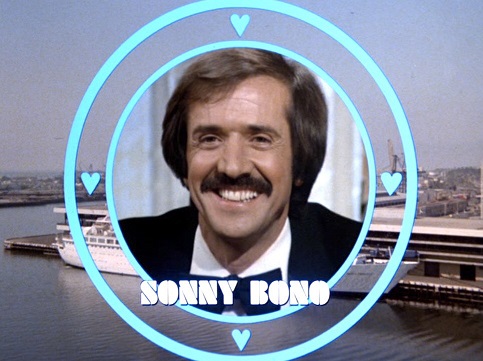
This week, Sonny Bono shocks the squares!

Episode 2.25 “Murder on the High Seas/Sounds of Silence/Cyrano de Bricker”

(Dir by Richard Kinon, originally aired on March 17th, 1979)

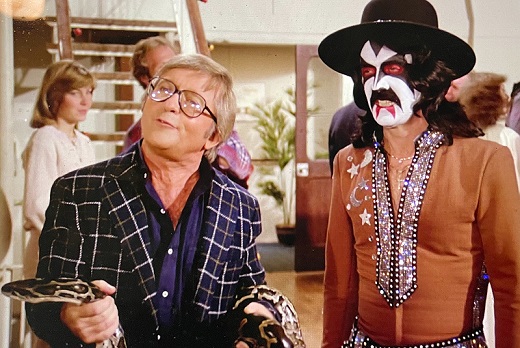
Uh-oh!  The singer who Julie hired to perform on the cruise had to cancel!  Fortunately, Gopher has a connection at a talent agent and he is able to recruit a replacement.  Meet Dominic Dark!

He’s pretty fearsome!  When he arrives on the boat, he’s accompanied by his manager (Arte Johnson) and a living snake.  When he performs in the Acapulco Lounge, he destroys his instruments and sings about how much he loves rebelling against conventional society.  But underneath that KISS-inspired makeup and behind those sub-Alice Cooper-style lyrics …. wait a minute …. is that….

Yes, this is one of the four episode of The Love Boat to feature singer and future U.S. Rep. Sonny Bono as a passenger on The Love Boat.  (Fred “Gopher” Grandy would also go on to serve in the House as well.)  Not surprisingly, Mr. Dark turns out to actually be a rather mild-mannered gentleman named Phil Backstrom.  Phil wants to abandon all the gimmicks and just make a name for himself as a singer but his manager orders him to keep putting on the makeup and to keep upsetting the squares.  While on the cruise, Phil meets and falls in love with Sara (Sheila Lenham), who understands his love of music and who is also deaf.

It’s actually a pretty sweet story and Sonny Bono is so likable that it’s easy to see how he managed to go from singing to having a career in politics.  But the main appeal of this entire storyline, and indeed this entire episode, is the chance to see Sonny Bono playing a 70s-style shock rocker.  It’s one of those ideas that is so ludicrous that it’s actually kind of fun.  Bono looks so awkward in his makeup that it’s hard not to root for him.  I also liked the fact that the other largely middle-aged and obviously wealthy passengers all loved Phil’s act.  It seemed like Phil’s biggest fans were the same people who, in theory, were supposed to be shocked by his antics.

As for the other two stories, Jill St. John plays Mitzi, an old friend of Doc’s who boards the boat with her new husband, Vinnie (Charlie Callas).  It’s supposed to be their honeymoon cruise but Vinnie seems to be more interested in gambling than honeymooning.  At one point, he says that, after living with Mitzi for two years before getting married, the honeymoon just feels like another trip.  Needless to say, Mitzi leaves their cabin and decides to spend the cruise in Doc’s office.  Doc Bricker is able to bring Mitzi and Vinnie back together but it’s hard not to feel that Mitzi made the right decision when she left Vinnie the first time.  I mean, Vinnie’s a jerk!  And he seems to have a bit of a gambling problem….

Finally, Isaac thinks that he overhears two people (Peter Lawford and Dana Wynter) plotting to kill Captain Stubing.  This leads to Isaac and eventually the entire crew getting into a panic but it turns out that Lawford and Wynter are just two mystery novelists plotting out their latest book.  The main problem with this plot is that it hinged on a mistake that Isaac, at least based on what we’ve seen of him in previous episodes, normally wouldn’t make.  Misunderstanding a conversation seemed more like something that Gopher would do.  Isaac has always been the smart and down-to-Earth member of the crew and Ted Lange never looks quite as comfortable with slapstick antics of this episode as Fred Grandy probably would have.

In the end, this was fairly negligible episode that was occasionally amusing due to the efforts of future congressman Sonny Bono.

Retro Television Reviews: Fantasy Island 2.15 “Cowboy/Substitute Wife”


Welcome to Retro Television Reviews, a feature where we review some of our favorite and least favorite shows of the past! On Tuesdays, I will be reviewing the original Fantasy Island, which ran on ABC from 1977 to 1986. The entire show is currently streaming on Tubi!

This week is all about deception.

Episode 2.15 “Cowboy/Substitute Wife”

(Dir by Arnold Laven, originally aired on January 20th, 1979)

Brian Kehoe (Hugh O’Brian) is from Texarkana.  In his youth, he was a rodeo rider but now he’s a broken-down old man who works as a rodeo clown.  He’s one of the best in the business and every rodeo rider on Fantasy Island swears that Brian has saved their lives multiple times.  (There’s a surprisingly large amount of rodeo people on Fantasy Island.)  However, Brian is deeply ashamed of just being a clown.  In fact, he’s spent his life telling his 11 year-old son, Tommy (Johnny Timko), that he’s the greatest rodeo champion of all time.

Brian’s fantasy is to be just that.  He’s spending the weekend with his son on Fantasy Island and he wants everyone to treat him like he’s a world famous rodeo star.  However, when he realizes that Tommy wants to see him in action, Brian realizes that he’s going to do have to ride a bull himself.  Unfortunately, Brian just can’t do it.  He’s old and out-of-practice.  So, he and his friends try to play a little trickery on Johnny.  Brian explains that he always wears a bandana over the lower half of his face whenever he rides.  When Tommy is cheering for his father, little does he realize he’s actually cheering for one of his father’s friends.  But when one the real riders is put in danger, Brian has no choice but to reveal the truth.  Of course, that was Mr. Roarke’s plan all along.

This was an okay fantasy.  I appreciated the fact that everyone pronounced rodeo correctly.  There weren’t any Yankees wandering around talking about the “roe-day-o.”  Hugh O’Brian did a good job of portraying the sadness beneath Brian’s confident façade.  And, when Tommy first learns that his father has been lying to him, he has a very honest reaction.  He is pissed off!  It takes Tommy a while to forgive his father.  This was a well-acted little fantasy, even if you never had any real doubt that things would eventually work out.

As for the other fantasy …. bleh.  Jayne Meadows Allen plays Nadine Winslow, a woman who suffers from hypochondria.  Her fantasy is to learn what’s wrong with her.  She’s examined by a Dr. Van Helsing (Hans Conried), who informs her that she only has a few weeks to live.  After Nadine leaves the exam room, we learn that Dr. Van Helsing is actually a waiter and it’s always been his fantasy to tell someone that they only have a few weeks to live.  Between this guy and that Nazi POW camp a few weeks ago, I’m starting to doubt Roarke’s instincts.

Nadine’s new fantasy is to find a new wife for her husband, Harvey (Peter Lawford, who appears to be slightly hung over in most of his scenes).  She settles on Monica (Sherry Jackson), whom Harvey meets during a bizarre Fantasy Island dating game that is hosted by a leering Mr. Roarke.  Monica and Harvey seem like a good couple but then Nadine spots her doctor working as a waiter and she realizes that she’s not dying.  So, she and Harvey get back together and, for some reason, they thank Mr. Roarke as opposed to suing him for emotional distress.  That whole fantasy was just dumb.

So, this was a pretty uneven episode.  I liked the rodeo stuff.  I disliked the death stuff.  That’s the way it usually goes.

Retro Television Review: Fantasy Island (dir by Richard Lang)


Welcome to Retro Television Reviews, a feature where we review some of our favorite and least favorite shows of the past!  On Tuesdays, I will be reviewing the original Fantasy Island, which ran on ABC from 1977 to 1996.  The entire show is currently streaming on Tubi!

Ah, Fantasy Island!

There have been several versions of Fantasy Island.  In the late 90s, there was a version that featured Malcolm McDowell as the somewhat aloof owner of the island.  More recently, there was a movie that featured Michael Pena as the owner of the Island and which tried to turn the whole thing into a horror franchise.  It wasn’t very good.  And right now, there’s a show on Fox that features Roselyn Sanchez as the grand niece of the island’s original owner.  The Fox series is about to start its second season.  It’s a bit silly, which is why I kind of love it.

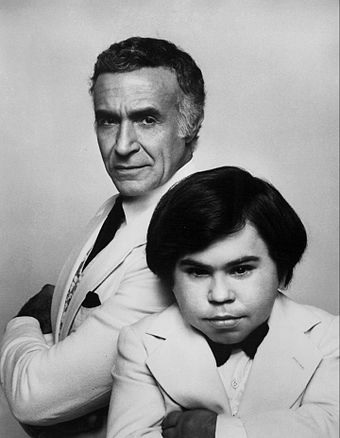
And then there’s the Fantasy Island that started it all, the Aaron Spelling-produced series that ran from 1977 to 1984 on ABC and which has lived on in reruns and on streaming platforms like Tubi.  Both the original series and all of its subsequent spin-offs took place on a mysterious tropical island where people would pay to live out their fantasies.  In the original series, the island was run by Mr. Roarke (Ricardo Montalban), who wore a white suit and encouraged everyone to smile whenever the guests arrived.  Serving as Mr. Roarke’s second-in-command was Tattoo (Herve Villechaize), who was 3’11, always wore a matching white suit, and announced the arrival of the plane by ringing a bell and shouting, “The plane, the plane!”  Of course, each week would bring in a different group of guest stars.  They would come to the island with a fantasy and, hopefully, they would learn that reality was the only fantasy that they needed.

All seven seasons of the original Fantasy Island are currently streaming on Tubi.  However, if you want to see the 1977 pilot film that started it all, you have to go to YouTube.

In many ways, the 90-minute pilot film feels like a typical episode of Fantasy Island.  It’s interesting to see that the show’s basic premise and format was already set in stone when the pilot was filmed.  (Pilots are notorious for often being dramatically different from the shows that they were created to sell.)  The pilot opens with the plane arriving (and yes, from the start, Tattoo rings the bell and shouts, “The plane!”) and three guests meeting Mr. Roarke.  Our three guest stars are Bill Bixby, Hugh O’Brian, and Eleanor Parker.  Bixby plays Arnold Greenwood, a former war correspondent who wants to be reunited with Francesca (Sandra Dee), the woman with whom he fell in love during World War II.  O’Brian is Paul, a famous big game hunter who wants to be hunted for once.  Eleanor Parker is Eunice Hollander Barnes, one of the world’s richest women.  She wants to fake her death so she can see who, from her life, would actually mourn her and who would just try to steal her fortune.

If the pilot’s format is the same as the series that followed, the general tone is somewhat different.  Mr. Roarke is an almost sinister figure, one who doesn’t really seem to think much of his guests and who is quick to point out that no one gets a fantasy until they’ve paid him the required $50,000.  (That’s $50,000 in 1970s money.  I have to admit that when Mr. Roarke first mentioned how much the fantasies cost, I was like, “Hey, I could afford this place!”)

Consider the story of the hunter.  Paul wants to be hunted because he’s suicidal.  His real fantasy is to die.  The night before Paul’s fantasy is to begin, Michelle (Victoria Principal) shows up at Paul’s room.  Michelle explains that Mr. Roarke has hired her to provide Paul with companionship during the night.  Unfortunately, Michelle ends up handcuffed to Paul and, as a result, she’s hunted along with him!  Now, you could argue that Mr. Roarke did this to teach Paul to think about someone other than himself.  But what if Paul hadn’t learned the lesson?  Then Michelle would be dead too!  What would Mr. Roarke do then?  Just have Tattoo dump the bodies in the lagoon?  “To hell with you, Roarke!” Paul yells and who can blame him?

And then there’s our war correspondent, Arnold.  Arnold’s fantasy seems simple enough but then it turns out that the reason he lost contact with Francesca is because he murdered her!  As a result of his fantasy, Arnold not only relives the first time he met Francesca but also how their relationship ended.  The entire experience leaves Arnold laughing like a madman as his sanity slips away.

As for Eunice’s story, it’s pretty stupid.  She dresses up like a maid so that she can listen to what people have to say about her once they think she’s dead.  It’s like an episode of Undercover Boss.  At least former Kennedy in-law Peter Lawford makes an appearance as Eunice’s husband.  Eunice ends up far less traumatized than either Paul or Arnold but she still had to fake her death to come to peace with her life.

The pilot is entertaining.  One can understand why it would lead to a series.  The island is lovely to look at.  Even with the somewhat sinister tone of two of the stories, it’s still impossible to watch the pilot without wondering what type of fantasy you would pursue if you went to the Island.  For me, that’s always been the main appeal of all of the various versions of Fantasy Island.  Still, it’s interesting that the fantasies themselves are less comforting than what I think many would expect on account of the show’s reputation.  For all the criticism that Blumhouse received for their reinterpretation of Fantasy Island, they were not the first to imagine Mr. Roarke as being somewhat less than benevolent.  Of course, when the actual series started, Mr. Roarke was a far friendlier host.

Next week, the series begins and hopefully, no further guests are traumatized to the point of catatonia.

A Movie A Day #314: Body and Soul (1981, directed by George Bowers)


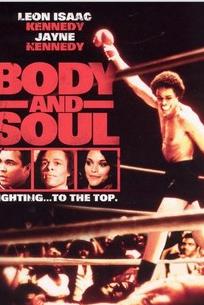
When his little sister falls ill with sickle-cell anemia, Leon Johnson (Leon Isaac Kennedy) has to make a decision.  He can either finish his education, graduate from medical school, and treat her as a doctor or he can drop out of school, reinvent himself as “Leon the Lover,” and make a fortune as a professional boxer!  At first, Leon’s career goes perfectly.  He is winning fights.  He is making money.  He has a foxy new girlfriend (played Leon Isaac Kennedy’s then-wife, Jayne Kennedy.)  But then the fame starts to go to Leon’s head.  He forgets where he came from.  He’s no longer fighting just to help his sister.  Now, he’s fighting for his own personal glory.  When Leon finally gets a title shot, a crooked boxing promoter known as Big Man (former JFK in-law Peter Lawford, looking coked up) orders Leon to take a dive.  Will Leon intentionally lose the biggest fight of his life or will he stay in the ring and battle Ricardo (Al Denava), a boxer so evil that he literally throws children to the ground?  More importantly, will he make his trainer (Muhammad Ali, playing himself!) proud?

Leon Isaac Kennedy, Muhammad Ali, and Peter Lawford all in the same movie!?  No surprise here, it’s a Cannon film.  Leon Isaac Kennedy was best known for playing a jailhouse boxer in the Penitentiary films and he was a good actor with charisma to burn so it probably made perfect sense to not only cast him in a remake of John Garfield’s Body and Soul but to let him write the script too.  The end result is a film that is too heavy-handed to be taken seriously but it is still an entertaining movie.  Body and Soul leaves not a single sports cliché unused but Kennedy was a convincing fighter and the boxing scenes are well-directed.  Muhammad Ali did a better job playing himself here then he did in The Greatest.  All in all, Body and Soul is a good movie for fight fans.

Body and Soul was not a box office success and Kennedy ended his film career a few years after it was released.  He is now the head of Leon Kennedy Ministries, Inc of Burbank, California.


Lisa Reviews An Oscar Nominee: The Longest Day (dir by Ken Annakin, Andrew Marton, Bernhard Wicki, Gerd Oswald, and Darryl F. Zanuck)


As my sister has already pointed out, today is the 73rd anniversary of D-Day.  With that in mind, and as a part of my ongoing mission to see and review every single film ever nominated for best picture, I decided to watch the 1962 film, The Longest Day!

The Longest Day is a pain-staking and meticulous recreation of invasion of Normandy, much of it filmed on location.  It was reportedly something of a dream project for the head of the 20th Century Fox, Darryl F. Zanuck.  Zanuck set out to make both the ultimate tribute to the Allied forces and the greatest war movie ever.  Based on a best seller, The Longest Day has five credited screenwriters and three credited directors.  (Ken Annakin was credited with “British and French exteriors,” Andrew Marton did “American exteriors,” and the German scenes were credited to Bernhard Wicki.  Oddly, Gerd Oswald was not credited for his work on the parachuting scenes, even though those were some of the strongest scenes in the film.)  Even though he was not credited as either a screenwriter or a director, it is generally agreed that the film ultimately reflected the vision of Darryl F. Zanuck.  Zanuck not only rewrote the script but he also directed a few scenes as well.  The film had a budget of 7.75 million dollars, which was a huge amount in 1962.  (Until Steven Spielberg’s Schindler’s List, The Longest Day was the most expensive black-and-white film ever made.)  Not only did the film tell an epic story, but it also had an epic length.  Clocking in at 3 hours, The Longest Day was also one of the longest movies to ever be nominated for best picture.

The Longest Day also had an epic cast.  Zanuck assembled an all-star cast for his recreation of D-Day.  If you’re like me and you love watching old movies on TCM, you’ll see a lot of familiar faces go rushing by during the course of The Longest Day.  American generals were played by actors like Robert Mitchum, Robert Ryan, Henry Fonda, and John Wayne.  Peter Lawford, then the brother-in-law of the President of the United States, had a memorable role as the Scottish Lord Lovat, who marched through D-Day to the sounds of bagpipes.  When the Allied troops storm the beach, everyone from Roddy McDowall to Sal Mineo to Robert Wagner to singer Paul Anka can be seen dodging bullets.  Sean Connery pops up, speaking in his Scottish accent and providing comic relief.  When a group of paratroopers parachute into an occupied village, comedian Red Buttons ends up hanging from the steeple of a church.  When Richard Beymer (who is currently playing Ben Horne on Twin Peaks) gets separated from his squad, he stumbles across Richard Burton.  Among those representing the French are Arletty and Christian Marquand.  (Ironically, after World War II, Arletty was convicted of collaborating with the Germans and spent 18 months under house arrest.  Her crime was having a romantic relationship with a German soldier.  It is said that, in response to the charges, Arletty said, “My heart is French but my ass is international.”)  Meanwhile, among the Germans, one can find three future Bond villains: Gert Frobe, Curt Jurgens, and Walter Gotell.

It’s a big film and, to be honest, it’s too big.  It’s hard to keep track of everyone and, even though the battle scenes are probably about an intense as one could get away with in 1962 (though it’s nowhere near as effective as the famous opening of Saving Private Ryan, I still felt bad when Jeffrey Hunter and Eddie Albert were gunned down), their effectiveness is compromised by the film’s all-star approach.  Often times, the action threatens to come to a halt so that everyone can get their close-up.  Unfortunately, most of those famous faces don’t really get much of a chance to make an impression.  Even as the battle rages, you keep getting distracted by questions like, “Was that guy famous or was he just an extra?”

Among the big stars, most of them play to their personas.  John Wayne, for instance, may have been cast as General Benjamin Vandervoort but there’s never any doubt that he’s playing John Wayne.  When he tells his troops to “send them to Hell,” it’s not Vandervoort giving orders.  It’s John Wayne representing America.  Henry Fonda may be identified as being General Theodore Roosevelt II but, ultimately, you react to him because he’s Henry Fonda, a symbol of middle-American decency.  Neither Wayne nor Fonda gives a bad performance but you never forget that you’re watching Fonda and Wayne.

Throughout this huge film, there are bits and pieces that work so well that you wish the film had just concentrated on them as opposed to trying to tell every single story that occurred during D-Day.  I liked Robert Mitchum as a tough but caring general who, in the midst of battle, gives a speech that inspires his troops to keep fighting.  The scenes of Peter Lawford marching with a bagpiper at his side were nicely surreal.  Finally, there’s Richard Beymer, wandering around the French countryside and going through the entire day without firing his gun once.  Beymer gets the best line of the film when he says, “I wonder if we won.”  It’s such a modest line but it’s probably the most powerful line in the film.  I wish The Longest Day had more scenes like that.

The Longest Day was nominated for best picture of 1962 but it lost to an even longer film, Lawrence of Arabia.

Horror Film Review: The Picture of Dorian Gray (dir by Albert Lewin)


picture-of-dorian-gray-32

Hello and welcome to the start of TSL’s annual October horrorthon!  All through the month of October, our focus will be on horror.  We will be sharing reviews and thoughts on some of the best (and worst) horror films ever made!  I have to admit that this is my favorite time of the year.  I love horror … like all good people!

I want to start things off by taking a look at a film from 1945.  The Picture of Dorian Gray is based on the famous novel by Oscar Wilde (a novel that some people think was inspired by the Jack the Ripper murders).  Dorian Gray (played by Hurd Hatfield) is a young and handsome aristocrat who lives in 19th century London.  When we first meet him, Dorian is intelligent, kind and virtuous.  He’s also more than a little boring.  He is the bland face of the establishment, a man destined to be celebrated for his position in society and largely forgotten after his death.

Dorian is posing for a painting that’s being done by his friend, an artist named Basil Hallward (Lowell Gilmore).  One day, Lord Henry Wotton (George Sanders) stops by the studio while Basil is painting Dorian.  Lord Henry is everything that Dorian Gray is not.  He’s a worldly and cynical man and he is very proud to live a life devoted to complete and total hedonistic pleasure.  He immediately sets out to corrupt Dorian and it turns out to be a lot easier than he was expecting.  Henry convinces Dorian that he can have everything that he wants as long as he’s young and handsome.  Dorian announces that he wishes the painting could age instead of him…

Now, here’s where the film takes a huge departure from Wilde’s novel.  In the novel, the painting ages while Dorian stay young.  No specific reason is given.  Instead, it’s just something that happens.  In the film, it turns out that Basil owns an ancient Egyptian statue and that the statue has mystical powers.  Dorian makes his wish in front of the statue and that’s why the painting starts to age.  Personally, I think the bit with the Egyptian statue is unnecessary and a little bit silly.  To me, the story is a lot more effective if the painting starts to age without an explanation.  The filmmakers obviously disagreed.

But no matter!  In the end, the Egyptian statue isn’t that important.  What is important that, freed from getting old or physically suffering for his actions, Dorian transforms into a different person.  Soon, he’s even more hedonistic than Lord Henry.  When he breaks the heart of a tragic singer named Sybil Vane (Angela Lansbury, in a poignant and Oscar-nominated performance), Dorian sees that the painting is now cruelly smirking while his own face remains innocent and untouched.  When Dorian eventually commits a murder to keep his secret from getting out, the blood appears on the painting’s hands while his own remain clean.

And the years pass.  Dorian finds himself both being hunted by Sybil’s brother (Richard Fraser) and falling in love with the niece (Donna Reed) of a man that he earlier murdered.  Dorian never ages but his portrait becomes more and more twisted.  What’s particularly interesting is that we see little of Dorian’s evil actions.  Instead, we watch and listen as other characters whisper about the horrific things that he’s done.  Physically, Dorian remains an innocent and young aristocrat.  But all we have to do is look at the picture and we can see what a monster Dorian has become…

The Picture of Dorian Gray is an absolutely gorgeous film, one that is full of elaborate sets that are often cast in shadow.  (It’s interesting to note that the more corrupt Dorian becomes, the darker and more shadowy his estate becomes.)  The film is in black-and-white, with the exception of three scenes in which the portrait is revealed in all of its Technicolor glory.  If that sounds like a gimmick … well, it is.  But it’s an amazingly effective gimmick.

The Picture of Dorian Gray is a classic exercise in psychological horror.  See it the next chance you get!

portrait-de-dorian-gray-1945-01-g