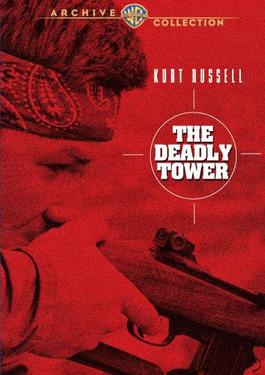
The Deadly Tower (1975, directed by Jerry Jameson)


Made for television, The Deadly Tower is a recreation of the terrible day in 1966 that a 25 year-old former Marine named Charles Whitman shot his wife and mother and then climbed to the top of the tower at the University of Texas in Austin and started to indiscriminately firing on the people below.  It was one of the first mass shootings of its kind.  What drove All-American boy Charles Whitman, who was eventually taken down by the police, to start his rampage is not known though the autopsy revealed that he did have a small brain tumor at the time of his death.

The Deadly Tower focuses mostly on the efforts of the policeman Ramiro Martinez (Richard Yinguez) and civilian Allan Crum (Ned Beatty) to get to the top of the tower and stop Whitman’s shooting rampage.  (Pernell Roberts, John Forsythe, and Clifton James all appear as other police officials, trying to deal with what was then an almost unheard of occurrence.)  Martinez risks his life to stop Whitman’s rampage while Allan worries that other shootings will follow.  One of the first examples of a true crime event being turned into a movie for television, The Deadly Tower a tense and effective docudrama.  Kurt Russell, who was then still known for being Disney’s top-paid star, plays Whitman.  Russell doesn’t have much dialogue in the film.  He’s blandly friendly while buying bullets and, when he’s sitting up in the tower with his rifle, he could just as easily pass for a teenager out hunting with his father during deer season.  Russell’s clean-cut appearance made him ideal for playing the role of someone who no one would have ever suspected could be capable of committing such a terrible crime.  It took courage to cast an actor then known for Disney films as one of America’s worst mass murderers and it also took courage for Russell to accept a role that was the total opposite of his family-friendly image.

The Deadly Tower used to show up on television frequently when I was a kid.  It’s still a scary movie, even if you know how it’s going to end.  Whitman may have been one of the first of his kind but sadly, he wouldn’t be the last.

Retro Television Review: The Love Boat 4.5 and 4.6 “The Mallory Quest/Julie, the Vamp/The Offer”


Welcome to Retro Television Reviews, a feature where we review some of our favorite and least favorite shows of the past!  On Wednesdays, I will be reviewing the original Love Boat, which aired on ABC from 1977 to 1986!  The series can be streamed on Paramount Plus!

This week, it’s a special two-hour episode of The Love Boat!

Episodes 4.5 and 4.6 “The Mallory Quest/Julie, The Vamp/The Offer”

(Dir by Richard Kinon, originally aired on November 15th, 1980)

This week, The Love Boat heads off on a two-week cruise that will take the ship, its crew, and its passengers through the Panama Canal.  There will also be stops at all the various islands on the way.  This is important because this is one of the episodes that was actually filmed on location.  Instead of the usual sets, we get to watch the action play out on an actual cruise ship.

Unfortunately, the actual cruise ship is kind of …. well, tacky.  Seriously, it’s hard not to notice that the hallways and the front lobby all look considerably more cramped and weathered than they have in other episodes of The Love Boat.  It’s also hard not to notice that the extras (who were apparently actual passengers) are all considerably older than the usual Love Boat background actors.

In fact, with the ship in such disrepair, it is any shocked that Captain Stubing is thinking of leaving?  When his old friend, Charlie (Dick Van Patten), boards the ship, he brings him a job offer.  If Stubing accepts the offer, he’ll be living in New York, he’ll be making three times the money, and Vicki will get to have a normal life.  Stubing loves the sea but he also wants Vicki to have a good future.  Vicki — in a scene that was well-acted by both Jill Whelan and Gavin MacLeod — tells him not to worry about her and that he needs to do what makes him happy.  And so, the Captain stays with the boat and I presume Vicki will continue to be taught by the tutor that we occasionally hear about but never actually see.

Meanwhile, Julie McCoy has been accused of being a vamp!  Maude Victor (Lani O’Grady) is convinced that Julie is trying to steal her fiancé, Roger (Bart Braverman).  Eventually, Roger himself become confused and Julie pretends to be interested in Roger just to get Roger and Maude back together again.  This was a dumb story and I don’t want to waste any more time on it.

Indeed, for all the Stubing drama and Julie silliness, this two-hour episode was dominated by one story.  Arrogant novelist Brian Mallory (Pernell Roberts) boards the boat with his long-suffering wife, Janet (Gayle Hunnicutt).  Brian has secretly bought tickets for three other passengers.  Peter (Skip Stephenson) is an insurance agent who is due to donate a kidney to his brother.  Marvin (Jimmie Walker) owns a bookstore.  Marcia Rand (Connie Stevens) brings along her fitness-obsessed boyfriend, Dave Porter (Peter Lupus).  Mallory reveals that Peter, Marvin, Marcia, and Gopher were the last four people to see his nephew, Tom.  Mallory has never met his nephew but he wants to track him down and apparently, Tom is living on one of the islands that the cruise is scheduled to visit.  Brian wants the four of them to help him look for Tom and he offers a $10,000 reward to make things interesting.  Why does Brian want to find his nephew?  Eventually, it is revealed that Tom is in possession of a family heirloom that Brian feels is rightfully his.  Sinister Lucius Kergo (Sorrell Brooke) is also on the cruise and he is determined to get the heirloom for himself.

Janet grows so tired of Brian’s arrogance and his obsession with finding his nephew that she declares that she’s leaving him.  Since the cruise is booked up, she ends up staying with Doc Bricker.  Doc falls for Janet but he realizes that she truly loves Brian and, when Brian starts to show some humility and some remorse for the way that he’s treated her, Doc encourages her to go back to him …. which she does because this is The Love Boat, not The Divorce Boat.

Anyway, Tom Mallory is eventually tracked down to a monastery in Puerto Rico.  Tom gives Brian the heirloom but the newly kind Brian gives it back to him so that he can sell it and use the money to build a free clinic.  Good for Brian!

Disheveled cruise ship aside and ignoring that terrible Julie plot, this was a fun episode.  The island scenery was gorgeous and the mystery of Tom’s location actually turned out to be a lot more intriguing than I was expecting it would.  Watching this episode made me want to take a cruise, even if it is a tacky one.
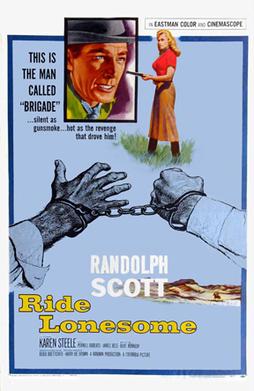
Ride Lonesome (1959, directed by Budd Boetticher)


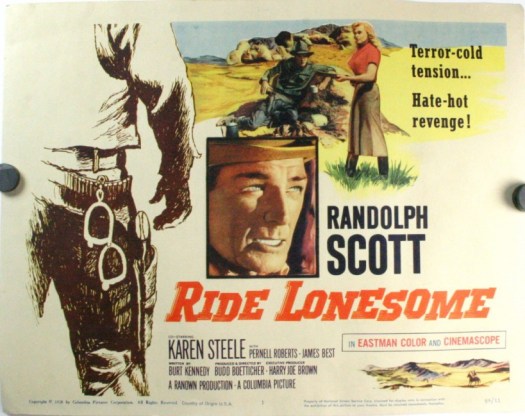
In the western Ride Lonesome, Randolph Scott plays Ben Brigade. Brigade is a bounty hunter. The only thing that really differentiates him from the outlaws that he captures is that he gets paid for what he does. When Brigade arrests a young outlaw named Billy John (James Best), he gives Billy just enough time to send word to his older brother, Frank (Lee Van Cleef). And when Brigade starts to lead Billy John back to the town of Santa Cruz, he takes his time and fails to cover his tracks, almost as if he is intentionally making time for Frank to eventually catch up to him. Along the way, Brigade meets up with three others, a woman named Carrie (Karen Steele) and two outlaws named Boone (Pernell Roberts) and Whit (James Coburn). Carrie is searching for her husband while Boone and Whit want to arrest Billy John themselves so that they can turn him in and get a pardon for their own crimes.

Ride Lonesome is one of the best of the many films that Randolph Scott made with director Budd Boetticher.  Boetticher specialized in making fast-paced westerns that had deceptively simple plots.  Nobody in a Boetticher western was totally good or totally bad and that’s certainly the case with Ride Lonesome, which may seem like a typical western but which is actually a character study of 6 very different people.  Brigade is often only the hero by default and his actions are often as ruthless as those of the men who are tracking him.  It’s only after he meets and gets to know Carrie that he starts to seriously consider that his plans could lead to innocent people getting hurt. Billy John may be a wanted killer but, underneath his bravado, he’s just someone trying to live up to his brother’s example.  Meanwhile, Boone and Whit may be outlaws but they turn out to be the most morally upright characters in the film.  Ride Lonesome takes a serious look at frontier justice and suggests that maybe black-and-white morality isn’t all that it’s cracked up to be.

Needless to say, the cast is great.  Randolph Scott was one of the great western heroes and Karen Steele, Pernell Roberts, Lee Van Cleef, and James Best all turn in memorable performances.  Best of all is James Coburn, making his film debut and showing that, even at the start of his career, he was already the epitome of cool.  Ride Lonesome is one of the best of of the Boetticher/Scott westerns and a true classic of the genre.


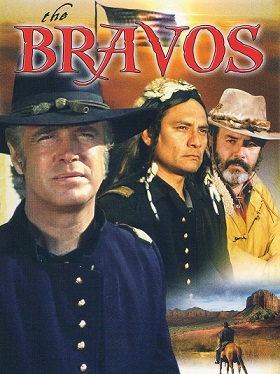
The Bravos (1972, directed by Ted Post)


Major John David Harkness (George Peppard) is the commander of Fort Bravo, a small and ill-equipped frontier fort.  Despite having only 77 soldiers and not many supplies, Harkness has managed to keep an uneasy peace between the local Indian tribes and the settlers who move through the area.  The peace, however, is disturbed when an arrogant wagon master (Pernell Roberts) kills the son of the tribal chief.

That’s not all that Harkness has to worry about.  A German outlaw (Bo Svenson) is hiding out at the camp.  His head scout (L.Q. Jones) suspects that something is forcing the local tribes out of the area.  Two settlers from Missouri (played by Barry Brown and Belinda Montgomery) are at the fort and trying to decide whether they should continue westward or return to Missouri.  Finally, Harkness’s 12 year-old son, Peter (Vincent Van Patten), has been expelled from his New England boarding school and is being sent to Fort Bravo to live with his father.  When Major Harkness refuses to turn the wagon master over to the Indians, they kidnap his son instead.

The Bravos was made for television and originally aired on ABC in 1972.  It was apparently meant to serve as the pilot for a television series, one that would have followed the daily adventures of the Major, his son, and all of the men at Fort Bravo (who were played by television mainstays like Dana Elcar, Randolph Mantooth, and George Murdock.)  For all intents and purposes, Pernell Roberts, Bo Svenson, Belinda Montgomery, and Barry Brown are all “special guest stars” and are meant to serve as examples of the type of television-friendly actors who would visit Fort Bravo on a weekly basis.  That the pilot didn’t lead to a series isn’t surprising.  TV westerns may have dominated the ratings in the 50s and the 60s but they quickly went out of fashion in the 70s as networks realized that they could make more money selling ad space for Norman Lear sitcoms and cop shows.  In the 70s, the people that advertisers were wanting to reach were watching Archie Bunker and Starsky and Hutch, not George Peppard.

Because of its TV origins, The Bravos is a fairly bland western.  It would be a few years before George Peppard would reinvent himself as a grizzled character actor and he’s sincere but fairly dull here.  Pernell Roberts is more effective as the headstrong wagon master and perhaps The Bravos would have worked better if Roberts and Peppard had switched roles.  In the end, the main reason to see the film is for the chance to see L.Q. Jones play a heroic role for once.  A member of Sam Peckinpah’s stock company, Jones brings some authentic grit to his role as the fort’s only scout.  Jones played a lot of villains but I always preferred him as one of the good guys.

The Bravos ends with a few major subplots unresolved.  Maybe they would have been resolved during the show’s first season but it was not to be.

High Noon, Part II: The Return of Will Kane (1980, directed by Jerry Jameson)


One year after throwing his tin star to the ground and riding out of town in disgust at the cowardice of the citizens who he once served, former Marshal Will Kane (Lee Majors, stepping into the role that won Gary Cooper an Oscar) returns to Hadleyville with his bride, Amy (Katherine Cannon).

Hadleyville has a new sheriff.  When Kane angrily left, he was replaced by J.D. Ward (Pernell Roberts), a corrupt tyrant who runs the town with an iron fist and who is more interested in making money than upholding the law.  Ward is determined to collect the bounty on Ben Irons (David Carradine), a reformed outlaw who swears that he’s innocent.  Kane decides to try to help Ben escape from Ward and his posse, which leads to potentially disastrous consequences for him.  Will the town finally show the courage necessary to stand behind Kane or will he once again be forced to go it alone?

High Noon, Part II is a made-for-TV movie.  It was obviously designed to be a pilot for a potential television series, one that would have featured the weekly adventures of Will Kane in Hadleyville.  As far as made-for-TV westerns are concerned, it’s about average, neither particularly good nor bad.  Lee Majors may not have been a great actor but he was believable in western roles and both Pernell Roberts and David Carradine give good performances as well.  Jerry Jameson directs in a workmanlike manner.  The story’s predictable but it’s a western so what do you expect?

The main problem with the film is that it’s set up to be a sequel to a film that never needed one.  When Gary Cooper threw that star in the dust and climbed up on that wagon with Grace Kelly in High Noon, the whole point of the story was that Will Kane was never going to return to Hadleyville because the citizens of Hadleyville deserted him when he most needed them.  Hadleyville didn’t deserve Will Kane.  That’s what set High Noon apart from other westerns.  Having Kane return to Hadleyville and once again pick up the tin star negates everything that made High Noon so effective.  The whole point of the ending was that Will Kane was never going to return but, according to this movie, he did and forgave the town for the unforgivable.  It’s impossible to watch High Noon II without thinking about how it goes against everything that the first High Noon was all about.

Oddly enough, the film’s forgettable screenplay was written by the great Elmore Leonard.  Leonard did better work before this film and he would do better work afterwards.


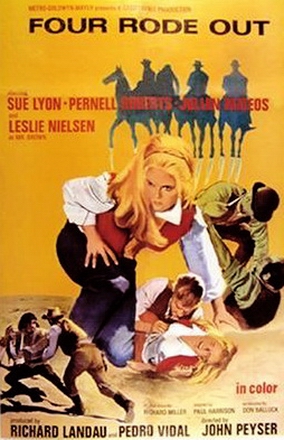
Four Rode Out (1970, directed by John Peyser)


In this self-conciously hip western, former Lolita Sue Lyon stars as Myra Polsen.  Myra has a reputation for being the town tramp and, when her father discovers Myra in bed with wanted outlaw Frenando Nunez (Julian Mateos), it leads to her father having a violent breakdown which ends with him shooting himself and Frenando escaping into the desert.  (Before anyone comments, that’s not a misspelling.  The outlaw’s name actually is Frenando.)  World-weary U.S. Marshall Ross (Pernell Roberts) heads into the desert to try to capture Frenando.  Accompanying him are Myra (who still loves Frenando) and the mysterious Mr. Brown (Leslie Nielsen!), a detective who is obsessed with Frenando and who says that he’ll kill the outlaw as soon as he sees him.

Also accompanying them is a ghostly folksinger played by Janis Ian, of At Seventeen fame.  Ian sings songs that comment upon the story and they’re just as empty-headed and bad as you would expect them to be.  Janis Ian’s presence marks this as being one of the handful of new wave westerns that were released in the wake of Easy Rider, The Wild Bunch, and the films of Sergio Leone.  These westerns attempted to appeal to the counter-culture by sympathizing with the outlaws and featuring crooked lawmen.  The addition of Janis Ian and her songs is Four Rode Out‘s way of saying, “This may be a western but this is a western that gets it.” Instead, it just comes across as artificial and forced.  There’s a lot of room for both moral ambiguity and political subtext in the western genre, which was something that Leone and Sam Peckinpah proved.  There’s less room for a hippie folksinger, as Four Rode Out demonstrates.

Other than Janis Ian’s songs and some dialogue that tries too hard to be profound, Four Rode Out isn’t bad.  Sue Lyon really digs into the role of Myra and even Pernell Roberts gives a good performance.  Of course, if you’re watching this movie in 2020, it’s probably going to be because of Leslie Nielsen.  This movie was made before Nielsen recreated himself as a comedic actor and it’s interesting to see how the same things that made Nielsen so funny — the deadpan delivery, the overly serious facial expressions — also made him a good villain.  For modern audiences, it can be difficult to look at Leslie Nielsen without laughing.  That’s how much we associate him with comedy.  But once you accept the fact that this is Leslie Nielsen playing a bad guy, he’s very convincing in the role.

One final note of interest: Four Rode Out was based on a story idea from the actor Dick Miller.  Yes, that Dick Miller.  Unfortunately, Miller himself is not in the movie.

Lonesome Cowboy: Randolph Scott in RIDE LONESOME (United Artists 1959)


gary loggins's avatarcracked rear viewer

Randolph Scott and director Budd Boetticher  teamed again for RIDE LONESOME, their sixth of seven Westerns and fourth with writer Burt Kennedy. Scott’s a hard case bounty hunter bringing in a killer, joined in his trek by an old “acquaintance” with an agenda of his own. Everyone’s playing things close to the vest here, and the stark naked desert of Lone Pine’s Alabama Hills, with its vast emptiness, plays as big a part as the fine acting ensemble.

Ben Brigade (Scott) has captured the murderous Billy John and intends to bring him to justice in Santa Cruz. Coming to a waystation, he finds Sam Boone and his lanky young companion Whit, known outlaws who’ve heard the territorial governor is granting amnesty to whoever brings in Billy. Also at the station is Mrs. Crane, whose husband has been murdered by marauding Mescaleros. Sam’s interested in forming a partnership and taking Billy…

View original post 394 more words

Surely, Leslie Nielsen can’t be the bad guy: The Sheepman (1958, directed by George Marshall)


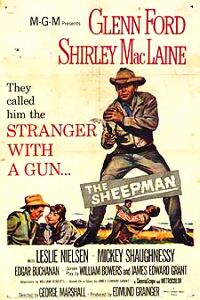
Thesheepman At the start of The Sheepman, reformed gambler and gunslinger Jason Sweet (Glenn Ford) shows up in the middle of cattle country. He has won a herd of sheep in a poker game and he is planning on grazing them on the nearby public land. Knowing that he will face opposition from the local cattle ranchers, Jason asks the local towns people to direct him to the town bully. After Jason beats up Jumbo (Mickey Shaughnessy), Jason is invited to meet Jumbo’s boss, Col. Stephen Bedford (Leslie Nielsen).
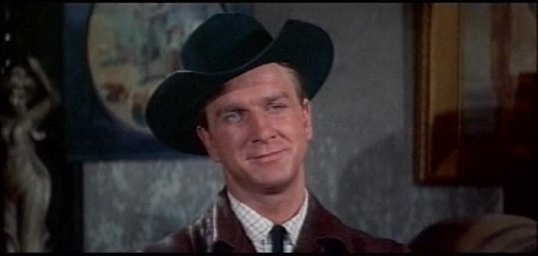
As soon as Jason meets Bedford, he realizes that he is not a colonel and his name is not Bedford. Instead, he is an old friend from Texas, a former gambler and outlaw named Johnny Bledsoe. Like Jason, Bledsoe has also gone straight and is now the most powerful man in town. He is also engaged to marry a local girl named Dell Payton (Shirley MacClaine), to whom Jason has taken a liking.  Bledsoe tells Jason to take his sheep somewhere else and when Jason refuses, Bledsoe threatens to have him, Dell, and his sheep killed.

Wait a minute, Leslie Nielsen is playing a bad guy?

Surely, you can’t be serious!

I am serious. And don’t call me Shirley.

(Sorry, had to do it.)

Leslie Nielsen is best remembered for being the deadpan comedian who could deliver the most ridiculous of lines with a totally straight face and who helped to make Airplane one of the funniest movies ever made. But before Nielsen recreated himself as a comedic actor, he was a dependably stiff supporting player and occasional leading man who appeared in nearly 100 dramatic pictures. The Sheepman is one of his “serious” roles.

Today, it is always strange to see one of Nielsen’s dramatic performances. Johnny Bledsoe is a standard western villain and Nielsen does okay with the role but, because his serious performances shared the same style as his comedic performances, it was impossible not to think of Dr. Rumack saying, “I just want to tell you both good luck. We’re all counting on you,” even while Johnny Bledsoe was offering to pay the outlaw Chocktaw (Pernell Roberts) to track down and kill Jason and his sheep.

The Sheepman is an average western and, as always, Glenn Ford is a good hero. But ultimately, the most interesting thing about it and the main reason to see it is to witness Leslie Nielsen doing his thing before he officially became the funniest man in the world.  Leslie Nielsen was not a terrible dramatic actor but watching The Sheepman made me all the happier that he eventually got to show the world his true calling.

Leslie Nielsen in The Sheepman (1958)