Shot on location, the 1981 film of the same name takes place in one of the toughest police precincts in New York City. The film opens with a prostitute (Pam Grier) walking up to a police car in the middle of the night and promptly gunning down the two cops inside. (The scene emphasis on the blood splattering in the squad car makes it all the more disturbing and frightening.) As soon as the cops are dead, people come out of the shadows and immediately start going through their pockets, collecting everything that they can.
Why were the cops killed? There is no real motive, beyond Grier’s prostitute being high on drugs and enjoying the kill. Indeed, we know from the start that Grier is the killer but the cops investigating the case continually ignore her, despite the fact that she’s always wandering around in the background. (Grier is perfectly frightening in the nearly silent role.) The new captain of the precinct, a by-the-book type named Dennis Connolly (Ed Asner), assumes that the killing must have been an organized assassination and he is soon ordering his cops to arrest and interrogate almost anyone that they see. If someone jaywalks, Connolly wants them in the back of a squad car so that they can be interrogated. He offers to give the men two weeks of extra vacation time for every lead that they find. When veteran detective John Joseph Vincent Murphy III (Paul Newman) says that the reward is going to do more damage than good, Connolly dismisses his concerns. Connolly is convinced that he knows how to run the precinct. He views the people who live in the Bronx as being enemies who have to be tamed and controlled. Murphy, who comes from a long line of cops, believes in working with the community as opposed to going strictly by the book.
It’s an episodic film, following Murphy and his partner, Corelli (Ken Wahl), as they try to keep the peace in a neighborhood full of empty lots, abandoned buildings, and horrific poverty. (The film is all the more effective for having actually been shot on location. Looking at the scenery in which everyone is living and working, it’s easy to understand why tempers get so easily frayed.) Corelli is ambitious. Murphy is cynical. When Murphy meets a nurse (Rachel Ticotin), it seems like love at first sight. They’re both survivors of the toughest city in America. But the nurse has a secret of her own. There’s a lot of stories that are told in Fort Apache, The Bronx but few of them have a happy ending.
It’s an effective film, though the structure is occasionally a bit too loose and the generic “cop music” on the soundtrack sometimes makes it seem as if the viewer is watching a cop show on one of the nostalgia channels. The film works because it allows the Bronx itself to be as important a character as the cops played by Newman, Asner, and Wahl. There’s a grittiness to the film that overcomes even the occasional melodramatic moment. In the end, the film suggests that, while cops come and go, the precinct will always remain the same. Killing two drug dealers just allows two more to move in. Reporting on a bad cop, like the one played in the film by Danny Aiello, will only lead to the ostracization of a good cop. To the film’s credit, neither Newman nor Asner are portrayed as being totally correct or totally wrong in their different approaches to police work. Newman is correct about Asner’s heavy-handed tactics creating mistrust and resentment in the community. Asner, however, has a point when he says that a cop killer cannot be allowed to go unpunished.
Paul Newman gives a great performance as Murphy, a role that a lesser actor would have turned into a cliche. Murphy is the latest in a long line of cops and he’s on the verge of abandoning the family business. Newman does a good job of portraying not only Murphy’s burnout but also how his affair with the nurse briefly inspires him to believe that he still might actually be able to make a difference in the world. The film ends on an ambiguous note, one that leaves you with the impression that Murphy couldn’t stop being a cop if he tried. The job may be burning him out but it’s still the only thing he knows.
Fort Apache, The Bronx is not an easy movie to find. Though it did well at the box office (and reportedly inspired shows like Hill Street Blues and NYPD Blue), the film was also controversial because of the way the Bronx was portrayed. While it’s not currently streaming or even available to rent on any of the major sites, I did find a good, age-restricted upload on YouTube. Look for it before someone takes it down.
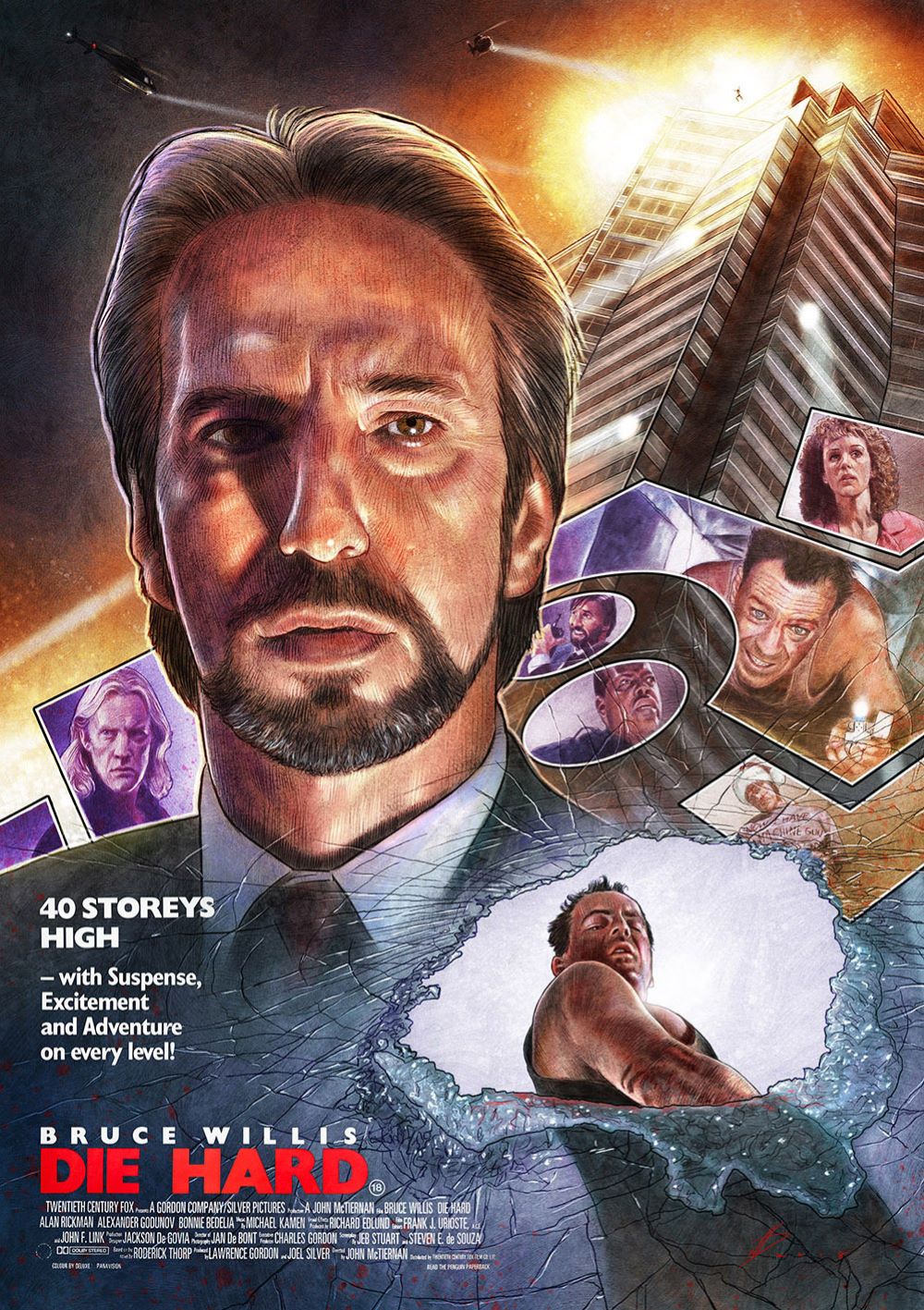
Die Hard is the ultimate Christmas film (though not the greatest) disguised as an action thriller, blending holiday cheer with high-stakes mayhem in a way that has sparked endless debates and turned it into a seasonal staple for millions. It stands as a landmark action movie and a sharp, character-driven thriller that continues to set the standard for the genre. The film mixes bombast with genuine heart, balancing tension, wit, and raw emotion so effectively that its imperfections only add to its enduring appeal.
Released in 1988 under John McTiernan’s direction, Die Hard follows New York cop John McClane (Bruce Willis) arriving in Los Angeles during the holidays to reconcile with his estranged wife Holly at her office Christmas party in Nakatomi Plaza. He’s fresh off a transcontinental flight, nursing a cocktail of jet lag and marital tension, hoping a festive gathering might thaw the ice between them after her career move to the West Coast has strained their family life. No sooner has he kicked off his shoes—famously leaving him barefoot for most of the chaos—than a disciplined crew of armed robbers, masquerading as terrorists under the command of Hans Gruber (Alan Rickman), storms the building, holding the revelers captive and forcing McClane to fight back shoeless and outgunned amid the towering offices. This lean setup—one man, one skyscraper, one chaotic evening—drives the story’s relentless pace, with straightforward spatial awareness keeping viewers locked into the rising peril. The Christmas setting isn’t just window dressing; twinkling lights, carols on the soundtrack, and a rooftop Santa sleigh add layers of irony and warmth to the gunfire, making the film a peculiar but perfect yuletide watch.
The movie refreshingly casts its action lead as an everyday underdog, full of sarcasm and frailty rather than invincible machismo. McClane takes real damage—he’s slashed by glass, battered by falls, and wheezing from asthma attacks—freaks out under pressure, second-guesses himself constantly, and limps through the ordeal covered in cuts and shards while grumbling about his lousy luck. These moments of raw vulnerability humanize him in a genre often dominated by perfect physiques and unflappable cool. Bruce Willis brings a rumpled, relatable edge to the role, drawing from his TV background on Moonlighting to infuse McClane with quick-witted banter and hangdog charm, making his pigheaded risks and desperate quips—like his tense radio chats or infamous air vent shuffle—land as the outbursts of an ordinary Joe desperate for survival and a way out. Willis’s casting was a gamble at the time, pivoting from wisecracking detective to gritty hero, but it paid off by redefining what an action star could be: flawed, funny, and fiercely determined.
Hans Gruber remains a standout antagonist, living up to every ounce of his legendary status—and remarkably, this was Alan Rickman’s very first film role, launching him into stardom with a performance that still defines screen villainy. Fresh from stage work, Rickman infuses him with suave detachment and subtle menace, his silky British accent dripping with condescension as he portrays a criminal mastermind who approaches the heist like a hostile merger, his cultured facade slipping just enough to reveal cold ruthlessness. Lines like his mocking “Mr. Mystery Guest” taunts or his gleeful disdain for American excess have become iconic, delivered with a theatrical precision that elevates Gruber above typical thugs. Clever writing highlights his contempt for yuppie excess and delight in red tape, while McTiernan’s direction turns their encounters into personal showdowns brimming with verbal sparring beyond mere firepower, turning cat-and-mouse into a battle of intellects as much as endurance.
A strong ensemble bolsters the narrative without bogging down the momentum. Bonnie Bedelia’s Holly exudes quiet strength, proving herself a sharp professional unafraid of bosses or bandits, which elevates her rapport with McClane above clichéd rescue tropes—she’s calling shots from the hostage room and holding her own in tense negotiations. Reginald VelJohnson’s Sergeant Al Powell elevates a stock radio contact into the story’s heartfelt core, offering McClane solace and shared regrets during their poignant nighttime talks about lost family and second chances, creating an unlikely but touching bromance across police lines. Figures like Hart Bochner’s smarmy Ellis, with his coke-fueled deal-making, or William Atherton’s pushy journalist Richard Thornburg, chasing scoops with ruthless ambition, add biting commentary on greed and sensationalism, sharpening the film’s take on ’80s excess and how corporate snakes and media vultures complicate the crisis. Even smaller roles, like the hapless deputy chief or the bickering SWAT team, paint a vivid picture of institutional incompetence that McClane must navigate alone.
Die Hard excels in choreographing escalating clashes within tight quarters, turning the skyscraper into a multi-level chessboard. McTiernan masterfully exploits Nakatomi’s design—raw construction levels with exposed beams, service elevators for ambushes, fire stairs slick with tension, upper decks for sniper duels, and cubicle warrens for close-quarters chaos—to distinguish every skirmish from rote shootouts, ensuring each fight feels unique and earned. Precise editing weaves between McClane’s scrambles, captive dread, robber schemes, and external responders, layering suspense without devolving into explosive filler; the cross-cutting builds dread as plans intersect disastrously. Standout sequences thrill because of careful buildup around deadlines and official blunders, like ill-timed interventions that raise the stakes sky-high. The practical effects—real stunts, squibs, and pyrotechnics—give the action a tangible weight that CGI-heavy modern films often lack, grounding the spectacle in sweat and physics.
Blending laughs with savagery proves the film’s toughest feat, yet it mostly triumphs. McClane’s biting comebacks, taped to dead bodies or barked into walkie-talkies, and the dark comedy amid cop-thug banter sustain levity amid dire threats and mounting casualties, preventing the film from tipping into grim slog. Gags like the executive’s C4 “gift” or Powell’s Twinkie diet poke fun at excess without diffusing danger. Certain gags and era-specific jabs feel dated—like mockery of inept brass or overzealous feds—but this institutional skepticism fuels the plot, portraying red tape and hubris as lethal as automatic weapons, a theme that resonates in any age of bloated bureaucracies.
The film’s action overload, ironically its signature strength, occasionally trips it up. Later stretches bombard with relentless blasts and ballets, prompting some to decry the carnage’s intensity or plot holes from initial reviews, where critics noted the escalating body count’s numbing effect. Elements like tactical decisions by authorities or vault breach logistics falter on nitpicks, relying now and then on lucky breaks to align the chaos, such as perfectly timed discoveries or overlooked details in the heist plan. Fans of taut caper tales might see the wilder antics as indulgence over invention, prioritizing popcorn thrills over airtight logic. Yet these are minor quibbles in a runtime that clocks in under two hours, keeping energy high without exhaustion.
Yet a solid emotional arc lends depth beyond mere spectacle. Fundamentally, it’s about a bullheaded officer confronting his marital neglect, enduring brutal comeuppance while seeking redemption amid the tinsel and terror. His raw confessions to Powell inject humanity that heightens the personal stakes, turning isolated survival into a quest for reconnection. The script, adapted from Roderick Thorp’s novel Nothing Lasts Forever, weaves family drama into the frenzy without halting the pace, making quieter moments—like shared vulnerabilities over radio—punch harder than any explosion.
Technically, Die Hard brims with assured flair bordering on swagger. Cinematographer Jan de Bont’s lenses capture glassy surfaces, mirrors for disorienting reflections, and soaring perspectives to render the tower both glamorous and hostile, a glassy trap turned warzone that mirrors the characters’ fractured relationships. Crisp cuts allow pauses for character amid the rush, preserving brisk tempo without shortchanging development; McTiernan’s post-Predator confidence shines in rhythmic pacing that breathes. Michael Kamen’s soundtrack fuses orchestral surges with jingly carols like “Let It Snow,” amplifying the bizarre fusion of festivity and fusillades that forever fuels “Christmas movie” arguments—ho-ho-hos interrupted by hails of bullets.
Die Hard‘s influence reshaped action cinema, birthing the “Die Hard in a [location]” trope for enclosed thrillers, from buses to battleships, spawning endless imitators chasing its formula. Sequels amplified scale at the cost of grounded heroism, proving surface mimics—snark, stunts, scheming foes—miss the original’s vulnerable punch, as later entries piled on global threats and gadgets. Detractors note it paved paths for bloated pyrotechnics in successors, but that’s on copycats, not this taut gem; its box-office success—over $140 million worldwide—proved audiences craved smart spectacle.
All told, Die Hard delivers razor-sharp, hilarious, masterfully built blockbuster entertainment that ages like fine whiskey. Pairing a rugged everyman lead, suave nemesis, and geography-smart sequences, it raises a benchmark few match. Flaws like overkill blasts or shaky rationale aside, its tension, depth, and gritty laughs cement its throne in action lore, a holiday gift that keeps on giving.
198o’s He Knows You’re Alone opens with a young couple making out in a car. (The guy, who is named Don, is played by Russell Todd, the devastatingly handsome actor who played the first victim in Friday the 13th Part II.) A report comes over the radio. There’s a killer on the loose. The girl is concerned. The guy is cocky. It’s hard not to notice that both of them look a little bit too old to be playing high school students. Suddenly the killer attacks and….
We sitting in a movie theater, watching as two friends, Ruthie (Robin Lamont) and Marie (Robin Tilgham), watch the film. Marie covers her eyes while Ruthie announces, excitedly, that the couple is going to die. Marie, uncomfortable with the onscreen violence, goes to the washroom. She splashes water on her face. She catches her breath. When she returns to the theater, Ruthie is excited because the girl on screen is about get slashed by her stalker. Marie hides her eyes. Just as the girl onscreen screams, the man sitting behind Marie drives a knife into the back of her neck, killing her.
It’s a brilliantly edited sequence, one that comments on how audiences love depictions of violence while fearing it in real life. It’s also a genuinely scary sequence, especially if you’re someone who frequently goes to the movies. (Would the sequence have the same impact on someone who has grown up almost exclusively in the streaming age? Probably not.) It’s a sequence that shows a hint of a self-awareness that was lacking in many 80s slasher films. It’s also so good that the rest of the film struggles to live up to it.
The killer in He Knows You’re Alone is Ray Carlton (played with wild-eyed intensity by Tom Rolfing), a serial killer who preys on women who are engage to be married. While Detective Len Gamble (Lewis Arlt) tries to track down Ray and get revenge for the murder of his fiancée, Ray stalks Amy Jenson (Caitlin O’Heaney) and her bridesmaids, Nancy (Elizabeth Kemp) and Joyce (Patsy Pease). (Why Ray focuses on the bridesmaids before going after Amy is never really explained.)
We also meet a few red herrings, all of whom would probably be suspects if the film hadn’t already shown us that Ray is the murderer. Joyce is having an affair with a married professor named Carl (James Rebhorn). While we don’t really get to know Amy’s fiancé, we do spend a good deal of time with her ex-boyfriend, hyperactive morgue attendant Marvin (Don Scardino). We also meet Nancy’s date for the weekend, a psych major named Elliott (Tom Hanks). This was Hanks’s film debut and, even though he doesn’t get much screentime, he’s so instantly likable that it’s easy to understand why he became a star.
As I mentioned earlier, the rest of He Knows You’re Alone struggles to live up to its opening moments. That doesn’t meant that He Knows You’re Alone is a bad movie. Though there are a few scenes that comes across as being filler, it’s still an effective slasher film. The fact that the killer is just some anonymous loser as opposed to a Freddy Krueger-style quip machine makes him all the more frightening. Ray Carlton is a killer who you can actually imagine siting behind you, preparing to strike. The film also makes good use of its chilly Long Island locations. There’s a grittiness to the film that leaves the viewer feeling as if the world itself is decaying along with Ray’s victims.
And then there’s Tom Hanks, a ray of cheerfulness amidst the drabness of the Mid-Atlantic hellhole that is New York. At one point, his psych student talks about how scary stories and movies can help people deal with the horrors of the real world, another hint that this film was more self-aware than the usual slasher flick. Originally, Hanks’s character was meant to be one of Ray’s victims but director Amand Mastroianni (who later went on to direct several episodes of Friday the 13th: The Series) said that Hanks proved to be so likable in the role that no one could stand the thought of killing him off.
He Knows You’re Alone is an effective little slasher flick. Watch it with the lights on. You never know who might be behind you.
I’ve been a fan of actor Jan-Michael Vincent for about as long as I can remember. I was a grade schooler in the mid-80’s when AIRWOLF was playing on network TV. I loved the show and Vincent’s character, Stringfellow Hawke. It was also around that time that I began my obsession with Charles Bronson, and Vincent co-starred in the iconic 1972 Bronson film THE MECHANIC (1972). Fox 16 out of Little Rock played the movie often, further cementing my appreciation for his work. And I specifically remember renting his 1980 movie DEFIANCE where his character takes on a ruthless gang in New York. It was my kind of movie, and I still watch it every few years. There’s just something I’ve always liked about Jan-Michael Vincent. July 15th, 2025 would have been his 80th birthday so I decided to watch one of his movies that I’ve never seen, VIGILANTE FORCE from 1976. It was playing on Amazon Prime, so I fired it up for my initial viewing.
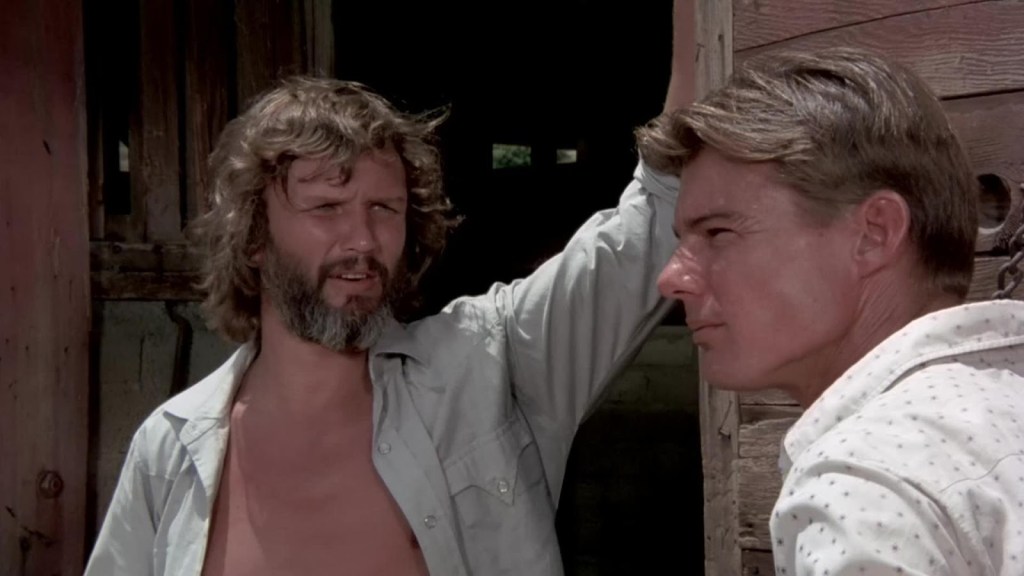
In VIGILANTE FORCE, Jan-Michael Vincent plays Ben Arnold, a guy from the small town of Elk Hills, California. It seems that the discovery of oil in the area has brought about a financial boom, but it’s also brought in a lot of rowdy out-of-towners and a surge in violent crime. Ben convinces the local community leaders to allow him to bring in his brother Aaron (Kris Kristofferson), a Vietnam war hero, to help restore order in town. Aaron assembles a group of ex-military types, friends of his, to help the local police restore order in town. Successful in cleaning out the riffraff at first, Aaron and his team of vigilantes eventually become the riffraff and use their law enforcement powers for their own corrupt, get-rich-quick schemes. Realizing that he made a horrible mistake in bringing in his brother, Ben is forced to confront Aaron and his team of murderous mercenaries in order to reclaim Elk Hills for its citizens.
I had not read anything beyond the title VIGILANTE FORCE and the basic cast list when I sat down to watch this film. I guess that’s a good thing, because I wasn’t expecting this movie to pit the brothers played by Vincent and Kristofferson against each other. I thought the two guys would be working together to get rid of a bunch of rednecks, and we do get that for the first half of the film, but when Kris goes bad, he really goes bad! And nobody is safe. This is one of those movies where he just kills whoever gets in his way, no matter how important or attractive they are. Writer-Director George Armitage, who would direct the excellent MIAMI BLUES (1990) fourteen years later, has said that he was trying to make a point about America’s involvement in the Viet Nam war with the Kristofferson character. Armitage apparently enjoys his references, as the film was made during the USA’s bicentennial year, but his two main characters are named after Benedict Arnold and Aaron Burr. While these ideas may have amused the director, his heavy-handed approach is not good for Kristofferson’s character in this film. His Viet Nam vet basically turns into an evil cartoon about halfway through the film and is no longer interesting, which is a shame because he gives a good performance.
Allegories aside, at its heart VIGILANTE FORCE is B-movie, drive-in fodder, and it’s pretty good at being that. It’s got that unpolished look and raw, energetic feel that I like in my low budget 70’s action movies. As you would expect in a film at this time, Jan-Michael Vincent is impressive and believable as the tough, good guy of the flick. Highly motivated due to the actions of our evil, out of control villain, Vincent handles the action scenes well in the film’s explosive finale. And I mean that literally, it seems that everything blows up big time at the end! Besides Kristofferson and Vincent, the film has a very recognizable supporting cast, which is one of the things I love about 70’s movies. Producer Gene Corman put together a cast that also includes Brad Dexter, Andrew Stevens, Victoria Principal, Bernadette Peters, Paul Gleason, Charles Cyphers, Loni Anderson and a host of other familiar voices and faces who add their unique talents to the proceedings. Principal, still a couple of years away from her career defining role as Pamela Ewing in the DALLAS TV series, is especially beautiful as Vincent’s girlfriend.
Overall, while VIGILANTE FORCE is not required viewing, I can definitely recommend it to anyone who likes 70’s redneck action cinema, or to fans of the main stars. I enjoyed it!
As Christmas approaches, Mortimer (Don Ameche) and Randolph Duke (Ralph Bellamy) make a bet to determine whether it’s nature or nurture that shapes someone’s future. The fabulously wealthy owners of Duke & Duke Commodity Brokers, the brothers casually frame their director, Louis Winthrope III (Dan Aykroyd), for everything from dealing drugs to sealing money to cheating on his girlfriend (Kirstin Holby). After Louis is kicked out of both his job and his mansion, the Dukes hire a street hustler named Billy Ray Valentine (Eddie Murphy) to take his place. Earlier Winthrope tried to get Valentine arrested for approaching him in the street. Now, Valentine is living in Winthrope’s mansion, with Winthrope’s butler and Winthrope’s job.
While Winthrope tries to survive on the streets with the help of a outwardly cynical but secretly kind-hearted prostitute named Ophelia (Jamie Lee Curtis, in her first non-horror starring role), Billy Ray surprises everyone by using his street smarts to become a successful, suit-wearing businessman. The Dukes, of course, have no intention of keep Billy Ray Valentine on as their director. Not only are the Dukes snobs but they’re racists as well. Once their one dollar bet has been settled, they start planning to put Billy Ray back out on the streets with Winthrope.
Trading Places was Eddie Murphy’s follow-up to 48 Hrs and he again showed himself to be a natural star while playing the type of role that could have been played by Dan Ayrkroyd’s partner, John Belushi, if not for Belushi’s early death. (Jim Belushi has a cameo as a party guest.) Murphy gets to show off a talent for physical comedy and Trading Places is one of the few films to really take advantage of Dan Aykryod’s talents as both a comedian and actor. Winthrope goes from being a coddled executive to being as streetwise as Valentine. This is probably Aykroyd’s best performance and he and Eddie Murphy make for a good team.
But the real stars of the film are four actors who weren’t really thought of as being comedic actors, Denholm Elliott, Don Ameche, Ralph Bellamy, and especially Jamie Lee Curtis. Ophelia is a much edgier character than the “final girls” that Curtis was playing in horror films and Curtis steals almost every scene that she’s in. Ameche and Bellamy are great villains and it’s fun to watch them get their comeuppance. What screwball comedy would be complete without a sarcastic butler? Denholm Elliot fills the role of Coleman perfectly.
Trading Places was a box office success when it was released and it’s now seen as being one of the new Christmas classics, a film for the adults to enjoy while the kids watch Rudolph and Frosty. I think the movie ends up going overboard towards the end with the gorilla and Dan Aykroyd wearing blackface but, for the most part part, it’s still a very funny and clever movie.
The story of D.B. Cooper has always fascinated me.
D.B. Cooper is the name assigned to a man who, in 1971, hijacked an airplane, demanded $200,000, and then jumped off the plane after he got the money. Reportedly, he was well-dressed and unfailingly polite during the entire hijacking. When he jumped off the plane, he was about 10,000 feet over the Washington wilderness. After he jumped, no further trace was found of him. Over 50 years after the incident, the identity and the location of D.B. Cooper remains a mystery.
It’s been said that, even though Cooper had a parachute with him when he jumped, there’s no way that he could have survived the jump. And yet, no body has ever been found. (Of course, finding a body in the wilderness is not as easy as some people assume.) Nine years after the the skyjacking, some of the money that Cooper received was found on the banks of the Columbia River, which was several miles away from the area that Cooper jumped over. Did Cooper survive the jump and lose the money? No one can say for sure.
Over the years, many people have come forward to say that they know the identity of D.B. Cooper. Many distant fathers and secretive boyfriends and long lost friends have been accused of being D.B. Cooper. Some of those suspects are more likely than others. Even John List, the murderer who inspired the Stepfather films, was suspected at one point.
D.B. Cooper remains a fascinating character precisely because he’s never been captured and the mystery itself will probably never be solved. Because he remains an enigma, it’s easy to project your own pet obsessions on him and his story. Myself, I always imagine D.B. Cooper as being some sort of clever, fun-loving international rogue, even though there’s not really any evidence to back that up. But, the fact of the matter is that I have a weakness for clever, fun-loving international rogues so, of course, that’s who I’m going to imagine D.B. to be.
I certainly would never imagine him to be like the character at the center of 1981’s The Pursuit of D.B. Cooper.
In this film, D.B. Cooper turns out to be Jim Meade (Treat Williams), a Vietnam vet and all around jackass who steals the money so that he can get back together with his estranged wife, Hannah (Kathryn Harrold). Hannah does take him back because, seriously, who is going to say no to that much money? Jim and Hannah spend the entire film running from one wilderness location to another. They steal cars. They steal trucks. Meade steals an airplane at one point. Hannah gets worried often and Jim tends to yell, “Woo hoo!” whenever he gets excited about anything. At one point, Jim and Hannah are chased across some white water rapids. When Hannah and Jim reach dry land, Jim gives the finger to the river. I will say that, as someone who grew up in the South, Jim is a type of character who seems very familiar to me. I’ve known a lot of Jim Meades and Treat Williams doesn’t do bad job playing Meade as being an impulsive, loud-mouthed good old boy. The only problem is that, at no point, does Jim Meade come across like someone who could have pulled off what D.B. Cooper pulled off.
Jim is being pursued by two old army buddies. The scruffier of the two is Remson (Paul Gleason), who somehow manages to keep popping up like a cartoon character at the most inopportune of times. No matter what bad thing happens to Remson, he still shows up good-as-new a few minutes later. Paul Gleason gives an energetic performance as Remson, a character who has little in common with the uptight authority figures that Gleason later played in The Breakfast Club and Die Hard.
The other person chasing Jim is Bill Gruen (Robert Duvall), who served with Meade in Vietnam but who is now working as an insurance investigator. Gruen says that he knew Meade had to be D.B. Cooper because only Meade could survive jumping out of a plane over wilderness terrain. Gruen wants some of the money for himself. Despite his greed, it’s hard not to like Gruen because he’s played by Robert Duvall. The best scene in the film is one where Duvall and Williams, exhausted from chasing each other, have a weary but friendly conversation. It’s the one moment where Williams actually calms down and provides some hint that there’s actually something going on underneath Meade’s manic exterior. Acting opposite Duvall brings out the best in him.
The Pursuit of D.B. Cooper had a notoriously troubled production and apparently, there was never a completed script during shooting. Reportedly, bits of the film were directed by Robert Mulligan, John Frankenheimer, and Buzz Kulik before Roger Spottiswoode took over. It’s a film that was obviously inspired by 70s chase films like Smokey and the Bandit but it also somehow managed to attract actors like Robert Duvall, who does his best to class up the joint. The action quickly gets repetitive and the movie never seems to know if it wants to be a comedy or a drama. On the plus side, Treat Williams and Kathryn Harrold make for a cute couple.
When this picture first came out, Universal Pictures offered a million dollar reward for any information that would lead to the capture and arrest of the real D.B. Cooper. No one collected.
Welcome to Retro Television Reviews, a feature where we review some of our favorite and least favorite shows of the past! On Mondays, I will be reviewing Miami Vice, which ran on NBC from 1984 to 1989. The entire show can be purchased on Prime!
Welcome to season 3!
Episode 3.1 “When Irish Eyes Are Crying”
(Dir by Mario DiLeo, originally aired on September 26, 1986)
The third season of Miami Vice opens with Gina saving the life of Sean Carrone (a very young Liam Neeson).
Carrone is a former commander in the IRA, a man who has lost two brothers during the Troubles and who killed his first British solider when was fourteen but who now says that he has renounced violence and is instead a believer in peace. When he gives a lecture in Miami, Gina, Zito, and Switek attend because they’ve gotten a hot tip from Izzy that an arms deal is going to occur afterwards. Instead, a teenage gunman attempts to assassinate Sean and Gina is forced to use deadly force to save Sean’s life.
Gina is put on administrative leave after the shooting, which gives her plenty of time to pursue her new romance with Sean! A jealous Crockett doesn’t trust Sean and it turns out that Crockett’s correct when it becomes apparent that Sean and his American benefactor (Paul Gleason) are looking to purchase Stinger missiles from arms dealers Max Kilzer (Walter Gotell, who played the head of the KGB in several Bond films) and Eddie Kaye (Jeff Fahey). With the dubious help of a haughty British MI6 agent (Daniel Gerroll), Crockett and Tubbs try to uncover Sean’s plans. Along the way, Tubbs gets to try out another fake accent, Crockett spends some time as Burnett without anyone noticing that Sonny Burnett looks and talks exactly like Sonny Crockett, and Eddie Kaye finds time to blow up Sonny’s beloved car.
On the plus side, this episode had a wonderful group of guest stars. When one episode finds substantial roles for Liam Neeson, Jeff Fahey, Paul Gleason, and Walter Gotell, it’s pretty good guess that the episode is going to be worth watching. All four of them give memorable performances. Liam Neeson is, of course, the star attraction here but I also enjoyed Jeff Fahey’s turn as a half-crazed bayou arms dealer who is first seen wearing a t-shirt that reads, “Kill Them All.” I also appreciated that this episode gave everyone in the cast something to do. During season 2, it was easy to forget that Gina and Trudy were even on the show.
That said, as I watched this episode, I couldn’t help but feel that it was missing the energy that made the first two seasons stand out. If the first season was tough and gritty and the second season was surreal and often shocking, the third season got off to a rather comfortable start. Don Johnson and Phillip Michael Thomas both seemed a little bit too relaxed in their roles as Crockett and Tubbs. The third season opener played out like a well-0iled machine and that was the problem. It was almost too efficient, with little of the spontaneity that ran through the previous two seasons.
It’s something that happens to every series. The first two seasons are all about experimenting and taking chances and finding the right tone. By the time the third season rolls around, the formula is in place and things can start to feel a little mechanical. That was how I felt about this episode. The supporting cast carried the drama while the main cast went through the motions. That said, the episode did what a season premiere should do. It re-introduced the viewer to the characters, it had enough violence to keep action fans happy, and it announced the show was back. We’ll see how season 3 plays out over the next few weeks.
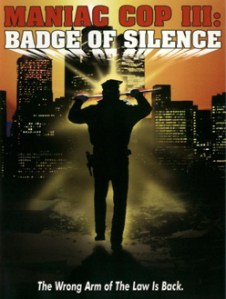
Despite finally getting his burial with honors at the end of Maniac Cop 2, Matt Cordell (Robert Z’Dar) returns for one last outing. Raised from the dead by a voodoo houngan (Julius Harris), Cordell invades a hospital to seek vengeance for a comatose policewoman named Katie Sullivan (Gretchen Baker). In a coma due to the wounds she received while thwarting a convenience store robbery, Katie is being framed by unscrupulous reporters and attorneys who claim that Katie was a bad cop who killed a clerk in cold blood. Cordell sees Katie as being a fellow victim of anti-cop bias and he is not going to let anyone treat her with disrespect, which is something that two doctors (Robert Forster and Doug Savant) are unfortunate enough to discover. Sean McKinney (Robert Davi) and Dr. Susan Lowery (Caitlin Dulany) try to figure out how to bring peace to the souls of both Cordell and Katie.
As opposed to the first two films, Maniac Cop III had a troubled production. Lustig and screenwriter Larry Cohen wanted to set the film in a Harlem hospital and bring in an African-American detective to investigate Cordell’s activities. The film’s Japanese producers insisted that Robert Davi return as the lead, even though the script’s lead character had little in common with the way Sean McKinney was portrayed in Maniac Cop 2. Larry Cohen then refused to do any rewrites on the script unless he was paid more. William Lustig filmed what he could and ended up with a 51-minute movie. Extra scenes were directed by one of the film’s producers and the film was also padded out with outtakes from Maniac Cop 2.
The film is disjointed and there’s too much time devoted to Jackie Earle Haley playing a character who has much in common Leo Rossi’s serial killer from the second film. (Haley’s performance is fine but the character feels superfluous). But the movie’s hospital setting leads to some interesting kill scenes and Z’Dar and Davi both give good performances as two different types of maniac cops. The supporting cast is full of good character actors like Haley, Forster, Savant, Julius Harris, Bobby Di Cicco, and Paul Gleason. Despite the film’s flaws, Maniac Cop III is a solid ending for the trilogy.
And, in an alternative universe, it was a Frank Sinatra movie.
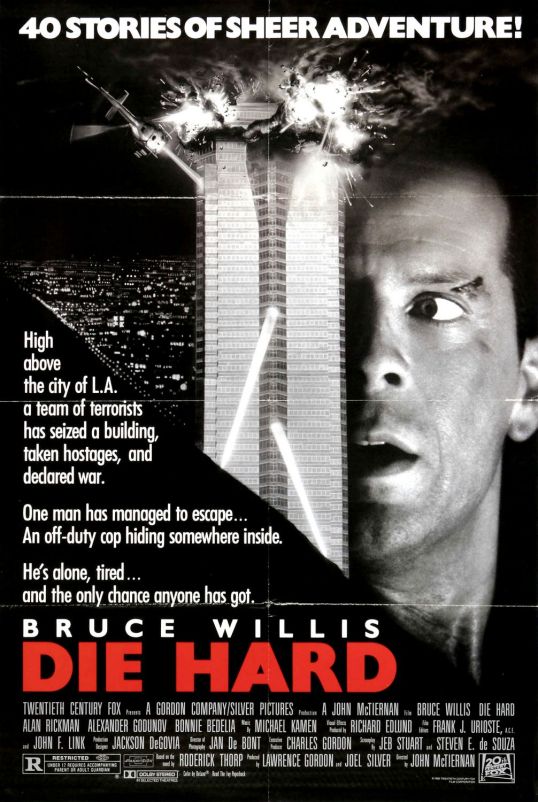
Released into theaters in 1988, Die Hard was based on a novel called Nothing Lasts Forever. Nothing Lasts Forever told roughly the same story as Die Hard, with one of the big exceptions being that the cop fighting the terrorists was not the youngish and quippy John McClane but instead was a weary, aging and retired detective named Joe Leland. Leland previously appeared in another novel called The Detective. In 1968, The Detective was turned into a film and the role of Leland was played by Frank Sinatra. As a part of his contract, Sinatra had the right to play Leland in any sequels to The Detective. When Die Hard was in pre-production, Sinatra could have demanded that the film be a Joe Leland film and that he be allowed to star in it. Fortunately, Sinatra did not do that and Joe Leland was instead transformed into John McClane. And, after the role was was turned down by Arnold Schwarzenegger, Sylvester Stallone, Clint Eastwood, Nick Nolte, Mel Gibson, Don Johnson, Harrison Ford, Burt Reynolds, Paul Newman, James Caan, Al Pacino, and Richard Dean Anderson, popular television actor Bruce Willis finally received the role.
Seriously, just consider that. Bruce Willis was not only not the first choice for John McClane but even Richard Dean Anderson was offered the role before the filmmakers finally went with Willis. It’s hard to imagine anyone else starring in Die Hard because, to most of us, Bruce Willis is John McClane. Growing up and watching Die Hard on television every Christmas, it was very easy to assume that Willis probably spent all of his spare time fighting terrorists and coming up with snarky quips. Definitely, it’s difficult to imagine Stallone and Schwarzenegger in the role. What made McClane such a compelling hero was that he wasn’t superhuman. He was just a blue collar guy who hurt his feet, got tired, and had his moments of frustration just like everyone else. He was the relatable action hero. It didn’t matter how many stories that one heard about Bruce Willis having an ego or occasionally being difficult to work with. Bruce Willis was John McClane and, after everything that McClane had been though, he had every right to occasionally be difficult.
You’ll notice that I haven’t really discussed the plot of Die Hard because …. well, everyone knows that plot. I mean, this is one of those films that has such a permanent place in pop cultural history that even people who somehow haven’t seen the film still know what it’s about. John McClane is an NYPD cop who flies to Los Angeles to see his estranged wife, Holly, for Christmas. Holly (Bonnie Bedelia) works for the Nakatomi Corporation. During the company’s Christmas party, terrorists led by Hans Gruber (Alan Rickman) take over the skyscraper. The terrorists claim to be politically-motivated but, actually, they just want to break into the building’s vault and make off with a lot of money. McClane makes his way through the unfinished skyscraper, killing the terrorists one-by-one. He only has two allies. Al Powell (Reginald VelJohnson) is an LAPD sergeant who is outside the building and who communicates with McClane via radio. Argyle (De’Veroux White) is the friendly limo driver who spends almost the entire siege oblivious in the parking garage. (The first time I ever watched Die Hard, I was so worried something bad would happen to Argyle.)
McClane has a lot of enemies and not all of them are terrorists. The Deputy Chief of the LAPD (Paul Gleason) thinks that McClane is making the situation worse. Two FBI agent, both named Johnson (and played by Robert Davi and Grand L. Bush), seem to view the entire siege as being a game with the older Johnson talking about how much it reminds him of Vietnam. A reporter (William Atherton) makes the situation worse with his on-the-spot reports. Meanwhile, there’s Harry Ellis (Hart Bochner). A coke-addled executive, Ellis actually thinks that he’s helping McClane by trying to negotiate with Gruber. I know that some people can’t stand Ellis but I always feel sorry for him. In his way, he was trying to help and you could tell that he was so proud of himself for not telling Gruber that McClane was in Los Angeles to see Holly.
Needless to say, there’s a lot of action in Die Hard. A lot of people die. One thing that I appreciate the movie is that the bad guys get as upset over their friends and family being killed as McClane gets over Holly being threatening. No one in the film is one-dimensional and even the bad guys have their own distinct personalities. Theo (Clarence Gilyard) gets so excited about the idea of opening the vault that you can’t help but relate. Karl (Alexander Godonuv) appears to be nearly indestructible. Hans Gruber may be totally evil but he has a quick wit and there’s something intriguing about how confident he is. Alan Rickman, famously, was not happy that his first role led to him being typecast as an international villain and one can’t blame him. Still, almost every action movie villain who has followed has owed something to Alan Rickman. Just as it’s difficult to imagine anyone other than Bruce Willis as John McClane, it’s impossible to imagine anyone other than Alan Rickman as Hans Gruber.
(That said, I’m sure there’s another alternate universe out there, right next to the Sinatra universe, where Blade Runner was not as troubled a production as it was and, as a result, Die Hard was made with Ridley Scott directing, Harrison Ford starring as McClane, and Rutger Hauer playing Hans.)
For all of the action, there’s also a lot of moments that make me laugh out loud and I’m not just talking about McClane’s one liners. The two FBI agents don’t get much screentime but Davi and Bush make the most of what they have. Paul Gleason is wonderfully deadpan as the clueless Chief Robinson. Even Rickman gets his share of laughs. “I read about them in Time Magazine” indeed.
Die Hard is a Christmas tradition with my family and a lot of other families as well. Does Die Hard count as a Christmas movie? I would say yes. The terrorists may not respect the holiday but John McClane does. No one ruins McClane’s Christmas!


 Through the Shattered Lens