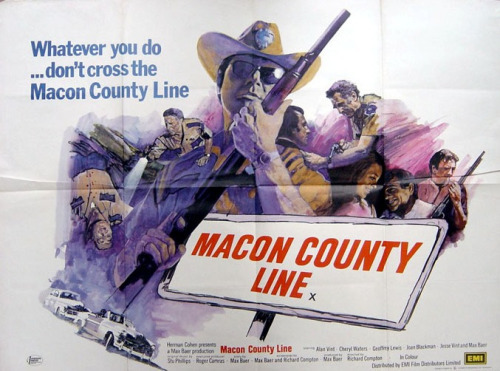
Yee-haw! Southern Fried Exploitation was box office gold during the 1970’s, a genre that usually had one or more of the following elements: race cars, moonshine, redneck sheriffs, scantily clad country girls, shotguns, and/or Burt Reynolds . One of the foremost practitioners of this art was Max Baer, namesake son of the heavyweight boxer and erstwhile Jethro Bodine of TV’s THE BEVERLY HILLBILLIES, who scored a surprise hit when he produced, wrote, and costarred in 1974’s MACON COUNTY LINE.
The story’s set in the 50’s, complete with some vintage tunes on the soundtrack (The Chords’ “Sh-Boom”, Laverne Baker’s “Jim Dandy”, Big Joe Turner’s “Corrine, Corrina”). “The story is true”, reads a pre-credits scrawl, “only the names have been changed” (Actually, the story was concocted by Baer and director Richard Compton, but what the hey…). Brothers Chris and Wayne Dixon (played by brothers Alan and Jesse Vint ) are a pair…
Eagle Lake, a mountain resort town in California, has a problem. It’s almost tourist season and there is a sniper stalking through the night, using his rifle to pick off citizens and painting messages like “The First” and “The Second” in the snow. It’s up to police chief Sam McNeill (Andy Griffith) to figure out the killer’s motives and capture him before the vacation season begins! To catch the killer, McNeill is going to have to investigate his friends and neighbors, all of whom have secrets that they don’t want to have revealed.
1974 was a busy year for Andy Griffith. Best-known for playing the folksy and reassuring Sheriff Taylor for over ten years on The Andy Griffith Show, Griffith tried to change his image by appearing in three unexpectedly dark made-to-TV movies. In Pray For The Wildcatsand Savages, Griffith played the villain. In Winter Kill, he’s back in a more familiar role. He is once again playing a lawman, though this one carries a gun and doesn’t have time to sit on his porch and play the guitar while Aunt Bea makes dinner. Instead, he’s getting pressure from all sides to capture a psycho sniper who, at the start of the movie, shoots an old woman after throwing pebbles at her bedroom window. Eventually, the sniper even ends up kidnapping Chief McNeill’s girlfriend! This never happened in Mayberry!
Winter Kill is a pretty good mystery. It’s not strictly a horror film but the sight of the masked sniper, making his way through the night and coldy gunning down unsuspecting victims is scary enough that it might as well be. Andy Griffith was surprisingly tough and gritty as Chief McNeill. He might be a good guy in this movie but you still know better than to mess with him. The rest of the cast is made up of television regulars but keep an eye out for a youngish Nick Notle playing a cocky ski instructor.
Winter Kill was actually meant to be a backdoor pilot for a show where Chief McNeill would battle crime on a weekly basis. Though that didn’t happen, the concept was later retooled and became a short-lived series called Adams of Eagle Lake.
You can’t always tell a book by its cover and that is the case with the Spirits, the nicest motorcycle gang to ever roll across America’s highways. When they come across an old couple on the side of the road with a flat tire, they don’t rob the couple. Instead, they change the tire. When they come across a young man named Chris (David Hyrly, who is overdubbed by a young Nick Nolte), they invite him to join them on their journey. When they are arrested, they sit in jail and roll a joint. The Spirits are solid dudes. But because they are rebels who live outside of straight society, they will always be picked on by the Man. After a redneck deputy rapes the Chris’s girlfriend, the deputy blames the Spirits. Soon, the Spirits find themselves under attack and are violently picked off one by one. In self-defense, the Spirits start to arm themselves. It all comes to a head in a violent confrontation in Northville Cemetery.
Made for a miniscule budget. featuring a largely amateur cast, and graphically violent, Northville Cemetery Massacre is an overlooked masterpiece, the type of movie that Sam Peckinpah would have made if he had worked on AIP biker movies instead of westerns. The Spirits are innocent and, as long as no one hassles them, peaceful but the rest of the world only sees their motorcycles and their leather jackets. The rapist deputy is one of the most evil lawmen in film history but because he wears a uniform and know the right people, he knows that he will never have to face justice. The ambiguous ending proves that the filmmaker’s had more on their mind than just cashing in one the tail end of the biker genre’s popularity. Adding to the film’s strength is a country-rock score from former Monkee Mike Nesmith and the casting of members of a real-life motorcycle club, the Scorpions. What the Scorpions may have lacked in acting ability, they made up for in authenticity.
Northville Cemetery Massacre was made in the early 70s but it wasn’t released by Cannon Films until 1976, at which point the biker genre was close to dead. Northville Cemetery Massacre provided audiences with one last chance to get their motor running, head out on the highway, and look for adventure with smoke and lightning and heavy metal thunder.
And I beheld as Scorsese remade a classic movie and, Lo, there was De Niro, decorated in india ink and speaking in tongues…
In 1991, Martin Scorsese remade the 1962 horror thriller, Cape Fear. Both versions deal with the same basic story but each tells it in a very different way. If the original Cape Fear was straightforward and to the point, Martin Scorsese’s version is so stylized that occasionally, it’s tempting to suspect that Scorsese might be parodying himself. Zoom shots, negative shots, sweeping camera movements, Scorsese’s Cape Fear is full of all of them. When a storm rolls in for the film’s operatic finale, the red clouds look as if their on fire. Hell is coming to North Carolina, the film appears to be announcing.
While the plot largely remains the same, there are a few significant changes to the characters involved:
In the first Cape Fear, Robert Mitchum’s Max Cady was an arrogant, swaggering brute. In the remake, Robert De Niro’s Cady is still an arrogant, swaggering brute but he’s now also an evangelical who is tattooed with bible verses and who speaks in tongues. Cape Fear‘s approach to Cady’s religion is so over-the-top that it almost makes Stephen King’s approach to religious characters seem subtle and nuanced. De Niro also speaks in a broad Southern accent. Occasionally, De Niro gets the accent right but most of the time, he sounds like he’s in a Vermont community theater production of Cat On A Hot Tin Roof.
In the first Cape Fear, Gregory Peck’s Sam Bowden was a lawyer who caught Max while Max was attacking a woman and who then testified against Max in court. That’s not the case with the remake’s version of Sam Bowden. Despite being played by Nick Nolte, the remake’s Sam Bowden is such a wimp that you can’t help but dislike him. His wife (Jessica Lange) doesn’t trust him. His teenage daughter (Juliette Lewis) resents him and his attempts to control her life. In this version, Sam didn’t testify against Max in court. Instead, Sam was Max’s lawyer and withheld evidence that could have secured Max’s acquittal. What Sam didn’t realize is that Max would spend his time in prison studying the law and that Max would eventually figure out what Sam did.
As in the original film, Max shows up in North Carolina and proceeds to stalk the Bowdens. Unlike Mitchum, who was all quiet menace, De Niro plays Max as being loud and obnoxious, the type who will sit in a theater, light a cigar, and intentionally laugh at the top of his lungs. Max knows enough about the law that he knows exactly what he can get away with. He poisons Sam’s dog. He rapes Sam’s associate, Lori (played, in a heart-breaking performance, by Ileana Douglas). In one of the film’s most unsettling scenes, he pretends to be the new drama teacher and toys with Sam’s daughter.
With the help of a private eye (Joe Don Baker), Sam tries to get Max out of his life. Eventually, Sam pretends to be out-of-town, all as part of a ruse to get Max to break into his house so that he can be shot in self-defense. It’s here that Nolte’s wimpy performance becomes an issue. It’s impossible not to laugh at the sight of Sam, all hunched down and desperately trying to run from room to room without being spotted through any of the windows.
To a certain extent, I suspect that were meant to see Sam as being a rather pathetic figure. Scorsese doesn’t really seem to have much sympathy for him or his dysfunctional family. If anything, the film seems to argue that Sam has been a bad lawyer, a bad husband, and a bad father and Max has been sent as a type of divine retribution. Only by defeating Max can Sam find forgiveness and hope to have the type of life that Gregory Peck enjoyed in the first movie.
Scorsese’s Cape Fear is an uneasy mishmash of styles. Is it an art film, a religious allegory, a horror film, or just a generic thriller? It doesn’t seem to be sure. Cape Fear‘s a Scorsese film so, of course, it’s always going to be worth watching. But there are times when the film definitely runs the risk of overdosing on style. Sometimes, Scorsese seems to be trying too hard to remind everyone that he’s a legitimately great director and ends up getting so invested in the film’s visuals that he runs the risk of losing the story. De Niro has some scenes in which he is genuinely chilling but then he has other scenes where he is basically just a live action cartoon character. The same can be said of the film itself. It’s always watchable. At times, it’s rather frightening. But other times, it’s just too cartoonish to be effective.
If anything, this remake proves that sometimes, it’s best to keep things simple.
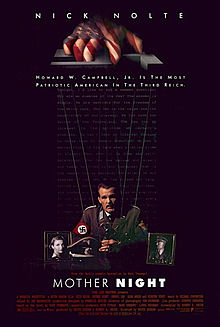
Four years after she played the mysterious (and dead) Laura Palmer in Twin Peaks, Sheryl Lee starred as another mysterious (and possibly dead) woman in Mother Night.
Lee is cast as Helga Noth, the German wife of American expatriate Harold W. Campbell (Nick Nolte). Harold is a playwright, living in Berlin and doing propaganda broadcasts for the Nazis. Working with Frank Wirtanen (John Goodman), a military intelligence officer, Campbell has developed a series of verbal tics that are meant to secretly deliver information to the Allied Forces. It is never clear whether Harold’s information serves any real purpose just as it is left ambiguous as to whether Harold believes any of the anti-Semitic propaganda that he broadcasts over the airwaves. Working as both a propagandist and a double agent, Harold serves both the Allies and the Axis.
In the final days of the war, Helga is reportedly killed on the Eastern Front and Harold is captured by the Americans. Frank arranges for Harold to be quietly sent to New York City but tells him that the government will never admit that they used him as a double agent.
Harold spends the next fifteen years living an isolated life in New York. His only friend is an elderly painter, Kraft (Alan Arkin), with whom he plays chess. Eventually, Harold opens up to the painter and talks about his past. Kraft, for his own shady reasons, reveals Harold’s identity to a group of neo-Nazis. Though Harold initially wants nothing to do with them, this changes when they reveal that they have Helga.
Or do they? Almost no one in Mother Night is who they claim or what they seem to be, especially not Harold.
Based on a novel by Kurt Vonnegut, Mother Night suffers from the same uneven quality that seems to afflict most films based on Vonnegut’s work. It is easy to go overboard when it comes to bringing Vonnegut’s unique mix of drama and satire to the screen and Mother Night does that in a few scenes, especially once Harold reaches New York. It is still an intriguing and thought-provoking film, though. Nick Nolte gives one of his best performances as Harold and Sheryl Lee does a good job in a difficult role.
The pinnacle of Vonnegut films remains George Roy Hill’s version of Slaughterhouse-Five but Mother Night is still superior to something like Alan Rudolph’s adaptation of Breakfast of Champions.
Blue Chips is a movie that will always make me think of England.
When I was a kid, I would spend every summer over in the UK. When I flew over for the summer of ’94, the in-flight movie was Blue Chips. I can still remember sitting in the back of the plane, trying to watch the movie on that tiny screen. At the time, I did not pay much attention to Blue Chips. It was about basketball, which was not something that I was interested in. It also starred Nick Nolte, who, over the years, starred in a lot of the movies that I saw while flying over the Atlantic Ocean. Try as I might, I could not understand a word that Nolte was saying. It was impossible to separate his gravely voice from the drone of the plane’s engines. I didn’t care much about Blue Chips.
Two months later, I was sitting in the back of my return flight when the flight attendant announced, “Our in-flight movie will be Blue Chips, starring Nick Nolte.” Still not caring about basketball and still unable to understand a word that Nick Nolte was saying, I sat through Blue Chips for a second time. What else was I going to do? Step outside and go for a walk?
Looking back, I can understand why Blue Chips would be shown on a plane. There’s nothing unconventional or controversial about Blue Chips. It’s not going to start any fights or leave anyone offended. Nick Nolte plays Pete Bell, a college basketball coach who, coming off of his first losing season, resorts to unethical measures to recruit three star players. Ricky Roe (Matt Nover) is a farmboy from Indiana and his racist father wants the college to buy him a new tractor. Penny Hardaway plays Butch McRae, whose mother (Alfre Woodard) wants a new house. Neon Bordeaux (Shaq!) doesn’t want anything but still gets a new Lexus. The corrupt head of the school’s booster club is named Happy and is played by J.T. Walsh. Other than Happy Gilmore, has there ever been anyone in a movie named Happy who hasn’t turned out to be bad news?
Blue Chips was directed by William Friedkin, though you’d never guess that this by the numbers movie was from the same director who did The French Connection, The Exorcist, or To Live And Die In L.A. In his autobiography, The Friedkin Connection, he devoted just a few words to Blue Chips, saying, “It’s hard to capture, in a sports film, the excitement of a real game, with its own unpredictable dramatic structure and suspense. I couldn’t overcome that.”
Friedkin’s right but I’m always happy whenever I come across Blue Chips on cable because it reminds me of that long-ago summer in England.
For tomorrow’s movie a day, it’s another sports-related film that always makes me think about Britain: Alan Clarke’s The Firm.
This is the time of year that the Shattered Lens usually takes one final look back at the best and worst of the previous year’s offerings in cinema, television, literature, and music! Last year, I kicked things off by taking a look at the best that the SyFy network had to offer.
Unfortunately, SyFy didn’t produce as many original films in 2014 as they did in 2013.
However, my beloved Lifetime network remained a consistent showcase for some of the best and worst melodrama that one could hope for.
With that in mind, here are my nominees for the best films and performances that were featured on either the SyFy or the Lifetime network last year! As always, winners are listed in bold.
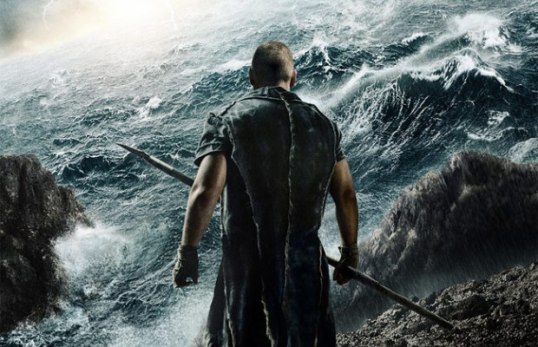
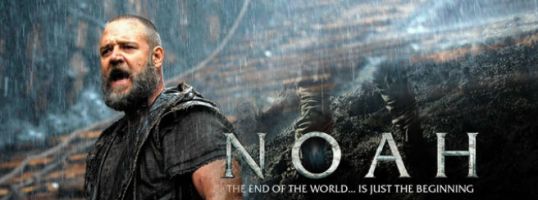
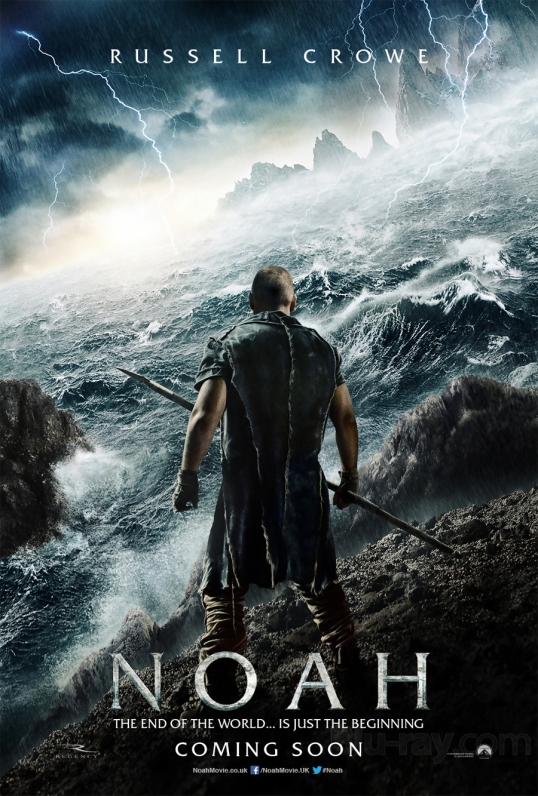
That’s a question that was first asked way back in March. At the time, the answer depended on who you asked. For instance, Noah is one of Arleigh’s favorite films of the year. My reaction, however, was far more mixed. Noah was one of those movies that I thought I would review as soon as I watched it but that proved to be a lot more difficult than I expected. As I found myself wondering what I should say in my review, it became very apparent to me that I wasn’t sure whether I liked the film or not.
By the time that I finally decided that I was, overall, disappointed by Darren Aronofsky’s controversial and spiritual-but-not-quite-biblical version of the Deluge, over a month had passed and we had all moved on to different movies.
And so that review remained unwritten. And, at first, I thought it wouldn’t matter. As much as I try to review every single movie that I see, I know that the world is not going to end if I miss a film or two. After all, I’ve never specifically written down just how much I hated the latest Transformers movie and the world has yet to plunge into the sun…
And yet, for all of its flaws and the fact that it left me feeling underwhelmed, Noah has stuck in my mind in a way that many of the films that I saw this year have not. It would be a struggle for me to remember much of anything about Dracula Untold but Noah … Noah has stayed with me.
Thinking back, it’s easy for me to say what did not work about Noah.
As opposed to Aronofsky’s best films (Requiem for A Dream, The Wrestler, and my beloved Black Swan), Noah felt oddly paced with certain scenes ending too quickly while other scenes seemed to drag on forever.
The film’s environmental message was delivered with such a heavy hand that it ultimately did not make much of a difference whether you agreed or not. For a film that went out of its way to establish itself as not being a traditional biblical film, Noah was certainly preachy.
While the film deserves credit for not flinching in its portrait of a surly and self-righteous Noah, it still doesn’t change the fact that the movie was essentially 138 minutes spent with a very unlikable character.
Anthony Hopkins gave perhaps the worst performance of his career as Methuselah. In the role of Tubal-Cain, Ray Winstone was such a one-dimensional villain that I half expected him to invent trains just so he could tie Emma Watson to the tracks.
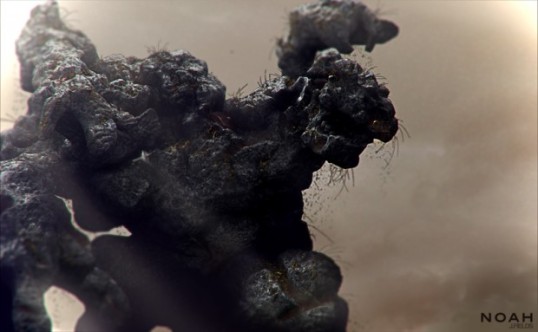
And, of course, there were the Watchers — fallen angels who had been turned into sentient piles of stone by a vengeful God. I know that some people loved the Watchers but to me, they looked ludicrous…
And yet, that’s the reason why we love Darren Aronofsky, isn’t it?
Obviously, it was a risk to portray the fallen angels as being a bunch of talking rocks. It was also a risk to take a character who is mentioned only once in the book of Genesis — in this case, Tubal-Cain — and then use that character as a representation of everything that’s wrong with the human race. It was a risk to make a “biblical” film that openly questioned both the existence and wisdom of God. We expect and demand that directors take risks but, at the same time, we also want to ridicule and judge when those risks don’t work out. That’s the issue that we, as film lovers, often face. Do we celebrate and perhaps excuse a director for his intentions or do we solely judge him based on the results?
And the thing with Noah is that, as much as the movie did not work for me, it also did work for me. For all of those flaws that I listed above, Noah is full of images that are so beautiful and so memorable that I can still visualize them as if I saw them yesterday:
Noah and his sons walk across a gray and blasted landscape, stopping just long enough to stare at a foreboding city in the distance.
Noah walks through a decadent settlement and briefly, this somber film is so full of bright colors and flamboyant characters that the viewer is almost as overwhelmed as Noah.
That Ark, looking small and isolated, floating across an endless blue ocean.
And finally, Noah talking about the horrors of humanity and briefly, we see that the shadows that he’s visualizing are dressed in modern clothing.
For all of my issues with Noah, it’s such a visually impressive film and takes so many risks that I can’t help but respect it. I don’t consider it to be a great film but, after all this time, I can say that it’s a film that only a true artist could make.
And, considering the current state of American film, that’s one of the best compliments that one can give.
Last Saturday, I watched the Lifetime premiere of The Trials of Cate McCall. (Okay, so technically I did not watch this last night. Instead, I watched it on Saturday night. However, if not for the fact that I came down with literally the world’s worst cold, I would have written this review on Sunday. Cut a girl some slack, okay?)
Why Was I Watching It?
Because it was on Lifetime, of course!
What Was It About?
What isn’t it about? Seriously, Cate McCall (Kate Beckinsale) has got a lot going on in her life.
Cate is a defense attorney. She used to be a prosecutor but then she convicted the wrong man and she dealt with her guilt by becoming an alcoholic. However, after being a few months sober and working under the watchful eye of her AA sponsor (Nick Nolte, of course), Cate is ready to take on the case of a Lacey Stubbs. Cate is convinced that Lacey was wrongly convicted of murder and she is determined to get Lacey out of a prison. Presiding over the case is Justice Sumpter (James Cromwell), who Cate had an affair with while she was a law student.
And, on top of all this, Cate is trying to get custody of her daughter and the innocent man she sent to prison wants to talk to her…
What Worked?
In the title role, Kate Beckinsale gave a great performance. Due to the film’s somewhat disjointed editing, Kate had to basically carry the entire movie on her shoulders and she proved herself to be more than up to the task.
According to the imdb, Taye Diggs played the character of Austin Moseby. However, at least in the version that was broadcast on Lifetime, there was no character named Austin Moseby and Taye Diggs was nowhere to be found. I have to admit that I’ve had a lot of fun speculating about who Austin Moseby might have been and why Taye Diggs was apparently edited out of the film. (Okay, technically, that’s not something that worked for the movie but it has worked towards keeping me amused.)
What Did Not Work?
Despite the snarky commentary that I posted on twitter while watching this film, I was really rooting for The Trials of Cate McCall. Kate Beckinsale is one of my favorite actresses, I loved courtroom dramas, and I feel that I have something of a responsibility to support films that feature complex and multi-faceted female protagonists. In other words, I so wanted The Trials of Cate McCall to be a good film.
Sadly, however, this film was never as good as I wanted it to be. Whether it was the result of postproduction meddling or just inept filmmaking, The Trials of Cate McCall ultimately ended up feeling like a random collection of scenes that never quite added up to being a compelling narrative. The film had potential but it just did not work.
Add to that, regardless of whether they were justified or not, Cate McCall’s actions towards the end of the film really should have gotten her disbarred.
“Oh my God! Just like me!” Moments
Who couldn’t relate to Cate’s struggles to balance about six hundred different things at one time?
Lessons Learned
Just because Taye Diggs is listed as being in a movie doesn’t mean that he’s actually in the movie…
Noah is Darren Aronofsky’s follow-up to his critically-acclaimed film Black Swan(which was reviewed by Lisa Marie Bowman herself) and he looks to tell the tale of Noah’s Ark from the Book of Genesis.
When news first came out that Aronofsky would follow-up Black Swan with a biblical epic that retold the Flood and Noah’s role in saving those not corrupted according to Heaven was a sort of headscratcher. The teasers and trailers that has come out about the film hasn’t really fired up the masses. Some think it as another sword-and-sandals epic that’s late to that particular subgenre’s resurgence. Some think too much fantasy elements has been added.
One thing I’m sure of is that Aronofsky will not make an uninteresting film.

 Eagle Lake, a mountain resort town in California, has a problem. It’s almost tourist season and there is a sniper stalking through the night, using his rifle to pick off citizens and painting messages like “The First” and “The Second” in the snow. It’s up to police chief Sam McNeill (Andy Griffith) to figure out the killer’s motives and capture him before the vacation season begins! To catch the killer, McNeill is going to have to investigate his friends and neighbors, all of whom have secrets that they don’t want to have revealed.
 You can’t always tell a book by its cover and that is the case with the Spirits, the nicest motorcycle gang to ever roll across America’s highways. When they come across an old couple on the side of the road with a flat tire, they don’t rob the couple. Instead, they change the tire. When they come across a young man named Chris (David Hyrly, who is overdubbed by a young Nick Nolte), they invite him to join them on their journey. When they are arrested, they sit in jail and roll a joint. The Spirits are solid dudes. But because they are rebels who live outside of straight society, they will always be picked on by the Man. After a redneck deputy rapes the Chris’s girlfriend, the deputy blames the Spirits. Soon, the Spirits find themselves under attack and are violently picked off one by one. In self-defense, the Spirits start to arm themselves. It all comes to a head in a violent confrontation in Northville Cemetery.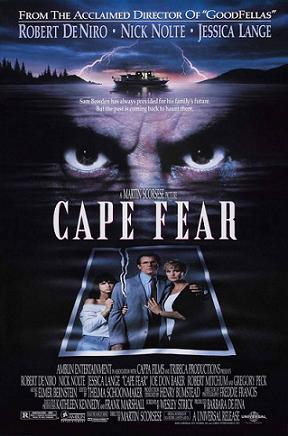
 Four years after she played the mysterious (and dead) Laura Palmer in Twin Peaks, Sheryl Lee starred as another mysterious (and possibly dead) woman in Mother Night.


 Through the Shattered Lens