An Offer You Can’t Refuse: Lepke (dir by Menahem Golan)


When it comes to reviewing mob movies, I usually describe them as either being “an offer you can refuse” or “an offer you can’t refuse.”

Usually, it’s not that difficult to decide which ranking I should use.  If the film is well-acted and if the action unfolds at a steady pace and if there’s plenty of tommy gun action and/or a stylish recreation of the Golden Age of American Gangsterism, chances are that the film will be an offer that you can’t refuse.

Now, if it’s a movie that just features a bunch of guys sitting around trying to sound tough and if it doesn’t really do much to recreate the gangster milieu and if the dialogue sounds like it was cribbed from a hundred other gangster films, it’ll probably be an offer you can refuse.

It’s simple and usually, it only takes me a few minutes to realize which description I’m going to use.  But I have to admit that I went back and forth on 1975’s Lepke.  To refuse or not to refuse, that was the question.

Lepke is a biographic film about Louis “Lepke” Buchalter, an early American gangster who came to prominence in the early days of the National Crime Syndicate.  An ally of Lucky Luciano’s, Lepke was the mastermind behind what became known, in the press, as Murder, Inc.  (Lepke himself was smart enough not to name the organization.)  If the Mob wanted someone killed, they would contact Albert Anastasia who would then contact Lepke who would then assign the job to someone else.  The actual assassin rarely knew who had actually ordered the hit and Lepke was such a feared figure that it was assumed that no one was ever going to turn informant.  Lepke was responsible for some of the most infamous gangland killings of the 20s and 30s, including the murder of Dutch Schultz.  Unfortunately, for Lepke, someone eventually did turn informant and he ended up as one of the few gangster to meet his end in the electric chair.

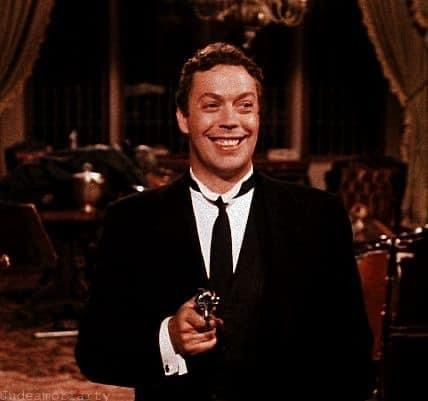
Lepke features Tony Curtis as the title character.  The film follows him from his youth as a member of a street gang to his early days with the National Crime Syndicate and eventually to his final days at Sing Sing.  Michael Callan plays Lepke’s childhood friend, who goes straight.  Gianni Russo plays Albert Anastasia while Vic Tayback plays Lucky Luciano.  Lepke’s wife, Bernice, is played by Anjanette Comer.  Though the beefy and rather loud Tayback is miscast as Luciano, the cast does a fairly good job.  Comedian Milton Berle gives a surprisingly strong performance as Lepke’s father-in-law.  There’s a great scene in which he interrogates his future son-in-law about what he’s going to get in exchange for giving away his daughter.  Curtis is convincingly tough and menacing as Lepke, who this film presents as being a working class family man whose job just happens to be killing people.  (Tony Curtis later wrote that he was on a cocaine high while filming Lepke, which perhaps explains the intensity of his performance.)

Lepke definitely holds your interest.  There’s enough mob hits and bursts of gunfire to satisfy most gang movie aficionados.  At the same time, the film’s recreation of the 20s and 30s is almost too generic and clean.  For all the tough talk and the gangland violence, there’s a definite lack of grittiness to the film’s recreation of one of the most violent eras in American history, which is why I found myself conflicted on whether to recommend it or not.  I decided that, in the end, the film does enough right to make it worth watching, even if it does still feel more like a made-for-TV crime flick than the gangster epic that so obviously aspires to be,

Historically, this film is important because it was the first American film to be directed by Menahem Golan and produced by Golan and Yoram Globus.  Four years after Lepke, Golan and Globus would purchase Cannon Films and go on to make some of the most deliriously entertaining films of all time.

January True Crime: The Versace Murder (dir by Menahem Golan)


In 1997, a 27 year-old man named Andrew Cunanan went on a killing spree, one that took him from San Diego to Miami Beach.  Though the FBI were already looking for him, Cunanan did not receive national attention until July 15th, 1997.  That was the day that Cunanan shot and killed fashion designer Gianni Versace in front of Versace’s mansion.  By that time, Cunanan had already killed at least four other people.  A week after killing Versace, Cunanan would take his own life, shooting himself on a houseboat that he had broken into.

Andrew Cunanan’s motives have remained a mystery.  It is known that at least two of the victims, Jeff Trail and David Madson, was acquainted with Cunanan.  Madson had a long-distance relationship with Cunanan that he ended a year before he was murdered.  Cunanan reportedly described Madson as being “the love of his life,” though Cunanan also apparently had a history of lying.  Whether Cunanan knew Chicago businessman Lee Miglin before killing him is a matter of some controversy.  It’s agreed that cemetery caretaker William Reese was only killed because he came across Cunanan stealing his truck.  Whether or not Cunanan had ever met Versace before in not known.  Cunanan claimed he had but, again, Cunanan had a history of lying.

In 2018, Cunanan and his crimes were the focus of the second season of Ryan Murphy’s American Crime Story.  Darren Criss won an Emmy for playing Cunanan and the series itself was critically acclaimed.  Personally, I thought the series started out strong but ran out of gas about halfway through as it became clear that Andrew Cunanan, much like the Menendez brothers, wasn’t really that interesting of a character.  Indeed, watching the show, I got the feeling that Cunanan’s main motivation was bitterness over the fact that he was essentially a fairly boring and uninteresting person.  He didn’t have much of a personality so he tried to fill that void by going after people who did.

American Crime Story may be the best-known dramatization of Cunanan’s crimes but it was hardly the first.  In 1998, less-than-a-year after Cunanan’s suicide, Menahem Golan’s The Versace Murder was released on video.  Shane Perdue played Andrew Cunanan.  A sad-eyed Franco Nero played Gianni Versace.  Steven Bauer and Renny Roker played the two FBI agents who pursued Cunanan across the country.  The film was shot in 20 days and watching it, it’s easy to see that it was a rush job.  Some scenes run too long, some scenes run too short.  Occasionally, the background music is so overwhelming that it’s a struggle to hear what anyone’s saying.  It’s definitely an exploitation film, made quickly as to capitalize on the interest in the case before everyone moved on.

And yet, it’s a strangely effective film.  A lot of that is due to the performance of Franco Nero, who doesn’t get a lot of screen time but who still makes a definite and even poignant impression as Versace.  The film’s strongest moments come towards the end, when the two FBI agents come across as a vigil being held in front of Versace’s mansion and they realize just how much Versace meant to the people of Miami Beach.  Matt Servitto and David Wolfson are also sympathetic as David Madson and Jeff Trail.  These three performances capture the tragedy of Cunanan’s crimes.  In the end, the fact that Shane Perdue is a bit bland in the role of Andrew Cunanan feels almost appropriate.  Whether it was intentional or not, Menahem Golan’s The Versace Murder reminds us that Andrew Cunanan’s victims deserve to be remembered far more than the man who killed them.

Musical Film Review: The Apple (dir by Menahem Golan)


1980’s The Apple takes place in the future!

Well, actually, it takes place in 1994.  The film imagines that, by the year 1994, the world would be a decadent, cynical, and soulless place where everyone listened to the mindless corporate music of Mr. Boogalow (Vladek Sheybal).  Really, the film’s version of the future wasn’t that far off.  It was more 2014 than 1994 but still….

Anyway, at the 1994 Worldvision Music Contest, Boogalow cheats to make sure that the latest shallow offering from BIM defeats a painfully earnest love song that is performed by Alphie (George Gilmour) and his girlfriend, Bibi (Catherine Mary Stewart).  Boogalow decides to sign Alphie and Bibi to a recording contract.  Alphie has visions of earthquakes and imagines being taken to Hell by Boogalow.  Alphie refuses to sign the contract.  Bibi, having had no such visions, signs the contract and soon, she is a part of the decadent Boogalow world.  Alphie, meanwhile, ends up living in a park with Mr. Topps (Joss Ackland) and a bunch of overage hippies.  Eventually, the Rapture occurs, largely because something had to happen to finally end this stupid movie.

The Apple was a film that I had heard a lot about before I actually sat down and watched it.  Just from what I had heard, I expected it to be bad-but-enjoyable, a disco campfest in the style of Sgt. Pepper’s Lonely Hearts Club Band In fact, I would have been happy if it had just been as silly as Skatetown USA.  Unfortunately, The Apple can’t compare to either of those two films.  The Apple may be campy but it’s also mind-numbingly dull.  It’s only has an 87 minute running time but it feels considerably longer.  With one big exception, the music is forgettable.  Catherine Mary Stewart probably gives as good a performance as could be expected under the circumstances but George Gilmour is a bland hero.  Even Vladek Sheyball, who was so memorable as the villainous chess master in From Russia With Love, makes for a forgettable bad guy.

Now, I did mention that there is one big exception when it comes to the forgettable music and that’s a song that Bibi sings after she’s signed with Boogalow and given up her soul to be a star.  The song is called Speed.  “America, the land of the free/Is shooting up with her energy/and everyday she has to take more/…. SPEEEEEED!”  Bibi performs the song on a stage while a bunch of backup dancers writhe on motorcycles and, for about three minutes, The Apple actually becomes the spectacle that it so obviously wants to be.  The song may be about drugs but it’s also about American culture.  America is a country that is on the mood.  We don’t need any of that fashionable European ennui.  We’re all about speed, which is one reason why I love this country.  At our most mellow, we still get more done in a day than the average European.  No trains for us!  We’re a motorcycle nation!

Other than that one scene, though, The Apple feels like a middle school production.  We’re told that Boogalow International Music is a decadent company but, in this film, that just means that people speak in an arch tone.  It’s a teenager’s impression of what it means to be decadent.  We’re meant to turn against BIM when its employees laugh at Alphie for being a boring straight guy.  But the fact of the matter is that Alphie is a boring straight guy and his music sucks.  The film takes a stand about corporate music but the 0nly alternative that it come up with is boring folk music.

Don’t listen to those who tell you that The Apple is so bad that it’s good.  It’s just bad.

The Eric Roberts Collection: Shakey Grounds (dir by Michael Garcia)


One of the over 30 films to feature Eric Roberts in 2025, Shakey Grounds tells the story of Travis (Eric Nelsen), a sullen and hard-drinking singer who lives in Arkansas and who is struggling to cope with the suicide of his best friend.  When recently fired record company executive Nick (Jonny Danks) shows up in Travis’s home town, it looks like it might be a chance for Travis to become a star.  But can Travis get out of his own way or is he destined to just be another angry burn-out?

I will admit that I have a weakness for low-budget films like this one and, as someone who has family in the state, I appreciate that the film took place in Arkansas and that it had a relatively positive attitude towards the Natural State.  Some of the performances are better than others.  I liked Ella Cannon’s performance as Mel and Mackenzie Ziegler did a good job as a character named Lisa (!), even though she wasn’t given a whole lot to do.  The main problem with the film was the script, which was overwritten and full exchanges of dialogue that just didn’t seem to flow naturally.  Even worse, I wasn’t really sold on Travis’s music or even Travis himself.  For the most part, he just came across as someone trying too hard to be Kurt Cobain.  His main song sounded like it was written by an AI that had been prompted to sound angsty.

As for Eric Roberts, he appears in one scene and one scene alone.  He plays the president of the record label, the one who fires Nick.  Acting from behind a desk, Eric doesn’t even stand up during his performance but he does spit out a few insults with elan.  Eric Roberts always seem to have fun playing a mean boss.  I can’t wait to see what he has in store for us in 2026!

Previous Eric Roberts Films That We Have Reviewed:

  1. Paul’s Case (1980)
  2. Star 80 (1983)
  3. Runaway Train (1985)
  4. To Heal A Nation (1988)
  5. Best of the Best (1989)
  6. Blood Red (1989)
  7. The Ambulance (1990)
  8. The Lost Capone (1990)
  9. Best of the Best II (1993)
  10. Love, Cheat, & Steal (1993)
  11. Voyage (1993)
  12. Love Is A Gun (1994)
  13. Sensation (1994)
  14. Dark Angel (1996)
  15. Doctor Who (1996)
  16. Most Wanted (1997)
  17. Mercy Streets (2000)
  18. Raptor (2001)
  19. Rough Air: Danger on Flight 534 (2001)
  20. Strange Frequency (2001)
  21. Wolves of Wall Street (2002)
  22. Border Blues (2004)
  23. Mr. Brightside (2004)
  24. Six: The Mark Unleased (2004)
  25. We Belong Together (2005)
  26. Hey You (2006)
  27. Depth Charge (2008)
  28. Amazing Racer (2009)
  29. The Chaos Experiment (2009)
  30. In The Blink of an Eye (2009)
  31. Bed & Breakfast (2010)
  32. Enemies Among Us (2010)
  33. The Expendables (2010) 
  34. Sharktopus (2010)
  35. Beyond The Trophy (2012)
  36. The Dead Want Women (2012)
  37. Deadline (2012)
  38. The Mark (2012)
  39. Miss Atomic Bomb (2012)
  40. Assault on Wall Street (2013)
  41. Bonnie And Clyde: Justified (2013)
  42. Lovelace (2013)
  43. The Mark: Redemption (2013)
  44. The Perfect Summer (2013)
  45. Revelation Road: The Beginning of the End (2013)
  46. Revelation Road 2: The Sea of Glass and Fire (2013)
  47. Self-Storage (2013)
  48. Sink Hole (2013)
  49. A Talking Cat!?! (2013)
  50. This Is Our Time (2013)
  51. Bigfoot vs DB Cooper (2014)
  52. Doc Holliday’s Revenge (2014)
  53. Inherent Vice (2014)
  54. Road to the Open (2014)
  55. Rumors of War (2014)
  56. So This Is Christmas (2014)
  57. Amityville Death House (2015)
  58. Deadly Sanctuary (2015)
  59. A Fatal Obsession (2015)
  60. Las Vegas Story (2015)
  61. Sorority Slaughterhouse (2015)
  62. Stalked By My Doctor (2015)
  63. Enemy Within (2016)
  64. Hunting Season (2016)
  65. Joker’s Poltergeist (2016)
  66. Prayer Never Fails (2016)
  67. Stalked By My Doctor: The Return (2016)
  68. The Wrong Roommate (2016)
  69. Dark Image (2017)
  70. The Demonic Dead (2017)
  71. Black Wake (2018)
  72. Frank and Ava (2018)
  73. Stalked By My Doctor: Patient’s Revenge (2018)
  74. Clinton Island (2019)
  75. A Karate Christmas Miracle (2019)
  76. Monster Island (2019)
  77. The Reliant (2019)
  78. The Savant (2019)
  79. Seven Deadly Sins (2019)
  80. Stalked By My Doctor: A Sleepwalker’s Nightmare (2019)
  81. The Wrong Mommy (2019)
  82. Exodus of a Prodigal Son (2020)
  83. Free Lunch Express (2020)
  84. Her Deadly Groom (2020)
  85. Top Gunner (2020)
  86. Deadly Nightshade (2021)
  87. The Elevator (2021)
  88. Just What The Doctor Ordered (2021)
  89. Killer Advice (2021)
  90. Megaboa (2021)
  91. Night Night (2021)
  92. The Poltergeist Diaries (2021)
  93. The Rebels of PT-218 (2021)
  94. Red Prophecies (2021)
  95. A Town Called Parable (2021)
  96. Bleach (2022)
  97. Dawn (2022)
  98. My Dinner With Eric (2022)
  99. 69 Parts (2022)
  100. The Rideshare Killer (2022)
  101. The Company We Keep (2023)
  102. D.C. Down (2023)
  103. Aftermath (2024)
  104. Bad Substitute (2024)
  105. Devil’s Knight (2024)
  106. Insane Like Me? (2024)
  107. Space Sharks (2024)
  108. The Wrong Life Coach (2024)
  109. Broken Church (2025)
  110. When It Rains In L.A. (2025)

Catching Up With The Films of 2025: The Fantastic Four: First Steps (dir by Matt Shankman)


I have to admit that I groaned when Marvel’s The Fantastic Four: First Steps opened with a title card informing me that it was taking place on “Earth-828.”

You have to understand that all of the multiverse nonsense is the one of the main things that led to me losing interest in both the Marvel and the DC films.  The idea that there are multiple Earths out there and they’ve all got different versions of the same heroes and villains just feels incredibly lazy to me.  It’s like a get out of jail free card.  If you make a bad movie, you can just claim that it was took place on another Earth.  If a character dies on one Earth, it doesn’t really matter because there’s another version out there.  What are the actual stakes when there’s a million different Earths to choose from?  For that matter, if I’m presumably living on Earth-1, why should I care about Earth-828?  Earth-828 has nothing to do with me.

Imagine my surprise, then, when one of the best things about the film was that it turned out to be that it was taking place on an alternate Earth, one that mixes the culture of the 1960s with advanced technology and a retro-futuristic style.  This is a rare Marvel film that is enjoyable just to look at.  The production design is top-notch, mixing the past with the future in a very playful way.  As much as I dislike the whole multiverse thing, Earth-828 does seem like it would be a fun place to visit.

Earth-828 has advanced technology because of its only team of super heroes, the Fantastic Four.  Fortunately, Marvel seems to understand that 1) origin stories tend to be bland in general and 2) viewers have already had to sit through two disappointing and presumably unrelated Fantastic Four films that centered around them getting their powers.  So, First Steps opens with the team having already taken their trip into space, the one that led to them returning with altered DNA.  Reed Richards (Pedro Pascal) can stretch himself.  His wife, Susan Storm Richards (Vanessa Kirby), can turn invisible and knock things around with …. invisibility rays, I guess.  Susan’s brother, Johnny (Joseph Quinn), can burst into flame and fly.  (Wow, DNA is amazing!)  And their friend, Ben Grimm (Ebon Moss-Bachrach), has skin that has been transformed into a layer of orange rock.  Ben can knock holes in walls but he can’t seem to get the world to understand that there is an intelligent and kind-hearted soul underneath the fearsome exterior.  The citizens of Earth-828 are worshipful of the Fantastic Four and the team has ushered in an era of peace.

When a naked silver woman on a surfboard (Julia Garner) appears in Times Square, she announces that Earth has been selected as the latest feast for Galactus (Ralph Ineson), a giant creature who is so powerful that he must consume planets in order to satisfy his appetite.  Galactus offers to spare Earth but only if he is given Reed and Susan’s baby, Franklin.  Galactus says that Franklin possesses the “power cosmic,” which is something that I assume we’re going to be hearing a lot about over the next few MCU films.

As far as later phase Marvel productions are concerned, The Fantastic Four: First Steps is an entertaining-enough film.  Vanessa Kirby is a bit on the dull side as Sue but it should be noted that, in all of the various film versions of The Fantastic Four, Sue has always been the least interesting member of the group.  Pascal is likable as Reed, even if his stretchy superpower feels a bit silly.  Ebon Moss-Bachrach and Joseph Quinn both give strong performances, with Quinn especially bringing some depth to a character who, in lesser hands, could come across as being shallow.  Ralph Ineson is a properly intimidating villain and Julia Garner has just the right amount of sad-eyed intensity for the role of the morally ambiguous Silver Surfer.  The film looks great, the retro style holds the viewer’s attention, and there are a few moments of genuine wit that harken back to the best moments of the 1st phase of the MCU.  That said, it’s hard to ignore that this is yet another Marvel movie where the whole thing ends with a fairly predictable battle and a healthy dose of Dues Ex Machina.  The film is entertaining but it definitely sticks to the established MCU formula.

The film ends with a mid-credits scene and a promise that the story will continue in Avengers: Doomsday.  I wonder what Earth that one will take place on.

The TSL Grindhouse: Record City (dir by Dennis Steinmetz)


1977’s Record City opens with a montage of rear-focused close-ups of women wearing short shorts and that pretty much tells you all that you really need to know about the film.  It’s crass, shameless, and very much a product of its time.

The film takes place over the course of one day at a California vinyl record shop.  It’s tempting to compare the film to something like Empire Records but, unlike Empire Records, Record City suggests that working in a record store is perhaps the worst thing that could ever happen to anyone.  The store is dirty and grimy.  The customers are rude and played by vaguely familiar comedy actors, all of whom seem to have been bitten by the overacting bug before stepping in front of the camera.  The employees all seem to hate each other.  Marty (Tim Thomerson) keeps getting slapped and kicked by Vivian (Deborah White).  Vivian keeps getting groped by almost every customer and employee who walks by her.  The only thing that Vivian hates more than men is other women.  The store’s owner (Jack Carter) is in trouble with the mob.  The store’s manager (Michael Callan) is lech who wears gold chains, keeps his shirt unbuttoned, and who expects the new cashier, Lorraine (Wendy Schaal), to sleep with him because, after all, he did hire her.  Danny (Dennis Bowen) is the shy guy with a crush on Lorraine.  Rupert (Stuart Goetz) is the nerdy virgin who goes from wearing a bowtie to dressing like a swinger but he still can’t get laid.  Both the customers and the employees are paranoid about “fairies” coming into Record City.  Pokey (Ed Begley, Jr.) wants to hold the place up and who can blame him?  Really, the only likable employee is a black man known only as The Wiz and that’s just because he’s played by Ted Lange.  (Yes, Isaac the Bartender from The Love Boat.)  Lange gets to perform a song at the end of the film.

When the film isn’t focused on the antics inside Record City, it’s all about the talent show that’s taking place in a nearby parking lot.  The talent show is hosted by radio DJ Gordon Kong (Rick Dees) and it gives the film an excuse to trot out a bunch of cameos, some of whom are more recognizable than others.  For instance, Gallagher — the comedian with the sledgehammer — shows up.  Kinky Friedman also shows up, playing himself and looking for records at Record City.  When he spots a woman with a blonde bowl cut and glasses, he accuses her of being John Denver and then grabs her breasts.  And to think — less  than 30 years later, Kinky Friedman would run for governor of my homestate.

Anyway, this is a terrible and rather boring movie but I did find it interesting for one reason.  It’s the reason why I find so many grindhouse films to be interesting.  Shot on location and for no other reason than to make money, Record City is a true product of its time.  There’s no attempt to try to make the 70s look nicer than they were.  There’s no attempt to try to make the record store look like anything more than a tacky establishment.  There’s an honesty to how low-rent the whole thing is.  Watching the movie is like stepping into a time machine and getting a chance to experience the past firsthand.  I was born long after the 70s but, after watching this film, I now feel like I’ve been there.

Film Review: The Final Countdown (dir by Don Taylor)


1980’s The Final Countdown opens with a series of stunning overhead shots of Pearl Harbor.  Warren Lasky (Martin Sheen), a systems analyst for Tideman Industries, is sent by his mysterious employer to observe operations on the USS Nimitz.  Captain Yelland (Kirk Douglas), the commanding officer of the Nimitz, is polite to Lasky, even if he doesn’t quite understand why he’s been sent.  For that matter, Lasky’s not sure what he’s supposed to do either.  When the Nimitz is surrounded by a sudden storm and programs from 1941 start playing over the radio, Yelland suspects that it’s some sort of test and that Lasky has been sent to see how they react.  However, when two Japanese airplanes are spotted overhead, it becomes clear that the Nimitz has somehow traveled through time.  The date is December 6th, 1941 and, in just 24 hours, the Japanese are going to attack Pearl Harbor.

Commander Dick Owens (James Farentino) argues that it would be dangerous to try to change history by attacking the approaching Japanese fleet.  However, it appears that the Nimitz has already changed history by saving the life of U.S. Senator Samuel Chapman (Charles Durning), who Owens believes would have been Roosevelt’s running mate in 1944 if he hadn’t been killed the day before Pearl Harbor.  With Chapman demanding that Pearl Harbor be warned and Lasky arguing that the Nimitz should try to change history by preventing the attack, Captain Yelland has a decision to make.

The Final Countdown was made with the full support of the U.S. Navy.  The production was allowed to film on the Nimitz and, outside of the main stars, the crew of the Nimitz played themselves.  As a result, there’s a lot of awkward line deliveries amongst the minor characters but there’s also an authenticity to the film that elevates the story.  Even when it becomes obvious that the Nimitz has traveled back to 1941, the crew handles things in a professional manner.  One comes into the film expecting a good deal of panic and freaking out and instead, the movie offers up a ship of people who play it cool and who get the job done and it’s kind of nice to see.  As for the professional actors, they all play their parts well enough.  Charles Durning gets to bluster a bit as the senator and Katharine Ross (playing the senator’s secretary) looks like she’d rather be anywhere but on a aircraft carrier but Kirk Douglas, Martin Sheen, James Farentino, and Ron O’Neal all give solid, if not particularly memorable, performances.

The film asks an interesting question.  Would you change history?  For that matter, can history actually be changed?  If the Nimitz prevented the attack on Pearl Harbor, would it have changed history for the better (as Lasky suggests) or would it have just kept America out of the war for a longer period of time?  Would Japan have given up its plans to attack America or would its leaders have tried again?  On a personal note, I’ve been to Pearl Harbor and it’s a moving experience.  It’s hard not to look down at the remains of the USS Arizona and not feel something.  I remember that, when I looked down at the Arizona, the first thing that I felt was anger that a ship that was sunk in an unprovoked attack also served as the tomb so many men who served their country.  But then I felt a certain pride in the fact that, in the 1940s, America didn’t take that attack lying down.  America didn’t make excuses or surrender.  America stood for itself and kicked some ass and the world was and is better for it.

As for The Final Countdown, Don Taylor’s direction is fairly stolid (Taylor was no visual stylist) and there’s never really any explanation as to why the Nimitz went into the past in the first place.  That said, I enjoyed the film.  The premise is an intriguing one and the final twist works far better than one might expect.  The Final Countdown is a good film that gets the job done.

Film Review: The Cassandra Crossing (dir by George Pan Cosmatos)


1976’s The Cassandra Crossing opens with a shot of the headquarters of the World Health Organization in Geneva, Switzerland.  Though the film (and the shot) may be from the 70s, one look at the ugly brutalism of the WHO’s headquarters is all it takes to understand the mentality that, nearly 50 years later, would lead to the organization serving as China’s mouthpiece during the COVID pandemic.

Three Swedish terrorists attack the American mission at the WHO.  One of them is killed by a guard.  Another immediately falls victims to an unidentified disease that is apparently a new form of the Bubonic plague.  The third (Lou Castel) escapes and boards a train that is heading for Sweden.  Two Americans, Col. MacKenzie (Burt Lancaster) and Major Stack (John Phillip Law), and Swedish doctor Elena Stadner (Ingrid Thulin), try to figure out how to stop the spread of the infection.

While the infected terrorist lurches around the train, the passengers go through their own personal dramas.  Renowned neurologist Jonathan Chamberlain (Richard Harris) flirts with his ex-wife, writer Jennifer Rispoli (Sophia Loren).  Wealthy Nicole Dressler (Ava Gardner, whose voice sounds like a cigarette ad) boards the train with her heroin-addicted younger boyfriend, Robby Navarro (a long-haired, dark glasses-wearing Martin Sheen, acting up a storm and apparently having a lot of fun for once).  Herman Kaplan (Lee Strasberg) is a regular on the train, a Holocaust survivor who enjoys a good chess game with the conductor, Max (Lionel Stander).  Haley (OJ Simpson) is a narcotics agent who is disguised as a priest.  Susan (Ann Turkel) is the hippie who just wants to have sex with her boyfriend (Ray Lovelock) but who keeps getting interrupted by other passengers.  When she complains about already having had to already deal with one “sweaty pervert” during the day, Chamberlain replies, “Which sweaty pervert?”  By this point, Chamberlain knows about the infected man and is trying to track him down before he can infect anyone else on the train.

The Cassandra Crossing is several films in one.  It’s an all-star disaster film.  It’s medical thriller.  Once Col. MacKenzie decides that the best way to deal with the train (and to cover-up the fact that America was researching germ warfare) would be to send the train over the infamous Cassandra Crossing, an unstable bridge that is on the verge of collapse, it becomes a conspiracy thriller.  It’s all a bit ludicrous, though in this post-pandemic age, there is definitely a renewed power to the images of Hazmat suit-wearing soldiers carrying submachine guns and threatening to kill anyone who resists going into quarantine.  When it comes to films that make Hazmat suits look menacing, The Cassandra Crossing can proudly stand with George Romero’s The Crazies and Zombi 3.

Of course, with any disaster film, the real purpose of the movie is to gather together a collection of familiar faces and then allow the viewer to spend two hours trying to guess who will survive and who will not.  The cast is full of actors who all probably deserved a better script.  Richard Harris, Burt Lancaster, and Ingrid Thulin all look somewhat embarrassed.  Ava Gardner and Martin Sheen fully embrace the melodrama.  In fact, it’s hard for me to think of any other movie where Sheen actually seemed to be having as much fun as he does while playing the drug-addicted, prone-to-histrionics mountain climber in The Cassandra Crossing.  As was typical of his film career, O.J. Simpson gives a very earnest performance.  He’s not exactly good but it’s obvious that he’s trying really hard and it would make him likable if not for the fact that he’s O.J. Simpson, just 20 years away from getting away with murder.  Out of the ensemble cast, Lionel Stander, Lee Strasberg, and Sophia Loren are the one who probably come the closest to actually giving good performances.  Loren’s husband, Carlo Ponti, produced the film with Sir Lew Grade and Loren gives a performance that is blessed with the confidence of knowing her career had survived far worse than The Cassandra Crossing.

The Cassandra Crossing is the epitome of a film that’s not necessarily good but which is definitely entertaining.  Between the drama-stuffed plot and the overwritten dialogue and the performances of Gardner and Sheen, it’s campy in the way that only an overproduced 70s disaster film can be.  For certain viewers, there’s undoubtedly a lot of joy to be found in the scenes in which the passengers finally start to stand up to the authoritarians trying to force them into quarantine.  That said, this is one of those films where we’re not meant to get particularly upset about hundreds of innocent people dying just because the main characters managed to come through unscathed.  The film’s ending is right up there with Man of Steel as far as needless destruction is concerned.  Fortunately, the ending also features some terrible miniature shots, all of which remind us not to take it all too seriously.

To paraphrase another 70s film: “Forget it, Jake.  It’s The Cassandra Crossing.

Film Review: The Concorde …. Airport ’79 (dir by David Lowell Rich)


In 1979’s The Concorde …. Airport ’79, Joe Patroni (George Kennedy) finally gets to fly the plane.

The plane is question is a Concorde, a supersonic airliner that can travel faster than the speed of sound.  When we first see the Concorde, it’s narrowly avoiding a bunch of dumbass hippies in a hot air balloon as it lands in Washington, D.C.  The recently widowed Joe Patroni joins a flight crew that includes neurotic Peter O’Neill (David Warner), who says that he has dreams in which he’s eaten by a banana, and suave co-pilot Paul Metrand (Alain Delon).  Because this is an Airport film, Mertrand is dating the head flight attendant, Isabelle (Syliva Kristel).  “You pilots are such men,” Isabelle says.  “It ain’t called a cockpit for nothing, honey,” Patroni replies.

(One thing that is not explained is just how exactly Joe Patroni has gone from being a chief technician in the first film to an airline executive in the second to a “liaison” in the third and finally to a pilot in the fourth.)

The Concorde is flying to Moscow with a stop-over in Paris.  There’s the usual collection of passengers, all of whom have their own barely-explored dramas.  Cicely Tyson plays a woman who is transporting a heart for a transplant.  She gets maybe four or five lines.  Eddie Albert is the owner of the airline and he’s traveling with his fourth wife.  (Of course, he’s old friends with Patroni.)  John Davidson is an American reporter who is in love with a Russian gymnast (Andrea Marcovicci).  Avery Schrieber is traveling with his deaf daughter.  Monica Lewis plays a former jazz great who will be performing at the Moscow Jazz Festival.  Jimmie Walker is her weed-smoking saxophonist.  Charo shows up as herself and gets kicked off the plane before it takes off.

The most important of the passengers is Maggie Whelan (Susan Blakely), a journalist who has evidence that her boyfriend, Kevin Harrison (Robert Wagner), is an arms trafficker.  Harrison is determined to prevent that evidence from being released so he programs a surface-to-air missile to chase the Concorde.  Patroni is able to do some swift maneuvers in order to avoid the missile, which means that we get multiple shots of passengers being tossed forward, backwards, and occasionally hanging upside down as Patroni flips over the plane.  Oddly no one really gets upset at Patroni about any of this and no one seems to be terribly worried about the fact that someone is obviously trying blow up their plane.  Even after the stop-over in Paris, everyone gets back on the Concorde!  That includes Maggie, who could have saved everyone a lot of trouble by just holding a press conference as soon as the plane landed in Paris.

A year after The Concorde came out, Airplane! pretty much ended the disaster genre.  However, even if Airplane! had never been released, I imagine The Concorde would have still been the final Airport film.  Everything about the film feels like the end of the line, from the terrible special effects to the nonsensical script to the Charo cameo and Martha Raye’s performance as a passenger with a weak bladder.  The first Airport film was an old-fashioned studio film standing defiant against the “New Hollywood.”  The second Airport film was a camp spectacular.  The third Airport film was an example of changing times.  The fourth Airport film is just silly.

And, really, that’s the main pleasure to be found in The Concorde.  It’s such an overwhelmingly silly film that it’s hard to look away from it.  For all of its weaknesses, The Concorde will always be remembered as the film that featured George Kennedy opening the cockpit window — while in flight — and shooting a flare gun at another plane.  As crazy as that scene is, just wait for the follow-up where Kennedy accidentally fires a second flare in the cockpit.  “Put that out,” Alain Delon says while David Warner grabs a fire extinguisher.  It’s a silly moment that it also, in its way, a great moment.

The Concorde brings the Airport franchise to a close.  At least George Kennedy finally got to fly a plane.

Film Review: Airport ’77 (dir by Jerry Jameson)


Airport ’77 is the one where the plane ends up underwater.

If the first two Airport movies emphasized the competence of the the crew in both the airplane and the airport, Airport ’77 takes the opposite approach.  The first of the Airport films to be released after Watergate, Airport ’77 is a cynical film where no one seems to be particularly good at his or her job.  Viewers should be concerned the minute they see that Jack Lemmon is playing Captain Don Gallagher, the pilot of the soon-to-be-submerged airplane.  As opposed to Charlton Heston or even the first film’s Dean Martin, Jack Lemmon was always a very emotional actor.  He excelled at playing characters who were frustrated with modern life.  Just as with Heston and Martin, Lennon plays a pilot who is having an affair with a flight attendant.  The big difference is that, this time, the pilot is the one who desperately wants to get married while the flight attendant (played by Brenda Vacarro) is the one who doesn’t want to get tied down.  As an actor, Lemmon didn’t have the arrogance of a Heston or the unflappability of Dean Martin.  Instead, Jack Lemmon was the epitome of midlife ennui.  He’s disillusioned and he’s beaten down.  He’s America at the tail end of the 70s.

Another sign that Airport ’77 is a product of the post-Watergate era is the character of co-pilot Bob Chambers (Robert Foxworth).  Chambers might seem like a nice and friendly professional but actually, he’s the one who comes up with the plan to knock out all of the passengers with sleeping gas and fly the plane into the Bermuda Triangle so that his partners-in-crime can steal the valuable art works in the cargo hold.  Chambers plans is to land the plane on an unchartered isle so that he and Banker (Monte Markham) can make their escape before the rest of the people on the plane even wake up.  Instead, Chambers turns out to be as incompetent a pilot as he is a criminal.  He crashes the plane into the ocean, where it promptly sinks to the bottom.  The impact wakes up the passengers, all of whom can only watch in horror as the ocean envelopes their plane.  With the water pressure threatening to crush the plane, Captain Gallagher and engineer Stan Buchek (Darren McGavin) try to figure out how to get everyone to the surface.

As usual, the passengers are played by a collection of familiar faces.  Olivia de Havilland and Joseph Cotten play former lovers who are reunited on the flight.  Christopher Lee is a businessman who is unhappily married to alcoholic Lee Grant.  Grant is having an affair with Lee’s business partner, Gil Gerard.  A young Kathleen Quinlan plays the girlfriend of blind pianist Tom Sullivan.  Robert Hooks is the bartender who ends up with a severely broken leg.  As the veterinarian who is called to doctor’s duty, M. Emmet Walsh gives the best performance in the film, if just because he’s one of the few characters who really gets to surprise us.  Actors like George Furth, Michael Pataki, and Tom Rosqui all wander around in the background, though I dare anyone watching to actually remember the names of the characters that they’re playing.  Airport ’77 has the largest number of fatalities of any of the Airport films, largely because even the good guys aren’t really sure about how to reach the surface.

George Kennedy returns as Joe Patroni, though his role is considerably smaller in this film than it was in the first two.   He shares most of his scenes with James Stewart, who plays the owner of the plane.  Fortunately, neither Stewart nor Kennedy were on the plane when it crashed.  Instead, they spend most of the movie in a control room, getting updates about the search.  They don’t get to do much in the film but it’s impossible not to smile whenever Jimmy Stewart is onscreen, even if he is noticeably frail.

Airport ’77 is the best-made of all of the Airport films.  The crash is well-directed and the scenes of water dripping into the plane are properly ominous.  There’s not much depth to the characters but Jack Lemmon and Darren McGavin are likable as the two main heroes and Christopher Lee seems to be enjoying himself in a change-of-pace role.  Olivia de Havilland and Joseph Cotten, two old pros, are wonderful together.  That said, Airport ’77 is never as much fun as the first two films.  Even with the plane underwater, it can’t match the spectacle of Karen Black having to fly a plane until Charlton Heston can be lowered into the cockpit.