Before The New One Comes Out — “Before Sunrise”


1995-before-sunrise-poster1


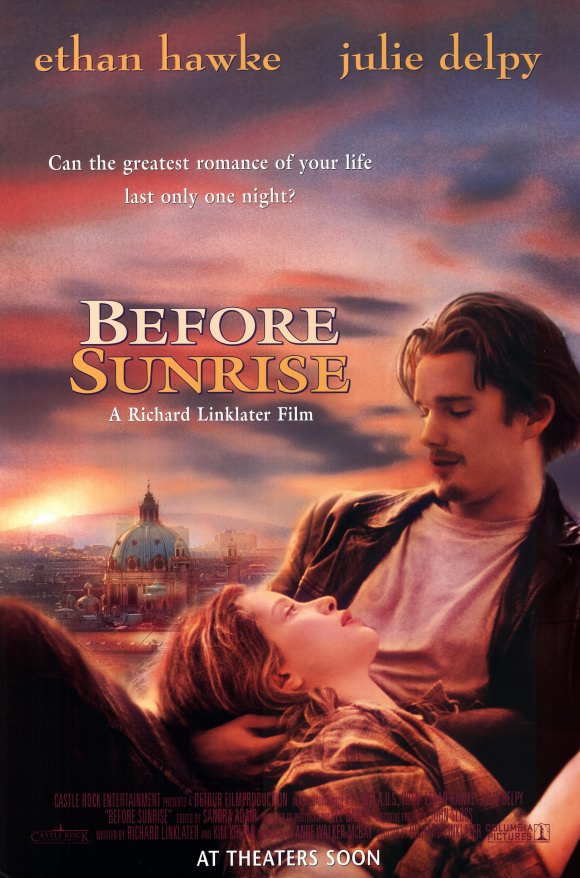
Folks who only “know” me from my online and (occasional — in fact, too occasional for my tastes, but that’s another matter for another time) print writing are probably going to be surprised by what I’m about to admit : the summer movie I’m most looking forward to here in 2013 isn’t Man Of Steel or Star Trek Into Darkness or Iron Man 3 or The Lone Ranger or any of that. Nope, friends, the one I absolutely can’t wait for — hell, pathetic as it sounds, the one I feel, at this point, that I’m flat-out living for is Before Midnight, the third collaboration between Richard Linklater, Julie Delpy, and Ethan Hawke that marks their next — and hopefully not last — look into the lives of my personal favorite couple in cinematic history, Jesse and Celine.

How much do I love these flicks? So much that I’m setting myself an arbitrary 1,000-word limit on my reviews of the first two so that I literally have to force myself not to spend all night writing about them. Say what you will for the likes of Pulp Fiction, Reservoir Dogs, or Linklater’s own Slacker or Dazed And Confused, but for me the first two Before films are the celluloid touchstone for so-called “Generation X”-types like myself, and are probably, I would imagine,  pretty damn engrossing for other audiences — both older and younger — as well.

Once you’ve seen the second, it’s fairly well impossible to look at the first through anything but the prism of what comes after, so pretending like I can take Before Sunrise on its own merits is an exercise in futility. Let’s not even go there, then. And let’s avoid the whole question of which is the “better” of the two, as well, since they’re inextricably linked and those of us who know ’em and love ’em wouldn’t have it any other way. Let’s just agree right here and know that we’re looking at them one at a time only because they came out one at a time, and let that be the end of it.

And while we’re at it, I might as well state for the record that I can’t look back at Before Sunrise without some kind of warm nostalgic glow that, I’m certain, warps my overall view of the film itself and colors everything about it with a far more rosy tint than it’s earned.

Or wait. Maybe it has earned it. In fact,  maybe the reason 1995 stands out as a great fucking year in my life is precisely because that’s when this movie came out. It would make sense. It’s not like there are a tremendous number of overly specific memories that flood my mind when you say “1995.”  I was living in an apartment I shared with a buddy of mine since high school, I worked a couple of dead-end gigs, I had a girlfriend that I had a semi-rocky but mostly just dull and listless relationship with — the usual stuff. But I did party a lot and have a ton of fun and found myself tenuously taking the first steps into what would eventually become — yawn! — “responsible adulthood” along with a good group of friends who were going through the same shit at the same time, some of whom I’m fortunate enough to still be “tight” with to this day.

Damn, we could talk about anything. And one thing we talked a lot about was Before Sunrise. How Ethan Hawke was so much more human than he’d seemed in anything else. How Julie Delpy was just fucking luminous in every frame. How the dialogue was so real and immediate and free-form and authentic.

Truth? I think these were people we wanted to be having a night we all wanted to have. Most of us probably didn’t catch the numerous Ulysses references dropped as Jesse and Celine made their way through the streets of Vienna, most of us didn’t know enough about film yet to really appreciate the spot-on choices Linklater made with his camera at every turn, and most of us couldn’t yet directly relate to the intense and abiding love these two developed over the course of one (goddamnit, I’ll say it) magical evening — we just knew this was what we wanted life, and love, to be like.

And I think we all still do. We’ve probably all been lucky enough to feel that same sense of unfolding wonderment at the discovery of another person in our lives — I know I have and I was smart enough to marry the girl — but it didn’t happen in Vienna, on a compressed time frame, and we were all probably a lot more clumsy about it. So hey — here’s to movie magic.

It’s kinda hard to believe that just a couple years prior to this, Hawke was starring in a flick called Reality Bites, because Before Sunrise is, at the end of the day, a story about how reality doesn’t “bite” at all, but about how amazing, wonderful, and almost unbearably perfect life can be, even if it’s only for all-too-brief moments here and there. Linklater and co-writer Kim Krizan delivered a crackerjack script, to be sure, but the best and most important line they gave us — even if it’s a cliche — is when Delpy’s Celine informs us of her belief that “if there’s a God, it’s not in you, or me, but right here — in the space between us,” because for all it’s amazing dialogue, naturalist acting, and pitch-perfect characterization, it’s in observing that space between our two young lovers that the real enchantment in this work lies.

When the two finally part company at the end, it really does rip your heart out — especially knowing what’s in store for them nine years down the road — but I have to admit, before I ever even heard that the first sequel was in the offing, my reaction to the way this one wrapped up was always the same — “Jesse, you schmuck, don’t get on that train, drop everything and tell this girl you want to love her for the rest of your life starting right now and let the chips fall where they may!” I spent the following years imagining that they must have met again in Vienna six months down the road precisely as they’d planned because, frankly, I just couldn’t bear to picture any other possible outcome — if any couple ever deserved to live “happily ever after,” it was this one.

Nearly 20 years (!) and God-knows-how-many viewings later, I still believe that. Even before knowing what happened next (but not yet knowing what happens after that one — folks in New York, LA, and Austin who have already gotten to see Before Midnight, know that I am well and truly envious) this simple, uncomplicated story, where nothing happens but everything happens — a story laced with a kind of, for lack of a better term, “active nostalgia,” that takes you right back to where you were in life when you first saw it but reveals new things each time that can only come from being certainly older and hopefully wiser — was enough to make me fall in love with love in a richer and more rewarding way than I had ever considered previously and to want the spontaneous joy of getting to know another person and what makes them tick that these two shared to never, ever, in a million billion years, end. Not for them, not for me, not for any of us.

Now I’m getting sappy. Or maybe I started out sappy right from the get-go here and have gotten progressively worse about it to the point where I just can’t ignore it any more.  And that 1,000 word limit? Guess I fucked that up. But ya know, I don’t care — I’m just happy right now. Happy to live in a world where stories like this are even possible. Happy to have a front-row seat to perhaps the greatest intermittent two-person character drama anybody’s ever come up with. And happy to share my thoughts on a movie that’s meant so much to me with you good people reading this. If you ain’t got a love like this, friends, I wish you nothing but the very best in finding it. And if you’ve got it, never take it for granted and never let it go. This. Is. What. Life’s. All. About.

 

Is It Too Late To Hate On Movie 43?


Originally,  I wasn’t planning on ever seeing Movie 43.

Remember Movie 43?  That’s the comedy with the huge ensemble cast that came out in January and stayed in theaters for about a week.  The trailers looked terrible, the commercials looked terrible, and finally, the reviews were terrible.  In fact, the reviews were so terrible (Richard Roeper called it the Citizen Kane of bad movies) that, at first, I was perfectly content never to see it.

However, as time passed, I continually heard Movie 43 referred to as being one of the worst films ever made.  Every 12 months, I post my picks for the 26 worst films of the year and I knew that Movie 43 was one of those films that would either appear on that list or, if it didn’t, I would have to be willing to defend the title’s absence.

I realized that before I could either defend or condemn, I would have to sit through the movie.  After all, I figured, it’s only 90 minutes of my life.

90 minutes that I’ll never get back, I might add.

Movie 43 is an anthology film in which 13 separate comedic sketches are loosely linked together by one overarching story.  For the most part, this is a film that was presumably made both for adolescent boys and for men who still think like adolescent boys.  Most of the humor is derived from bodily functions and there’s a real strain of misogyny running through the entire film.  However, the film’s problem is not that it’s crude and misogynistic but that it manages to be so dull about being crude and misogynistic.  If you think its hilarious when Meg is insulted on Family Guy or when Seth McFarlane smirks after making an anti-Semitic comment, you might enjoy Movie 43 but the rest of us are going to find far less to enjoy.

Oddly enough, there are actually two different versions of Movie 43 in circulation.  In the version that was released in U.S. theaters, the various vignettes are tied together by a story in which an insane director (Dennis Quaid) pitches scene after scene to a callous movie executive (Greg Kinnear).  In the version that was released in the UK, they’re linked together by a story about 3 teenagers searching for the most offensive film ever made.  To be honest, both versions are pretty stupid but I prefer the one about the 3 teenagers, if just because that way I can pretend that neither Dennis Quaid nor Greg Kinnear had anything to do with this movie.

As for the sketches themselves, there’s 13 of them and they are a mixed bag as far as both humor and quality are concerned:

1)      The Catch (dir by Peter Farrelly)

Kate Winslet and Hugh Jackman go on a blind date.  Jackman has testicles hanging from his neck and only Winslet thinks this is an odd thing.  This skit goes on forever.

2)      Homeschooled (dir by Will Graham)

Liev Schreiber and Naomi Watts explain how they’re making sure that their teenage son is getting the full high school experience despite the fact that he’s being homeschooled.  They do this through a combination of hazing and incest.  This skit worked pretty well, mostly because of the dedication that Schreiber and Watts brought to their absurd roles.

3)      The Proposition (dir by Steve Carr)

Uhmm…yeah.  So, this is the skit that opens with Anna Faris asking Chris Pratt to defecate on her.  I skipped over it because, quite frankly, life is too short.

4)      Veronica (dir by Griffin Dunne)

Neil (Kieran Culkin) is working the night shift at a depressing grocery store when his ex-girlfriend Veronica (Emma Stone) comes in.  They argue about who infected who with an STD.  Little do they realize that Neil has accidentally turned on the intercom and everyone in the store can hear them.  I actually kind of liked this short skit.  Culkin and Stone had a lot of chemistry and it was well-directed by Griffin Dunne.  Plus, it only lasted 2 minutes and, therefore, ended before the joke got old.

5)      iBabe (dir by Stephen Brill)

The iBabe is an MP3 player that happens to look like a life-size nude woman.  Unfortunately, a fan was built into the iBabe’s vagina and now, teenage boys are being dismembered while fingering and fucking iBabe.  Richard Gere plays the President of the company that makes iBabe.  I’ve never thought of Richard Gere as being a comedic actor and his performance here does nothing to change that.

6)      Superhero Speed Dating (directed by James Duffy)

Robin (Justin Long) goes speed dating and Batman (Jason Sudekis) tries to mess things up for him.  This skit – which also features (and wastes) Uma Thurman, Kristen Bell, and Bobby Cannavale – is so incredibly bad that I don’t even know where to begin.  Between this film and his appearance in last year’s The Conspirator, I’m having to rethink my slight crush on Justin Long.

7)      Machine Kids (directed by Jonathan Von Tulleken)

This commercial parody asks us to consider the children who work inside copiers and vending machines and how they are effected when we criticize those machines for not accepting our dollar.  This was actually so weird that I couldn’t help but love it.

8)      Middleschool Date (dir by Elizabeth Banks)

7th grader Amanda (Chloe Moretz) is having her first “middle school” date with Nathan (Jimmy Bennett) when she starts her first period.  In response, Nathan and his older brother (Christopher Mintz-Plasse) panic.  Believe it or not, this was actually one of the better parts of Movie 43, if just because the scene’s humor comes not from Amanda getting her period but instead from how every male around her descends into histrionics as a result.   It helps that this was the only part of Movie 43 that was both written and directed by women.  It also helps that director Elizabeth Banks is so clearly on Amanda’s side.  The end result is one of the few moments in Movie 43 that doesn’t feel misogynistic. 

9)      Tampax (dir by Patrik Forsberg)

This is another fake commercial.  Two girls are at the beach.  One uses tampax tampons and the other doesn’t.  Guess which one gets eaten by a shark?  As opposed to the previous skit, this bit of menstrual humor was obviously written and directed by a man (and the message, not surprisingly, is “Ewww!  Girls are scary and dangerous!”) but I’m going to have to admit that this one made me laugh if just because, like Middleschool Date, it reminded me of some of the period horror stories that I used to hear (and believe) back when I was younger.  (Though I was raised to be more concerned about bears than sharks…)

10)  Happy Birthday (dir by that noted comedian, Brett Ratner)

Pete (Johnny Knoxville) kidnaps an angry leprechaun (Gerard Butler) and gives it to Brian (Seann William Scott).  The leprechaun’s equally angry brother (also played by Gerard Butler) shows up and violence ensues.  Watching this skit was like being told a joke by someone who has no sense of humor.

11)  Truth or Dare (dir by Peter Farelly and Patrik Forsberg)

Halle Berry and Stephen Merchant are on a first date and Merchant has testicles on his neck…oh wait.  Sorry, that was Hugh Jackman and Kate Winslet’s skit.  In this skit, Berry challenges Merchant to game of truth or dare.  It escalates as the dares get continually more and more outrageous.  Whoops?  Did I say outrageous?  I meant to say stupid and oddly dull.  Watching this skit was like listening to a someone who has no sense of humor continue to tell a joke even though everyone else has already guessed the punchline.

12)  Victory’s Glory (dir by Rusty Cundieff)

In this parody of “inspirational” sports movies, Coach Jackson (Terrence Howard) speaks to his basketball team before they play their first game against an all-white team.  The gist of the speech is that Jackson’s team is going to win because they’re black and the other team is white.  This skit started out strong but, like a lot of Movie 43, it ran on for a bit too long.

13)  Beezel (dir by James Gunn)

This was actually my favorite part of Movie 43.  Unfortunately, since Beezel shows up in the middle of the end credits, I get the feeling that a lot of disappointed audience members had probably already walked out of the theater before it even began.  Beezel is a cartoon cat who has an unhealthy obsession with his owner (Josh Duhamel).  When Duhamel’s girlfriend (played by Elizabeth Banks) catches Beezel masturbating to pictures of Duhamel in a swimsuit, Beezel responds by plotting her demise.  Beezel was actually the only part of Movie 43 that truly felt edgy and unpredictable.  This is largely because this segment was directed by James Gunn, one of the few truly transgressive artists currently working in mainstream film.

So, here’s the question: is Movie 43 the worst film of 2013 as so many critics have claimed?  A few isolated moments aside, Movie 43 is pretty bad.  Even the parts of the film that do work can’t hope to compete with the pure horrifying incompetence of that parts that don’t.  However, thanks largely to James Gunn and Elizabeth Banks, it’s still a smidgen or so better than Tyler Perry’s Temptation.  (For all of its failings, Movie 43 never suggests that AIDS is God’s way of punishing wives who stray.  Nope, for that message, you have to go to Tyler Perry.)

Movie 43 is not the worst film of 2013.

It just seems like it.

Film Review: Trance (dir by Danny Boyle)


trance

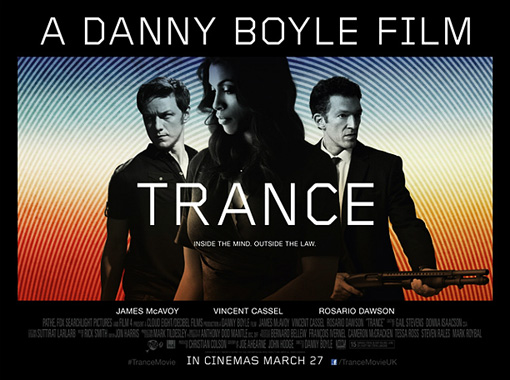
Trance, the latest film from Danny Boyle, is an enjoyable mess.  The film makes little sense, the characters are rarely consistent, and tonally, Trance is all over the place.  At the same time, it’s also a lot of fun.

Seeking to do for hypnosis what Inception did for dreams, Trance opens with Simon (an excellent James McAvoy), a fine art auctioneer who has gotten into trouble with online gambling.  Desperately needing money, Simon agrees to help the criminal Franck (Vincent Cassel) steal a painting.  However, during the robbery, Simon attacks Franck.  Franck responds by whacking Simon on the head.

As a result of the blow to his head, Simon ends up with amnesia and can’t remember anything that happened immediately after the robbery.  Unfortunately for Franck, Simon was attempting to steal the painting for himself when he got hit on the head.  As a result, neither Simon nor Franck have the painting and Simon can’t remember where he hid it.  After unsuccessfully attempting to restore Simon’s memory through physical torture, Franck then decides that Simon should see a hypnotist.

Simon goes to see Dr. Elizabeth Lamb (a surprisingly effective Rosario Dawson).  In several hallucinogenic and increasingly surreal scenes, we watch as Elizabeth leads the hypnotized Simon through the twists and turns of his own troubled subconscious.  While Simon initially lies about why he’s undergoing hypnosis, Elizabeth quickly reveals that she knows what’s going on.  However, to Franck’s surprise, Elizabeth agrees to continue to treat Simon and help him remember the location of the painting.  Soon, both Simon and Franck find themselves falling in love with Elizabeth, little suspecting that Elizabeth has an agenda of her own…

Judging from some of the reviews and other online comments that I’ve come across, I may be in a minority but I actually really enjoyed Trance.  Seriously, how can you not enjoy a film that’s so unapologetically over-the-top?  I loved the film for its lush cinematography.  I loved the fact that everyone’s apartment appeared to decorated exclusively with neon.  I loved the fact that all three of the main characters came across like they were continually on the verge of having a nervous breakdown.  In the end, I even loved the fact that Boyle didn’t even attempt to make the film realistic.  Trance is a celebration of pure style, a collection of barely connected set pieces that come together to make Trance into a pure cinematic experience.

Danny Boyle is one of those directors that people tend to either love or hate.  If you don’t like Danny Boyle, you probably won’t enjoy Trance.  However, if you’re like me and you’re an unapologetic fan, you’ll appreciate Trance for what it is, a pure triumph of style over substance.  Like many other Boyle films, the visuals are so strong, the music is so propulsive, and camerawork is so kinetic that you can forgive the fact that the film’s plot doesn’t make much sense.  Boyle may be a messy filmmaker but it’s often a beautiful mess.

6 Trailers From The Girl Who Survived A Tornado


Hi!  The trailer kitties and I had to compile this week’s edition of Lisa Marie’s Favorite Grindhouse and Exploitation Film Trailers in a hurry because we have been under tornado warning for most of today.  That’s just part of the fun of living in Texas!

And without further ado, here are the trailers!

1) Baby Needs A New Pair Of Shoes (1974)

2) The Hitter (1979)

3) The Bus Is Coming (1971)

4) The Shout (1978)

5) Long Weekend (1978)

6) The Last Shark (1982)

What do you think, Trailer Kitty?


Is The Great Gatsby Great Or Is It Simply Ghastly?


(Special thanks to frequent TSL reader and commenter Dr. Jim for inspiring the title of my review.)

Gatsby

Do you remember when everyone was predicting that Baz Luhrmann’s adaptation of The Great Gatsby would battle it out with The Dark Knight Rises and The Master for Best Picture at the 2012 Academy Awards?

It may be hard to remember but, at this time last year, that’s what a lot of self-styled film divas were predicting.  And who could blame them?  The Great Gatsby was adapted from a great book, Baz Luhrmann was an A-list director, and the film featured actors like Leonardo DiCaprio, Tobey Maguire, and Carey Mulligan.  The flashy first trailer came out and people, like me, were very excited.

And then, suddenly, Warner Bros announced that The Great Gatsby would not be released in December of 2012.  No, instead, it would be released in May of 2013.  This led to a lot of speculation.  Some film bloggers claimed that Warner Bros was just worried that the Great Gatsby would struggle to find an audience if it was released at the same time as other prestige pictures like Lincoln and Les Miserables.  However, I think most people just assumed that the film probably wasn’t that good.  Suddenly, the opulence of that first trailer was no longer something to be celebrated but, instead, it was taken as evidence that Luhrmann had emphasized style over substance.

Last Friday, The Great Gatsby finally premiered on movie screens across the country and we finally got a chance to discover whether Lurhmann’s film was great or simply ghastly.

Before I started writing this review, I debated with myself whether or not I should include a spoiler warning.  You see, I am a F. Scott Fitzgerald fanatic.  I have read and I have loved almost all of his books (even the unfinished Last Tycoon) and I even went through a period where I identified (perhaps a bit too strongly) with Zelda Fitzgerald.  The Great Gatsby is one of my favorite books of all time and it’s hard for me to imagine a world where anyone hasn’t read it.

Unfortunately, judging from the reactions of some of the people in the audience at the showing that I attended, apparently I was giving the rest of the world a little bit too much credit.  So, if you haven’t read The Great Gatsby, then you really should stop reading this review and go pick up a copy.

And, if you’re still reading this review, here’s your SPOILER WARNING.

gatsby3

With the exception of a few unnecessary scenes that feature Nick Carraway (Tobey Maguire) is a sanitarium, Luhrmann’s film closely follows the plot of Fitzgerald’s novel.  Nick, a recent Yale graduate, moves to New York City in the 1920s.  He has abandoned his earlier plans to be a writer so that he can concentrate on making money as a bonds salesman.  Needing a place to live, Nick ends up renting out a small cottage.  Living across the bay is Nick’s cousin Daisy (Carey Mulligan) and her extremely wealthy and crude husband, Tom Buchanan (Joel Edgerton).  And living right next door to Nick, in a gigantic castle, is the mysterious Jay Gatsby (Leonardo DiCaprio).

While the Buchanans are a part of the old rich and the American establishment, Gatsby is a much more enigmatic figure.  As Nick discovers, nobody seems to be sure who Gatsby is, where he came from, or how he has made his money.  He seems to devote most of his time to throwing massive parties where he is often nowhere to be found.  However, through the cynical golfer Jordan Baker (Elizabeth Debicki), Nick learns that Gatsby used to know Daisy and that he’s still madly in love with her.  Gatsby befriends Nick, attempting to use him as a way to get to Daisy.  Meanwhile, Nick also finds himself unwillingly in the position of being Tom’s confidante, accompanying him when he drives into New York to meet with his mistress, Myrtle Wilson (Isla Fisher).

gatsby4

To answer the obvious question, The Great Gatsby is not the disaster that so many of us feared but, at the same time, it’s not the triumph that so many of us had hoped for.  Instead, it’s somewhere in the middle.  As with most of his past films, Luhrmann unapologetically embraces style over substance and as such, the film is a lot of fun to watch even though it’s never as intellectually challenging or emotionally captivating as Fitzgerald’s novel.  Whereas Fitzgerald’s novel viewed Gatsby and Daisy with a captivating ambivalence, Luhrmann’s film is content to be a big, glossy soap opera.  As someone who loves the novel, I was frequently annoyed to see how interesting characters like Jordan Baker and Tom Buchanan were simplified for the film version.  But, as someone who loves on-screen spectacle, I enjoyed watching The Great Gatsby even if I could never quite bring my heart to fully embrace it.

One thing that The Great Gatsby definitely gets right is the casting of Leonardo DiCaprio as Jay Gatsby.  DiCaprio’s gives one of his best performances here, perfectly capturing Gatsby’s allure while hinting at the insecurity that lies underneath the confident façade.  Carey Mulligan is well cast in the difficult role of Daisy and Tobey Magurie makes for the perfect Nick Carraway.  (That said, you have to wonder if Maguire and DiCaprio are ever going to start aging or do they both have a picture of Dorian Gray hidden away in a closet somewhere.)

Unlike Fitzgerald’s novel, Luhrmann’s The Great Gatsby is not quite great.  But it’s not exactly ghastly either.  If anything, perhaps it will inspire a few more people to read Fitzgerald’s classic novel.

LIBRARY IMAGE OF THE GREAT GATSBY

Film Review: Body Shots (dir. by Michael Cristofer)


(Spoilers)

Recently, I saw a 1999 film called Body Shots on the Fox Movie Channel.  If you look at the poster at the top of this review, you’ll see that Body Shots was apparently advertised with the boast: “There are movies that define every decade…”  That’s true.  It’s also true that, every decade, there are movies that define self-importance and pretension.  Can you guess what Body Shots defines?

Since Body Shots claims to be a film that exposes what secretly goes on in American society, I figured I would start this review by sharing a secret of my own.

Ready?

I love over-the-top morality tales.  I love movies that attempt to expose 20something for being the shallow, terrible people that older people believe us to be.  Every decade sees at least a handful of these films.  Typically, they are made by male filmmakers in their 50s and they attempt to paint an accusing portrait of the foibles of youth.  These films assure the older generation that their children have all grown up to be a bunch of drug-abusing, heavy-drinking, over-sexed degenerates.  It’s a proud of tradition of American cinema and television, one that includes everything from the crazed pot smokers of Reefer Madness to The Newsroom’s Jeff Daniels announcing that my generation is the “WORST.  GENERATION.  EVER.”

Typically, dreadfully earnest filmmakers who think that they are making an important statement about the future of human society are responsible for these films.  That the filmmakers often turn out to be so totally out-of-touch and histrionic just adds to the campy charm.

Body Shots is a part of this tradition.  According to the imdb, director Michael Cristofer (who is currently appearing on Smash) was 54 years-old when he made this film about 8 decadent 20-somethings who spend a decadent night at a Los Angeles nightclub and then have to deal with the consequences in the morning.

For the first part of Body Shots, we’re introduced to the 8 main characters (4 men and 4 women, which works out nicely as far as pairing off is concerned).  While they’re all generically attractive (and, at times, interchangeable), they are also each meant to represent a different take on sexuality and relationships.

body-shots-645-75

The men:

Rick (played by Sean Patrick Flannery) is a lawyer.  He doesn’t have much of a personality but he’s in the most scenes so I guess he’s supposed to be the protagonist.  Flannery is required to awkwardly deliver the line, “Hey, Penorisi, have another cocktail, why don’t you?” not once but three time.

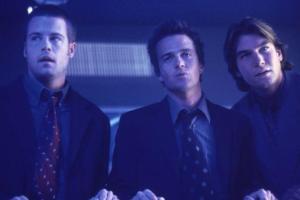
Mike Penorisi (played by Jerry O’Connell) is a professional football player who drives a Mercedes and who spends almost the entire movie struggling to keep his hair out of his eyes.  We know he’s a jerk because Jerry O’Connell plays him and he does things like shout, “If pussy’s on the menu, I’m there!”  (Seriously, Body Shots?)

Shawn (played by Brad Rowe) is a friend of Rick’s.  He’s a nice guy and he says things like, “Sex without love equals violence.”  (And, again, seriously?  Agck!  If a guy ever said that to me, I would be out the door so quick…)

Trent (played by Ron Livingston) is Shawn’s roommate.  We’re continually told that Trent is a loser but, since he’s played by Ron Livingston, he’s also one of the only likable people in the entire film.  Trent is crude and obsessed with sex but, as opposed to everyone else in the film, he’s at least honest about it.  Unlike the rest of the cast, Livingston is intentionally funny.

The women:

Jane (played by Amanda Peet) is kind of Rick’s girlfriend.  Like Rick, she really doesn’t have much of a personality and she’s mostly distinguished by being an absolutely terrible dancer.  (Unfortunately, the filmmakers don’t seem to realize just how awkward Peet looks out on the dance floor.)

Sara (played by Tara Reid) is Jane’s best friend.  She’s blonde, drinks to excess, and is open about her sex life.  So, naturally, the filmmakers go out of their way to punish her during the film’s second half.

Whitney (played by Emily Proctor, from CSI: Miami) is another blonde who drinks to excess and is open about her sex life.  In order to keep us from confusing her with Sara, the filmmakers have Whitney sodomize one of the men with a dildo.

Emma (played by Sybil Temchen) is depressed and worries that people can tell that she “hasn’t gotten laid in months” just by looking at her.

Anyway, these eight characters spend the first part of the movie getting ready to go out, going out, meeting up, hooking up, and occasionally telling us their thoughts on sex and relationships.  And by telling us, I mean that, in a technique beloved by first-time playwrights who have yet to learn anything about being subtle or allowing characters to reveal themselves organically, they literally look straight at the camera and deliver monologues about what they’re looking for in life.  I suppose this is all supposed to make us feel as if we’re getting an intimate look into the inner angst and secret loneliness of these characters but the monologues are all so awkwardly written that they just make the characters seem even more shallow than before.  Trust me, I could have happily lived my entire life without having Jerry O’Connell staring straight at me while discussing oral sex.  (“No teeth!” Jerry grins.  BLEH!)

And yet, I still enjoyed the first part of Body Shots, precisely because the characters were so shallow and the movie was so unintentionally over-the-top in its efforts to paint the Los Angeles nightlife as the equivalent of Sodom and Gomorrah.  The scenes where the women were getting ready to go out for the night all had a ring of truth of them and Ron Livingston (who appeared to be the only member of the cast to understand just how silly a film Body Shots would ultimately turn out to be) was a lot of fun.

Even better, once everyone gets to the club, Michael Cristofer decides to earn his auteur credentials by tossing in every trick he can think of.  Scenes where the action is needlessly sped up follow scenes that play out in slow motion.  The camera glides through the club, focusing on all the neon while a generic beat blasts in the background.  The walls are covered with graffiti that reads, “Swim At Your Own Risk” and “No Diving” and you better believe that the camera lingers over every letter.  Meanwhile, Amanda Peet dances awkwardly while trying to give Sean Patrick Flannery a come hither look while Emily Proctor passes out shots and Jerry O’Connell keeps tossing back his hair.  And then Ron Livingston shows up, straight from a golf course and – you’ve got it! – still dressed for his game.

Seriously, it’s all so stupid and silly and over-the-top unbelievable.  And, of course, while all this going on, the characters still find the time to stare straight at the camera and tell us their feelings about bondage and whether or not true love actually exists.  Cristofer is trying so hard to say something profound and he fails so completely that it’s actually a lot of fun to watch.

Unfortunately, during the second part of the film, Body Shots falls apart.  The next morning, Sara shows up at Jane’s apartment and says that Penorisi raped her.  Penorisi is arrested and claims that the sex was consensual and that Sara was just upset because he accidentally called her “Whitney.”  We get flashbacks to both Mike and Sara’s version of the events.  While they each tell a different story, Cristofer seems to be implying that, regardless of who is telling the truth, it wouldn’t have happened if Sara had not been out drinking and flirting.

To be honest, it’s pretty fucking offensive.

If the first part of Body Shots appeared to have been made by an out-of-touch guy with good intentions, the second part is the work of a moralistic hypocrite.  What makes it even worse is that the film ends without resolving the case.  I’m sure that Cristofer would argue that the open ending was meant to make the audience think about what they had just seen but, ultimately, it feels like a cop out.  It’s almost as if Cristofer reached a point where he said, “Okay, I’m tired of making this movie.  Let’s just quit.”

And considering how the second half of the movie plays out, you can’t really blame him.  Still, the first part of Body Shots is unintentionally hilarious and a lot of fun.  Just don’t watch past the 45-minute mark.

What Lisa Marie Watched Last Night #80: A Mother’s Rage (dir by Oren Kaplan)


Last night, I turned the TV over to the Lifetime Movie Network and I watched A Mother’s Rage.

Why Was I Watching It?

First off, it was on the Lifetime Movie Network and, as anyone who knows me can tell you, I am an LMN fanatic.  Seriously, there’s nothing I love more than watching a good, silly Lifetime movie.

Secondly, just the title, A Mother’s Rage, is so melodramatic and over-the-top.  Just hearing that title, I knew this movie would be the epitome of everything I usually love about a good Lifetime movie.

What Was It About?

After her daughter is murdered, Rebecca Mayer (Lori Loughlin) sets out to find the man responsible.  Driving across a desolate desert highway and hallucinating that her daughter (Jordan Hinson) is still alive, Rebecca murders every man that she comes across.

Fortunately, all of these men happen to be rather scummy but still, the local police are determined to catch Rebecca and stop her trail of a murder.  Sheriff Emily Tobin (Kristen Dalton) pursues Rebecca with the help of her own teenaged daughter (played by Alix Elizabeth Gitter).

What Worked?

Lori Loughlin and Jordan Hinson were well cast as mother and ghost daughter and, for the first 20 minutes or so, the movie did a pretty good job of keeping you guessing as to whether or not Hinson was real or if she was just a hallucination.

Over the course of the film, Loughlin did murder a few people but, fortunately, everyone she killed was so sleazy that she still managed to remain a sympathetic character.

What Did Not Work?

Even by the melodramatic standards of Lifetime, A Mother’s Rage was not a very believable story.  Plot holes abound and the film’s final scenes were so sloppily edited that the film’s  imdb message board is full of people still trying to figure out what exactly happened at the end of the movie.

One huge issue that I had with this film was that Lori Loughlin essentially murders several people in broad daylight and yet, somehow, there are never any witnesses.  Seriously, Loughlin apparently managed to find the least traveled highway in America.

Then again, it was a Lifetime movie and therefore, it all worked.  Criticizing a Lifetime movie for being melodramatic is like criticizing a kitten for being cute.

“Oh my God!  Just like me!” Moments

Lori Loughlin’s daughter is described as being an aspiring dancer who had a massively overprotective mother and, seriously, how could I not relate to that?  Meanwhile, Kristen Dalton’s daughter spends her time stealing crime scene photographs and trying to solve crimes and again, how could I not relate?  Seriously, there were times when this entire film seemed like one big “Oh my God!  Just like me!” moment.

Lessons Learned

I will apparently watch anything that shows up on Lifetime.

Grindhouse Classics : “Pick-Up”


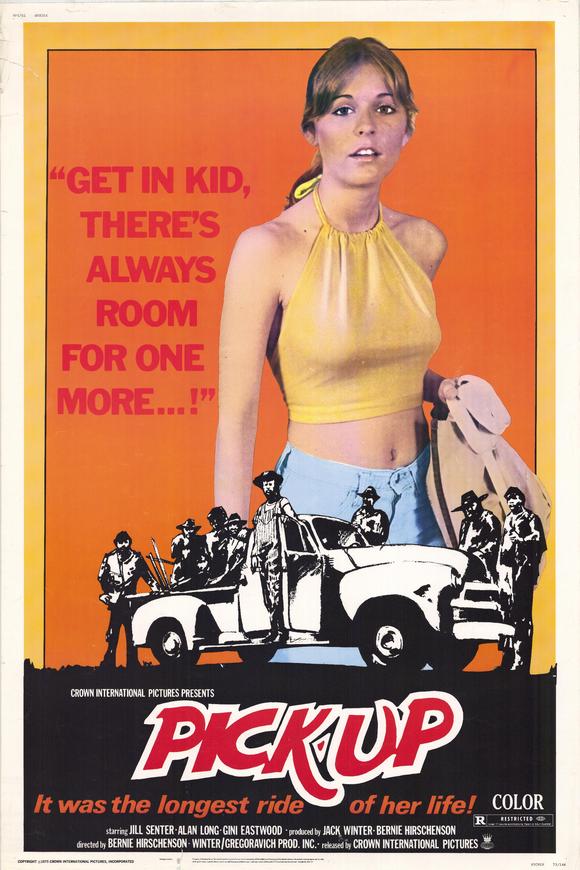
pick_up_poster_01

One word that doesn’t usually (if ever) come to mind when you’re talking about the drive-in fare churned out by Crown International Pictures in the 1970s is weird.

Yeah, okay, fair enough — I suppose just about any CIP flick looks a little bit “weird” to a contemporary audience, given that they’re all very much  products of their time, but honestly, pretty much everything released under their banner boils down, story-wise,  to a simple morality play with a generous helping of sex (always) and violence (sometimes) thrown in — and more often than not, as with most exploitation fare, the most common themes in the Crown back catalog are “don’t set your sights above your station in life” and “don’t talk to strangers.”

At first glance, 1975’s Pick-Up, directed (and produced, and shot, and edited) by Bernard Hirschenson, would appear to fit comfortably into the “don;t talk to strangers” category, since it’s the story of two footloose-and-fancy-free hippie chicks named Carol (Jill Senter) and Maureen (Gini Eastwood — no relation, at least that I know of, to you-know-who), who hitch a ride across Florida with a far-out guy named Chuck (Alan Long) who is, like them, at loose ends and just “taking in what the world has to offer, one day at a time, man” in his fuck-pad RV.

Come on — he’s gotta be trouble, right? I mean, he’s an Aries, and according to the supposedly-metaphysically-tuned-in Maureen, Aries guys are bad news these days because of some state of flux going on in the universe or something. Still, the girls hop in for a ride anyway —

31361

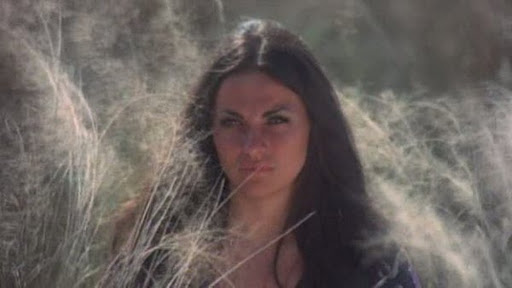
Trouble eventually does come their way, but Chuck isn’t the cause. After a deluge, the RV gets stuck in the Everglades mud, and that’s when things, as I promised at the outset, get weird. Chuck and Carol get busy screwing their brains out, but Maureen in between reading star charts and tarot cards and having waking (and sleeping) visions of her childhood, is visited by Pythia, a priestess of Apollo, who gives her a sacred dagger for some reason or other. And if you think that sounds strange, wait until the slimy politician and latex-faced clown show up.

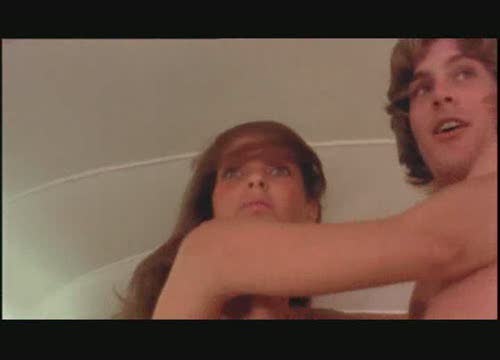
Okay, yeah, none of this makes a tremendous amount of narrative sense — or even common sense — but it sure is interesting. It turns out that Maureen was molested by a priest as a child (guess they were into girls in the ’70s) and this is at the root of her psychological disturbances, which culminate in quite possibly the most bizarre  scene (of many contenders) in the film, where she and Chuck finally “make it” on a stone altar with the clown, the politician, and the priestess watching on. And all this right after Chuck kills a wild boar (be warned, this film does feature genuine animal slaughter, although hardly of Cannibal Holocaust proportions) What does it all mean? Who knows. And honestly, who really cares? Pick-Up was clearly made with the stoner crowd in mind and, frankly, was probably made by members of the stoner crowd, as well. It’s all good, man. Just go with the flow.

4517859_l2

There are some notable things to point out in relation to this film while we have a moment — the Florida Everglades locations are authentic, and were probably an absolute bitch to film in (good thing everybody was probably high), and both Senter and Eastwood are not only reasonably talented actresses, but absolutely gorgeous, as well — yet neight ever made another film. Go figure.

Drive-in-cult-classics

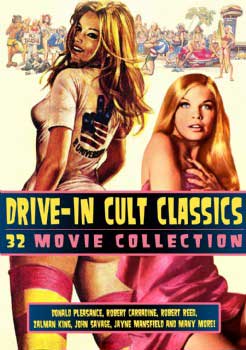
Like most of the Crown stuff we’ve covered both here and at my “main” site — http://trashfilmguru.wordpress.com , for those of you who don’t know — Pick-Up is available on Mill Creek’s 12-disc, 32-movie “Drive-In Cult Classics” DVD boxed set collection. There are no extras, but the remastered widescreen transfer looks surprisingly crisp and clean and the mono sound is, at the very least, perfectly adequate. This may not be the best film in the collection by any stretch, nor is it the most fun, but it’s definitely one of the most interesting, and it’s well worth the 80 minutes of your life it takes to watch it.

Is Upstream Color The Best Film of 2013?


(Minor Spoilers Ahead)

Is Upstream Color, the new film from Shane Carruth, the best film of 2013?

Realistically, it’s probably too early to say.  After all, it’s only April and there’s a lot of films waiting to be released.  However, it’s hard for me to imagine how a more thought-provoking, haunting, and occasionally frustrating film could be released this year.

Don’t get me wrong.  A lot of viewers aren’t going to embrace this low budget, independently made film.  Some will dismiss Upstream Color as being pretentious or they’ll incorrectly assume that the film is all about style over substance.  Even in this age of Tree of Life and Beasts of the Southern Wild, Upstream Color is not the type of film that’ll be embraced come Oscar time.

But no matter.  As of right now, Upstream Color is the best film of 2013.

Director Shane Carruth made his directorial debut in 2004 with Primer.  Made on a budget of $7,000 and filmed in my hometown of Dallas, Primer was a low-key but intriguing film about time travel.  It was a science fiction film that succeeded not through CGI but through an intelligent presentation of ideas.  I have to admit that I’ve watched Primer a handful of times and I still don’t quite understand everything that happens in the film.  However, that’s a huge part of the film’s appeal.

The same can be said of Upstream Color.

Playing out like a mash-up of David Cronenberg and Terrence Malick and told through a series of jump cuts, Upstream Color begins with Kris (Amy Seimitz), a successful young woman who is kidnapped by an enigmatic figure known as the Thief (Thiago Martins).  The Thief uses a drug made out of orchid larvae to hijack her mind.  Once she has given him all of her money, the Thief vanishes while the larva continues to grow in Kris’s body.

A mysterious man identified in the credits as The Sampler (played quite brilliantly by Andrew Sensenig) comes to Kris’s aid.  As Kris lies unconscious in a tent, The Sampler cuts the larva out of her body and then puts it into the body of a pig.  The pig is set loose in a pen with hundreds of other pigs who apparently carry larvae in their bodies.  Kris, meanwhile, wakes up the next morning in her car with no memory of why she’s covered in blood, why she’s lost her job, or why her bank account is now empty.

One jump cut later and suddenly, we see Kris riding a train through downtown Dallas.*   We’re not sure how much time has passed but we can see that Kris has changed.  With her hair cut short, Kris sits huddled in the back of the train.  Also on the train is Jeff (Shane Carruth).  Despite Kris’s efforts to be anonymous, Jeff notices her and eventually manages to strike up a conversation with her.

Kris finds herself oddly drawn towards Jeff, especially after he confesses to her that he once stole a lot of money from his employers and he’s not quite sure why he did it.  Not realizing that they’re both victims of the Thief, Jeff and Kris fall in love.  Fortunately, Carruth and Seimetz have a palpable chemistry.  You believe both of them as wounded souls and as lovers.  As a result, even as the film gets more and more surreal, you still care about these two characters and their relationship.

While Kris and Jeff fall in love and struggle to understand what happened to them in the past, the Sampler continues to appear throughout the film as a detached observer.  Sometimes, he’s recording the sounds of nature.  At other times, he’s looking over his pigs.  And then, sometimes, he’s just there.  For his first few appearances, the Sampler seems to be almost a benevolent figure but, halfway through the film, he performs one action that forces you to reconsider everything that you’ve previously seen him do.

Who is the Sampler and how is he connected to the Thief and Kris and Jeff?  This is one of the many questions that the film poses and, quite frankly, the answer is not easy to find.  Don’t get me wrong, the answer is there.  You just have to be willing to look for it.  Carruth, a former engineer, directs with an eye for the reoccurring patterns of nature. (For instance, the curve of the larva in Kris’s bloodstream is later replicated by the sight of Kris and Jeff curled up in each other’s arms.)  As opposed to the very verbal Primer, Upstream Color is a film almost totally told through image and, as a result, one has to be willing to be an observant viewer in order to learn the answers to the film’s questions.  The film’s final 15 minutes features no dialogue, just images scored to Carruth’s propulsive electronic score.  It’s a brave move on Carruth’s part and, even more importantly, it works brilliantly.

As you might guess from reading this review, Upstream Color is not an easy film to understand.  As a filmmaker, Carruth emphasizes the surreal and the obscure but, much like David Lynch, he comes up with images that are so haunting that you can’t look away even if you don’t fully understand what you’re seeing.  Upstream Color may, at times, be an obscure film but it’s compelling in its obscurity.  This is a film that is meant to be seen with four of your smartest friends.  This is a film that is meant to be debated and argued about.

In other words, it may very well be the best film of 2013.

——

*On a personal note, I do have to admit that I loved seeing how much of this movie was filmed at places that I either go to or drive by every single day.