
Some people are looking forward to the new Star Trek film. Me, I’m looking forward to Francis Ha.
Seriously, it’s in black-and-white and it’s about dancing. How can you not be excited?
Some people are looking forward to the new Star Trek film. Me, I’m looking forward to Francis Ha.
Seriously, it’s in black-and-white and it’s about dancing. How can you not be excited?

Don’t get me wrong, folks — by and large I kinda like Bates Motel, and I certainly enjoy reading Lisa Marie’s write-ups on each episode here on TSSL, but let’s not kid ourselves —- that show is a soap opera less- than- cleverly-concealed beneath some standard horror genre trappings. You can, of course, say the same for The Walking Dead, another show which I also dig for the most part, but it’s high time we stopped pretending either of these were anything but — well, crap. Enjoyable crap, sure, but crap nonetheless. And I’m certainly not above enjoyin’ me some crap.
Writer/director Karl Kempter’s 2001 shot-on-video offering Mayhem Motel, for instance. This is most definitely crap — hell, it’s even weird crap, disgusting crap, nauseating crap (less than five minutes into the proceedings a character billed in the credits as “Pukey” throws up in a bathtub — for real — and then proceeds to sit down in his own regurgitated mess), but then, it never pretends to be anything else. There are no affectations here toward “quality character drama,” Kempter isn’t fooling himself that his film has anything “important” to say, and in fact there’s no real story here to speak of at all, just a series of vignettes centered around a bunch of degenerate fuckwads and various other products of the gene pool’s decidedly shallow end who all happen to be staying (perhaps at the same time, perhaps not — it’s never made clear and frankly doesn’t matter anyway) at the same fleabag motel.
I don’t know about you, but I find that refreshing lack of anything even remotely approaching an agenda to be a strangely noble thing.
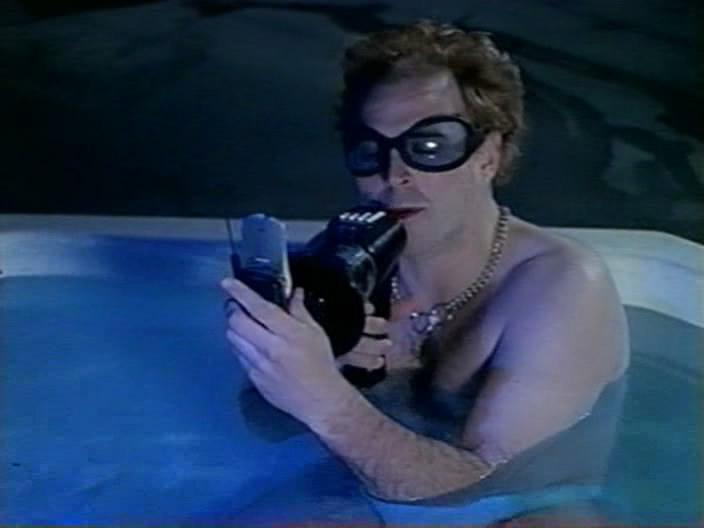
It also means that Mayhem Motel is both a difficult movie to explain, and an easy one to review — plot recaps are completely unnecessary since there literally is no plot, but at the same time simply saying “you’ve really just gotta see it and decided for yourself” sounds like something of a cop-out, even though — well, you really do just gotta see it and decide for yourself. There’s definitely not much of anything resembling a “point” to be taken away from this at-times-self-consciously-weird-for-its-own-sake string of mish-mashed, completely unrelated events — apart from maybe some vague overall suggestion that sex with strangers can get ya killed — and most (okay, all) of the scenes seem more designed to provoke some sort of visceral reaction (even if it’s only “okay, what exactly was that all about?”) from the audience rather than actually involving you in them, but what the hell — it certainly makes for a one-of-a-kind 70-minute viewing experience.

What I can’t say with any certainty, however, is whether or not it’s actually a good one — that’s up to you. The movie’s a mass of contradictions — I mentioned that’s it’s both unpretentious and self-consciously-weird-for-its-own-sake, and trust me, both are true — but the acting (roughly half the parts are played by a guy named Matthew Biancaniello, the other almost-half by a woman named Sara Berkowitz) is of a generally high standard for this type of production (i.e. one shot for a reported $22,000), the lighting is uniformly interesting (if not uniformly effective), and in between the midget, the floating plastic Easter eggs, the guy with a tracheotomy, and the blow-up rubber fuck doll, Kempter really does succeed in creating both a sleazy and genuinely otherworldly atmosphere here. And besides, we ll know that most people will do just about anything for money, but seeing what they’re willing to do for no money is so much more interesting.
So yeah — it’s fair to say that Mayhem Motel does what it sets out to do, I just can’t say whether or not what it sets out to do is really worth doing. That’s a purely subjective call, and while I enjoyed it for what it was, I can certainly see why some folks might turn this off a few minutes after the opening credits. I’m not prepared to say this is one of those things you’re either gonna absolutely love or absolutely hate — like, say, White Castle hamburgers — since I don’t see it as being able to elicit strong reactions along either of the emotional poles like that, but you’re either gonna find it interesting or completely pointless.
Or, perhaps, both interesting and completely pointless.

Mayhem Motel is available on DVD either as a stand-alone release from Brain Damage films (I can’t speak to its technical specs or any extras on that version as I haven’t seen it), or as part of the “Decrepit Crypt Of Nightmares” 50-film, 12-disc box set from Pendulum Pictures, the Mill Creek sub-label that specializes in zero-budget indie and homemade horror. That’s how I caught it and it’s presented full-frame with fairly lousy stereo sound (something of a surprise since Kempter apparently makes his living as a sound mixing guy on various other projects) and no special features or other frills of any sort. Considering the whole package retails for no more than twenty bucks, whaddaya want, anyway? I’d say give it a go if you’re feeling adventurous — beyond that, you’re on your own.
Disconnect, the feature film directing debut of award-winning documentarian Henry-Alex Rubin, has been getting some fairly positive reviews. According to Rotten Tomatoes, the film has a critical score of 71 while audiences have been even more impressed. The last time I checked, it had an audience score of 83%. If you’ve seen any of the commercials for this film then you’ve undoubtedly heard it referred to as being “the best film of the year.”
That’s high praise for a film that’s essentially Crash with better acting.
Much like Crash (which, incidentally, I consider to be the worst film to have ever won the Oscar for Best Picture), Disconnect is an ensemble film that tells several different stories. For whatever reason, first-time directors seem to have a weakness for movies with ensemble casts and multiple-story lines. When done well, an ensemble film can say something profound about the way that people in a society relate to one another. When done poorly (like in Crash or Disconnect), they just feel trendy. Watching Disconnect, I felt as if the filmmakers couldn’t come up with a way to tell one compelling story from beginning to end so, instead, they just tossed together fragments of three separate stories and then desperately tried to come up with a theme to connect them all.
That theme, by the way, is that our reliance of modern technology has created a society where people are Disconnected from one another.
Gee, you think?
Disconnect tells three separate, inter-connected stories. In one story, Paula Patton and Alexander Skarsgard are a married couple who are struggling to deal with the recent death of their child. Skarsgard deals with his grief by going on long business trips and getting addicted to online gambling. Meanwhile, Patton joins an online support group and finds herself tempted to have affair another member (Michael Nyqvist). Patton’s activities leads to identity theft and bankruptcy. With the help of a sleazy private investigator (Frank Grillo), Patton and Skarsgard try to track down the man who stole their identity. This story falls apart once Patton and Skarsgard find the man and both characters suddenly start acting in the most inconsistent ways conceivable. It really should be impossible t0 make charismatic performers like Alexander Skarsgard and Paula Patton seem bland and boring but somehow, Disconnect manages to do it.
In the film’s best storyline, Grillo’s teenage son (Colin Ford) catfishes and cyber-bullies an alienated classmate (Jonah Bobo). When Bobo hangs himself as a result, Ford is wracked with both guilt and fear. Ford’s attempts to cover-up his involvement leads to him meeting and briefly befriending Bobo’s father (Jason Bateman), who has no idea what led to his son attempting suicide. In this story, Bateman proves that he’s as good with drama as he is with comedy and Ford’s complex and multi-layered performance is more than award-worthy. This was probably the most powerful part of the film and, if the filmmakers had simply concentrated on this story (as opposed to diluting it by making only one part of a multi-part film), Disconnect would fully deserve the high-praise that it’s currently receiving.
In the film’s third (and most flamboyant) storyline, Andrea Riseborough is a cynical and opportunistic reporter who does a story about a cocky teenager (Max Thieriot) who performs on an adults-only site and who recruits other teenagers for a manipulative pimp (played by none other than Marc Jacobs). Riseborough finds herself charmed by the teenager (and who can blame her because, after all, he’s played by Max Thieriot) and soon she’s having an affair with him. However, her news story captures the attention of the F.B.I. and soon both Thieriot and Riseborough find themselves in danger.
At first, I thought I was going to enjoy this storyline because I love Max Thieriot. He’s ideally cast here and he gives a good, sympathetic performance. For that matter, so does Andrea Riseborough and even Marc Jacobs brings a certain reptilian charm to his role. However, this story falls apart as it quickly becomes obvious that the filmmakers, having set up a potentially interesting situation, have no idea what to do with it. Instead, much as with the characters played by Skarsgard and Patton, Riseborough ceases to behave with anything resembling logic or consistency. Both she and Thieriot go from being interesting, well-rounded characters to being mere plot devices.
That, ultimately, is the main reason why Disconnect fails. With the exception of the characters played by Bateman and Ford, nobody in this film feels real and, again with the notable exception of Bateman and Ford’s storyline, very little that happens feels genuine. The film is watchable because of the talented cast but, otherwise, it’s a melodramatic and predictable mess that seems to think that it’s a lot smarter than it actually is.
Perhaps that’s why so many people over on the imdb have been praising this film as “the best of the year.”
Some people will always enjoy feeling like they’re thinking without actually having to do it.


Can we just be honest about something?
Most of us are a little bit scared of the elderly.
Oh, we try to deny it. We talk about how they’re “real characters” or we attempts to convince ourselves that their eccentricities are actually signs of an incurable zest of life. We tell ourselves that old people remind us of the value of carpe diem but, ultimately, they creep most of us out because, when we look at them, we see our own future. Regardless of what we do today or tomorrow, we’re all going to eventually become old. Perhaps that’s why there’s a whole industry devoted to keeping old people out of sight and out of mind.
Today’s entry in the Daily Grindhouse, the obscure 1974 film Homebodies, is effective precisely because it understands that unpleasant truth.
Directed by Larry Yust, Homebodies tells the story of Mattie (Paula Trueman). Mattie is one of seven elderly retirees who are the sole residents of a condemned apartment building. All around them, buildings are being torn down and replaced with new apartments. When an uncaring social worker (Linda Marsh) shows up and informs them that they’re going to be forcefully relocated to an assisted living facility, Mattie take matters into her own hands. She realizes that every time there’s an accident on a construction site, work stops for a few days. Hence, if there are enough accidents, work will be stopped indefinitely. Mattie and her fellow residents (some reluctantly and some not) are soon murdering anyone they view as a threat. While this is effective initially, things get complicated once Mattie starts to view some of her fellow residents with the same contempt that she previously reserved for construction workers.
Homebodies is one of those odd and dark films that could have only been made in the 70s. When the film begins, one would be excused for expecting to see a heart-warming comedy about a bunch of plucky seniors outsmarting the forces of progress and real estate. After all, the elderly residents of the condemned building are all appropriately quirky and, as played by Paula Trueman, Mattie doesn’t seem like she’d be out-of-place as one of the prankers on Betty White’s Off Their Rockers. Linda Marsh’s social worker and Kenneth Tobey’s construction foreman both seem like the type of authority figures who one would expect to see humiliated in a mawkish 1970s comedy film.
Instead, Homebodies turns out to be an effectively creepy and dark little film. When the elderly residents of the apartment building fight back, they do so with a surprising brutality that’s all the more effective because of the harmless exteriors of Mattie and her fellow residents. Paula Trueman makes Mattie into a truly fascinating and frightening monster. When a few of her fellow residents start to question Mattie’s methods, you truly do fear for them because Mattie has truly proven herself to be capable of just about anything. While Trueman dominates the film, the entire cast is excellent. As a classic film lover, I was happy to see that one of the residents was played by Ian Wolfe, a character actor who will be recognizable to anyone who has ever watched TCM.
(Remember the old man who gave the lecture at the observatory in Rebel Without A Cause? Him.)
I first saw Homebodies on YouTube and I was going to share it below but, apparently, the video has been pulled from the site. That’s a shame because it’s a film that definitely deserves to be seen, if for no other reason than to appreciate the performances from a cast of underrated character actors who, sadly, are no longer with us. Unfortunately, the best I can offer is this Spanish-language trailer for the film.

(Warning: This Review Contains Spoilers)
A few nights ago, I somehow managed to convince my BFF Evelyn to accompany me to see the latest film from Tyler Perry, Temptation.
Now, I know what you’re asking. Why did I want to see it? There’s a few reasons.
Tyler Perry is the most successful film director that I know next to nothing about. Prior to seeing Temptation, the extent of my exposure to Perry’s aesthetic was catching about 5 minutes of Madea Goes To Jail on Lifetime. (5 minutes was about all I could take.) Still, as a critic who occasionally mentions the auteur theory, I felt the need to experience at least one of Perry’s films for myself.
Secondly, I thought the commercials for Temptation were intriguing. Between all the smoldering glances and the portentous dialogue, Temptation looked like it would be a lot of fun.
Finally, Temptation has been getting such negative reviews that I simply knew I would have to see it eventually. Seriously, when a film is compared to The Room by more than one critic, I have to see it.
Before I get around to comparing him to Tommy Wiseau (who, for the uninformed, directed the so-bad-it’s-good classic The Room), I want to say a few good things about Tyler Perry.
1) Largely as a result of his own hard work, Tyler Perry has found a lot success in an industry that, historically, hasn’t been very accommodating to black filmmakers.
2) Although critically reviled, Tyler Perry’s films have provided a showcase for talented African-American performers who are usually ignored by mainstream, Hollywood filmmakers.
3) Tyler Perry’s films are also popular with an audience that is largely ignored by mainstream Hollywood filmmakers.
4) Despite his reputation for being an egotist, Tyler Perry was actually rather charming and humble when he introduced the clip for Precious at the 2010 Academy Awards.

That said, Tyler Perry’s Temptation is a bad, bad movie. At the same time, it’s also a lot of fun in much the same way that Tommy Wiseau’s The Room is fun. Much like Tommy Wiseau, Tyler Perry seems to have a better understanding of melodrama than reality. Much like The Room, you watch Temptation in utter amazement that someone not only wrote this crap but then directed it and released it. When Evelyn and I saw the film, the theater was deserted except for the two of us and that worked out perfectly because the only way to really enjoy Temptation is to yell back at the screen.

Judith (played by Jurnee Smollett-Bell, who gives a good performance and deserves a better film) is married to Brice (Lance Gross), a hard-working, practical-minded pharmacist who loves his wife and has perhaps the sexiest abs ever seen on a movie screen. However, Brice often forgets Judith’s birthday and refuses to have sex anywhere other than a bedroom so we can all guess what’s going to happen, right?
Judith works as a therapist at a matchmaking agency that’s run by Janice (Vanessa L. Williams, whose amazingly bad French accent is explained in one of the few intentionally funny scenes to be found in this film). Among her co-workers is Ava. Ava is played by Kim Khardashian, who delivers her lines just as robotically as you would expect Kim Khardashian to deliver her lines in a Tyler Perry film. Evelyn and I especially had a fun time imitating the way that Kim described the character of Harley (played by Robbie Jones) as being “The. Largest. Social. Media. Inventor. Since. Zuck. Er. Berg.”
Harley claims that he wants to invest in Janice’s business but it soon becomes obvious that, despite having the second most sexist abs ever seen on a movie screen, Harley is actually the devil and he’s intent on seducing Judith. Harley taunts Judith for never having sex outside of a bedroom. (At this point, Evelyn yelled, “Girl, that man’s no good for you!”) Janice responds by attempting to have sex with Brice in the kitchen just to be rejected because, as Brice points out, that’s not what the kitchen is for. Soon, Janice is having steamy bathtub sex with Harley and snorting cocaine.

“Girl,” I said as I watched her descent into decadence, “you need to get Jesus in your life.” As anyone who knows me can tell you, I was being sarcastic so you can imagine my reaction when, one scene later, Judith is confronted by her mother (Ella Joyce) and a group of church ladies who have formed a prayer circle to pray for Judith’s soul. Say what you will about The Room, a prayer circle is one plot element that Tommy Wiseau left out of his epic.
While all this is going on, Brice has befriended Melinda (Brandy Norwood). Melinda is on the run from her ex-boyfriend. Not only did this boyfriend physically abuse her but he also infected her with HIV. Is there anybody out there who can’t guess who Melinda’s ex-boyfriend is?
Temptation is a film with a message and that message seems to be that straying from either marriage or the church will result in God punishing you with HIV. It reminded me of the type of horror stories that I used to hear when I was younger. These stories were always about some girl disobeying her parents, sneaking out at night, or lying in confession and either dying in a car accident or being forced into prostitution as a result. Interestingly enough, the story’s outrage was never directed towards the other driver or the pimp. The main message of these stories was that these terrible things would never have happened if only the girl hadn’t insisted on doubting authority or thinking for herself.
That seems to be the message of Temptation as well. If only Judith had been content to only have sex in the bedroom. If only Judith had been content to obey her husband and keep going to church. Instead, she had to wonder what it would be like to have sex in the kitchen and she just had to stop giving praise to the Lord. As a result of trusting the wrong man, both she and Melinda get HIV. Meanwhile, Brice is allowed to find love with a new, church-going woman. The film ends with sadder but finally wiser Judith going to church with her mother and the obvious message is that HIV was God’s way of reminding Judith not to stray in the future.
In some ways, Tyler Perry is lucky that Temptation is such an inept film because, otherwise, it would seriously be one of the most offensive films ever made.
However, it is such an inept, predictable, melodramatic, and overwritten film that, much like with The Room, Temptation almost becomes a work of outsider art. You watch fascinated that anyone could possibly share this film’s worldview. I recently caught a midnight showing of the Room and it was a lot of fun. I threw spoons across the theater and yelled at the screen. I have a feeling that, within the next few years, Tyler Perry’s Temptation will start to show up on the midnight circuit.
Hopefully, when it does, Evelyn and I will be able to catch a showing and join in with the entire audience as we shout, at the screen, “Girl, that man’s no good for you!”

Today’s blast from the past comes to us from the Citizens For Decent Literature, Inc. Originally made and released back in 1965, this 30-minute film features a deep-voiced authority figure explaining the dangers of adult magazines and sordid paperbacks.
How can I put into words how much I love this little piece of politically incorrect Americana?
It’s just so 1965.
Today’s scene that I love comes from Ed Wood’s classic plea for world peace, Plan 9 From Outer Space.
On Saturday night, the Snarkalecs and I watched the SyFy original movie, Battledogs. (Also watching was a mentally unstable moron from Buffalo, NY named Michael Conklin. But more about him later…)

Why Were We Watching It?
Because we’re snarkalecs and that’s what snarkalecs do.
What Was It About?
Donna Voorhees (Ariana Richards) is a nature photographers who visits our friend to the north and gets bitten by a Canadian lycanthrope. When she returns to New York, she ends up transforming into a werewolf herself and manages to kill nearly everyone at JFK Airport. Everyone that she doesn’t kill is infected with the werewolf virus.
Donna and the rest of the infected are captured by the military. Under the watch of the sinister Lt. Gen. Monning (Dennis Haysbert), the infected are doped up with tranquilizers and left to aimlessly wander around a prison. With the help of a sympathetic major (Craig Sheffer) and a scientist (Kate Vernon), Donna and the rest of the infected escape the prison and soon New York is overrun by werewolves.
Meanwhile, the U.S. President (Bill Duke) spends a lot of time sitting out in the middle of Central Park and looking depressed…
What Worked?
Battledogs was produced by the Asylum. As soon as I saw the words “The Asylum Presents…” at the beginning of the opening credits, I knew that Battledogs was going to be a lot of fun.
Battledogs was surprisingly well-cast. While Craig Sheffer made for a dull hero, Dennis Haysbert was a great villain. Admittedly, he was one of those villains who spent the whole movie talking about his plans as opposed to actually carrying them out but, fortunately. Haysbert has a great voice. Haysbert turned Lt. Gen. Monning into a genuinely menacing character.
The scenes in which the tranquilized infected wander about in a daze had a nicely surreal feel to them. While watching them, I actually compared them to a similar scene from Jean Rollin’s Night of the Hunted. That’s probably going a bit too far but still, they were handled very well.
On a final note, Bill Duke plays perhaps the most ineffectual president in the history of ineffectual presidents. Speaking as someone who has little faith in governmental authority, I found Duke’s performance to be the most realistic part of the film.
What Did Not Work?
Oh, I suppose there are things I could complain about. I could point out that the film may have been set in New York but it was obviously (and I do mean obviously) filmed in Canada. (Actually, no, it was not! As Mike Conklin so politely points out in the comments below, Battledogs was filmed in Buffalo and yes, a look at the imdb does confirm that this film — despite seeming very Canadian, was indeed filmed in New York. I apologize for the careless error. — LMB) There were also a few plot holes that I could talk about if I felt like being nit-picky.
But you know what?
There is nobody worse than someone who would actually get nit-picky about an Asylum film. Asylum Films are made for audiences who have a sense of humor and their “flaws” are ultimately a very intentional part of the fun. The Asylum makes fast-paced, unpretentious films for people who want to be entertained for 90 minutes. You know what you’re going to get when you see “The Asylum” name and, unlike most major studio films, Asylum films can be counted on to deliver exactly what they promise. This film promised battle dogs and it delivered.
Therefore, the entire film worked.
“Oh my God! Just like me!” Moments
To be honest, despite featuring not one but two female leads, Battledogs was a pretty masculine film. The emphasis was definitely on people either shooting guns or beating each other up. That’s not necessarily a criticism because, if New York was overrun by werewolves, I imagine there was be a certain amount of societal breakdown. However, the fact of the matter is that I’m scared of guns and the only fights I’ve ever been in have involved a lot of hair-pulling and little else. As a result, there really weren’t any “Oh my God! Just like me!” moments in Battledogs.
That said, Ariana Richards’ character reminded me of my sister, the Dazzling Erin, because they’re both talented photographers.
Lessons Learned
Apparently, the best way to avoid being killed in a nuclear blast is to jump into the Hudson River right when the bomb goes off. In today’s unpredictable world, that’s a good thing to know.
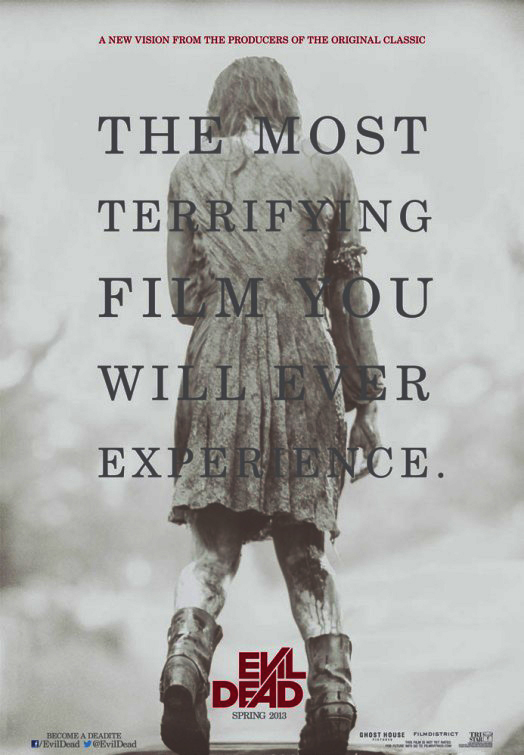
Let’s get one thing straight right off the bat — first-time director Fede Alvarez’s new remake/”reimagining” of Sam Raimi’s 1981 classic The Evil Dead (this time going out minus the article at the beginning of the title, so it’s just Evil Dead, thank you very much) is not, as its ad poster claims, “the most terrifying film you will ever experience.” That’s actually a gutsier tag line than it sounds on first reading, since it’s essentially promising that not only is this flick scarier than anything you’ve already seen, it’s scarier than anything else you’re ever going to see for the rest of your life. It can’t live up to that, period — and truth be told, it’s not even very scary at all.
Which isn’t to say that it’s bad or anything. In many key respects — eschewing CGI for “real” special effects, not even trying to cast somebody new in the role of Ash since absolutely anyone would suffer in comparison to Bruce Campbell (who, along with Raimi, is on board as at least an air-quote producer on this one) — Alvarez and his cohorts (including, it pains me to say, co-screenwriter Diablo Cody, who I was fairly certain was going to fuck things up here in some way, shape, or form but, pleasingly, doesn’t) get a lot of what they’re trying to do here right. The film is gory beyond belief, moves at nearly the same breakneck pace as its ’81 template, there’s a sublimely wrong tree-rape (yes, you read that correctly) scene, the script provides a believably updated reason for why our five protagonists are getting together in a remote cabin in the woods — that looks very much like the original, might I add — in the first place ( I won’t spell it out too specifically but it gives new meaning to the old “withdrawal’s a bitch” cliche), and the performances are, on the whole, fairly solid.
They’ve also wisely chosen not to mess with the whole “haunted book inked in human blood and bound in human skin that releases untold evil onto the world” premise, so points all around for not only not messing with what worked in the original, but also for not trying to catch lightning in a bottle twice by hewing too closely to it. Alvarez seems to have gone into this one knowing what he should and shouldn’t play around with, and that puts him a step ahead of your average horror remake director.
Here’s the rub, though — whenever you’re trying to update the look and feel of a $375,000 production on a budget of $14 million, something’s bound to get lost in translation, and no matter how hard it tries, Evil Dead circa 2013 just can’t capture the grittiness, the grime, the immediacy and, dare I say it, the heart of its progenitor. Alvarez is definitely going for an old-school approach here, and I commend him for that, but it’s still (and obviously) not old-school in actuality. Once you poke beneath the paper-thin surface, it becomes fairly obvious that any successes the new film has are more or less of the cosmetic and superficial variety. It looks good, sure — but it still feels kinda wrong, even though it’s doing its level best to cover that up by, again to its credit, not giving you too much time to think.
I mentioned before that I by and large liked the cast — Shiloh Fernandez, Lou Taylor Pucci, Jessica Lucas, Elizabeth Blackmore and, especially, Jane Levy as our doomed (or is she?) central “heroine,” Mia — all do a nice job. But none of them especially stand out, either, which isn’t too bad a mini-metaphor for the movie itself as a whole — it’s thoroughly competent in terms of its execution, but there’s not much extra “spark” to the proceedings. Alvarez seems to understand the essential ingredients for making a solid, respectful, won’t-piss-you-off updating of a classic, but he’s got some way to go before he can create a genuine classic from whole cloth himself.
In some respects, there’s really not a whole lot he can do about that — The Evil Dead was shot in a remote Tennessee cabin while Evil Dead constructed its own location in New Zealand that set out to ape the look and feel of middle-of-nowhere USA as best it can — but that’s just endemic of the greater problem at work here, namely that this is a story that just plain not only doesn’t need a so-called “upgrade,” but literally can’t survive one with its celluloid soul intact. I give Alvarez all the kudos in the world for trying, and for at least understanding the surface elements of what made the original the undeniable classic that it’s rightly hailed as, but so much of what made Raimi’s flick the singular triumph that it was can never be duplicated. Hence, I guess, why I just referred to it as a “singular” work. In short, while we’re still talking about the first one some 32 years after its release, I’ll be damn surprised if people are talking about this remake very much even a year from now.
Still — they did what they could here, I suppose. I had an exchange with a couple of friends on facebook earlier today about the endless stream of remakes in general that we’re forced to navigate, and it made me realize that at some unspecified, silently-arrived-at point, I went from going into these things thinking “I hope they get it right this time” to “dear God I hope they don’t fuck this one up.” It’s a subtle shift, sure, but it certainly speaks volumes about the general performance of the studios’ big-budget-remake machine. I’m pleased to say that Alvarez et. al. don’t fuck this one up (and whatever you do, hang around until the credits are over — you’re guaranteed to leave with a smile on your face even if you don’t actually like the film at all), but it is what it is. The Evil Dead 1981 was a product of blood, sweat, tears, determination, and — weird as it may sound — love, put together by folks who didn’t always know what they were doing but were always giving it more than their best effort. Evil Dead 2013 is, for all its attempts to duplicate the trappings of its predecessor, a professionally-executed Hollywood production. You tell me which is gonna be better.
Hell — tell me which has to be.
 Film critic Roger Ebert passed away today. He was 70 years old.
For a lot of people, Roger Ebert was American film criticism. They waited to hear his opinion of every new film and that opinion was often cited as if it was gospel. I think most people are like me in that they couldn’t tell you when they first heard the name “Roger Ebert” or when they first learned he was a film critic. Instead, he was one of those pop cultural figures whose existence we took for granted. Just as there would always be movies, there would always be a review from Roger Ebert.
I have to admit that it was rare that I ever agreed with Ebert’s opinion. I once posted a comment to that effect over on the AwardsDaily website and I ended up getting yelled at by the site administrators. I really shouldn’t have been surprised by the reaction. Ebert was (and is) a hero and an inspiration to a whole generation of film bloggers and online critics but very few of them seem to understand what made Ebert a great critic.
Roger Ebert was a great critic not because he was opinionated but because — unlike so many other self-proclaimed film critics — he sincerely loved film and that love came through in his reviews. When Roger Ebert was critical, it wasn’t because he was trying to show how clever or sardonic he could be. Instead, it was because he understood what film was truly capable of achieving.
(Incidentally, when you see certain pompous and self-important online film critics promoting themselves as the logical heir to the legacy of Roger Ebert, remind them that Roger not only wrote the script for Russ Meyer’s Beyond the Valley of the Dolls but that he was also never ashamed to admit it and that it was a pretty good screenplay to boot! Film snobs may have embraced Ebert but Ebert rarely embraced them.)
As I said, I often did not agree with Roger Ebert. He was rarely a friend to the horror genre and he was critical of a lot of films I loved and he gave positive reviews to a lot of films I hated (like Rod Lurie’s Straw Dogs, for example). I usually tuned him out whenever he started going on about politics. Within an hour of his death, the political ghouls over on twitter were already quoting him, not about the films that he loved but, instead, on his views about President Obama, as if the only thing that mattered was that they had lost a vote in the next election. Politics are temporary. Films are forever.
However, the great thing about Roger Ebert was that you didn’t have to agree with him in order to enjoy and respect him as a film critic. Ebert was opinionated but he was rarely shrill. Unlike a lot of the critics who claim to have been inspired by him, Ebert didn’t talk down to readers. Ebert may have been the most prominent film critic in America but he never stopped writing like a guy who just happened to love movies. In a world where every critic with a web site is currently bragging about how powerful she believes herself to be, this humility made Ebert a pleasure to read. He was a witty and knowledgeable writer and his brave battle with cancer was both heart-breaking and inspiring.
With the passing of Roger Ebert, the world has lost a man who truly loved films.
A lot of the current wave of self-proclaimed film critics and award divas could learn a lot from his example.
Roger Ebert, R.I.P.

