Retro Television Review: Homicide: Life On The Street 4.13 “I’ve Got A Secret”


Welcome to Retro Television Reviews, a feature where we review some of our favorite and least favorite shows of the past!  On Sundays, I will be reviewing Homicide: Life On The Street, which aired from 1993 to 1999, on NBC!  It  can be viewed on Peacock.

Ring ring.  “Homicide.”

Episode 4.13 “I’ve Got A Secret”

(Dir by Gwen Arner, originally aired on February 2nd, 1996)

This week, almost everyone has a secret.

For example, when Pembleton and Bayliss are called in about a man found dead in his car, they discover that, earlier in the day, he went to a local ER after being shot.  The gunshot wound, which was accidental, didn’t kill him.  Instead, it was the internal bleeding that the doctor either missed or intentionally ignored.  Dr. Kate Wystan (Mimi Kennedy) may come across as being a selfless doctor who has dedicated her life to helping the residents of Baltimore’s most crime-ridden neighborhood but Pembleton and eventually Bayliss come to suspect that her secret is that, because the victim was black and a known criminal, she didn’t give him the same standard of care that she gives to her other patients.  Pembleton considers this to be murder, though it sounds more like a case of malpractice than anything else.

Munch spots Kay kissing a man outside of police headquarters and he becomes obsessed with trying to figure out who the man is.  He’s always believed that Kay is happy being single and alone.  (Uhm, hello?  Munch?  Remember when she dated Ed Danvers?)  Kay’s secret is that apparently she has a life outside of Homicide.

Finally, Lewis and Kellerman spend the entre episode chasing a burly man who is wanted for killing both of his parents.  At first, this entire storyline feels almost like a parody of NBC’s request that the series start featuring more action.  Lewis and Kellerman spend the entire first half of the episode chasing this guy through allies and pool halls and every time, they fail to catch him.  There’s none of the badass heroics that we’ve come to expect from cop shows.  Eventually, Lewis reveals that his brother is in a mental institution.  When Lewis tries to visit his brother, he’s just turned away.  Lewis’s secret is that he actually cares about his brother.

This was an okay episode.  By this point in the series, Homicide had reached the point where it could do an episode where the true enjoyment came less from the storyline and more from just listening to the characters talk to each other.  I really didn’t care much about the crimes that they were investigating.  Instead, I just enjoyed listening to Pembleton and Bayliss talk and bounce ideas off of each other.  They’ve come along way since the day that Bayliss objected to Pembleton’s interrogation technique and Pembleton shouted that he would never have a partner.  By the same token, Kellerman and Lewis have their own unique chemistry that is fun to experience.  They’re like the sensitive frat cops.  As for Munch and Kay, they should just hook up already.  It’s obvious to everyone that they’re in love!

Maybe that’s their secret?

October True Crime: Sins of the Mother (dir by John Patterson)


In the city of Spokane, Washington, Kevin Coe (Dale Midkiff) is a real estate agent who always tries to come across as being the slickest guy in the room.  With his quick smile and his moderately expensive suits, Kevin certainly seems to fit the stereotype.  It’s only when you start to look a little closer that the surface starts to crack.

For someone who goes out of his way to come across as being confident, Kevin is actually very immature and more than a little whiny.  He’s living with a perfectly nice young woman named Ginny (Heather Fairfield) but it’s obvious that he’s keeping secrets from her.  He comes home one morning with scratches on his face and, when she asks about them, he claims that 1) he got mauled by a dog and 2) he doesn’t need any sort of medical attention.  Kevin is someone who frequently loses his job because he’s just not that good at it.  When one boss fires him, Kevin replies that he’s going to start his own business and someday, maybe he’ll be the one doing the hiring and firing.  It’s classic empty cope.

And then there’s Kevin’s mother.  Ruth Coe (Elizabeth Montgomery) is someone who likes to present herself as being a grand diva, in the manner of a Golden Screen star.  She’s extremely close to her son, at times overprotective and at times overly critical.  Kevin often goes from yelling at his mom to dancing with her within minutes.  Ruth makes it clear that she doesn’t like Ginny and Ginny eventually grows to dread seeing Ruth wandering around their house, uninvited.  And yet, despite all of the time that Kevin spends talking about how wants to get away from his mother and to live his own life, Kevin doesn’t really make much of an effort to do that.

Meanwhile, Detective Liz Trent (Talia Balsam) is investigating a series of rapes that have been committed in Spokane.  When she comes to suspect that Kevin is the rapist, Kevin claims that it’s not true and it’s just another case of the world treating him unfairly.  Ruth stands by her son and eventually shocks everyone with just how far she’s willing to go to try to keep him out of prison.

Sins of the Mother is based on a true story.  Kevin Coe may have only been convicted of four rapes but he is suspected of having committed at least 41.  In prison, he insisted he was innocent and refused to attend any counseling programs.  He also refused to apply for parole, even after he became eligible.  After his criminal sentence was completed in 2008, he was sent to the Special Commitment Center on Washington’s McNeil Island, which is a institution that houses sexual predators who are likely to reoffend.  I’m writing this review on September 15th.  Coe, as of this writing, is scheduled to be released from McNeil on October 3rd so, by the time you’re reading this, he could already be out.  Coe is 78 and is reported to be in fragile health.

As for the movie, it’s mostly memorable for Elizabeth Montgomery’s over the top performance as Ruth Coe.  Sweeping into every scene and delivering her lines in what appears to be a deliberately fake-sounding Southern accent, Montgomery chews the scenery with gusto.  While the rest of the cast often seems to be going through the motions, Montgomery grabs hold of this movie and refuses to surrender it.

Late Night Retro Television Reviews: Baywatch Nights 1.1 “Pursuit”


Welcome to Late Night Retro Television Reviews, a feature where we review some of our favorite and least favorite shows of the past!  On Tuesdays, I will be reviewing Baywatch Nights, an detective show that ran in Syndication from 1995 to 1997.  The entire show is currently streaming on Tubi!

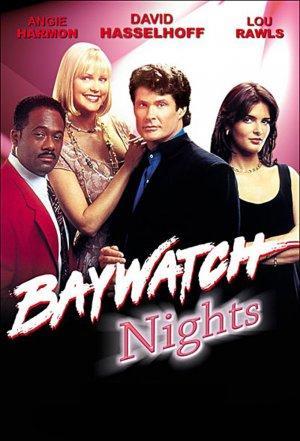
The year was 1995 and Baywatch, a show about lifeguards, was the most popular in the world.  Even though the critics never cared for the show, it got monster ratings.  Having played head lifeguard Mitch Buchanan for 6 years, star David Hasselhoff was growing tired with Baywatch’s format.  He wanted to try something new and that new thing was Baywatch Nights.  During the two years that Baywatch Nights aired, Mitch would spend his days as a lifeguard and his nights as a private investigator!

Baywatch Nights ran for two seasons.  The second season is remembered for featuring Mitch battling aliens, ghosts, and vampires.  The first season featured Mitch dealing with more traditional villains.  For our latest Late Night Retro Television Review, we’ll be looking at both seasons of Baywatch Nights!

Episode 1.1 “Pursuit”

(Dir by Gus Trikonis, originally aired on September 30th, 1995)

The very first episode of Baywatch Nights opens with Mitch Buchanan (played, of course, by David Hasselhoff) speaking directly to the audience.  He’s standing at his lifeguard stand, wearing his signature red Baywatch swim trunks.

“Some people,” Mitch says straight to the camera, “think that the beach closes when the sun goes down.  Uh-uh.  That’s when it really starts to heat up.”  Mitch goes on to explain that he’s working a second job as a private investigator.  His old friend, Garner Ellerbee (Gregory Alan Williams), is a partner in a detective agency with Ryan McBride (Angie Harmon), who was born in Texas, became a detective in New York, and recently moved to California.  Mitch is working with them.  Suddenly, Mitch says that he hopes those watching will enjoy this “new show.”

This brings up an interesting question.  Are we listening to Mitch or are we listening to David Hasselhoff?  If it’s David Hasselhoff talking directly to the audience, his monologue would seem to suggest that he thinks that Baywatch is real life, even though it’s a TV show.  He talks about Garner and Ryan as if they’re real people.  If we’re listening to Mitch Buchanan, that means that he has somehow become aware that he’s a character on a television show.  Has Mitch become self-aware?  Or has he realized that he’s living in some sort of Truman Show-style situation?

These are all questions that will probably never be answered.

As for the episode, it jumps right into things.  Mitch, Garner, and Ryan have their private detective offices located right above a nightclub called — wait for it — “Nights.”  Occasionally, they are helped by Destiny Desimone (Lisa Stahl), a perky blonde who spends her days doing Tarot card readings on the beach and her nights hanging out around the office.  When Ryan can’t figure out how to use a computer, Destiny is there to help  When Mitch and Garner can’t figure out how to have multiple landlines in one office, Destiny figures it all out!  It’s all very 90s, with boxy computers and long telephone cords.

Mitch’s first case involves serving as a bodyguard for a model named Cassidy (Carol Alt).  Cassidy says that someone is stalking her and she’s especially worried because another model has recently been murdered.  (“Her name was Alexa,” Mitch muses as he looks at the murdered model’s body, “This was her last photo session.”)  Mitch protects Cassidy and, of course, he falls for her but, in the end, he realizes that Cassidy has actually been stalking herself and was responsible for the other model’s death.  Mitch is shaken by his discovery of Cassidy’s guilt, even though the exact same thing previously happened to him during the first season of Baywatch, when he fell in love with a woman who turned out to be a black widow murderer.  Mitch muses that he knows how to be a lifeguard but he’s still learning how to be a private eye.

(Mitch, seriously, just watch reruns of Baywatch!  I mean, you’re only one episode into Baywatch Nights and you’re already recycling old plots so I imagine you should just keep doing what you did the first time.)

This episode’s plot is pretty predictable but, for a pilot, it’s likable.  Angie Harmon, Gregory Alan Williams, and David Hasselhoff all have a likable chemistry and, as a Texas girl, I appreciated the fact that Angie Harmon’s accent was authentic.  Mitch narrates the episode in a hard-boiled, private eye manner and David Hasselhoff’s earnest delivery is so at odds with his words that it becomes rather charming.  As a friend of mine once said when we watched him in Starcrash, “Every country should have a Hoff!”

As far as first episodes go, Pursuit does everything it needs to do.  It introduces us to the characters and their personalities.  Ryan is supercool and has really pretty hair.  Destiny is quirky.  Garner is determined.  And Mitch …. well, Mitch is David Hasselhoff.  Wisely, the first episode didn’t spend too much time trying to rationalize the idea of Mitch working all day as a lifeguard and then all night as a private eye.  Realistically, it seems like he would end up too exhausted to be good at either job.  Instead, the first episode simply tells the audience that Mitch is now a detective and that the audience better be willing to accept it.

(Unfortunately, most of the audience didn’t accept it, which is why the second episode featured Mitch dealing with sea monsters and resurrected Vikings.  We’ll get to that in a while.)

Next week, Mitch battles a group of thieves on skates!  Seriously, you know that’s going to be fun!

Shattered Politics #85: In the Loop (dir by Armando Iannucci)


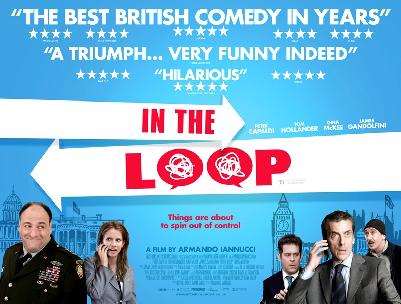
In_the_Loop_poster

First released in 2009, In The Loop is one of the most brilliant political satires ever made.

The film opens in London, as a slightly ridiculous man named Toby (Chris Addison) starts his first day as the special assistant to the Secretary of State for International Development, Simon Foster (Tom Hollander).  And what a day to start!  Both the President of the United States and the British Prime Minister are eager to invade the Middle East and, during an interview the previous night, Simon accidentally announced that war was “unforseeable.”  This has led to people accidentally assuming that Simon is anti-war (Simon really doesn’t seem to have an opinion one way or the other) but it also means that the Prime Minister’s compulsively profane assistant, Malcolm Tucker (Peter Capaldi), is now running around the office and threatening people.

(I doubt that there’s any way that I can do justice to Capaldi’s performance here.  You simply have to see him.  He is a force of nature, a tornado of nonstop profanity and aggression.)

Not every government official in the U.S. is enthusiastic about going to war.  Both Assistant Secretary of State for Diplomacy Karen Clarke (Mimi Kennedy) and her former lover, Gen. George Miller (James Gandolfini) are opposed to the war.  Karen’s assistant, Liza (Anna Chlumsky), has even written a paper that explains why a war in the Middle East could not be won.  Karen hopes to use Simon as a spokesman to keep the British out of the war and, therefore, America as well.

(Toby, meanwhile, just wants to have sex with Liza.)

However, there are a few factors that complicate things.  First off, Malcolm is determined to make sure that the Prime Minister gets what he wants and if that means bullying and scaring everyone into supporting an unwinnable war, that’s exactly what he’s going to do.  Secondly, U.S. Assistant Secretary of State For Policy Linton Barwick (David Rasche) is eager enough to start a war that he’s actually started a secret committee to find a way to get into the war.  (The committee, of course, has been called the Committee For Future Planning.)  Third, and perhaps most importantly, Simon is an idiot.

Along with being both a satire of American-British relations (my favorite moment comes when a random American tourist tells Malcolm to stop cursing in public) and the lead-up to the Iraq War, In The Loop is also a devastating look at how government works.  In the Loop makes a good case that, for all the titles and the committee and the talk about doing what’s right, most government policy is the result of a combination of stupidity and needless aggression.  As played by Capaldi, Malcolm has no ideology or core beliefs.  He simply makes sure that the Prime Minister gets what he wants.

And if that means going to war, then Malcolm will do whatever it takes to push Britain into war.

Director Armando Iannucci is probably best known for creating two political comedies, the Thick of It and Veep.  And while I’ve never seen The Thick Of It, I absolutely love Veep.  From what I’ve read, all three projects share the same fictional universe.  (Capaldi’s Malcolm was the main character on The Thick Of It.)

Though, actually, I think it’s debatable just how fictional that universe is.  Ultimately, In The Loop is probably one of the most plausible satires that I’ve ever seen.

http://www.youtube.com/watch?v=_VDc7-YH1LA

Film Review: Midnight in Paris (dir. by Woody Allen)


Woody Allen’s latest film, Midnight in Paris, has an appealing premise behind it. 

Gil (Owen Wilson) is a Hollywood screenwriter who has come to Paris with his shallow fiancée Inez (Rachel McAdams) and her stuffy Republican parents (played by Kurt Fuller and Mimi Kennedy).  Disillusioned with American culture, Gil idealizes the Paris of the 1920s, the Paris that was home to Ernest Hemingway, F. Scott Fitzgerald, and James Joyce.  However, Inez and her parents are far less impressed with Paris and, as quickly become clear, with Gil himself.  While Inez spends her time with self-important “intellectual” Paul (a bearded Michael Sheen), Gil takes to wandering the streets of Paris at night.

One night, as Gil wanders around Paris, a vintage car approaches out of the shadows and the two well-dressed passengers in the back seat invite Gil to join them.  Gil does so and discovers that he’s been transported back to 1920s Paris.  He meets everyone from Hemingway (Corey Stoll) to Salvador Dali (Adrien Brody) to F. Scott and Zelda Fitzgerald (Tom Hiddleston and Alison Pill).  At the end of the night, Gil finds himself transported back to modern-day Paris.  Soon, Gil finds himself sneaking out at midnight every night so he can escape to the past, where he eventually meets and starts to romance an idealistic model named Adrianna (Marion Cotillard).  While Gil finds himself torn between his modern life and the past that he loves, he also begins to discover that the inhabitants of the 20s feel the same way about their present as he does about his.

The premise of the film itself is likable and one that I think anyone can relate to.  Who doesn’t wish that they could go back in the past and live with all the amazing people who they’ve only read about?  Myself, there are many eras that I often fantasize about finding myself in.  1920s Paris is definitely one of them but I’ve also occasionally dreamed of being in 1950s New York, having a threesome with Kerouac and Cassady or maybe being in Paris during the early days of the French new wave, appearing in movies directed by Rollin, Truffaut and Godard.  Ever since I read Peter Biskind’s Easy Riders and Raging Bulls, there’s been a part of me that wishes so much I could have been out in Hollywood or New York in the 1970s, hanging out on the beach with directors like Martin Scorsese, William Freidkin, Jon Milius, and even Peter Bogdonavich.  (But especially Freidkin, his terrible charisma just radiates from the page.) 

Still, Allen is smart enough as a screenwriter to know that everyone tends to idealizes the past, even those who we now idealize in the present.  Perhaps my favorite part of the film came when Wilson, while in the 1920s, sees a character getting into a horse-drawn carriage so that she can go back to the time that she idealizes as fiercely as he idealizes the 20s.

Midnight in Paris has a lot to recommend it.  Cotillard, despite the fact that she’s played the same idealized French mystery woman about a thousand times, gives a likeable performance and Rachel McAdams is hilariously shallow.  Michael Sheen, as well, makes a perfect stand-in for every pompous, self-important jerk who has ever talked down to you.  On the basis of his cameo appearance here as Dali, Adrien Brody really needs to consider doing more comedy.  He’s a lot more appealing when he’s being funny than when he’s trying to be a leading man.

At the same time, I have to admit that I wanted to like Midnight in Paris more than I actually did.  I like Owen Wilson as both an actor and a writer but he’s a little bit miscast here and the end result is that he occasionally seems like he’s trying too hard.  You just never buy him and McAdams as a couple and, as such, there’s really not much at stake as far as his romance with Cotillard is concerned. 

As well, I found it hard not to be a little bit disappointed with the way Allen presented 1920s Paris.  Though they were all well-cast and acted, Hemingway, the Fitzgeralds, Gertrude Stein (Kathy Bates), and all the rest just fell flat as actual characters.  Gil gets a chance to go into the past and essentially, he discovers that Hemingway was macho, the Fitzgeralds were neurotic and self-destructive, and that Dali didn’t make much sense.  Personally, I would be a bit let down if I got a chance to meet these icons and I discovered that essentially they just acted the exact same way that they acted in various PBS educational programs.

Despite this, Midnight in Paris is still a likable, frequently engaging comedy that works best as a tribute to a legendary and beautiful city that Allen (not to mention myself) obviously loves.  Flaws and all, this movie made me want to visit Paris once again (though Florence and Venice remains my favorite cities of all time) and, for that reason alone, it makes Midnight in Paris a film worth seeing.