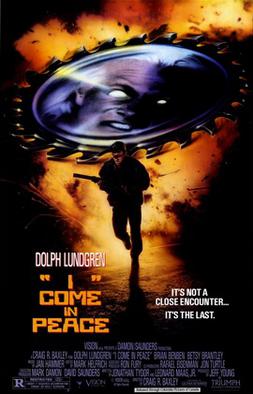
Dolph Lundgren is Jack Crain, a Houston cop who teams up with FBI agent Larry Smith (Brian Benben) to investigate who is killing criminals in H-town. The killer is a drug dealer but not your everyday drug dealer. He’s an alien named Talec (Matthias Hues) and he’s figured out how to say “I come in peace,” but the rest of the English language is beyond him. “I come in peace,” turns out to be the scariest phrase you can hear when you’re being pursued by a white-haired, intergalactic mass murderer. His targets include Jesse Vint and Michael J. Pollard. This terminator wannabe is after character actors!
On the second-tier action stars of the 90s, Lundgren was the one who could actually act. Van Damme could actually do all the acrobatic stunts his characters did but he couldn’t show emotion like Lundgren. Steven Seagal seemed like he could handle himself in a fight but he lacked Lundgren’s self-aware humor. Lundgren plays Jack as almost being a parody of the type of hard-boiled cop who is always getting yelled at by the commissioner for wasting the city’s money. Brian Benben is remembered, by some, as the star of HBO’s DreamOn, the sitcom that convinced a generation of young men that there’s nothing women love more than obscure pop cultural obsessions. Benben is actually pretty funny in IComeInPeace. He’s the everyman who can’t believe he’s having to deal with an intergalactic drug dealer. Good heroes need a good villain and Matthias Hues is just right as the drug dealing alien who literally doesn’t know what he’s saying.
If you want to see a Terminator rip-off with nonstop action, a memorable villain, frequently (and intentionally) funny dialogue, an Al Leong cameo, and Dolph Lundgren as a hero who pushes people around just because he feels like it, IComeInPeace is the movie for you!
Every Monday night at 9:00 Central Time, my wife Sierra and I host a “Live Movie Tweet” event on X using the hashtag #MondayMuggers. We rotate movie picks each week, and our tastes are quite different. Tonight, Monday May 5th, we celebrate Cinco de Mayo with DARK ANGEL (1990) starring Dolph Lundgren, Brian Benben, Betsy Brantley, Matthias Hues, and Michael J. Pollard.
I really enjoy Amazon Prime’s plot description for the film… “A renegade cop undercover on a drug sting discovers a murderous alien who feasts on the brains of heroin addicts.” Honestly, if that description doesn’t make you want to watch the film, there’s probably nothing I can say to bring you along. On a side note, I remember this movie going under the name I COME IN PEACE when I was in high school, which is kind of cool because the bad guy will say he comes in peace right before committing horrific murder. But now it’s called DARK ANGEL, so that’s that.
So join us tonight for #MondayMuggers and watch DARK ANGEL! It’s on Amazon Prime. The trailer is included below:
“What is it exactly that you want?” a preacher (Frank Maxwell) asks a congregation of leather-clad bikers.
“We want to get loaded!” Heavenly Blues (Peter Fonda) replies, “And we want to have a good time!”
And have a good time, they proceed to have. Of course, it’s a good time for them. Everyone else who meets the bikers at the center of 1966’s The Wild Angels are horrified by this collection of rebellious and violent outsiders. Sure, Heavenly Blues might actually be a soulful guy who mistakenly believes that he can control the gang’s more excessive tendencies. His girlfriend, Mike (Nancy Sinatra), actually seems rather reserved and conservative when compared to the rest of the gang. But make no mistake about it, the majority of the members of the gang are into violence for its own sake. They are bullies who couldn’t make the football team so, instead, they hopped on a motorcycle and formed their own society. They’re self-styled rebels but what are they rebelling against? What have you got?
I know, I know. That famous line comes from Marlon Brando and it was uttered in The Wild One. Peter Fonda, to put it lightly, was no Marlon Brando and, as directed by Roger Corman, The Wild Angels doesn’t have the societal concerns that lay at the hear of The Wild One. As Corman was often the first to admit, his main concern when it came to making movies was to make money. Corman wasn’t necessarily against message films. He often stated that, as a director, 1962’s The Intruderwas the film in which he took the most pride. The Intruder took a firm stand against racism and it let everyone know where Corman stood on when it came to the Civil Rights Movement. It was also one of his few films to lose money. The Wild Angels celebrates rebellion but one gets the feeling that celebration is motivated by the fact that younger filmgoers would be happy to pay to see a movie about a bunch of “youngish” people telling the old folks to shut up and get out of the way. The Wild Angels themselves don’t seem to be motivated by any sort of grand ideology. Heavenly Blues preaches about getting loaded and having a good time and celebrating freedom but he also allows the members of the gang to drape a Nazi flag over a casket. What does Heavenly Blues actually believe in?
Heavenly Blues believes in loyalty to his friends. For all the fights and the orgies and the scenes of motorcycles roaring down country roads, this is ultimately just a film about a guy who wants to give his best friend a decent burial. The Loser (Bruce Dern) dies about halfway through the film and one gets the feeling that he probably would have lived if the gang hadn’t kidnapped him from the hospital. Heavenly Blues wants to give The Loser the type of wild funeral that Blues thinks he would have wanted though I think The Loser probably would have been happier not have been killed by the actions of his idiot friends. Diane Ladd, who was married to Bruce Dern at the time and who has said Laura Dern was conceived during the filming of The Wild Angels, is heart-breaking as The Loser’s girlfriend, Gaysh. Gaysh wants to mourn her boyfriend while the rest of the gang is more concerned with figuring out who her next boyfriend is going to be.
Does Heavenly Blues ever realize that he’s traveling with a bunch of animals? He does but one gets the feeling that he’s accepted his fate. There’s no going back. The past can’t change and the future cannot be controlled so Heavenly Blues is content to live in the present. All he can do is try to give his friend a decent burial while the sirens of cops shriek in the distance.
The Wild Angels was a controversial film when it was first released. It also made a lot of money and led to a whole cycle of outlaw biker films, culminating with Easy Rider. Seen today, it’s a portrait of a society coming apart, with the establishment and the bikers not even willing to stop fighting long enough to allow for a simple burial. It’s definitely a time capsule film, one of those productions that epitomizes an era. There’s not much going on underneath the surface and most of the film’s bikers really are awful people but there is something touching about Blues giving it all up just to try to give his friend a decent burial.
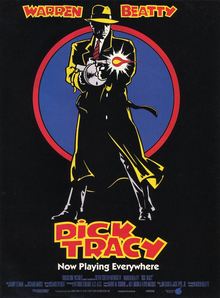
The year is 1937 and “Big Boy” Caprice (Al Pacino) and his gang of flamboyant and often disfigured criminals are trying to take over the rackets. Standing in their way is ace detective Dick Tracy (Warren Beatty), the yellow trench-wearing defender of the law. Tracy is not only looking to take down Caprice but he and Tess Trueheart (Glenne Headly) are currently the guardians of The Kid (Charlie Korsmo), a young street kid who witnessed one of Caprice’s worst crimes. Tracy’s investigation leads him through a rogue’s gallery of criminals and also involves Breathless Mahoney (Madonna), who has witnessed many of Caprice’s crimes but who also wants to steal Tracy’s heart from Tess.
Based on the long-running comic strip, Dick Tracy was a labor of love on the part of Warren Beatty. Not only starring but also directing, Tracy made a film that stayed true to the look and the feel of the original comic strip (the film’s visual palette was limited to just seven colors) while also including an all-star cast the featured Madonna is an attempt to appeal to a younger audience who had probably never even heard of Dick Tracy. When Dick Tracy was released, the majority of the publicity centered around Madonna’s participation in the film and the fact that she was dating Beatty at the time. Madonna is actually probably the weakest element of the film. More of a personality than an actress, Madonna is always Madonna no matter who she is playing and, in a film full of famous actors managing to be convincing as the members of Dick Tracy’s rogue gallery, Madonna feels out of place. Michelle Pfeiffer would have been the ideal Breathless Mahoney.
It doesn’t matter, though, because the rest of the film is great. It’s one of the few comic book films of the 90s to really hold up, mostly due to Beatty’s obvious enthusiasm for the material and the performances of everyone in the supporting cast who was not named Madonna. Al Pacino received an Oscar nomination for playing Big Boy Caprice but equally good are Dustin Hoffman as Mumbles, William Forsythe as Flaptop, R.G. Armstong as Pruneface, and Henry Silva as Influence. These actors all create memorable characters, even while acting under a ton of very convincing makeup. I also liked Dick Van Dyke as the corrupt District Attorney. Beatty knew audience would be shocked to see Van Dyke not playing a hero and both he and Van Dyke play it up for all its worth. Beatty embraces the comic strip’s campiness while still remaining respectful to its style and the combination of Danny Elfman’s music and Stephen Sondheim’s songs provide just the right score for Dick Tracy’s adventures. The film can be surprisingly violent at times but the same was often said about the Dick Tracy comic strip. It wasn’t two-way wrist radios and trips to the Moon. Dick Tracy also dealt with the most ruthless and bloodthirsty gangsters his city had to offer.
Dick Tracy was considered to be a box office disappointment when it was originally released. (Again, you have to wonder if Beatty overestimated how many fans Dick Tracy had in 1990.) But it holds up well and is still more entertaining than several of the more recent comic book movies that have been released.
Since Sunday is a day of rest for a lot of people, I present #SundayShorts, a weekly mini review of a movie I’ve recently watched.
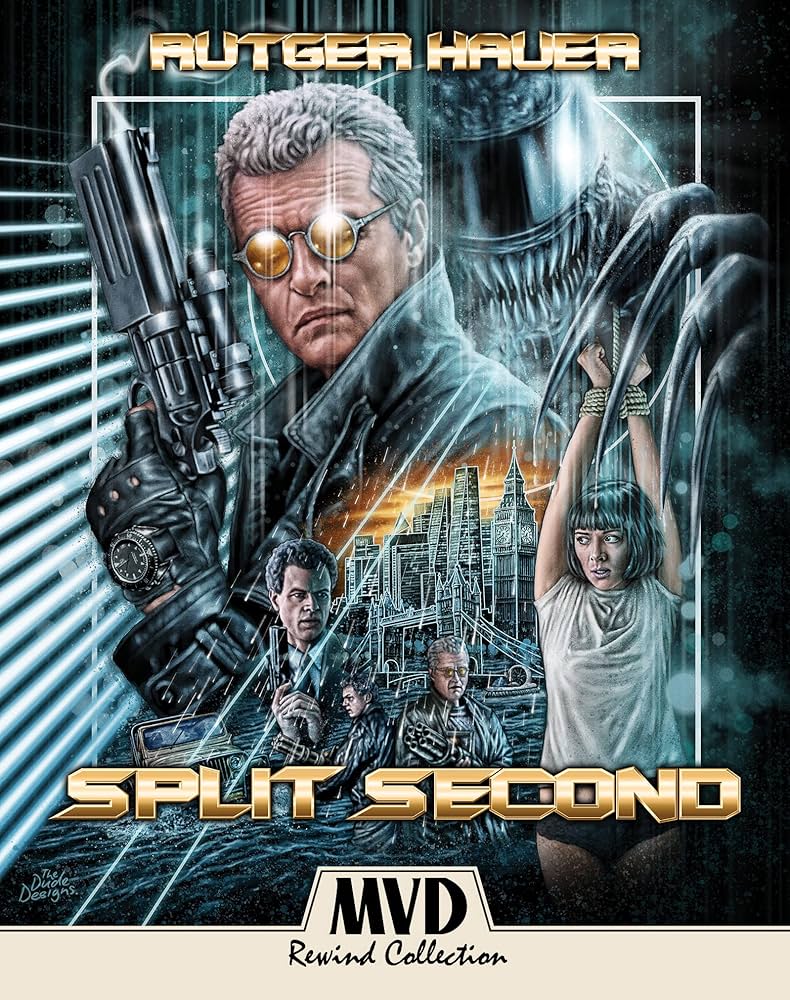
Rutger Hauer chews the scenery in grand style as a badass London cop on the trail of a serial killer who rips the hearts out of the chest of its victims, is about 10 feet tall, and whose teeth appear to be that of a beastly monster. SPLIT SECOND is a fun mishmash of genres….part action, part horror, part comedy, and all entertainment! It’s especially enjoyable for fans of Hauer like me. It’s currently streaming on Amazon Prime, Pluto and Tubi.
Fast Facts:
I saw SPLIT SECOND in a movie theater in Conway, Arkansas in 1992. I was the only person in the theater. It’s a fun movie, but it did not perform well at the box office, only earning $5.4 Million on a $7 Million budget.
1992 was a good year for Rutger Hauer. Not only did he star in SPLIT SECOND, he also starred as the head vampire Lothos in the movie version of BUFFY THE VAMPIRE SLAYER. Written by Joss Whedon, Hauer’s co-stars included Kristy Swanson, Luke Perry, Donald Sutherland & Paul Reubens (PeeWee Herman).
Detective Dick Durkin is played by actor Alistair Duncan. When the movie was originally released in 1992, he was credited as Neil Duncan. Whatever his name, Mr. Duncan is absolutely hilarious in the film. His reaction when he first sees the creature is so good… “We need to get bigger guns. BIG F’ING GUNS!”
The original script took place in Los Angeles and involved a ritualistic serial killer who murders five people every five years during the last quarter-century. The producers decided the script needed to be changed because the story was too similar to a film called THE FIRST POWER starring Lou Diamond Phillips. The script that was ultimately used for the movie was set in London, which was half under water due to global warming.
If you like Kim Cattrall from SEX AND THE CITY, she’s in this. My wife thought that was interesting.
Billy Colton (Derek Rydall) is a teenager who has a reputation for exaggeration. Lisa Grace (Shannon Tweed) is his next door neighbor, a high-priced prostitute who does not mind if Billy spies on her. When Billy tries to tell everyone about his wild new neighbor, no one believes him. Billy decides to prove his story by grabbing his camera and sneaking next door. Instead of getting proof that she’s a prostitute, Billy witnesses his neighbor being murdered by a robed Satanist, who just happens to be Zachary Willard (Allen Garfield), Billy’s hated science teacher! Billy goes to the police with his camera but Captain Crane (Richard Roundtree) points out that Billy forgot to take off the lens cap.
What can Billy do? He knows that Zachary and his strange brother, Stanley (Michael J. Pollard), are sacrificing prostitutes to Satan but he can’t get anyone to believe him. Working with his best friend (Teresa Van der Woude) and a burned out ex-cop (Elliott Gould), Billy sets out to stop the Willard Brothers.
Combine Rear Window with late 80s Satanic conspiracy theories and this is the result. Not as bad as it sounds, Night Visitor is an unfairly obscure movie about Satanism in suburbia. While it has its share of dumb moments (like when Billy uses a watermelon to end a car chase), it also has enough good moments that suggest that Night Visitor is deliberately satirizing the excesses of the Satanic panic that, at the time of filming, was sweeping across the nation. It also has a once in a lifetime cast. Along with those already mentioned, keep an eye out for character actor extraordinaire Henry Gibson and future adult film star Teri Weigel. Allen Garfield is especially good as the evil Mr. Willard. Any actor can say, “I sacrifice you in the name of Satan.” It takes a good actor like Allen Garfield to say it without making anyone laugh.
One final note: this movie was originally called Never Cry Devil, which is a much better title than Night Visitor.
(Lisa is currently in the process of cleaning out her DVR! It’s going to take a while. She recorded this 1962 literary adaptation off of FXM on January 30th!)
Hemingway’s Adventures Of A Young Man is one of those films that you just know was made specifically to win Oscars. It’s a big prestige production, complete with a historical setting, an epic scope and big, all-star cast. That most of those stars appear in relatively small roles was undoubtedly meant to evidence of the film’s importance.
“Look!” the film seems to shout at times, “This is such an important film that even Paul Newman was willing to stop by for a day’s work!”
The film is based on ten short stories by Ernest Hemingway and, loosely, A Farewell to Arms. The stories all dealt with the early life of Nick Adams, who was a literary stand-in for Hemingway. Since the Nick Adams stories were autobiographical (and, for that matter, so was A Farewell to Arms), the film can also be viewed as biopic. Richard Beymer (who, a year earlier, had starred in West Side Story and who is currently playing Ben Horne on Twin Peaks) may be playing Nick Adams but the film leaves little doubt that he was actually meant to be playing Ernest Hemingway.
The film opens with Nick hunting with his father, Dr. Harold Adams (Arthur Kennedy). He is present when his father travels to an Indian camp and helps to deliver a baby. He respects his father but Nick wants to see the world and the film follows him as he explores America, working odd jobs and meeting colorful characters along the way. Paul Newman shows up as a punch-drunk boxer and proceeds to overact to such an extent that he reminded me of Eric Roberts appearing in a Lifetime film. Nick meets rich men, poor men, and everything in between. He works as a journalist. He works as a porter. Eventually, when World War I breaks out, Nick enlists in the Italian army and the film turns into the 100th adaptation of A Farewell to Arms.
And really, I think it would have been an enjoyable film if it had been directed by someone like Otto Preminger, George Stevens, or maybe even Elia Kazan. These are directors who would have embraced both the pulpy potential of the Nick Adams stories and the soapy melodrama of the war scenes. A showman like Preminger would have had no fear of going totally and completely over the top and that’s the approach that this material needed. Instead, Hemingway’s Adventures Of A Young Man was directed, in a painfully earnest style, by Martin Ritt. Ritt tries to imitate Hemingway’s famously understated style with his understated direction but, cinematically, it’s just not very interesting. Ritt portrays everything very seriously and very literally and, in the end, his direction is more than a little dull.
Sadly, the same can be said for Richard Beymer’s performance in the lead role. Beymer comes across as being the nice guy who everyone says you should marry because he’ll be able to get a good and stable job and he’ll probably never go to jail. Two months ago, when I watched and reviewed Twin Peaks, I really loved Beymer’s performance as Ben Horne. He just seemed to be having so much fun being bad. Unfortunately, in Hemingway’s Adventures Of A Young Man, he never seemed to be having any fun at all. No wonder he temporarily put his film career on hold so that he could fully devote himself to working as a civil rights activist.
In the end, this is a movie that’s a lot more fun to look at than to actually watch. Visually, the film is frequently quite pretty in an early 1960s prestige movie so sort of way. And there are some good performances. Eli Wallach, Ricardo Montalban, Susan Strasberg, Arthur Kennedy — there’s a whole host of performers doing memorable supporting work. Unfortunately, even with all that in mind, this well-intentioned film largely falls flat.
If you’re ever visiting my former hometown of Denton, Texas, you owe it to yourself to do two things.
Number one, go to Recycled Books and Records. It’s right across the street from the old courthouse and it’s perhaps the greatest used bookstore in the world. When I was going to college at UNT, I would spend hours in Recycled Books. Not only do they have three floors of books but they have some really nice apartments on the fourth floor. I attended my share of hazily remembered parties in those apartments.
The second thing that you must do is stop by the Campus Theater. The Camps Theater is located on the other side of the old courthouse and it is a true historical landmark. (It’s also the home of the Denton Community Theatre.) When you step inside of the theater, be sure to look for a plaque on the wall. The plaque will inform you that, in 1967, Arthur Penn’s Bonnie and Clyde premiered at the Campus Theater.
Bonnie and Clyde not only premiered in Denton but it was also filmed around North Texas. This was a pragmatic decision, made to minimize studio interference. Even with that in mind, that’s still the way it should have been because Bonnie Parker and Clyde Barrow are true Texas legends. In the 1930s, they were young, they robbed banks, and they killed people. Much like many of the outlaws of the era, they became folk heroes and they died in a hail of bullets.
In the picture above, Clyde is short, scrawny, and slightly handsome in a class clown sort of way. Bonnie, meanwhile, is even shorter than Clyde and has the hard look of someone who has never known an easy life. Both of them have a look that should be familiar to anyone who has spent any time in the small towns that dot the North Texas landscape. They look like real people. They don’t look like film stars.
Here’s the movie’s version of Bonnie and Clyde:
In other words, Bonnie and Clyde is not a documentary. But that doesn’t matter. 50 years after it was first released Bonnie and Clyde remains a powerful and, even more importantly, extremely entertaining film. When the film was released, it was controversial for it violence and, having recently rewatched it, I have to say that the violence still makes an impression. When guns are fired, the shots seem to literally explode in your ear. When people are torn apart by bullets, they die terrible deaths and the film’s most graphic demises are reserved for its most likable characters. Towards the end of the film, with the Texas Rangers relentlessly closing in on Bonnie and Clyde, the tension becomes almost unbearable.
What makes the violence all the more disturbing is that it often interrupts scenes that, until the bullets started flying, were often humorous. A bank robbery starts out as a lark, becomes an exciting chase scene as Bonnie and Clyde attempt to escape, and suddenly turns into an act of shocking of violence when Clyde fire a gun and shoots a man point-blank in the face. Later, stopping to help an old farmer change a tire leads to a sudden ambush. Perhaps the film’s outlook is best captured in a scene in which the Barrow gang cheerfully bonds with a hostage until they suddenly find out that he’s an undertaker, a reminder that the promise of death is always present.
“Get him out of here!” Bonnie snaps.
Like many of the great gangster films, Bonnie and Clyde presents its outlaws as being folk heroes. They may rob banks and occasionally kill people but they look good doing it and they seem like they would be fun to hang out with. The thing that set Bonnie and Clyde apart from previous gangster films is that it refused to even pretend to condemn its bank robbers. The cops and the Texas Rangers are all on the side of the banks and the banks are on the side of big business. Bonnie and Clyde aren’t outlaws. They’re rebels. When they rob banks, they’re not just taking money. They’re standing up to the same establishment that was feared in the 30s, resented in the 60s, and hated today.
Clyde is played by Warren Beatty (who also produced the film) and Bonnie is played by Faye Dunaway and both of them give performances that literally define screen charisma. You never forget that you’re watching two movie stars but, at the risk of repeating myself, Bonnie and Clyde is not meant to be a documentary. At times, it almost seems as if Beatty’s Clyde and Dunaway’s Bonnie know that they’re characters in a gangster movie. They know that they’re doomed because that’s how gangster movies work so, as a result, they’re determined to live as much life as possible before that final reel. The supporting cast — Gene Hackman, Estelle Parsons, Michael J. Pollard, Gene Wilder — are all great but the film is definitely a celebration of Beatty and Dunaway.
Bonnie and Clyde went from premiering at the Campus Theater to a best picture nomination. However, it lost to In The Heat of the Night.
The Story of Suicide Sal
A Poem by Bonnie Parker
We each of us have a good “alibi”
For being down here in the “joint”;
But few of them really are justified
If you get right down to the point.
You’ve heard of a woman’s “glory”
Being spent on a “downright cur,”
Still you can’t always judge the story
As true, being told by her.
As long as I’ve stayed on this “island,”
And heard “confidence tales” from each “gal,”
Only one seemed interesting and truthful —
The story of “Suicide Sal.”
Now “Sal” was a gal of rare beauty,
Though her features were coarse and tough;
She never once faltered from duty
To play on the “up and up.”
“Sal” told me this tale on the evening
Before she was turned out “free,”
And I’ll do my best to relate it
Just as she told it to me:
I was born on a ranch in Wyoming;
Not treated like Helen of Troy;
I was taught that “rods were rulers”
And “ranked” as a greasy cowboy.”
Then I left my old home for the city
To play in its mad dizzy whirl,
Not knowing how little of pity
It holds for a country girl.
There I fell for “the line” of a “henchman,”
A “professional killer” from “Chi”;
I couldn’t help loving him madly;
For him even now I would die.
One year we were desperately happy;
Our “ill gotten gains” we spent free;
I was taught the ways of the “underworld”;
Jack was just like a “god” to me.
I got on the “F.B.A.” payroll
To get the “inside lay” of the “job”;
The bank was “turning big money”!
It looked like a “cinch” for the “mob.”
Eighty grand without even a “rumble” —
Jack was last with the “loot” in the door,
When the “teller” dead-aimed a revolver
From where they forced him to lie on the floor.
I knew I had only a moment —
He would surely get Jack as he ran;
So I “staged” a “big fade out” beside him
And knocked the forty-five out of his hand.
They “rapped me down big” at the station,
And informed me that I’d get the blame
For the “dramatic stunt” pulled on the “teller”
Looked to them too much like a “game.”
The “police” called it a “frame-up,”
Said it was an “inside job,”
But I steadily denied any knowledge
Or dealings with “underworld mobs.”
The “gang” hired a couple of lawyers,
The best “fixers” in any man’s town,
But it takes more than lawyers and money
When Uncle Sam starts “shaking you down.”
I was charged as a “scion of gangland”
And tried for my wages of sin;
The “dirty dozen” found me guilty —
From five to fifty years in the pen.
I took the “rap” like good people,
And never one “squawk” did I make.
Jake “dropped himself” on the promise
That we make a “sensational break.”
Well, to shorten a sad lengthy story,
Five years have gone over my head
Without even so much as a letter–
At first I thought he was dead.
But not long ago I discovered
From a gal in the joint named Lyle,
That Jack and his “moll” had “got over”
And were living in true “gangster style.”
If he had returned to me sometime,
Though he hadn’t a cent to give,
I’d forget all this hell that he’s caused me,
And love him as long as I live.
But there’s no chance of his ever coming,
For he and his moll have no fears
But that I will die in this prison,
Or “flatten” this fifty years.
Tomorrow I’ll be on the “outside”
And I’ll “drop myself” on it today;
I’ll “bump ’em” if they give me the “hotsquat”
On this island out here in the bay…
The iron doors swung wide next morning
For a gruesome woman of waste,
Who at last had a chance to “fix it,”
Murder showed in her cynical face.
Not long ago I read in the paper
That a gal on the East Side got “hot,”
And when the smoke finally retreated
Two of gangdom were found “on the spot.”
It related the colorful story
of a “jilted gangster gal.”
Two days later, a “sub-gun” ended
The story of “Suicide Sal.”
The Story of Bonnie and Clyde
Another Poem by Bonnie Parker
You’ve read the story of Jesse James
Of how he lived and died;
If you’re still in need
Of something to read,
Here’s the story of Bonnie and Clyde.
Now Bonnie and Clyde are the Barrow gang,
I’m sure you all have read
How they rob and steal
And those who squeal
Are usually found dying or dead.
There’s lots of untruths to these write-ups;
They’re not so ruthless as that;
Their nature is raw;
They hate all the law
The stool pigeons, spotters, and rats.
They call them cold-blooded killers;
They say they are heartless and mean;
But I say this with pride,
That I once knew Clyde
When he was honest and upright and clean.
But the laws fooled around,
Kept taking him down
And locking him up in a cell,
Till he said to me,
“I’ll never be free,
So I’ll meet a few of them in hell.”
The road was so dimly lighted;
There were no highway signs to guide;
But they made up their minds
If all roads were blind,
They wouldn’t give up till they died.
The road gets dimmer and dimmer;
Sometimes you can hardly see;
But it’s fight, man to man,
And do all you can,
For they know they can never be free.
From heart-break some people have suffered;
From weariness some people have died;
But take it all in all,
Our troubles are small
Till we get like Bonnie and Clyde.
If a policeman is killed in Dallas,
And they have no clue or guide;
If they can’t find a fiend,
They just wipe their slate clean
And hand it on Bonnie and Clyde.
There’s two crimes committed in America
Not accredited to the Barrow mob;
They had no hand
In the kidnap demand,
Nor the Kansas City depot job.
A newsboy once said to his buddy;
“I wish old Clyde would get jumped;
In these awful hard times
We’d make a few dimes
If five or six cops would get bumped.”
The police haven’t got the report yet,
But Clyde called me up today;
He said, “Don’t start any fights
We aren’t working nights
We’re joining the NRA.”
From Irving to West Dallas viaduct
Is known as the Great Divide,
Where the women are kin,
And the men are men,
And they won’t “stool” on Bonnie and Clyde.
If they try to act like citizens
And rent them a nice little flat,
About the third night
They’re invited to fight
By a sub-gun’s rat-tat-tat.
They don’t think they’re too tough or desperate,
They know that the law always wins;
They’ve been shot at before,
But they do not ignore
That death is the wages of sin.
Some day they’ll go down together;
And they’ll bury them side by side;
To few it’ll be grief
To the law a relief
But it’s death for Bonnie and Clyde.
Earlier tonight, I watched a 1966 film called The Russians Are Coming, The Russians Are Coming.
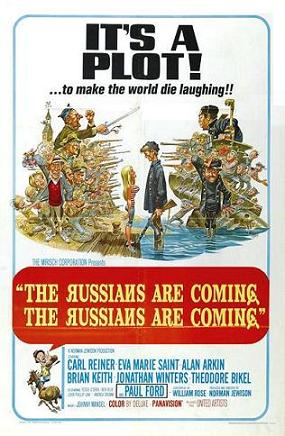
It’s a cheerful comedy about what happens when the captain (played by Theodore Bikel) of a Russian submarine decides that he wants to take a look at the United States. Though he was only planning to look at America through a periscope, he accidentally runs the submarine into a sandbar sitting near Gloucester Island, which itself sits off the coast of Massachusetts. The captain sends a nine man landing party, led by Lt. Yuri Rozanov (a youngish Alan Arkin, making his film debut and receiving an Oscar nomination for his efforts), to the island. Their orders are simple. Yuri and his men are too either borrow or steal a boat that can be used to push the submarine off the sandbar. If they run into any locals, they are to claim to be Norwegian fisherman.
Needless to say, things that don’t quite go as planned. The first Americans that Yuri and his men meet are the family of Walt Whitaker (Carl Reiner), a vacationing playwright. Walt’s youngest son immediately identifies the Norwegian fisherman as being “Russians with submachine guns.” When Walt laughingly asks Yuri if he’s a “Russian with a submachine gun,” Yuri produces a submachine gun and promptly takes Walt, his wife (Eva Marie Saint), and his children hostage.
Yuri may be a Russian. He may officially be an enemy of America. But he’s actually a pretty nice guy. All he wants to do is find a boat, keep his men safe, and leave the island with as little drama as possible. However, the inhabitants of the island have other plans. As rumors spread that the Russians have landed, the eccentric and largely elderly population of Gloucester Island prepares for war. Even as Police Chief Mattocks (Brian Keith) and his bumbling assistant, Norman Jonas (Jonathan Winters), attempt to keep everyone calm, Fendall Hawkins (Paul Ford) is organizing a militia and trying to contact the U.S. Air Force.
Meanwhile, Walt’s babysitter, Allison (Andrea Dromm) finds herself falling in love with one of the Russians, the gentle Alexei Kolchin (John Phillip Law).
As I said at the start of this review, The Russians Are Coming, The Russians Are Coming is a cheerful comedy, one with a rather gentle political subtext, suggesting that the majority of international conflicts could be avoided if people got to know each other as people as opposed to judging them based on nationality or ideology. There’s a rather old-fashioned liberalism to it that probably seemed quite daring in 1966 but which feels rather quaint today. Sometimes, the comedy gets a bit broad and there were a few times that I found myself surprised that the film didn’t come with a laugh track. But overall, this is a well-acted and likable little movie.
As I watched The Russians Are Coming, The Russians Are Coming (and, as someone who is contractually obligated to use a certain number of words per review, allow me to say how much I enjoyed the length of that title), I found myself considering that the film would have seemed dated in 2013 but, with all the talk of Russian hacking in the election and everything else, it now feels a little bit more relevant. Not a day goes by when I don’t see someone on twitter announcing that the Russians are coming. Of course, if the film were released today, its optimistic ending would probably be denounced as an unacceptable compromise. Peaceful co-existence is no longer as trendy as it once was.
Another interesting thing to note about The Russians Are Coming, The Russians are Coming: though the film was written by William Rose (who also wrote another example of mild 1960s feelgood liberalism, Guess Who’s Coming To Dinner), it was based on a novel by Nathaniel Benchley. Benchley was the father of Peter Benchley, the author of Jaws. It’s easy to see the eccentrics of Gloucester Island as distant cousins of the inhabitants of Amity Island.
As previously stated, The Russians Are Coming, The Russians Are Coming was nominated for best picture but it lost to the far more weighty A Man For All Seasons.
Truman Gates (Patrick Swayze) may have been raised in Appalachia but, now that he lives in Chicago, he’s left the old ways behind. He has a job working as a cop and his wife (Helen Hunt) is pregnant with their first child. When Truman’s younger brother, Gerald (Bill Paxton), shows up in town and asks for Truman’s help, Truman gets him a job as a truck driver. But, on his first night on the job, Gerald’s truck is hijacked by a Sicilian mobster named Joey Rosellini (Adam Baldwin) and Gerald is killed. Truman’s older brother, Briar (Liam Neeson), soon comes to Chicago and declares a blood feud on the mob.
Of the many action films that Patrick Swayze made between Dirty Dancing and Ghost, Roadhouse may be the best known but Next of Kin is the best. Next of Kin spends as much examining the family dynamics of Rosellini’s family as it does with Truman’s, suggesting that there is not much of a difference between the two groups. There’s even a scene where Joey’s uncle (played by Andreas Katsulas) tells Joey that the Sicily was the Appalachia of Italty. Next of Kin also has a better supporting cast than most of the films that Swayze made during this period. Along with Paxton and Neeson, the hillbillies are represented by actors like Ted Levine and Michael J. Pollard while Ben Stiller has an early role as Joey’s cousin. Patrick Swayze gives one of his better performances as Truman but the entire movie is stolen by Liam Neeson, who is a surprisingly believable hillbilly.
 “I come in peace.”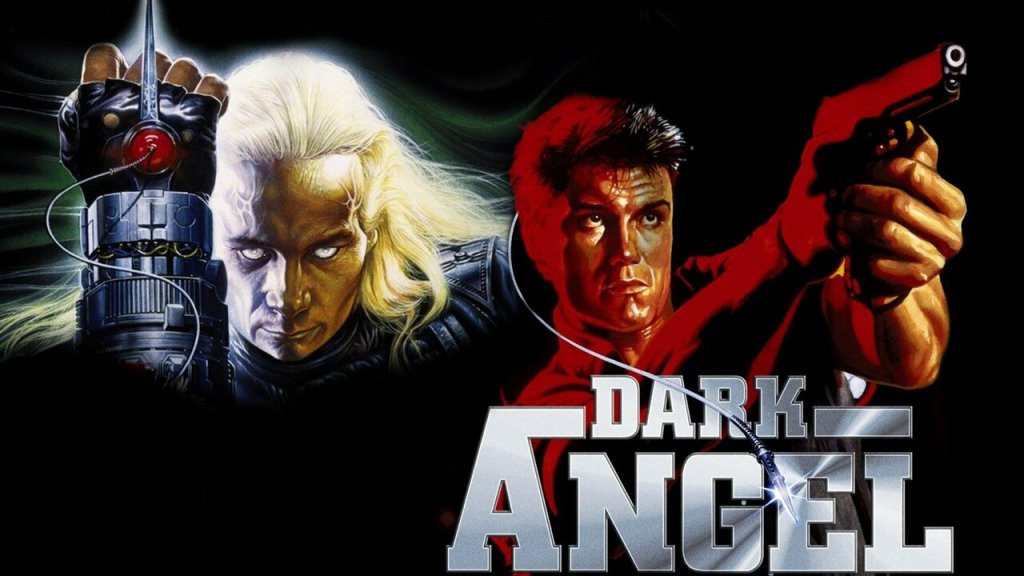
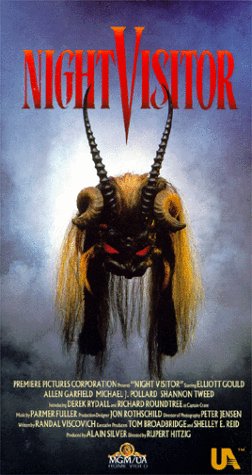 Billy Colton (Derek Rydall) is a teenager who has a reputation for exaggeration. Lisa Grace (Shannon Tweed) is his next door neighbor, a high-priced prostitute who does not mind if Billy spies on her. When Billy tries to tell everyone about his wild new neighbor, no one believes him. Billy decides to prove his story by grabbing his camera and sneaking next door. Instead of getting proof that she’s a prostitute, Billy witnesses his neighbor being murdered by a robed Satanist, who just happens to be Zachary Willard (Allen Garfield), Billy’s hated science teacher! Billy goes to the police with his camera but Captain Crane (Richard Roundtree) points out that Billy forgot to take off the lens cap.


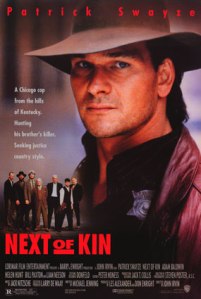 Truman Gates (Patrick Swayze) may have been raised in Appalachia but, now that he lives in Chicago, he’s left the old ways behind. He has a job working as a cop and his wife (Helen Hunt) is pregnant with their first child. When Truman’s younger brother, Gerald (Bill Paxton), shows up in town and asks for Truman’s help, Truman gets him a job as a truck driver. But, on his first night on the job, Gerald’s truck is hijacked by a Sicilian mobster named Joey Rosellini (Adam Baldwin) and Gerald is killed. Truman’s older brother, Briar (Liam Neeson), soon comes to Chicago and declares a blood feud on the mob.
 Through the Shattered Lens