96 years ago today, Marlon Brando was born in Omaha, Nebraska.
Unfortunately, Brando is one of those actors who, later in his life, became better known for his eccentricities than for his performances. Though Brando never stopped being a good actor, it’s undeniable that some of his later performances reveal an actor who often did seem to be a bit bored with the films that he was making. It’s sad to think that there’s people out there who might only know Brando because they stumbled across The Island of Dr. Moreau on Starz at like 3 in the morning.
Regardless of the reputation that he developed in his later years, Marlon Brando was one of the best actors of all time. His early performances are still exciting to watch and, even when his work was becoming progressively more eccentric in the 70s and 80s, he still continued to give performances that could grab your attention and leave you surprised by their power.
Of course, my favorite Brando film remains The Godfather so it only makes sense to share a scene from that film on Brando’s birthday. In this beautifully acted scene, Tom Hagen (Robert Duvall) informs Don Vito (Brando) that Sonny has been killed. Of course, first, Tom has to have a drink. This scene might not be as iconic as some of the other scenes in The Godfather but it’s wonderfully performed by both actors and it reminds us that The Godfather is powerful not because it’s a crime film but because it’s a film about family.
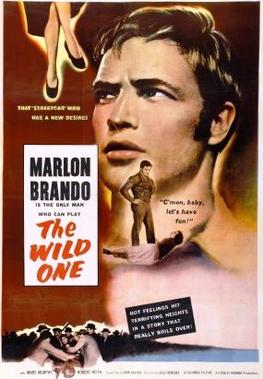
Motorcycles have always been unbelievably sexy and, in 1953, so was Marlon Brando.
1953 was the year that Brando played Johnny Strabler in The Wild One. Johnny’s the leader of the Black Rebels Motorcycle Club. He wears a leather jacket and always has a cap tilted rakishly on his head. When Johnny moves, he makes it a point to take his time. He doesn’t run from anyone and, perhaps most importantly, he doesn’t run to anyone. Johnny’s a rebel and he doesn’t care who knows it. “What are you rebelling against?” Johnny is asked. “Whaddya got?” Johnny replies and, when he says it, you not only believe him but you want to join him in his rebellion.
And yet, from the minute that we see Johnny, it’s obvious that there’s more to him than just his jacket and his attitude. He speaks softly and when he smiles, there’s something almost shy about the expression. You look into his brooding, soulful eyes and you know that Johnny isn’t just about making trouble. He’s searching for something that society alone can’t deliver. Johnny’s a bad boy, the type who you fool yourself into thinking that you — and only you — can reach and help heal.
At least, that’s the way that Kathie (Mary Murphy) feels about him, even though she’s way too smart to accept his invitation to go to a dance with him. Kathie works at a diner in a small California town. When Johnny and his gang ride into the town, all of the boring, responsible citizens want to force him to leave. Kathie, alone, sees that Johnny’s not as bad as everyone assumes he is. And if there’s any doubt about the fact that Johnny’s got a good soul despite his brooding nature, Chino (Lee Marvin) shows up to remind everyone of what a truly bad biker is like.
Chino and Johnny may both love their motorcycles but otherwise, they’re opposites. If Johnny has the soul of a poet, Chino has no soul at all. Johnny’s searching for freedom while Chino is merely searching for power. Chino and Johnny were once friends, all part of the same gang. However, Johnny eventually went off on his own and took the younger gang members with him. Chino, in many ways, represents America’s destructive and wild path. He’s an old west outlaw who rides a motorcycle instead of a horse. Johnny, meanwhile, is a wanderer who represents the part of America that created Kerouac and Dylan.
(Interestingly enough, both Brando and Marvin were 29 years old when they made The Wild One. However, Brando looked much younger and Marvin looked considerably older, which only added to the film’s theme of generational conflict. Brando, himself, has never rode a motorcycle before making The Wild One and reportedly avoided the actual bikers who were hired to act as extras. Lee Marvin, on the other hand, was an experienced rider and fit right in with the film’s cast. To be honest, Lee Marvin is actually more convincing than Brando but Brando had the eyes and the wounded way of speaking whereas Marvin was every single guy who needlessly revs his motorcycle’s engine in the middle of the night.)
Anyway, needless to say, the townspeople are even less happy once Chino’s gang shows up. Unfortunately, few of them understand the difference between Johnny and Chino. In fact, the majority of the upright citizens prove themselves to be just as and, in some cases, more violent than the bikers that they’re trying to run out of town. It all leads to violence, tragedy, and, ultimately, understanding. This was a 50s film after all. Director Laszlo Benedek may have played up the more sordid aspects of the story but the film was produced by the reliably and safely liberal Stanley Kramer and the film concludes on a very Krameresque note.
If you only know Marlon Brando from the latter half of his career, when he was best known for his weight, his eccentricities, and his personal tragedies, than watching The Wild One is quite a revelation. It’s a well-directed film with a host of effective supporting turns but it’s Brando who makes the film unforgettable. Watching the film, you understand why Brando became a star and you also see just how much he inspired so many of the actors who came after him. James Dean’s performance in Rebel Without A Cause owes a huge debt to Brando’s work here. In fact, every rebel owes a debt to The Wild One. In the role of Johnny, Brando invites and inspires us all to ride down the road and see what we find.
The Wild One was a huge hit in 1953, leaving teenagers excited and parents concerned. That same year, Brando also played Mark Anthony in Julius Caesar and received an Oscar nomination for the performance. The Wild One was ignored at the Oscars but lives on whenever anyone hit the road and goes searching for America.
Unlike today, when superheroes dominate at the box office and your local multiplex, costumed crusaders were dead as the proverbial doornail in theaters of the 1970’s. The last was 1966’s BATMAN, at the height of the camp craze, but after that zer0… zilch… nada. I didn’t care; my comic book reading days were pretty much at an end by 1978, driven away by other distractions, like making money, girls, beer, and girls. I had moved on.
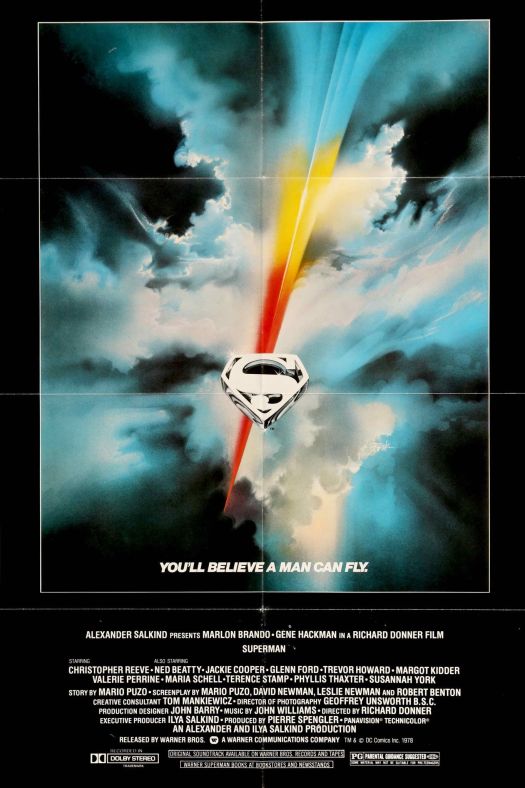
But when Warner Brothers announced they were making a new, big budget Superman movie, I was intrigued. I’d always loved the old 50’s TV series starring George Reeves as the Man of Steel, corny as it was, and with a cast featuring Marlon Brando , Gene Hackman , and Glenn Ford , not to mention that girl from Brian DePalma’s SISTERS as Lois Lane, I wanted to see this new version. I also wanted…
“My family, my friend, I’ve criss-crossed this great land of ours countless times. I hold the map of it here, in my heart, next to the joyful memories of the carefree days I spent, as a young boy, here in your beautiful town of Twin Peaks.”
Last year, there were many Twin Peaks moments that many of us could not stop talking about. There was Cooper announcing, “I am the FBI.” There was Matthew Lillard’s interrogation. There was Naomi Watts telling off the loan sharks and Jim Belushi talking about his dreams. There were the musical performances at the Roadhouse. There was Laura’s scream at the end of the Part 18. And of course, there was every single minute of Part 8.
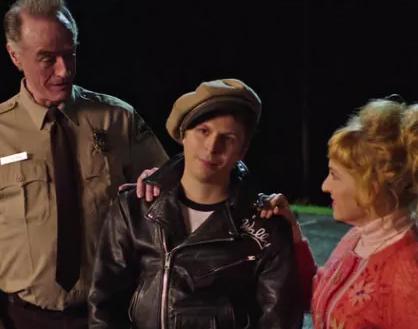
And then there was the arrival of Wally Brando.
Played by Michael Cera, Wally Brando was the son of Lucy (Kimmy Robertson) and Deputy Andy (Harry Goaz). They were obviously quite proud of their son and Wally … well, Wally really loved Marlon Brando. (That probably has something do with the fact that Wally and Marlon Brando shared a birthday.) Interestingly enough, in the scene above, Micahel Cera is speaking to Robert Forster, who co-starred with Brando in 1967’s Reflections in a Golden Eye.
(Of course, by imitating Brando’s look in The Wild One, Wally Brando reminds us that Twin Peaks took place in a world where pop culture and society’s darkest secrets collided.)
How big of a splash did Wally Brando make? When Part 4 of Twin Peaks premiered, Wally Brando immediately started to trend on twitter. People were reminded that Michael Cera was capable of doing more than just playing sensitive teenagers. It was one of the first great moments of the Twin Peaks revival. As much attention as Cera received for his performance, I also think that Harry Goaz, Kimmy Robertson, and Robert Forster deserved just as much credit for making this scene work. Andy and Lucy were so proud and Sheriff Truman’s reactions were just priceless.
Today would have been Marlon Brando’s 94th birthday and I’m sure that, somewhere, Wally Brando is wearing a party hat, opening his presents from Lucy and Andy, watching Guys and Dolls, and smiling.
4 Shots from 4 Films is just what it says it is, 4 shots from 4 of our favorite films. As opposed to the reviews and recaps that we usually post, 4 Shots from 4 Films lets the visuals do the talking!
In honor of Marlon Brando’s birthday, here’s…
4 Shots From 4 Films
A Streetcar Named Desire (1952, dir by Elia Kazan)
Today would have been Marlon Brando’s 94th birthday so it seems appropriate that today’s music video should be for a song that was, at least partially, inspired by Marlon Brando’s career!
In 2014 interview, Scott Walker explained the idea behind this song, saying that he found that there were several movies that features scenes of Marlon Brando being physically assaulted. Along with detailing some of the assaults that Brando suffered on screen, the song serves as a tribute to sadomasochism in general.
In the third verse, there are several references to Brando’s films. First there’s mention of Brando getting beat up by John Saxon in The Appaloosa. “I took it from dad” is probably a reference to One-Eyed Jacks, the only film that Brando ever directed. Fat Johnny Friendly was the racketeer played by Lee J. Cobb in On The Waterfront while the three vigilantes are a reference to Brando’s role in The Chase. “I took it for The Wild One” is obviously a reference to the film of the same name. As “Lizbeth,” that’s presumably a reference to Elizabeth Taylor, who beat Brando with a riding crop in Reflections in a Golden Eye.
The year was 1973 and Marlon Brando was the obvious front-runner to win the Oscar for Best Actor. His performance in The Godfather had not only provided an important anchor to that sprawling film but it also rejuvenated his career.
No one was surprised when Liv Ullman and Roger Moore announced that Brando had won the Oscar. The shock came when a young woman named Sacheen Littlefeather approached the stage. The rest is Oscar history:
Brando had actually given Sacheen a 15-page speech that he wanted her to read from the stage. However, the show’s producers — realizing what Brando was planning — told Sacheen that, if she stayed on stage for longer than 60 seconds, she would be forcibly removed. Hence, Sacheen improvised her stage comments and then read Brando’s speech backstage. As a result of this incident, the Academy banned proxy acceptances.
As for Brando’s Oscar, Roger Moore took it home with him and kept it until, a few days later, armed guard showed up to take it back from him.
After Tom Logan (Jack Nicholson) and his gang of rustlers (played by Randy Quaid, Frederic Forrest, and Harry Dean Stanton) rob a train, Logan uses the money to buy a small ranch. Their new neighbor is Braxton (John McLiam), a haughty land baron who considers himself to be an ambassador of culture to the west but who is not above hanging rustlers and hiring gunmen. One such gunman is the eccentric Robert E. Lee Clayton (Marlon Brando), a “regulator” who speaks in a possibly fake Irish brogue, is a master of disguise, and uses a variety of hand-made weapons. Braxton hires Clayton to kill Logan and his men, despite the fact that his daughter (Kathleen Lloyd) has fallen in love with Logan.
A flop that was so notorious that it would be five years before Arthur Penn got a chance to direct another film, The Missouri Breaks is best remembered for Marlon Brando’s bizarre performance. Brando reportedly showed up on the set late and insisted on largely improvising his part, which meant speaking in a comical Irish accent, singing an impromptu love song to his horse, and disguising himself as an old woman for one key scene. (According to Patrick McGilligan’s Jack’s Life: A Biography of Jack Nicholson, co-star Harry Dean Stanton grew so incensed at Brando’s behavior that he actually tried to rip the dress off of Brando, saying that he simply would not be “killed’ by a man wearing a dress.) Brando’s later reputation for being a disastrously weird performer largely started with the stories of his behavior on the set of The Missouri Breaks.
I had heard so many bad things about Brando and The Missouri Breaks that I was surprised when I finally watched it and discovered that it is actually a pretty good movie. For all of his notoriety, Brando does not enter this leisurely paced and elegiac western until after half a hour. The majority of the movie is just about Jack Nicholson and his gang, with Nicholson giving a low-key and surprisingly humorous performance that contrasts well with Brando’s more flamboyant work. While Arthur Penn may not have been able to control Brando, he still deftly combines moments of comedy with moments of drama and he gets good performances from most of the supporting cast. Quaid, Stanton, Forrest, and Nicholson are all just fun to watch and the rambling storyline provides plenty of time to get to know them. Whenever Brando pushes the movie too close to self-parody, Nicholson pulls it back. The Missouri Breaks may have been a flop when it was released but it has aged well.
The 1950’s were a time of change in movies. Television was providing stiff competition, and studios were willing to do anything to fend it off. The bigger budgeted movies tried 3D, Cinerama, wide-screen, and other optical tricks, while smaller films chose to cover unusual subject matter. The following five films represent a cross-section of nifty 50’s cinema:
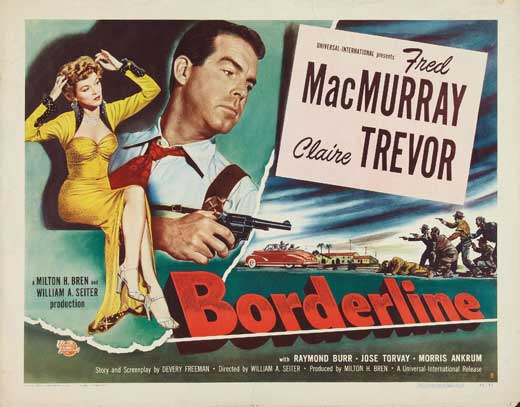
BORDERLINE (Universal-International 1950; D: William A. Seiter)
BORDERLINE is a strange film, straddling the borderline (sorry) between romantic comedy and crime drama, resulting in a rather mediocre movie. Claire Trevor plays an LAPD cop assigned to Customs who’s sent to Mexico to get the goods on drug smuggler Pete Ritchey (Raymond Burr , being his usual malevolent self). She’s tripped up by Ritchey’s rival Johnny Macklin (Fred MacMurray , channeling his inner Walter Neff), and taken along as he tries to get the dope over the border. What she doesn’t know is he’s also…
Nowadays, that can be a dangerous thing to admit. On The Waterfront won the Oscar for Best Picture of 1954 and Marlon Brando’s lead performance as boxer-turned-dockworker Terry Malloy is still regularly cited as one of the best of all time. The scene where he tells his brother (played by Rod Steiger) that he “could have been a contender” is so iconic that other films still continue to either parody or pay homage to it. On The Waterfront is one of those films that regularly shows up on TCM and on lists of the greatest films ever made.
And yet, despite all that, it’s become fashionable to criticize On The Waterfront or to cite it as an unworthy Oscar winner.Certain film bloggers wear their disdain for On The Waterfront like a badge of honor. Ask them and they’ll spend hours telling you exactly why they dislike On The Waterfront and, not surprisingly, it all gets tedious pretty quickly.
Like all tedious things, the answer ultimately comes down to politics. In the early 50s, as the House UnAmerican Affairs Committee conducted its search for communists in Hollywood, hundreds of actors, writers, and directors were called before the committee. They were asked if they were currently or ever had been a member of the Communist Party. It was demanded that they name names. Refusing to take part was career suicide and yet, many witnesses did just that. They refused to testify, apologize, or name names.
And then there was the case of Elia Kazan. When he was called in front of HUAC, he not only testified about his communist past but he named names as well. Many of his past associates felt that Kazan had betrayed them in order to protect his own career. On The Waterfront was Kazan’s answer to his critics.
In On The Waterfront, Terry Malloy’s dilemma is whether or not to voluntarily testify before a commission that is investigating union corruption on the waterfront. Encouraging him to testify is the crusading priest, Father Barry (Karl Malden), and Edie (Eva Marie Saint), the saintly girl who Terry loves. Discouraging Terry from testifying is literally every one else on the waterfront, including Terry’s brother, Charlie (Rod Steiger). Charlie is the right-hand man of gangster Johnny Friendly (a crudely intimidating Lee J. Cobb), who is the same man who earlier ordered Terry to throw a big fight.
At first, Terry is content to follow the waterfront of code of playing “D and D” (deaf and dumb) when it comes to union corruption. However, when Johnny uses Terry to lure Edie’s brother into an ambush, Terry is forced to reconsider his previous apathy. As Terry gets closer and closer to deciding to testify, Johnny order Charlie to kill his brother…
The issue that many contemporary critics have with On The Waterfront is that they view it as being essentially a “pro-snitch” film. It’s easy to see that Elia Kazan viewed himself as being the damaged but noble Terry Malloy while Johnny Friendly was meant to be a stand-in for Hollywood communism. They see the film as being both anti-union and Kazan’s attempt to defend naming names.
And maybe they’re right.
But, ultimately, that doesn’t make the film any less effective. Judging On The Waterfront solely by its backstory ignores just how well-made, well-acted, well-photographed, well-directed, and well-written this film truly is. Elia Kazan may (or may not) have been a lousy human being but, watching this film, you can’t deny his skill as a director. There’s a thrilling grittiness to the film’s style that allows it to feel authentic even when it’s being totally heavy-handed.
And the performances hold up amazingly well. Marlon Brando’s performance as Terry Malloy gets so much attention that it’s easy to forget that the entire cast is just as great. Rod Steiger makes Charlie’s regret and guilt poignantly real. Karl Malden, who gets stuck with the film’s more pedantic dialogue, is the perfect crusader. Eva Marie Saint is beautiful and saintly. And then you’ve got Lee J. Cobb, playing one of the great screen villains.
The motives behind On The Waterfront may not be the best. But, occasionally, a great film does emerge from less than pure motives. (Just as often, truly good intentions lead to truly bad cinema.) Regardless of what one thinks of Elia Kazan, On The Waterfront is a great work of cinema and it’s on that basis that it should be judged.





 After Tom Logan (Jack Nicholson) and his gang of rustlers (played by Randy Quaid, Frederic Forrest, and Harry Dean Stanton) rob a train, Logan uses the money to buy a small ranch. Their new neighbor is Braxton (John McLiam), a haughty land baron who considers himself to be an ambassador of culture to the west but who is not above hanging rustlers and hiring gunmen. One such gunman is the eccentric Robert E. Lee Clayton (Marlon Brando), a “regulator” who speaks in a possibly fake Irish brogue, is a master of disguise, and uses a variety of hand-made weapons. Braxton hires Clayton to kill Logan and his men, despite the fact that his daughter (Kathleen Lloyd) has fallen in love with Logan.


 Through the Shattered Lens