Guilty Pleasure No. 93: Porky’s (dir. by Bob Clark)


Porky’s is one of those movies that plays very differently depending on when you first see it. On the surface, it is a loud, lewd early‑’80s teen sex comedy about a bunch of high‑school boys in 1950s Florida trying to get laid and get even, but underneath the pranks and bare flesh there are streaks of surprisingly serious material about prejudice, masculinity, and power. That mix of dopey laughs and darker undercurrents is exactly what makes the film interesting to talk about, and also what makes it so divisive today.

Set in the 1950s and released in 1981, Porky’s follows a tight‑knit group of teenage boys whose main goals in life are sex, sports, and practical jokes. Their adventures eventually take them to Porky’s, a sleazy backwater strip club run by the hulking, corrupt Porky, who humiliates them and sets up the revenge plot that drives the back half of the film. Around that spine, the story wanders through locker‑room banter, elaborate pranks, and various attempts to sneak into the girls’ showers or otherwise spy on naked bodies. It is very much a “horny boys on the prowl” narrative, and the film never pretends to be anything else.

What keeps it from being just another disposable sex comedy is the way some of those side stories hit harder than expected. One of the kids is brutally abused by his father, and the film doesn’t treat it like a throwaway detail; those scenes have a rawness and anger that clash with the goofy tone elsewhere. There is also a thread about anti‑Semitism and racism in their community, with one character confronting his own bigoted upbringing as he befriends a Jewish classmate and pushes back against the prejudice around him. That material is handled in a pretty straightforward, earnest way, which is jarring given how crude the surrounding humor can be, but it does show that writer‑director Bob Clark had more on his mind than dirty jokes.

The humor, for better or worse, is what most people remember. Porky’s leans heavily on slapstick and sex‑obsessed gag setups: peeping through holes in shower walls, mistaken identities during sex, ridiculous anatomical bragging, prank phone calls, and elaborate schemes that escalate into full‑on chaos. Some of the set pieces are staged with real comic timing, and if you’re on its wavelength, these sequences can still land as big, cathartic laughs. Others feel juvenile in the worst way, stretching one joke way past its breaking point, or punching down at easy targets rather than punching up at the hypocritical adults the boys are constantly butting up against.

Viewed from today’s lens, a big chunk of that humor is undeniably uncomfortable. The movie is saturated with sexist, homophobic, and racist language, and a few of the “pranks” involving the girls are essentially sexual harassment played for laughs. At the time, it was sold as a gleefully politically incorrect romp; now, those same scenes read as mean‑spirited or creepy in a way that undercuts the supposed lighthearted tone. The film occasionally tries to complicate this by giving some of the female characters sharper edges or letting them turn the tables, but it never fully escapes the fact that the camera is mostly aligned with the boys and their fantasies.

That said, Porky’s is not entirely dismissive of its women. There are moments where adult women, in particular, are allowed to call out the boys’ behavior or assert their own sexuality in ways that undercut the usual “conquest” narrative. The movie also makes a point of ridiculing hypocritical authority figures—teachers, coaches, cops, and parents—whose prudish public morals don’t match their private behavior. When Porky’s is skewering bigotry, religious hypocrisy, and small‑town moral panics, it feels sharper and more progressive than its reputation as a dumb “tits‑and‑ass” comedy suggests. Those flashes of insight are part of why some viewers argue that, beneath the sleaze, the film is quietly critical of the very attitudes it seems to indulge.

Performance‑wise, the cast is made up largely of unknowns who sell the illusion that this is a real, scrappy group of friends rather than polished Hollywood teens. The camaraderie feels genuine; their constant ribbing, in‑jokes, and shifting alliances are believable enough that you can see why the movie became a touchstone for a certain generation of viewers. Bob Clark’s direction is surprisingly controlled for such an anarchic script. He keeps the story moving, balances multiple subplots, and stages the bigger comic payoffs in a way that feels almost like a live‑action cartoon. The downside is that this slickness can make the nastier gags pop more, for better and worse.

On a technical level, Porky’s is very much a product of its time, but not a cheap one. The period detail—cars, music, clothing, diners, and dingy roadside bars—helps sell the 1950s setting, giving the film a nostalgic sheen that softens some of its rougher edges. The soundtrack leans on era‑appropriate rock and roll, which adds energy to the locker‑room and party scenes. The film also doesn’t shy away from male nudity, which was less common in comedies of the time and adds to its reputation as equal‑opportunity when it comes to what it exposes, even if the gaze is still clearly tilted toward ogling women.

Where Porky’s can stumble is in tone. The shifts between broad farce and serious drama can be abrupt. One minute you are watching a drawn‑out gag about a teacher trying to identify a student by his anatomy; the next, you are plunged into a grim confrontation with an abusive parent. That whiplash can pull you out of the movie, because the emotional weight of the dramatic scenes doesn’t always get enough breathing room before the script lurches back to naughty antics. As a result, some viewers feel the darker elements trivialize real issues, while others think those same scenes give the film more substance than its imitators.

Even if someone has never seen Porky’s, they have probably felt its influence. The film was a massive box‑office hit relative to its budget and paved the way for a wave of raunchy teen comedies through the ’80s and ’90s, eventually echoing into movies like American Pie and beyond. Its success made it clear that there was a huge audience for R‑rated, adolescent sex comedies that mixed crude jokes with a veneer of coming‑of‑age sentiment. You can see its blueprint in later films: packs of horny friends, elaborate revenge schemes, school authority figures as comic foils, and a big, raucous set piece as the payoff.

Whether Porky’s “holds up” is going to depend a lot on your tolerance for outdated attitudes and offensive language. If you go in expecting a cozy nostalgia trip, you may be surprised by how sour some jokes taste now, and how casually the film treats behavior that would be framed very differently in a modern story. If you approach it as both a time capsule and the prototype of a genre, it becomes easier to see its strengths—the lively ensemble, the willingness to poke at racism and hypocrisy, the low‑budget ingenuity in its set pieces—alongside its very real flaws.

Porky’s is neither the hidden gem some defenders make it out to be nor the irredeemable trash its harshest critics describe. It is a messy, uneven, often funny, often cringeworthy movie that captures a particular moment in pop culture, both in what it laughs at and what it takes for granted. If you are curious about the roots of modern raunchy teen comedies and prepared for the rough, politically incorrect ride, it is still worth a look as a piece of film history and as an example of how comedy ages—for better and for worse.

Previous Guilty Pleasures

  1. Half-Baked
  2. Save The Last Dance
  3. Every Rose Has Its Thorns
  4. The Jeremy Kyle Show
  5. Invasion USA
  6. The Golden Child
  7. Final Destination 2
  8. Paparazzi
  9. The Principal
  10. The Substitute
  11. Terror In The Family
  12. Pandorum
  13. Lambada
  14. Fear
  15. Cocktail
  16. Keep Off The Grass
  17. Girls, Girls, Girls
  18. Class
  19. Tart
  20. King Kong vs. Godzilla
  21. Hawk the Slayer
  22. Battle Beyond the Stars
  23. Meridian
  24. Walk of Shame
  25. From Justin To Kelly
  26. Project Greenlight
  27. Sex Decoy: Love Stings
  28. Swimfan
  29. On the Line
  30. Wolfen
  31. Hail Caesar!
  32. It’s So Cold In The D
  33. In the Mix
  34. Healed By Grace
  35. Valley of the Dolls
  36. The Legend of Billie Jean
  37. Death Wish
  38. Shipping Wars
  39. Ghost Whisperer
  40. Parking Wars
  41. The Dead Are After Me
  42. Harper’s Island
  43. The Resurrection of Gavin Stone
  44. Paranormal State
  45. Utopia
  46. Bar Rescue
  47. The Powers of Matthew Star
  48. Spiker
  49. Heavenly Bodies
  50. Maid in Manhattan
  51. Rage and Honor
  52. Saved By The Bell 3. 21 “No Hope With Dope”
  53. Happy Gilmore
  54. Solarbabies
  55. The Dawn of Correction
  56. Once You Understand
  57. The Voyeurs 
  58. Robot Jox
  59. Teen Wolf
  60. The Running Man
  61. Double Dragon
  62. Backtrack
  63. Julie and Jack
  64. Karate Warrior
  65. Invaders From Mars
  66. Cloverfield
  67. Aerobicide 
  68. Blood Harvest
  69. Shocking Dark
  70. Face The Truth
  71. Submerged
  72. The Canyons
  73. Days of Thunder
  74. Van Helsing
  75. The Night Comes for Us
  76. Code of Silence
  77. Captain Ron
  78. Armageddon
  79. Kate’s Secret
  80. Point Break
  81. The Replacements
  82. The Shadow
  83. Meteor
  84. Last Action Hero
  85. Attack of the Killer Tomatoes
  86. The Horror at 37,000 Feet
  87. The ‘Burbs
  88. Lifeforce
  89. Highschool of the Dead
  90. Ice Station Zebra
  91. No One Lives
  92. Brewster’s Millions

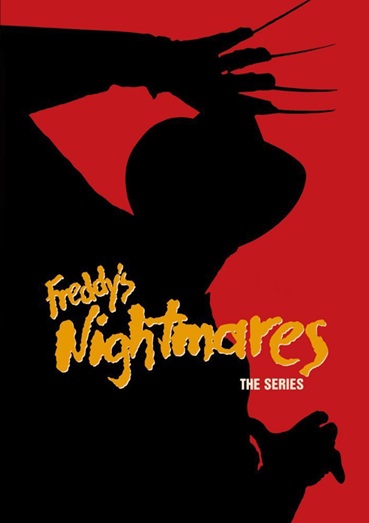
Late Night Retro Television Reviews: Freddy’s Nightmares 1.1 “No More Mr. Nice Guy”


Welcome to Late Night Retro Television Reviews, a feature where we review some of our favorite and least favorite shows of the past! On Fridays, I will be reviewing Freddy’s Nightmares, a horror anthology show which ran in syndication from 1988 to 1990. The entire series can be found on Plex!

Having finished up Friday the 13th, I’m not going to take a look at another syndicated horror show that aired around the same time.  Freddy’s Nightmares was an anthology show hosted by Robert Englund, in character as Freddy Krueger.  Each story would take place in Freddy’s hometown of Springwood, Ohio.  Would the show be a dream or a nightmare?  Let’s find out!

Episode 1.1 “No More Mr. Nice Guy”

(Dir by Tobe Hooper, originally aired on October 9th, 1988)

Freddy Krueger has become such a familiar and popular figure that I think it’s sometimes forgotten that, when he first appeared, he was truly a horrifying character.  He was a child molester and a serial killer, one who escaped legal justice only because someone forgot to read him his rights when he was arrested.  He was killed by the citizens of Springwood, Ohio, set on fire in the same boiler room where he killed his victims.  Yes, he was brutally murdered and yes, the respectable people who murdered him covered up their crime.  At the same time, what would you do if a monster like Freddy was loose in your town and stalking your children?  “I’m burning in Hell,” Freddy says and that’s exactly what he deserved.

How did Freddy Krueger then become an oddly beloved pop cultural icon?  Some of that was undoubtedly due to his one-liners, which tended to be a slightly better than the typical slasher film banter.  If Freddy was pure evil in the first three Nightmare on Elm Street films, he became more a homicidal prankster as the series continued.  I think another reason why Freddy became popular is because the actor who first played him, Robert Englund, himself always comes across as being such a nice guy.  Unlike the personable but physically intimidating Kane Hodder, who looked like he could kill you even when he wasn’t playing Jason Voorhees, Englund always comes across as being slightly nerdy and very friendly.  He’s the neighbor who you would trust to get your mail while you’re on vacation.  If Englund hadn’t been cast as Freddy Krueger in 1984, he probably would have spent the 90s playing quirky programmers and hackers in tech thrillers.  The thing with Robert Englund is that seems to have a good sense of humor, he’s at peace with his place in pop culture, and he always seem to be having fun.  (In his autobiography, he even jokes about something that fans had been laughing about for years, the fact that the female lead in A Nightmare In Elm Street 2 looked almost exactly like Meryl Street.)  Those are qualities that bled over into Freddy.

As a result, Freddy became popular enough to host his own horror anthology.  The premiere episode of Freddy’s Nightmares open with Englund, in full Freddy makeup, telling us that we’re not about to see one of our nightmares.  Instead, we’re going to see his nightmare.  The episode gives us Freddy’s origin story, starting with Freddy getting off on a murder charge on a technicality and ending with Freddy getting bloody revenge of the police chief (played by Ian Patrick Williams) who set him on fire.

By almost any standard, it’s a disturbing story.  We open with Freddy on trial and we hear details about an 8 year-old boy that he left in a dumpster.  After the charges against Freddy are dismissed (damn those Carter judges!), Freddy happily gets into an ice cream truck and later, the police chief has a vision of the same truck coming straight at him.  After getting set on fire, Freddy doesn’t waste any time coming back and using his razor-blade gloves to slash his way to vengeance.  I think what’s particularly disturbing about this episode is that the police chief is not a bad guy.  He arrested Freddy as Freddy was trying to attack his twin daughters.  Throughout the episode, Freddy — in both life and death — makes it clear that he’s coming for the man’s daughters.  And in the end, Freddy will probably get them because their father fell asleep in a dentist’s chair and got his mouth drilled by Dr. Krueger.

Agck!  That’s disturbing stuff.  Of course, it would be even more disturbing if the show’s special effects and gore were anywhere close to being a realistic as what was present in the movies.  The show itself looks remarkably cheap.  I would say it almost looks like a community theater production of A Nightmare on Elm Street.  Director Tobe Hooper (of Texas Chainsaw Massacre fame) manages to wring a few jump scares out of the material and a scene where we see one of Freddy’s courtroom fantasies is genuinely horrifying but, for the most part, the budget is low enough that the viewer can safely say, “It’s only a TV show, it’s only a TV show….”  In the end, it’s very much an 80s TV show, right down to the oddly gratuitous scene where the police chief suddenly imagines the dental hygienist in her underwear.

Where will Freddy’s Nightmares lead us?  We’ll find out.  I’m sure it will be bloody, wherever it is!

Real Men (1987, directed by Dennis Feldman)


Due to a chemical spill that is spreading through the ocean, life on Earth is going to end in five years unless something is done.  A group of friendly alien offer to give Earth either the “Good Package” or the “Big Gun.”  The Good Package can clean up the ocean.  The Big Gun is a big gun.  They both sound good to me!  The aliens only want a glass of water in return and they want that glass to be delivered by CIA Agent Pillbox.

Unfortunately, Pillbox has been killed in the field so the government tracks down a meek office worker named Bob Wilson (John Ritter) who looks just like Pillbox.  Tough and streetwise Nick Pirandello (Jim Belushi) is sent to recruit Bob and take him to the aliens.  Trying to stop Nick and Bob are a group of rogue CIA agents who would rather get the Big Gun than the Good Package.  Nick teaches Bob how to be a “real man” and Bob teaches Nick how to be a real friend.  They also beat up clowns.

A box office failure that did even worse with the critics, Real Men is a movie that was saved by cable.  When I was a kid, Real Men used to show up on HBO all the time.  Whatever flaws the film may have had, the mix of John Ritter’s physical comedy, Jim Belushi’s wiseguy attitude, and the action scenes made it the type of movie that was ideal for home viewing, especially if you had just gotten out of school and wanted to watch something before your parents came home and asked if you had done your homework.  Real Men was fun enough to hold up to repeat viewings but it was also slight enough that it wasn’t a huge tragedy if the channel got changed before the movie ended.

When I rewatched Real Men, I thought the film’s storytelling could have been tighter but it still turned out to be better than I was expecting.  There were a lot of classic buddy movies released in the 80s and while Real Men may not be the equivalent of a 48 Hours or a Midnight Run, John Ritter and Jim Belushi are still an entertainingly mismatched team.  Ritter again shows that he was a master at physical comedy while Belushi provides sarcastic commentary from the side.  A lot of the odd couple-style banter is predictable (Bob doesn’t smoke but Nick does) but Ritter and Belushi deliver their lines with enough conviction to still make it work.  Nick teaches Bob to believe in himself and Bob is able to both save the world and tell off the neighborhood bullies.  The film’s mix of action, science fiction, and broad comedy confounded critics in 1987 but it holds up today.

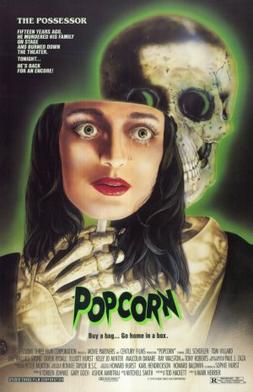
October Hacks: Popcorn (dir by Mark Herrier and Alan Ormsby)


The 1991 film, Popcorn, tells the story of what happens when an experimental film goes wrong.

In the late 60s, a freaked-out hippie named Lanyard Gates directed a short film called PossessorPossessor featured footage of him apparently preparing to sacrifice a woman on an altar.  Gates declined to film a third act conclusion to the film.  Instead, he murdered his family on stage and in front of a terrified audience.  The resulting panic caused a fire to break out, killing almost everyone at the Dreamland Theater.  As a result, Possessor has become a legendary film, one that is believed lost.  Of course, it’s not lost, as a group of film students and their professor find out over the course of Popcorn.

Years later, one of those film students, an aspiring screenwriter named Maggie (Jill Schoelen), has been having disturbing nightmares about being caught in a fire and being pursued by a madman.  When she sees Possessor, she realizes that much of the imagery in her dreams comes from the film.  When Maggie attempts to talk to her mother about all of this, Suzanne (Dee Wallace) denies knowing anything about Possessor or Lanyard Gates but it’s not hard to tell that she’s lying.

Still, Maggie does have other things to worry about.  Her school’s film department has been hit by budget cuts and neither she nor her classmates will be able to make their student films unless they raise some money.  One of the students, Toby (Tom Villard), suggests holding a fundraiser at the Dreamland Theater, where they could show old movies and even recreate some of the old gimmicks that were used to promote those movies.  Professor Davis (Tony Roberts) thinks that is a great idea!  Why, he could even control the giant, remote-controlled bug that was used to promote Mosquito!

Filmed in Jamaica (and featuring a somewhat random performance by a reggae band), Popcorn was originally offered to director Bob Clark.  However, Clark didn’t want to return to the horror genre so, instead, it was Clark’s frequent collaborator, Alan Ormsby, who was hired to direct the film.  Reportedly, Ormsby was replaced a few weeks into filming by Mark Herrier, with the assumption being that the producers felt that Ormsby was spending too much time on filming the three fake movies that are screened during the fund raiser.  Those films are Mosquito, The Attack of the Electrified Man, and a dubbed Japanese film called The Stench.  In the film’s credits, Ormsby is credited with directing the three fake film while Mark Herrier is credited with directing the “modern” scenes.

Perhaps not surprisingly, the three fake film are actually the best thing about Popcorn.  If Alan Ormsby was taking a lot of time to shoot the fake films, it obviously paid off because all three of them perfectly capture the feel of the era when they were supposedly shot and all of them are filled with the type of details that only a true fan of old horror movies would think to include.  Mosquito is a giant bug film that feels as if it could have come straight from 1957.  The Amazing Electrified Man feels like one of the films that poor Lon Chaney Jr. would have found himself starring in after leaving Universal.  And The Stench is the perfect import — slow-moving, a bit pompous, and terribly dubbed.

As for the rest of Popcorn, it’s a well-made slasher film.  Mark Herrier did a good job directing the “modern” scenes, with a scene in which the killer’s face seems to literally melt after he kisses one of his victims being a definite creepy highlight.  The kills are reasonably creative and, in one case involving electrocution, rather disturbing.  Jill Schoelen is a likable heroine, Derek Rydall is cute as her hapless boyfriend, and Tom Villard’s uninhibited performance gives the film a much-needed jolt of energy.  Though the old films may be the highlight of Popcorn, the “modern” scenes hold up as well.

Porky’s Revenge (1985, directed by James Komack)


The senior class of Angel Beach High finally graduate in Porky’s Revenge, the last official Porky’s film.  It’s a good thing, too.  Most of the members of the Porky’s cast were already in their late 20s when they were cast in the first Porky’s.  By the time Porky’s Revenge was made, most of them looked more like they should be planning for their retirement than for college.

Director Bob Clark did not return for Porky’s Revenge and it really shows.  The third film doesn’t have any messages about tolerance or fighting bigotry.  Instead, it’s just a typical teen sex comedy with a subplot about Brian Schwartz (Scott Colomby) trying to help Coach Goodenough (Bill Hindman) pay back his gambling debt to Porky (Chuck Mitchell).  Otherwise, the gang plays basketball, tries to arrange an orgy with the cheerleaders, and even helps Ms. Balbircker (Ellen Parsons) find love.  I guess everyone forgot about Ms. Balbricker allying herself with the Klan during the previous film.

Porky’s Revenge doesn’t really have enough ambition to be terrible though.  It’s just bland.  Just as it doesn’t have the social conscience of the first two film, it’s also not as raunchy.  There’s considerably less nudity and the occasionally rough edges of the first two films have been removed.  That makes Porky’s Revenge less problematic but it also makes it less interesting.  The first two films may have been imperfect but they did capture the feel of high school.  This one doesn’t do that because the actors are too old and suddenly their characters are too nice.  If not for the title, you would think this was just another dumb comedy that played for a week at the drive-in as opposed to being the second sequel to the most commercially-successful Canadian film of the 80s.

I did laugh when the gang went to the ruins of Porky’s to make sure that it hadn’t been rebuilt, just to discover that Porky now owned his own steamboat.  I’m also glad that everyone finally graduated and gave the Porky’s saga a fitting close.

There was a direct-to-video sequel to Porky’s Revenge.  It came out in 2009 and was called Porky’s Pimpin’ Pee Wee.  I think I can live without watching it.

Porky’s II: The Next Day (1983, directed by Bob Clark)


The teens of Angel Beach, Florida are back!  They’re still trying to get laid, they’re still playing pranks on each other, and, this time, they’re …. FIGHTING THE KLAN!?

Porky’s II continues with the first Porky’s mix of raunchiness and social commentary.  While Pee Wee (Dan Monahan) tries to get back at his friends for spending the whole previous movie making fun of the size of his dick, the other members of the large ensemble cast thwart an attempt by the Klan to keep them from putting on a Shakespearean showcase.  The Klan is upset that a Seminole has been cast as Romeo so they burn a cross and do everything they can to sabotage the production.  Also trying to keep the show from going on is the hypocritical Rev. Bubba Flavel (Bill Wiley) and Mrs. Balbricker (Nancy Parsons), who both consider Shakespeare’s plays to be obscene.  When Wendy (Kaki Hunter) discovers that one of the county commissioners has been lying about supporting the play, she humiliates him in public by pretending to vomit in a fountain and accusing him of impregnating her.  It’s slightly funnier than it sounds but just slightly.

The first Porky’s took a stand against anti-Semitism while the second Porky’s takes a stand against censorship and the Klan.  That’s actually pretty cool when you consider that both of these films are usually just thought of as being dumb sex comedies.  Just like the first film, Porky’s II may be raunchy but it has a conscience.  That was due to director Bob Clark, who obviously meant for the Porky’s films to be about more than just T&A.

Unfortunately, Porky’s II is never as funny as the first Porky’s.  Too many of the jokes are recycled from the first film and the cast’s habit of laughing at their own “humorous” lines is even more grating the second time around.  Even the film’s most famous scene, where Wendy humiliates the duplicitous commissioner, goes on for too long and doesn’t have as much of a payoff as it should.  The best scenes in the film are the scenes that were lifted from Hamlet, Romero & Juliet, and A Midsummer Night’s Dream.  You wouldn’t expect the ensemble of Porky’s to feature that many Shakespearean actors but apparently it did.  Fans of A Christmas Story, which was also directed by Clark and which came out the same year as Porky’s II, will especially want to pay attention to the MacBeth sword fight scene just because the famous holiday leg lamp makes an appearance.

Porky’s II is nowhere near as good or memorable as the first Porky’s but its heart is in the right place.  While not as big of a success as the first Porky’s, it still did well enough to lead to Porky’s III, which I’ll review tomorrow.

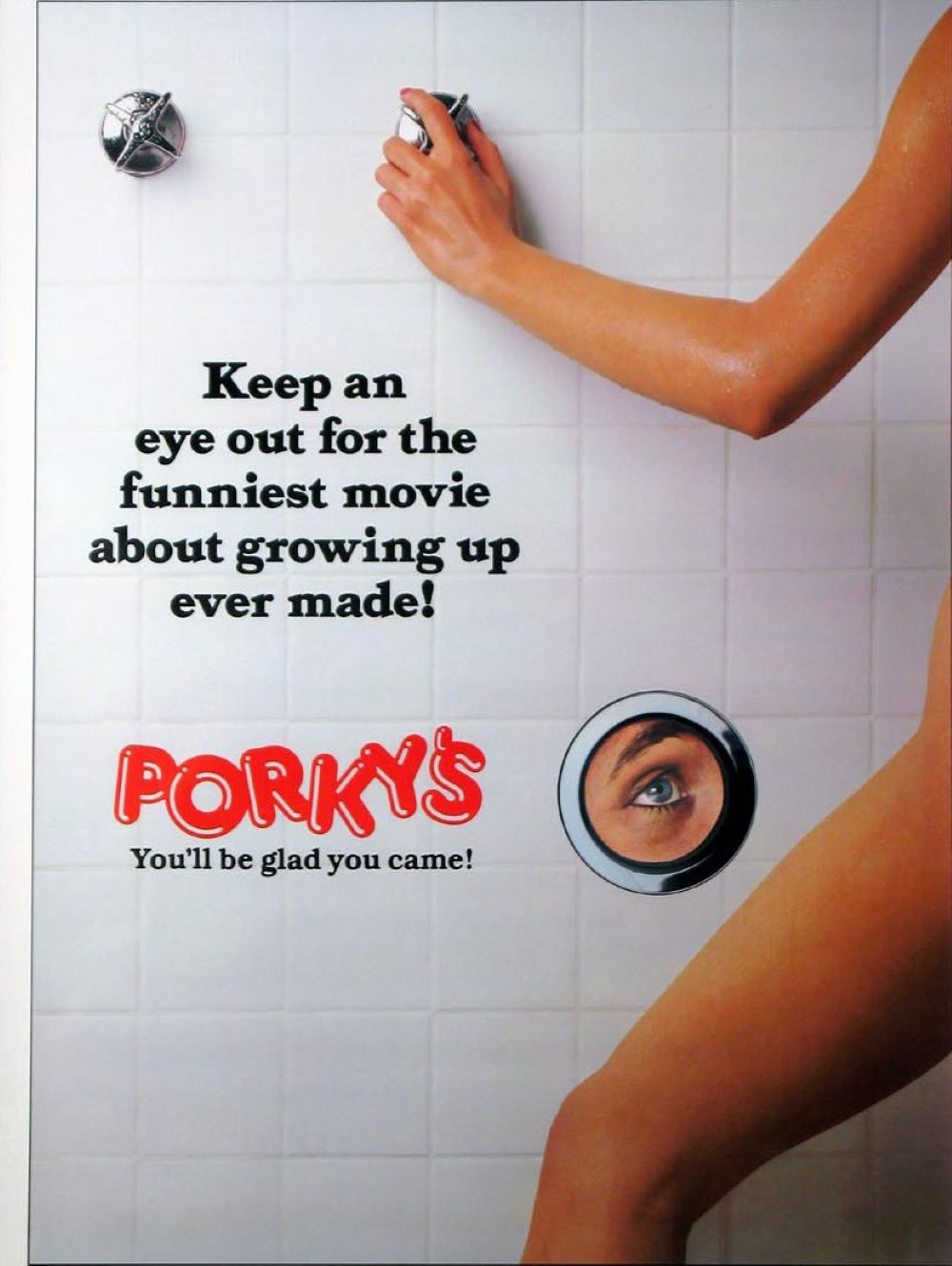
Porky’s (1981, directed by Bob Clark)


Porky’s.

On the one hand, it’s a crude, juvenile, and raunchy sex comedy where a bunch of teenagers in 1960s Florida think that it’s a hoot and not at all problematic to spy on the girls shower and to hire a black man to scare all of their (white) friends.

On the other hand, it’s a heartfelt plea for tolerance where Tim (Cyril O’Reilly) finally stands up to his abusive father (Wayne Maunder) and makes friends with Brian Schwartz (Scott Colomby), who is apparently the only Jewish person living in Angel Beach, Florida.

What’s strange about Porky’s is that everyone knows it for being the template for almost every bad high school film that followed, with tons of nudity, jokes about sex, and characters with names like Pee Wee, Miss Honeywell, Cherry Forever, and Porky.  But, when you sit down and watch the movie, you discover that, for all the raunchiness, it actually devotes even more time to Brian Schwartz dealing with the local bigots than it does to any of the things that it’s known for.  Everyone remembers the shower scene but it’s obvious the film’s heart is with Brian and his attempts to make the world a better place.  Porky’s is a sex comedy with a conscience.

Porky’s is an episodic film about a group of teenage boys trying to get laid and also trying to get revenge on the owner of the local brothel.  There’s a lot of characters but I’d dare anyone to tell me the difference between Billy, Tommy, and Mickey.  I went through the entire movie thinking that Billy was Mickey until I turned on the subtitles and discovered who was who.  Porky’s has a reputation for being a terrible movie but it’s actually a pretty accurate depiction of the way that most men like to imagine how their high school years went.  It captures the atmosphere of good-spirited teenage hijinks if not the reality.

One of the interesting things about Porky’s is that Bob Clark went from directing this to directing A Christmas Story.  The innocence of A Christmas Story might seem like it has nothing in common with raunchiness of Porky’s but, actually, they’re both nostalgic films that are set in an idealized past.  (If you still think A Christmas Story has nothing in common with Porky’s, just remember that Ralphie didn’t actually say “fudge.”)  Of course, A Christmas Story struggled at the box office and only became a hit when it was released on video while Porky’s is still the most successful Canadian film to ever be released in the U.S.  Sex sells.  As cool as it was to see Brian Schwartz stand up for himself, I doubt the people who made Porky’s a monster hit were buying their tickets because they had heard the film struck a blow against anti-Semitism.  They were going because they knew there was a shower scene.

Porky’s deserves its reputation for being a not-so great movie but I would be lying if I said that I didn’t laugh more than once while watching it.  (Of course, I still didn’t laugh as much as the characters in the films laughed.  I’ve never seen a cast that was as apparently amused with themselves as the cast of Porky’s.)  There’s a lot of bad moments but it’s hard not to crack a smile when Miss Honeywell demonstrates why she’s known as Lassie or when one of the coaches suggests that wanted posters can be hung around the school to help catch the shower voyeur.  Plus, everyone learns an important lesson about tolerance and how to destroy a brothel.  As bad as it is, it’s hard to really dislike Porky’s.

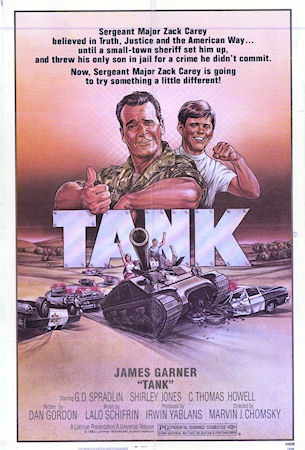
A Movie A Day #204: Tank (1984, directed by Marvin Chomsky)


If you had just moved to a small town in Georgia and your teenage son was framed for marijuana possession and sentenced to years of hard labor, what would you do?

Would you hire a good lawyer and file appeal after appeal?

Would you go to the media and let them know that the corrupt sheriff and his evil deputy are running a prostitution ring and the only reason your son is in prison is because you dared to call them out on their corruption?

Or would you get in a World War II-era Sherman tank and drive it across Georgia, becoming a folk hero in the process?

If you are Sgt. Zack Carey (James Garner), you take the third option.  Sgt. Carey is only a few months from retirement but he is willing to throw that all away to break his son (C. Thomas Howell) out of prison and expose the truth about Sheriff Buelton (G.D. Spradlin) and Deputy Euclid Baker (James Cromwell, playing a redneck).  Helping Sgt. Carey out are a prostitute (Jenilee Harrison), Carey’s wife (Shirley Jones), and the citizens of Georgia, who lines the road to cheer the tank as it heads for the Georgia/Kentucky border.  It’s just like the O.J. Bronco chase, with James Garner in the role of A.C. Cowlings.

The main thing that Tank has going for it is that tank.  Who has not fantasized about driving across the country in a tank and blowing up police cars along the way?  James Garner is cool, too, even if he is playing a role that would be better suited for someone like Burt Reynolds.  Tank really is Smoky and the Bandit with a tank in the place of that trans am.  Personally, I would rather have the trans am but Tank is still entertaining.  Dumb but entertaining.

One final note, a piece of political trivia: According to the end credits, the governor of Georgia was played by Wallace Willkinson.  At first, I assumed this was the same Wallace Wilkinson who later served as governor of Kentucky.  It’ not.  It turns out that two men shared the same name.  It’s just a coincidence that one played a governor while the other actually became a governor.