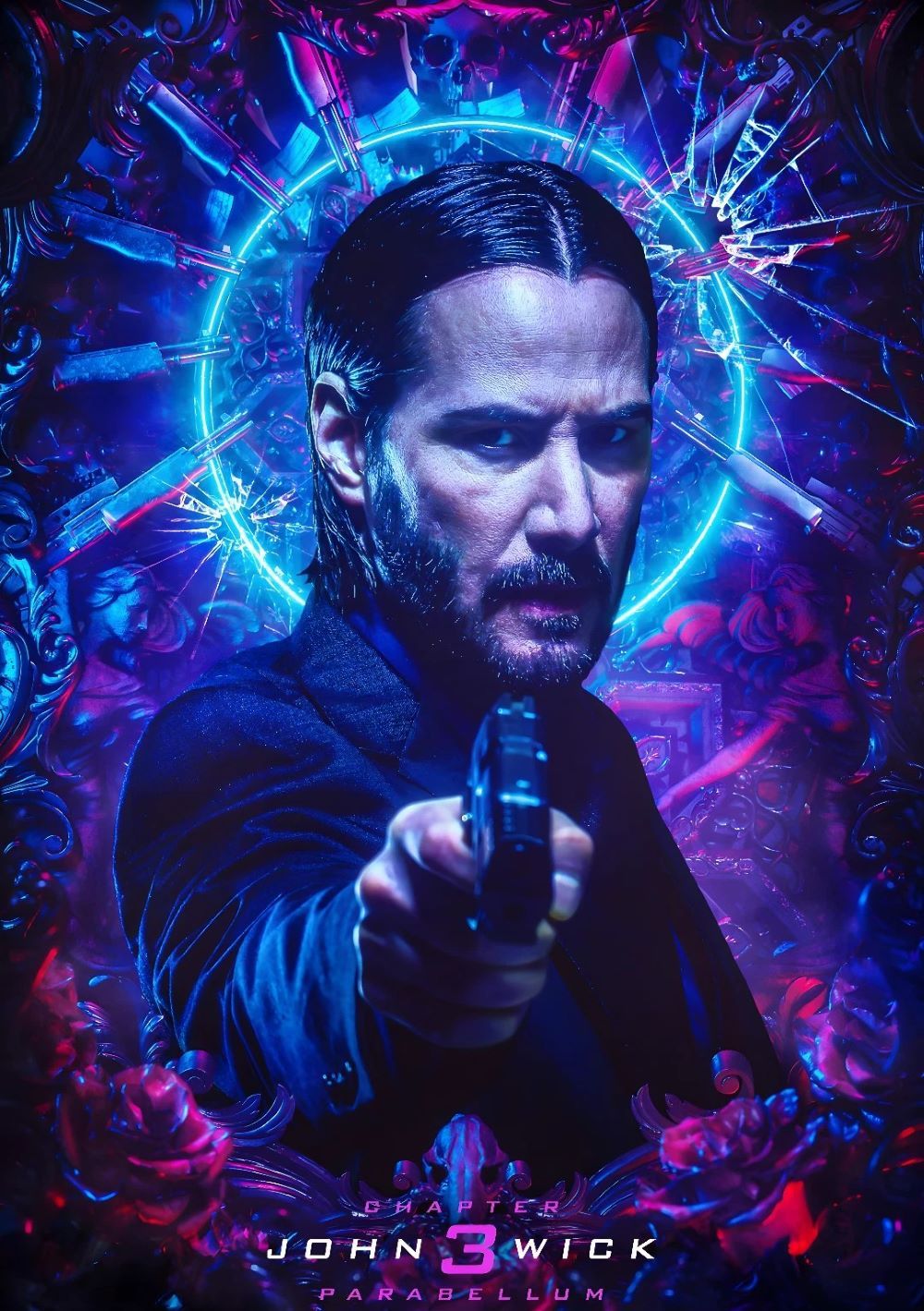
John Wick: Chapter 3 – Parabellum (dir. by Chad Stahelski) Review


“Nothing’s ever just a conversation with you, John.” — Sofia Al-Azwar

John Wick: Chapter 3 – Parabellum launches straight from the previous installment’s shocking finale, hurling John into a frantic dash through New York’s underbelly as a $14 million bounty turns every shadow into a threat. This chapter dials the franchise’s signature intensity even higher, plunging you into an assassin underworld bound by ironclad rules that start to fracture under pressure. The action explodes with creative savagery, though the storyline sometimes buckles beneath its ambitions, offering a pulse-pounding yet slightly bloated addition to the saga.

The movie opens with John scrambling through New York streets, his excommunicado status ticking down like a bomb. He’s got one hour before every killer in the city turns on him, and boy, do they. Keanu Reeves is back in top form, looking battered but unbreakable, his puppy-dog eyes conveying more grief and determination than any monologue could. The film’s Latin subtitle, Parabellum—meaning “prepare for war”—sets the tone perfectly as John grabs weapons from the oddest places, like a horse stable or a knife shop where he gets to use blades almost like guns with each throw.

What makes this entry stand out is how it expands the Wick-verse without losing that gritty intimacy. We dive deeper into the High Table’s bureaucracy, with the Adjudicator (Asia Kate Dillon) showing up as this cold, efficient enforcer who judges allies like Winston (Ian McShane) and Charon (Lance Reddick) for helping John. It’s a smart addition, adding layers to the rules that have always governed this world—markers, blood oaths, no business on Continental grounds. Halle Berry pops in as Sofia, an old flame running a Moroccan palace full of attack dogs, leading to one of the film’s wildest sequences where pooches tear into bad guys alongside John. Mark Dacascos as Zero, the sushi-loving villain who’s bald and sports a penchant for movie quotes, brings some quirky charm, even if he’s no Santino from Chapter 2.

Director Chad Stahelski, a former stuntman himself, continues to treat action like high art, and man, does Chapter 3 flex its muscles here harder than ever. The choreography is balletic and brutal, blending gun fu with knives, swords, and even books—there’s a library fight where John uses a volume as a shield and club, then politely reshelves it, which is peak Wick weirdness. Fights escalate from motorcycle sword duels slicing through rainy streets to hall-of-mirrors mayhem that nods to Enter the Dragon, with reflections multiplying the chaos into a dizzying ballet of blades. Indonesian martial arts legends Cecep Arif Rahman and Yayan Ruhian, The Raid 2 alumni who make their franchise debut here, light up the massive finale melee, trading blows with John in a flurry of fists, elbows, and blades that feels like a love letter to silat and caps the chaos perfectly.

Every sequence feels meticulously planned, relying on practical stunts that make CGI-heavy blockbusters look lazy and fake—think real falls, real crashes, real bone-crunching impacts that leave you wincing. The gun fu style—precise headshots amid flips, slides, and reloads—never gets old, evolving with fresh twists like pencil kills upgraded to book barrages or horse-mounted shootouts. The film’s true strength lies in these set pieces: they’re not just fights, they’re symphony-like spectacles where camera work syncs breathlessly with the violence, spatial awareness stays razor-sharp so you track every bullet and block, and the escalation feels organic, building from claustrophobic knife scraps to epic rooftop brawls. It’s the kind of action that honors the genre’s legends while pushing boundaries, making you forget any plot gripes amid the sheer kinetic joy.

That said, it’s not all flawless, and one drawback from Chapter 2 creeps back in here: the film leans heavily into more world-building of its universe, which puts character development on the back burner. John’s arc—fighting to earn back his freedom—repeats beats from the previous entry, and some twists, like Winston’s apparent betrayal, land more as fan service than emotional gut-punches. At 131 minutes, it drags in spots, especially during quieter moments that try to humanize John but end up repetitive, while the dialogue stays sparse and stylized, leaving characters like the Elder (Saïd Taghmaoui) feeling underdeveloped. But then again, the franchise has staked its claim on being action-focused from the jump, so if fans are bought into this wild ride by now, they’re probably here for the balletic bloodshed over deep psychology anyway—it’s like the film loves its assassins’ code more than fleshing out motivations beyond revenge.

Visually, it’s a stunner. Dan Laustsen’s cinematography turns New York into a neon-soaked hellscape, with rain-slicked streets and ornate Continental lobbies popping in crisp 2.40:1. The Morocco desert scenes add exotic flair, though they borrow heavily from The Good, the Bad and the Ugly. Tyler Bates and Joel J. Richard’s score pounds with industrial electronica, syncing perfectly to the violence, while select tracks like Team Rezo’s “Pray for Kaeo” amp up horse chases. Sound design is Oscar-worthy—the thud of fists, crack of gunfire, all mixed to immerse you in the carnage.

Keanu Reeves carries it all, 54 at release but moving like a man half his age thanks to rigorous training. His physical commitment sells John’s exhaustion; you see the toll in every limp and gasp. Supporting cast shines too—McShane’s suave Winston steals scenes with dry wit, Reddick’s Charon is unflappably loyal, and Berry holds her own in dog-assisted fury. Dacascos adds levity, slicing foes with a sunny disposition, but Dillon’s Adjudicator is more menacing presence than fleshed-out foe. It’s ensemble work in service of spectacle, not drama.

For fans of the series, John Wick: Chapter 3 delivers bigger, bolder chaos that honors stunt performers as the real stars. It celebrates cinema history with nods to Buster Keaton (a horse chase echoes The General) and Hong Kong action flicks, all while pushing practical effects. Critics raved about the thrills, calling it “blissfully brutal” entertainment that shames neighbors like generic superhero fare. Audiences loved the over-the-top kills and Reeves’ stoic heroics.

To keep it fair, though, this isn’t exactly groundbreaking stuff. The simplicity that charmed in the original—a widower’s rampage—has bloated into a globe-trotting saga chasing its own tail. Female characters, while badass like Sofia, still orbit John’s story, and the violence, though stylish, borders on cartoonish excess. Some felt it lost narrative steam, prioritizing set pieces over heart, turning Wick from grieving everyman to invincible machine. Compared to Chapter 2‘s operatic betrayal, this one’s more procedural, like a video game level grind.

Ultimately, John Wick: Chapter 3 – Parabellum is a love letter to action cinema, casual fun if you’re in for the mayhem. It’s not deep, but damn if it doesn’t make you cheer as John unleashes hell. Grab popcorn, dim the lights, and prepare for war—you won’t regret it, unless you’re after Oscar bait. Solid 8/10 for pure, delirious popcorn thrills.

Weapons used by John Wick throughout the film

  • TTI STI 2011 Combat Master: Iconic pistol from the armory scene—John’s “2011” choice with optics, extended mags, and flawless reliability for extended shootouts.
  • Glock 19 / 19X / 17: Multiple pickups during mint guard fights in Casablanca and Continental siege; versatile Glocks he commandeers mid-battle.
  • Walther PPQ / CCP: Snagged from assassins during the motorcycle chase; quick-use comped models for on-the-run defense.
  • TTI SIG-Sauer MPX Carbine: Siege standout with Trijicon MRO sight, Streamlight laser, and +11 mags—John’s signature stance shines in hallway clears.
  • SIG-Sauer MPX / MPX Copperhead: Casablanca mint raid grabs; compact 9mm shredders with red dots and grips for close-quarters fury.
  • Benelli M4 Super 90: Climactic Continental siege with Charon; armor-piercing slugs, extended tubes, ghost rings—devastating hallway blasts.
  • Benelli M2 Super 90 (TTI Ultimate package, implied variants): Siege support; Charon favors these, John grabs similar for enforcer waves.

John Wick Franchise (spinoffs)
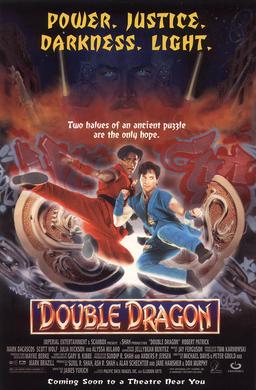
Guilty Pleasure No. 61: Double Dragon (dir by James Yukich)


The time is …. the future!

The future looks a lot like a cheap music video.  Due to repeated earthquakes, California is now an island and Los Angeles has been left in ruins.  The city has been renamed New Angeles, even though the correct name would have been Nuevos Angeles but whatever.  The important thing is that city is now a mess.  The police allow the gangs to run rampant at night in return for not running rampant during the day.  The nightly news, which is anchored by George Hamilton and Vanna White, is full of stories about the federal government refusing to send any more aid to California, despite the fact that Jerry Brown is the Vice President.  For some reason, Andy Dick plays the weatherman and gives continual updates on the smog and rain.

Despite the fact that the city is the most dangerous place on Earth, Satori Imada (Julia Nickson) still makes the time to drive her teenage sons, Billy (Scott Wolf) and and Jimmy Lee (Mark Dacascos, who was clearly not a teenager when this film was shot) to and from their karate tournaments.  However, that might all end because Sartori possesses half of a magic medallion and the evil Koga Shuko (Robert Patrick, looking oddly like Sugar Ray’s Mark McGrath) has the other half.  Satori gives her half of the medallion to Billy and tells him that he and his brother must keep it out of the hands of Shuko.

That’s not going to be easy because Shuko not only has control of the local gangs but also the police.  Fortunately, rebel leader Marian Delario (Alyssa Milano) is willing to help out the Lee brothers.  It all leads to a lot of fights, a lot of running, some campy humor, and stiffly delivered dialogue.  For whatever reason, the filmmakers decided that the way to make this marital arts film a success would be to push accomplished martial artist Mark Dacascos into the background and instead focus on Scott Wolf, who spends most of the movie looking like he’s either confused by the plot or terrified as to what Double Dragon might do to his career.

Yeah, this movie is pretty stupid and the plot is pretty much impossible to follow.  And yet, it is oddly entertaining in its own weird way.  If you ignore the story and just focus on the visuals, it can actually be kind of fun.  Look at all the bright colors.  Look at Robert Patrick, with his goat-tee and his 90s pop star hair.  Look at Alyssa Milano, who, surprisingly, seems to actually be in on the joke.  Look at all of the Mad Max-inspired fashion choices.  From a purely visual point of view, New Angeles is a huge improvement on Los Angeles.  Along with the film visuals, the film is also worth watching just so one can witness just how over-the-top Robert Patrick goes in his performance.  I don’t normally think of Patrick as being someone who chews the scenery but, in this film, he gives into every cartoonish impulse that he has and it’s actually a lot of fun to watch.  There’s not a moment of subtlety to be found in either his performance or Alyssa Milano’s and thank the Angels for that.  Finally, I have to appreciate the fact that the film’s main message appears to be that the government and all other forms of civil authority are basically useless.  Not even Vice President Jerry Brown can be bothered to help out the people of New Angeles.  That pretty much tells you all that you need to know.

In the end, Double Dragon is not a particularly good film but it’s fun in its own deeply dumb way.

Previous Guilty Pleasures

  1. Half-Baked
  2. Save The Last Dance
  3. Every Rose Has Its Thorns
  4. The Jeremy Kyle Show
  5. Invasion USA
  6. The Golden Child
  7. Final Destination 2
  8. Paparazzi
  9. The Principal
  10. The Substitute
  11. Terror In The Family
  12. Pandorum
  13. Lambada
  14. Fear
  15. Cocktail
  16. Keep Off The Grass
  17. Girls, Girls, Girls
  18. Class
  19. Tart
  20. King Kong vs. Godzilla
  21. Hawk the Slayer
  22. Battle Beyond the Stars
  23. Meridian
  24. Walk of Shame
  25. From Justin To Kelly
  26. Project Greenlight
  27. Sex Decoy: Love Stings
  28. Swimfan
  29. On the Line
  30. Wolfen
  31. Hail Caesar!
  32. It’s So Cold In The D
  33. In the Mix
  34. Healed By Grace
  35. Valley of the Dolls
  36. The Legend of Billie Jean
  37. Death Wish
  38. Shipping Wars
  39. Ghost Whisperer
  40. Parking Wars
  41. The Dead Are After Me
  42. Harper’s Island
  43. The Resurrection of Gavin Stone
  44. Paranormal State
  45. Utopia
  46. Bar Rescue
  47. The Powers of Matthew Star
  48. Spiker
  49. Heavenly Bodies
  50. Maid in Manhattan
  51. Rage and Honor
  52. Saved By The Bell 3. 21 “No Hope With Dope”
  53. Happy Gilmore
  54. Solarbabies
  55. The Dawn of Correction
  56. Once You Understand
  57. The Voyeurs 
  58. Robot Jox
  59. Teen Wolf
  60. The Running Man

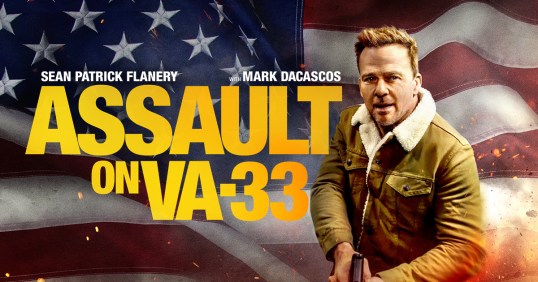
Film Review: Assault on VA-33 (dir by Christopher Ray)


Adrian (Weston Cage Coppola) is an international criminal and terrorist, a man who isn’t going to let a little thing like being wanted by the FBI prevent him from getting what he wants.  Adrian wants his brother to be freed from prison.  He wants money.  He wants a plane that he and his criminal associates can use to get out of the country.  His plan is to take over a veteran’s hospital and hold the patients and the doctors hostage until he gets what he wants.  Among the hostages is General Welch (Gerald Webb) of the Joint Chiefs of Staff.

Also inside of VA-33 is Jason Hill (Sean Patrick Flannery).  Jason is a decorated veteran who is struggling with PTSD and a bad leg.  Jason’s wife, Jennifer (Gina Holden), is a doctor at the hospital and also one of the hostages.  With his 14 year-old daughter waiting for him outside and the initially skeptical police chief Malone (Michael Jai White) providing as much support as he can, Jason must take out of the terrorists and liberate VA-33.

Assault on VA-33 is an entertaining action film.  The film was directed by Christopher Ray, the son of Fred Olen Ray.  From his father, Christopher Ray obviously picked up the ability to make an enjoyable film on a low budget.  However, Ray also served, for seven years, in the U.S. Navy and there’s a deep respect for veterans that runs throughout Assault on VA-33, a respect that sets this film apart from many of the other Die Hard-inspired action films that have come out over the years.  For me, the film’s key scene is not any of the many action sequences but instead it’s when Jason first attempts to call the police and finds himself being dismissed because the man on the other end, upon hearing that Jason is at the VA, just assumes that Jason is suffering from paranoid hallucinations.  “Thank you for your service,” the voice at the other end of the line says somewhat condescendingly as Jason struggles to get the police to understand that this is all really happening.  The consequences of war is a theme that runs through the entire film as both Jason and the General struggle to deal with the physical and mental scars with which they’ve been afflicted.

Sean Patrick Flannery is a good action hero, playing Jason not as being superhuman but instead as just being a tough but weary man who, due to his past injuries, doesn’t move quite as fast as he used to but who is still trying to do the right thing and protect innocent people, including his wife and his daughter.  Adrian’s henchmen are all properly memorable and menacing.  I especially liked Tim McKiernan as the terrorist who is left in charge of the front desk.  Rob Van Dam has some good moments as the terrorist who has been assigned to wait outside in the van and who keeps reminding everyone that his name is Zero.

Assault on VA-33 is a fun and quickly paced action movie.  Flannery is an effective hero and the villains are all properly evil.  I would also suggest sticking around through the end credits, just so you can enjoy the film’s musical score, which is definitely a bit better than the music that we typically associate with indie action films.  It’s an enjoyable movie and a good way to spend 88 minutes of your life.

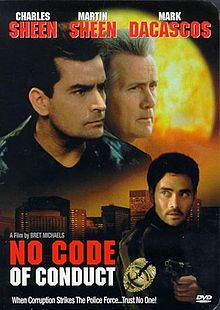
A Movie A Day #183: No Code of Conduct (1998, directed by David Lee…sorry, Bret Michaels)


From the strange period of time in which Charlie Sheen wanted people to call him Charles, comes this generic action movie.
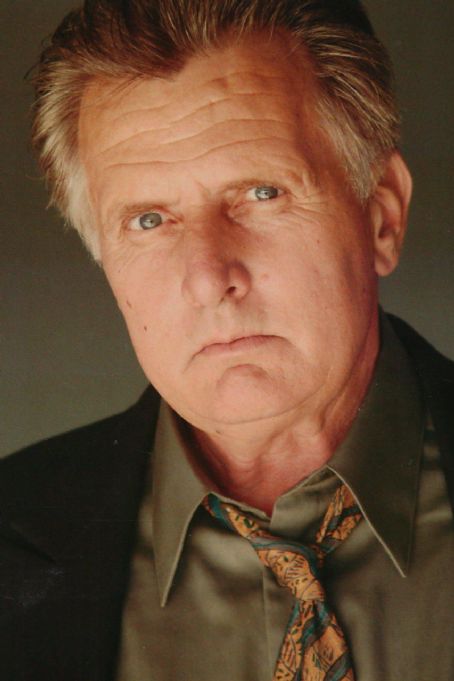
Detective Jake Peterson (Charles Sheen) is a loser.  Even though his father (Martin Sheen) is the chief of police, Jake is so bad at his job that he has been assigned to work in the evidence locker.  His wife (Meredith Salenger) is always yelling at him for being a neglectful father.  The only person who likes Jake is his partner (Mark Dascasos, who is wasted) and partner’s never live for long in cop movies.  When Jake discovers that evil businessman Julian Disanto (Ron Masak) is plotting to smuggle Mexican heroin into Arizona, he has a chance for redemption but it will not be easy because Disanto is not only working with a corrupt DEA agent (Paul Gleason, of course) but he also has a band of psychotic henchmen.

This predictable and not very exciting action film is interesting for two reasons.  First of all, it was directed by the poor man’s David Lee Roth, Bret Michaels.  At the time, the future star of Rock of Love and Celebrity Apprentice winner was best known for being the lead singer of the most boring hair metal band of the 80s, Poison.  It is always interesting when someone who found fame as something other than a filmmaker tries his hand at directing.  Sometimes, the results can be surprisingly good and sometimes, the result is No Code For Conduct.  Michaels and Sheen (who co-wrote the script) may have been trying to pull off an homage to the action films of their youth but No Code For Conduct has more in common with the work of Uwe Boll than the work of William Friedkin.

The other interesting thing about No Code for Conduct is that, even though “Charles” and Martin are top-billed, it is actually a four Sheen/Estevez movie.  Renee Estevez briefly appears as a cop while Martin’s brother, Joe Estevez, is in charge of the police motor pool.  If No Code For Conduct is an act-off between the members of the Sheen/Estevez clan, Joe emerges as the clear winner.  Charlie does his wide-eyed intense thing.  Martin goes through the movie with a “the shit I do for my son” air of resignation.  Renee is not around long enough to make an impression.  But Joe?

Joe Estevez is the man!

Joe Estevez, the only Estevez that matters

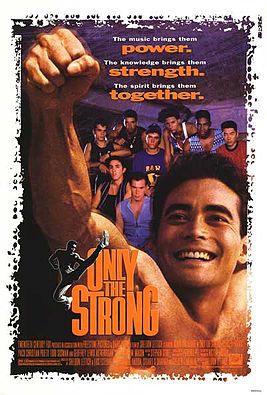
Insomnia File No. 18: Only The Strong (dir by Sheldon Lettich)


What’s an Insomnia File? You know how some times you just can’t get any sleep and, at about three in the morning, you’ll find yourself watching whatever you can find on cable? This feature is all about those insomnia-inspired discoveries!

Last night, if you were suffering from insomnia at one in the morning and you turned over to one of the Cinemax stations, you could have watched the 1993 film, Only The Strong.

Only The Strong is an example of a film genre that is a personal favorite of mine.  This is one of those films where a dedicated but unorthodox teacher returns to his old high school and saves a bunch of troubled teenagers by teaching them how to beat the crap out of each other.  (For another example, check out The Principal.)  It’s hard for me to explain why I always enjoy these films.  I’m always tempted to say it’s because there’s a part of me that would love to be a teacher but, honestly, that answer is way too easy.  Add to that, if I was a teacher, I doubt I’d be one of the “I’m going to teach you how to beat the crap out of each other” teachers that tend to show up in these films.  It seems like that would be a lot of effort.

In fact, now that I think about it, I don’t think I’ve ever met a “I’m going to teach you how to beat the crap out of each other” type of teacher.  I get the feeling that these teachers might not actually exist.  Maybe that’s why I like these films. For someone, like me, who went to a very nice but somewhat boring high school in the suburbs, a film like Only The Strong is the ultimate fantasy of what high school was like.

Anyway, in Only The Strong, Mark Dacascos plays Louis Stevens.  Louis was a troubled teenager but, luckily, he took a sociology class taught by Mr. Kerrigan (Geoffrey Lewis).  Kerrigan taught Louis that there was something more to life than just selling drugs and getting into fights.  After he graduated, Louis joined the Green Berets and spent four years living in the jungles Brazil.  In Brazil, he learned capoeira, a type of martial art that combines dance, acrobatics, and kick boxing.  In fact, Louis got so good at capoeira that, when he is recalled to the states, a village wiseman gives him a special instrument, a musical bow called a berimbau.

Louis returns to his old high school and visits Mr. Kerrigan.  He discovers that Kerrigan has been beaten down by life and is no longer the inspiring teacher that he once was.  He also discovers that his ex-girlfriend, Dianna (Stacey Travis), is now a teacher and she’s dating another teacher, Hector Cervantes (John Fionte).  Hector assumes that Louis worked for the CIA in Brazil and accuses him of organizing death squads.

Annoyed by what has happened to his old high school, Louis starts to leave.  However, before walking out, he uses capoeira to beat up a Jamaican drug dealer.  Everyone is so impressed that Louis is soon working for the high school, teaching 12 of the school’s worst students both capoeira and self-discipline…

(To be honest, as I watched the movie last night, none of the 12 students really seemed to be that dangerous to me.  It was difficult to imagine the majority of them ever committing a felony, though I could visualize more than a few of them waiting in line at Starbucks.  Then I remembered that this movie was made in 1993 and perhaps it was easier to scare audiences back then.)

It doesn’t take long for Louis to start to make a difference.  In fact, it only takes a four-minute training montage.  Soon, those 12 students are being respectful and thinking about the future.  Donavon (Ryan Bollman) is even remixing capoeira music and acting so worshipful towards Louis that you just know that he’s going to end up getting killed towards the end of the film, in order to provide Louis with the proper motivation to go out and kick some ass.  Unfortunately, the local Brazilian drug lord is not happy about Louis’s influence (especially after Louis encourages the drug lord’s cousin to spend his weekend camping instead of stripping cars).  Needless to say, it all leads to a violent showdown.  It also all leads to one of those inspiring graduation ceremonies that always tend to pop up in movies like this.

Anyway, Only The Strong is one of those films that currently has a 0% rating at the Rotten Tomatoes but I thought it was kind of fun in its own stupid way. (It probably helps to be half-asleep when you watch it.)  Even if you don’t buy into the film’s argument that it could be used to save an inner city high school, capoeira is a lot of fun to watch and Mark Dacascos has an appealing smile, which serves to set him apart from a lot of the other actors that starred in actions films in the 1990s.  Only The Strong is silly but fun, making it a good film to watch at one in the morning.

Only_the_Strong

Previous Insomnia Files:

  1. Story of Mankind
  2. Stag
  3. Love Is A Gun
  4. Nina Takes A Lover
  5. Black Ice
  6. Frogs For Snakes
  7. Fair Game
  8. From The Hip
  9. Born Killers
  10. Eye For An Eye
  11. Summer Catch
  12. Beyond the Law
  13. Spring Broke
  14. Promise
  15. George Wallace
  16. Kill The Messenger
  17. The Suburbans

Film Review: Instinct to Kill (Dir by Gustavo Graef Marino)


Hi there and welcome to another edition of Lisa Marie Watches An Obscure Film Via On Demand And Then Reviews It.

Last week, I watched and reviewed a 2001 guilty pleasure called Tart.

This week, I watched another film from 2001, Instinct to Kill.

Instinct to Kill begins with homicide detective Jim Beckett (Tim Abell) sitting outside a suburban house and secretly filming Tess (Missy Crider) as she dresses.  As Jim watches, Tess joins her parents for dinner.  Tess’s father strikes her mother.  In case we needed anymore reason to hate him, Jim chuckles.

A day later, Tess is at cheerleader practice and again, she is being watched.  Sitting in the bleachers, Jim films her until he finally approaches her and strikes up a conversation.  Jim may be creepy but he’s also charming. Agck!

The film jumps forward 3 months.  Tess and Jim are getting married.  Jim and his partner Lance (Kadeem Hardison) spend the reception filming the bridesmaids and leering over  all the cleavage.  Bad Jim, bad!

And again, the film moves forward by 3 months.  As all too often happens, the daughter of an abusive father has ended up with an abusive husband.  As Jim attempts to murder Tess, Lance rushes into the house with his gun drawn.  Jim is arrested and sent to prison.

3 months later, Jim escapes from prison and, after retrieving a disguise kit from his own abusive father, Jim starts to stalk his ex-wife, her family, and her friends.  As Lance attempts to track down his former friend, Tess gets a bodyguard and a self-defense instructor in the form of J.T. (Mark Dacascos).

According to the imdb, Instinct to Kill was rated R for featuring “brutal violence and strong sexual content” and yes, it certainly had both of those.  However, to be honest, if you toned down the violence and edited out all of the boob shots, Instinct to Kill would be an almost prototypical Lifetime movie. After all, it has all the classic Lifetime elements: a sociopathic ex-husband, a sensitive guy who teaches self-defense, and a female protagonist who comes out of it all newly empowered and confident.  Fortunately, I happen to love Lifetime movies and maybe that’s why, somewhat to my surprise, I actually found Instinct to Kill to be an effective B-movie.

Some of that may also be due to the fact that Instinct To Kill’s executive producer was Mark L. Lester, who has directed some of the best B-movies of all time.  (He also directed The Ex, which has become a bit of a staple on the Lifetime Movie Network.)  I don’t know how involved Lester actually was with the production of this film but it feels much like a Lester film — the villain is flamboyant, the action moves quickly, and the end result packs much more of an emotional punch than you would expect.

Instinct to Kill may have a generic title but it’s definitely not a generic film.  Tim Abell makes for a genuinely scary villain and Mark Dacascos is the epitome of strength and sensitivity.  That said, the film’s best performance comes from Missy Crider, who believably transforms from being a helpless victim to an empowered warrior over the course of the film and, as a result, elevates the entire film.

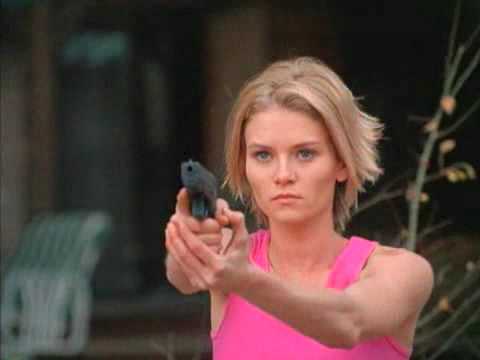
Missy Crider in Instinct to Kill