Lisa Reviews An Oscar Nominee: 42nd Street (dir by Lloyd Bacon and Busby Berkeley)


forty-second-street-1933

If you’re a regular reader of this site, it will not take you by surprise to learn that the 1933 Best Picture Nominee, 42nd Street, is one of my favorite films of all time.

I mean, how couldn’t it be?  Not only is it a pre-Code film (and we all know that pre-Code films were the best) and one the features both Ginger Rogers and Dick Powell in early roles but it’s also a film that depicts the backstage world of a stage musical with such a combination of love and snark that it will be familiar to everyone from community theater nerds to Broadway veterans.  42nd Street is a classic musical, though I have to admit that I think the majority of the songs are a bit overrated.  Even more importantly, 42nd Street is the ultimate dance film.  The film’s big production number, choreographed and filmed in the brilliant and flamboyant Busby Berkeley style, is such an iconic moment that it’s still being imitated and lovingly parodied to this day.

Every dance movie owes a debt to 42nd Street but few have come close to matching it.  Remember how much we all hated Smash?  There were a lot of reasons to hate Smash but the main reason was because it tried to be 42nd Street and it failed.  There can only be one 42nd Street.

It’s hard to estimate the number of show business clichés that currently exist as a result of 42nd Street.  Then again, it can be argued that they were clichés before they showed up in 42nd Street but 42nd Street handled them in such an expert fashion that they were transformed from being urban legends to immortal mythology.

42nd Street takes place in the backstage world, following the production of a Broadway musical through casting to rehearsals to opening night.  It’s an ensemble piece, one populated by all the usual suspects.  Julian Marsh (Warner Baxter) is the down-on-his-luck producer who desperately needs a hit.  Dorothy Brock (Bebe Daniels) is the celebrated star who is dating a rich, older man (Guy Kibbee, who made quite the career out playing rich, older men) while secretly seeing her ex, a down-on-his-luck Vaudevillian (George Brent).  From the minute that we first see Dorothy, we know that she’s eventually going to end up with a boken ankle.  It’s just a question of which chorus girl will be promoted to take her place.  Will it be “Anytime” Annie (Ginger Rogers) or will it be the naive and wholesome Peggy (Ruby Keeler)?  You already know the answer but it’s still fun to watch.

If you had any doubts that this was a pre-code film, the fact that Ginger Rogers is playing a character named “Anytime” Annie should answer them.  42nd Street is often described as being a light-hearted camp spectacle but there’s a cynicism to the film, a cynicism that could only be expressed during the pre-code era.  The dialogue is full of lines that, just a few years later, would never have gotten past the censors.

(This is the film where it’s said that Anytime Annie “only said no once and then she didn’t hear the question!”  This is also the film where Guy Kibbee cheerfully tells Annie that what he does for her will depend on what she does for him.  Just try to get away with openly acknowleding the casting couch in 1936!)

The menacing shadow of the Great Depression looms over every glossy production number.  Julian needs a hit because he lost all of his money when the Stock Market crashed and if the show is not a hit, everyone involved in the production will be out on the streets.  The chorus isn’t just dancing because it’s their job.  They’re dancing because it’s an escape from the grim reality of the Great Depression and, for the audience watching, the production numbers provided a similar escape.  42nd Street said, “Yes, life is tough.  But sometimes life is fun.  Sometimes life is sexy.  Sometimes, life is worth the trouble.”  Someday, 42nd Street promises, all the misery will be worth it.

Ultimately, 42nd Street is all about that iconic, 20-minute production number:

42nd Street was nominated for best picture but it lost to the nearly forgotten Cavalcade.

Horror On The Lens: Plan 9 From Outer Space (dir by Edward D. Wood, Jr.)


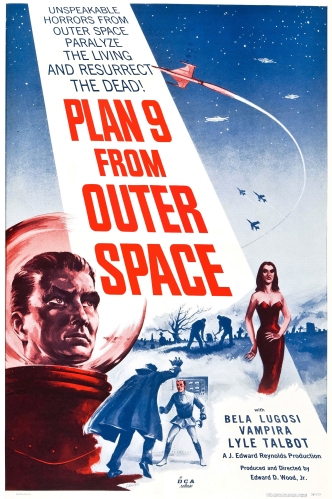
Plan_9_Alternative_posterWatching Ed Wood’s infamous Plan 9 From Outer Space is something of an October tradition here at the Shattered Lens!  And you know how much I love tradition!  (Add to that, I shared Bride of the Monster last night and I’m going to be reviewing at least two sci-fi horror films later today so it just seems appropriate to go ahead and share Plan 9 today!)

Incidentally, I know this film has a reputation for being the worst film ever made.  Personally, I don’t think that it deserves that reputation.  Is it bad?  By traditional standards of quality, I guess it can be argued that Plan 9 From Outer Space is a bad movie.  But it’s also a lot of fun and how can you not smile when you hear Criswell’s opening and closing statements?

Enjoy and be sure to read Gary’s review!

(And also be sure to read Jedadiah Leland’s tribute to Criswell!)

(On another note: Watch this as quickly as you can because, for the first time since we started Horror on the Lens, the films of Ed Wood are being yanked off of YouTube.  Copyright violations, they say.  Personally, I think that’s shameful.  First off, Ed Wood is no longer alive.  Wood had no children and his widow died in 2006, having never remarried.  Whatever money is being made off of his films is not going to support his family.  Wherever he is, I think Ed would be more concerned that people see his films than some faceless corporation make money off of them.)


Horror on the Lens: Plan 9 From Outer Space (dir by Edward D. Wood, Jr.)


Plan_9_Alternative_posterWatching Ed Wood’s infamous Plan 9 From Outer Space is something of an October tradition here at the Shattered Lens!  And you know how much I love tradition!

Incidentally, I know this film has a reputation for being the worst film ever made.  Personally, I don’t think that it deserves that reputation.  Is it bad?  By traditional standards of quality, I guess it can be argued that Plan 9 From Outer Space is a bad movie.  But it’s also a lot of fun and how can you not smile when you hear Criswell’s opening and closing statements?

Enjoy!


Shattered Politics #15: Sunrise at Campobello (dir by Vincent J. Donehue)


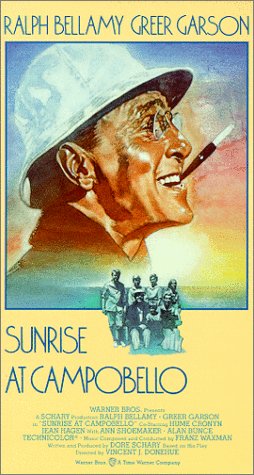
Sunrise_at_Campobello_film

I can still remember that day like yesterday.

I was either 10 or 11 and I was at a big family gathering in Arkansas.  I was at my aunt’s house.  My great-grand uncle was sitting in a corner of the living room and watching the TV.  Because he was nearly blind, only an inch or two separated his face from the screen.  And, because he was almost deaf, the television was blaring.  When we first arrived, he was watching what sounded to be a cartoon but, after a few minutes, he changed the channel.

Apparently, whatever channel he was watching was showing a program about the Great Depression because my great-grand uncle snorted a little and yelled (not because he was mad but because he was deaf), “Some people like Roosevelt!  I say he was a dictator!”

That blew my young mind.  It wasn’t because I necessarily knew that much about Franklin D. Roosevelt, beyond the fact that he had been President.  Instead, it shocked me because that was the first time that I had ever heard anyone call a U.S. President a dictator.  It was the first time that I truly understoodd that not everyone shared the same opinions, especially when it came to politics and history.

Looking back, so many of the things that define me as a person — my skepticism about conventional wisdom, my mistrust of authority, and my tendency to dismiss “experts” — are the result of that day, that documentary on the Great Depression, and my great-grand uncle’s opinion of Franklin D. Roosevelt.

(Want to know why I hate it when the headlines of clickbait articles say stuff like, “Neil deGrasse Tyson gave his opinion on the movies and it was glorious?”  Blame me great-grand uncle.  Nobody was going to tell him FDR wasn’t a dictator.  Nobody’s going tell me what’s glorious.  I’ll make up my own mind.)

And, let’s face it — FDR is a controversial figure.  Most of what you read about Roosevelt is positive but if you glance under the surface, you realize that the legacy of the New Deal is far more ambiguous than most people are willing to admit.  You realize that there are serious questions about whether Roosevelt knew about the upcoming attack on Pearl Harbor.  You discover that Roosevelt wanted to reform the Supreme Court so that it would be a rubber stamp for the executive branch.  And, of course, his decision to run for a third term set up exactly the type of precedent that — if not for a constitutional amendment — could have been exploited by the wrong people.

And, yet, as ambiguous as his legacy may be, how can you not be inspired by FDR’s personal story?  He went from being a dilettante who was often dismissed as being an intellectual lightweight to being four-times elected President of the United States.  In between running unsuccessfully for vice president in 1920 and being elected governor of New York in 1928, Roosevelt was crippled by polio.  It’s always been a huge part of the Roosevelt legend that his battle with polio transformed him and made him into the President who led the country during the Great Depression and World War II.

It’s an inspiring story, regardless of what you may think of Roosevelt’s political ideology or his legacy of government intrusion.

It’s also a story that’s told in our 15th entry in Shattered Politics, the 1960 film Sunrise at Campobello.  This film opens with FDR (played by Ralph Bellamy) as an athletic and somewhat shallow man who, while on a vacation with his family, is struck down my polio.  The film follows he and his wife, Eleanor (Greer Garson), as they learn how to deal with his new physical condition.  Throughout the film, Roosevelt remains upbeat and determined while Eleanor remains supportive and eventually — after being out of the public eye for three years — Roosevelt gets a chance to relaunch his political career by giving a nominating speech for Gov. Al Smith at the Democratic National Convention.

(A little bit of history that everyone should know: Al Smith was the first Catholic to ever be nominated for President by a major political party.)

Sunrise at Campobello is one of those films that tends to show up fairly regularly on TCM.  It’s a well-acted film with Ralph Bellamy and Greer Garson really making the aristocratic Roosevelts into sympathetic and relatable characters.  At the same time, whenever I’ve watched the film, I’ve always been struck by how long it seems.  (The movie itself is only 144 minutes, which means its shorter than the average Christopher Nolan flick but it’s one of those films that seems longer than it actually is.)  Sunrise at Campobello was based on a stage play and it’s directed like a stage play as well, with little visual flair and emphasis on dialogue and character.  The end result is a film that I can’t really recommend for the casual viewer but one that is, at the very least, interesting for students of history like me.

Horror on The Lens: Plan 9 From Outer Space (dir by Edward D. Wood, Jr.)


Plan_9_Alternative_posterWatching Plan 9 From Outer Space is a bit of a Halloween tradition around the Shattered Lens Bunker and, if you know anything about me, you know that I’m all about tradition!

First released back in 1959 and directed by the infamous Ed Wood, Plan 9 From Outer Space is often described as being one of the worst films ever made.  Well, every year, I take it upon myself to defend Plan 9 From Outer Space by pointing out that 1) as opposed to a truly terrible film like Man Of Steel, Plan 9 From Outer Space was made with next to no money, 2) Gregory Walcott does a fairly good job in the lead role, and 3) the film, at the very least, does seem to be sincere in its attempt to promote world peace.  Add to that, the film is way too much fun to watch for it to be truly the worst film ever made.

So, seriously, can we at least give Ed Wood the amount of respect that we usually give to Tommy Wiseau?

Enjoy Plan 9 From Outer Space!  And remember — can you prove it didn’t happen?


Horror On The Lens: Plan 9 From Outer Space (dir by Edward D. Wood, Jr.)


Plan_9_Alternative_poster

We have a few traditions here at the Shattered Lens.  Every Christmas, we feature Treevenge.  Every Halloween, we invite everyone to watch Night of the Living Dead.  And every October, we offer up Ed Wood’s classic plea for world peace, Plan 9 From Outer Space.

Enjoy!