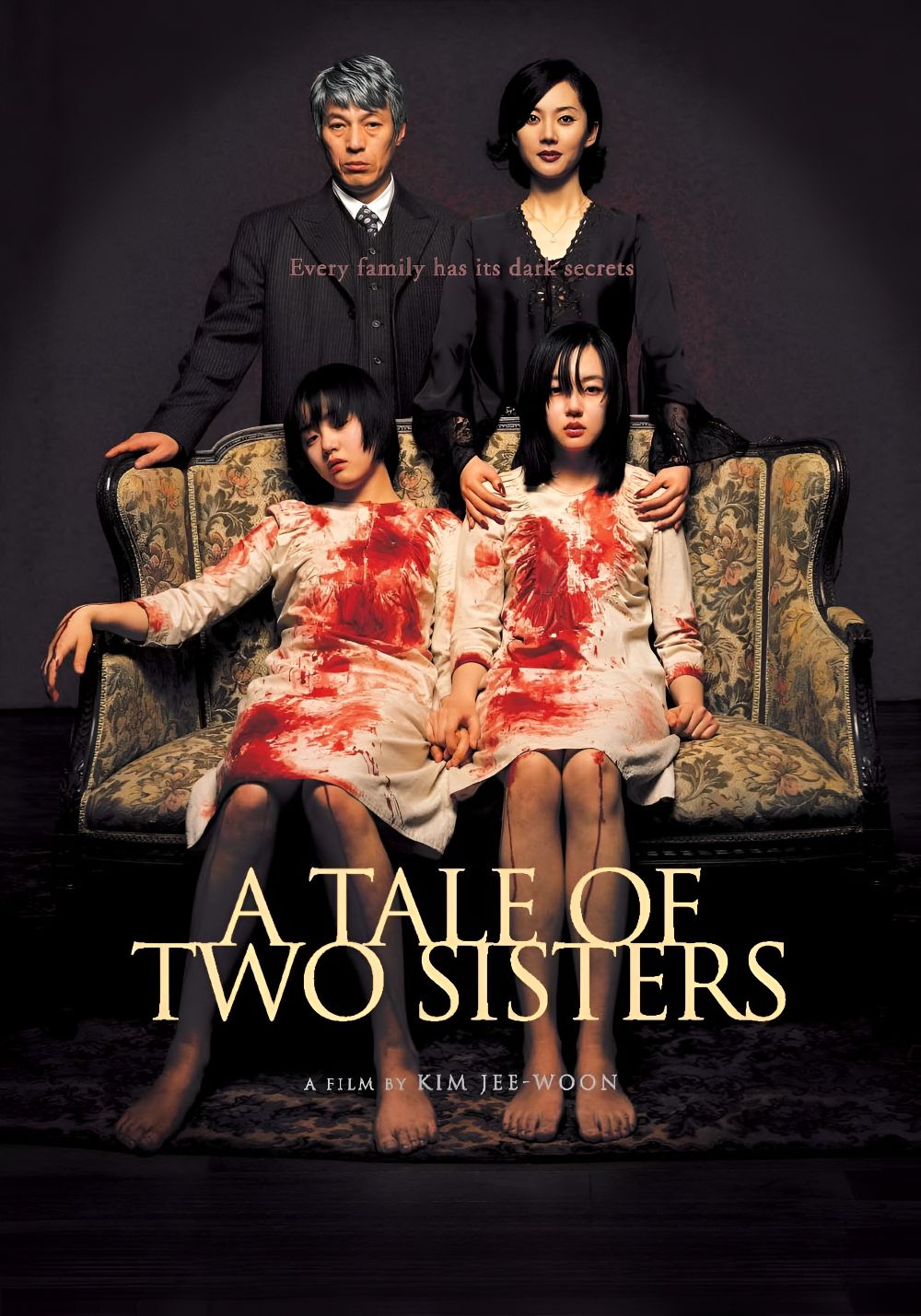
“There’s something strange in this house.” — Eun-joo
A pretty room can hide a lot, and A Tale of Two Sisters makes you suspicious of every one it shows you. The wallpaper is elegant, the furniture looks carefully chosen, and the countryside outside seems peaceful enough. Yet almost immediately, you want someone to open a window and let the dread out. Kim Jee-woon’s 2003 South Korean horror film builds its power around that mismatch between appearance and feeling. Everything looks arranged, but nothing feels settled. Underneath its polished surfaces is a family whose grief and resentment have made ordinary life almost impossible, whether or not a ghost happens to be watching.
The story follows Su-mi, played by Im Soo-jung, and her younger sister Su-yeon, played by Moon Geun-young, as they return to their secluded family home. Waiting there are their emotionally withdrawn father and their stepmother, Eun-joo, whose attempts at friendliness have a distinctly threatening edge. Su-mi is openly hostile toward her, while Su-yeon seems to shrink from confrontation. Nobody looks particularly pleased to be together. Kim gives us these tensions before supplying much explanation, so we spend the opening stretch reading faces and weighing uncomfortable silences. It’s an effective way to make the audience feel unwelcome in the house, too.
What’s impressive is how little the movie initially needs to do to create unease. The family members don’t interact like people working through their problems; they behave like people trying to prevent those problems from being named. Conversations become contests over who gets to define what’s normal. Eun-joo’s brittle politeness clashes with Su-mi’s refusal to play along, while the father’s passivity allows the hostility to keep spreading. Even without the supernatural material, this would be an unpleasant place to spend a weekend. The horror works because it amplifies an emotional situation that already feels dangerous rather than replacing it with something unrelated.
That brings us back to the house, which is much more than an attractive backdrop. Its patterned walls and rich colors make the rooms visually busy, giving your eyes plenty of places to wander and very few places to rest. Doorways suggest hidden spaces, and shadows seem to deepen when nobody is paying attention. Kim repeatedly makes you question where to look, which is a wonderfully simple way of making you doubt your own observation. A room can appear perfectly still while the composition insists otherwise. The beauty doesn’t soften the tension; it gives the tension somewhere elegant to hide.
The scares grow naturally from that visual uncertainty. Kim lets shots breathe long enough for anticipation to become its own kind of punishment. You begin studying empty space, listening for movement, and wondering whether the film has already shown you something you failed to notice. When a disturbing image finally arrives, it feels like the release of pressure that has been building for minutes. There are sudden shocks, but they aren’t the whole strategy. The more effective moments leave a residue, making the next quiet scene uncomfortable before anything happens. The film understands that a scare can end while the fear keeps going.
The performances make sure this atmosphere has something human at its center. Im Soo-jung gives Su-mi an intensity that can seem prickly or even exhausting, but there’s vulnerability beneath it. Her anger often feels like a method of staying upright rather than a simple personality trait. Moon Geun-young brings a gentler presence to Su-yeon, and their contrasting energies make the sisters’ attachment immediately important. Su-mi’s protectiveness gives the film a clear emotional thread even when its events become difficult to follow. We may not understand every strange occurrence, but we understand why she feels compelled to keep her sister close.
Yum Jung-ah makes Eun-joo a particularly unsettling presence because she rarely lets an interaction settle into one mood. An awkward smile can become a reprimand, and a gesture of concern can suddenly feel like a demand for obedience. The performance draws tension from the work involved in maintaining a pleasant appearance. Eun-joo seems to want control not only over the household but also over how everyone experiences it. That makes her more compelling than a straightforward wicked stepmother, even with the film’s connection to the Korean folktale Janghwa Hongryeon jeon. She embodies the gap between domestic respectability and the hostility simmering underneath.
The storytelling is where the film becomes more demanding, and occasionally less satisfying. Kim withholds information, unsettles our confidence in what we see, and eventually asks us to rethink earlier scenes. That can be absorbing, especially when a revelation changes the emotional meaning of an image. It can also leave a first-time viewer feeling a few steps behind. Not every transition is easy to place, and the later explanations don’t turn the whole experience into a tidy equation. Some viewers will enjoy that uncertainty more than others. There are moments when the effort of sorting out the story competes with the experience of feeling it.
Still, treating the film mainly as a mystery to solve undersells its strongest quality. Beneath its narrative complications is an exploration of guilt: how it distorts memory, reshapes attachment, and makes the past feel permanently present. Without spoiling the major revelations, the film gradually changes what we think its frightening moments are expressing. Images that initially register as threats begin to carry sorrow as well. That shift matters because it gives the horror an emotional afterlife. The point isn’t simply that appearances were misleading. It’s that those appearances offered a way of avoiding something much harder to face.
The music and cinematography help sustain that sadness without draining away the dread. There’s a tenderness to parts of the film that makes its cruelty more painful, particularly when the sisters’ relationship occupies the foreground. Occasionally, the emotional emphasis edges toward melodrama, and the deliberate pacing won’t suit anyone looking for a brisk sequence of scares. But the lingering feels earned more often than not. Kim allows scenes to remain troubling after their immediate purpose seems finished. He’s interested in what an experience leaves behind, and that patience makes the eventual emotional damage harder to brush aside.
What remains after A Tale of Two Sisters isn’t just a collection of frightening images or a clever arrangement of revelations. It’s a changed relationship with the beautiful rooms where the story unfolded. Their elegance starts to look less like comfort than a surface nobody has managed to see beneath. The film can be frustrating, but its best moments turn that uncertainty into something painfully intimate. Kim makes us look closely at a home, then question whether looking closely can ever reveal everything. By the end, the wallpaper hasn’t changed. What we imagine behind it has.