Is It Too Late To Hate On Movie 43?


Originally,  I wasn’t planning on ever seeing Movie 43.

Remember Movie 43?  That’s the comedy with the huge ensemble cast that came out in January and stayed in theaters for about a week.  The trailers looked terrible, the commercials looked terrible, and finally, the reviews were terrible.  In fact, the reviews were so terrible (Richard Roeper called it the Citizen Kane of bad movies) that, at first, I was perfectly content never to see it.

However, as time passed, I continually heard Movie 43 referred to as being one of the worst films ever made.  Every 12 months, I post my picks for the 26 worst films of the year and I knew that Movie 43 was one of those films that would either appear on that list or, if it didn’t, I would have to be willing to defend the title’s absence.

I realized that before I could either defend or condemn, I would have to sit through the movie.  After all, I figured, it’s only 90 minutes of my life.

90 minutes that I’ll never get back, I might add.

Movie 43 is an anthology film in which 13 separate comedic sketches are loosely linked together by one overarching story.  For the most part, this is a film that was presumably made both for adolescent boys and for men who still think like adolescent boys.  Most of the humor is derived from bodily functions and there’s a real strain of misogyny running through the entire film.  However, the film’s problem is not that it’s crude and misogynistic but that it manages to be so dull about being crude and misogynistic.  If you think its hilarious when Meg is insulted on Family Guy or when Seth McFarlane smirks after making an anti-Semitic comment, you might enjoy Movie 43 but the rest of us are going to find far less to enjoy.

Oddly enough, there are actually two different versions of Movie 43 in circulation.  In the version that was released in U.S. theaters, the various vignettes are tied together by a story in which an insane director (Dennis Quaid) pitches scene after scene to a callous movie executive (Greg Kinnear).  In the version that was released in the UK, they’re linked together by a story about 3 teenagers searching for the most offensive film ever made.  To be honest, both versions are pretty stupid but I prefer the one about the 3 teenagers, if just because that way I can pretend that neither Dennis Quaid nor Greg Kinnear had anything to do with this movie.

As for the sketches themselves, there’s 13 of them and they are a mixed bag as far as both humor and quality are concerned:

1)      The Catch (dir by Peter Farrelly)

Kate Winslet and Hugh Jackman go on a blind date.  Jackman has testicles hanging from his neck and only Winslet thinks this is an odd thing.  This skit goes on forever.

2)      Homeschooled (dir by Will Graham)

Liev Schreiber and Naomi Watts explain how they’re making sure that their teenage son is getting the full high school experience despite the fact that he’s being homeschooled.  They do this through a combination of hazing and incest.  This skit worked pretty well, mostly because of the dedication that Schreiber and Watts brought to their absurd roles.

3)      The Proposition (dir by Steve Carr)

Uhmm…yeah.  So, this is the skit that opens with Anna Faris asking Chris Pratt to defecate on her.  I skipped over it because, quite frankly, life is too short.

4)      Veronica (dir by Griffin Dunne)

Neil (Kieran Culkin) is working the night shift at a depressing grocery store when his ex-girlfriend Veronica (Emma Stone) comes in.  They argue about who infected who with an STD.  Little do they realize that Neil has accidentally turned on the intercom and everyone in the store can hear them.  I actually kind of liked this short skit.  Culkin and Stone had a lot of chemistry and it was well-directed by Griffin Dunne.  Plus, it only lasted 2 minutes and, therefore, ended before the joke got old.

5)      iBabe (dir by Stephen Brill)

The iBabe is an MP3 player that happens to look like a life-size nude woman.  Unfortunately, a fan was built into the iBabe’s vagina and now, teenage boys are being dismembered while fingering and fucking iBabe.  Richard Gere plays the President of the company that makes iBabe.  I’ve never thought of Richard Gere as being a comedic actor and his performance here does nothing to change that.

6)      Superhero Speed Dating (directed by James Duffy)

Robin (Justin Long) goes speed dating and Batman (Jason Sudekis) tries to mess things up for him.  This skit – which also features (and wastes) Uma Thurman, Kristen Bell, and Bobby Cannavale – is so incredibly bad that I don’t even know where to begin.  Between this film and his appearance in last year’s The Conspirator, I’m having to rethink my slight crush on Justin Long.

7)      Machine Kids (directed by Jonathan Von Tulleken)

This commercial parody asks us to consider the children who work inside copiers and vending machines and how they are effected when we criticize those machines for not accepting our dollar.  This was actually so weird that I couldn’t help but love it.

8)      Middleschool Date (dir by Elizabeth Banks)

7th grader Amanda (Chloe Moretz) is having her first “middle school” date with Nathan (Jimmy Bennett) when she starts her first period.  In response, Nathan and his older brother (Christopher Mintz-Plasse) panic.  Believe it or not, this was actually one of the better parts of Movie 43, if just because the scene’s humor comes not from Amanda getting her period but instead from how every male around her descends into histrionics as a result.   It helps that this was the only part of Movie 43 that was both written and directed by women.  It also helps that director Elizabeth Banks is so clearly on Amanda’s side.  The end result is one of the few moments in Movie 43 that doesn’t feel misogynistic. 

9)      Tampax (dir by Patrik Forsberg)

This is another fake commercial.  Two girls are at the beach.  One uses tampax tampons and the other doesn’t.  Guess which one gets eaten by a shark?  As opposed to the previous skit, this bit of menstrual humor was obviously written and directed by a man (and the message, not surprisingly, is “Ewww!  Girls are scary and dangerous!”) but I’m going to have to admit that this one made me laugh if just because, like Middleschool Date, it reminded me of some of the period horror stories that I used to hear (and believe) back when I was younger.  (Though I was raised to be more concerned about bears than sharks…)

10)  Happy Birthday (dir by that noted comedian, Brett Ratner)

Pete (Johnny Knoxville) kidnaps an angry leprechaun (Gerard Butler) and gives it to Brian (Seann William Scott).  The leprechaun’s equally angry brother (also played by Gerard Butler) shows up and violence ensues.  Watching this skit was like being told a joke by someone who has no sense of humor.

11)  Truth or Dare (dir by Peter Farelly and Patrik Forsberg)

Halle Berry and Stephen Merchant are on a first date and Merchant has testicles on his neck…oh wait.  Sorry, that was Hugh Jackman and Kate Winslet’s skit.  In this skit, Berry challenges Merchant to game of truth or dare.  It escalates as the dares get continually more and more outrageous.  Whoops?  Did I say outrageous?  I meant to say stupid and oddly dull.  Watching this skit was like listening to a someone who has no sense of humor continue to tell a joke even though everyone else has already guessed the punchline.

12)  Victory’s Glory (dir by Rusty Cundieff)

In this parody of “inspirational” sports movies, Coach Jackson (Terrence Howard) speaks to his basketball team before they play their first game against an all-white team.  The gist of the speech is that Jackson’s team is going to win because they’re black and the other team is white.  This skit started out strong but, like a lot of Movie 43, it ran on for a bit too long.

13)  Beezel (dir by James Gunn)

This was actually my favorite part of Movie 43.  Unfortunately, since Beezel shows up in the middle of the end credits, I get the feeling that a lot of disappointed audience members had probably already walked out of the theater before it even began.  Beezel is a cartoon cat who has an unhealthy obsession with his owner (Josh Duhamel).  When Duhamel’s girlfriend (played by Elizabeth Banks) catches Beezel masturbating to pictures of Duhamel in a swimsuit, Beezel responds by plotting her demise.  Beezel was actually the only part of Movie 43 that truly felt edgy and unpredictable.  This is largely because this segment was directed by James Gunn, one of the few truly transgressive artists currently working in mainstream film.

So, here’s the question: is Movie 43 the worst film of 2013 as so many critics have claimed?  A few isolated moments aside, Movie 43 is pretty bad.  Even the parts of the film that do work can’t hope to compete with the pure horrifying incompetence of that parts that don’t.  However, thanks largely to James Gunn and Elizabeth Banks, it’s still a smidgen or so better than Tyler Perry’s Temptation.  (For all of its failings, Movie 43 never suggests that AIDS is God’s way of punishing wives who stray.  Nope, for that message, you have to go to Tyler Perry.)

Movie 43 is not the worst film of 2013.

It just seems like it.

Quick Review: Contagion (dir. by Steven Soderbergh)


Note that this isn’t the only review for Contagion.

Arleigh has an in-depth review of the film, which is also available to see, whereas this is more of a summary. As it’s for the same film, I’ve used the same tags that were in Arleigh’s post.

Before I start, I have to say that I haven’t had a theatre be so quiet during a film since I went to see Mirrors, and that was because there was no one there. My showing for Contagion was packed, but no one made a sound throughout the film. I coughed twice (because I had to), and you wouldn’t believe how many heads turned in my general direction. If nothing else, it shows that the movie had some impact to the audience, and that’s always (okay, usually) interesting to see. By the time the movie is over, you will probably pay attention to how many times you touch your face or the objects around you.

If there’s one thing I can give director Steven Soderbergh, it’s that he has a great ability to work with ensemble casts. He did a great job in getting everyone to work together on the Oceans Eleven remake and sequels. He also walked away with a Best Director Oscar for Traffic. His films have the ability to avoid having his stars chew up enough screen time that they appear to be an actual center character. Catherine Zeta-Jones’ had a character who’s story was just as strong as Benecio Del Toro’s.

On this, Contagion is no different. In essence, it’s almost like watching cameos in a miniseries.

Although the film is peppered with various actors, no one person can be considered the main character of the film. Soderbergh is able to get them all to play their roles well. He and Scott Z. Burns – one of the writers on The Bourne Ultimatum and a collaborator with Soderbergh – give us a number of perspectives for this story and damn, the whole thing is very tight overall. The movie has very little wasted space.

Like the story itself, the movie moves at a great pace, opening with Elizabeth Emhoff (Gwenyth Paltrow) on her second day after exposure to the virus after returning from a trip to Hong Kong. This eventually escalates to other infections reported in other areas around the world. In an effort to contain and understand what they’re dealing with, the Center for Disease Control starts an investigation. Lead by Dr. Ellis Cheever (Lawrence Fishburne), he sends Dr. Erin Mears (Kate Winslet) to Minnesota to determine the scale of the problem.

In addition to the CDC’s efforts, the World Health Organization also gets involved, sending their own field agent to Hong Kong, played by Marion Cotillard. Both doctors come up with information that appear to be helpful for the overall investigation in various ways.

The other two angles in the film are through a conspiracy theory blogger / investigative reporter played by Jude Law and Mitch Emhoff (Matt Damon), who has to deal with the impact of his wife’s sickness. Enrico Colantoni, Brian Cranston, Sanaa Lathan, Elliot Gould and Jennifer Ehle round out the cast. It should be noted that Ehle is the daughter of Kenneth Branaugh’s Hamlet actress Rosemary Harris, who looks remarkably like her mother. That’s just something that caught my eye.

In terms of the Kid Factor, I would be hesitant to take kids to see this unless they had a pretty clear handle on death or getting sick. Teens and adults could probably handle the film, but anyone under than that may freak out a little. Mind you, there’s very little gore in this film. When I think about it, there’s not even a whole lot of blood. There is some violence though as the story escalates and humanity goes wild, but it’s not that far a cry from many zombie movies. It’s up to the parents discretion on whether their kids should see this.

I should also point out that the music in this film is also very good. Cliff Martinez, who also worked on the score for Drive (also out this month) did an impressive job with an electronic score that sits in the background of the film, but also fits the pacing of the film well. It’s worth giving it a listen if at all possible. This quick review was actually written to the Contagion score.

Contagion is definitely worth seeing, easily recommended, but if you happen to be particular about germs, note that this may not be the most comfortable film to watch. Don’t be shocked if you end up hugging yourself while watching this in the theatre. With Soderbergh moving away from film directing to pursue other interests, Contagion is a nice final bow to his career.

Review: Contagion (dir. by Steven Soderbergh)


In a world where almost every season news media both traditional and on-line warn the population of what could be an outbreak of a new super-virus that could cause a new pandemic similar to the Spanish Flu of 1918. This was a pandemic which occurred before transcontinental travel was the norm and the virus still managed to kill 1% of the world’s population. Now, it’s 2011 and with warnings of swine flu, bird flu, Ebola, SARS and any number of infectious diseases still in the public’s consciousness we get a new film from filmmaker Steven Soderbergh which seriously explores a world discovering a new deadly disease and how the world responds and deals with the crisis.

Contagion begins with a simple “Day 2” caption as we see one Beth Emhoff (Gwyneth Paltrow) awaiting her flight to board in O’Hare at Chicago. There’s a bit of character building about this character who we see as already in the early stages of what looks to be the flu. From there Soderbergh does an interesting bit where he lets the camera linger for just a split second longer whenever Beth touches something. Soderbergh does this many times that the audience will soon get used to it and forget the significance of the act. We see Beth get a ride home from a colleague back to her home where she’s welcomed home by her husband Mitch and her young son Clark who runs to her and gives her a big hug.

The story really hits the ground running as Beth and soon those she has come into contact with begin to show similar symptoms and quickly die. The CDC and it’s head administrator, Dr. Ellis Cheever (Laurence Fishburne), soon begin to see a pattern to the deaths and the similarity to their symptoms. We soon see another aspect of the story begin with the arrival of Dr. Erin Mears whose job is to investigate the circumstance which seems to be leading into a cluster case starting with Beth and the area she lives in.

The third aspect of this film throws in internet news blogger Alan Krumwiede (Jude Law) who begins to suspect that several deaths around the world looks to be interconnected in someway and that the government, the CDC and the WHO (World Health Organization) are trying to hide these disturbing facts from the general public. Krumwiede becomes the purveyor of unfiltered news which seems to do more harm than good as more and more people begin to believe his conspiracy theories about what looks to be a growing global pandemic cause by an unknown virus every expert brought in to help cannot seem to figure out.

Let me just first say that to call Contagion a thriller in the traditional sense would be flimsy at best. Soderbergh and the film’s writer, Scott Z. Burns, have made a thriller but in a sense that it skews heavily on using realism and an almost docudrama style to push the film’s narrative. The thriller aspect comes from the notion that this film’s plot is not far off from actually becoming a real event. There’s no usage of dramatic tropes from past disaster and apocalyptic films to manipulate the audience. The film as a thriller would be quite mundane when stacked up against films like Outbreak and The Andromeda Strain. It’s the realness of the story, the events taking place on the screen which gives the film it’s dramatic heft.

We begin to see what Soderbergh is trying to accomplish with this film. How transcontinental travel which took weeks during the 1918 Spanish Flu pandemic now can spread a highly infectious disease in a manner of less than a day’s plane flight over one ocean. The film shows in disturbing detail just how easily we as a people can spread a disease just by doing the most innocuous thing like absently touching one’s face many times a minute then transferring whatever we had to any surface we touch. Contagion definitely will add to the paranoia of those who already have an unhealthy habit of disinfecting everything before they even touch it.

The film doesn’t just touch upon the medical side of solving the growing crisis, but also explores how the governmental response and sociological reaction to the epidemic. For the former we see how protocols and the need to slowly disseminate information to the public only adds to the public’s mistrust of the very agencies created to help them in case of such an event. Soderbergh doesn’t condemn or praise these agencies for their bureaucracy. We see the reason why places like the CDC take their time to finally inform the public as we get the unfiltered and manipulative news blog side of the news media in the form of Krumwiede’s blog. While he does dare to ask the questions other more traditional news organizations fail to ask he also becomes too enamored with how many people read his blog that he’s willing to manipulate the news itself in order to gain more followers.

Contagion hits the second half of the film with the world in full crisis mode and the film taking on a more apocalyptic tone. We see streets in San Francisco full of garbage bags as agencies who used to pick them up have either gone on strike or have stopped their daily runs in fear of infection. Then there are the riots at pharmacies and stores as interstate commerce grounds to a halt and no new supplies of goods and sundries make it to stores. Society itself begin to devolve as everyone and every group start to look after their own and begin to turn on others for the dwindling supplies.

It’s here in the second half that we see the film take on some of the more traditional aspects of a thriller, but even here Soderbergh doesn’t seem to want to linger on the more sensational side of the story. He continues, for good or ill, on the narrative style he began with and that’s to see the epidemic from beginning to conclusion in as clinical a manner as possible. It’s for this reason that at times the more intimate and personal side of the film’s story involving the Emhoff family seemed like it was from a different film. The Emhoff’s end up becoming the heart of the film, but it’s this emotional center that never seemed to fit with the sterile and cold narrative style Soderbergh chose to tell the film’s story.

The performances by the star-studded cast was quite good, but no one person really stood out. If I had to choose one it would have to be Kate Winslet’s Dr. Mears who goes out into the field early in the crisis investigating the early stages of the epidemic. We see her frustration at having to deal with local governmental agencies who fear the hit a quarantine would put on local economies (as if people dying in droves wouldn’t be a bigger hit) and the very danger of contracting the disease itself since having no knowledge of how it works she must use means of protection that may or may not protect her. While her story-arc in the film was just one of several it was her’s which really showed a major impact at how impersonal can be and how no one is truly safe.

Contagion is a film that tells a story about the possibility of such an event occurring and does it well, if not in a very clinical way, but it also shows just how unprepared we truly are when it comes to the smallest of creatures who sees us as nothing more than living forms of intercontinental travel. It’s exploration of such a global crisis in all it’s aspects (medical, research, governmental, media and sociological) makes it seem more like a docudrama more at home in the Discovery Channel, The Science Channel and the like instead of a cinema multiplex. It’s all due to Soderbergh’s storytelling skills that he’s able to pull off such a non-traditional thriller and make people more afraid about their surroundings coming out of the film than they were going into it. It’s not one of Soderbergh’s best films, but it’s a strong offering from him and one of the better films to come out in 2011.

Trailer: Contagion (Official)


If there’s one type of genre film I always will end up watching (sometimes to my regret if they turn out to be awful) it will be the apocalyptic-themed film. It doesn’t matter if the apocalypse about to hammer down on the planet in the film is nuclear war, some cosmic event, zombies, the Rapture, etc. As long as the world is in the brink of snuffing out I will watch it.

To find out last year that Steven Soderbergh was going to make his next big project just such an apocalyptic film was exciting. He was to take the worldwide, multi-subplot storyline and a huge cast like he did with Traffic and substitute an lethal pandemic virus for the drug war. It’s cast was to include Matt Damon, Marion Cotillard, Kate Winslet, Gwyneth Paltrow, Laurence Fishburne, John Hawkes and Jude Law to name a few. The film was going to be filmed around the world to truly give it that international feel to it.

Contagion will have a release date of September 16, 2011 and if any film really could benefit from a really great viral marketing it would be this.

Lisa Marie Goes Down On Mildred Pierce (dir. by Michael Curtiz)


A quick note: By titling this post “Lisa Marie Goes Down On Mildred Pierce” I have now not only proven that there’s no dare I will not accept but I’ve also won a small but useful sum of cash.  Never let them tell you that blogging doesn’t pay off.

Like a lot of people, I was looking forward to HBO’s remake of Mildred Pierce, featuring Kate Winslet in the role made famous by Joan Crawford.  And I hate to say it but, as hard as I’ve tried, I simply can not get into this remake.  Maybe it’s because the remake’s director, Todd Haynes, has apparently decided to use five hours to tell the exact same story that the original film told in less than two.  All I know is that the HBO version has, so far, been slow, ponderous, and ultimately a rather dull affair.

As I attempted to stay awake through the remake, I found myself wondering how the original 1945 film compared to the remake.  Fortunately, I just happened to have the original on DVD.  As well, by watching the original Mildred Pierce, I could continue my current mission to see every single film ever nominated for best picture.  (Joan Crawford won the Oscar for Best Actress for her performance as Mildred but the film itself lost Best Picture to Billy Wilder’s The Lost Weekend.)

 Mildred Pierce opens with the murder of sleazy playboy Monty Beragon (Zachary Scott).  Monty’s wife, Mildred (Joan Crawford), responds to the murder by attempting to frame her ex-business partner, the equally sleazy Wally Fay (Jack Carson).  However, the police arrest Mildred’s 1st husband, the well-meaning but really, really dull Bert (Bruce Bennett).  This leads to Mildred going to the police in an attempt to clear Bert’s name.  As the police interrogate Mildred, she tells them (and the film uses flashbacks to show us)  how she went from being a dissatisfied housewife to a succesful businesswoman to finally becoming Monty’s wife.  Through it all, Mildred is motivated by the need to take care of and spoil her manipulative daughter Veda (Ann Blyth).

Seen now, Mildred Pierce is an artifact of different time but, as a secret history nerd, I happen to love studying artifacts.  Like many of the films of the late 40s, Mildred Pierce‘s melodramatic plot serves as a reflection of a culture that, in the wake of World War II, was no longer as smugly complacent about how the world worked.  As I watched Mildred Pierce, the thing I immediately noticed was just how much the film seemed to be suspended between pre-War and post-War culture.  It’s the type of film that goes out of it’s way to acknowledge Mildred’s role as a “new woman” but, at the same time, still finds time to include numerous “comedic” scenes of various men leering at Mildred’s ankles. 

(Actually, I guess they were supposed to be staring at her legs but, since this was the 40s, this could only be represented by an occasional flash of ankle.  Personally, my ankles are okay but I like my legs better.)

Mildred Pierce is often cited as being a forerunner to feminist cinema and I have to admit I have some issues with that.  Yes, the film does acknowledge that a woman can be tough and that a woman can be a succesful businesswoman.  However, the film’s message ultimately seems to be that mothers who work will ultimately raise daughters who will become burlesque dancers and potential killers.  Mildred Pierce doesn’t so much celebrate female independence as much as it fears it.  If only Mildred had remained married to boring and predictable Bert than Veda would never have ended up as a murder suspect.

The question of ideology aside, the original Mildred Pierce remains an entertaining example of old school melodrama.  Director Michael Curtiz was one of those “craftsmen” who, in the 30s and 40s, seemed to direct hundreds of films without ever really establishing any sort of unique style of their own.  Instead, they simply used whichever style that would be most efficient towards dramatizing the script.  For Mildred Pierce, Curtiz imitated the style of a B-movie film noir.  It’s a good approach for this story even if Curtiz doesn’t seem to understand  the shadows of noir quite as well as his contemporaries Billy Wilder or Robert Siodmak.

Of course, Mildred Pierce is best known as the film that won Joan Crawford an Oscar.  I haven’t seen many of Crawford’s films (though I have seen Faye Dunaway playing her in Mommie Dearest) and I’ve got an unapologetic girlcrush on Kate Winslet but I honestly have to say that I prefer Crawford’s version of Mildred to Winslet’s.  Because, as much as I idolize Kate Winslet, she doesn’t seem to so much be playing Mildred Pierce as much as she’s observing her.  Crawford, meanwhile, sank her perfectly manicured nails into the role and pretty much refused to let go until she got her Oscar.  Crawford plays Mildred as a woman so obsessed with survival that she seems to be perfectly willing to destroy the rest of the world if that’s what it takes.  To be honest, it’s really not a great acting job but it certainly is fun to watch. Technically, Winslet gives the better performance but Crawford is a lot more entertaining.

(That said, I still love Kate and I actually would probably fall at her feet and say, “Thank you,” if I ever met her in real life because she’s really one of my heroes.  Physically, I developed early and I had to deal, at way too early an age, with a combination of a physical maturity and emotional immaturity.  By the time I was 13, I was so totally overwhelmed by the insecurity and uncertainty but then I read an interview with Kate Winslet in which she said, “I like having tits and an ass.”  And that, to be honest, was the first time I had ever come across anyone saying that it was okay to like your body.  So, anyway, the point of all that is that I love Kate Winslet.)

Crawford pretty much dominates the entire film but a few of the other performers do manage to make an impression.  As Mildred’s ex-husband, Bruce Bennett is pretty boring but the other men in Mildred’s life are well-played by Jack Carson and Zachary Scott.  Scott especially was well-cast as the type of guy that we always says we’re done with just to end up hooking up with them whenever we’re at our weakest.  As Veda, Anne Blyth gives such a driven and intense performance that you actually believe that she could be the daughter of Mildred Pierce.

In the end, Mildred Pierce isn’t really a great film but it is a lot of fun and that’s a definite improvement on the current remake.

Film Review: Eternal Sunshine of the Spotless Mind (dir. by Michel Gondry)


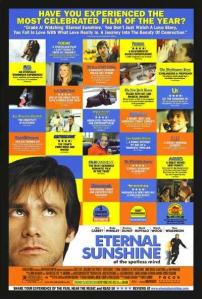
Last week, I started a poll to determine which film I should watch on Sunday and review on Monday.  Well, a lot of votes were cast and you, the readers of Through The Shattered Lens, proved to me once again that you are the greatest readers ever by picking one of my favorite films of all time.  From 2004, it’s the Charlie Kaufman-scripted, Michel Gondry-directed Eternal Sunshine of the Spotless Mind.

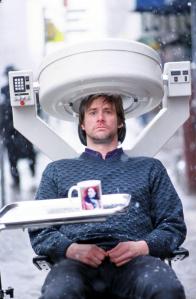
The plot plays out like something from a Philip K. Dick story.  I don’t want to reveal too much because I don’t want to ruin the film for anyone who hasn’t seen this film.  Eternal Sunshine is one of those rare films that carries with it the joy of discovery.  Depressed Joel (played by Jim Carrey) discovers that his ex-girlfriend Clementine (Kate Winslet) has hired Lacuna Inc. to totally erase all memories of him from her mind.  Embittered, Joel decides to go through the same process.  The Lacuna technicians (Elijah Wood and Mark Ruffalo) comes to Joel’s apartment in the middle of the night and start the process of erasing his memories of Clementine.  However, as Joel is losing his past, he realizes that he doesn’t want to lose his time with Clementine.  Hence, Joel finds himself running through his rapidly fading memories of Clementine, trying to save at least some scrap of her memory from being erased.  Meanwhile, as Joel fights to save his identity, Ruffalo entertains himself by inviting his girlfriend (Kirsten Dunst) over to Joel’s apartment while Elijah Wood sneaks off so he can meet his new girlfriend — who is none other than Clementine.

The genius of this Charlie Kaufman’s screenplay is that it takes an idea that seems very much “out there” and uses it to explore emotions that we’ve all felt.  Who doesn’t have someone that they wish they could wipe from their mind?  Me, I wish I could forget the exchange student from Keele University who broke up with me via e-mail.  I’d love to obliterate all memory of the frat boy who told me I was “white trash” or the former love of my life who managed to break my nose and my heart with just one movement of his hand.  We all have those people in our lives and what we forget is that by wiping out all the bad memories, we lose all the good ones as well.  Yes, Paul Walsh may have made me cry with his e-mail but, for two months before that, he held me while I cried and I can’t remember what I was crying about but I do remember feeling like I had never been held like that before.  And Dane may have hurt me terribly but now, every time I doubt myself, I simply remember that I’ve already survived the worst that could happen.  As for that frat boy who called me “white trash” — well, fuck him.  Yeah, there’s really no downside to erasing him from my mind.  In fact, I’ve already started because, to be honest, I can’t remember his name for the life of me.

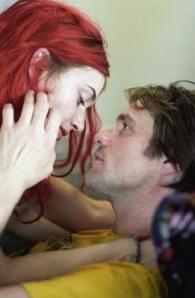
Ironically enough considering the title, there’s very little sunshine to be found in this film.  Not only is every scene drenched in melancholy but, quite literally, director Michel Gondry appears to have exclusively filmed on overcast days.  For such a deliriously romantic film — one that celebrates the idea of enduring love — Eternal Sunshine of the Spotless Mind is almost totally told in tones of gray and darkness.  In fact, as I watched the film last night, I was struck by the fact that often times, the only color in the film was provided by the Clementine’s ever-changing hair.  (Interestingly enough, Joel mentions Clementine’s hair as one of the things that he especially wants to forget about her.)  That the film works as both a dark comedy and a love story despite the grim images is a testament to the talents of both screenwriter Charlie Kaufman and director Michel Gondry.  (On the basis of the director’s later films — the latest being the enjoyable but shallow Green Hornet — I kind of suspect that Kaufman perhaps deserves a little bit more credit that Gondry.)

I think it’s also a testament to the talents of the film’s cast, all of whom gel into a perfect ensemble and allow the audience to believe in the film no matter how odd the film’s events may seem.  As I watched them last night, I found myself thinking about how much I truly love to watch good acting.  As long as a film has one or two good performance, it can be out-of-focus, choppily edited, and an hour or two too long.  By the same token, I find nothing more offensive than a million-dollar film full of expensive technology and boring performances. (Hello, Avatar.  How are you, Battle L.A?)  When I find a film, like Eternal Sunshine, that is actually both well-made and well-acted, I’m pretty much in love.

As the two lovers, Jim Carrey and Kate Winslet have a very surprising and very real chemistry together.  Watching them, you believed in their love and then you just as strongly believed in their hate.  This is one of those odd love stories where you not only believed that the two of them would actually get together but you also completely understood how and why Joel eventually drove Clementine away.  Carrey makes Joel’s depression believable without allowing it to get tedious or repetitive while Kate Winslet — well, where to begin?  Kate Winslet is probably one of the best actresses ever and this is one of her best performances.  I’ve always had a bit of a girlcrush on Winslet — there’s an honesty to her performances that few other actresses can match.  When she’s onscreen, the audience is with her.  She never puts up the whole “film star” barrier and, as a result, she inhabits her characters completely and brings them to life with both their strengths and their flaws.  And Clementine has got her share of flaws.  (I remember that when my mom saw this movie, she absolutely hated Clementine and the ever-changing color of her hair.)  Winslet doesn’t shy away from making Clementine human and, as a result, I think she elevated everyone else in the film as well.

As good as Carrey and Winslet are, the supporting roles are well-played as well and, as in all great movies, they give the impression of a world that existed before the movie started and one that will continue after the end credits.  I especially loved the performances of the Lacuna Staff, from Tom Wilkinson’s bland yet intimidating doctor to the creepy geekiness of Elijah Wood.  Mark Ruffalo and Kisten Dunst have a few great scenes where they’re partying the night away in Joel’s apartment while Joel’s memory is slowly erased.  The sight of a very hairy Ruffalo and a very giggly Dunst dancing in their matching panties pretty much epitomizes “geek love” for me.  I know that some people have complained that the scenes with Ruffalo and Dunst seemed out-of-place when compared to the ones between Carrey and Winslet but actually, I love the chemistry between Ruffalo and Dunst.  Even playing one of the nerdiest characters ever, Mark Ruffalo is still hot.  As for Dunst, she’s basically playing the same character that she always plays.  (As my friend Jeff recently put it, “Kirsten Dunst In Her Underwear” is as much of a film genre as drama, comedy, and science fiction.)  But I’ve always thought that she’s a likable enough actress (plus, by going red for Spiderman, she also indirectly helped this redhead’s social life) and she actually provides a nice (if surprising) moral center for Eternal Sunshine.

(Also, I’ll admit right now that if my boyfriend had a job that allowed him to hang out into a different stranger’s apartment every night, I’d probably sneak over and dance around in my underwear as well.)

It took me a while and a handful of viewings to really appreciate Eternal Sunshine of the Spotless Mind.  When I first saw it, I thought it was a strange film.  I liked it but I never expected that it would become one of my favorite movies.  However, with each viewing, I find myself relating to and loving this film just a little bit more.  So, thank you to everyone who voted in my poll and who gave me a chance to fall in love with this film all over again.

Love ya. 🙂

Poll: Lisa Marie Submits To Your Will


Last year, I gave up control to the reader of the site and you know what?  I kinda liked it in a sneaky, dirty little way.  So I figured, why not do it again?

Of course, I’m sure you’ve already guessed that I’m referring to my What Movie Should Lisa Marie Review poll.  This is the poll that led to me reviewing Anatomy of a Murder. 

Here’s how it works.  Earlier today, I put on a blindfold and then I randomly groped through my DVD collection until I had managed to pull out ten movies.  I then promptly stubbed my big toe on the coffee table, fell down to the floor, and spent about 15 minutes cursing and crying.  Because, seriously, it hurt!  Anyway, I then took off the blindfold and looked over the 10 movies I had randomly selected.  Two of them — Dracula A.D. 1972 and A Blade in the Dark — were movies that I had already reviewed on this site.  So I put them back and I replaced them with two movies of my own choosing — in this case, Eternal Sunshine of the Spotless Mind and The Unbearable Lightness of Being.

Between now and next Sunday (March 27th), people will hopefully vote in this poll.  On Sunday, I will watch and review whichever movie has received the most votes.  Even if that movie turns out to be Incubus. *shudder*  (Have I mentioned how much I love Eternal Sunshine of the Spotless Mind?)

Now, of course, there’s always the possibility that no one will vote in this poll and I’ll end up looking silly.  Those are the risks you take when you set up an online poll.  However, I have a backup plan.  If nobody votes, I will just spend every day next week shopping for purses at Northpark Mall and then blogging about it.  And by that, I mean blogging every single little detail.  So, it’s a win-win for me.

Anyway, here’s the list of the 10 films:

1) Barbarella — From 1968, Jane Fonda plays Barbarella who flies around space while getting molested by …. well, everyone.  Directed by Roger Vadim.

2) Barry Lyndon — From 1975, this best picture nominee is director Stanley Kubrick’s legendary recreation of 18th-century Europe and the rogues who live there.

3) Caligula — Yes, that Caligula.  From 1979, it’s time for decadence, blood, and nudity in the Roman Empire.  Starring Malcolm McDowell, Helen Mirren, Peter O’Toole, John Gielgud, John Steiner, and Theresa Ann Savoy.

4) Eternal Sunshine of the Spotless Mind — Oh my God, I love this movie.  Jim Carrey breaks up with Kate Winslet and deals with the pain by getting his mind erased by Tom Wilkinson, Mark Ruffalo, Kirsten Dunst, and an amazingly creepy Elijah Wood.

5) Incubus — From 1969, this low-budget supernatural thriller not only stars a young William Shatner but it also features the entire cast speaking in Esperanto.  For.  The.  Entire.  Movie.

6) Inland Empire — If you want to give Lisa nightmares, you can vote for David Lynch’s disturbing 3-hour film about lost identity, sexual repression, human trafficking, and talking rabbits.

7) Kiss Me Deadly — From 1955, this Robert Aldrich-directed cult classic features hard-boiled P.I. Mike Hammer and a host of others chasing after a mysterious glowing box and accidentally destroying the world in the process.

8 ) Mandingo — From 1975, this infamous little film is a look at slavery, incest, and rheumatism in the pre-Civil War South.  Starring James Mason, Ken Norton, Perry King, and Susan George.  Supposedly a really offensive movie, one I haven’t sat down and watched yet.

9) Sunset Boulevard — From 1950, hack screenwriter William Holden ends up the kept man of psychotic former screen goddess Gloria Swanson.  Directed by Billy Wilder.

10) The Unbearable Lightness of Being — From 1988, Philip L. Kaufman’s adaptation of Milan Kundera’s classic novel (one of my favorite books, by the way) features Daniel Day-Lewis, Juliette Binoche, and Lena Olin having sex and dealing with ennui.  After I first saw this movie, I insisted on wearing a hat just like Lena Olin did.

Everyone, except for me, is eligible to vote.  Vote as often as you want.  The poll is now open until Sunday, March 27th.

(Edit: Voting is now closed but check below for the results! — Lisa)

Titanic In Retrospect


Recently, I tried to rewatch an obscure art film from 1997 called Titanic.  From the time I was 12 until I was 16, I watched this movie a lot and, without fail, I cried and cried at the movie’s end.  (Admittedly, it was pretty easy to make me cry back then.)  I decided to rewatch it because I was curious as to whether or not Titanic could still make me cry. 

For those of you who aren’t into art films, here’s a quick synopsis and review of Titanic.

The film’s plot: Bill Paxton and an obnoxious fat guy are held hostage on a submarine by a senile old biddy who insists on telling them the story of how she lost her virginity 98 years ago.

Meanwhile, in London, Leonardo DiCaprio steals some poor kid’s sketch book and then sneaks onto a cruise ship where, pretending to be an artist, he seduces and murders lonely widows. 

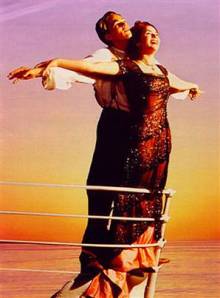
Also on the cruise ship is Kate Winslet.  Kate’s engaged to Billy Zane but she’s unhappy about it because — well, there’s some men you fuck and there’s some men you marry and let’s just say that you don’t marry Billy Zane.  Once the boat sets sail, Kate decides to jump overboard.  However, just before she can jump, she’s spotted by Leo.  Leo quickly tosses a burlap sack containing the corpse of Lady Astor into the Atlantic and then rescues Kate.

Kate rewards him by taking him down to her cabin and showing him a painting by Someone Picasso.  (Early on in the film, Billy correctly says that Someone Picasso will never amount to anything and that’s true.  Someone was always overshadowed by his older brother Pablo.)  Leo looks at the painting and says, “Look at what he does with color here.”  As a former Art History major, that line made me smile.  That’s the type of statement that is regularly uttered by people who can’t think of anything else to say.  When a guy looks at a painting and says, “Look at what he does with color here,” what he’s actually saying is, “Look, babe, I went to the damn art museum with you so there better be a blow job in my immediate future.”

Leo has dinner with Billy and Kate.  Leo says, “I’m just a tumbleweed blowing in the wind.”  Over at the next table, a shifty young man named Bob Dylan overhears and thinks, “That would make a good song.  But the little man must die so nobody knows I stole that line from him…”

Anyway, Leo eventually slips Kate a rohypnol, convinces her to pose naked while he secretly tapes her for Youtube, and then proceeds  to have sex with her in the back seat of a car.  Afterward, Kate says, “Do you want to hang out tomorrow?”  Leo replies, “Uhmm…I might be busy.  I’ll call you.”  “My God,” I said as I watched all this, “it’s like reliving my freshman year of college all over again.”

Anyway, 8 more hours pass.  All the rich passengers on the ship do rich things while all the poor passengers get drunk and trash the lower levels of the boat.  Suddenly, without warning, the boat is besieged by the living dead.  Billy Zane insists that they would be safer in the basement.  Leo disagrees while Kate says, “So, you think you can just fuck me and leave!?  No way!”

12 more hours pass.  The living dead manage to rip a hole in the side of the boat.  Billy chases Leo and Kate around the Titanic as it sinks.  “I hope you’ll be very happy together!” he screams.  Meanwhile, up top, two rich guys put on tuxedos and one of them says something like, “We’re going to die like gentlemen.”  Which I guess is what they end up doing though, honestly, it sounds to me like the guy’s just being a smartass.

Eventually, Kate and Leo end up sitting on an iceberg together.  Kate wonders if this is a dream.  Leo proceeds to spin a top on the ice to find out.  Suddenly, Bob Dylan floats by in a rowboat.  “This machine kills fascists!” he shouts as he shoots Leo with a crossbow.  Leo sinks into the water.  Bob Dylan smirks.  “How does it feel to be on your own?” he asks.

The end.

A quick review: I guess the easiest way to review Titanic is to answer my original question.  Does the film still make me, at the age of 24, cry like it did when I was 12?  No, it does not.  To be honest, the only tears that I shed while rewatching Titanic were tears of shame and boredom.  This is the movie that I once thought was the greatest thing ever?  True, I was young and stupid but still…

On the plus side, Kate Winslet gives a good performance even if her character is basically just a sexist male fantasy.  Billy Zane is also a lot of fun as her jilted suitor.

On the negative side, there’s everything else.  The script — written by Someone Cameron — is full of laughably bad lines and plotwise, the film has all the depth of a lanced boil.  The romantic elements of the plot made me cry back when I was 12 because I didn’t have a whole lot of real world experience to compare Titanic’s fantasy against.  Now, at the age of 24, I’ve actually had to deal with my fair share of guys who say actually do make dumbfug statement about things like being a tumbleweed blowing in the wind (not to mention being king of the world).  I’m not saying that a good movie can’t present a romantic idealization of reality.  I’m just saying that a good movie can do that without insulting the viewer’s intelligence like Titanic does.

One last note — Leo DiCaprio has become a great actor.  But, in Titanic, he just comes across like a shrill poseur.

I Learned Something Today Conclusion: Just because you and a million others think that a movie is great today, that doesn’t mean that the movie’s going to be anywhere near as good 12 years later.  In this age of Avatar and the Social Network, that’s a lesson that I think many self-appointed film “gurus” would do well to consider before they throw a hissy fit just because a complete stranger on the Internet disagrees with them.

Soderbergh to Traffic in Contagion


Steven Soderbergh has always been an indepedent-minded filmmaker from the time broke-out with his Sex, Lies and Videotape and up to his dabbling into microbudgeted, HD-shot films like Bubble and The Girlfriend Experience. In-between such arthouse fares he’s also managed to churn out commercial-friendly works like the Ocean’s Trilogy and to a certain extent both Erin Brockovich and Traffic.

While he surely has earned the ability to choose his projects his last major production didn’t pan out as some have thought it would. I’m talking about the passion project and, one I call the ego-project, epic biopic about Che Guevara which ran so long that it had to be released as two films: The Argentine and Guerrilla. His latest studio offering in The informant! also didn’t light up the box-office or even do marginally well.

Hopefully, the announcement broken by The Playlist site about his upcoming major project will change this pattern. Soderbergh has put on the fast-track the production of a film from Scott Z. Burns’ Contagion script. He will direct this action-thriller which some have labeled as Traffic meets The Stand/Outbreak. The premise of the script details the reaction of the cast of characters to a developing viral pandemic which goes global. The film will take place across four continents and already has snagged quite a talented rollcall of actors: Matt Damon, Marion Cotillard, Kate Winslet and Jude Law. We’re sure to get more news about further cast developments the closer to the start of filming.

While I like Soderbergh’s “Sundance” films I also think that he can make commercially-entertaining films and has proven that he could with the Ocean’s series. Here’s to hoping that he could create an action-thriller w/ some horror aspects to it with this latest project. It’s always exciting to see a director try on a new genre and see how well they do in it. I’m betting on Soderbergh hitting a home run instead of fouling out.

Source: The Playlist