Embracing the Melodrama Part II #67: Split Image (dir by Ted Kotcheff)


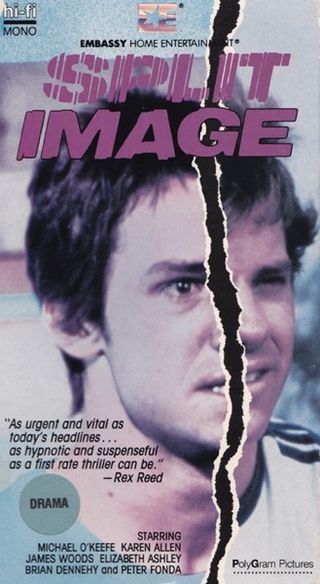
Split_Image_VHS_coverUnlike Desperate Lives, the 1982 melodrama Split Image is available to be viewed on YouTube.  In fact, you can watch it below and I suggest that you do so.  It’s a pretty good film and, apparently, it’s never been released on DVD or Blu-ray and it’ll probably never be available on Netflix either. So, if you’ve ever wanted to see Peter Fonda play a cult leader, your best bet is to watch the video below.

But before you watch the video, here’s a little information on Split Image, one of the best films that you’ve never heard of.

Essentially, the film follows the same plot as the Canadian film Ticket To Heaven.  A college athlete (played by Michael O’Keefe) starts dating a girl (Karen Allen) who is a member of a sinister religious cult.  Soon, O’Keefe is a brainwashed member of the cult and only answering to the name of Joshua.  (The head of the cult is played, in an appropriately spaced-out manner, by Peter Fonda.)  His parents (Brian Dennehy and Elizabeth Ashley) hire a cult deprogrammer (James Woods) to kidnap their son and break Fonda’s hold on him.  However, it turns out that Woods’ methods are almost as psychologically destructive as Fonda’s manipulation.

Even if it’s not quite as memorably creepy as Ticket To Heaven, Split Image is still a well-made film, featuring excellent performances from Dennehy, Woods, O’Keefe, and Fonda.  However, for me, the most interesting thing about Split Image is that it was largely filmed and set down here in Dallas.  Just watch the scene where Woods and his men attempt to kidnap Michael O’Keefe.  It was shot on the campus of Richland Community College, which is one of the places where I regularly go to run.

(Interestingly enough, 33 years after the release of Split Image, Richland still looks exactly the same!)

You can watch Split Image below!
 

Embracing the Melodrama #50: In the Bedroom (dir by Todd Field)


in_the_bedroom_ver3

If some enterprising young filmmaker were to try to remake Ordinary People as a film noir, he would probably be wasting his time because director Todd Field already beat him to it with the 2001 best picture nominee In The Bedroom.

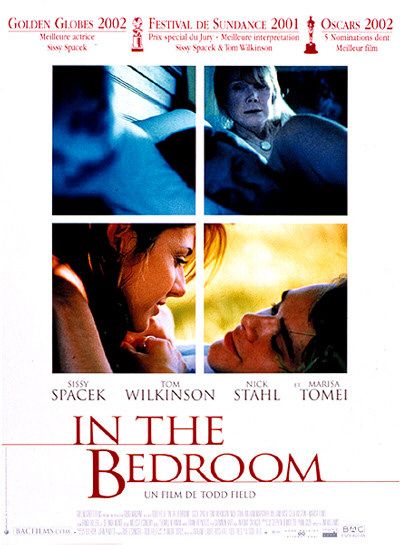
In the Bedroom takes place in a small town in Maine, the type of idyllic location where almost everyone is a fisherman and, in one way or another, everyone’s future is dependent on the whims of the rich and powerful Strout family.  Dr. Matt Fowler (Tom Wilkinson) and his wife Ruth (Sissy Spacek) seem to have the perfect life: a happy marriage and a smart and likable son, Frank Fowler (Nick Stahl).  Frank has just graduated from college and appears to have a great future ahead of him except for one thing.  He’s fallen in love with Natalie Strout (Marisa Tomei), the ex-wife of the abusive Richard Strout (William Mapother).  When Frank announces that he’s thinking about not going to grad school but instead staying in town so he can work as a fisherman and marry Natalie, Ruth is horrified that her son is throwing his life away.  However, Matt argues that Frank is just going through a phase.

The violent and unstable Richard is determined to win Natalie back.  When Frank attempts to protect Natalie during one of Richard’s rampages, Richard kills Frank by shooting him in the eye.  Richard is arrested for the murder but, largely as a result of his family’s influence, he is only convicted of accidental manslaughter and gets off with probation.  Matt and Ruth are left to both work through their grief and guilt and to eventually seek their own violent vengeance on Richard Strout.

In the Bedroom is probably one of the darkest films that I’ve ever seen in my entire life.  Not only is the film thematically dark but a good deal of it takes place at night and Todd Field fills the screens with shadows.  In the Bedroom is full of scenes of characters just staring at each other, struggling to find the right words to express their feelings and, far too often, simply giving up and saying nothing.  Field makes good use of the frequent silence though.  When Matt and Ruth yell at each other in the kitchen of their home, it’s both shocking and poignant because it stands in such sharp contrast to their usual silence.  Later. when Matt confronts Richard, the frequent pauses in their strained conversation serves to make the scene all the more ominous and creepy.

However, despite being one of the saddest films ever made, In The Bedroom is worth watching just for the performances of the cast.  You probably know that Tom Wilkinson, Sissy Spacek, and Marisa Tomei are all great so instead, I’m going to focus on the two members of the cast who did not receive Oscar nominations.  William Mapother does a really good job playing an unlikable character.  The dangerous yet dorky vibe that made him so menacing when he played Ethan Rohm on Lost is fully present and put to good use here.  Finally, Nick Stahl gives a wonderful performance as poor, doomed Frank.  With limited screen time, Stahl makes Frank into such a believable and sympathetic character that his death becomes a tragedy that the audience feels as well.

Sadly, Nick Stahl has recently been in the new more for his personal troubles than his film careers.  Films like In The Bedroom and Bully show why Nick deserves a chance to make a comeback.

bedroom-11