Scene That I Love: Queeg Cracks in The Caine Mutiny


The Caine Mutiny (1954, dir by Edward Dmytryk, DP: Franz Planer)

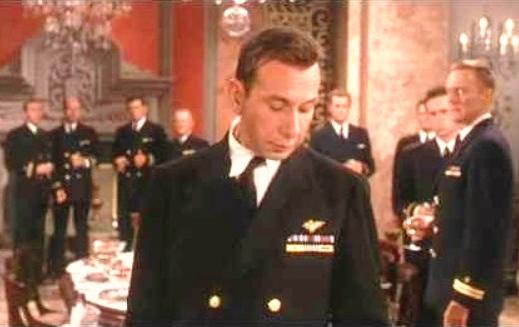
Today’s scene that I love comes from 1954’s The Caine Mutiny.

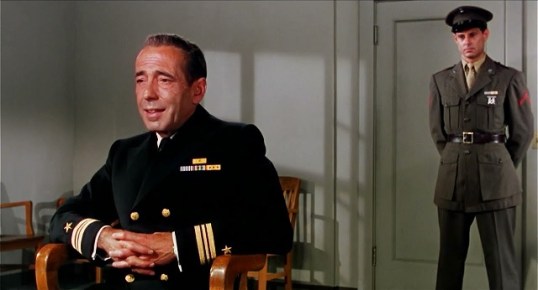
In this scene, Captain Queeg (Humphrey Bogart) is cross-examined by Barney Greenwald (Jose Ferrer).  The court martial concerns whether or not an officer under Queeg’s command was justified in taking over the ship from Queeg.  Greenwald, tasked with defending the head mutineer, knows that the only way to win the case is to expose Queeg himself as a paranoid and unstable officer.  Greenwald does his job but he’s not happy about it.

This scene, directed by Edward Dmytryk, features both Bogart and Ferrer at their absolute best.

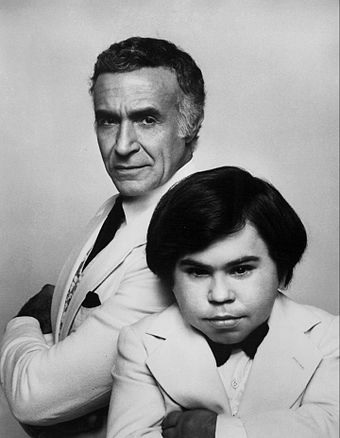
Retro Television Review: Fantasy Island 7.8 “Random Choices/My Mommy, The Swinger”


Welcome to Retro Television Reviews, a feature where we review some of our favorite and least favorite shows of the past!  On Tuesdays, I will be reviewing the original Fantasy Island, which ran on ABC from 1977 to 1984.  Unfortunately, the show has been removed from most streaming sites.  Fortunately, I’ve got nearly every episode on my DVR.

This week, we have two more fantasies that do not feature Tattoo.  What even is the point?

Episode 7.8 “Random Choices/My Mommy, The Swinger”

(Dir by Bob Sweeney, originally aired on December 3rd, 1983)

Elaine Ashley (Florence Henderson) is divorced and raising two kids on her own.  Her fantasy is to be a swinger for the weekend!  Mr. Roarke arranges for Lawrence to watch the kids and then he sets Elaine up with tennis player Martin Avery (Robert Goulet).  While Lawrence attempts to explain to the kids why their mother doesn’t want them around for the weekend, Martin offers Elaine a job.  It’s a good job with a nice salary but it would require her to put her children in a boarding school.  On the plus side, I guess Elaine would finally get laid again since that seems to be her main concern.  On the negative side, no more kids.

Elaine is tempted.  In fact, Elaine is so tempted that it actually make her into a really unsympathetic character.  At first, Elaine takes the job but then, when she sees how upset her children are about no longer living with her, she changes her mind.  Hey, Elaine — how did you think the children would react!?

This fantasy irked me.  Of course, to be absolutely honest about things, Florence Henderson irks me in general.  Maybe I’m still holding the last episode of The Brady Bunch Variety Hour against her but, whenever Florence Henderson appeared on this show or on The Love Boat, the characters she played always came across as being judgmental and self-absorbed.  That’s certainly the case here.  You take your children to a tropical paradise and then you abandon them with the butler?  Really?

As for the other fantasy, it featured Jose Ferrer as a dying billionaire who needed to find someone who he could trust to give away his money to people who deserved it.  Roarke determined that person was Eddie Random (James Read), an angry young man who felt his father had been cheated by Ferrer’s tycoon.  The entire fantasy came down to Eddie proving himself by taking supplies to an Island and helping a crotchety old man come to terms with the death of his wife.

This second fantasy felt like a backdoor pilot.  It literally ended with Eddie and the billionaire leaving to have many more adventures.  As such, the fantasy itself felt rather incomplete and …. well, silly.  Why would the tycoon need Fantasy Island to help him find the right person to give away his money?  Why does he even need a person to do that?  He should have just arranged for a big scavenger hunt and whoever found the most items would get the money.  That would have been a lot more fun.

You know who always enjoyed fantasies dealing with money?  Tattoo.  I miss him.

Film Review: Voyage of the Damned (dir by Stuart Rosenberg)


In 1939, an ocean liner named the MS St. Louis set sail from Hamburg.  Along with the crew, the ship carried 937 passengers, all of whom were Jewish and leaving Germany to escape Nazi persecution.  The ship was meant to go to Havana, where the passengers had been told that they would be given asylum.  Many were hoping to reunite with family members who had already taken the voyage.

What neither the passengers nor Captain Gustav Schroeder knew was that the entire voyage was merely a propaganda operation.  No sooner had the St. Louis left Hamburg than German agents and Nazi sympathizers started to rile up anti-Semitic feelings in Cuba.  The plan was to prevent the passengers from disembarking in Cuba and to force the St. Louis to then return to Germany.  The Nazis would be able to claim that they had given the Jews a chance to leave but that the rest of the world would not take them in.  Not only would the Jews be cast as pariahs but the Germans would be able to use the world’s actions as a way to defend their own crimes.

Captain Schroeder, however, refused to play along.  After he was refused permission to dock in Cuba, he then attempted to take the ship to both America and Canada.  When both of those countries refused to allow him to dock, Schroeder turned the St. Louis toward England, where he planned to stage a shipwreck so that the passengers could be rescued at sea.  Before that happened, Belgium, France, the Netherlands, and the United Kingdom jointly announced that they would accept the refugees.

Tragically, just a few days after the passengers disembarked, World War II officially began and Belgium, France, and the Netherlands all fell to the Nazi war machine.  It is estimated that, of the 937 passengers on the St. Louis, more than 600 of them subsequently died in the Nazi concentration camps.

The journey of the St. Louis was recreated in the 1976 film, Voyage of the Damned, with Max von Sydow as Captain Schroeder and a collection of familiar faces playing not only the ship’s passengers and crew but also the men and women in Cuba who all played a role in the fate of the ship.  In fact, one could argue that there’s a few too many familiar faces in Voyage of the Damned.  One cannot fault the performances of Max von Sydow, Malcolm McDowell, and Helmut Griem as members of the crew.  And, amongst the passengers, Lee Grant, Jonathan Pryce, Paul Koslo, Sam Wanamaker, and Julie Harris all make a good impression.  Even the glamorous Faye Dunaway doesn’t seem to be too out-of-place on the ship.  But then, in Havana, actors like Orson Welles and James Mason are awkwardly cast as Cubans and the fact that they are very obviously not Cuban serves to take the viewer out of the story.  It reminds the viewer that, as heart-breaking as the story of the St. Louis may be, they’re still just watching a movie.

That said, Voyage of the Damned still tells an important true story, one that deserves to be better-known.  In its best moments, the film captures the helplessness of having nowhere to go.  With Cuba corrupt and the rest of the world more interested in maintaining the illusion of peace than seriously confronting what was happening in Germany, the Jewish passengers of the St. Louis truly find themselves as a people without a home.  They also discover that they cannot depend on leaders the other nations of the world to defend them.

Defending the passengers falls to a few people who are willing to defy the leaders of their own country.  At the start of the film, Nazi Intelligence Chief Wilhelm Canaris (Denholm Elliott) explains that Captain Schroeder was selected specifically because he wasn’t a member of the Nazi Party and could not be accused of having ulterior motives for ultimately returning the passengers to Germany.  Canaris and his fellow Nazis assume that anti-Semitism is so natural that even a non-Nazi will not care what happens to the Jewish passengers.  Instead, Schroeder and his crew take it upon themselves to save the lives of the passengers.  It is not Franklin Roosevelt who tries to save the passengers of St. Louis.  Instead, it’s just a handful of people who, despite unrelenting pressure to do otherwise, step up to do the right thing.  Max von Sydow, who was so often cast in villainous roles, gives a strong performance as the captain who is willing to sacrifice his ship to save his passengers.

Flaws and all, Voyage of the Damned is a powerful film about a moment in history that must never be forgotten.

Retro Television Review: The Love Boat 5.1 and 5.2 “The Expedition/Julie’s Wedding/The Mongala/Julie’s Replacement/The Three R’s/The Professor’s Wife”


Welcome to Retro Television Reviews, a feature where we review some of our favorite and least favorite shows of the past!  On Wednesdays, I will be reviewing the original Love Boat, which aired on ABC from 1977 to 1986!  The series can be streamed on Paramount Plus!
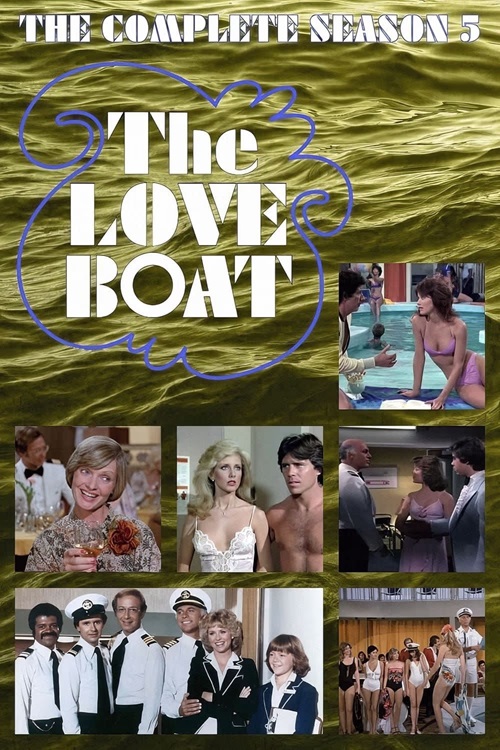
This week, we start season 5 of The Love Boat!

Episode 5.1 and 5.2 “The Expedition/Julie’s Wedding/The Mongala/Julie’s Replacement/The Three R’s/The Professor’s Wife”

(Dir by Roger Duchowny, originally aired on October 10th, 1981)

The fifth season of The Love Boat opens with a two-hour spectacular.  Our Love Boat crew is in Australia, where they will be guiding The Sea Princess on a voyage through the South Pacific.  It’s a bit odd to start off a season of The Love Boat on a different boat but I guess the plan was to show off all the different ships that sailed for Princess Cruise Lines.  This episode was actually shot on the boat during a cruise.  It’s interesting to see how different the Sea Princess is from the show’s usual location.  It has nicer hallways than the Pacific Princess and a much larger lobby.  However, I prefer the relative privacy of the Pacific Princess’s multi-level dining room to the wide open space provided by the Sea Princess.

Captain Stubing, Gopher, Isaac, and Doc are shocked when Julie does not board the ship.  She’s been on vacation with her boyfriend, Tony (Anthony Andrews), for the last few months. Tony lives in Australia so, really, it shouldn’t be too hard for Julie to make it to the ship. Instead, a substitute cruise director named Yvonne (Delvene Delaney) shows up.  Doc and Gopher are happy because it gives them a new co-worker to lust after.  Captain Stubing is upset because Julie has sent them all a letter in which she explains that she will be marrying Tony and retiring to the animal habitat where he works.  She asks Stubing to give her away and she invites Vicki to be a bridesmaid.  Gopher, Isaac, and Doc will be ushers.

Doc is briefly distracted from chasing Yvonne when he spots Barbara Carroll (Michelle Phillips) boarding the boat.  However, Barbara has eyes for Ralph Sutton (Patrick Duffy), a rancher who is blind without his glasses.  Unfortunately, that means that he can’t read the love letter that Barbara wrote him.  Because she wants Ralph for herself, Connie Walker (Jennilee Harrison) lies about what the letter says.  *GASP*  (Don’t worry, it all works out.)

Meanwhile, an expedition headed by shady Deke Donner (Jose Ferrer) goes to an island and captures a hairy man (Patrick Ward) who they believe is the Mongola, a.k.a., the missing link!  (Wait, what?)  They hide the ape-man in the ship’s cargo area (huh?) and try to keep anyone else from learning that they’re transporting a living thing.  Everyone acts like he’s a caveman but it’s kind of obvious that the Mongola is just a confused guy with a beard.  Dr. Jill McGraw (Donna Dixon) falls in love with the Mongola, much to the consternation of her colleague, Dr. Barry Mason (Gary Frank).  Meanwhile, Deke’s old friend, Prof. Milo Ender (Harry Morgan), is stunned to discover that the Mongola has a vaccination scar.  Milo’s wife, Vivian (Katherine Helmond), encourages Milo to keep the secret to himself so that they can at least make some money off of the Mongola.  (Like, seriously, what the Hell is even going on with this story?)  Milo agrees, though it doesn’t seem to occur to him that, if he could notice the vaccination scar, then pretty much anyone could notice the vaccination scar.  Eventually, the Mongola gets loose from his cage and jumps overboard.  “He’s shark food,” Deke says.  (What in the name of God is going on here?)  However, the Mongola apparently survives because the police are waiting to arrest Deke as soon as the ship docks in Australia.

But what about the wedding!? you’re saying.  Well, the wedding doesn’t happen.  It nearly happens.  Julie shows up at the church.  However, Tony finds out that he’s going to die in a month or two so he leaves Julie at the altar.  Julie flies back to Los Angeles with the rest of the Love Boat crew.

Seriously, this is the most morbid episode of The Love Boat that I’ve ever seen.

Still, morbid or not, it’s an entertainingly weird episode and the Australian and New Zealand scenery is lovely to look at.  (As with all of the two-hour episodes of The Love Boat, there’s a lot of travelogue padding.)  There’s something oddly appealing about seeing the usual Love Boat shenanigans mixed in with a story about the Missing Link and Julie discovering that the love of her life is terminally ill.  I mean, the song isn’t lying.  The Love Boat really does promise something for everyone.

I mean, in the end, we all know that Julie couldn’t get married because then she’d have to leave the show and that wouldn’t happen until Lauren Tewes’s cocaine use became a problem during the seventh season.  Tony could either cheat on her or he could die.  (Better he die than do what almost every man does at his bachelor party.)  The episode ends with Tony still alive so I guess the show’s writer were leaving their options open.  Maybe Tony will make a miraculous recovery, who knows?

Myself, I’m just happy that the crew is back together.  It’s time to set sail …. again!
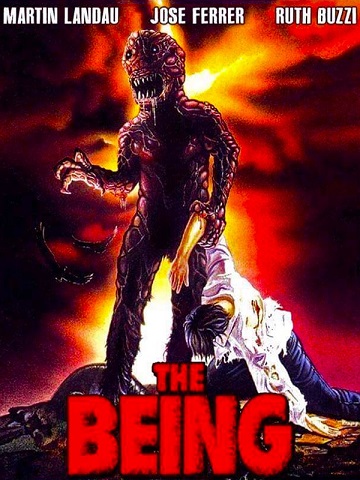
Horror Film Review: The Being (dir by Jackie Kong)


The 1983 film, The Being, takes place in the town of Pottsville, Idaho.

Pottsville is a small town with a quaint downtown, a drive-in that shows violent slasher films, and a group of neighborhood activists who have come together to take a stand against smut.  (Maybe they should start with that drive-in….)  It’s home to a quarry, several potato farms, a trailer park, a diner, a church, and a …. ahem …. nuclear waste dump.

Strange things are happening in town.  The young son of Marge Smith (Dorothy Malone) has vanished and Dorothy has become a familiar sight, wandering around the town in the middle of the night and searching for her child.  One person loses his head while fleeing an unseen assailant.  Two rednecks are killed while smoking weed at the drive-in theater.  People are dying and Detective Mortimer Lutz (Bill Osco) is determined to find out who (or what) is doing the killing.  He’s particularly concerned about the fact that a mysterious green slime is found at all of the crime scenes.

Meanwhile, Mayor Gordon Lane (Jose Ferrer) is more concerned with just covering up the crimes and the history of nuclear waste disposal because he’s got potatoes to harvest and he also hopes to be the first potato farmer in the White House.  (George Washington already beat him to that, though one could point out that Washington never actually lived in the current White House.)  While his wife (Ruth Buzzi) encourages everyone in town to take a stand against smut, Mayor Lane calls in a chemical safety engineer named Garcon Jones (Martin Landau) to investigate.

The Being is a bit of an oddity.  On the one hand, the title character is grotesque and the scenes in which the creature attacks its victims are notably gory.  On the other hand, the film has a strangely off-center sense of humor, starting with Bill Osco’s opening narration, which Osco delivers in the teeth-clenched rat-a-tat style of Rod Serling.  Halfway through the film, the action stops so that Lutz can have a rather bizarre dream in which he sees Garcon fall out of an airplane while the mayor’s wife flies by on a broomstick with blood flowing from her eyes.  This is the type of film in which the notably bloody conclusion is followed by satiric title cards that tell us what happened to each of the survivors.  The Being is a horror film that seems to be cheerfully aware of its budgetary limitations and, as a result, it’s full of moments in which it seems to wink at the audience and say, “Hey, don’t worry so much.  Sit back and have fun.”

For a low-budget, often poorly lit film about a killer mutant, The Being has an impressive cast.  Dorothy Malone, Jose Ferrer, and Martin Landau were all Hollywood veterans and all three of them give admirably straight-faced performances in their smallish roles.  (Ferrer and Malone won Oscars long before appearing in The Being.  Landau won his Oscar a decade after.)  Ferrer, in particular, does a good job of portraying the mayor’s irritation at having to actually deal with the people that he governs.  I also liked the performance of Ruth Buzzi.  Buzzi plays someone who should be very familiar to anyone who has ever lived in a small town, the person who has found a small amount of power and who is determined to never give up.

Low-budget aside, The Being is just odd enough to be watchable.

Scene That I Love: Greenwald Confronts Keefer in The Caine Mutiny


Today’s scene that I love comes from 1954’s The Caine Mutiny.

In this scene, directed by Edward Dmytryk, the Caine mutineers celebrate their acquittal when they’re confronted by their own defense attorney.  Having previously exposed Captain Queeg’s paranoia on the stand, Barney Greenwald (Jose Ferrer) has dealt with his guilty conscience by having a bit too much to drink.  He interrupts the celebration and calls out the man who he claims is the real “author of the Caine Mutiny,” the arrogant Keefer (Fred MacMurray).

This scene features Ferrer at his most vitriolic and MacMurray at his sleaziest.  Fred MacMurray was typically cast as a nice, All-American guy so it’s always interesting to see him cast as a bad guy in films like this one, The Apartment, and Double Indemnity.  MacMurray always tended to underplay his villains, playing them as self-centered cads who hid their true motives behind a façade of bland affability.  The Caine Mutiny features one of MacMurray’s best performances.

From The Caine Mutiny:

Film Review: The Greatest Story Ever Told (dir by George Stevens)


The 1965 biblical epic, The Greatest Story Ever Told, tells the story of the life of Jesus, from the Nativity to the Ascension.  It’s probably the most complete telling of the story that you’ll ever find.  It’s hard to think of a single details that’s left out and, as a result, the film has a four hour running time.  Whether you’re a believer or not, that’s a really long time to watch a reverent film that doesn’t even feature the campy excesses of something like The Ten Commandments.

(There’s actually several different version of The Greatest Story Ever Told floating around.  There’s a version that’s a little over two hours.  There’s a version that’s close to four hours.  Reportedly, the uncut version of the film ran for four hour and 20 minutes.)

Max von Sydow plays Jesus.  On the one hand, that seems like that should work because Max von Sydow was a great actor who gave off an otherworldly air.  On the other hand, it totally doesn’t work because von Sydow gives an oddly detached performance.  The Greatest Story Ever Told was von Sydow’s first American film and, at no point, does he seem particularly happy about being involved with it.  von Sydow is a very cerebral and rather reserved Jesus, one who makes his points without a hint of passion or charisma.  When he’s being friendly, he offers up a half-smile.  When he has to rebuke his disciples for their doubt, he sounds more annoyed than anything else.  He’s Jesus if Jesus was a community college philosophy professor.

The rest of the huge cast is populated with familiar faces.  The Greatest Story Ever Told takes the all-star approach to heart and, as a result, even the minor roles are played by actors who will be familiar to anyone who has spent more than a few hours watching TCM.  Many of them are on screen for only a few seconds, which makes their presence all the more distracting.  Sidney Poitier shows up as Simon of Cyrene.  Pat Boone is an angel.  Roddy McDowall is Matthew and Sal Mineo is Uriah and John Wayne shows up as a centurion and delivers his one line in his trademark drawl.

A few of the actors do manage to stand out and make a good impression.  Telly Savalas is a credible Pilate, playing him as being neither smug nor overly sympathetic but instead as a bureaucrat who can’t understand why he’s being forced to deal with all of this.  Charlton Heston has just the right intensity for the role of John the Baptist while Jose Ferrer is properly sleazy as Herod.  In the role Judas, David McCallum looks at the world through suspicious eyes and does little to disguise his irritation with the rest of the world.  The Greatest Story Ever Told does not sentimentalize Judas or his role in Jesus’s arrest.  For the most part, he’s just a jerk.  Finally, it’s not exactly surprising when Donald Pleasence shows up as Satan but Pleasence still gives a properly evil performance, giving all of his lines a mocking and often sarcastic bite.

The Greatest Story Ever Told was directed by George Stevens, a legitimately great director who struggles to maintain any sort of narrative momentum in this film.  Watching The Greatest Story Ever Told, it occurred to me that the best biblical films are the ones like Ben-Hur and The Robe, which both largely keep Jesus off-screen and instead focus on how his life and teachings and the reports of his resurrection effected other people.  Stevens approaches the film’s subject with such reverence that the film becomes boring and that’s something that should never happen when you’re making a film set in Judea during the Roman era.

I do have to admit that, despite all of my criticism of the film, I do actually kind of like The Greatest Story Ever Told.  It’s just such a big production that it’s hard not to be a little awed by it all.  That huge cast may be distracting but it’s still a little bit fun to sit there and go, “There’s Shelley Winters!  There’s John Wayne!  There’s Robert Blake and Martin Landau!”  That said, as far as biblical films are concerned, you’re still better off sticking with Jesus Christ Superstar.

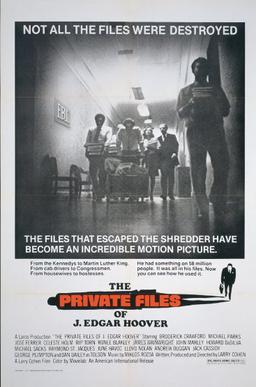
18 Days of Paranoia #3: The Private Files of J. Edgar Hoover (dir by Larry Cohen)


The 1977 film, The Private Files of J. Edgar Hoover, opens in 1972.

J. Edgar Hoover, the much-feared and long-serving director of the FBI, has just been found dead at his home and it seems like the entire city of Washington, D.C. is scrambling.  Not only are people jockeying for Hoover’s job but they’re also wondering what might be found in his secret files.  As quickly becomes apparent, Hoover had a file on everyone.  While Presidents lauded him and the press portrayed him as hero, Hoover spent nearly 50 years building up a surveillance state.  Hoover said it was to fight criminals and subversives but mostly, it was just to hold onto his own power.  Even President Nixon is heard, in the Oval Office, ordering his men to get those files.

Hoover may have known everyone’s secrets but, the film suggests, very few people knew his.  The film is narrated by a former FBI agent named Dwight Webb (Rip Torn).  Dwight talks about how he was kicked out of the FBI because it was discovered that he not only smoked but that he was having an adulterous affair with a secretary.  “You know how Hoover was about that sex stuff,” he says, his tone suggesting that there’s more to the story than just Hoover being a bit of a puritan.

We flash back to the 1920s.  We see a young Hoover (James Wainwright) as a part of the infamous Palmer Raids, an early effort by the Justice Department to track down and deport communist subversives.  Though Hoover disagrees with the legality of the Palmer Raids, he still plays his part and that loyalty is enough to eventually get him appointed, at the age of 29, to be the head of the agency that would eventually become the FBI.  Hoover may start out as a relatively idealistic man but it doesn’t take long for the fame and the power to go to his head.

Hoover (now played by Broderick Crawford) serves a number of Presidents, each one worse the one who proceeded him.  Franklin Delano Roosevelt (Howard Da Silva) is an avuncular despot while the Kennedy brothers (William Jordan as John and Michael Parks as Bobby) are two rich brats who think that they can control Hoover but who soon discover that Hoover is far more clever than they realize.  Hoover finds himself a man out-of-place in the 60s and the 70s,  Suddenly, he’s no longer everyone’s hero and people are starting to view the FBI as being not a force for law enforcement but instead an instrument of oppression.

Through it all, Hoover remains an enigma.  He demands a lot of from his agents but he resents them if they’re too successful.  Melvin Purvis (Michael Sacks) might find fame for leading the manhunt that took down Dillinger but he’s driven to suicide by Hoover’s cruel treatment.  Unlike Clint Eastwood’s film about Hoover, The Private Files of J. Edgar Hoover suggests that Hoover was not gay but that instead, that he was so repressed that he was essentially asexual.  When one woman throws herself at him, he accuses her of being a subversive and demands to know how anyone could find him attractive.  He’s closest to his mother and when she dies, he shuts off his emotions.  His own power, for better and worse, becomes the one thing that he loves.  He’s married to the FBI and he often behaves like an abusive spouse.

The Private Files of J. Edgar Hoover is an interesting film.  It’s an attempt to do a huge American epic on a less than epic budget.  At the start of the film, the low budget is undeniably distracting.  The 1920s are essentially represented by a back lot and two old cars.  The scenes of the FBI dealing with gangsters like Dillinger and Creepy Karpis feel awkward and slapdash.  But, as the film’s timeline gets closer to what was then the modern era, the film’s story tightens up and so does Larry Cohen’s direction.  (One get the feeling that Cohen was, perhaps understandably, more interested in the Hoover of the 60s and the 70s than the Hoover of the 20s and 30s.  There’s a sharpness to the second half of the movie that is just missing from the first half.)  Broderick Crawford gives a chilling performance as a man who is determined to hold onto his power, just for the sake of having it.  The scenes were Hoover and Bobby Kennedy snap at each other have a charge that’s missing from the first half of the film.  Michael Parks does a great job portraying RFK as basically being a spoiled jerk while Crawford seems to relish the chance to play up the resentful, bitter old man aspects of Hoover’s personality.  The film ultimately suggests that whether the audience previously admired RFK or whether they previously admired Hoover, they were all essentially duped.

Though the film never quite overcomes the limits of its low budget, it works well as a secret history of the United States.  In 1977, it undoubtedly took guts to make a film that portrayed Roosevelt and Kennedy as being as bad as Nixon and Johnson.  (It would probably even take guts today.  One need only rewatch something like The Butler or Hyde Park on Hudson to see the ludicrous lengths Hollywood will go to idealize presidents like Kennedy and dictators like FDR.)  While this film certainly doesn’t defend J. Edgar Hoover’s excesses, it often suggests that the president he served under were just as bad, if not even worse.  In the end, it becomes a portrait of not only how power corrupts but also why things don’t change, regardless of who is nominally in charge.  In the end the film’s villain is not J. Edgar Hoover.  Instead, the film’s villain is the system that created and then enabled him.  The man may be dead but the system remains.

Previous entries in the 18 Days of Paranoia:

  1. The Flight That Disappeared
  2. The Humanity Bureau


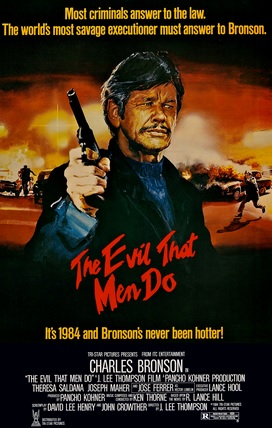
A Movie A Day #303: The Evil That Men Do (1984, directed by J. Lee Thompson)


Clement Molloch (Joseph Maher) is a doctor who uses his medical training to torture journalists and dissidents in an unnamed South American country.  Holland (Charles Bronson) is a former  CIA assassin, who is content with being retired.  But when Molloch kills a journalist who was also an old friend of Holland’s, it all becomes about revenge.  No one’s more dangerous than Charles Bronson seeking revenge.  Working with the dead journalist’s widow (Theresa Saldana), Holland heads down to South America.  Since Molloch is always surrounded by bodyguards, it is not going to be easy to get him.  But who can stop Charles Bronson?

Bronson was 62 years old when he made The Evil The Men Do and he was still the toughest, coolest killer in the movies.  The Evil That Men Do is a rarity, an 80s Bronson film that was not produced by Cannon.  It still feels like a Cannon production, even if it is a little more interesting than some of the other films that Bronson was making at that time.  Dr. Molloch was clearly based on the notorious Nazi Klaus Barbie and Joseph Maher plays Molloch as being a dignified sadist.  Molloch also has a strange relationship with his equally cruel sister (Antoinette Bower).  That Molloch is so extremely evil makes the film’s final scenes all the more satisfying.

The Evil That Men Do is one of the best of Bronson’s later films.  Charles Bronson, man.  No one got revenge better than Bronson.

Horror Film Review: The Sentinel (dir by Michael Winner)


Here’s the main lesson that I’ve learned from watching the 1977 horror film, The Sentinel:

Even in the 1970s, the life of a model was not an easy one.

Take Alison Parker (Cristina Raines) for instance.  She should have everything but instead, she’s a neurotic mess.  Haunted by a traumatic childhood, she has attempted to commit suicide twice and everyone is always worried that she’s on the verge of having a breakdown.  As a model, she’s forced to deal with a bunch of phonies.  One of the phonies is played by Jeff Goldblum.  Because he’s Goldblum, you suspect that he has to have something up his sleeve but then it turns out that he doesn’t.  I get that Jeff Goldblum probably wasn’t a well-known actor when he appeared in The Sentinel but still, it’s incredibly distracting when he suddenly shows up and then doesn’t really do anything.

Alison has a fiancée.  His name is Michael Lerman (Chris Sarandon) and I figured out that he had to be up to no good as soon as he appeared.  For one thing, he has a pornstache.  For another thing, he’s played by Chris Sarandon, an actor who is best known for playing the vampire in the original Fright Night and Prince Humperdink in The Princess Bride.  Not surprisingly, it turns out that Michael’s previous wife died under mysterious circumstances.  NYPD Detective Rizzo (Christopher Walken) suspects that Michael may have killed her.

(That’s right.  Christopher Walken is in this movie but, much like Jeff Goldblum, he doesn’t get to do anything interesting.  How can a movie feature two of the quirkiest actors ever and then refuse to give them a chance to act quirky?)

Maybe Alison’s life will improve now that she has a new apartment.  It’s a really nice place and her real estate agent is played by Ava Gardner.  Alison wants to live on her own for a while.  She loves Michael but she needs to find herself.  Plus, it doesn’t help that Michael has a pornstache and may have killed his wife…

Unfortunately, as soon as Alison moves in, she starts having weird dreams and visions and all the usual stuff that always happens in movies like this.  She also discovers that she has a lot of eccentric neighbors, all of whom are played by semi-familiar character actors.  For instance, eccentric old Charles (Burgess Meredith) is always inviting her to wild parties.  Her other two neighbors (played by Sylvia Miles and Beverly D’Angelo) are lesbians, which the film presents as being the height of shocking decadence.  At first, Alison likes her neighbors but they make so much noise!  Eventually, she complains to Ava Gardner.  Ava replies that Alison only has one neighbor and that neighbor is neither Burgess Meredith nor a lesbian.

Instead, he’s a blind priest who spends all day sitting at a window.  He’s played by John Carradine, who apparently had a few hours to kill in 1977.

But it doesn’t stop there!  This movie is full of actors who will be familiar to anyone who enjoys watching TCM.  Along with those already mentioned, we also get cameos from Martin Balsam, Jose Ferrer, Arthur Kennedy, Eli Wallach, Richard Dreyfuss, and Tom Berenger.  There are 11 Oscar nominees wasted in this stupid film.  (Though, in all fairness, Christopher Walken’s nomination came after The Sentinel.)

Personally, The Sentinel bugged me because it’s yet another horror movie that exploits Catholic iconography while totally misstating church dogma.  However, the main problem with The Sentinel is that it’s just so incredibly boring.  I own it on DVD because I went through a period where I basically bought every horror film that could I find.  I’ve watched The Sentinel a handful of times and somehow, I always manage to forget just how mind-numbingly dull this movie really is.  There’s a few scary images but mostly, it’s just Burgess Meredith acting eccentric and Chris Sarandon looking mildly annoyed.  If you’ve ever seen Rosemary’s Baby, The Exorcist, or The Omen, you’ll figure out immediately what’s going on but The Sentinel still insists on dragging it all out.  Watching this movie is about as exciting as watching an Amish blacksmith shoe a horse.

There’s a lot of good actors in the film but it’s obvious that most of them just needed to pick up a paycheck.  I’ve read a lot of criticism of Cristina Raines’s lead performance but I actually think she does a pretty good job.  It’s not her acting that’s at fault.  It’s the film’s stupid script and lackluster direction.