Rudy Baylor (Matt Damon) is an idealistic young law school graduate who discovers that having a degree and passing the bar doesn’t automatically make you a success. He gets a job working a bar that just happens to be owned by an ambulance chasing attorney named Bruiser Stone (Mickey Rourke). Bruiser takes Rudy on as an associate and assigns his associate, Deck Shifflet (Danny DeVito), to teach Rudy how to find cases. When Bruiser flees the country to escape an FBI investigation, Rudy and Deck start their own law firm. Rudy soon finds himself with the case of his young career, representing a family in a law suit against Great Benefit Insurance. Rudy also falls for Kelly (Claire Danes), a young woman who is being abused by her husband (Andrew Shue).
It can be hard to believe today but, in the 90s, every John Grisham novel was adapted for the screen. Most of the adaptations weren’t very good but audiences ate them up. In many ways, The Rainmaker is the ultimate John Grisham adaptation because it contains every single trope that John Grisham made popular with his legal thrillers. This time, Matt Damon is the charismatic attorney. Roy Scheider is the soulless corporate CEO who needs to be brought down. Jon Voight is the intimidating opposing counsel. Danny DeVito is the eccentric comic relief and Mickey Rourke is the dues ex machina who returns to the movie to give Rudy a piece of information at the exact right moment. The appeal of Grisham is that he made readers (and eventually moviegoers) feel like insiders while presenting them with stories that were essentially very simple good vs evil morality tales. The insurance company is so cartoonishly evil that there’s no doubt Rudy is going to defeat them. There’s also no doubt that Rudy is going to find a better calling than ambulance chasing because the only thing that people hate more than insurance companies is lawyers.
The Rainmaker is never as complex as it pretends to be but it’s an entertaining legal movie. It was also director Francis Ford Coppola’s last big hit. It’s really more of a Grisham film than a Coppola film but Coppola’s influence is still felt in the almost uniformly excellent cast. (Ignore Andrew Shue if you can. Melrose Place was very popular in the 90s.) Damon, Danes, Rourke, Voight, Dean Stockwell, Danny Glover, Teresa Wright, Virginia Madsen, and Mary Kay Place all give memorable performances. Roy Scheider is loathsome as the sweater-wearing CEO. Best of all is Danny DeVito, who gets all of the best lines.
The Rainmaker was the best of the 1990s Grisham adaptations. While it’s not quite a masterpiece, it’s still emotionally very satisfying.
1970’s The Revolutionary tells the story of a young man named A (Jon Voight).
When we first meet him, A is a college student who lives in the industrial town of Axton. A comes from a wealthy family but he chooses to live in a tiny and quite frankly repellent apartment. He has a girlfriend named Ann (Collin Wilcox). A and Ann don’t really seem to have much of a relationship. “We should make love,” A says in a flat tone of voice. Ann is willing to show her emotions while the self-serious A goes through life with everything under wraps. Ann and A are both members of a radical political group. The group spends a lot of time talking and discussing theory but they don’t really do much else.
A grows frustrated with the group. He gets a job at a factory, where he falls under the sway of a communist named Despard (Robert Duvall). Despard is a bit more active than A’s former comrades. Despard, for instance, is willing to call a general strike but, when that strike still fails, A, along with Despard and everyone else involved, goes underground. Suspended from the university, he soon finds himself being drafted into the Army. His father asks A if he wants to be drafted. A questions why only the poor should be drafted. His father looks at A as if he’s hopelessly naive and his father might be right.
A continues to wander around Axton in an idealistic daze, trying to get people to read the flyers that he spends his time passing out. Things change when A meets Leonard II (Seymour Cassel), a radical who recruits A into an apparent suicide mission….
The Revolutionary took me by surprise. On the one hand, it’s definitely very much a political film. The movie agrees with A’s politics. But, at the same time, the film is also willing to be critical of A and his self-righteous view of the world. One gets the feeling that A’s politics have less to do with sincere belief and more to do with his own need to be a part of something. Up until the film’s final few minute, A is something of a passive character, following orders until he’s finally forced to decide for himself what his next move is going to be. A’s father thinks he’s a fool. Despard views him as being an interloper. Even Leonard II seems to largely view A as being a pawn. A wanders through Axton, trying to find his place in the chaos of the times.
It’s not a perfect film, of course. The pace is way too slow. Referring to the lead character only as “A” is one of those 70s things that feels embarrassingly cutesy today. As was the case with many counterculture films of the early 70s, the film’s visuals often mistake graininess with authenticity. Seriously, this film features some of the ugliest production design that I’ve ever seen. But for every scene that doesn’t work or that plays out too slow, there’s one that’s surprisingly powerful, like when an army of heavily armored policemen break up a demonstration. The film itself is full of talented actors. Seymour Cassel is both charismatic and kind of frightening as the unstable Leonard II. Jon Voight and Robert Duvall are both totally convincing as the leftist revolutionary and his communist mentor. (In real life, of course, Voight and Duvall would become two of Hollywood’s most prominent Republicans.) In The Revolutionary, Duvall brings a certain working class machismo to the role of Despard and Voight does a good job of capturing both A’s intelligence and his growing detachment. A can be a frustrating and passive character but Voight holds the viewer’s interest.
The film works because it doesn’t try to turn A into some sort of hero. In the end, A is just a confused soul trying to figure out what his place is in a rapidly changing world. Thanks to the performance of Voight, Duvall, and Cassel, it’s a far more effective film than it perhaps has any right to be.
Though the Academy of Motion Picture Arts and Sciences claim that the Oscars honor the best of the year, we all know that there are always worthy films and performances that end up getting overlooked. Sometimes, it’s because the competition too fierce. Sometimes, it’s because the film itself was too controversial. Often, it’s just a case of a film’s quality not being fully recognized until years after its initial released. This series of reviews takes a look at the films and performances that should have been nominated but were, for whatever reason, overlooked. These are the Unnominated.
First released in 1995, Heat is one of the most influential and best-known films of the past 30 years. It also received absolutely zero Oscar nominations.
Maybe we shouldn’t be too surprised that Academy — especially the Academy of the 1990s — didn’t shower the film with nominations. For all of its many strengths, Heat is still a genre piece, an epic three-hour crime film from director Michael Mann. It’s a film about obsessive cops and tightly-wound crooks and it’s based on a made-for-TV movie that Mann directed in the late 80s. While the Academy had given a best picture nomination to The Fugitive just two years before, it still hadn’t fully come around to honoring genre films.
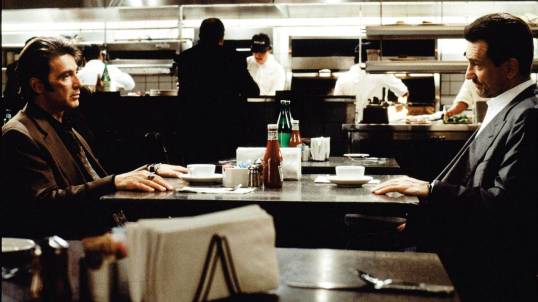
And yet one would think that the film could have at least picked up a nomination for its editing or maybe the sound design that helps to make the film’s signature 8-minute gun battle so unforgettable. (Heat is a film that leaves you feeling as if you’re trapped in the middle of its gunfights, running for cover while the cops and the crooks fire on each other.) The screenplay, featuring the scene where Al Pacino’s intense detective sits down for coffee with Robert De Niro’s career crook, also went unnominated.
Al Pacino was not nominated for playing Vincent Hanna and maybe we shouldn’t be too surprised at that. Pacino yells a lot in this movie. When people talk about Pacino having a reputation for bellowing his lines like a madman, they’re usually thinking about the scene where he confronts a weaselly executive (Hank Azaria) about the affair that he’s having with Charlene (Ashley Judd), the wife of criminal Chris Shiherlis (Val Kilmer). And yet, I think that Pacino’s performance works in the context of the film and it’s often forgotten that Pacino has quite scenes in Heat as well. Pacino’s intensity provides a contrast to Robert De Niro’s tightly controlled career criminal, Neil McCauley. McCauley has done time in prison and he has no intention of ever going back. But, as he admits during the famous diner scene, being a criminal is the only thing that he knows how to do and it’s also the only thing that he wants to do. (“The action is the juice,” Tom Sizemore says in another scene.) If any two actors deserved a joint Oscar nomination it was Pacino and De Niro. In Heat, they’re the perfect team. Pacino’s flamboyance and De Niro’s tightly-controlled emotions come together to form the heart of the picture.
No one from the film’s supporting cast was nominated either, despite there being a wealth of riches to choose from. Ashley Judd and Val Kilmer come to mind as obvious contenders. Kilmer is amazing in the shoot-out that occurs two hours into the film. Ashley Judd has a killer scene where she helps her husband escape from the police. Beyond Judd and Kilmer, I like the quiet menace of Tom Sizemore’s Michael Cheritto. (Just check out the look he gives to an onlooker who is getting a little bit too curious.) Kevin Gage’s sociopathic Waingro is one of the most loathsome characters to ever show up in a movie. William Fichtner, Jon Voight, Danny Trejo, and Tom Noonan all make a definite impression and add to Michael Mann’s portrait of the Los Angeles underworld. In an early role, Natalie Portman plays Hanna’s neglected stepdaughter and even Amy Brenneman has some good moments as Neil’s unsuspecting girlfriend, the one who Neil claims to be prepared to abandon if he sees “the heat coming.”
I have to mention the performance of Dennis Haysbert as Don Breedan, a man who has just been released from prison and who finds himself working as a cook in a diner. (The owner of the diner is played by Bud Cort.) Haysbert doesn’t have many scenes but he gives a poignant performance as a man struggling not to fall back into his old life of crime and what eventually happens to him still packs an emotional punch. For much of the film’s running time, he’s on the fringes of the story. It’s only by chance that he finds himself suddenly and briefly thrown into the middle of the action.
Heat is the ultimate Michael Mann film, a 3-hour crime epic that is full of amazing action sequences, powerful performances, and a moody atmosphere that leaves the viewer with no doubt that the film is actually about a lot more than just a bunch of crooks and the cops who try to stop them. Hanna and McCauley both live by their own code and are equally obsessed with their work. Their showdown is inevitable and, as directed by Michael Mann, it takes on almost mythological grandeur. The film is a portrait of uncertainty and fear in Los Angeles but it’s also a portrait of two men destined to confront each other. They’re both the best at what they do and, as a result, only one can remain alive at the end of the film.
I rewatched Heat yesterday and I was amazed at how well the film holds up. It’s one of the best-paced three-hour films that I’ve ever seen and that epic gunfight is still powerful and frightening to watch. Like Martin Scorsese’s Casino, it was a 1995 film that deserved more Oscar attention than it received.
Heat (1995, dir by Michael Mann, DP: Dante Spinotti)
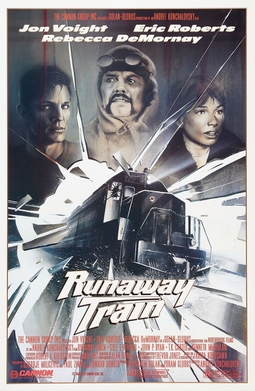
In 1985’s Runaway Train, Eric Roberts plays Buck McGeehy, a prisoner at Stonehaven Maximum Security Prison in Alaska.
Like the majority of the prisoners, Buck looks up to Manny (Jon Voight), a bank robber who has just been released from spending three years in solitary confinement. Manny is a tough guy who refuses to allow the prison system to beat him down. Warden Ranken (John P. Ryan) views Manny as being a threat to his authority and he’s especially angry that it was the courts that ordered that Manny finally be released from solitary. When Ranken tries to arrange for Manny to be assassinated at a prison boxing match, it’s Buck who saves Manny’s life. When Manny later manages to escape from the prison, Buck tags along.
Manny and Buck are a study in contrasts. Manny is as cold as the Alaskan landscape. He’s ruthless and doesn’t allow himself to get too close to anyone but, at the same time, he does live by a definite code. Buck is simple-minded, an earnest guy who talks too much and who probably wouldn’t have survived a day in prison if it wasn’t for his skill as a boxer. Buck and Manny manage to make their way across the frozen wilderness but, when they hop on a train, they soon find themselves trapped on the out-of-control locomotive, along with a railroad engineer named Sara (Rebecca De Mornay). The three of them have to find a way to either escape from or stop the train. At the same time, the obsessed Warden Ranken is determined to recapture Manny and, if that means flying a helicopter over the train so that Ranken can lower himself onto it, so be it.
Runway Train, which was based on a script by Akira Kurosawa, was one of the few Cannon films to find success with not just critics but also audiences and the industry. The Golden Globes nominated it for Best Film. The Academy didn’t go quite that far but they did nominate the film for Best Editing, along with also nominating Jon Voight for Best Actor and Eric Roberts for Best Supporting Actor. While Voight is a multiple-Oscar nominee (and one-time winner for Coming Home), Runaway Train is, so far, the only film for which Eric Roberts has been nominated. (He should have been nominated for Star 80 but his character in that film was a bit too realistically sleazy for the Academy to honor.) Roberts has described Runaway Train as being one of his favorite films and he even used the title for his autobiography. It was on this film that he met Danny Trejo, who not only trained Roberts for the boxing scenes but also helped Roberts kick his addiction to cocaine.
And Roberts has every reason to be proud. Runaway Train is a fast-moving, visually stunning thrill ride, a masterpiece of the pulp imagination. Yes, the symbolism of the runaway train is a bit obvious. Yes, the philosophical edge of the film’s dialogue can sometimes feel a bit out-of-place. Who cares? John Voight and Eric Roberts sell their characters with such skill that you don’t care that they’re both criminals who have done terrible things. From the minute we see that frozen jail and the prisoners tossing burning pieces of paper at the guards, we know why both Manny and Buck have to escape. John P. Ryan turns the warden into everyone’s worst nightmare of a small, pretty man with power, an authoritarian who uses the system to control the lives of others and who resents anyone who does not bow down before him. Even though her role is largely limited to reacting to what everyone else does around her, Rebecca de Mornay still turns Sara into a compelling character and never allows her to become merely a damsel in distress. Runaway Train is a heart-pounding action film and one that still holds up today.
Previous Eric Roberts Films That We Have Reviewed:
Though the Academy of Motion Picture Arts and Sciences claim that the Oscars honor the best of the year, we all know that there are always worthy films and performances that end up getting overlooked. Sometimes, it’s because the competition too fierce. Sometimes, it’s because the film itself was too controversial. Often, it’s just a case of a film’s quality not being fully recognized until years after its initial released. This series of reviews takes a look at the films and performances that should have been nominated but were, for whatever reason, overlooked. These are the Unnominated.
Directed by John Boorman, 1998’s The General tells the story of Martin Cahill.
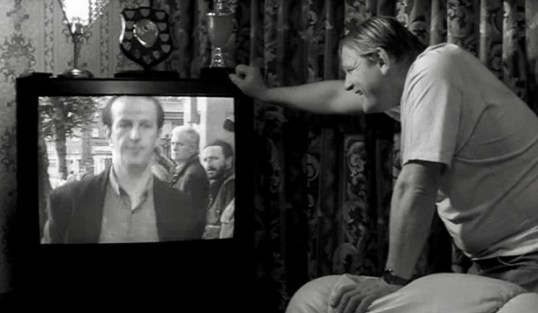
Martin Cahill (Brendan Gleeson) was a Dublin-based crime lord, a thief by trade who never made any apologies for his profession. The film opens with the end of Martin Cahill’s life. Leaving his suburban home, he’s sitting behind the steering wheel of his car when a young man runs up and shoots him in the face. Cahill’s car rolls forward while his wife (Maria Doyle Kennedy) screams for help. Cahill has been assassinated in front of his family and the reaction of the local police is to celebrate until Cahill’s oldest nemesis, Inspector Ned Kenney (Jon Voight), announces that they have nothing to cheer about. The film leaves it somewhat ambiguous as to who shot Cahill, though it heavily suggests that he was shot by the IRA, both because of their mistaken belief that he was moving drugs into the neighborhood but also because of his refusal to share his profits with them.
The film flashes back and we watch as Martin Cahill, a rebellious young man who stole to impress girls and to get a shot back at the establishment, grows up to become Martin Cahill, the crime lord that the papers nickname The General. Cahill is a professional thief and he’s fairly honest about it. When his government-controlled flat is torn down, Cahill camps out on the site in a tent, refusing to leave because the location of the new building is to close to the police station. He says he’d rather be moved to a richer part of town. It’s better for his work. As portrayed by Brendan Gleeson, Cahill is a fascinating and complex character, a ruthless criminal who is also devoted to his pigeons, his children and both his wife and his girlfriend (Angeline Bail). (Fortunately, for Martin, his wife and his girlfriend know about each other and are good friends.) He’s the type of crime lord who will test a man’s loyalty by nailing him to a pool table and then take him to the hospital afterwards. “Sorry, Martin,” another associate says after Martin shoots him in the leg to make a fake break-in look authentic. It’s hard not to like the film’s version of Martin Cahill, an intelligent and ultimately honest man who understands the importance of allowing his enemies to believe him to be a buffoon. He may be a criminal but he considers it to be an honest living, unlike the government officials who force unwanted laws and exorbitant taxation on the citizenry Director John Boorman certainly seems to like Cahill, which is interesting as Boorman was actually the victim of one of Cahill’s robberies. (Boorman recreates the robbery in the film.)
The film went unnominated at the Oscars, which were dominated that year by Shakespeare in Love and Saving Private Ryan. Brendan Gleeson definitely deserved a nomination for his charismatic performance as Martin Cahill. Equally worthy of a nomination was Seamus Deasy’s black-and-white cinematography, which gives the film the dream-like feel of a half-remembered legend. (The version of the film that’s on Tubi features desaturated color. It’s actually an effective look for the film’s story but I still prefer the black-and-white original.) Neither was nominated and, indeed, Brendan Gleeson would have to wait until 2023 to finally receive his first Oscar nominations for The Banshees of Inisherin.
The General (1998, dir by John Boorman, DP: Seamus Deasy)
Deliverance (1972, directed by John Boorman, DP: Vilmos Zsigmond)
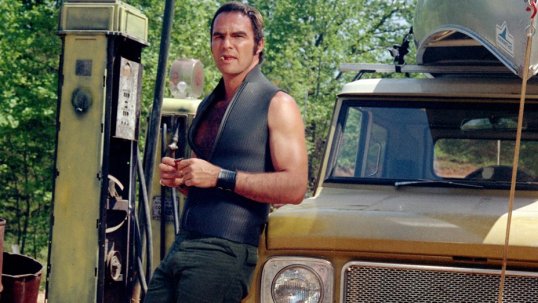
“Machines are going to fail!” Lewis Medlock says in Deliverance, delivering a line that feels even more relevant today than it might have in 1972. Lewis is the athlete and self-styled alpha male who drags his friends on a canoeing trip that involves some dangerous rapids. When Lewis suffers a compound fraction, it’s a shocking moment because, up until that point, Lewis seemed invulnerable to harm. Even when they return to civilization and Lewis learns he might lose his leg, he remains defiant.
Lewis was played by the late Burt Reynolds, who born 89 years ago today. In this scene that I love, Lewis explains his philosophy to his best friend and eventual savior, Ed Gentry (Jon Voight).
In Reagan, Dennis Quaid stars at the 40th President of the United States.
Framed as a story being told by a former KGB agent (Jon Voight) who is attempting to make a younger politician understand why Russia lost the Cold War, Reagan starts with Reagan’s childhood, includes his time as an actor and as the anti-communist head of the SAG, and then gets into his political career. Along the way, several familiar faces pop up. Robert Davi plays a thuggish Russian leader. Mena Suvari plays Reagan’s first wife while Penelope Ann Miller plays his second. Xander Berekely plays George Schultz (who was just previously played by Sam Waterston in The Dropout miniseries.) C. Thomas Howell, Kevin Dillon, Dan Lauria, and Lesley-Anne Down all have small but important roles. And the usual suspects when it comes to conservative filmmaking — Nick Searcy, Kevin Sorbo, and Pat Boone — are there to compliment Voight and Davi. I was a little surprised to see that Dean Cain was not present.
As usually happens to films that feature sympathetic Republicans, Reagan was slammed by critic but better-appreciated by the audience for which the film was made. I wasn’t particularly surprised. Movie critics tend to be liberal and Reagan is very much not that. For a professional film critic, a film like Reagan must be met with snark and derision because otherwise, one would risk cancellation. Don’t get me wrong. I’m not saying that there aren’t things to criticize about Reagan the film. I’m just saying that one should always keep in mind that critics have their own individual biases. One reason why the Rotten Tomatoes score is such an unfortunate development is because it ignores the fact that most films have things that work and things that don’t work and that quality is often in the eye of the beholder. Instead, it just tells us that a film is either a 90% or a 10%.
As for Reagan, it’s definitely a bit on the heavy-handed side but, then again, I think the same can be said for just about every political film that’s come out over the last few decades. For those who claim Reagan is somehow more heavy-handed than most, I invite them to sit through Rob Reiner’s LBJ. Indeed, the only director who has really shown a willingness to admit that a President can be both good and bad was Oliver Stone and when was the last time anyone watched Nixon? Reagan is at its weakness when it tries to recreate Reagan’s time as an actor. Dennis Quaid gives a good and charming performance throughout the film but he’s also 70 years old and, in the scenes where he plays the youngish Ronald Reagan, all of the soft-lighting and Vaseline on the lens ends up making him look like a wax figure. Once Reagan gets older, Quaid is allowed to act his age and both he and the film become much more convincing. I enjoyed the film once Reagan became President, though you should understand that I have biases of my own. I’m a fan of low taxes and individual freedom, which is why I’m also not a fan of communism or, for that matter, any extreme ideology that attempts to tell people how to live or think. “Tear down this wall!” Regan says while standing in front of the Berlin Wall and it’s a rousing moment, both in reality and on film.
In the end, Reagan is a film that will be best appreciated by people who already like Ronald Reagan. Yes, the film is heavy-handed and the framing device is a bit awkward. But Dennis Quaid’s heartfelt (and, towards the end, heartbreaking) performance carries the film. The film is not at all subtle but you know what? I’ve seen a countless number of mediocre films that have portrayed Reagan negatively, often with as little nuance and just as heavy-handed an approach as Reagan uses in its positive portrayal of the man. I sat through The Butler, for God’s sake. There’s nothing wrong with having a film that looks at the man from the other side. Those who like Ronald Reagan will feel vindicated. Those who don’t will say, “What was up with that Pat Boone scene?”
It’s hard to know where to really start with Megalopolis.
Directed, written, produced, and financed by Francis Ford Coppola, Megalopolis takes place in an alternate version of the United States of America. In this alternative world, New York is called New Rome and it is dominated by a handful of wealthy families. Former District Attorney Franklyn Cicero (Giancarlo Esposito) has been elected mayor. Everyone seems to hate Cicero and the character tends to come across as being a bit whiny so you really do have to wonder how he got elected in the first place.
Cicero is obsessed with the powerful Crassus-Catallina family, which is headed by banker Hamilton Crassus III (Jon Voight). Hamilton’s nephew is Cesar Catallina (Adam Driver), a brilliant architect who won a Nobel Prize for inventing a type of invisible material. Ever since Cesar’s wife vanished under mysterious circumstances, a cloud of scandal has hung over Cesar’s name and with that scandal has come popularity with both the masses and the tabloid press. When Cesar was tried for murder, the prosecutor was Franklin Cicero. Cesar was acquitted but he now spends his time drinking and mourning his wife. Cesar also has the power to stop time for everyone but him. Why he has this power and how he came to possess it is never made clear, though Cesar compares it to the way that a great painter or writer can capture one moment for eternity.
Cesar is driven through the rainy streets of New York by his chauffeur, Fundi Romaine (Laurence Fishburne). Fundi also serves as the film’s narrator, ruminating about how the Roman Empire eventually became a victim of its own decadence. Just in case the viewer somehow doesn’t pick up on the fact that the movie is comparing modern America to ancient Rome, Fundi informs us of this fact. Thanks, Fundi!
After Cesar publicly denounces Cicero’s plans to turn New Rome into a casino, Cicero’s daughter Julia (Nathalie Emmanuel) decides to take a break from decadent partying to follow Cesar around and try to discover whether or not he actually murdered his wife. Julia discovers that Cesar is not only still mourning his wife but she also witnesses him stopping time. Soon, Julia is working for Cesar’s design firm. At some point, she and Cesar become lovers.
Meanwhile, Cesar’s former lover, Wow Platinum (Aubrey Plaza), has married Crassus and is plotting to take control of his bank. Working with Wow is Cesar’s buffoonish cousin, Clodio Pulcher (Shia LaBeouf), who organizes the angry citizens of New Rome into a mob that threatens the safety and power of both Cicero and Cesar. “Make Rome Great Again,” a sign reads at one of Clodio’s rallies, just in case anyone was missing Coppola’s point.
Clodio is obsessed with destroying Cesar. First, he frames Cesar for deflowering New Rome’s vestal virgin, the singer Vesta Sweetwater (Grace VanderWaal). Then, he sends a 12 year-old assassin after Cesar. Cesar fears that he’s lost his ability to stop time. Julia falls more and more in love with him. Cicero gets booed everywhere he goes and, after his fixer (Dustin Hoffman) is mysteriously killed, he finds himself helpless against Clodio’s mob. Can Cesar be convinced to abandon his self-pity long enough to stand up to Clodio?
And what about the Russian spy satellite that just crashed into New Rome? Who will rebuild the city?
And …. well, let’s just say that there’s a lot going on in New Rome.
Francis Ford Coppola originally came up with the idea for Megalopolis in 1977 and he spent decades trying to bring the film to the big screen. Eventually, Coppola ended up producing and financing the film himself. From 2023 to the the day of the film’s Cannes premiere, the trade papers were full of stories about how difficult the production had been, with the underlying theme being that everything was Francis Ford Coppola’s fault and that the movie would be an unmitigated disaster. (In the coverage found in both Variety and The Hollywood Reporter, there seemed to be a good deal of hostility directed at Coppola’s decision to work outside of the Hollywood system.) Disgruntled members of the crew complained that Coppola was an undisciplined director who spent most of the production high. A half-baked attempt to generate a #MeToo scandal around the film made it obvious that Coppola had burned a lot of bridges with both Hollywood and the media. The film was released to critical derision and poor box office returns. Coppola is 85 years old and it’s entirely possible that Megalopolis will be his final film.
Critics be damned, I liked the majority of Megalopolis. Though the film may be thematically and narratively incoherent, it is a feast for the eyes and it’s hard not to respect the fact that, in this age of overwhelming conformity, Coppola brought his own unique vision to the screen. There are a few moments of genuinely macabre beauty to be found in the film. When the Russian satellite crashes into New York, we don’t see the impact but, on the city walls, we do see the shadows of people screaming in fear. When a drunk Cesar is driven through New Rome, he sees gigantic statues stepping off of their bases and slumping to the ground, exhausted with being on display. Coppola films New Rome like a beautiful, open-air prison. It’s an amazing view but don’t even think about trying to escape. The scenes in New Rome’s Coliseum are filled with an epic yet seedy grandeur. At times, the film’s scenes seem to be almost randomly assembled, leaving us to wonder if we’re seeing the past, the present, or maybe just something that Cesar is imagining in his head.
What is the film actually about? It’s not always easy to say. Even in his best films, Coppola has had a tendency to be self-indulgent. Sometimes, that self-indulgence pays off. Though few would admit it now, The Godfather Part II is one of the most self-indulgent films ever made. But it’s also brilliant so it doesn’t matter. However, with Megalopolis, it’s hard not to feel that this film was such a passion project for Coppola that he didn’t stop to consider whether or not he really had anything new to say. Megalopolis is hardly the first film to compare the supposed decline of America to the fall of the Roman Empire. As much as I enjoyed the film’s visuals, I cringed at the film’s ending. One can only imagine how a past Coppola collaborator like John Milius would have reacted to a bunch of children reciting a pledge to take care of the “one Earth.”
It’s a random film, one in which plot points are raised and often quickly abandoned. At one point, Cesar starts to recite Hamlet’s famous “to be or not to be” soliloquy. The cast is huge and everyone seems to be acting in a different movie. Surprisingly enough, neither Esposito nor Adam Driver are particularly believable in their roles, though I think that has more to do with the film’s loose narrative structure than anything else. Shia LaBeouf is convincingly feral as Clodio while Jon Voight seems to be having fun as the wealthy and crude Crassus. The best performance in the film comes from Aubrey Plaza, who plays her role like a vampish femme fatale who has somehow found herself in a science fiction story. Plaza holds nothing back with her performance and she actually manages to bring some genuine human emotion to Coppola’s surreal epic.
Megalopolis is a monument to self-indulgence but it’s always watchable. Coppola may not know what he’s trying to say but he captures the surreal beauty that comes from getting trapped in one’s own imagination. Megalopolis is not a film for everyone but I’m glad it exists. At a time when artistic freedom seems to be under constant attack, it’s hard not to be happy that Coppola did things his way.
ALERT! They took down their whiny trailer because all those bad reviews from Christmas Past were FAKE! Francis listen, I get it- everyone likes attention or whatever, but you playing the I’m so Put-Upon card is really really really ANNOYING! Cut it out! Paisan, you’ve had a great career and made BANK- BE HAPPY.
Welcome all, I’m going to review the “Megalopolis” trailer and just so you know – this was directed by a GENIUS. Really, that’s in the trailer and not just for a little while; they give a middle-finger to anyone who didn’t like a Coppola film for a solid 44 seconds! If you don’t think this movie is genius, too bad moron- it’s awesome, you’re a filthy plebe!
From what I can glean from the trailer, Cesar Catilina (Adam Driver) is tired of New York decadence; so, he wants to make a new city that’s way fancier and weirder. I’ve played Sim City before; so, maybe it’s got like a lot of happy faces when the plumbing works and sad faces if there’s not enough power? Without question, that was a fun game and if you didn’t enjoy it – you are part of the great unwashed!
This trailer has A LOT of scowling. Cesar Catilina scowls A LOT in the trailer and no one can scowl like Adam Driver. He was born to scowl!!!! Cesar appears to be a magical city planner who wants to make a better city that is vaguely or overtly communist- it is difficult to discern. If it’s anything like real communism, Francis will like it a lot theoretically without any consequences.
I have the distinct impression that this movie is more like a painting; it is visually stunning but with no plot. If you don’t like the film, remember you’re a petite bourgeois rube who brushes his teeth with his fingers. This film seems like “The Darjeeling Limited”- really pretty and Jason Schwatzman was in that film too and it revolved around finding good … tea??? I originally wrote it as “The Darjeeling UNLIMITED” now that would’ve been a film- Think of all the tea we could’ve watched them drink! Remember kids, you only rent Darjeeling Tea!!!
If you want a film where if you say you liked it, you’re 12% more sophisticated- “Megalopolis” is for you! For me, after this trailer, I think I’m going watch something with Dwayne “THE ROCK” Johnson in it. Maybe he’ll do a “Rampage 2”?
In conclusion, this film is GENIUS and the director is a GENIUS and if you don’t think so, I’m going to register you as a pederast and put garbage on your lawn!
The Painter tells the rather predictable story of Peter.
Orphaned by a terrorist attack when he was a child, Peter (Charlie Webber) was raised by a CIA agent named Byrne (Jon Voight). Realizing that the attack had left Peter with superhearing, Byrne raised Peter to be a CIA assassin. But after a failed mission led to the shooting his pregnant wife, Elena (Rryla McIntosh), an embittered Peter retired from the agency. Now, going by the name of Mark, he paints!
Why do retired CIA agents always end up living in a cabin and obsessively pursuing only one hobby? This feels like the 100th film that I’ve seen about a former assassin living in a cabin. Some retired agents keep bees. Some become bricklayers. Some become painters. Oddly, none of them seem to become both bricklayers and painters.
Anyway, Peter is happy with his isolated life but then, everything is upended when a 17 year-old girl named Sophia (Madison Bailey) follows him to his cabin and claims to be his daughter. She says that Elena has vanished and she needs Peter’s help to find her. Peter insists that his name is Mark until his superhearing picks up the sound of heavily armed men gathering outside of his cabin.
This is another one of those action films where the main character is someone who kills without the slightest hesitation and who has trouble showing his emotions. Naturally, there’s a conspiracy inside the CIA and this leads to several scenes of people saying stuff like, “Copy that.” The only fictional character who ever sounded cool saying, “Copy that,” was Kiefer Sutherland on 24. All the rest of these people are just pretenders.
The Painter is pretty stupid. It won’t take you long to guess who the main villain is going to turn out to be and it also won’t take you long to guess how the final showdown is going to go. The action scenes are so haphazardly edited that it’s difficult to keep track of who is actually fighting who and, even if you did know who was fighting who, you wouldn’t really care because none of these people are particularly compelling.
In general, if your main character is going to be remorseless killer, it’s a good idea to cast a charismatic actor in the lead role. Audiences will forgive a lot as long as their watching someone with a compelling screen presence. Unfortunately, both Charlie Webber and Madison Bailey give rather bland performances and neither Peter nor Sophia are particularly likable characters. In particular, Peter drags one innocent computer store owner into his mess and then doesn’t seem to be particularly upset when the poor guy ends up with a bullet in his brain. It’s one thing to be an assassin. It’s another thing to be a jerk about it.
On the plus side, Jon Voight is enough of an old pro to understand that this is a movie that does not reward subtlety and he gives a performance that is totally over-the-top but which is also more than appropriate for the material with which he’s working. (Voight is still a talented actor and it’s a shame that, due to voting for different candidates than the majority of Hollywood, he’s pretty much going to end his career appearing in movies like this.) As well, Max Montesi gives such a cheerfully bizarre performance as a rival assassin that he actually bring the movie to life whenever he’s on the screen.
Unfortunately, the lunacy of Voight and Montesi is not enough to save The Painter. At one point, someone dismisses Peter’s paintings as being “derivative.” They could have been talking about this film as a whole.
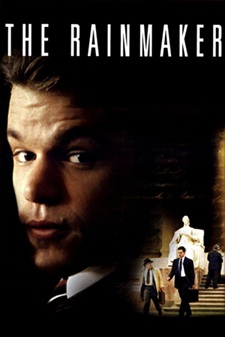 Rudy Baylor (Matt Damon) is an idealistic young law school graduate who discovers that having a degree and passing the bar doesn’t automatically make you a success. He gets a job working a bar that just happens to be owned by an ambulance chasing attorney named Bruiser Stone (Mickey Rourke). Bruiser takes Rudy on as an associate and assigns his associate, Deck Shifflet (Danny DeVito), to teach Rudy how to find cases. When Bruiser flees the country to escape an FBI investigation, Rudy and Deck start their own law firm. Rudy soon finds himself with the case of his young career, representing a family in a law suit against Great Benefit Insurance. Rudy also falls for Kelly (Claire Danes), a young woman who is being abused by her husband (Andrew Shue).

 Through the Shattered Lens